

Hostname: page-component-5db58dd55d-688nx Total loading time: 0 Render date: 2026-06-10T07:35:02.172Z Has data issue: false hasContentIssue false

Activity-induced propulsion of a vesicle

Published online by Cambridge University Press:  23 May 2022

Zhiwei Peng
Affiliation:
Division of Chemistry and Chemical Engineering, California Institute of Technology, Pasadena, CA 91125, USA
Tingtao Zhou
Affiliation:
Division of Engineering and Applied Science, California Institute of Technology, Pasadena, CA 91125, USA
John F. Brady*
Affiliation:
Division of Chemistry and Chemical Engineering, California Institute of Technology, Pasadena, CA 91125, USA Division of Engineering and Applied Science, California Institute of Technology, Pasadena, CA 91125, USA
*
Email address for correspondence: jfbrady@caltech.edu

Abstract

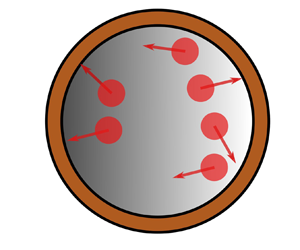
Modern biomedical applications such as targeted drug delivery require a delivery system capable of enhanced transport beyond that of passive Brownian diffusion. In this work, an osmotic mechanism for the propulsion of a vesicle immersed in a viscous fluid is proposed. By maintaining a steady-state solute gradient inside the vesicle, a seepage flow of the solvent (e.g. water) across the semipermeable membrane is generated, which in turn propels the vesicle. We develop a theoretical model for this vesicle–solute system in which the seepage flow is described by a Darcy flow. Using the reciprocal theorem for Stokes flow, it is shown that the seepage velocity at the exterior surface of the vesicle generates a thrust force that is balanced by the hydrodynamic drag such that there is no net force on the vesicle. We characterize the motility of the vesicle in relation to the concentration distribution of the solute confined inside the vesicle. Any osmotic solute is able to propel the vesicle so long as a concentration gradient is present. In the present work, we propose active Brownian particles (ABPs) as a solute. To maintain a symmetry-breaking concentration gradient, we consider ABPs with spatially varying swim speed, and ABPs with constant properties but under the influence of an orienting field. In particular, it is shown that at high activity, the vesicle velocity is $\boldsymbol {U}\sim [K_\perp /(\eta _e\ell _m) ]\int \varPi _0^{swim} \boldsymbol {n}\,{\rm d}\varOmega$, where $\varPi _0^{swim}$ is the swim pressure just outside the thin accumulation boundary layer on the vesicle interior surface, $\boldsymbol {n}$ is the unit normal vector of the vesicle boundary, $K_\perp$ is the membrane permeability, $\eta _e$ is the viscosity of the solvent, and $\ell _m$ is the membrane thickness.

Information

Type
JFM Papers
Copyright
© The Author(s), 2022. Published by Cambridge University Press

Access options

Get access to the full version of this content by using one of the access options below. (Log in options will check for institutional or personal access. Content may require purchase if you do not have access.)

Article purchase

Temporarily unavailable