





No CrossRef data available.
Article contents
Contactless precision steering of particles in a fluid inside a cube with rotating walls
Published online by Cambridge University Press: 30 June 2025
Abstract
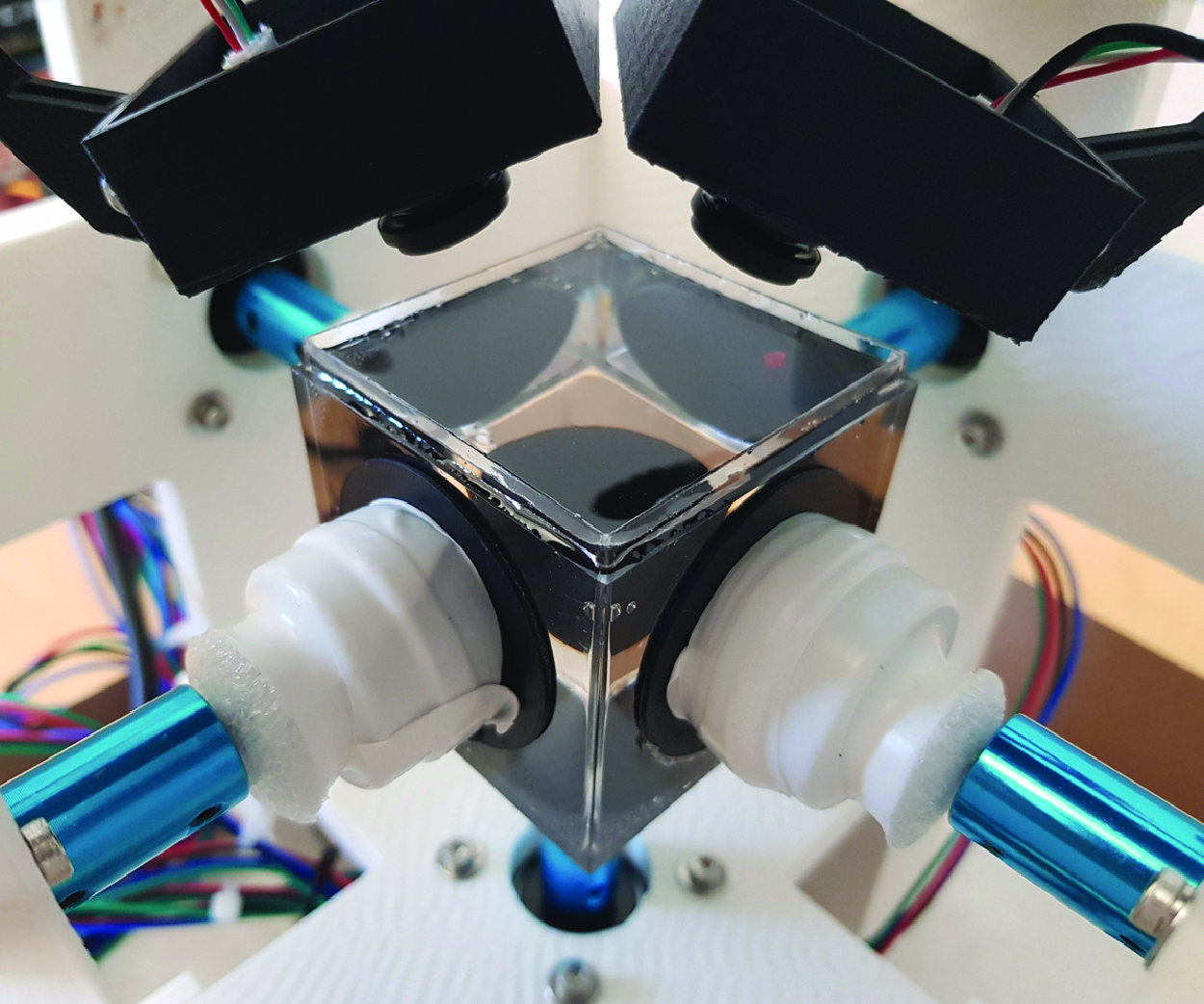
Contactless manipulation of small objects is essential for biomedical and chemical applications, such as cell analysis, assisted fertilisation and precision chemistry. Established methods, including optical, acoustic and magnetic tweezers, are now complemented by flow control techniques that use flow-induced motion to enable precise and versatile manipulation. However, trapping multiple particles in fluid remains a challenge. This study introduces a novel control algorithm capable of steering multiple particles in flow. The system uses rotating disks to generate flow fields that transport particles to precise locations. Disk rotations are governed by a feedback control policy based on the optimising a discrete loss framework, which combines fluid dynamics equations with path objectives into a single loss function. Our experiments, conducted in both simulations and with the physical device, demonstrate the capability of the approach to transport two beads simultaneously to predefined locations, advancing robust contactless particle manipulation for biomedical applications.
Information
- Type
- JFM Papers
- Information
- Copyright
- © Harvard University, 2025. Published by Cambridge University Press
Footnotes
†
Petr Karnakov and Lucas Amoudruz contributed equally.
References
Amoudruz, L. & Koumoutsakos, P. 2022 Independent control and path planning of microswimmers with a uniform magnetic field. Adv. Intell. Syst. 4 (3), 2100183.10.1002/aisy.202100183CrossRefGoogle Scholar
Amoudruz, L., Litvinov, S. & Koumoutsakos, P. 2024 Path planning of magnetic microswimmers in high-fidelity simulations of capillaries with deep reinforcement learning. arXiv preprint arXiv:2404.02171.Google Scholar
Ashkin, A., Dziedzic, J.M., Bjorkholm, J.E. & Chu, S. 1986 Observation of a single-beam gradient force optical trap for dielectric particles. Opt. Lett. 11 (5), 288–290.10.1364/OL.11.000288CrossRefGoogle ScholarPubMed
Bausch, A.R., Möller, W. & Sackmann, E. 1999 Measurement of local viscoelasticity and forces in living cells by magnetic tweezers. Biophys. J. 76 (1), 573–579.10.1016/S0006-3495(99)77225-5CrossRefGoogle ScholarPubMed
Bradbury, J. Frostig, R., Hawkins, P., Johnson, M.J., Leary, C., Maclaurin, D., Necula, G., Paszke, A., VanderPlas, J., Wanderman-Milne, S. & Zhang, Q. 2018 JAX: composable transformations of Python+NumPy programs. Version 0.3.13. Available at: http://github.com/jax-ml/jax.Google Scholar
Campbell, L.C., Wilkinson, M.J., Manz, A., Camilleri, P. & Humphreys, C.J. 2004 Electrophoretic manipulation of single dna molecules in nanofabricated capillaries. Lab on a Chip 4 (3), 225–229.10.1039/b312592kCrossRefGoogle ScholarPubMed
Elvira, K.S., i Solvas, X.C., Wootton, R.C.R. & deMello, A.J. 2013 The past, present and potential for microfluidic reactor technology in chemical synthesis. Nat. Chem. 5 (11), 905–915.10.1038/nchem.1753CrossRefGoogle ScholarPubMed
Ghosh, S. & Ghosh, A. 2018 Mobile nanotweezers for active colloidal manipulation. Science Robotics 3 (14).10.1126/scirobotics.aaq0076CrossRefGoogle ScholarPubMed
Guo, F. 2016 Three-dimensional manipulation of single cells using surface acoustic waves. Proc. Natl Acad. Sci. 113 (6), 1522–1527.10.1073/pnas.1524813113CrossRefGoogle ScholarPubMed
Jericho, S.K., Jericho, M.H., Hubbard, T. & Kujath, M. 2004 Micro-electro-mechanical systems microtweezers for the manipulation of bacteria and small particles. Rev. Sci. Instrum. 75 (5), 1280–1282.10.1063/1.1711143CrossRefGoogle Scholar
Karabacak, N.M. 2014 Microfluidic, marker-free isolation of circulating tumor cells from blood samples. Nat. Protocol 9 (3), 694–710.10.1038/nprot.2014.044CrossRefGoogle ScholarPubMed
Karnakov, P., Amoudruz, L. & Koumoutsakos, P. 2025 Optimal navigation in microfluidics via the optimization of a discrete loss. Phys. Rev. Lett. 134 (4), 044001.10.1103/PhysRevLett.134.044001CrossRefGoogle ScholarPubMed
Karnakov, P., Litvinov, S. & Koumoutsakos, P. 2022 Computing foaming flows across scales: from breaking waves to microfluidics. Sci. Adv. 8 (5), eabm0590.10.1126/sciadv.abm0590CrossRefGoogle ScholarPubMed
Karnakov, P., Litvinov, S. & Koumoutsakos, P. 2023 Flow reconstruction by multiresolution optimization of a discrete loss with automatic differentiation. Eur. Phys. J. E
46 (7), 59.10.1140/epje/s10189-023-00313-7CrossRefGoogle ScholarPubMed
Karnakov, P., Litvinov, S. & Koumoutsakos, P. 2024 Solving inverse problems in physics by optimizing a discrete loss: fast and accurate learning without neural networks. PNAS Nexus 3 (1), pgae005.10.1093/pnasnexus/pgae005CrossRefGoogle ScholarPubMed
Kislaya, A., Samant, A.A., Veenstra, P., Tam, D.S.W. & Westerweel, J. 2025 Particle manipulation in hele–shaw flow with programmable hydrodynamics. Phys. Fluids 37 (3), 032012.10.1063/5.0251563CrossRefGoogle Scholar
Lam, K.H., Li, Y., Li, Y., Lim, H.G., Zhou, Q. & Shung, K.K. 2016 Multifunctional single beam acoustic tweezer for non-invasive cell/organism manipulation and tissue imaging. Sci. Rep. 6 (1), 37554.10.1038/srep37554CrossRefGoogle ScholarPubMed
Li, A., Li, H., Li, Z., Zhao, Z., Li, K., Li, M. & Song, Y. 2020 Programmable droplet manipulation by a magnetic-actuated robot. Sci. Adv. 6 (7), eaay5808.10.1126/sciadv.aay5808CrossRefGoogle ScholarPubMed
Li, P. 2015 Acoustic separation of circulating tumor cells. Proc. Natl Acad. Sci. USA 112 (16), 4970–4975.10.1073/pnas.1504484112CrossRefGoogle ScholarPubMed
Liu, Y., Cheng, D.K., Sonek, G.J., Berns, M.W., Chapman, C.F. & Tromberg, B.J. 1995 Evidence for localized cell heating induced by infrared optical tweezers. Biophys. J. 68 (5), 2137–2144.10.1016/S0006-3495(95)80396-6CrossRefGoogle ScholarPubMed
Lutz, B.R., Chen, J. & Schwartz, D.T. 2006 Hydrodynamic tweezers: 1. noncontact trapping of single cells using steady streaming microeddies. Anal. Chem. 78 (15), 5429–5435.10.1021/ac060555yCrossRefGoogle ScholarPubMed
MacDonald, M.P., Spalding, G.C. & Dholakia, K. 2003 Microfluidic sorting in an optical lattice. Nature 426 (6965), 421–424.10.1038/nature02144CrossRefGoogle Scholar
Medina-Sánchez, M., Schwarz, L., Meyer, A.K., Hebenstreit, F. & Schmidt, O.G. 2016 Cellular cargo delivery: toward assisted fertilization by sperm-carrying micromotors. Nano Lett. 16 (1), 555–561.10.1021/acs.nanolett.5b04221CrossRefGoogle ScholarPubMed
Mills, J.P., Qie, L., Dao, M., Lim, C.T. & Suresh, S. 2004 Nonlinear elastic and viscoelastic deformation of the human red blood cell with optical tweezers. Mol. Cell. Biomech. 1 (3), 169.Google ScholarPubMed
Minzioni, P. 2017 Roadmap for optofluidics. J. Opt. 19 (9), 093003.10.1088/2040-8986/aa783bCrossRefGoogle Scholar
Miyamoto, D.T., Ting, D.T., Toner, M., Maheswaran, S. & Haber, D.A. 2016 Single-cell analysis of circulating tumor cells as a window into tumor heterogeneity. In Cold Spring Harbor Symposia On Quantitative Biology, vol. 81, pp. 269–274. Cold Spring Harbor Laboratory Press.Google Scholar
Or, Y., Vankerschaver, J., Kelly, S.D., Murray, R.M. & Marsden, J.E. 2009 Geometric control of particle manipulation in a two-dimensional fluid. In Proceedings of the 48h IEEE Conference on Decision and Control (CDC) held jointly with 2009 28th Chinese Control Conference, pp. 19–26. IEEE.10.1109/CDC.2009.5399499CrossRefGoogle Scholar
Ozcelik, A., Rufo, J., Guo, F., Gu, Y., Li, P., Lata, J. & Huang, T.J. 2018 Acoustic tweezers for the life sciences. Nat. Meth. 15 (12), 1021–1028.10.1038/s41592-018-0222-9CrossRefGoogle ScholarPubMed
Ozkumur, E. 2013 Inertial focusing for tumor antigen–dependent and–independent sorting of rare circulating tumor cells. Sci. Transl. Med. 5 (179), 179ra47–179ra47.10.1126/scitranslmed.3005616CrossRefGoogle ScholarPubMed
Pauzauskie, P.J., Radenovic, A., Trepagnier, E., Shroff, H., Yang, P. & Liphardt, J. 2006 Optical trapping and integration of semiconductor nanowire assemblies in water. Nat. Mater. 5 (2), 97–101.10.1038/nmat1563CrossRefGoogle ScholarPubMed
Piñan Basualdo, F.N., Bolopion, A., Gauthier, M. & Lambert, P. 2021 A microrobotic platform actuated by thermocapillary flows for manipulation at the air-water interface. Sci. Robot. 6 (52), eabd3557.10.1126/scirobotics.abd3557CrossRefGoogle ScholarPubMed
Ren, Z., Zhang, M., Song, S., Liu, Z., Hong, C., Wang, T., Dong, X., Hu, W. & Sitti, M. 2022 Soft-robotic ciliated epidermis for reconfigurable coordinated fluid manipulation. Sci. Adv. 8 (34), eabq2345.10.1126/sciadv.abq2345CrossRefGoogle ScholarPubMed
Riordon, J., Sovilj, D., Sanner, S., Sinton, D. & Young, E.W.K. 2019 Deep learning with microfluidics for biotechnology. Trends Biotechnol. 37 (3), 310–324.10.1016/j.tibtech.2018.08.005CrossRefGoogle ScholarPubMed
Schneider, T.M., Mandre, S. & Brenner, M.P. 2011 Algorithm for a microfluidic assembly line. Phys. Rev. Lett. 106 (9), 094503.10.1103/PhysRevLett.106.094503CrossRefGoogle ScholarPubMed
Sundvik, M., Nieminen, H.J., Salmi, A., Panula, P. & Hæggström, E. 2015 Effects of acoustic levitation on the development of zebrafish, Danio rerio, embryos. Sci. Rep. 5 (1), 13596.10.1038/srep13596CrossRefGoogle ScholarPubMed
Teh, S.-Y., Lin, R., Hung, L.-H. & Lee, A.P. 2008 Droplet microfluidics. Lab on a Chip 8 (2), 198–220.10.1039/b715524gCrossRefGoogle ScholarPubMed
Walker, B.J., Ishimoto, K., Gaffney, E.A. & Moreau, C. 2022 The control of particles in the Stokes limit. J. Fluid Mech. 942, A1.10.1017/jfm.2022.253CrossRefGoogle Scholar
Xiao-Bo, W., Ying, H., Gascoyne, P.R.C. & Becker, F.F. 1997 Dielectrophoretic manipulation of particles. IEEE Trans. Ind. Applics. 33 (3), 660–669.10.1109/28.585855CrossRefGoogle Scholar
van der Wee, E.B., Blackwell, B.C., Balboa Usabiaga, F., Sokolov, A., Katz, I.T., Delmotte, B. & Driscoll, M.M. 2023 A simple catch: fluctuations enable hydrodynamic trapping of microrollers by obstacles. Sci. Adv. 9 (10), eade0320.10.1126/sciadv.ade0320CrossRefGoogle ScholarPubMed
Wu, J. 1991 Acoustical tweezers. J. Acoust. Soc. Am. 89 (5), 2140–2143.10.1121/1.400907CrossRefGoogle ScholarPubMed
Wu, M. 2017 Isolation of exosomes from whole blood by integrating acoustics and microfluidics. Proc. Natl Acad. Sci. USA 114 (40), 10584–10589.10.1073/pnas.1709210114CrossRefGoogle ScholarPubMed
Xu, S., Nunez, C.M., Souri, M. & Wood, R.J. 2023 A compact dea-based soft peristaltic pump for power and control of fluidic robots. Sci. Robot. 8 (79), eadd4649.10.1126/scirobotics.add4649CrossRefGoogle ScholarPubMed
Ye, Z., Diller, E. & Sitti, M. 2012 Micro-manipulation using rotational fluid flows induced by remote magnetic micro-manipulators. J. Appl. Phys. 112 (6).10.1063/1.4754521CrossRefGoogle Scholar
Zhang, L., Abbott, J.J., Dong, L., Kratochvil, B.E., Bell, D. & Nelson, B.J. 2009 Artificial bacterial flagella: fabrication and magnetic control. Appl. Phys. Lett. 94 (6).Google Scholar
Zhu, J., He, Y., Wang, Y. & Cai, L.-H. 2024 Voxelated bioprinting of modular double-network bio-ink droplets. Nat. Commun. 15 (1), 5902.10.1038/s41467-024-49705-zCrossRefGoogle ScholarPubMed

Amoudruz et al. supplementary material movie 1
Two sinking beads in the robotic device. The control policy initially aims to keep the beads at their targets. The control policy is switched off and the beads sink due to gravity. Left, middle: view from the cameras, with tracking of individual beads. Right: three-dimensional reconstruction of the beads positions.

File
819.1 KB
Amoudruz et al. supplementary material movie 2
Two beads swapping target positions in the robotic device. Left, middle: view from the cameras, with tracking of individual beads. Right: three-dimensional reconstruction of the beads positions.
File
2.2 MB
Amoudruz et al. supplementary material movie 3
Two beads with rotating target positions in the robotic device. Left, middle: view from the cameras, with tracking of individual beads. Right: three-dimensional reconstruction of the beads positions.
File
4.3 MB