

Hostname: page-component-5d84bcc8dc-zf88q Total loading time: 0 Render date: 2026-08-12T04:01:29.347Z Has data issue: false hasContentIssue false

Effect of leading-edge curvature actuation on flapping fin performance

Published online by Cambridge University Press:  01 July 2021

David Fernández-Gutiérrez
Affiliation:
Department of Mechanical Engineering, Massachusetts Institute of Technology, Cambridge, MA 02139, USA
Wim M. van Rees*
Affiliation:
Department of Mechanical Engineering, Massachusetts Institute of Technology, Cambridge, MA 02139, USA
*
Email address for correspondence: wvanrees@mit.edu

Abstract

Ray-finned fish are able to adapt the curvature of their fins through musculature at the base of the fin. In this work we numerically investigate the effects of such leading-edge curvature actuation on the hydrodynamic performance of a heaving and pitching fin. We present a geometric and numerical framework for constructing the shape of ray-membrane-type fins with imposed leading-edge curvatures, under the constraint of membrane inextensibility. This algorithm is coupled with a three-dimensional Navier–Stokes solver, enabling us to assess the hydrodynamic performance of such fins. To determine the space of possible shapes, we present a simple model for leading-edge curvature actuation through two coefficients that determine chordwise and spanwise curvature, respectively. We systematically vary these two parameters through regimes that mimic both passive elastic deformations and active actuation against the hydrodynamic loading, and compute thrust and power coefficients, as well as hydrodynamic efficiency. Our results demonstrate that both thrust and efficiency are predominantly affected by chordwise curvature, with some small additional benefits of spanwise curvature on efficiency. The main improvements in performance are explained by the altered trailing-edge kinematics arising from leading-edge curvature actuation, which can largely be reproduced by a rigid fin whose trailing-edge kinematics follow that of the curving fin. Changes in fin camber, for fixed trailing-edge kinematics, mostly benefit efficiency. Based on our results, we discuss the use of leading-edge curvature actuation as a robust and versatile way to improve flapping fin performance.

Information

Type
JFM Papers
Copyright
© The Author(s), 2021. Published by Cambridge University Press

Access options

Get access to the full version of this content by using one of the access options below. (Log in options will check for institutional or personal access. Content may require purchase if you do not have access.)

Article purchase

Temporarily unavailable

Fernández-Gutiérrez et al Supplementary Movie 1

Perspective views of the fin geometry during a flapping cycle for different combinations of chordwise and spanwise curvature parameters.

Download Fernández-Gutiérrez et al Supplementary Movie 1(Video)
Video 2.1 MB

Fernández-Gutiérrez et al Supplementary Movie 2

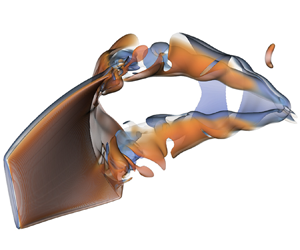
Vorticity field generated by the reference rigid fin during the first two cycles, viewed from different perspectives

Download Fernández-Gutiérrez et al Supplementary Movie 2(Video)
Video 1.7 MB

Fernández-Gutiérrez et al Supplementary Movie 3

Vorticity field generated by the curving fin in the maximum thrust configuration during the first two cycles, viewed from different perspectives.

Download Fernández-Gutiérrez et al Supplementary Movie 3(Video)
Video 2.1 MB

Fernández-Gutiérrez et al Supplementary Movie 4

Vorticity field generated by the curving fin in the maximum efficiency configuration during the first two cycles, viewed from different perspectives.

Download Fernández-Gutiérrez et al Supplementary Movie 4(Video)
Video 1.2 MB
Supplementary material: PDF

Fernández-Gutiérrez et al Supplementary Material

Fernández-Gutiérrez et al Supplementary Material

Download Fernández-Gutiérrez et al Supplementary Material(PDF)
PDF 4.1 MB