

Hostname: page-component-5db58dd55d-mhzq2 Total loading time: 0 Render date: 2026-06-10T10:33:10.376Z Has data issue: false hasContentIssue false

Jet mixing enhancement with Bayesian optimization, deep learning and persistent data topology

Published online by Cambridge University Press:  20 August 2024

Yiqing Li
Affiliation:
Chair of Artificial Intelligence and Aerodynamics, School of Mechanical Engineering and Automation, Harbin Institute of Technology, 518055 Shenzhen, PR China
Bernd R. Noack*
Affiliation:
Chair of Artificial Intelligence and Aerodynamics, School of Mechanical Engineering and Automation, Harbin Institute of Technology, 518055 Shenzhen, PR China Guangdong Provincial Key Laboratory of Intelligent Morphing Mechanisms and Adaptive Robotics, Harbin Institute of Technology, 518055 Shenzhen, PR China
Tianyu Wang
Affiliation:
Chair of Artificial Intelligence and Aerodynamics, School of Mechanical Engineering and Automation, Harbin Institute of Technology, 518055 Shenzhen, PR China
Guy Y. Cornejo Maceda*
Affiliation:
Chair of Artificial Intelligence and Aerodynamics, School of Mechanical Engineering and Automation, Harbin Institute of Technology, 518055 Shenzhen, PR China
Ethan Pickering
Affiliation:
Independent Scholar
Tamir Shaqarin
Affiliation:
Department of Mechanical Engineering, Tafila Technical University, 66110 Tafila, Jordan
Artur Tyliszczak
Affiliation:
Faculty of Mechanical Engineering and Computer Science, Czestochowa University of Technology, 42-201 Czestochowa, Poland
*
Email addresses for correspondence: bernd.noack@hit.edu.cn, yoslan@hit.edu.cn

Abstract

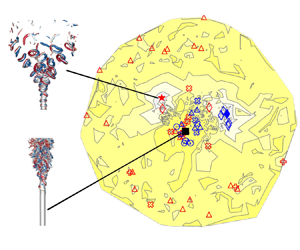
We optimize jet mixing using large eddy simulations (LES) at a Reynolds number of $3000$. Key methodological enablers consist of Bayesian optimization, a surrogate model enhanced by deep learning and persistent data topology for physical interpretation. The mixing performance is characterized by an equivalent jet radius ($R_{eq}$) derived from the streamwise velocity in a plane located $8$ diameters downstream. The optimization is performed in a 22-dimensional actuation space that comprises most known excitations. This search space parameterizes the distributed actuation imposed on the bulk flow and at the periphery of the nozzle in the streamwise and radial directions. The momentum flux measures the energy input of the actuation. The optimization quadruples the jet radius $R_{eq}$ with a $7$-armed blooming jet after around $570$ evaluations. The control input requires $2\,\%$ momentum flux of the main flow, which is one order of magnitude lower than an ad hoc dual-mode excitation. Intriguingly, a pronounced suboptimum in the search space is associated with a double-helix jet, a new flow pattern. This jet pattern results in a mixing improvement comparable to the blooming jet. A state-of-the-art Bayesian optimization converges towards this double-helix solution. The learning is accelerated and converges to another better optimum by including a deep-learning-enhanced surrogate model trained along the optimization. Persistent data topology extracts the global and many local minima in the actuation space. These minima can be identified with flow patterns beneficial to the mixing.

Information

Type
JFM Papers
Copyright
© The Author(s), 2024. Published by Cambridge University Press

Access options

Get access to the full version of this content by using one of the access options below. (Log in options will check for institutional or personal access. Content may require purchase if you do not have access.)

Article purchase

Temporarily unavailable