





No CrossRef data available.
Article contents
The near-wake vortex dynamics of a wall-mounted hemisphere measured with tomographic particle image velocimetry
Published online by Cambridge University Press: 30 May 2025
Abstract
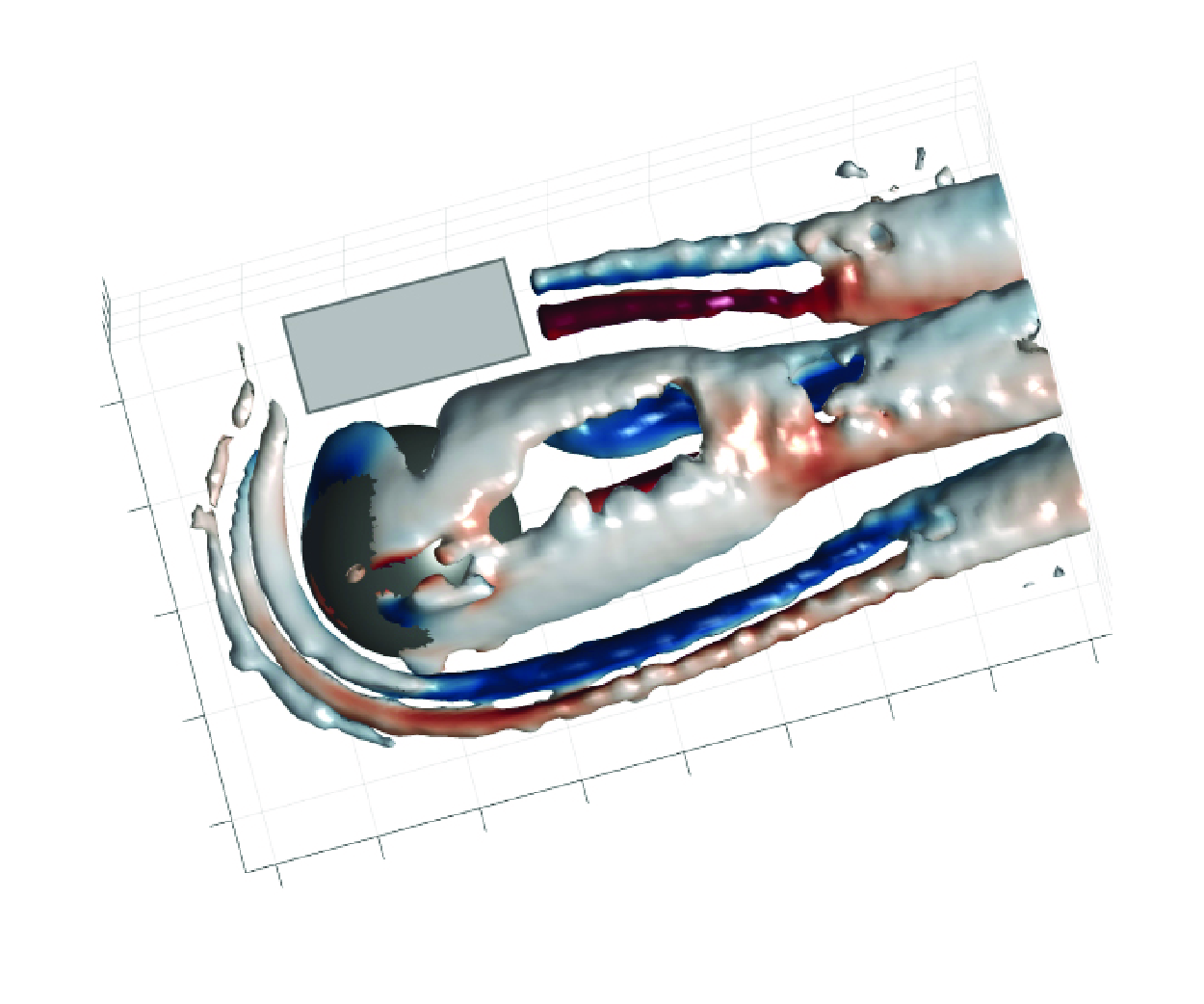
The dynamics of flow over an isolated surface-mounted hemisphere are investigated with tomographic particle image velocimetry (PIV). The 10 mm height hemisphere is completely submerged in the laminar boundary layer, and the height-based Reynolds number is 1530. The evolution of typical coherent structures around the hemisphere are discussed, with emphasis on the hairpin vortex (HV) and side hairpin vortex (SHV) formed periodically in the middle and both sides of the wake, respectively. Proper orthogonal decomposition (POD) analysis is conducted to explore the vortex dynamics. The shedding processes of the HV and SHV are each dominated by two different POD modes with correspondingly different characteristic frequencies, which has not been reported before in the literature. Furthermore, the coexistence of symmetric and asymmetric shedding patterns is explored for the first time in the shedding process of the HV at such a low Reynolds number. The asymmetric behaviour is controlled by the asymmetric shedding POD mode, whose dominant frequency is exactly half of the symmetric mode. In addition, SHVs on both sides of the wake are throughout formed and shed alternately, and the streamwise extensions of a horseshoe vortex also oscillate asymmetrically, which are responsible for the formation of the asymmetric shedding pattern of the HV. These findings help to fill the gaps in the related field and contribute to studies on the vortex dynamics of the flow over a hemisphere.
JFM classification
Information
- Type
- JFM Papers
- Information
- Copyright
- © The Author(s), 2025. Published by Cambridge University Press
References
Acarlar, M.S. & Smith, C.R. 1987
a A study of hairpin vortices in a laminar boundary layer. Part 1. Hairpin vortices generated by a hemisphere protuberance. J. Fluid Mech. 175, 1–43.CrossRefGoogle Scholar
Acarlar, M.S. & Smith, C.R. 1987
b A study of hairpin vortices in a laminar boundary layer. Part 2. Hairpin vortices generated by fluid injection. J. Fluid Mech. 175, 43–83.10.1017/S0022112087000284CrossRefGoogle Scholar
Adrian, R.J., Meinhart, C.D. & Tomkins, C.D. 2000 Vortex organization in the outer region of the turbulent boundary layer. J. Fluid Mech. 422, 1–54.CrossRefGoogle Scholar
Arbey, H. & Williams, J.E.F. 1984 Active cancellation of pure tones in an excited jet. J. Fluid Mech. 149, 445.10.1017/S0022112084002743CrossRefGoogle Scholar
Asgari, E., Saeedi, M. & Etemadi, M. 2022 Large-eddy simulation of a developing turbulent boundary layer over a wall-mounted hemisphere under the influence of a surrounding ditch: flow characteristics and aerodynamic forces. J. Wind Engng Ind. Aerodyn. 227, 105047.10.1016/j.jweia.2022.105047CrossRefGoogle Scholar
Baker, C.J. 1979 The laminar horseshoe vortex. J. Fluid Mech. 95 (2), 347–367.10.1017/S0022112079001506CrossRefGoogle Scholar
Berkooz, G., Holmes, P. & Lumley, J.L. 1993 The proper orthogonal decomposition in the analysis of turbulent flows. Annu. Rev. Fluid Mech. 25 (1), 539–575.10.1146/annurev.fl.25.010193.002543CrossRefGoogle Scholar
Cao, Y. & Tamura, T. 2020 Large-eddy simulation study of Reynolds number effects on the flow around a wall-mounted hemisphere in a boundary layer. Phys. Fluids 32 (2), 025109.10.1063/1.5142371CrossRefGoogle Scholar
Carr, I.A. & Plesniak, M.W. 2016 Three-dimensional flow separation over a surface-mounted hemisphere in pulsatile flow. Exp. Fluids 57 (1), 9.10.1007/s00348-015-2099-zCrossRefGoogle Scholar
Cheng, C.M. & Fu, C.L. 2010 Characteristic of wind loads on a hemispherical dome in smooth flow and turbulent boundary layer flow. J. Wind Engng Ind. Aerodyn. 98 (6–7), 328–344.10.1016/j.jweia.2009.12.002CrossRefGoogle Scholar
Citro, V., Giannetti, F., Luchini, P. & Auteri, F. 2015 Global stability and sensitivity analysis of boundary-layer flows past a hemispherical roughness element. Phys. Fluids 27 (8), 084110.10.1063/1.4928533CrossRefGoogle Scholar
Crane, R.J., Popinhak, A.R., Martinuzzi, R.J. & Morton, C. 2022 Tomographic PIV investigation of vortex shedding topology for a cantilevered circular cylinder. J. Fluid Mech. 931, R1.10.1017/jfm.2021.904CrossRefGoogle Scholar
Elsinga, G.E., Scarano, F., Wieneke, B. & van Oudheusden, B.W. 2006 Tomographic particle image velocimetry. Exp. Fluids 41 (6), 933–947.10.1007/s00348-006-0212-zCrossRefGoogle Scholar
Essel, E.E., Tachie, M.F. & Balachandar, R. 2021 Time-resolved wake dynamics of finite wall-mounted circular cylinders submerged in a turbulent boundary layer. J. Fluid Mech. 917, A8.10.1017/jfm.2021.265CrossRefGoogle Scholar
Fu, C.-L., Cheng, C.-M., Lo, Y.-L. & Cheng, D.-Q. 2015 LES simulation of hemispherical dome’s aerodynamic characteristics in smooth and turbulence boundary layer flows. J. Wind Engng Ind. Aerodyn. 144, 53–61.10.1016/j.jweia.2015.05.010CrossRefGoogle Scholar
Gao, T.-D., Sun, J., Chen, W.-Y., Fan, Y. & Zhang, Y.-T. 2021 Experimental investigation on the effect of particles on large scale vortices of an isolated hemispherical roughness element. Phys. Fluids 33 (6), 063308.10.1063/5.0050773CrossRefGoogle Scholar
Gordeyev, S.V. & Thomas, F.O. 1999 Temporal subharmonic amplitude and phase behaviour in a jet shear layer: wavelet analysis and Hamiltonian formulation. J. Fluid Mech. 394, 205–240.10.1017/S0022112099005650CrossRefGoogle Scholar
Goswami, S. & Hemmati, A. 2022 Mechanisms of wake asymmetry and secondary structures behind low aspect-ratio wall-mounted prisms. J. Fluid Mech. 950, A31.10.1017/jfm.2022.824CrossRefGoogle Scholar
Hajimirzaie, S.M., Wojcik, C.J. & Buchholz, J.H.J. 2012 The role of shape and relative submergence on the structure of wakes of low-aspect-ratio wall-mounted bodies. Exp. Fluids 53 (6), 1943–1962.10.1007/s00348-012-1406-1CrossRefGoogle Scholar
Han, X., Zhou, Y., Li, J., Zheng, Y. & Rinoshika, A. 2022 Dynamics of three-dimensional vortical structures behind a barchan dune based on tomographic particle image velocimetry. Phys. Fluids 34 (7), 075123.10.1063/5.0098530CrossRefGoogle Scholar
Hunt, J.C.R., Wray, A.A. & Moin, P. 1988 Eddies, Streams, and Convergence Zones in Turbulent Flows. Center for Turbulence Research.Google Scholar
Jeong, J. & Hussain, F. 1995 On the identification of a vortex. J. Fluid Mech. 285, 69–94.10.1017/S0022112095000462CrossRefGoogle Scholar
Klebanoff, P.S., Cleveland, W.G. & Tidstrom, K.D. 1992 On the evolution of a turbulent boundary layer induced by a three-dimensional roughness element. J. Fluid Mech. 237, 101–187.10.1017/S0022112092003379CrossRefGoogle Scholar
Klebanoff, P.S., Tidstrom, K.D. & Sargent, L.M. 1962 The three-dimensional nature of boundary-layer instability. J. Fluid Mech. 12 (1), 1–34.10.1017/S0022112062000014CrossRefGoogle Scholar
Li, J., Qiu, X., Shao, Y., Liu, H., Fu, Y., Tao, Y. & Liu, Y. 2022 Turbulent coherent structures in channel flow with a wall-mounted hemisphere. AIP Adv. 12 (3), 035006.CrossRefGoogle Scholar
Liu, J., Wang, J., Zhu, Y. & Pan, C. 2024 Vortex dynamics in the near wake of a surface-mounted hemisphere. Phys. Fluids 36 (1), 013619.10.1063/5.0188075CrossRefGoogle Scholar
Lozano-Durán, A., Flores, O. & Jiménez, J. 2012 The three-dimensional structure of momentum transfer in turbulent channels. J. Fluid Mech. 694, 100–130.10.1017/jfm.2011.524CrossRefGoogle Scholar
Manhart, M. 1998 Vortex shedding from a hemisphere in a turbulent boundary layer. Theor. Comput. Fluid Dyn. 12 (1), 1–28.10.1007/s001620050096CrossRefGoogle Scholar
Mendez, M.A., Raiola, M., Masullo, A., Discetti, S., Ianiro, A., Theunissen, R. & Buchlin, J.M. 2017 POD-based background removal for particle image velocimetry. Exp. Therm. Fluid Sci. 80, 181–192.10.1016/j.expthermflusci.2016.08.021CrossRefGoogle Scholar
Qiu, X., Liu, H.-X., Li, J.-H., Tao, Y.-Z. & Liu, Y.-L. 2023 Evolution of vortex structure around a wall-mounted rough hemisphere. J. Hydrodyn. 35 (3), 467–481.10.1007/s42241-023-0033-zCrossRefGoogle Scholar
Raffel, M., Willert, C., Scarano, F., Khler, C.J. & Kompenhans, J. 2018 Particle Image Velocimetry: A Practical Guide. Springer.10.1007/978-3-319-68852-7CrossRefGoogle Scholar
Savory, E. & Toy, N. 1986
a The flow regime in the turbulent near wake of a hemisphere. Exp. Fluids 4 (4), 181–188.10.1007/BF00717812CrossRefGoogle Scholar
Savory, E. & Toy, N. 1986
b Hemisphere and hemisphere-cylinders in turbulent boundary layers. J. Wind Engng Ind. Aerodyn. 23, 345–364.10.1016/0167-6105(86)90054-1CrossRefGoogle Scholar
Scarano, F. 2002 Iterative image deformation methods in PIV. Meas. Sci. Technol. 13 (1), R1–R19.10.1088/0957-0233/13/1/201CrossRefGoogle Scholar
Sciacchitano, A. & Wieneke, B. 2016 PIV uncertainty propagation. Meas. Sci. Technol. 27 (8), 084006.10.1088/0957-0233/27/8/084006CrossRefGoogle Scholar
Sirovich, L. 1987 Turbulence and the dynamics of coherent structures. I. Coherent structures. Q. Appl. Maths 45 (3), 561–571.10.1090/qam/910462CrossRefGoogle Scholar
Svizher, A. & Cohen, J. 2006 Holographic particle image velocimetry measurements of hairpin vortices in a subcritical air channel flow. Phys. Fluids 18 (1), 014105.10.1063/1.2158429CrossRefGoogle Scholar
Tamai, N., Asaeda, T. & Tanaka, N. 1987 Vortex structures around a hemispheric hump. Boundary-Layer Meteorol. 39 (3), 301–314.10.1007/BF00116124CrossRefGoogle Scholar
Tang, Z.Q. & Jiang, N. 2012 Dynamic mode decomposition of hairpin vortices generated by a hemisphere protuberance. Sci. China Phys. Mech. Astron. 55 (1), 118–124.10.1007/s11433-011-4535-2CrossRefGoogle Scholar
Theodorsen, T. 1952 Mechanism of turbulence. In Proceedings of the 2nd Midwestern Conference on Fluid Mechanics, pp. 1–19.Google Scholar
Tu, H., Wang, Z., Gao, Q., She, W., Wang, F., Wang, J. & Wei, R. 2023 Tomographic PIV investigation on near-wake structures of a hemisphere immersed in a laminar boundary layer. J. Fluid Mech. 971, A36.10.1017/jfm.2023.621CrossRefGoogle Scholar
Vaid, A., Vadlamani, N.R., Malathi, A.S. & Gupta, V. 2022 Dynamics of bypass transition behind roughness element subjected to pulses of free-stream turbulence. Phys. Fluids 34 (11), 114110.10.1063/5.0120241CrossRefGoogle Scholar
Wang, C.Y., Gao, Q., Wang, H.P., Wei, R.J., Li, T. & Wang, J.J. 2016
a Divergence-free smoothing for volumetric PIV data. Exp. Fluids 57 (1), 15.10.1007/s00348-015-2097-1CrossRefGoogle Scholar
Wang, H.P., Gao, Q., Wei, R.J. & Wang, J.J. 2016
b Intensity-enhanced MART for tomographic PIV. Exp. Fluids 57 (5), 87.10.1007/s00348-016-2176-yCrossRefGoogle Scholar
Wang, C., Shen, Y., Mang, S., Gao, Q., Wang, Z. & Wang, J. 2022 A novel algorithm for visualizing and quantifying vortices in complex 3D flows based on marching and converging vortex atoms. Phys. Fluids 34 (11), 115131.10.1063/5.0128611CrossRefGoogle Scholar
Wang, H.F., Cao, H.L. & Zhou, Y. 2014 POD analysis of a finite-length cylinder near wake. Exp. Fluids 55 (8), 1790.CrossRefGoogle Scholar
Wang, H.F. & Zhou, Y. 2009 The finite-length square cylinder near wake. J. Fluid Mech. 638, 453–490.10.1017/S0022112009990693CrossRefGoogle Scholar
Wieneke, B. 2008 Volume self-calibration for 3D particle image velocimetry. Exp. Fluids 45 (4), 549–556.10.1007/s00348-008-0521-5CrossRefGoogle Scholar
Wood, J.N., De Nayer, G., Schmidt, S. & Breuer, M. 2016 Experimental investigation and large-eddy simulation of the turbulent flow past a smooth and rigid hemisphere. Flow Turbul. Combust. 97 (1), 79–119.10.1007/s10494-015-9690-5CrossRefGoogle Scholar
Ye, Q., Schrijer, F.F.J. & Scarano, F. 2016 Geometry effect of isolated roughness on boundary layer transition investigated by tomographic PIV. Intl J. Heat Fluid Flow 61, 31–44.10.1016/j.ijheatfluidflow.2016.05.016CrossRefGoogle Scholar
Ye, Q., Wang, Y. & Shao, X. 2023 Dynamics of cavitating tip vortex. J. Fluid Mech. 967, A30.CrossRefGoogle Scholar
Zhang, J., Shi, L., Tang, Z., Ma, X. & Jiang, N. 2023 Influence of hemisphere disturbance on laminar boundary layer at low Reynolds numbers. Phys. Fluids 35 (10), 103607.10.1063/5.0169636CrossRefGoogle Scholar
Zhou, J., Adrian, R.J., Balachandar, S. & Kendall, T.M. 1999 Mechanisms for generating coherent packets of hairpin vortices in channel flow. J. Fluid Mech. 387, 353–396.10.1017/S002211209900467XCrossRefGoogle Scholar
Zhou, Z., Wang, Z. & Fan, J. 2010 Direct numerical simulation of the transitional boundary-layer flow induced by an isolated hemispherical roughness element. Comput. Meth. Appl. Mech. Engng 199 (23-24), 1573–1582.CrossRefGoogle Scholar
Zhu, H.-Y., Wang, C.-Y., Wang, H.-P. & Wang, J.-J. 2017 Tomographic PIV investigation on 3D wake structures for flow over a wall-mounted short cylinder. J. Fluid Mech. 831, 743–778.10.1017/jfm.2017.647CrossRefGoogle Scholar
Zhu, Y., Wang, J. & Liu, J. 2024 Tip effects on three-dimensional flow structures over low-aspect-ratio plates: mechanisms of spanwise fluid transport. J. Fluid Mech. 983, A35.10.1017/jfm.2024.169CrossRefGoogle Scholar