




No CrossRef data available.
Article contents
Rossby waves and zonal momentum redistribution induced by localised forcing in the rotating shallow-water model
Published online by Cambridge University Press: 07 January 2020
Abstract
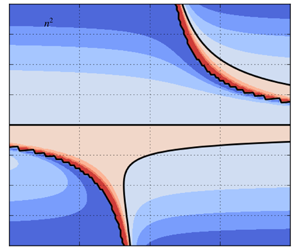
The aim of this study is to understand the dynamics of Rossby waves induced by a localised and periodic ‘plunger’ forcing – imposed on a background flow – which is intended as an elementary representation of transient mesoscale eddy forcing in the ocean. We consider linearised dynamics and its quasi-nonlinear extension, and focus on the rotating shallow-water model. The plunger induces a spectrum of Rossby waves that drive zonal momentum flux convergence at the forced latitudes. This behaviour has a robust and significant dependence on the background flow, which we treat as zonal and uniform. We systematically analyse this dependence using two methods. First, we use the eddy geometry formulation, in which Reynolds stresses are expressed in terms of eddy elongation and eddy tilt parameters, and consider the relationship between eddy geometry and zonal momentum redistribution. Second, we implement decompositions of flow responses into linear dynamical eigenmodes and compare with expectations from linear Rossby wave theory. Both methods compliment each other and aid the understanding of zonal momentum redistribution and its dependence on uniform background flow. We find that this dependence is determined by two factors: (i) dispersion-constrained resonance with the plunger forcing and (ii) efficiency of nonlinear eddy self-interactions. These results significantly improve our understanding of shallow-water Rossby waves, and may also be applied towards the development of parameterisations of oceanic mesoscale eddies.
Information
- Type
- JFM Papers
- Information
- Copyright
- © The Author(s), 2020. Published by Cambridge University Press
References
Berloff, P. 2015 Dynamically consistent parameterization of mesoscale eddies. Part I: simple model. Ocean Model 87, 1–19.CrossRefGoogle Scholar
Berloff, P. 2016 Dynamically consistent parameterization of mesoscale eddies. Part 2: eddy fluxes and diffusivity from transient impulses. Fluids 22, 1–25.Google Scholar
Berloff, P. & Kamenkovich, I. 2013a On spectral analysis of mesoscale eddies. Part I: linear analysis. J. Phys. Oceanogr. 43, 2505–2527.CrossRefGoogle Scholar
Berloff, P. & Kamenkovich, I. 2013b On spectral analysis of mesoscale eddies. Part II: nonlinear analysis. J. Phys. Oceanogr. 43, 2528–2544.CrossRefGoogle Scholar
Eady, E. 1957 The general circulation of the atmosphere and oceans. In The Earth and its Atmosphere (ed. Bates, D. R.), pp. 130–151. Basic Books.Google Scholar
Fox-Kemper, B., Ferrari, R. & Pedlosky, J. 2003 On the indeterminacy of rotational and divergent eddy fluxes. J. Phys. Oceanogr. 33 (2), 478–483.2.0.CO;2>CrossRefGoogle Scholar
Gent, P. 2011 The Gent–McWilliams parameterization: 20/20 hindsight. Ocean Model. 39, 2–9.CrossRefGoogle Scholar
Gent, P. & McWilliams, J. 1990 Isopycnal mixing in ocean circulation models. J. Phys. Oceanogr. 20, 150–155.2.0.CO;2>CrossRefGoogle Scholar
Haidvogel, D. & Rhines, P. 1983 Waves and circulation driven by oscillatory winds in an idealized ocean basin. Geophys. Astrophys. Fluid Dyn. 25, 1–63.CrossRefGoogle Scholar
Haigh, M. & Berloff, P. 2018 Potential vorticity redistribution by localised transient forcing in the shallow-water model. J. Fluid Mech. 852, 199–225.CrossRefGoogle Scholar
Holland, W. & Rhines, P. 1980 An example of eddy-induced ocean circulation. J. Phys. Oceanogr. 10, 1010–1031.2.0.CO;2>CrossRefGoogle Scholar
Hoskins, B. & Ambrizzi, T. 1993 Rossby wave propagation on a realistic longitudinally varying flow. J. Atmos. Sci. 50, 1661–1671.2.0.CO;2>CrossRefGoogle Scholar
Hoskins, B., James, I. & White, G. 1983 The shape, propagation, and mean flow interaction of large-scale weather systems. J. Atmos. Sci. 40, 1595–1612.2.0.CO;2>CrossRefGoogle Scholar
Marshall, D., Maddison, J. & Berloff, P. 2012 A framework for parameterizing eddy potential vorticity fluxes. J. Phys. Oceanogr. 42, 539–557.CrossRefGoogle Scholar
Mizuta, G. 2009 Rossby wave radiation from an eastward jet and its recirculations. J. Mar. Res. 67, 185–212.CrossRefGoogle Scholar
Mizuta, G. 2018a Upgradient and downgradient potential vorticity fluxes produced by forced Rossby waves. Part I: basic experiments. J. Phys. Oceanogr. 48, 1191–1209.CrossRefGoogle Scholar
Mizuta, G. 2018b Upgradient and downgradient potential vorticity fluxes produced by forced Rossby waves. Part II: parameter sensitivity and physical interpretation. J. Phys. Oceanogr. 48, 1211–1230.CrossRefGoogle Scholar
O’Rourke, A. & Vallis, G. 2013 Jet interaction and the influence of a minimum phase speed bound on the propagation of eddies. J. Atmos. Sci. 70, 2614–2628.CrossRefGoogle Scholar
O’Rourke, A. & Vallis, G. 2016 Meridional Rossby wave generation and propagation in the maintenance of the wintertime tropospheric double jet. J. Atmos. Sci. 73, 2179–2201.CrossRefGoogle Scholar
Pedlosky, J. 1977 On the radiation of mesoscale energy in the mid ocean. Deep-Sea Res. 24, 591–600.CrossRefGoogle Scholar
Plumb, R. 1985 On the three-dimensional propagation of stationary waves. J. Atmos. Sci. 42, 217–229.2.0.CO;2>CrossRefGoogle Scholar
Rhines, P. & Holland, W. 1979 A theoretical discussion of eddy-driven mean flows. Dyn. Atmos. Oceans 3, 289–325.CrossRefGoogle Scholar
Shevchenko, I. & Berloff, P. 2016 Eddy backscatter and counter-rotating gyre anomalies of midlatitude ocean dynamics. Fluids 1 (3), 28.CrossRefGoogle Scholar
Shevchenko, I., Berloff, P., Guerrero-Lopez, D. & Roman, J. 2016 On low-frequency variability of the midlatitude ocean gyres. J. Fluid Mech. 795, 423–442.CrossRefGoogle Scholar
Tamarin, T., Maddison, J., Heifetz, E. & Marshall, D. P. 2016 A geometric interpretation of eddy Reynolds stresses in barotropic ocean jets. J. Phys. Oceanogr. 46, 2285–2307.CrossRefGoogle Scholar
Thompson, R. 1971 Why there is an intense eastward current in the North Atlantic but not in the South Atlantic? J. Phys. Oceanogr. 235–237.2.0.CO;2>CrossRefGoogle Scholar
Vallis, G. 2017 Atmospheric and Oceanic Fluid Dynamics: Fundamentals and Large-Scale Circulation, p. 109. Cambridge University Press.CrossRefGoogle Scholar
Wardle, R. & Marshall, J. 2000 Representation of eddies in primitive equation models by a PV flux. J. Phys. Oceanogr. 30, 2481–2503.2.0.CO;2>CrossRefGoogle Scholar
Waterman, S. & Hoskins, B. 2013 Eddy shape, orientation, propagation, and mean flow feedback in western boundary current jets. J. Phys. Oceanogr. 43, 1666–1690.CrossRefGoogle Scholar
Waterman, S. & Jayne, S. 2012 Eddy-driven recirculations from a localized transient forcing. J. Phys. Oceanogr. 42, 430–447.CrossRefGoogle Scholar
Waterman, S. & Lilly, J. 2015 Geometric decomposition of eddy feedbacks in barotropic systems. J. Phys. Oceanogr. 45, 1009–1024.CrossRefGoogle Scholar
- 2
- Cited by