

Hostname: page-component-89b8bd64d-9prln Total loading time: 0 Render date: 2026-05-09T16:48:54.576Z Has data issue: false hasContentIssue false

Vortex dynamics in rotating Rayleigh–Bénard convection

Published online by Cambridge University Press:  06 November 2023

Shan-Shan Ding
Affiliation:
School of Physics Science and Engineering, Tongji University, Shanghai 200092, PR China
Guang-Yu Ding
Affiliation:
Center for Complex Flows and Soft Matter Research and Department of Mechanics and Aerospace Engineering, Southern University of Science and Technology, Shenzhen 518055, PR China Department of Physics, The Chinese University of Hong Kong, Shatin, Hong Kong, PR China
Kai Leong Chong
Affiliation:
Department of Physics, The Chinese University of Hong Kong, Shatin, Hong Kong, PR China Shanghai Institute of Applied Mathematics and Mechanics, School of Mechanics and Engineering Science, Shanghai University, Shanghai 200072, PR China
Wen-Tao Wu
Affiliation:
School of Physics Science and Engineering, Tongji University, Shanghai 200092, PR China
Ke-Qing Xia*
Affiliation:
Center for Complex Flows and Soft Matter Research and Department of Mechanics and Aerospace Engineering, Southern University of Science and Technology, Shenzhen 518055, PR China Department of Physics, The Chinese University of Hong Kong, Shatin, Hong Kong, PR China
Jin-Qiang Zhong*
Affiliation:
School of Physics Science and Engineering, Tongji University, Shanghai 200092, PR China Department of Aeronautics and Astronautics, Fudan University, Shanghai 200433, PR China
*
Email addresses for correspondence: xiakq@sustech.edu.cn, jinqiang@fudan.edu.cn

Abstract

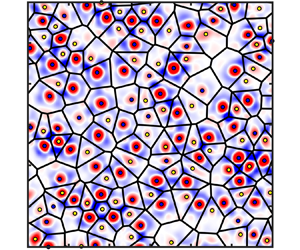
We investigate the spatial distribution and dynamics of the vortices in rotating Rayleigh–Bénard convection in a reduced Rayleigh number range $1.3\le Ra/Ra_{c}\le 83.1$. Under slow rotations ($Ra\approx 80\,Ra_{c}$), the vortices are distributed randomly, which is manifested by the size distribution of the Voronoi cells of the vortex centres being a standard $\varGamma$ distribution. The vortices exhibit Brownian-type horizontal motion in the parameter range $Ra\gtrsim 10\,Ra_{c}$. The probability density functions of the vortex displacements are, however, non-Gaussian at short time scales. At modest rotating rates ($4\,Ra_{c}\le Ra\lesssim 10\,Ra_{c}$), the centrifugal force leads to radial vortex motions, i.e. warm cyclones (cold anticyclones) moving towards (outwards from) the rotation axis. The horizontal scale of the vortices decreases with decreasing $Ra/Ra_c$, and the size distribution of their Voronoi cells deviates from the $\varGamma$ distribution. In the rapidly rotating regime ($1.6\,Ra_{c}\le Ra\le 4\,Ra_{c}$), the vortices are densely distributed. The hydrodynamic interaction of neighbouring vortices results in the formation of vortex clusters. Within clusters, cyclones exhibit inverse-centrifugal motion as they submit to the outward motion of the strong anticyclones, and the radial velocity of the anticyclones is enhanced. The radial mobility of isolated vortices, scaled by their vorticity strength, is shown to be a simple power function of the Froude number. For all flow regimes studied, we show that the number of vortices with a lifespan greater than $t$ decreases exponentially as $\exp ({-t/{\tau }})$ for large time, where $\tau$ represents the characteristic lifetime of long-lived vortices.

Information

Type
JFM Papers
Copyright
© The Author(s), 2023. Published by Cambridge University Press

Access options

Get access to the full version of this content by using one of the access options below. (Log in options will check for institutional or personal access. Content may require purchase if you do not have access.)

Article purchase

Temporarily unavailable