



No CrossRef data available.
Article contents
Application of small-scale testing for investigation of ion-beam-irradiated materials
Published online by Cambridge University Press: 10 October 2012
Abstract
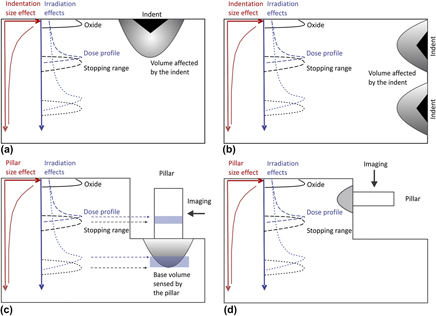
Small-scale testing techniques such as nanoindentation and micro-/nanocompression are promising methods for addressing mechanical properties of ion-beam-irradiated materials. We performed different proton irradiations and critically evaluated the results obtained from nanoindentation and pillar compression, both performed parallel and perpendicular to the irradiation direction. Experiments parallel to beam direction suffer from variation of material properties with penetration depth. This is improved by cross-sectional experiments, thereby probing the effect of different doses along the beam penetration depth on mechanical properties. Finally, we demonstrate that, compared with nanoindentation, miniaturized uniaxial compression experiments offer a more reliable and straightforward interpretation of the mechanical data, as they impose a nominally uniaxial stress on a well-defined volume at a specific position. Moreover, the exposed pillar geometry is not influenced by surface contamination and enables in situ observation of the governing mechanical processes, which is typically not possible during indentation experiments in a half-space geometry.
Keywords
Information
- Type
- Research Article
- Information
- Copyright
- Copyright © Materials Research Society 2012
References
REFERENCES
Kinchin, G. and Pease, R.: The displacement of atoms in solids by radiation. Rep. Prog. Phys. 18, 1 (1955).CrossRefGoogle Scholar
Wirth, B.D.: How does radiation damage materials? Science 318, 923 (2007).CrossRefGoogle ScholarPubMed
Bai, X.-M., Voter, A.F., Hoagland, R.G., Nastasi, M., and Uberuaga, B.P.: Efficient annealing of radiation damage near grain boundaries via interstitial emission. Science 327, 1631 (2010).CrossRefGoogle ScholarPubMed
Byun, T.S. and Maloy, S.A.: Dose dependence of mechanical properties in tantalum and tantalum alloys after low-temperature irradiation. J. Nucl. Mater. 377, 72 (2008).CrossRefGoogle Scholar
Maloy, S.A., Romero, T., James, M.R., and Dai, Y.: Tensile testing of EP-823 and HT-9 after irradiation in STIP II. J. Nucl. Mater. 356, 56 (2006).CrossRefGoogle Scholar
Odette, G.R., Alinger, M.J., and Wirth, B.D.: Recent developments in irradiation-resistant steels. Annu. Rev. Mater. Res. 38, 471 (2008).CrossRefGoogle Scholar
Singh, B.N. and Zinkle, S.J.: Defect accumulation in pure fcc metals in the transient regime: A review. J. Nucl. Mater. 206, 212 (1993).CrossRefGoogle Scholar
Hosemann, P.: Studying radiation damage in structural materials by using ion accelerators. Rev. Accel Sci. Technol. 4, 161 (2011).CrossRefGoogle Scholar
Azevedo, C.R.F.: A review on neutron-irradiation-induced hardening of metallic components. Eng. Fail. Anal. 18, 1921 (2011).CrossRefGoogle Scholar
Byun, T.S. and Farrell, K.: Tensile properties of Inconel 718 after low-temperature neutron irradiation. J. Nucl. Mater. 318, 292 (2003).CrossRefGoogle Scholar
Lucas, G.E. and Gelles, D.S.: The influence of irradiation on fracture and impact properties of fusion reactor materials. J. Nucl. Mater. 155–157, 164 (1988).CrossRefGoogle Scholar
Olander, D.R.: Fundamental Aspects of Nuclear Reactor Fuel Elements (University of Michigan, Michigan, 1976).CrossRefGoogle Scholar
Matsukawa, Y., Briceno, M., and Robertson, I.M.: Combining in situ transmission electron microscopy and molecular dynamics computer simulations to reveal the interaction mechanisms of dislocations with stacking-fault tetrahedron in nuclear materials. Microsc. Res. Tech. 72, 284 (2009).CrossRefGoogle ScholarPubMed
Li, N., Mara, N.A., Wang, Y.Q., Nastasi, M., and Misra, A.: Compressive flow behavior of Cu thin films and Cu/Nb multilayers containing nanometer-scale helium bubbles. Scr. Mater. 64, 974 (2011).CrossRefGoogle Scholar
Wei, Q.M., Li, N., Mara, N., Nastasi, M., and Misra, A.: Suppression of irradiation hardening in nanoscale V/Ag multilayers. Acta Mater. 59, 6331 (2011).CrossRefGoogle Scholar
Was, G.S., Busby, J.T., Allen, T., Kenik, E.A., Jensson, A., Bruemmer, S.M., Gan, J., Edwards, A.D., Scott, P.M., and Andreson, P.L.: Emulation of neutron irradiation effects with protons: Validation of principle. J. Nucl. Mater. 300, 198 (2002).CrossRefGoogle Scholar
Hosemann, P., Dai, Y., Stergar, E., Leitner, H., Olivas, E., Nelson, A.T., and Maloy, S.A.: Large- and small-scale materials testing of HT-9 irradiated in the STIP Irradiation Program. Exp. Mech. 51, 1095 (2011).CrossRefGoogle Scholar
Hosemann, P., Stergar, E., Peng, L., Dai, Y., Maloy, S.A., Pouchon, M.A., Shiba, K., Hamaguchi, D., and Leitner, H.: Macro- and microscale mechanical testing and local electrode atom probe measurements of STIP-irradiated F82H, Fe-8Cr ODS and Fe-8Cr-2W ODS. J. Nucl. Mater. 417, 274 (2011).CrossRefGoogle Scholar
Oliver, W.C. and Pharr, G.M.: An improved technique for determining hardness and elastic modulus using load and displacement sensing indentation experiments. J. Mater. Res. 7, 1564 (1992).CrossRefGoogle Scholar
Uchic, M.D., Dimiduk, D.M., Florando, J.N., and Nix, W.D.: Sample dimensions influence strength and crystal plasticity. Science 305, 986 (2004).CrossRefGoogle ScholarPubMed
Kiener, D., Grosinger, W., Dehm, G., and Pippan, R.: A further step towards an understanding of size-dependent crystal plasticity: In situ tension experiments of miniaturized single crystal copper samples. Acta Mater. 56, 580 (2008).CrossRefGoogle Scholar
Legros, M., Gianola, D.S., and Motz, C.: Quantitative in situ mechanical testing in electron microscopes. MRS Bull. 35, 354 (2010).CrossRefGoogle Scholar
Kiener, D. and Minor, A.M.: Source truncation and exhaustion: Insights from quantitative in situ TEM tensile testing. Nano Lett. 11, 3816 (2011).CrossRefGoogle ScholarPubMed
Kiener, D. and Minor, A.M.: Source-controlled yield and hardening of Cu(100) studied by in situ transmission electron microscopy. Acta Mater. 59, 1328 (2011).CrossRefGoogle Scholar
Ziegler, J.F., Biersack, J.P., and Littmark, U.: The Stopping Range of Ions in Matter (Pergamon Press, New York, 1985).CrossRefGoogle Scholar
Hosemann, P., Kiener, D., Wang, Y., and Maloy, S.A.: Issues to consider using nanoindentation on shallow ion-beam-irradiated materials. J. Nucl. Mater. 425, 136 (2012).CrossRefGoogle Scholar
Hosemann, P., Swadener, J.G., Kiener, D., Was, G.S., Maloy, S.A., and Li, N.: An exploratory study to determine applicability of nanohardness and microcompression measurements for yield stress estimation. J. Nucl. Mater. 375, 135 (2008).CrossRefGoogle Scholar
Kiener, D., Hosemann, P., Maloy, S.A., and Minor, A.M.: In situ nanocompression testing of irradiated copper. Nat. Mater. 10, 608 (2011).CrossRefGoogle ScholarPubMed
Johnson, K.L.: The correlation of indentation experiments. J. Mech. Phys. Solids 18, 115 (1970).CrossRefGoogle Scholar
Harvey, S., Huang, H., Venkataraman, S., and Gerberich, W.W.: Microscopy and microindentation mechanics of single-crystal Fe-3 wt-% Si. 1. Atomic force microscopy of a small indentation. J. Mater. Res. 8, 1291 (1993).CrossRefGoogle Scholar
Kiener, D., Pippan, R., Motz, C., and Kreuzer, H.G.M.: Microstructural evolution of the deformed volume beneath microindents in tungsten and copper. Acta Mater. 54, 2801 (2006).CrossRefGoogle Scholar
Rester, M., Motz, C., and Pippan, R.: Microstructural investigation of the volume beneath nanoindentations in copper. Acta Mater. 55, 6427 (2007).CrossRefGoogle Scholar
Nibur, K.A. and Bahr, D.F.: Identifying slip systems around indentations in FCC metals. Scr. Mater. 49, 1055 (2003).CrossRefGoogle Scholar
Minor, A.M., Asif, S.A.S., Shan, Z.W., Stach, E.A., Cyrankowski, E., Wyrobek, T.J., and Warren, O.L.: A new view of the onset of plasticity during the nanoindentation of aluminum. Nat. Mater. 5, 697 (2006).CrossRefGoogle Scholar
Burnett, P.J. and Page, T.F.: Surface softening in silicon by ion-implantation. J. Mater. Sci. 19, 845 (1984).CrossRefGoogle Scholar
Chicot, D. and Lesage, J.: Absolute hardness of films and coatings. Thin Solid Films 254, 123 (1995).CrossRefGoogle Scholar
Saha, R. and Nix, W.D.: Effects of the substrate on the determination of thin film mechanical properties by nanoindentation. Acta Mater. 50, 23 (2002).CrossRefGoogle Scholar
Burnett, P.J. and Rickerby, D.S.: The relationship between hardness and scratch adhesion. Thin Solid Films 154, 403 (1987).CrossRefGoogle Scholar
McLaughlin, K.K. and Clegg, W.J.: Deformation underneath low-load indentations in copper. J. Phys. D 41, 1 (2008).CrossRefGoogle Scholar
Zaafarani, N., Raabe, D., Singh, R.N., Roters, F., and Zaefferer, S.: Three-dimensional investigation of the texture and microstructure below a nanoindent in a Cu single crystal using 3D EBSD and crystal plasticity finite element simulations. Acta Mater. 54, 1863 (2006).CrossRefGoogle Scholar
Schulz, F. and Hanemann, H.: Die Bestimmung der Mikrohärte von Metallen Z. Metallkd. 33, 124 (1941).Google Scholar
Nix, W.D. and Gao, H.: Indentation size effects in crystalline materials: A law for strain gradient plasticity. J. Mech. Phys. Solids 46, 411 (1998).CrossRefGoogle Scholar
Liu, Y. and Ngan, A.H.W.: Depth dependence of hardness in copper single crystals measured by nanoindentation. Scr. Mater. 44, 237 (2001).CrossRefGoogle Scholar
Pharr, G.M., Herbert, E.G., and Gao, Y.: The indentation size effect: A critical examination of experimental observations and mechanistic interpretations. Ann. Rev. Mater. Res. 40, 271 (2010).CrossRefGoogle Scholar
Cordill, M.J., Moody, N.R., and Gerberich, W.W.: The role of dislocation walls for nanoindentation to shallow depths. Int. J. Plast. 25, 281 (2009).CrossRefGoogle Scholar
Singh, D.R.P., Chawla, N., Tang, G., and Shen, Y.L.: Micropillar compression of Al/SiC nanolaminates. Acta Mater. 58, 6628 (2010).CrossRefGoogle Scholar
Sneddon, I.N.: The relation between load and penetration in the axisymmetric Boussinesq problem for a punch of arbitrary profile. Int. J. Eng. Sci. 3, 47 (1965).CrossRefGoogle Scholar
Zhang, H., Schuster, B.E., Wei, Q., and Ramesh, K.T.: The design of accurate microcompression experiments. Scr. Mater. 54, 181 (2006).CrossRefGoogle Scholar
Uchic, M.D., Shade, P.A., and Dimiduk, D.: Plasticity of micrometer-scale single crystals in compression. Ann. Rev. Mater. Res. 39, 361 (2009).CrossRefGoogle Scholar
Kiener, D., Motz, C., and Dehm, G.: Microcompression testing: A critical discussion of experimental constraints. Mater. Sci. Eng., A 505, 79 (2009).CrossRefGoogle Scholar
Kiener, D., Motz, C., Dehm, G., and Pippan, R.: Overview on established and novel FIB-based miniaturized mechanical testing using in-situ SEM. Int. J. Mater. Res. 100, 1074 (2009).CrossRefGoogle Scholar
Michler, J., Wasmer, K., Meier, S., Ostlund, F., and Leifer, K.: Plastic deformation of gallium arsenide micropillars under uniaxial compression at room temperature. Appl. Phys. Lett. 90, 043123 (2007).CrossRefGoogle Scholar
Ye, J., Mishra, R.K., Pelton, A.R., and Minor, A.M.: Direct observation of the NiTi martensitic phase transformation in nanoscale volumes. Acta Mater. 58, 490 (2010).CrossRefGoogle Scholar
Girault, B., Schneider, A.S., Frick, C.P., and Arzt, E.: Strength effects in micropillars of a dispersion-strengthened superalloy. Adv. Eng. Mater. 12, 385 (2010).CrossRefGoogle Scholar
Dimiduk, D.M., Uchic, M.D., and Parthasarathy, T.A.: Size-affected single-slip behavior of pure nickel microcrystals. Acta Mater. 53, 4065 (2005).CrossRefGoogle Scholar
Buzzi, S., Dietiker, M., Kunze, K., Spolenak, R., and Loffler, J.F.: Deformation behavior of silver submicrometer pillars prepared by nanoimprinting. Philos. Mag. 89, 869 (2009).CrossRefGoogle Scholar
Moser, B., Wasmer, K., Barbieri, L., and Michler, J.: Strength and fracture of Si micropillars: A new scanning electron microscopy-based microcompression test. J. Mater. Res. 22, 1004 (2007).CrossRefGoogle Scholar
Rinaldi, A., Peralta, P., Friesen, C., and Sieradzki, K.: Sample-size effects in the yield behavior of nanocrystalline nickel. Acta Mater. 56, 511 (2008).CrossRefGoogle Scholar
Kiener, D., Guruprasad, P.J., Keralavarma, S.M., Dehm, G., and Benzerga, A.A.: Work hardening in micropillar compression: In situ experiments and modeling. Acta Mater. 59, 3825 (2011).CrossRefGoogle Scholar
Shade, P.A., Wheeler, R., Choi, Y.S., Uchic, M.D., Dimiduk, D.M., and Fraser, H.L.: A combined experimental and simulation study to examine lateral constraint effects on microcompression of single-slip oriented single crystals. Acta Mater. 57, 4580 (2009).CrossRefGoogle Scholar
Raabe, D., Ma, D., and Roters, F.: Effects of initial orientation, sample geometry and friction on anisotropy and crystallographic orientation changes in single crystal microcompression deformation: A crystal plasticity finite element study. Acta Mater. 55, 4567 (2007).CrossRefGoogle Scholar
Gianola, D.S. and Eberl, C.: Micro- and nanoscale tensile testing of materials. JOM 61, 24 (2009).CrossRefGoogle Scholar
Kiener, D., Motz, C., Schöberl, T., Jenko, M., and Dehm, G.: Determination of mechanical properties of copper at the micrometer scale. Adv. Eng. Mater. 8, 1119 (2006).CrossRefGoogle Scholar
Kiener, D., Motz, C., Rester, M., and Dehm, G.: FIB damage of Cu and possible consequences for miniaturized mechanical tests. Mater. Sci. Eng., A 459, 262 (2007).CrossRefGoogle Scholar
Volkert, C.A. and Minor, A.M.: Focused ion-beam microscopy and micromachining. MRS Bull. 32, 389 (2007).CrossRefGoogle Scholar
Bei, H., Shim, S., George, E.P., Miller, M.K., Herbert, E.G., and Pharr, G.M.: Compressive strengths of molybdenum alloy micropillars prepared using a new technique. Scr. Mater. 57, 397 (2007).CrossRefGoogle Scholar
Shim, S., Bei, H., Miller, M.K., Pharr, G.M., and George, E.P.: Effects of focused ion-beam milling on the compressive behavior of directionally solidified micropillars and the nanoindentation response of an electropolished surface. Acta Mater. 57, 503 (2009).CrossRefGoogle Scholar
McElhaney, K.W., Vlassak, J.J., and Nix, W.D.: Determination of indenter tip geometry and indentation contact area for depth-sensing indentation experiments. J. Mater. Res. 13, 1300 (1998).CrossRefGoogle Scholar
Busby, J.T., Hash, M.C., and Was, G.S.: The relationship between hardness and yield stress in irradiated austenitic and ferritic steels. J. Nucl. Mater. 336, 267 (2005).CrossRefGoogle Scholar
Mukouda, I., Shimomura, Y., Iiyama, T., Harada, Y., Katano, Y., Nakazawa, T., Yamaki, D., and Noda, K.: Microstructure in pure copper irradiated by simultaneous multi ion beam of hydrogen, helium and self ions. J. Nucl. Mater. 283–287, 302 (2000).CrossRefGoogle Scholar
Zinkle, S.J., and Knoll, R.W.: A Literature Review of Radiation Damage Data for Copper and Copper Alloys (University of Wisconsin, Madison, WI, 1984).Google Scholar
Shimomura, Y. and Mukouda, I.: Void formation in neutron- and ion-irradiated copper and nickel. in Microstructural Processes in Irradiated Materials, edited by Zinkle, S.J., Lucas, G.E., Ewing, R.C., and Williams, J.S. (Mater. Res. Soc. Symp. Proc. 540, Warrendale, PA, 1999); p. 527.Google Scholar
Westmoreland, J.E. and Malmberg, P.R.. Cooperative radiation effects simulation orogram. in NRL Memorandum Report 2555, edited by Steele, L.E. and Wolicki, E.A. (Naval Research Laboratory, Washington, DC, 1972); p. 80.Google Scholar
Kenik, E.A. and Mitchell, T.E.: Orientation dependence of threshold displacement energy in copper and vanadium. Philos. Mag. 32, 815 (1975).CrossRefGoogle Scholar
Fish, R.L., Straalsund, J.L., Hunter, C.W., and Holmes, J.J.: Swelling and tensile property evaluations of high-fluence EBR-II thimbles. ASTM Spec. Tech. Publ. 529, 149 (1973).Google Scholar
Robach, J.S., Robertson, I.M., Lee, H.J., and Wirth, B.D.: Dynamic observations and atomistic simulations of dislocation-defect interactions in rapidly quenched copper and gold. Acta Mater. 54, 1679 (2006).CrossRefGoogle Scholar
Marian, J., Martinez, E., Lee, H.J., and Wirth, B.D.: Micro-/mesoscale computational study of dislocation-stacking-fault tetrahedron interactions in copper. J. Mater. Res. 24, 3628 (2009).CrossRefGoogle Scholar
Oh, S.H., Rentenberger, C., Im, J., Motz, C., Kiener, D., Karnthaler, H.-P., and Dehm, G.: Dislocation plasticity of Al film on polyimide investigated by cross-sectional in situ transmission electron microscopy straining. Scr. Mater. 65, 456 (2011).CrossRefGoogle Scholar
Kiener, D., Zhang, Z., Sturm, S., Cazottes, S., Imrich, P.J., Kirchlechner, C., and Dehm, G.: Advanced nanomechanics in the TEM: Effects of thermal annealing on FIB-prepared Cu samples. Philos. Mag. A, iFirst (2012).CrossRefGoogle Scholar
Moser, G., Felber, H., Rashkova, B., Imrich, P.J., Kirchlechner, C., Grosinger, W., Motz, C., Dehm, G., and Kiener, D.: Sample preparation by metallography and focused ion beam for nanomechanical testing. Pract. Metall. 49, 343 (2012).CrossRefGoogle Scholar
- 92
- Cited by