


Introduction
A fundamental tenet of variationist sociolinguistics is that variation is inherent, indicative of linguistic structure rather than its absence (Labov Reference Labov2006:18). The choice between different ways of encoding the same meaning or function, and the social and linguistic contexts in which variants alternate, define the object of study. The analytic framework that tackles structured heterogeneity requires an accounting of the locus of variation and the variants that compete therein. This is not trivial. As summarized by Labov (Reference Labov1969:728), ‘[t]he final decision as to what to count is actually the solution to the problem in hand; this decision is approached only through a long series of exploratory maneuvers’. These maneuvers entail the determination of a well-defined variable context and examination of all variants within ‘the total population of utterances in which the feature varies’ (Labov Reference Labov1969:728–29)—that is, adherence to the principle of accountability (Labov Reference Labov1966:49). The crucial assumptions are that variants are equivalent choices and that differences between them are independent of interpretation.
The sociolinguistic variable is a heuristic—not a ‘description of the grammar, but a device for finding out about the grammar’ (Labov Reference Labov1978:12). Nonetheless, extension of accountability and its relevance to structured heterogeneity beyond phonology (cf. Sankoff Reference Sankoff, Bailey and Shuy1973) has not been straightforward, with debate focused on the nature of equivalence (Rickford Reference Rickford, Fasold and Shuy1975; Labov Reference Labov1978; Lavandera Reference Lavandera1978; Dines Reference Dines1980; Sankoff & Thibault Reference Sankoff, Thibault, Johns and Strong1981; Romaine Reference Romaine1984). Equivalency is notoriously thorny in the case of discourse-pragmatic features due to inherent multifunctionality (Dines Reference Dines1980; Stubbe & Holmes Reference Stubbe and Holmes1995; Andersen Reference Andersen2001; Aijmer Reference Aijmer2002; Cheshire Reference Cheshire2007; Pichler Reference Pichler2010, Reference Pichler2013). Multifunctional linguistic expressions have several, albeit related, functions, depending on the context of use (we define function below, after introducing our theoretical framework); this complicates the isolation of the envelope of variation and the identification of categorical contexts. As a result, variationist approaches to discourse-pragmatic variation typically deal with a set of variants that only partially overlap in function. However, the assumption driving such investigation is that, like other cases of variation, discourse-pragmatic variables are systematically constrained by a probabilistic choice mechanism. While several approaches to defining the variable context have been employed in the investigation of discourse-pragmatic variation and change, including appeals to structure, position, and broad functional domains (e.g. Dines Reference Dines1980; D'Arcy Reference D'Arcy2005, Reference D'Arcy2017; Tagliamonte & Denis Reference Tagliamonte and Denis2010; Pichler Reference Pichler2013; see Waters Reference Waters2016 for review), the difficulty of multifunctionality persists. This raises three issues. One, if we cannot talk in a specific sense about semantic or functional equivalence (anchors in our definition of a variable), then in what way can discourse-pragmatic variables be representative of two or more ways of saying the same thing? Two, in the face of this functional ambiguity, how can the principle of accountability be maintained? And three, how can the principal function of a multifunctional form be determined without relying on subjective, posthoc assessment?
These are inherently interrelated questions, but we concentrate here on the third. Our aim is to present an approach to deconstructing the multifunctionality of a pragmatic marker into its composite parts. This approach reveals a form's principal function and an array of contextually derived functions. Our argument hinges on a case study, one that adopts methods and theory from four linguistic disciplines: formal syntax, prosodic analysis, discourse analysis, and sociolinguistic theory. The feature we use to illustrate our case is eh, specifically as deployed in Canadian English, illustrated in (1).Footnote 1
- (1)
a.
MW: They've got a nice yard next door, eh?
INT: Yes they do! (MW: TEA/F/49)
b.
DC: Oh I've used up three tapes eh? Talking and talking and talking!
(DC: TEA/M/52)
The literature on Canadian eh has considered multiple aspects of its use: functions (Avis Reference Avis1972; Johnson Reference Johnson1976; Gibson Reference Gibson1977; Gold & Tremblay Reference Gold and Tremblay2006), corpus frequency (Tagliamonte Reference Tagliamonte2006; Columbus Reference Columbus2010), and covariants (Denis & Tagliamonte Reference Denis, Tagliamonte and Pichler2016). Denis & Tagliamonte (Reference Denis, Tagliamonte and Pichler2016) examined eh’s place in the utterance-final tag system, alongside forms such as right and you know, as in (2). Following Wiltschko & Heim (Reference Wiltschko, Heim, Kaltenböck, Keizer and Lohmann2016), we refer to the forms that fall within this domain as confirmationals.
- (2)
a. Parents are right, right?
b. cf. Parents are right, you know?
c. cf. Parents are right, eh? (BM: SCVE/M/77)
Eh has several functions, not all of which are shared by right and you know (though each is independently multifunctional). Hence, the envelope of variation is not a simple matter of one-for-one interchangeability. The domain of overlap is restricted to a subset of contexts. Our concern is not the resolution of the variable context (and thus, an accounting of where eh viably competes with right, you know, and other related forms), but the articulation of the contextual factors that determine eh’s multifunctionality. As we demonstrate, a transdisciplinary approach that integrates methods and theory from multiple linguistic subfields is necessary. Different linguistic ‘layers’ correspond to particular aspects of the function(s) of eh in context: its surrounding syntactic context, its associated intonational contour, the relative authority of discourse participants, and its socio-indexical value. Our analysis combines empirical evidence from the storyboard elicitation method (Burton & Matthewson Reference Burton, Matthewson, Bochnak and Matthewson2015) and from sociolinguistic corpora, which we outline below. These methods mutually reinforce each other, reducing interpretive subjectivity.
Corpora and storyboards
The Toronto English Archive (TEA; Tagliamonte Reference Tagliamonte2003–2006, Reference Tagliamonte2006, Reference Tagliamonte2012) and the Synchronic Corpus of Victoria English (SCVE; D'Arcy Reference D'Arcy2017) are large corpora of contemporary vernacular Canadian English. Both were collected using Labovian sociolinguistic interview methods (Labov Reference Labov1972)—the TEA in 2002–2005 and the SCVE in 2011–2012. All speakers were locally born and raised. The TEA, which contains over 350 hours of speech from 224 participants, represents the variety of Canada's largest urban centre, Toronto. Denis & Tagliamonte (Reference Denis, Tagliamonte and Pichler2016) examined eh (along with right and you know) in this corpus. The SCVE represents the capital of British Columbia. It contains over 200 hours of speech from 162 Victorians. In both corpora, speakers come from a range of educational and occupational backgrounds, and were between the ages of nine and ninety-eight years at the time of interview. Together these materials provide access to a wide regional, social, and generational backdrop of Canadian English usage.
A challenge for the variationist analysis of discourse-pragmatic phenomena concerns the nature of traditional sociolinguistic interview data. Although interview materials are a rich source of casual language, they remain stylistically narrow vis-à-vis the full range of pragmatic strategies in interaction. That is, while narratives of personal experience and the probing of memories can elicit a range of vernacular features, they are often carried out in the guise of strangers talking to strangers. Building rapport and trust is important to the successful interview, but even the most skillful fieldworker cannot create shared knowledge, fabricate habitual actions, or act as a bona fide authority on the topics discussed during the interview. As a consequence, some of the contexts that are central to understanding the full range of functions performed by discourse-pragmatic features are either unattested or exceptionally infrequent in these kinds of data. For example, some clause types (e.g. exclamatives, imperatives) are rare simply because they are not representative of the type of talk these interviews aim to capture. For these reasons, variationist analyses that rely on a single source of data may be somewhat limited in their ability to fully model discourse-pragmatic variation. To this end, we employ a mixed-methods approach to uncovering the range of functions performed by eh in Canadian English and deconstructing them according to context.
Following a long tradition within generative grammar, we enrich our data through elicitation of native-speaker judgments. However, the conversational nature of discourse-pragmatic features and the heavy influence of context on their interpretation render traditional elicitation insufficient for our purposes. The need to explain the context, which is compositional across linguistic and social layers, places a heavy burden on the consultant and risks eliciting unnatural judgments. For this reason, we have used an alternative method of elicitation: storyboards.
Storyboards are scripted cartoons that precisely set up the scenario of an utterance, allowing the fieldworker to straightforwardly establish the relevant background knowledge of discourse participants in a particular scenario. A typical storyboard has three panels. For reasons of space, we only give the last one or two panels in this paper. The final panel includes a speech bubble for the utterance in question. The storyboard data we discuss here was elicited by the first author in formal experimental settings. Twenty-five native speakers of Canadian English were consulted for each context we present. Participants were asked to judge the well-formedness of utterances with and without eh. We provide no quantitative analysis of responses in this article: there was full consensus among participants.Footnote 2
A case for transdisciplinarity
Multifunctionality depends on context of use, and context is divisible into several types. As such, it is necessary to explore the problem from several linguistic domains: prosody, syntax, semantics, pragmatics, and sociolinguistics. This requires a transdisciplinary lens. Cheshire (Reference Cheshire2007:158) notes that ‘in certain situations the forms may have a single principal function [… but] it does not help us to understand the nature of [discourse-pragmatic features in general] to prioritise one function over another’. We agree that contextual prioritization is unhelpful. In what follows, we show instead that to ‘understand the nature’ of a discourse-pragmatic feature, it is necessary to distinguish between two types of functions: the principal function of the form itself, and the function of the form in context.
Since Ferdinand de Saussure, it is recognized that the relation between form and meaning is arbitrary. At the same time, a particular morpheme (or word) may be interpreted differently depending on the context in which it is used. We use the term function, rather than meaning or interpretation, to encompass the aspect of interpretation that is tied to language in use. Specifically, we take function to be decomposable into several aspects, including (i) the aspect of interpretation that arises from the lexical entry of a given form, (ii) the aspect of interpretation that is derived from its syntactic context, (iii) the aspect of interpretation that is derived from prosody, and (iv) the aspect of interpretation that derives from the utterance situation. We argue that these combine in different ways to produce different interpretations in usage (i.e. different functions). We outline these differences in what follows but do not explicitly address more indirect functions that come about in combination with assumptions about the normal course of a conversation (Grice Reference Grice, Cole and Morgan1975), such as those outlined by Holmes (Reference Holmes1983, Reference Holmes1995) for sentence-tags (e.g. facilitative, mitigating). We do, however, note where the functions we outline are consistent with these indirect functions (see notes 7, 9, 11, and 13.).
To see the distinction between these aspects of interpretation, it is useful to consider multifunctionality from a syntactic point of view.Footnote 3 In formal syntax, the function of a particular unit of language (henceforth UoL) is dependent on its syntactic context (Wiltschko Reference Wiltschko2014).Footnote 4 In this way, the relation between form and function is mediated by syntax. That is, a given UoL has a principal (sometimes rather abstract) interpretation and this interpretation is enriched by the syntactic context in which it appears. By way of illustration, consider the UoL clear. In syntactic contexts that require adjectives, the UoL clear functions as an adjective and denotes a state (e.g. the clear adj table). In contrast, in syntactic contexts that require verbs, the UoL clear is a verb and denotes an event (e.g. clear vb the table). This contextual determination of function is summarized in (3), a formula that will be essential in teasing apart the contribution of the UoL eh from the contribution that the context plays in deriving its multifunctionality.
(3) The contextual determination of function
Function = UoL + Context
Noted above, Cheshire (Reference Cheshire2007) postulates that for discourse-pragmatic markers to have a principal function, a specific function must be prioritized. We agree that to ‘privileg[e] one function over another’ would be ‘unfaithful’ to the multifunctional nature of discourse-pragmatic markers (Cheshire Reference Cheshire and Pichler2016:265); in our framework, this would necessitate a decision concerning which context is basic. Under our approach, we recognize two distinct concepts of function: the function of the UoL itself (4a) and the contextually derived function (4b) (from here on, context is represented in formal representations as Cx). This recognition avoids having to prioritize one contextually derived function over another. Multifunctionality emerges from the way in which the principal function is modulated according to contextual factors. Thus, we understand Cheshire's notion of principal function not as one prioritized contextually derived function, but as (4a), f (UoL), and it is the principal function of a UoL that remains constant as context varies.
(4) Two types of function
a. f (UoL) principal function
b. f (UoL + Cx) contextually derived function
UoLs do not exist in the absence of context. It is only by identifying the different ways in which varying the context augments its meaning that we can identify the constant, principal function of the form. For example, we can identify the principal function of the UoL clear as something like the concept of clearness. This is independent of context. Outlined in (5), however, this concept can be realized either as a state or as (the result of) an event depending on the syntactic context in which the UoL appears.
(5) Two types of function
a. f (clear) the concept of clearness
b. f (UoL: clear + Cx: Adj) state of clearness
c. f (UoL: clear + Cx: V) event of clearness
Of the two contextually derived functions (state vs. event), we would be hard pressed to identify which one is more principal among them. Because there is no principal context, there can be no principal function of a UoL in context, in usage. In other words, Cheshire (Reference Cheshire2007) identifies the impossibility of determining a principal context. However, this does not mean that we cannot identify a principal function of a UoL itself.
With this in mind, we now turn to the multifunctionality of eh, a pragmatic marker that is also a stereotype of Canadian English. Its multifunctionality is derivable in the same way as that of clear, except that rather than look to syntactic context alone, at least three additional types of contexts must also be considered: prosodic, discursive, and social. Thus, to fully understand the multifunctionality of a discourse-pragmatic UoL, we must recognize the multifaceted nature of context. This is schematized in (6), where context is multifarious. The list is not exhaustive, as other linguistic components of context can influence patterns of multifunctionality (e.g. genre and discourse type; see Cooper & Ranta Reference Cooper, Ranta, Cooper and Kempson2008 and Ginzburg Reference Ginzburg2012). We leave the question of whether other aspects of context play a role in the interpretation of eh for future work.
(6) The multifaceted contextual determination of function
Function = UoL + Context
where Context = {Cxsyntax, Cxprosody, Cxdiscourse, Cxsocial, …}
Once we acknowledge that multiple linguistic domains are relevant to the analysis of discourse-pragmatic phenomena, we can bring the theoretical and analytical toolkits from the relevant subfields to bear on empirical evidence and theory-building. In short, we argue that integrating knowledge across disciplines is not only warranted when deconstructing discourse-pragmatic multifunctionality, but necessary.
The test case: Canadian eh
Canadian eh presents an ideal test case for our proposal. Within Canada, eh has an array of sociolinguistic and ideological associations, including as a shibboleth of the variety (Denis Reference Denis2013). The literature contains a rich description of putative functions in interaction. The most comprehensive set was proposed by Gold & Tremblay (Reference Gold and Tremblay2006), who listed ten contexts for eh. These are given in (7), with corresponding examples from the original article.
- (7)
a. Statement of opinion: Nice day, eh?
b. Statement of fact: It goes over here, eh?
c. Command: Think about it, eh?
d. Exclamation: What a game, eh?
e. Question: What are they trying to do, eh?
f. Request for repetition: Eh? What did you say?
g. Fixed expression: Thank you, eh? / I know, eh?
h. Insults: You're a real snob, eh?
i. Accusations: You took the last piece, eh?
j. Narrative: This guy is on the 27th floor, eh, then he gets out on the ledge, eh…
Gibson (Reference Gibson1977) first identified such contexts as corresponding to discourse functions. However, these functions are not intrinsic to eh itself. Rather, they represent the function of the specific context in which eh is embedded. It goes over here (7b) is a statement of fact because it contains a fact (it is an assertion), Think about it (7c) is a command because it is an imperative, and so forth. In other words, the function of the UoL eh is independent of the stipulated functions in (7); the discourse functions identified by Gold & Tremblay (Reference Gold and Tremblay2006) cannot be derived from eh itself. What then is the function of this UoL, and how can it be identified?
How do we identify the function of eh?
If the function of a given UoL is modulated by context, then we expect to see a contextual determination of the functions of eh (cf. (4b)). Its principal function (the contribution of the UoL eh to the utterance) should be identifiable by subtracting out the function of an utterance without eh from the function of that same utterance with eh. What is consistently left should be the principal function. To get a sense of what the difference boils down to, consider the exclamation in (8). Both utterances are well-formed but when the context is manipulated, we observe that their acceptability is in complementary distribution.
- (8)
a. What a surprise!
b. What a surprise, eh?
In the storyboard scenario in (9), Anne has organized a surprise party for Charlie.Footnote 5 Ben was meant to get Charlie to the party at a certain time. As Charlie opens the door, everyone shouts “Surprise!”. In this scenario, it is possible for Charlie to say to Anne “What a surprise!”, as in (9a), but they could not say “What a surprise, eh?”, as in (9b). The asterisk here indicates that the sentence is not well-formed in this sequence of events; it does not signal that the sentence is ungrammatical in all contexts.
(9) Surprise party I

a. What a surprise!
b. *What a surprise, eh?

Well-formedness is reversed in this scenario if it is Anne who is speaking as in (10). She cannot utter the bare exclamative; as the organizer of the party, she is not the one who is surprised. Yet, she can use the exclamative followed by eh.
(10) Surprise party II
a. *What a surprise!
b. What a surprise, eh?

These differences illustrate that an exclamative without eh functions as a real exclamation: (9a) expresses the speaker's surprise. (10a) is not well-formed because the speaker is not surprised. Thus, eh must modify the exclamation. The meaning of (8b) must be consistent with the fact that (9b), in which the speaker is surprised but the addressee is not, is not well-formed, while (10b), in which the speaker is not surprised but the addressee is, is well-formed. We suggest that the meaning of (8b) is something like confirm that you are surprised. More abstractly, when eh is used in the context of an exclamative clause, the utterance means confirm that you would perform this exclamation.
Evidence of eh’s confirmational nature is also available in the corpus data, as in (11). Importantly, WJ's exclamation elicits an audible, back-channelling yeah from the addressee—a response to the request for confirmation that the speaker would perform this exclamation. Without eh, What a change would be interpreted as a real exclamation; we would not expect the interlocutor to respond with yeah.
(11)
WJ: I can remember the graders coming down and grading the gravel roads and dust everywhere of course, um so that would've been- that would've been what, late forties forty-six forty-seven forty-five, in there, yeah.
INT: Wow, they'd grade the roads.
WJ: They would grade the roads, yup. What a change, eh?
INT: yeah
WJ: yeah
INT: mm (WJ: SCVE/M/69)
The interpretation of these utterances (i.e. the contextually derived function) arises as a result of the principal function of eh in interaction with the context in which it is uttered. Following Wiltschko & Heim (Reference Wiltschko, Heim, Kaltenböck, Keizer and Lohmann2016), we assume that the principal function of eh is (I believe) you agree with this speech act. What ‘agreement with a speech act’ means depends on the speech act, but generally it indicates that the addressee agrees with the appropriateness/relevance of the speech act. For our analysis, this entails that the type of speech act of the host utterance will affect both its ability to be modified by eh and its interpretation when eh is present.
Syntactic context
The syntactic context of eh has an effect on its function in that English syntax distinguishes a set of clause types that are characteristically used to perform different types of speech acts: declarative mood is typically used to make an assertion, interrogative mood is typically used to pose a question, and imperative mood is typically used to issue a direction/command (Allan Reference Allan2006; Roberts Reference Roberts, Fogal, Harris and Moss2018). And, we add, an exclamative clause type is typically used as an exclamation. Other factors contribute to speech act interpretation (e.g. intonation, discourse particles), but if we assume that the type of speech act is (at least partially) determined by the host clause, then the function of an utterance followed by eh will differ depending on the host clause. We are not suggesting that the function of eh (principal or contextually derived) is synonymous with the clause type (or the speech act type) (cf. Gibson Reference Gibson1977; Gold & Tremblay Reference Gold and Tremblay2006). We are suggesting that its contextually derived function is determined (in part) by the clause type it co-occurs with. This is summarized in (12) for exclamative contexts.
(12) The function of eh
a. f (eh) you agree with this speech act
b. f (UoL: eh + Cxsyn: exclamative) you agree with this exclamation
We now illustrate our case with other clause types. The scenario in (13) illustrates interrogatives. Andy and Bill are attending a public lecture, but Bill arrived late. When he arrives, he asks Andy, “What's he talking about?”, in (13a). The response should contain a description of the lecture, since the interrogative clause is interpreted as a question; Andy, who has been there longer and is familiar with the content of the talk, can answer the question. In this scenario, Bill cannot add eh to his interrogative clause, in (13b).Footnote 6
(13) Lecture I
a. What's he talking about?
b. *What's he talking about, eh?

To understand why not, consider (14). Here Andy is attending a lecture but does not understand what the presenter is talking about. Betty looks equally bewildered. Unlike (13), Andy has no reason to believe that Betty has a better understanding of the content than he does. As a result, the interrogative clause “What's he talking about?” in (14a) is no longer felicitous. However, the same question followed by eh is well-formed in (14b).Footnote 7
(14) Lecture II
a. *What's he talking about?
b. What's he talking about, eh?

This is similar to what we illustrated with exclamatives. In the absence of eh, the interrogative is interpreted as a question. This renders the addition of eh ill-formed in (13b) because it changes the speech act from a question (here about the content of the lecture) to a different type of speech act. In contrast, (14b) is not meant as a question. Instead, Andy intends to confirm with Betty that she is likewise confused. In this scenario, an interrogative clause can be followed by eh, where it modifies the speech act: the question becomes a request for confirmation that the addressee agrees with (the appropriateness/relevance of) the question. This is schematized for interrogative clauses in (15).
(15) The function of eh
a. f (eh) you agree with this speech act
b. f (UoL: eh + Cxsyn: interrogative) you agree with this question
Our corpora provide further support for this analysis. Examples (16) and (17) show the two interrogative clauses modified with eh in the TEA.Footnote 8
(16)
PT: His first name's Phil, that's all I know and he's an American but I never met him. It's too bad eh?
INT: Yeah well I mean maybe it was better.
PT: Who knows.
INT: Who knows. You can't- you can't-
PT: Who knows eh?
INT: Yeah yeah. And- so tell me a little bit about growing up in Markham- about going to school there and- (PT: TEA/F/55)
(17)
VB: The one good thing about all these, like, kids who are growing up too fast, is that there's a high demand for like, beauticians.
INT: [Yeah. ]
VB: [So ], I might as well take advantage. [You know what- ]
AS: [But how sad is that ] though, eh?
[Like,] in our society now, that all people are worried about is
VB: [Yeah.]
AS: [image] and culture and stuff. Like, what about the basis of society, things
VB: [Yeah.]
AS: like that. Like, who's going to be the garbage men in the future? That's what I'm worried about.
(AS: TEA/M/16; VB: TEA/F/16)
In both cases, the addressee does not respond to the content of the question directly (e.g. by naming an individual who might know, by giving an estimate of the extent of sadness). Rather, both addressees respond with the response particle yeah. The questions are therefore interpreted as requests for confirmation, specifically that the addressees confirm that they agree with the speech acts modified by eh. That said, while these formulaic phrases may seem to have interrogative structure, they may not function as a question; instead, they may be performing other kinds of speech acts. This could be the case but our general argument holds: regardless of the speech act of the clause, the addition of eh results in a confirmational speech act. (That we must exemplify the interrogative context with these potentially nonquestions underscores the interactional gaps in sociolinguistic interviews.)
Our case for imperatives is presented in (18) and (19), where the interpretation differs depending on whether or not eh is used. This is again apparent in the fact that well-formedness differs according to situation. Without eh, an imperative clause is interpreted as a command, which is well-formed if, as in (18), Bill orders Andy to get him a beer.
(18) Couch I
a. Get me a beer.
b. *Get me a beer, eh?
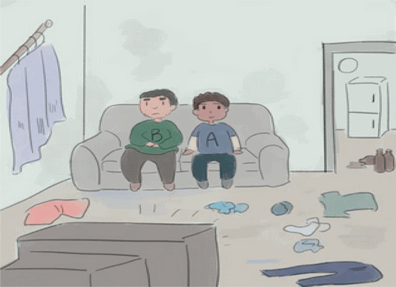
Following our hypothesis, an imperative modified by eh should mean you agree with this command; the real-world consequence is that without Bill's prior intention to get Andy a beer, the utterance in (18b) is infelicitous. That is, with the modification of the imperative by eh, the utterance is interpreted as a request for confirmation that the addressee intends to carry out the command. This is illustrated in (19), where Bill is already on his way to the kitchen. In this scenario, Andy is confirming that Bill will bring him a beer (perhaps as he usually does). Note that the bare imperative is also possible in this context, in which case Andy need not believe that Bill is planning to get him a beer (i.e. it is a real command, cf. (18a)).Footnote 9
(19) Couch II
a. Get me a beer.
b. Get me a beer, eh?

We thus see the same effect of eh as in the previous scenarios. While a bare imperative is interpreted as a command, complete with the expectation that the addressee will comply with the request (even if they did not already plan to do so), the addition of eh changes the speech act. With eh, an imperative indicates that the speaker thinks the action is already part of the addressee's plan. The storyboard elicitations confirm that eh is used only when the addressee is thought to agree with the appropriateness/relevance of the command. This is schematized in (20).
(20) The function of eh
a. f (eh) you agree with this speech act
b. f (UoL: eh + Cxsyn: imperative) you agree with this command
The example in (21) illustrates an imperative modified by eh in our corpus data. As with exclamatives and interrogatives, the addition of eh to the imperative call me later modifies the speech act from a command to a request for confirmation. This is evidenced by the addressee's response, yeah, which would be an infelicitous response to the command. We note that classic sociolinguistic interviews (from which our natural speech data come), as one-on-one conversations typically involving the elicitation of narratives, are an unlikely interactional context for imperatives to occur in. It is thus not surprising that this example occurs outside of the interview situation itself in speech with a third party.
(21)
RD: Call me later, eh?
[son]: Yeah. Are you going to be at work or?
RD: No ah, I'm going to take the morning off, so. (RD: TEA/M/61)
Finally, eh can modify a declarative clause. Without eh, a declarative is likely interpreted as an assertion, the speech act with which it is characteristically associated; it is used if the speaker wants the addressee to know something they believe to be unknown to the addressee. Consider the scenario in (22). Ben is taking a stroll when a bird on the sidewalk starts talking to him. Initially he is perplexed, but his confusion is resolved when he is told that he is on Candid camera.Footnote 10 In this context, a bare declarative is a well-formed assertion, as in (22a). However, in (22b) the same declarative modified by eh is not. This is because eh functions here to request confirmation that the addressee agrees with the assertion, yet the candidness of Candid camera entails that Ben had no clue that he was part of a show. He does not have the requisite knowledge to agree with the assertion.
(22) Candid Camera I
a. Surprise! You're on Candid camera.
b. *Surprise! You're on Candid camera, eh?

Consider now the scenario in (23). Here Andy and Ben are catching up over a drink. Andy believes he saw Ben on last night's episode of Candid camera. He seeks to confirm with Bill that it was indeed him. In this scenario, the bare declarative (characteristically used to make an assertion) is ill-formed in (23a): we do not usually tell people things that we believe they already know (the sentence is only well-formed if Bill is not aware that he was on Candid camera). However, in (23b) the addition of eh results in a well-formed utterance. Eh marks the declarative clause as a request for confirmation that the speaker's belief is appropriate.
(23) Candid Camera II
a. *You were on Candid Camera last night.
b. You were on Candid Camera last night, eh?

Once again we see that eh has an interpretive effect. In (23), in the absence of eh, a declarative is interpreted as an assertion; in the presence of eh, it is interpreted as a request for confirmation. Again, it is the host clause that determines the target of confirmation. The function of eh in the context of a declarative is thus to request confirmation that the assertion is appropriate. This is schematized in (24).
(24) The function of eh
a. f (eh) you agree with this speech act
b. f (UoL: eh + Cxsyn: declarative) you agree with this assertion
In our corpus data, the vast majority of eh tokens modify declaratives. For example, in the TEA, there are 255 eh-declaratives, compared to two interrogatives, three imperatives, and one exclamative. Example (25), from those materials, exemplifies the function of eh with a declarative clause.Footnote 11
(25)
INT: And you're getting married soon too, eh?
RS: Yes.
INT: Is that right?
RS: Yes. June 2006. (RS: TEA/M/36)
The interviewer asks the interviewee to confirm that he is getting married soon, which he does. The confirmational nature of the declarative with eh is then reiterated: Is that right?
Here, as in (23), eh has the effect of requesting confirmation of the truth of the proposition. This is not part of the intrinsic meaning of eh but an artefact. We know this because when eh combines with clause types other than declaratives, the target of confirmation is not the truth. For example, there is no sense in which a question or exclamation is true or false. Rather, as we have suggested, eh requests confirmation of the appropriateness of the speech act. With declaratives this indirectly derives a request for confirming the truth precisely in contexts where the addressee is believed to have knowledge about the truth of the proposition. In both the storyboard scenario in (23) and the corpus example in (25), this is the case—the addressees have first-hand knowledge (of being on Candid camera, about getting married). As we demonstrate below, however, confirming the truth of a proposition is not the only outcome, nor indeed the most frequent outcome of modifying a declarative with eh.
To summarize, we have illustrated that eh contributes to the interpretation of an utterance. Moreover, we have seen that the syntactic context (i.e. the host clause) contributes to the derived function of an eh-modified utterance: it determines the target of confirmation. Crucially, this is but one aspect of eh’s contextually derived functions. We can further deconstruct eh by considering other types of context. In the cases examined above, when a speaker modifies a sentence with eh, they are requesting confirmation from the addressee that they agree with the specific speech act. Note that the principal function of the UoL eh—f (eh): you agree with this speech act—does not derive a confirmational interpretation. How then does an assertion (i.e. the speaker believes that the addressee agrees with a speech act) become a request for confirmation (i.e. that the addressee confirm this belief)? In the next subsection, we show that prosodic context is critical to interpretation.
Prosodic context
In the examples discussed thus far, we have assumed that the pragmatic marker is realized with rising intonation (cf. note 7; see also Avis Reference Avis1972; Johnson Reference Johnson1976; Wiltschko & Heim Reference Wiltschko, Heim, Kaltenböck, Keizer and Lohmann2016). We know on independent grounds that intonational contours contribute to the interpretation of an utterance. Consider declarative clauses, as in Table 1. The simple mapping from a declarative clause to the speech act of an assertion is typically only available in English when the intonational contour is falling. When other contours are used, such as rising intonation or surprise intonation, they operate to modify speech acts (Trinh & Crnič Reference Trinh, Crnič, Reich, Horch and Pauly2011:1): rising intonation can be used to derive a question (Bartels Reference Bartels1997; Gunlogson Reference Gunlogson2003; Truckenbrodt Reference Truckenbrodt, Yoo and Delais-Roussarie2011), whereas the surprise intonation derives an exclamation (Rosengren Reference Rosengren and Rosengren1992).Footnote 12
Ways in which intonation modifies speech acts.

Given that rising intonation causes a clause type that is typically associated with assertive force to be interpreted as a question, we assume that this is a general function of rising intonation in English. We thus follow Heim, Keupdjio, Lam, Osa-Goméz, Thoma, & Wiltschko (Reference Heim, Keupdjio, Lam, Osa-Gómez, Thoma; and Wiltschko2016) and assume that rising intonation on eh contributes to the interpretation of the utterance: it creates a question, thereby requiring a response. If the utterance is an assertion, the response will be either confirmation or disconfirmation of the assertion.
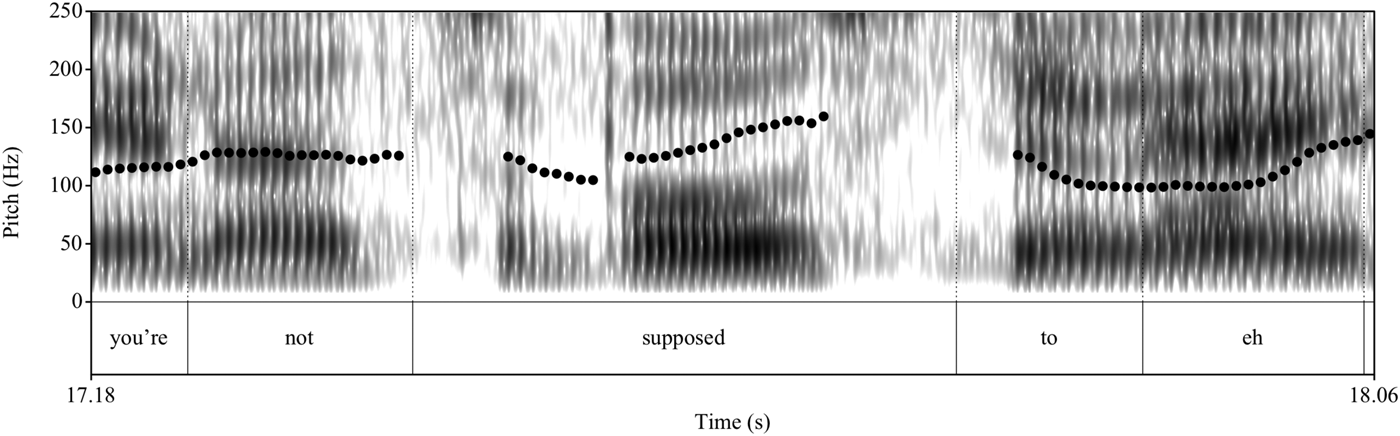
The excerpt in (26) contains an example of eh with rising intonation (i.e. confirmational eh), which is visible in the pitch track in Figure 1. In this example, eh occurs at the end of the turn, and the interlocutor responds with two confirmational strategies: echoing RP's final clause and using the response particle yeah.
(26)
INT: It's just an amazing dog ‘cause there's a crosswalk there and the dog just knows. It plants itself if there's cars around. It's just amazing.
RP: And you always want to go and pet them and you're not supposed to, eh?
INT: You're not supposed to, yeah.
RP: But that's what makes it worse! (RP: TEA/M/1941)
Spectrogram and pitch tracker of example (26) (Pitch range 90–220 Hz).
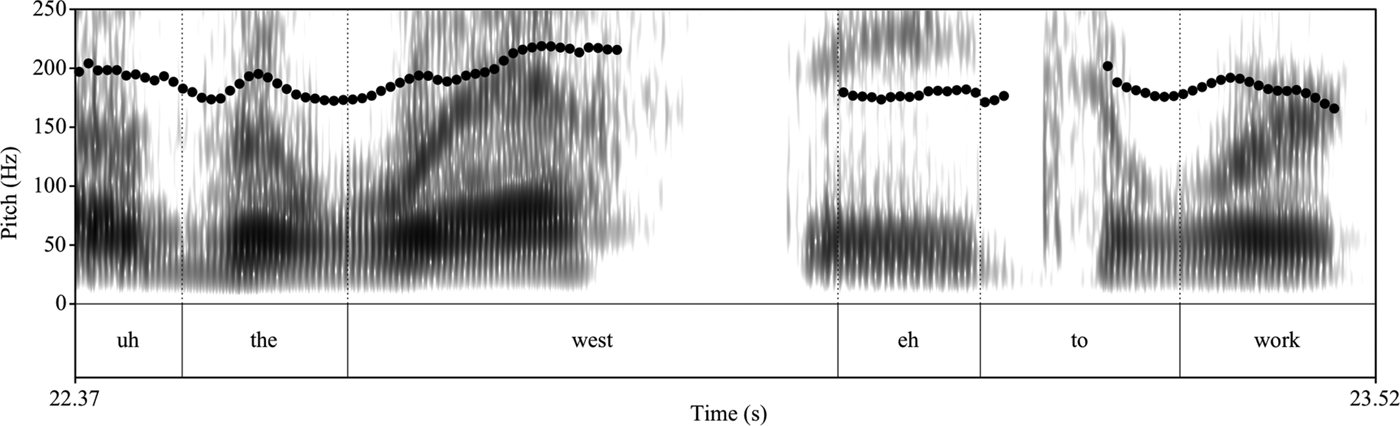
Eh can also be realized with a level contour, in which case a different function is derived, one that is not confirmational. That is, a different prosodic contour leads to a different interpretation. In this prosodic context, eh has the derived function of being an assertion of the addressee's belief. This is known in the literature as the narrative function of eh, which Johnson (Reference Johnson1976:157) describes as ‘the hyperdefensive use of eh, because the speaker here seems to be anticipating at every turn a challenge to the accuracy of plausibility of his story, even from people who are not in a position to do so with much authority’. This sets up a contrast between the contextually derived confirmational function of eh, which is dependent on rising intonation and requests confirmation from the addressee, and its contextually derived narrative function, in which the level intonation does not request any response. Narrative eh simply asserts that the speaker believes that the addressee agrees with the relevant speech act. This is consistent with Johnson's description of narrative eh as ‘hyperdefensive’; if a speaker is expecting to be challenged by their addressee, they may assert that they believe the addressee does in fact believe the proposition in order to encourage agreement with them.
Narrative eh is exemplified in (27); the level intonation is visible in the corresponding pitch track in Figure 2.
(27)
FG: And then when the Small Arms were there, well they named- they- they took the streetcar out that far out to- pretty near to Dixie Road. [INT: Right.] Yeah, because that was where like, all the girls came from, uh- uh the West eh, to work in the factory. [INT: Right.] Yeah, and they had a dormitories there but that's all gone now, like-
(FG: TEA/F/76)
Spectogram and pitch tracker of example (27) (Pitch range 90–220 Hz).
Our analysis predicts that confirmational eh will occur in turn-final position, because requesting a response requires the current speaker to end their turn. Narrative eh does not come with this restriction, since a response is not required. Thus, it can appear turn-medially, as in (27). A response is not ruled out, as (27) demonstrates, but it is not essential.Footnote 13 This is shown in (28), where the interviewer provides no (audible) response to eh; the level intonation of eh in this example is visible in the corresponding spectrogram in Figure 3.
(28)
JL: If I get too far away from Yonge Street I start getting nervous, you know?
INT: [laughing]]
JL: I gotta be close to Yonge.
INT: Yep. [laughing]
JL: That's- that's funny, eh. Everybody's different. And me, I was close to Yonge Street, if I was Yonge and Wellesley, Yonge and Lawrence, Yonge and Eglinton, fine.
INT: Right. (JL: TEA/M/51)
Spectrogram and pitch tracker of example (28) (Pitch range 90–220 Hz).

The contribution of prosody to the derived function of eh is summarized in (29).
(29) The function of eh
a. f (eh) you agree with this speech act
b. f (UoL: eh + Cxpros: rising) confirm that you agree with this speech act
c. f (UoL: eh + Cxpros: level) I believe you agree with this speech act
Discourse context
The third relevant context is discourse context. This is not directly encoded in the linguistic signal, but it interacts with the use of eh to create particular interpretations. We illustrate this with two scenarios, (30) and (32).
In (30), John runs into Mary, who is walking a dog. She has been thinking about adopting a new dog; John suspects she has done so. In this scenario, the bare declarative clause with falling intonation (an assertion), (30a), is judged as odd in the storyboard elicitations. Assertions are typically used in situations where the speaker knows something that the addressee does not. As the owner of the dog, Mary (not John) is the one who knows with certainty that the dog is hers. Thus, in this situation, Mary has the authority relative to the proposition that Mary owns a new dog. In contrast, if the declarative clause is followed by eh (with rising intonation), as in (30b), the utterance is rendered licit. The contextually derived function, confirm that you agree with the assertion, yields a request for confirmation for the truth of the proposition. This is appropriate in a scenario where the addressee has the authority relative to the proposition at issue, as in (30).
(30) New dog I
a. ?You have a new dog.
b. You have a new dog, eh?

The excerpt from our corpora in (31) contains an example of eh being used in the context of addressee authority. The interviewer and AK are discussing the good behaviour of AK's infant. AK has the authority when it comes to whether or not her child makes a fuss at sleep time; she responds to the interviewer's request for confirmation (signaled here by eh with rising intonation) by further elaborating on her child's behaviour.
(31)
INT: Man, sleeps through the night [AK: yep] holds her own bottle [AK: mm-hm] she doesn't even fuss when you put her down, eh?
AK: No. She doesn't- see now ‘cause I put her down awake but I got her her um, aquarium for her- the side of her bed, which plays music constantly for like five minutes straight which she needs because she likes …
(INT: TEA/F/21)
A different discourse context obtains in (32). John runs into Mary, who has just adopted a new dog. Because she had previously informed John about how excited she was about the adoption, she expects John to comment on the dog. When he does not, she wants to make sure he understands that the dog is hers. In this situation Mary can utter the bare declarative clause, (32a). This is the canonical, unmarked use of a declarative clause to perform an assertion: the speaker tells the addressee something they (presumably) do not know. However, Mary can also modify her utterance with a confirmational eh, as in (32b).
(32) New dog II
a. I have a new dog.
b. I have a new dog, eh?

Given that eh can function to confirm the truth of a proposition, the felicity of the eh-modified declarative clause in (32b) is a bit surprising: the speaker (Mary) has the authority relative to the proposition that Mary has a new dog. Why would Mary request confirmation for the truth of a proposition she has authority over? In this situation, we suggest that Mary uses eh not because she wants to make sure she has her facts right but because she wants to make sure John has his facts right. In other words, the contextually derived function of eh is sensitive to the authority of the discourse participants. In (32b), the function of eh is still confirm you agree with the assertion. Agreement with the assertion is not about the truth of the proposition, however, but about the belief state of the addressee. In this context, to agree with a speech act can be paraphrased as confirm that you know. This is another contextually derived function of eh.
Most of the examples in our corpus data are of this type. In (33), BC is telling a story about his past, a scenario in which he is the authority. He is not requesting that the interviewer confirm that the beds were constructed of slats; he uses eh to confirm that the interviewer understands the details of the construction of the beds in question, ensuring that the rest of his narrative will be cogent.
(33)
BC: And uh, uh they were out at a dance somewhere so my- my cousin and I took- the- the beds were um, there- there were slats across [INT: yes] boards, eh [INT: yep] that- to hold a- the straw mattress
INT: Oh right, yeah.
BC: it was, so we took all the- all the slats off, we just had them on the edge, so that when they ca-- they came in- my brother was a big lad, they came in, they popped onto the bed and “crash”! (BC: TEA/M/60)
The effect of authority on the interpretation of eh raises the question as to what happens when there is no authority, such as in the case of a subjective judgment. The scenario in (34) tests this. Andrzej and Bonnie have just seen a movie together. When they leave the theater, Andrzej can utter the unmarked declarative clause in (34a) (an assertion), but he can also modify the declarative with eh, as in (34b) (a request for confirmation).
(34) Movie
a. That was a good movie.
b. That was a good movie, eh?

Since subjective judgments (such as evaluating whether or not a movie was good) do not rely on authority, the derived function of eh under such circumstances is necessarily different from the previous discourse contexts discussed here. Outside of assumed speaker/hearer authority, eh can be paraphrased as confirm that you agree with the proposition. The corpus excerpt in (35) illustrates this use: eh modifies a subjective judgment about a strip mall located in a less-than-desirable neighbourhood, and the interviewer confirms the speaker's assessment by providing evidence to corroborate the judgment.
(35)
RS: Yeah. So if you're going down Don Mills heading west uh y-- you know, just before the Peanut Plaza actually you'll come across there's Woodbine Junior High.
INT: Know the Peanut Plaza.
RS: Do you? Yeah so then y--
INT: I hate that place.
RS: I know [ it's pretty scummy eh?]
INT: [ It's the worst. ]
RP: I know.
INT: You get shot there.
RS: Oh I know. It's kind of I- when they opened the bar down there actually, Jackie's Sports Bar and Billiards, I uh, started going down there a lot and then I found that there wasn't the best clientele of people down there. (RS: TEA/M/34)
To summarize, the discourse context has an effect on the interpretation of eh. Assuming that the syntactic context is a declarative clause and the prosodic context is rising intonation, three functions are derivable by manipulating the discourse context. If the addressee (A) has the authority relative to the proposition (p), the contextually derived function of eh is to request confirmation for the truth of p. If the speaker (S) has the authority relative to the proposition, the contextually derived function of eh is to request confirmation that A knows p. Lastly, if no discourse participant has authority, the contextually derived function is to confirm that the speaker agrees with the assertion. This is summarized in (36).Footnote 14
(36) The function of eh
a. f (eh) you agree with this speech act
b. f (UoL: eh + Cxdisc: A = authority confirm that you agree with this
+ Cxpros: rising assertion (→ confirm that p is true)
+ Cxsyn: declarative)
c. f (UoL: eh + Cx disc: S = authority confirm that you agree with this
+ Cxpros: rising assertion (→ confirm that you know p)
+ Cxsyn: declarative)
d. f (UoL: eh + Cx disc: no authority confirm that you agree with this
+ Cxpros: rising assertion
+ Cxsyn: declarative)
We have now established that eh has a variety of contextually derived functions and we have disentangled this multifunctionality by deconstructing the syntactic context, the prosodic context, and the discourse context. An additional aspect of eh’s meaning relates to its social indexicality—not what eh conveys but what its use conveys. In the next section, we discuss how different socio-indexical associations may also be contextually derived, in this case from the social context of use.
Social context
Denis & Tagliamonte (Reference Denis, Tagliamonte and Pichler2016) reported that eh represents just 3.1% (N = 1938) of features with similar confirmational functions (right, you know) in the TEA. In the SCVE, its use is even more marginal, 0.47% (N = 2551). Given the variety of contextually derived functions we have shown to be associated with eh, it is perhaps surprising that its use is not more widespread in these datasets, particularly given its status as a quintessential Canadian shibboleth and an important marker of Canadian identity (Allen Reference Allen1959; Avis Reference Avis1972; Love Reference Love1973; Johnson Reference Johnson1976; Gibson Reference Gibson1977; Schecter Reference Schecter1979; Denis Reference Denis2013). This raises two interrelated questions. First, in the relatively rare instances when it is used in these sociolinguistic corpora, what is eh being used for? Second, if other forms are available for (more or less) the same linguistic functions, then what does eh specifically contribute to the interaction?
Just as eh is used in a variety of contexts that impact its interpretation, it also occurs in tandem with social contexts, where it indexes multiple social constructs (Denis Reference Denis2013). Indeed, eh projects an indexical field of potential social meanings—social types, qualities, and stances—and differences across social contexts (e.g. speaker, audience, location, situation, activity, interactional goals, etc.) activate different aspects of the field and give them meaning (cf. Eckert Reference Eckert2008). As with the linguistic functions of eh, we conceptualize its social associations as being contextually derived. However, unlike its principal linguistic function, the UoL eh does not have a principal social association. Instead, it evokes a constellation of ideologically interrelated meanings that can be connected in interaction and that are variably activated as social context varies. We represent this in (37).Footnote 15
(37) Socio-indexical field for eh
f s (UoL: eh + Cxsoc: …) {Canadian, not American, ‘hoser’ (see below), male, working class, locally oriented, friendly, beer drinker, …}
Without going into great detail about the (complex) mapping of social contexts to aspects of the socio-indexical field, we briefly mention two sets of social associations identified by Denis (Reference Denis2013), noting that they are but a subset of possibilities.Footnote 16 The 1980s American-Canadian sketch comedy show SCTV had a recurring sketch called ‘The great white north’ that featured two Canadian brothers, Bob and Doug McKenzie. The McKenzies are hosers (‘Canadian young men who wear toques and flannel shirts while drinking beer and conducting inane conversations’; Dollinger & Fee Reference Dollinger and Fee2017). In the construction and performance of these characters, the actors make frequent use of eh in their (largely improvised) dialogue, which reinforced the hoser persona (see also Gold Reference Gold2008). While the hoser is largely a negative Canadian stereotype, it captures critical ideological and social aspects of eh in the Canadian context. These encompass markers of hegemonic masculinity but also link to Canadian identity more generally, including its oppositional sense of self as ‘not American’. Indeed, Denis (Reference Denis2013:8) suggested that Canadians reappropriated eh as the linguistic equivalent of a backpack flag pin—a linguistic device that declares I am Canadian. Denis (Reference Denis2013) discusses accounts of Canadians travelling abroad who claim to use eh far more away than at home in order to identify themselves as ‘not American’. Regardless of the accuracy of such self-reports, they underscore the saliency of the ideological associations of eh with Canadian-ness.
We can now answer our questions above. The answer to the first one, why people use it, is also the answer to the second one, what it contributes to interactions. What sets eh apart from other confirmationals is its socio-indexical field. This enables it to contribute something unique, in that it allows the speaker to claim identities and stances distinct from those associated with right and you know. It is, in short, a feature of the national repertoire ‘available for a range of expressions of Canadian identity’ (Denis Reference Denis2013:10). That may in part explain why it is not particularly frequent in our sociolinguistic corpora data. The materials were collected in cosmopolitan settings with largely (but not strictly) middle-class speakers, and both speaker and interviewer were Canadian (i.e. being Canadian was backgrounded, but being an urban local was overtly foregrounded in the interviews through questions about experiences growing up in the respective cities). This is not to say that the necessary linguistic (pre)conditions for eh were not present, but that important ideological identity and stance conditions were likely minimized.
Implications and conclusions
The multifunctionality of discourse-pragmatic features poses a methodological challenge for variationist analysis because it undermines assumptions regarding semantic equivalency and renders opaque the confines of the variable context. Both are critical to operationalizing predictive criteria and modeling the variable grammar. The question we have tackled here is the following: can linguistic criteria for identifying and classifying the multiple functions of discourse-pragmatic features be systematically and objectively defined? Our test case was eh, a notoriously multifunctional tag that is characteristic of, but not unique to, Canadian English.
Syntactic, prosodic, and discursive contexts all contribute to the multifunctionality of eh. The social setting adds further interpretive context. Thus, a seemingly simplex form, eh, must be deconstructed to determine its derived function in a given utterance. The UoL, eh, encodes the speaker's assessment of the addressee's belief set, the syntax is a factor in determining the likely speech act that the belief set applies to, intonation encodes the speaker's request for the addressee to respond or asserts the belief that the addressee is in agreement, and speaker/addressee authority condition the scope and acceptability of confirmation and agreement.
This approach leads to the possibility to identify points of equivalence that are more in line with traditional approaches to the variable context (Labov Reference Labov1972): the potential to identify covariation between functionally similar (yet only partially overlapping) discourse-pragmatic markers becomes objective and reproducible. To exemplify, consider eh, right, and you know. Recall that f (UoL: eh + Cxpros: rising + Cxsyn: declarative), Confirm that you agree with this assertion, can be interpreted in two ways depending on the authority of speakers. If the addressee has the authority, it is interpreted as Confirm that p is true; if the speaker has the authority it is interpreted as Confirm that you know p. We posit that the principal function of the UoL right is something like (I believe) p is true while the principal function of the UoL you know is something like (I believe) you know p. This allows us to understand why eh covaries with you know in some contexts, with right in other contexts, and with both in yet others. We schematize this in (38).
(38) The function of eh, right, and you know
a. f (eh) you agree with this speech act
b. f (UoL: eh + Cxdisc: A = authority confirm that you agree with this
+ Cxpros: rising assertion (→ confirm that p is true)
+ Cxsyn: declarative)
c. f (UoL: eh + Cx disc: S = authority confirm that you agree with this
+ Cxpros: rising assertion (→ confirm that you know p)
+ Cxsyn: declarative)
d. f (right) p is true
e. f (UoL: right + Cx:pros:rising) confirm that p is true
f. f (you know) you know p
g. f (UoL: you know + Cx:pros:rising) confirm that you know p
Under the transdisciplinary lens we have applied here, the exponents of form and function become predictable, constrainable, and potentially derivable for probabilistic modelling within and across speech communities. Relying solely on the sociolinguistic corpora that we discuss here would not have allowed us to fully explicate this, due to the lack of tokens in several particular contexts. However, this lack of variety substantiates the variationist analysis of eh, right, and you know by Denis & Tagliamonte (Reference Denis, Tagliamonte and Pichler2016). The vast majority of tokens in the TEA appear in one contextual combination: Cxdisc: S = authority, Cxpros: rising, Cxsyn: declarative. This is a context in which eh and you know are unambiguously available and in which right has emerged over the last century (Denis & Tagliamonte Reference Denis, Tagliamonte and Pichler2016).Footnote 17
Eh is not restricted to a single variety of English and other tags are cross-linguistically widespread (Heim et al. Reference Heim, Keupdjio, Lam, Osa-Gómez, Thoma; and Wiltschko2016). These UofLs all share a related principal function, but they may differ across multiple parameters, and not all contextually derived functions are available across all variants, varieties, and languages. Cross-linguistic and dialectal variation thus suggest that a UoL can be modified by various factors relating to the syntactic, prosodic, and discourse context, as we have outlined here.


 Open access

