
Skip to main content Accessibility help
×
Home

Computations with oracles that measure vanishing quantities

Published online by Cambridge University Press:  23 June 2016


EDWIN BEGGS
Affiliation:
College of Science, Swansea University, Swansea, SA2 8PP, Wales, U.K. Emails: e.j.beggs@swansea.ac.uk, j.v.tucker@swansea.ac.uk
JOSÉ FÉLIX COSTA
Affiliation:
Instituto Superior Técnico, Universidade de Lisboa, Lisboa, Portugal Email: fgc@math.ist.utl.pt
DIOGO POÇAS
Affiliation:
Department of Mathematics and Statistics, McMaster University, Hamilton, Ontario, L8S 4K1, Canada Email: pocasd@math.mcmaster.ca
JOHN V. TUCKER
Affiliation:
College of Science, Swansea University, Swansea, SA2 8PP, Wales, U.K. Emails: e.j.beggs@swansea.ac.uk, j.v.tucker@swansea.ac.uk

Abstract

We consider computation with real numbers that arise through a process of physical measurement. We have developed a theory in which physical experiments that measure quantities can be used as oracles to algorithms and we have begun to classify the computational power of various forms of experiment using non-uniform complexity classes. Earlier, in Beggs et al. (2014 Reviews of Symbolic Logic 7(4) 618–646), we observed that measurement can be viewed as a process of comparing a rational number z – a test quantity – with a real number y – an unknown quantity; each oracle call performs such a comparison. Experiments can then be classified into three categories, that correspond with being able to return test results

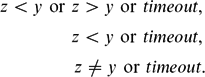
$$\begin{eqnarray*} z < y\text{ or }z > y\text{ or }\textit{timeout},\\ z < y\text{ or }\textit{timeout},\\ z \neq y\text{ or }\textit{timeout}. \end{eqnarray*} $$
These categories are called two-sided, threshold and vanishing experiments, respectively. The iterative process of comparing generates a real number y. The computational power of two-sided and threshold experiments were analysed in several papers, including Beggs et al. (2008 Proceedings of the Royal Society, Series A (Mathematical, Physical and Engineering Sciences) 464 (2098) 2777–2801), Beggs et al. (2009 Proceedings of the Royal Society, Series A (Mathematical, Physical and Engineering Sciences) 465 (2105) 1453–1465), Beggs et al. (2013a Unconventional Computation and Natural Computation (UCNC 2013), Springer-Verlag 6–18), Beggs et al. (2010b Mathematical Structures in Computer Science 20 (06) 1019–1050) and Beggs et al. (2014 Reviews of Symbolic Logic, 7 (4):618-646). In this paper, we attack the subtle problem of measuring physical quantities that vanish in some experimental conditions (e.g., Brewster's angle in optics). We analyse in detail a simple generic vanishing experiment for measuring mass and develop general techniques based on parallel experiments, statistical analysis and timing notions that enable us to prove lower and upper bounds for its computational power in different variants. We end with a comparison of various results for all three forms of experiments and a suitable postulate for computation involving analogue inputs that breaks the Church–Turing barrier.


Type
Paper
Copyright
Copyright © Cambridge University Press 2016 

Access options

Get access to the full version of this content by using one of the access options below.

References

Balcázar, J.L., Días, J. and Gabarró, J. (1990). Structural Complexity I, 2nd edition, Springer-Verlag.CrossRefGoogle Scholar
Beggs, E., Costa, J.F., Loff, B. and Tucker, J.V. (2008). Computational complexity with experiments as oracles. Proceedings of the Royal Society, Series A (Mathematical, Physical and Engineering Sciences) 464 (2098) 27772801.CrossRefGoogle Scholar
Beggs, E., Costa, J.C., Loff, B. and Tucker, J.V. (2009). Computational complexity with experiments as oracles II. Upper bounds. Proceedings of the Royal Society, Series A (Mathematical, Physical and Engineering Sciences) 465 (2105) 14531465.CrossRefGoogle Scholar
Beggs, E., Costa, J.F., Poças, D. and Tucker, J.V. (2013a). On the power of threshold measurements as oracles. In: Mauri, G., Dennunzio, A., Manzoni, L. and Porreca, A.E. (eds.) Unconventional Computation and Natural Computation (UCNC 2013), Lecture Notes in Computer Science, volume 7956, Springer-Verlag, 618.CrossRefGoogle Scholar
Beggs, E., Costa, J.F., Poças, D. and Tucker, J.V. (2013b). Oracles that measure thresholds: The turing machine and the broken balance. Journal of Logic and Computation 23 (6) 11551181.CrossRefGoogle Scholar
Beggs, E., Costa, J.F. and Tucker, J.V. (2010a). Computational models of measurement and Hempel's axiomatization. In: Carsetti, A. (ed.) Causality, Meaningful Complexity and Knowledge Construction, Theory and Decision Library A, volume 46, Springer-Verlag, 155184.Google Scholar
Beggs, E., Costa, J.F. and Tucker, J.V. (2010b). Limits to measurement in experiments governed by algorithms. Mathematical Structures in Computer Science 20 (06) 10191050. Special issue on Quantum Algorithms, editor Salvador Elías Venegas-Andraca.CrossRefGoogle Scholar
Beggs, E., Costa, J.F. and Tucker, J.V. (2010c). Physical oracles: The Turing machine and the Wheatstone bridge. Studia Logica 95 (1–2) 279300. Special issue on Contributions of Logic to the Foundations of Physics, editors D. Aerts, S. Smets & J. P. Van Bendegem.CrossRefGoogle Scholar
Beggs, E., Costa, J.F. and Tucker, J.V. (2010d). The Turing machine and the uncertainty in the measurement process. In: Guerra, H. (ed.) Physics and Computation, P&C 2010, CMATI – Centre for Applied Mathematics and Information Technology, University of Azores, 6272.Google Scholar
Beggs, E., Costa, J.F. and Tucker, J.V. (2012a). Axiomatising physical experiments as oracles to algorithms. Philosophical Transactions of the Royal Society, Series A (Mathematical, Physical and Engineering Sciences) 370 (12) 33593384.CrossRefGoogle ScholarPubMed
Beggs, E., Costa, J.F. and Tucker, J.V. (2012b). The impact of models of a physical oracle on computational power. Mathematical Structures in Computer Science 22 (5) 853879. Special issue on Computability of the Physical, editors Cristian S. Calude and S. Barry Cooper.CrossRefGoogle Scholar
Beggs, E., Costa, J.F. and Tucker, J.V. (2014). Three forms of physical measurement and their computability. Reviews of Symbolic Logic 7 (4) 618646.CrossRefGoogle Scholar
Beggs, E. and Tucker, J.V. (2006). Embedding infinitely parallel computation in Newtonian kinematics. Applied Mathematics and Computation 178 (1) 2543.CrossRefGoogle Scholar
Beggs, E. and Tucker, J.V. (2007a). Can Newtonian systems, bounded in space, time, mass and energy compute all functions? Theoretical Computer Science 371 (1) 419.CrossRefGoogle Scholar
Beggs, E. and Tucker, J.V. (2007b). Experimental computation of real numbers by Newtonian machines. Proceedings of the Royal Society, Series A (Mathematical, Physical and Engineering Sciences) 463 (2082) 15411561.CrossRefGoogle Scholar
Bekey, G.A. and Karplus, W.J. (1968). Hybrid Computation, John Wiley & Sons.Google Scholar
Born, M. and Wolf, E. (1964). Principles of Optics. Electromagnetic Theory of Propagation, Interference and Diffraction of Light, second (revised) edition, Pergamon Press.Google Scholar
Bournez, O. and Cosnard, M. (1996). On the computational power of dynamical systems and hybrid systems. Theoretical Computer Science 168 (2) 417459.CrossRefGoogle Scholar
Carnap, R. (1966). Philosophical Foundations of Physics, Basic Books.Google Scholar
Geroch, R. and Hartle, J.B. (1986). Computability and physical theories. Foundations of Physics 16 (6) 533550.CrossRefGoogle Scholar
Hempel, C.G. (1952). Fundamentals of concept formation in empirical science. International Encyclopedia of Unified Science, volume 2 no. 7, Chicago Univ. Press.Google Scholar
Krantz, D.H., Suppes, P., DuncanAAAALuce, R. and Tversky, A. (1990). Foundations of Measurement, vol. 1 (1971), vol. 2 (1989) and vol. 3 (1990), Academic Press.Google Scholar
Kreisel, G. (1974). A notion of mechanistic theory. Synthese 29 (1) 1126.CrossRefGoogle Scholar
Pauly, A. (2009). Representing measurement results. Journal of Universal Computer Science 15 (6) 12801300.Google Scholar
Pauly, A. and Ziegler, M. (2013). Relative computability and uniform continuity of relations. Journal of Logic and Analysis 5 (7) 139.Google Scholar
Pour-El, M. (1974). Abstract computability and its relations to the general purpose analog computer. Transactions of the American Mathematical Society 199 128.CrossRefGoogle Scholar
Pour-El, M. and Richards, I. (1979). A computable ordinary differential equation which possesses no computable solution. Annals of Mathematical Logic 17 (1–2) 6190.CrossRefGoogle Scholar
Pour-El, M. and Richards, I. (1981). The wave equation with computable initial data such that its unique solution is not computable. Advances in Mathematics 39 (4) 215239.CrossRefGoogle Scholar
Pour-El, M. and Richards, I. (1989). Computability in Analysis and Physics, Perspectives in Mathematical Logic, Springer-Verlag.CrossRefGoogle Scholar
Siegelmann, H.T. and Sontag, E.D. (1994). Analog computation via neural networks. Theoretical Computer Science 131 (2) 331360.CrossRefGoogle Scholar
Weihrauch, K. (2000). Computable Analysis, Springer-Verlag.CrossRefGoogle Scholar
Weihrauch, K. and Zhong, N. (2002). Is wave propagation computable or can wave computers beat the Turing machine? Proceedings of the London Mathematical Society 85 (2) 312332.CrossRefGoogle Scholar
Woods, D. and Naughton, T.J. (2005). An optical model of computation. Theoretical Computer Science 334 (1–3) 227258.CrossRefGoogle Scholar
Ziegler, M. (2009). Physically-relativized Church-Turing hypotheses: Physical foundations of computing and complexity theory of computational physics. Applied Mathematics and Computation 215 (4) 14311447.CrossRefGoogle Scholar

Full text views

Full text views reflects PDF downloads, PDFs sent to Google Drive, Dropbox and Kindle and HTML full text views.

Total number of HTML views: 0
Total number of PDF views: 57 *
View data table for this chart

* Views captured on Cambridge Core between September 2016 - 5th December 2020. This data will be updated every 24 hours.

Hostname: page-component-b4dcdd7-qjxlp Total loading time: 0.272 Render date: 2020-12-05T09:12:35.281Z Query parameters: { "hasAccess": "0", "openAccess": "0", "isLogged": "0", "lang": "en" } Feature Flags last update: Sat Dec 05 2020 09:00:49 GMT+0000 (Coordinated Universal Time) Feature Flags: { "metrics": true, "metricsAbstractViews": false, "peerReview": true, "crossMark": true, "comments": true, "relatedCommentaries": true, "subject": true, "clr": false, "languageSwitch": true }

Send article to Kindle

To send this article to your Kindle, first ensure no-reply@cambridge.org is added to your Approved Personal Document E-mail List under your Personal Document Settings on the Manage Your Content and Devices page of your Amazon account. Then enter the ‘name’ part of your Kindle email address below. Find out more about sending to your Kindle. Find out more about sending to your Kindle.

Note you can select to send to either the @free.kindle.com or @kindle.com variations. ‘@free.kindle.com’ emails are free but can only be sent to your device when it is connected to wi-fi. ‘@kindle.com’ emails can be delivered even when you are not connected to wi-fi, but note that service fees apply.

Find out more about the Kindle Personal Document Service.

Computations with oracles that measure vanishing quantities
Available formats
×

Send article to Dropbox

To send this article to your Dropbox account, please select one or more formats and confirm that you agree to abide by our usage policies. If this is the first time you use this feature, you will be asked to authorise Cambridge Core to connect with your <service> account. Find out more about sending content to Dropbox.

Computations with oracles that measure vanishing quantities
Available formats
×

Send article to Google Drive

To send this article to your Google Drive account, please select one or more formats and confirm that you agree to abide by our usage policies. If this is the first time you use this feature, you will be asked to authorise Cambridge Core to connect with your <service> account. Find out more about sending content to Google Drive.

Computations with oracles that measure vanishing quantities
Available formats
×
×

Reply to: Submit a response


Your details


Conflicting interests

Do you have any conflicting interests? *