





1. Introduction
In a cyclic proof system, proofs are finite graphs which represent the ill-founded derivations obtained by unravelling them. Broadly speaking, the logics benefiting from cyclic proofs often feature notions of (co-)induction or fixed points (e.g., Brotherston Reference Brotherston2006; Das Reference Das and Kobayashi2021; Fortier and Santocanale Reference Fortier, Santocanale and Rocca2013; Niwiński and Walukiewicz Reference Niwiński and Walukiewicz1996; Simpson Reference Simpson, Esparza and Murawski2017; Sprenger and Dam Reference Sprenger and Dam2003). Differing from conventional proof systems, cyclic systems typically eschew explicit induction axioms which can instead be simulated by cyclic derivations. Cut-free cyclic proof systems lend themselves well to proof theoretic investigations (e.g., Afshari and Leigh Reference Afshari and Leigh2017; Afshari et al. Reference Afshari, Leigh and Menéndez Turata2021; Marti and Venema Reference Marti, Venema, Das and Negri2021) and proof search procedures (e.g., Brotherston et al. Reference Brotherston, Distefano, Petersen, Bjørner and Sofronie-Stokkermans2011, Reference Brotherston, Gorogiannis, Petersen, Jhala and Igarashi2012; Tellez and Brotherston Reference Tellez, Brotherston and de Moura2017).
Since cyclic proofs contain infinite paths, their soundness cannot be reduced to the local soundness of their derivation rules. Instead, one usually needs to impose further soundness conditions on these paths. The most common such condition is known as the global trace condition (GTC). While the concrete formulation of the trace condition differs between logics, it usually adheres to a certain form: a path satisfies the trace condition if it has a suffix along which some parameter (such as a term or fixed-point quantifier) can be traced and which progresses (e.g., decreases or is unfolded) infinitely often.
Motivated by this structural similarity, Brotherston (Reference Brotherston2006) developed an abstract framework to uniformly represent and reason about cyclic proof systems. The formalism has been used to give a general proof of the decidability of proof checking for cyclic proofs and to study various transformations of cyclic derivations which maintain the GTC. While Brotherston’s notion of trace condition encompasses most cyclic proof systems in the literature, it does not readily capture the common trace condition of $\mu$
-calculi, which hold a prominent position in cyclic proof theory.
$\mu$
-calculi, which hold a prominent position in cyclic proof theory.
This article introduces an abstract representation of cyclic proof systems which extends Brotherston’s approach. It is formed by an abstract, category theoretical rendition of cyclic derivations and their trace conditions. By replacing Brotherton’s notion of single progress points with a more nuanced, algebraic notion of progress, we are able to succinctly express most trace conditions, including those of $\mu$
-calculi. Our categorical formalism, in addition, allows for the composition of trace information, yielding two novel results: derivation compression and an alternative soundness condition. Derivation compression allows a cyclic derivation with n simple cycles to be represented as a graph of size O(n), which we believe should yield performance-gains in implementations of, for example, cyclic proof checking algorithms. Second, we give a soundness condition on derivations that induces a proof checking algorithm reliant on Ramsey’s theorem instead of automata-theoretic machinery. While a similar condition has been known in the field of program termination (Lee et al. Reference Lee, Jones and Ben-Amram2001), this is, to the best of our knowledge, the first time such a condition has been considered for cyclic proofs. Furthermore, we reprove some known results to demonstrate applicability of our representation in cyclic proof theory: we show decidability of proof checking and regularisability of ill-founded proofs in finite proof systems via automata theory. Lastly, we show that the proof checking problem for our abstract notion of proof is PSPACE-complete.
$\mu$
-calculi. Our categorical formalism, in addition, allows for the composition of trace information, yielding two novel results: derivation compression and an alternative soundness condition. Derivation compression allows a cyclic derivation with n simple cycles to be represented as a graph of size O(n), which we believe should yield performance-gains in implementations of, for example, cyclic proof checking algorithms. Second, we give a soundness condition on derivations that induces a proof checking algorithm reliant on Ramsey’s theorem instead of automata-theoretic machinery. While a similar condition has been known in the field of program termination (Lee et al. Reference Lee, Jones and Ben-Amram2001), this is, to the best of our knowledge, the first time such a condition has been considered for cyclic proofs. Furthermore, we reprove some known results to demonstrate applicability of our representation in cyclic proof theory: we show decidability of proof checking and regularisability of ill-founded proofs in finite proof systems via automata theory. Lastly, we show that the proof checking problem for our abstract notion of proof is PSPACE-complete.
Overview.
In Section 2, we introduce cyclic proof systems, the modal $\mu$
-calculus serving as a concrete example which is frequently revisited throughout the rest of the article. Section 3 presents our abstract notion of trace condition which is then used in Section 4 to introduce an abstract notion of cyclic derivation. In Section 5, we give a soundness condition, equivalent to the GTC, inspired by a result from program termination. Section 6 relates our abstract notion of trace to prevalent uses of automata theory in cyclic proof theory. In Section 7, we give a proof of the PSPACE-completeness of checking the GTC of abstract cyclic proofs with certain kind of trace conditions. We close with a discussion of related and future work in Section 8.
$\mu$
-calculus serving as a concrete example which is frequently revisited throughout the rest of the article. Section 3 presents our abstract notion of trace condition which is then used in Section 4 to introduce an abstract notion of cyclic derivation. In Section 5, we give a soundness condition, equivalent to the GTC, inspired by a result from program termination. Section 6 relates our abstract notion of trace to prevalent uses of automata theory in cyclic proof theory. In Section 7, we give a proof of the PSPACE-completeness of checking the GTC of abstract cyclic proofs with certain kind of trace conditions. We close with a discussion of related and future work in Section 8.
This article is an extended version of Afshari and Wehr (Reference Afshari, Wehr, Ciabattoni, Pimentel and de Queiroz2022) with the following notable additions.
-
(1) The notion of trace interpretations is introduced in Section 3 to formally express the connection of concrete and abstract cyclic proofs.
-
(2) The connection between our notion of trace categories and the most common uses of automata theory in cyclic proof theory is included in Section 6.
-
(3) Section 7 is extended to incorporate a complete proof of PSPACE-hardness. By applying the automata-theoretic results of Section 6, it is shown that proof checking for certain trace categories is in PSPACE.
2. Cyclic Proof Systems
We begin by giving a general account of cyclic proof systems and their associated notion of cyclic proof. We illustrate the definitions by presenting a cyclic proof system for the modal $\mu$
-calculus from the literature.
$\mu$
-calculus from the literature.
A tree is a finite, non-empty set of sequences $T\subseteq \omega^*$
which is prefix closed, that is, if
$T\subseteq \omega^*$
which is prefix closed, that is, if $tn \in T$
for
$tn \in T$
for $t \in \omega^*$
and
$t \in \omega^*$
and $n \in \omega$
then
$n \in \omega$
then $t \in T$
as well. We call
$t \in T$
as well. We call $t \in T$
a node of T and any
$t \in T$
a node of T and any $tn \in T$
a child of t. A node
$tn \in T$
a child of t. A node $t\in T$
is a leaf of T if it has no children. The root of any tree T thus is the empty sequence
$t\in T$
is a leaf of T if it has no children. The root of any tree T thus is the empty sequence $\varepsilon \in \omega^*$
. A cyclic tree is a pair
$\varepsilon \in \omega^*$
. A cyclic tree is a pair $C = (T, \beta)$
consisting of a tree T and a partial function
$C = (T, \beta)$
consisting of a tree T and a partial function $\beta \colon \mathrm{Leaf}(T) \to T$
mapping (some) leaves of T to nodes of T with
$\beta \colon \mathrm{Leaf}(T) \to T$
mapping (some) leaves of T to nodes of T with $\beta(s) \not\in \mathrm{dom}(\beta)$
for all
$\beta(s) \not\in \mathrm{dom}(\beta)$
for all $s \in \mathrm{dom}(\beta)$
. Each
$s \in \mathrm{dom}(\beta)$
. Each $s \in\mathrm{dom}(\beta)$
is called a bud and
$s \in\mathrm{dom}(\beta)$
is called a bud and $\beta(s)$
its companion.
$\beta(s)$
its companion.
A derivation system is a triple  consisting of a set of sequents
  , a set $\mathcal{R}$
of derivation rules and a rule interpretation
$\mathcal{R}$
of derivation rules and a rule interpretation  such that for each $r \in \mathcal{R}$
,
$r \in \mathcal{R}$
,  for some $n \in \omega$
. In this case, we call
$n \in \omega$
. In this case, we call $\Gamma$
the conclusion of r and the
$\Gamma$
the conclusion of r and the $\Delta_i$
its premises. Henceforth, we refer to a derivation system
$\Delta_i$
its premises. Henceforth, we refer to a derivation system  simply by $\mathcal{R}$
. An
$\mathcal{R}$
. An $\mathcal{R}$
-pre-proof is a triple
$\mathcal{R}$
-pre-proof is a triple $\Pi = (C, \lambda, \delta)$
consisting of a cyclic tree
$\Pi = (C, \lambda, \delta)$
consisting of a cyclic tree $C = (T, \beta)$
together with a labelling
$C = (T, \beta)$
together with a labelling  such that $\lambda(t) = \lambda(\beta(t))$
for every
$\lambda(t) = \lambda(\beta(t))$
for every $t \in \mathrm{dom}(\beta)$
.
$t \in \mathrm{dom}(\beta)$
. $\delta : T \setminus \mathrm{dom}(\beta) \to \mathcal{R}$
is a function with
$\delta : T \setminus \mathrm{dom}(\beta) \to \mathcal{R}$
is a function with $\rho(\delta(t)) = (\Gamma,\Delta_1, \ldots, \Delta_n)$
,
$\rho(\delta(t)) = (\Gamma,\Delta_1, \ldots, \Delta_n)$
, $\lambda(t) = \Gamma$
and
$\lambda(t) = \Gamma$
and $\lambda(ti)=\Delta_i$
where
$\lambda(ti)=\Delta_i$
where $\mathrm{Chld}(t) =\{t1, \ldots, tn\}$
for each
$\mathrm{Chld}(t) =\{t1, \ldots, tn\}$
for each $t \in \mathrm{dom}(\delta)$
. The sequent
$t \in \mathrm{dom}(\delta)$
. The sequent $\lambda(\varepsilon)$
is called the endsequent of
$\lambda(\varepsilon)$
is called the endsequent of $\Pi$
.
$\Pi$
.
We denote by  the set of $\mathcal{R}$
-pre-proofs. A cyclic proof system is a tuple
$\mathcal{R}$
-pre-proofs. A cyclic proof system is a tuple  consisting of a derivation system
  and a set
  called $\mathcal{R}$
-proofs. A pre-proof is said to satisfy the soundness condition of
$\mathcal{R}$
-proofs. A pre-proof is said to satisfy the soundness condition of $\mathcal{R}$
if is an
$\mathcal{R}$
if is an $\mathcal{R}$
-proof. An
$\mathcal{R}$
-proof. An $\mathcal{R}$
-proof with endsequent
$\mathcal{R}$
-proof with endsequent $\Gamma$
is called a proof of
$\Gamma$
is called a proof of $\Gamma$
. We extend the naming convention for derivation systems to cyclic derivation systems, referring to
$\Gamma$
. We extend the naming convention for derivation systems to cyclic derivation systems, referring to  by
by $\mathcal{R}$
.
$\mathcal{R}$
.
To illustrate these notions, we present a cyclic proof system for the modal $\mu$
-calculus. It will also serve as an example motivating the abstract definitions of Sections 3 and 4. This presentation of the system is taken from Afshari and Leigh (Reference Afshari and Leigh2017) and is an adaptation of the tableaux of Niwiński and Walukiewicz (Reference Niwiński and Walukiewicz1996). The choice of logic for this example is secondary, the main focus being the cyclic aspects of the proof system.
$\mu$
-calculus. It will also serve as an example motivating the abstract definitions of Sections 3 and 4. This presentation of the system is taken from Afshari and Leigh (Reference Afshari and Leigh2017) and is an adaptation of the tableaux of Niwiński and Walukiewicz (Reference Niwiński and Walukiewicz1996). The choice of logic for this example is secondary, the main focus being the cyclic aspects of the proof system.
For a set  of propositional letters and a countable set
  of variables, the $\mu$
-formulas are given by the following grammar:
$\mu$
-formulas are given by the following grammar:

If  occur in $\varphi$
, we say x subsumes y, writing
$\varphi$
, we say x subsumes y, writing $x <_\varphi y$
, if
$x <_\varphi y$
, if $\sigma y.\psi$
occurs as a subformula of
$\sigma y.\psi$
occurs as a subformula of $\varphi$
for some
$\varphi$
for some $\sigma \in \{\mu, \nu\}$
and
$\sigma \in \{\mu, \nu\}$
and $\psi$
, and furthermore x is free in
$\psi$
, and furthermore x is free in $\sigma y.\psi$
. If the relation
$\sigma y.\psi$
. If the relation $<_\varphi$
is a strict preorder, we call
$<_\varphi$
is a strict preorder, we call $\varphi$
well-named. In the remainder of this article, we assume all
$\varphi$
well-named. In the remainder of this article, we assume all $\mu$
-formulas are well-named. This is a reasonable restriction as any
$\mu$
-formulas are well-named. This is a reasonable restriction as any $\mu$
-formula is
$\mu$
-formula is $\alpha$
-equivalent to a well-named one. Any
$\alpha$
-equivalent to a well-named one. Any $\mu$
-formula is positive in all variables. The fixed-point formulas
$\mu$
-formula is positive in all variables. The fixed-point formulas $\mu x.\varphi$
and
$\mu x.\varphi$
and $\nu x.\varphi$
denote, respectively, the least and greatest fixed point of the semantic counterpart to the function
$\nu x.\varphi$
denote, respectively, the least and greatest fixed point of the semantic counterpart to the function $x\mapsto\varphi(x)$
. These are well defined by the observation on positivity and the Knaster–Tarski theorem. The semantics of the modalities and connectives are as in the modal logic K.
$x\mapsto\varphi(x)$
. These are well defined by the observation on positivity and the Knaster–Tarski theorem. The semantics of the modalities and connectives are as in the modal logic K.
The derivation rules of the cyclic $\mu$
-calculus are given in Fig. 1. The sequents of this calculus are finite sets of
$\mu$
-calculus are given in Fig. 1. The sequents of this calculus are finite sets of $\mu$
-formulas. Not all pre-proofs derive valid endsequents. For example,
$\mu$
-formulas. Not all pre-proofs derive valid endsequents. For example, $\mu x.\Box x$
is invalid but is concluded by the
$\mu x.\Box x$
is invalid but is concluded by the $\mu$
-pre-proof given in Fig. 2. It is thus necessary to impose an additional soundness condition which delineates
$\mu$
-pre-proof given in Fig. 2. It is thus necessary to impose an additional soundness condition which delineates $\mu$
-proofs from
$\mu$
-proofs from $\mu$
-pre-proofs.
$\mu$
-pre-proofs.
Derivation rules of the modal $\mu$
-calculus.
$\mu$
-calculus. $\Gamma$
ranges over finite sets of formulas;
$\Gamma$
ranges over finite sets of formulas; $\varphi[\psi / x]$
denotes the standard substitution of
$\varphi[\psi / x]$
denotes the standard substitution of $\psi$
for x in
$\psi$
for x in $\varphi$
.
$\varphi$
.

A $\mu$
-pre-proof of an invalid
$\mu$
-pre-proof of an invalid $\mu$
-formula. The dashed arrow represents the bud-companion relation
$\mu$
-formula. The dashed arrow represents the bud-companion relation $\beta$
.
$\beta$
.

A branch through a pre-proof $((T, \beta), \lambda, \delta)$
is an infinite sequence
$((T, \beta), \lambda, \delta)$
is an infinite sequence $t \in T^\omega$
such that
$t \in T^\omega$
such that $t_0 = \varepsilon$
and for any
$t_0 = \varepsilon$
and for any $t_i$
, either (a)
$t_i$
, either (a) $t_{i + 1} \in \mathrm{Chld}(t_i)$
or (b)
$t_{i + 1} \in \mathrm{Chld}(t_i)$
or (b) $t_i \in \mathrm{dom}(\beta)$
and
$t_i \in \mathrm{dom}(\beta)$
and $t_{i + 1} = \beta(t_i)$
. This induces the sequence
$t_{i + 1} = \beta(t_i)$
. This induces the sequence  with
with $\Gamma_i := \lambda(t_i)$
and the partially defined
$\Gamma_i := \lambda(t_i)$
and the partially defined $r : \omega \to \mathcal{R}$
with
$r : \omega \to \mathcal{R}$
with $r_i:= \delta(t_i)$
, both of which we use interchangeably with
$r_i:= \delta(t_i)$
, both of which we use interchangeably with $t \in T^\omega$
to denote a branch.
$t \in T^\omega$
to denote a branch.
Given a branch $(\Gamma_i)_{i \in \omega}$
through a
$(\Gamma_i)_{i \in \omega}$
through a $\mu$
-pre-proof, a formula
$\mu$
-pre-proof, a formula $\varphi' \in \Gamma_{i + 1}$
is called a precursor of
$\varphi' \in \Gamma_{i + 1}$
is called a precursor of $\varphi \in \Gamma_i$
, written
$\varphi \in \Gamma_i$
, written $\varphi' \leftarrow_i\varphi$
, if
$\varphi' \leftarrow_i\varphi$
, if $t_{i + 1} \in \mathrm{Chld}(t_i)$
and either
$t_{i + 1} \in \mathrm{Chld}(t_i)$
and either $\varphi$
is principal in
$\varphi$
is principal in $r_i$
, that is,
$r_i$
, that is, $\varphi$
is ‘altered by
$\varphi$
is ‘altered by $r_i$
’, and
$r_i$
’, and $\varphi'$
is one of the residual formulas, or
$\varphi'$
is one of the residual formulas, or $\varphi$
is not principal in
$\varphi$
is not principal in $r_i$
and
$r_i$
and $\varphi = \varphi'$
. If
$\varphi = \varphi'$
. If $t_i \in \mathrm{dom}(\beta)$
and
$t_i \in \mathrm{dom}(\beta)$
and $\varphi = \varphi'$
then
$\varphi = \varphi'$
then $\varphi' \leftarrow_i \varphi$
as well. A sequence of formulas
$\varphi' \leftarrow_i \varphi$
as well. A sequence of formulas $(\varphi_i)_{i \in \omega}$
is called a trace along
$(\varphi_i)_{i \in \omega}$
is called a trace along $(\Gamma_i)_{i \in \omega}$
if
$(\Gamma_i)_{i \in \omega}$
if $\varphi_{i + 1} \leftarrow_i \varphi_{i}$
for all
$\varphi_{i + 1} \leftarrow_i \varphi_{i}$
for all $i \in \omega$
. It is easily observed that the subsumption order is preserved along traces, that is,
$i \in \omega$
. It is easily observed that the subsumption order is preserved along traces, that is, $\mathord{<_{\varphi_{i + 1}}} \subseteq \mathord{<_{\varphi_i}}$
whenever
$\mathord{<_{\varphi_{i + 1}}} \subseteq \mathord{<_{\varphi_i}}$
whenever $\varphi_{i + 1} \leftarrow_i \varphi_i$
, which is why we henceforth associate with each trace
$\varphi_{i + 1} \leftarrow_i \varphi_i$
, which is why we henceforth associate with each trace $(\varphi_i)_{i \in \omega}$
a global subsumption order
$(\varphi_i)_{i \in \omega}$
a global subsumption order $\mathord{<_\varphi} := \mathord{<_{\varphi_0}} = \bigcup_{i \in \omega} \mathord{<_{\varphi_i}}$
.
$\mathord{<_\varphi} := \mathord{<_{\varphi_0}} = \bigcup_{i \in \omega} \mathord{<_{\varphi_i}}$
.
Let $(\Gamma_i)_{i \in \omega}$
be a branch through a
$(\Gamma_i)_{i \in \omega}$
be a branch through a $\mu$
-pre-proof and
$\mu$
-pre-proof and $(\varphi_i)_{i \in \omega}$
a trace along it. The trace is called a
$(\varphi_i)_{i \in \omega}$
a trace along it. The trace is called a $\nu$
-trace if there exists an
$\nu$
-trace if there exists an  such that $\varphi_i = \nu x.\psi$
and
$\varphi_i = \nu x.\psi$
and $\varphi_{i + 1} = \psi[\varphi_i / x]$
for infinitely many
$\varphi_{i + 1} = \psi[\varphi_i / x]$
for infinitely many $i \in \omega$
, and furthermore for any
$i \in \omega$
, and furthermore for any  if there are infinitely many $\varphi_i = \mu y.\theta$
then
$\varphi_i = \mu y.\theta$
then $x <_{\varphi} y$
. In other words, there is a greatest fixed-point variable x that occurs infinitely often and subsumes all infinitely occurring
$x <_{\varphi} y$
. In other words, there is a greatest fixed-point variable x that occurs infinitely often and subsumes all infinitely occurring $\mu$
-variables. A
$\mu$
-variables. A $\mu$
-proof is a
$\mu$
-proof is a $\mu$
-pre-proof that satisfies the global trace condition, that is, every infinite branch has a
$\mu$
-pre-proof that satisfies the global trace condition, that is, every infinite branch has a $\nu$
-trace. As the unique branch through the pre-proof in the example of Fig. 2 does not have a
$\nu$
-trace. As the unique branch through the pre-proof in the example of Fig. 2 does not have a $\nu$
-trace, it fails to be a proof.
$\nu$
-trace, it fails to be a proof.
At this point, we want to clearly distinguish between a ‘trace condition’ and a ‘global trace condition’. A trace condition is a specification of which traces along infinite branches of a pre-proof are considered progressing. A global trace condition is a certain type of condition on cyclic proofs, usually formulated via a trace condition, used to ensure soundness of proofs. Alternative soundness conditions have been considered, such as the reset condition (Jungteerapanich Reference Jungteerapanich, Giese and Waaler2009), induction orders (Sprenger and Dam Reference Sprenger and Dam2003) and trace manifolds (Brotherston Reference Brotherston2006). These soundness conditions are often still defined in reference to a trace condition, or at least its implicit notion of progress. It is, therefore, possible for two differently formulated soundness conditions for a certain derivation system to share the same underlying trace condition. For example, this is the case for the GTC of the $\mu$
-proofs specified above and the reset proof system for the modal
$\mu$
-proofs specified above and the reset proof system for the modal $\mu$
-calculus given by Stirling (Reference Stirling2013).
$\mu$
-calculus given by Stirling (Reference Stirling2013).
3. Abstracting the Trace Condition
In this section, we demonstrate our formalism for capturing the trace conditions of cyclic proof systems. It encompasses two levels of abstraction: The notion of a trace category which captures what it means to be a trace condition, and a family of concrete trace categories, generated by the notion of an activation algebra.
An abstract notion of trace condition requires an abstract notion of branches through a proof. Working in a category theoretical framework, we observe that branches are infinite sequences of rule applications and identify them with infinite sequences of morphisms called paths. A trace condition is then a condition on such paths which is invariant under certain path transformations.
A semi-category is a category which may not have (all) identity morphisms. That is, a semi-category $\mathcal{C}$
consists of a collection of objects
$\mathcal{C}$
consists of a collection of objects $\mathrm{Ob}(\mathcal{C})$
and collections of morphisms
$\mathrm{Ob}(\mathcal{C})$
and collections of morphisms  between each pair of objects $X, Y \in\mathrm{Ob}(\mathcal{C})$
. There is a composition
$X, Y \in\mathrm{Ob}(\mathcal{C})$
. There is a composition  which is associative. A semi-functor is a semi-category homomorphism. That is, for semi-categories $\mathcal{C}, \mathcal{D}$
, a semi-functor
$\mathcal{C}, \mathcal{D}$
, a semi-functor $F : \mathcal{C} \to \mathcal{D}$
consists of a map on objects
$F : \mathcal{C} \to \mathcal{D}$
consists of a map on objects $F_0 : \mathrm{Ob}(\mathcal{C}) \to \mathrm{Ob}(\mathcal{D})$
and a further map
$F_0 : \mathrm{Ob}(\mathcal{C}) \to \mathrm{Ob}(\mathcal{D})$
and a further map $F_2$
on morphisms of C such that for
$F_2$
on morphisms of C such that for $f : X \to Y$
we have
$f : X \to Y$
we have $F_1(f) : F_0(X)\to F_0(Y)$
.
$F_1(f) : F_0(X)\to F_0(Y)$
. $F_1$
distributes over the composition operation, that is,
$F_1$
distributes over the composition operation, that is, $F_1(g \circ f) = F_1(g) \circ F_1(f)$
. As is also common for standard functors, we denote both
$F_1(g \circ f) = F_1(g) \circ F_1(f)$
. As is also common for standard functors, we denote both $F_0$
and
$F_0$
and $F_1$
by F.
$F_1$
by F.
The standard $<$
-ordering of the natural numbers
$<$
-ordering of the natural numbers $\omega$
induces a semi-category whose objects are the natural numbers and in which there is a (unique) morphism between n and m, denoted ‘
$\omega$
induces a semi-category whose objects are the natural numbers and in which there is a (unique) morphism between n and m, denoted ‘ $n < m : n \to m$
’, if
$n < m : n \to m$
’, if $n < m$
. The
$n < m$
. The $\leq$
-ordering induces an analogous proper category. In this article, we denote both of these categories by
$\leq$
-ordering induces an analogous proper category. In this article, we denote both of these categories by $\omega$
; which one is meant will be clear from the context.
$\omega$
; which one is meant will be clear from the context.
A path through a category $\mathcal{T}$
is a functor
$\mathcal{T}$
is a functor $P \colon \omega \to \mathcal{T}$
. Given
$P \colon \omega \to \mathcal{T}$
. Given $P, P' \colon \omega \to \mathcal{T}$
, we call P a subpath of P’, written
$P, P' \colon \omega \to \mathcal{T}$
, we call P a subpath of P’, written $P \subseteq P'$
, if there is a semi-functor
$P \subseteq P'$
, if there is a semi-functor $S \colon \omega \to \omega$
between the
$S \colon \omega \to \omega$
between the $\omega$
-semi-categories such that
$\omega$
-semi-categories such that $P = P' \circ S$
. The transitive, symmetric closure of
$P = P' \circ S$
. The transitive, symmetric closure of $\subseteq$
is denoted
$\subseteq$
is denoted $\sim$
. This means
$\sim$
. This means $P \subseteq P'$
holds if P’ can be transformed into the P by applying a combination of two path transformations: (1) discarding a finite prefix of path P’, for example, by taking
$P \subseteq P'$
holds if P’ can be transformed into the P by applying a combination of two path transformations: (1) discarding a finite prefix of path P’, for example, by taking $S(m) := m + n$
. (2) Composing morphisms along P’. For example, if P’ is of the form
$S(m) := m + n$
. (2) Composing morphisms along P’. For example, if P’ is of the form
 $$X_0^0 \xrightarrow{R^0_0} X_0^1 \xrightarrow{R^1_0} \cdots X_0^{n_0} \xrightarrow{R_0^{n_0}} X_1^0 \xrightarrow{R_1^0} \cdots X_1^{n_1} \xrightarrow{R_1^{n_1}} X_2^0 \xrightarrow{R_2^0} \cdots X_2^{n_2} \xrightarrow{R_2^{n_2}} ...$$
then $P \subseteq P'$
for the path P below
$P \subseteq P'$
for the path P below
 $$X_0^0 \xrightarrow{R^{n_0}_0 \circ \cdots \circ R^0_0} X_1^0 \xrightarrow{R^{n_1}_1 \circ \cdots \circ R^{0}_1 } X_2^0 \xrightarrow {R^{n_2}_2 \circ \cdots \circ R^{0}_2 } ...$$
witnessed by $S(i) := \sum_{j < i} (n_j + 1)$
.
$S(i) := \sum_{j < i} (n_j + 1)$
.
Definition 3.1. Given a category $\mathcal{T}$
, a trace condition is a predicate on paths invariant under
$\mathcal{T}$
, a trace condition is a predicate on paths invariant under $\sim$
. That is, for any two paths
$\sim$
. That is, for any two paths $P \sim P'$
the trace condition holds for P if and only if it holds for P’.
$P \sim P'$
the trace condition holds for P if and only if it holds for P’.
A trace category is a category equipped with a trace condition.
Note that the notion of trace category in the above definition is unrelated to the ‘traced monoidal categories’ of Joyal et al. (Reference Joyal, Street and Verity1996).
Remark 3.1. Any trace condition is invariant under taking suffixes and composition. All concrete trace conditions in the literature are closed under taking suffixes, making closure under suffixes a natural criterion for identifying trace conditions.
Composition of rules along branches is not part of cyclic proof systems and hence there is a priori no precedent for it. The cumulative nature of trace conditions, however, suggests that composition of traces should not invalidate them. Indeed, all trace categories which we use to model concrete trace conditions from the literature have a trace condition closed under composition. Furthermore, it is precisely this closure condition that has proven instrumental in deriving new results in our framework.
The remainder of this section is concerned with defining a family of concrete trace categories which can model the trace conditions of many cyclic proof systems we know of.
Definition 3.2. An activation algebra is a tuple $\mathcal{A} = (A, \leq, \vee, 0, \alpha)$
consisting of a finite semilattice
$\mathcal{A} = (A, \leq, \vee, 0, \alpha)$
consisting of a finite semilattice $(A, \leq, \vee, 0)$
and an activation element
$(A, \leq, \vee, 0)$
and an activation element $\alpha \in A$
where
$\alpha \in A$
where $0 \neq \alpha$
. We often write
$0 \neq \alpha$
. We often write $\mathcal{A}$
to refer to the carrier set A.
$\mathcal{A}$
to refer to the carrier set A.
Definition 3.3. Let $\mathcal{A}$
be an activation algebra. The
$\mathcal{A}$
be an activation algebra. The $\mathcal{A}$
-activated trace category
$\mathcal{A}$
-activated trace category $\mathcal{T}_\mathcal{A}$
has as its objects the finite sets. The morphisms between sets X, Y are relations
$\mathcal{T}_\mathcal{A}$
has as its objects the finite sets. The morphisms between sets X, Y are relations $R \subseteq X \times \mathcal{A} \times Y$
. The identities are
$R \subseteq X \times \mathcal{A} \times Y$
. The identities are $1_X := \{(x, 0, x) ~|~ x \in X\}$
. We often write
$1_X := \{(x, 0, x) ~|~ x \in X\}$
. We often write $x R^a y$
to mean
$x R^a y$
to mean $(x, a, y) \in R$
. Given morphisms
$(x, a, y) \in R$
. Given morphisms $R \colon X \to Y, R' \colon Y \to Z$
, their composition is specified by
$R \colon X \to Y, R' \colon Y \to Z$
, their composition is specified by $(x, c, z) \in R' \circ R$
iff
$(x, c, z) \in R' \circ R$
iff
 $$\exists y \in Y \exists a, b \in A.\;(x, a, y) \in R \mathrm{ and } (y, b, z) \in R' \mathrm{ and } a \vee b = c.$$
A path $P \colon \omega \to \mathcal{T}_\mathcal{A}$
satisfies the trace condition if there exists a subpath
$P \colon \omega \to \mathcal{T}_\mathcal{A}$
satisfies the trace condition if there exists a subpath $P' \subseteq P$
and a sequence
$P' \subseteq P$
and a sequence $\sigma \colon \Pi i \in \omega. P'(i)$
along it such that
$\sigma \colon \Pi i \in \omega. P'(i)$
along it such that $\sigma_i P'(i < i + 1)^\alpha \sigma_{i + 1}$
for all
$\sigma_i P'(i < i + 1)^\alpha \sigma_{i + 1}$
for all $i \in \omega$
.
$i \in \omega$
.
Example 3.1. The simplest example of an activation algebra is given by the simplest semilattice of at least two elements: the binary Boolean algebra $\mathbb{B} = \{\top, \bot\}$
. The choice
$\mathbb{B} = \{\top, \bot\}$
. The choice $\alpha := \top$
is forced as necessarily
$\alpha := \top$
is forced as necessarily $\bot = 0 \neq \alpha$
. This activation algebra is implicit in Brotherston’s (2006) abstract notion of trace and suffices to model most trace conditions in the literature.
$\bot = 0 \neq \alpha$
. This activation algebra is implicit in Brotherston’s (2006) abstract notion of trace and suffices to model most trace conditions in the literature.
Example 3.2. The activation algebra used to formalise the trace condition of the modal $\mu$
-calculus is the three-value failure algebra
$\mu$
-calculus is the three-value failure algebra $\mathbb{F} := (\{0, 1, 2\}, \leq, \vee, 0, 1)$
. In this algebra, the value 2 can be used to represent a ‘failure’ state (see the proof of Proposition 3.1).
$\mathbb{F} := (\{0, 1, 2\}, \leq, \vee, 0, 1)$
. In this algebra, the value 2 can be used to represent a ‘failure’ state (see the proof of Proposition 3.1).
Example 3.3. More complex examples are the ‘k out of n’ algebras for $0 < k \leq n$
given by
$0 < k \leq n$
given by ${n \choose k} := (A, \leq, \vee, \emptyset, \alpha)$
where
${n \choose k} := (A, \leq, \vee, \emptyset, \alpha)$
where $A := \{X \subseteq n ~|~ \left|X\right| < k\} \cup \{\alpha\}$
, the order
$A := \{X \subseteq n ~|~ \left|X\right| < k\} \cup \{\alpha\}$
, the order $\leq$
is such that
$\leq$
is such that $X \leq Y$
iff
$X \leq Y$
iff $X \subseteq Y$
for
$X \subseteq Y$
for $X, Y \subseteq n$
, and
$X, Y \subseteq n$
, and $a \leq \alpha$
for all
$a \leq \alpha$
for all $a \in A$
. More concretely, observe the Hasse diagram of
$a \in A$
. More concretely, observe the Hasse diagram of ${3 \choose 2}$
.
${3 \choose 2}$
.
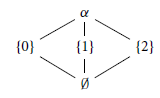
The idea behind ${n \choose k}$
is to view the singleton sets
${n \choose k}$
is to view the singleton sets $\{i\}$
as ‘events’ which can occur along a trace. To achieve activation, k distinct ‘events’ need to take place along a segment. As opposed to
$\{i\}$
as ‘events’ which can occur along a trace. To achieve activation, k distinct ‘events’ need to take place along a segment. As opposed to $\mathbb{B}$
and
$\mathbb{B}$
and $\mathbb{F}$
, we are not yet aware of a cyclic proof system whose trace condition is best expressed in terms of some
$\mathbb{F}$
, we are not yet aware of a cyclic proof system whose trace condition is best expressed in terms of some ${n \choose k}$
(except of course
${n \choose k}$
(except of course ${1 \choose 1}$
which the same as
${1 \choose 1}$
which the same as $\mathbb{B}$
). We conjecture that cyclic proof systems whose trace condition is naturally modelled in some non-trivial
$\mathbb{B}$
). We conjecture that cyclic proof systems whose trace condition is naturally modelled in some non-trivial ${n \choose k}$
would require a kind of fairness condition of their progressing traces.
${n \choose k}$
would require a kind of fairness condition of their progressing traces.
Lemma 3.1. The trace condition in Definition 3.3 is well defined, that is, it fulfils the invariance condition of Definition 3.1.
Proof. It suffices to prove invariance under $\subseteq$
. Let
$\subseteq$
. Let $P \subseteq Q$
with
$P \subseteq Q$
with $P = Q \circ S$
. Suppose P satisfies the trace condition meaning there exists
$P = Q \circ S$
. Suppose P satisfies the trace condition meaning there exists $P' \subseteq P$
with
$P' \subseteq P$
with $P' = P \circ S'$
and a validating sequence
$P' = P \circ S'$
and a validating sequence $\sigma$
. Then,
$\sigma$
. Then, $P' \subseteq Q$
via
$P' \subseteq Q$
via $P' = Q \circ S \circ S'$
, meaning
$P' = Q \circ S \circ S'$
, meaning $\sigma$
is a validating sequence through a subpath of Q as well.
$\sigma$
is a validating sequence through a subpath of Q as well.
For the converse direction, let $P = Q \circ S$
and suppose Q satisfies the trace condition as witnessed by
$P = Q \circ S$
and suppose Q satisfies the trace condition as witnessed by $Q' = Q \circ S'$
and a sequence
$Q' = Q \circ S'$
and a sequence $\sigma \colon \Pi i \in \omega. Q'(i)$
. It remains to show that there is
$\sigma \colon \Pi i \in \omega. Q'(i)$
. It remains to show that there is $P' \subseteq P$
and a suitable sequence
$P' \subseteq P$
and a suitable sequence $\sigma'' : \Pi i \in \omega.P'(i)$
along it. By fixing
$\sigma'' : \Pi i \in \omega.P'(i)$
along it. By fixing $b := S'(0)$
and analysing Definition 3.3, one can conclude there are two sequences
$b := S'(0)$
and analysing Definition 3.3, one can conclude there are two sequences $\sigma' \colon \Pi i \in \omega. Q(b + i)$
and
$\sigma' \colon \Pi i \in \omega. Q(b + i)$
and $a \colon \omega \to \mathcal{A}$
such that
$a \colon \omega \to \mathcal{A}$
such that $\sigma'_i\, Q(b + i < b + i + 1)^{a_i}\,\sigma'_{i + 1}$
with
$\sigma'_i\, Q(b + i < b + i + 1)^{a_i}\,\sigma'_{i + 1}$
with $a_i \leq \alpha$
. For
$a_i \leq \alpha$
. For $i_j := S'(j) - b$
, we then have
$i_j := S'(j) - b$
, we then have $\sigma'_{i_j} = \sigma_j$
and
$\sigma'_{i_j} = \sigma_j$
and $\bigvee_{i = i_j}^{i < i_{j + 1}} a_i = \alpha$
. Now construct the following sequence:
$\bigvee_{i = i_j}^{i < i_{j + 1}} a_i = \alpha$
. Now construct the following sequence:
 \begin{align*} k_0 & \,:= \mathrm{least } i \in \omega \mathrm{ such that } S(i) \geq b \\ k_{n + 1} & \,:= \mathrm{least } i > k_n \mathrm{ s.t. } S(k_n) \leq S'(j) < S'(j + 1) \leq S(i) \mathrm{ for some } j \in \omega \end{align*}
We claim setting $S''(i) := S(k_i)$
induces the desired subpath
$S''(i) := S(k_i)$
induces the desired subpath $P' := Q \circ S'' P$
with
$P' := Q \circ S'' P$
with $P'(i) = P(k_i)$
as witnessed by
$P'(i) = P(k_i)$
as witnessed by $\sigma'' \colon \Pi i \in \omega. P'(i)$
given by
$\sigma'' \colon \Pi i \in \omega. P'(i)$
given by $\sigma''_{i} := \sigma'_{S(k_i)}$
. For this, we need to check that
$\sigma''_{i} := \sigma'_{S(k_i)}$
. For this, we need to check that $\sigma''_{i + 1}\,P'(i < i + 1)^\alpha\,\sigma''_{i + 1}$
. Let
$\sigma''_{i + 1}\,P'(i < i + 1)^\alpha\,\sigma''_{i + 1}$
. Let $j \in \omega$
be such that
$j \in \omega$
be such that $S''(i) \leq S'(j) < S'(j + 1) \leq S''(i + 1)$
. Then,
$S''(i) \leq S'(j) < S'(j + 1) \leq S''(i + 1)$
. Then, $P'(i < i + 1) = Q(b + i_{j + 1} \leq S(k_{i + 1})) \circ Q(b + i_j < b + i_{j + 1}) \circ Q(S(k_i) \leq b + i_j)$
, meaning
$P'(i < i + 1) = Q(b + i_{j + 1} \leq S(k_{i + 1})) \circ Q(b + i_j < b + i_{j + 1}) \circ Q(S(k_i) \leq b + i_j)$
, meaning
 $$\left(\sigma''_i, \underbrace{\bigvee_{l = b + i_{j + 1}}^{l < S(k_{i + 1})} a_{l - b}}_{\leq \alpha} \vee \underbrace{\bigvee_{l = i_j}^{l < i_{j + 1}} a_l}_{= \alpha} \vee \underbrace{\bigvee_{l = S(k_i)}^{l < b + i_{j}} a_{l - b}}_{\leq \alpha}, \underbrace{\sigma'_{k_{i + 1} - b}}_{= \sigma''_{i + 1}}\right) \in P'(i < i + 1)$$
and thus $(\sigma''_i, \alpha, \sigma''_{i + 1}) \in P'(i < i + 1)$
as desired.
$(\sigma''_i, \alpha, \sigma''_{i + 1}) \in P'(i < i + 1)$
as desired.
We now proceed to demonstrate how trace categories can be used to specify the trace conditions and, thereby, the GTCs of cyclic proof systems. Fix a derivation system  and a trace category $\mathcal{T}$
. A trace interpretation
$\mathcal{T}$
. A trace interpretation $\iota : \mathcal{R} \to \mathcal{T}$
consists of a function
$\iota : \mathcal{R} \to \mathcal{T}$
consists of a function  mapping sequents to their trace sets and for each rule $r\in \mathcal{R}$
with
$r\in \mathcal{R}$
with $\rho(r) = (\Gamma, \Delta_1,\ldots, \Delta_n)$
a morphism
$\rho(r) = (\Gamma, \Delta_1,\ldots, \Delta_n)$
a morphism $r_i : \iota(\Gamma) \to \iota(\Delta_i)$
for each
$r_i : \iota(\Gamma) \to \iota(\Delta_i)$
for each $1 \leq i \leq n$
called a trace map. Let
$1 \leq i \leq n$
called a trace map. Let $(C, \lambda, \delta)$
be a pre-proof and
$(C, \lambda, \delta)$
be a pre-proof and $t \in T^\omega$
be a branch through C. Its corresponding path
$t \in T^\omega$
be a branch through C. Its corresponding path $P : \omega \to \mathcal{T}$
is defined as follows:
$P : \omega \to \mathcal{T}$
is defined as follows:
 $$P(i) := \iota(\lambda(\pi_i)) \qquad P(i < i + 1) := \begin{cases} r_j : \iota(\lambda(\pi_i)) \to \iota(\lambda(\pi_{i + 1})) & \pi_i \not\in \mathrm{Leaf}(T) \mathrm{ and } \pi_{i + 1} = \pi j \\ 1_{P(i)} & \pi_i \in \mathrm{dom}(\beta) \end{cases}$$
This induces a cyclic proof system  in which
  contains those $\mathcal{R}$
-pre-proofs for which every induced path
$\mathcal{R}$
-pre-proofs for which every induced path $P : \omega \to \mathcal{T}$
through them satisfies the trace condition of
$P : \omega \to \mathcal{T}$
through them satisfies the trace condition of $\mathcal{T}$
.
$\mathcal{T}$
.
In the following, we demonstrate how to specify the trace condition for the modal $\mu$
-calculus by a trace interpretation
$\mu$
-calculus by a trace interpretation $\iota : \mu \to \mathbb{F}$
.
$\iota : \mu \to \mathbb{F}$
.
Definition 3.4. The trace interpretation $\iota \colon \mu \to \mathcal{T}_\mathbb{F}$
is given by
$\iota \colon \mu \to \mathcal{T}_\mathbb{F}$
is given by  in which
  . For each $r \in \mu$
with
$r \in \mu$
with $\rho(r) = (\Gamma, \Delta_1, \ldots, \Delta_n)$
, the trace maps
$\rho(r) = (\Gamma, \Delta_1, \ldots, \Delta_n)$
, the trace maps $r_i \colon \iota(\Gamma) \to \iota(\Delta)$
are defined by
$r_i \colon \iota(\Gamma) \to \iota(\Delta)$
are defined by $ r_i := \{((\varphi, x), a^*, (\varphi', x)) ~|~ \varphi' \leftarrow_r^i \varphi \} $
where
$ r_i := \{((\varphi, x), a^*, (\varphi', x)) ~|~ \varphi' \leftarrow_r^i \varphi \} $
where $a^*$
is defined by:
$a^*$
is defined by:
 $$ a^* := \begin{cases} 2, & \mathrm{ if }r \mathrm{ instance of } \mu, \varphi = \mu y.\theta, \varphi' = \theta[\mu y.\theta / y] \mathrm{ and } y <_{\varphi} x, \\ 1, & \mathrm{ if } r \mathrm{ instance of } \nu, \varphi = \nu x.\theta, \varphi' = \theta[\nu x. \theta / x], \\ 0, & \mathrm{ otherwise.} \end{cases} $$
Proposition 3.1. The notion of $\mu$
-proofs and that induced by
$\mu$
-proofs and that induced by $\iota : \mu \to \mathbb{F}$
coincide.
$\iota : \mu \to \mathbb{F}$
coincide.
Proof. It suffices to prove that a branch $(\Gamma_i)_{i \in \omega}$
through a
$(\Gamma_i)_{i \in \omega}$
through a $\mu$
-pre-proof has a
$\mu$
-pre-proof has a $\nu$
-trace if and only if its induced path
$\nu$
-trace if and only if its induced path $P \colon \omega \to \mathcal{T}_\mathbb{F}$
satisfies the trace condition of
$P \colon \omega \to \mathcal{T}_\mathbb{F}$
satisfies the trace condition of $\mathcal{T}_\mathbb{F}$
.
$\mathcal{T}_\mathbb{F}$
.
Suppose $(\Gamma_i)_{i \in \omega}$
has a
$(\Gamma_i)_{i \in \omega}$
has a $\nu$
-trace
$\nu$
-trace $(\varphi_i)_{i \in \omega}$
. Then there exists
$(\varphi_i)_{i \in \omega}$
. Then there exists  bounded by a $\nu$
-quantifier and an increasing sequence
$\nu$
-quantifier and an increasing sequence $(j_i)_{i \in \omega}$
such that
$(j_i)_{i \in \omega}$
such that
-
(i) $\varphi_{j_i} = \nu x.\psi$
and
$\varphi_{j_i + 1} = \psi[\varphi_{j_i} / x]$
, and
$\varphi_{j_i} = \nu x.\psi$
and
$\varphi_{j_i + 1} = \psi[\varphi_{j_i} / x]$
, and -
(ii) no formula
$\mu y.\theta$
with
$y <_{\varphi} x$
is unfolded along
$(\varphi_{i})_{i>j_0}$
.


The subpath $P \circ S \subseteq P$
induced by
$P \circ S \subseteq P$
induced by $S(i) := j_{i}$
and the sequence
$S(i) := j_{i}$
and the sequence $\sigma_i := (\varphi_{j_{i}}, x)$
witness that P satisfies the trace condition: clearly always
$\sigma_i := (\varphi_{j_{i}}, x)$
witness that P satisfies the trace condition: clearly always $(\sigma_i, a, \sigma_{i + 1}) \in P(j_{i}, j_{i + 1})$
for some
$(\sigma_i, a, \sigma_{i + 1}) \in P(j_{i}, j_{i + 1})$
for some $a \in \mathbb{F}$
. We know
$a \in \mathbb{F}$
. We know $1 \leq a$
since between
$1 \leq a$
since between $\Gamma_{j_i}$
and
$\Gamma_{j_i}$
and $\Gamma_{j_{i + 1}}$
,
$\Gamma_{j_{i + 1}}$
, $\nu x.\psi$
is unfolded, and further
$\nu x.\psi$
is unfolded, and further $a < 2$
, as no
$a < 2$
, as no $\mu y.\theta$
with
$\mu y.\theta$
with $y <_{\varphi} x$
is unfolded after
$y <_{\varphi} x$
is unfolded after $j_0$
, yielding
$j_0$
, yielding $a = 1$
as desired.
$a = 1$
as desired.
Conversely, suppose P satisfied the trace condition. Then there exist $S \colon \omega \to \omega$
and
$S \colon \omega \to \omega$
and $\sigma \colon \Pi i \in \omega.~P(S(i))$
such that
$\sigma \colon \Pi i \in \omega.~P(S(i))$
such that $(\sigma_{i}, 1, \sigma_{i + 1}) \in P(S(i < i + 1))$
for every
$(\sigma_{i}, 1, \sigma_{i + 1}) \in P(S(i < i + 1))$
for every $i \in \omega$
. Necessarily,
$i \in \omega$
. Necessarily, $\sigma_i = (\varphi_i, x)$
for some fixed
$\sigma_i = (\varphi_i, x)$
for some fixed $\nu$
-variable x and
$\nu$
-variable x and $\varphi_i \in \Gamma_{S(i)}$
. Furthermore, because the activation algebra element along that trace is precisely 1, we can conclude that between
$\varphi_i \in \Gamma_{S(i)}$
. Furthermore, because the activation algebra element along that trace is precisely 1, we can conclude that between $\Gamma_{S(i)}$
and
$\Gamma_{S(i)}$
and $\Gamma_{S(i + 1)}$
:
$\Gamma_{S(i + 1)}$
:
-
(i) the formula
$\nu x.\psi$
corresponding to x in
$\varphi_i$
is unfolded (as
$1 \leq \alpha$
), -
(ii) no
$\mu y.\theta$
with
$y <_{\varphi} x$
is unfolded (as
$\alpha < 2$
).


By scrutinising the derivation rules, it can be deduced that $\varphi_{S(0)}$
can be ‘traced back’ to some
$\varphi_{S(0)}$
can be ‘traced back’ to some $\varphi \in \Gamma_0$
and subsequently completed into a trace
$\varphi \in \Gamma_0$
and subsequently completed into a trace $(\varphi'_i)_{i \in \omega}$
along
$(\varphi'_i)_{i \in \omega}$
along $(\Gamma_i)_{i \in \omega}$
with
$(\Gamma_i)_{i \in \omega}$
with $\varphi'_{S(i)} = \varphi_i$
. By the observations above, this must be a
$\varphi'_{S(i)} = \varphi_i$
. By the observations above, this must be a $\nu$
-trace.
$\nu$
-trace.
Remark 3.2. We have claimed that the trace condition given for the modal $\mu$
-calculus in Section 2 cannot be represented naturally in terms of the activation algebra
$\mu$
-calculus in Section 2 cannot be represented naturally in terms of the activation algebra $\mathbb{B}$
. From the description in Section 2, it is clear that any natural representation of it as
$\mathbb{B}$
. From the description in Section 2, it is clear that any natural representation of it as $\iota : \mu \to \mathcal{T}_\mathbb{B}$
must coincide with the trace interpretation given in Definition 3.4 on trace objects and relations. That is,
$\iota : \mu \to \mathcal{T}_\mathbb{B}$
must coincide with the trace interpretation given in Definition 3.4 on trace objects and relations. That is, $\iota(\Gamma)$
must be the set
$\iota(\Gamma)$
must be the set  (or equivalent) and for a derivation rule with $\rho(r) = (\Gamma, \Delta_1, \ldots, \Delta_n)$
any
$\rho(r) = (\Gamma, \Delta_1, \ldots, \Delta_n)$
any $((\varphi, x), a, (\varphi', y)) \in r_i : \iota(\Gamma) \to \iota(\Delta_i)$
should be such that
$((\varphi, x), a, (\varphi', y)) \in r_i : \iota(\Gamma) \to \iota(\Delta_i)$
should be such that $\varphi' \leftarrow_r^i \varphi$
and
$\varphi' \leftarrow_r^i \varphi$
and $x = y$
. It thus remains to describe how to assign the values a in the triples in
$x = y$
. It thus remains to describe how to assign the values a in the triples in $r_i$
. Clearly, non-unfolding rules should assign
$r_i$
. Clearly, non-unfolding rules should assign $a = 0$
and
$a = 0$
and $\nu$
-unfoldings
$\nu$
-unfoldings $a = 1$
. For
$a = 1$
. For $\mu$
-unfoldings, if such an unfolding occurs infinitely often, the trace should be ‘spoiled’. Neither an assignment of
$\mu$
-unfoldings, if such an unfolding occurs infinitely often, the trace should be ‘spoiled’. Neither an assignment of $a = 0$
nor
$a = 0$
nor $a = 1$
can model this behaviour. The assignment of
$a = 1$
can model this behaviour. The assignment of $a = f$
in Definition 3.4 on the other hand, succinctly takes care of this case.
$a = f$
in Definition 3.4 on the other hand, succinctly takes care of this case.
For further examples of modelling of the trace conditions of cyclic proof systems in trace categories, in particular, those of cyclic arithmetic (Simpson Reference Simpson, Esparza and Murawski2017), $\mathrm{HFL}_\mathbb{N}$
(Kori et al. Reference Kori, Tsukada, Kobayashi, Baier and Goubault-Larrecq2021) and Grzegorczyk modal logic (Savateev and Shamkanov Reference Savateev and Shamkanov2021), we refer the reader to Wehr (Reference Wehr2021).
$\mathrm{HFL}_\mathbb{N}$
(Kori et al. Reference Kori, Tsukada, Kobayashi, Baier and Goubault-Larrecq2021) and Grzegorczyk modal logic (Savateev and Shamkanov Reference Savateev and Shamkanov2021), we refer the reader to Wehr (Reference Wehr2021).
We close this section by stressing that the purpose of activation algebras is to specify trace conditions of cyclic proof systems in a natural manner. Indeed, if naturality is of no concern, the following result shows that the trace category $\mathcal{T}_\mathbb{B}$
, or equivalently the formalism of Brotherston (Reference Brotherston2006), is sufficient to model the majority of trace conditions from the literature, including that of the modal
$\mathcal{T}_\mathbb{B}$
, or equivalently the formalism of Brotherston (Reference Brotherston2006), is sufficient to model the majority of trace conditions from the literature, including that of the modal $\mu$
-calculus.
$\mu$
-calculus.
Concretely, the notion of naturality we allude to here is embodied in the fact that the information of traces may be separated into two parts: the elements of the trace sets signify which objects is being tracked, while the elements of the activation algebra describe how progress of these trace objects is detected. Indeed, Theorem 3.1 is achieved by collapsing this separation. An example of the importance of maintaining this distinction is given by (Leigh and Wehr Reference Leigh and Wehr2023): the article describes how to generate so-called reset proof systems for cyclic proof systems whose trace condition is specified in terms of a trace interpretation into some $\mathcal{A}$
-activated category. One of the examples considered there is the modal
$\mathcal{A}$
-activated category. One of the examples considered there is the modal $\mu$
-calculus. The trace interpretation in terms of
$\mu$
-calculus. The trace interpretation in terms of $\mathbb{F}$
(as in Definition 3.4) leads to a very natural reset system, whereas the reset system induced by the trace interpretation into
$\mathbb{F}$
(as in Definition 3.4) leads to a very natural reset system, whereas the reset system induced by the trace interpretation into $\mathbb{B}$
given by Theorem 3.1 would be highly artificial.
$\mathbb{B}$
given by Theorem 3.1 would be highly artificial.
Theorem 3.1. For any activation algebra $\mathcal{A}$
, there exists a function I mapping objects of
$\mathcal{A}$
, there exists a function I mapping objects of $\mathcal{T}_\mathcal{A}$
to objects of
$\mathcal{T}_\mathcal{A}$
to objects of $\mathcal{T}_\mathbb{B}$
and maps
$\mathcal{T}_\mathbb{B}$
and maps $R : X \to Y$
in
$R : X \to Y$
in $\mathcal{T}_\mathcal{A}$
to maps
$\mathcal{T}_\mathcal{A}$
to maps $I(R) : I(X) \to I(Y)$
in
$I(R) : I(X) \to I(Y)$
in $\mathcal{T}_\mathbb{B}$
. Furthermore, associate to each path
$\mathcal{T}_\mathbb{B}$
. Furthermore, associate to each path $P : \omega \to \mathcal{T}_\mathcal{A}$
a path
$P : \omega \to \mathcal{T}_\mathcal{A}$
a path $\hat{P} : \omega \to \mathcal{T}_\mathbb{B}$
given by
$\hat{P} : \omega \to \mathcal{T}_\mathbb{B}$
given by $\hat{P}(i) := I(P(i))$
and
$\hat{P}(i) := I(P(i))$
and $\hat{P}(i < i + 1) := I(P(i < i + 1))$
. Then P satisfies the trace condition iff
$\hat{P}(i < i + 1) := I(P(i < i + 1))$
. Then P satisfies the trace condition iff $\hat{P}$
does.
$\hat{P}$
does.
Proof. Writing $\mathcal{A} = (A, \leq, \vee, 0, \alpha)$
, take
$\mathcal{A} = (A, \leq, \vee, 0, \alpha)$
, take $I(X) := X \times A$
and, for
$I(X) := X \times A$
and, for $R : X \to Y$
,
$R : X \to Y$
,
 $$ I(R) :=~ \{((x, a), \bot, (y, a \vee b)) ~|~ a \in A, x R^b y\} \cup~ \{((x, a), \top, (y, 0)) ~|~ a \in A, x R^b y, a \vee b = \alpha\} $$
Suppose that P satisfied the trace condition. That means there is a subpath $P \circ S$
and a sequence
$P \circ S$
and a sequence $\sigma : \Pi i \in \omega. P(S(i))$
such that
$\sigma : \Pi i \in \omega. P(S(i))$
such that $\sigma_{i} P(S(i))^\alpha \sigma_{i + 1}$
. We claim that
$\sigma_{i} P(S(i))^\alpha \sigma_{i + 1}$
. We claim that $\hat{P} \circ S$
is the witnessing subpath of P with the sequence
$\hat{P} \circ S$
is the witnessing subpath of P with the sequence $\hat{\sigma} : \Pi i \in \omega. \hat{P}(S(i))$
given by
$\hat{\sigma} : \Pi i \in \omega. \hat{P}(S(i))$
given by $\hat{\sigma_i} := (\sigma_i, 0)$
. We prove that
$\hat{\sigma_i} := (\sigma_i, 0)$
. We prove that $\hat{\sigma}_{i} \hat{P}(S(i < i + 1))^{\top} \hat{\sigma}_{i + 1}$
: There must be
$\hat{\sigma}_{i} \hat{P}(S(i < i + 1))^{\top} \hat{\sigma}_{i + 1}$
: There must be $\sigma_i = x_0, ..., x_n = \sigma_{i + 1}$
and
$\sigma_i = x_0, ..., x_n = \sigma_{i + 1}$
and $a_0, ..., a_{n - 1}$
for
$a_0, ..., a_{n - 1}$
for $n := S(i + 1) - S(i)$
and
$n := S(i + 1) - S(i)$
and $b := S(i)$
such that
$b := S(i)$
such that $x_j P(b + j)^{a_j} x_{j + 1}$
and
$x_j P(b + j)^{a_j} x_{j + 1}$
and $\alpha = \bigvee_{j < n} a_j$
. Then define
$\alpha = \bigvee_{j < n} a_j$
. Then define $\hat{x}_j := (x_j, \bigvee_{k < j - 1}a_k)$
and observe that
$\hat{x}_j := (x_j, \bigvee_{k < j - 1}a_k)$
and observe that $\hat{\sigma}_i = \hat{x}_0 \hat{P}(b)^{\bot} \hat{x}_1 \hat{P}(b + 1)^{\bot} ... \hat{x}_{n - 1} \hat{P}(b + n - 1)^{\top} (x_n, 0) = \hat{\sigma}_{i + 1}$
because
$\hat{\sigma}_i = \hat{x}_0 \hat{P}(b)^{\bot} \hat{x}_1 \hat{P}(b + 1)^{\bot} ... \hat{x}_{n - 1} \hat{P}(b + n - 1)^{\top} (x_n, 0) = \hat{\sigma}_{i + 1}$
because $\hat{x}_{n-1} = (x_{n-1}, \bigvee_{k < n - 2} a_k)$
and
$\hat{x}_{n-1} = (x_{n-1}, \bigvee_{k < n - 2} a_k)$
and $(\bigvee_{k < n - 2} a_k) \vee a_{n - 1} = \alpha$
.
$(\bigvee_{k < n - 2} a_k) \vee a_{n - 1} = \alpha$
.
Conversely, suppose that $\hat{P}$
satisfied the trace condition. Then there is a subpath
$\hat{P}$
satisfied the trace condition. Then there is a subpath $\hat{P} \circ S$
and a sequence
$\hat{P} \circ S$
and a sequence $\hat{\sigma} : \Pi i \in \omega. \hat{P}(S(i))$
such that
$\hat{\sigma} : \Pi i \in \omega. \hat{P}(S(i))$
such that $\hat{\sigma}_i \hat{P}(S(i < i + 1))^{\top} \hat{\sigma}_{i + 1}$
. There must be
$\hat{\sigma}_i \hat{P}(S(i < i + 1))^{\top} \hat{\sigma}_{i + 1}$
. There must be $\sigma_i = (x_0, a_0), ..., (x_n, a_n) = \sigma_{i + 1}$
and
$\sigma_i = (x_0, a_0), ..., (x_n, a_n) = \sigma_{i + 1}$
and $b_0, ..., b_{n - 1} \in \mathbb{B}$
for
$b_0, ..., b_{n - 1} \in \mathbb{B}$
for $n := S(i + 1) - S(i)$
and
$n := S(i + 1) - S(i)$
and $k := S(i)$
such that
$k := S(i)$
such that $(x_j, a_j) \hat{P}(k + j)^{b_j} (x_{j + 1}, a_{j + 1})$
and
$(x_j, a_j) \hat{P}(k + j)^{b_j} (x_{j + 1}, a_{j + 1})$
and $\top = \bigvee_{j < n} b_j$
. Per construction, the latter means there is some
$\top = \bigvee_{j < n} b_j$
. Per construction, the latter means there is some $J < n$
such that
$J < n$
such that $(x_J, a_J) \hat{P}(k + J)^\top (x_{J + 1}, 0)$
. Consider analogous
$(x_J, a_J) \hat{P}(k + J)^\top (x_{J + 1}, 0)$
. Consider analogous $\sigma_{i + 1} = (x'_0, a'_0), \ldots, (x'_m, a'_m) = \sigma_{i + 2} $
and
$\sigma_{i + 1} = (x'_0, a'_0), \ldots, (x'_m, a'_m) = \sigma_{i + 2} $
and $b'_0, ..., b'_{m - 1} \in \mathbb{B}$
such that
$b'_0, ..., b'_{m - 1} \in \mathbb{B}$
such that $(x'_j, a'_j) \hat{P}(k' + j)^{b'_j} (x'_{j + 1}, a'_{j + 1})$
with
$(x'_j, a'_j) \hat{P}(k' + j)^{b'_j} (x'_{j + 1}, a'_{j + 1})$
with $k' := S(i + 1)$
, yielding an analogous J’ such that
$k' := S(i + 1)$
, yielding an analogous J’ such that $(x'_{J'}, a'_{J'}) \hat{P}(k + J')^\top (x_{{J'} + 1}, 0)$
. Intuitively, this means that the
$(x'_{J'}, a'_{J'}) \hat{P}(k + J')^\top (x_{{J'} + 1}, 0)$
. Intuitively, this means that the $a_j$
and
$a_j$
and $a'_j$
between
$a'_j$
between $(x_{J + 1}, 0)$
and
$(x_{J + 1}, 0)$
and $(x'_{J' + 1}, 0)$
‘accumulate’ activation algebra elements up to
$(x'_{J' + 1}, 0)$
‘accumulate’ activation algebra elements up to $\alpha$
. That is, there must be
$\alpha$
. That is, there must be $c_0, \ldots, c_{l - 1} \in A$
with
$c_0, \ldots, c_{l - 1} \in A$
with $l := n - (J + 1) + (J' + 1)$
such that
$l := n - (J + 1) + (J' + 1)$
such that $\alpha = \bigvee_{j < l} c_j$
and
$\alpha = \bigvee_{j < l} c_j$
and $x_{J + 1} P(k + J + 1 < k + J + 2)^{c_0} \ldots P(k + n - 1 < k + n)^{c_{n - J - 1}} x_n = x'_0 P(k' < k' + 1)^{c_{n - J}} \ldots P(k' \!+ J' < k' + J'\!+ 1)^{c_{l-1}} x'_{J' \!+ 1}$
. In other words,
$x_{J + 1} P(k + J + 1 < k + J + 2)^{c_0} \ldots P(k + n - 1 < k + n)^{c_{n - J - 1}} x_n = x'_0 P(k' < k' + 1)^{c_{n - J}} \ldots P(k' \!+ J' < k' + J'\!+ 1)^{c_{l-1}} x'_{J' \!+ 1}$
. In other words, $x_{J + 1} P(k + J + 1 < k' + J' + 1)^\alpha x'_{J' + 1}$
, which can be extended to
$x_{J + 1} P(k + J + 1 < k' + J' + 1)^\alpha x'_{J' + 1}$
, which can be extended to $x_0 P(k < k' + m)^\alpha x'_m$
by observing that necessarily
$x_0 P(k < k' + m)^\alpha x'_m$
by observing that necessarily $a_j < \alpha$
and
$a_j < \alpha$
and $a'_j < \alpha$
for all
$a'_j < \alpha$
for all $j < n$
and
$j < n$
and $j < m$
, respectively, for the original trace along
$j < m$
, respectively, for the original trace along $\hat{P}$
to be successful. Based on this observation, we may conclude that the subpath
$\hat{P}$
to be successful. Based on this observation, we may conclude that the subpath $P \circ S'$
of P with
$P \circ S'$
of P with $S'(i) = S(2i)$
satisfies the trace condition for the sequence
$S'(i) = S(2i)$
satisfies the trace condition for the sequence $\sigma' : \Pi i \in \omega. P(S'(i))$
with
$\sigma' : \Pi i \in \omega. P(S'(i))$
with $\sigma'_i := \pi_1(\sigma_{2i})$
, that is,
$\sigma'_i := \pi_1(\sigma_{2i})$
, that is, $\pi_1(\sigma_{2i}) P(S(2i < 2i + 2))^\alpha \pi_1(\sigma_{2i + 2})$
as demonstrated above.
$\pi_1(\sigma_{2i}) P(S(2i < 2i + 2))^\alpha \pi_1(\sigma_{2i + 2})$
as demonstrated above.
Remark 3.3. The statement of Theorem 3.1 is given in terms of functions, rather than functors. This is so because the resulting functions fail to be functors on both accounts: preserving identities and distributing over composition. The failure of identity preservation is easily observed. Notice that any $I(1_X)$
will contain triples of the form
$I(1_X)$
will contain triples of the form $((x, \alpha), \top, (x, 0))$
which the identities of
$((x, \alpha), \top, (x, 0))$
which the identities of $\mathcal{T}_\mathbb{B}$
do not contain. This issue could be alleviated by taking the definition to be
$\mathcal{T}_\mathbb{B}$
do not contain. This issue could be alleviated by taking the definition to be
 \begin{align*} I(R) :=~ & \{((x, a), \bot, (y, a \vee b)) ~|~ a \in A, x R^b y\} \\ \cup~ & \{((x, a), \top, (y, 0)) ~|~ a \in A \setminus \{\alpha\}, x R^b y, a \vee b = \alpha\} \end{align*}
instead, that is, explicitly excluding that kind of transition. However, as this still does not resolve the distributivity over composition, we chose to forgo this in favour of a simpler definition and proof.
The failure of distributivity over composition is a bit more subtle. For this, suppose there were $a < b < c < \alpha \in A$
such that
$a < b < c < \alpha \in A$
such that $a \vee b = \alpha$
and consider
$a \vee b = \alpha$
and consider $R := \{(\star, b, \star)\} $
and
$R := \{(\star, b, \star)\} $
and $ R' := \{(\star, c, \star)\}$
. Then clearly,
$ R' := \{(\star, c, \star)\}$
. Then clearly, $(\star, a) \, I(R)^{\top}\, (\star, 0)\, I(R')^{\bot}\, (\star, c)$
. However, as
$(\star, a) \, I(R)^{\top}\, (\star, 0)\, I(R')^{\bot}\, (\star, c)$
. However, as $R' \circ R = \{(\star, b \vee c, \star)\}$
, the only two transitions possible via
$R' \circ R = \{(\star, b \vee c, \star)\}$
, the only two transitions possible via $I(R' \circ R)$
are
$I(R' \circ R)$
are $(\star, a)\, I(R' \circ R)^{\bot}\, (\star, \alpha)$
and
$(\star, a)\, I(R' \circ R)^{\bot}\, (\star, \alpha)$
and $(\star, a)\, I(R' \circ R)^{\top}\, (\star, 0)$
. Thus,
$(\star, a)\, I(R' \circ R)^{\top}\, (\star, 0)$
. Thus, $I(R') \circ I(R) \neq I(R'\circ R)$
.
$I(R') \circ I(R) \neq I(R'\circ R)$
.
4. Abstract Cyclic Derivations
This section combines the abstract notions of branches, traces and the trace condition into an abstract presentation of cyclic derivations. Abstract cyclic derivations (ACDs) are pairs $(C, \mathrm{Tr})$
of cyclic trees C and maps Tr which ‘decorate’ the edges of C with maps of a trace category. Such an ACD is considered to be a proof if all paths which can be generated by traversing C satisfy the trace condition imposed by the trace category. To express these ideas in a category theoretical manner, we begin by giving a categorical representation of cyclic trees, by defining the (semi-)category induced by the finite paths through these trees.
$(C, \mathrm{Tr})$
of cyclic trees C and maps Tr which ‘decorate’ the edges of C with maps of a trace category. Such an ACD is considered to be a proof if all paths which can be generated by traversing C satisfy the trace condition imposed by the trace category. To express these ideas in a category theoretical manner, we begin by giving a categorical representation of cyclic trees, by defining the (semi-)category induced by the finite paths through these trees.
Fix a cyclic tree $C = (T, \beta)$
. The finite paths from s to t, denoted by
$C = (T, \beta)$
. The finite paths from s to t, denoted by $\mathrm{Path}_C(s, t) \subseteq T^+$
, are defined as the smallest sets satisfying the following three conditions:
$\mathrm{Path}_C(s, t) \subseteq T^+$
, are defined as the smallest sets satisfying the following three conditions:
-
(1) For any
$s \in T$
, we have
$s \in \mathrm{Path}_C(s, s)$
, -
(2) For any
$t, u \in T$
with u child of t, if
$p \in \mathrm{Path}_C(s, t)$
then
$pu \in \mathrm{Path}_C(s, u)$
, -
(3) For any
$t \in \mathrm{dom}(\beta)$
, if
$p \in \mathrm{Path}_C(s, t)$
then
$p\beta(t) \in \mathrm{Path}_C(s, \beta(t))$
.


The category $\mathcal{P}_C$
of paths through
$\mathcal{P}_C$
of paths through $C = (T, \beta)$
has the nodes of T as its objects and fixes
$C = (T, \beta)$
has the nodes of T as its objects and fixes  . The identities are $1_s = s \colon s \to s$
and, given morphisms
$1_s = s \colon s \to s$
and, given morphisms $p \colon s \to t$
and
$p \colon s \to t$
and $q \colon t \to u$
, we define
$q \colon t \to u$
, we define $q \circ p = pq'$
where
$q \circ p = pq'$
where $q = tq'$
for
$q = tq'$
for $q' \in T^*$
. The semi-category
$q' \in T^*$
. The semi-category $\mathcal{P}^S_C$
of progressing paths is the same as
$\mathcal{P}^S_C$
of progressing paths is the same as $\mathcal{P}_C$
except that
$\mathcal{P}_C$
except that  .
.
The informal notion of ‘decorating a cyclic tree with trace information’ can thus be expressed as a functor.
Definition 4.1. An abstract cyclic derivation over a trace category $\mathcal{T}$
is a pair
$\mathcal{T}$
is a pair $(C, \mathrm{Tr})$
consisting of a cyclic tree
$(C, \mathrm{Tr})$
consisting of a cyclic tree $C = (T, \beta)$
and a functor
$C = (T, \beta)$
and a functor $\mathrm{Tr} \colon \mathcal{P}_C \to \mathcal{T}$
such that for any
$\mathrm{Tr} \colon \mathcal{P}_C \to \mathcal{T}$
such that for any $s \in \mathrm{dom}(\beta)$
,
$s \in \mathrm{dom}(\beta)$
, $\mathrm{Tr}(s) = \mathrm{Tr}(\beta(s))$
and
$\mathrm{Tr}(s) = \mathrm{Tr}(\beta(s))$
and $\mathrm{Tr}(s\beta(s)) = 1_{\mathrm{Tr}(s)}$
.
$\mathrm{Tr}(s\beta(s)) = 1_{\mathrm{Tr}(s)}$
.
We delineate the abstract cyclic proofs from mere ACDs via a GTC.
Definition 4.2. Let D be an ACD given by $(C, \mathrm{Tr} \colon \mathcal{P}_C \to \mathcal{T})$
. A path through D is a path
$(C, \mathrm{Tr} \colon \mathcal{P}_C \to \mathcal{T})$
. A path through D is a path $P : \omega \to \mathcal{T}$
such that there exists a semi-functor
$P : \omega \to \mathcal{T}$
such that there exists a semi-functor $P' \colon \omega \to \mathcal{P}^S_C$
with
$P' \colon \omega \to \mathcal{P}^S_C$
with $P = \mathrm{Tr} \circ P'$
. D satisfies the GTC if every path through D satisfies the trace condition of
$P = \mathrm{Tr} \circ P'$
. D satisfies the GTC if every path through D satisfies the trace condition of $\mathcal{T}$
. We call an ACD satisfying the GTC an abstract cyclic proof.
$\mathcal{T}$
. We call an ACD satisfying the GTC an abstract cyclic proof.
Requiring P’ to be a semi-functor in the definition above rules out constant ‘paths’ obtained via $P(i) := \mathrm{Tr}(s), P(i < i + 1):= 1_{\mathrm{Tr}(s)}$
which are not generated by traversing the ACD along any branch of the cyclic tree.
$P(i) := \mathrm{Tr}(s), P(i < i + 1):= 1_{\mathrm{Tr}(s)}$
which are not generated by traversing the ACD along any branch of the cyclic tree.
As ACDs serve as an abstract representation of pre-proofs, each pre-proof naturally induces an ACD.
Definition 4.3. Let  be a cyclic proof system whose soundness condition is induced by a trace interpretation $\iota : \mathcal{R} \to \mathcal{T}$
. Any pre-proof
$\iota : \mathcal{R} \to \mathcal{T}$
. Any pre-proof $(C, \lambda, \delta)$
induces an abstract cyclic derivation
$(C, \lambda, \delta)$
induces an abstract cyclic derivation $(C, \mathrm{Tr})$
with
$(C, \mathrm{Tr})$
with
 \begin{align*} \mathrm{Tr}(s) := \iota(\lambda(s)) \qquad \quad \mathrm{Tr}(s < si) := r_i : \iota(\lambda(s)) \to \iota(\lambda(si)) \mathrm{ where } r = \delta(s)\end{align*}
Example 4.1. Consider the $\mu$
-pre-proof and its corresponding ACD depicted in Fig. 3. For the sake of readability, we have opted to write the carrier sets of the ACD as simple sets of variables x, y, etc., instead of sets of pairs
$\mu$
-pre-proof and its corresponding ACD depicted in Fig. 3. For the sake of readability, we have opted to write the carrier sets of the ACD as simple sets of variables x, y, etc., instead of sets of pairs $(\varphi, x), (\psi, y)$
, etc., since each variable occurs in only one of the formulas in the sequent. Fully specified, the first set should be
$(\varphi, x), (\psi, y)$
, etc., since each variable occurs in only one of the formulas in the sequent. Fully specified, the first set should be $\{(\nu x.x, x), (\mu y.\nu z.y, z)\}$
. The annotated morphisms are
$\{(\nu x.x, x), (\mu y.\nu z.y, z)\}$
. The annotated morphisms are $1 := \{(x, 0, x), (z, 0, z)\}$
,
$1 := \{(x, 0, x), (z, 0, z)\}$
, $ R_x := \{(x, 1, x), (z, 0, z)\}$
,
$ R_x := \{(x, 1, x), (z, 0, z)\}$
, $R_y := \{(x, 0, x), (z, 2, z)\}$
and
$R_y := \{(x, 0, x), (z, 2, z)\}$
and $R_z := \{(x, 0, x), (z, 1, z)\}$
.
$R_z := \{(x, 0, x), (z, 1, z)\}$
.
A $\mu$
-proof and its corresponding ACD, discussed in Example 4.1.
$\mu$
-proof and its corresponding ACD, discussed in Example 4.1.

Note that $(z, 2, z) \in R_y$
as
$(z, 2, z) \in R_y$
as $y <_\varphi z$
with
$y <_\varphi z$
with $\varphi := \mu y.\nu z.y$
. The
$\varphi := \mu y.\nu z.y$
. The $\mu$
-pre-proof above has only one branch
$\mu$
-pre-proof above has only one branch $\Gamma$
which has one
$\Gamma$
which has one $\nu$
-trace (that on x) and is thus a proof. Similarly, its corresponding path
$\nu$
-trace (that on x) and is thus a proof. Similarly, its corresponding path $\hat{\Gamma} : \omega \to \mathcal{T}_\mathbb{F}$
is a path through the ACD and satisfies the trace condition with
$\hat{\Gamma} : \omega \to \mathcal{T}_\mathbb{F}$
is a path through the ACD and satisfies the trace condition with $S(i) := 5i$
and
$S(i) := 5i$
and $\sigma := i \mapsto x$
. In principle, verifying that the ACD is a proof would require checking infinitely many other paths P. This is because paths through ACDs need not start at their root and a step
$\sigma := i \mapsto x$
. In principle, verifying that the ACD is a proof would require checking infinitely many other paths P. This is because paths through ACDs need not start at their root and a step $P(i < i + 1)$
may correspond to a path segment
$P(i < i + 1)$
may correspond to a path segment $p \in \mathrm{Path}_C(s, t)$
with
$p \in \mathrm{Path}_C(s, t)$
with $\left|p\right| > 2$
. However, as all such paths are subpaths of
$\left|p\right| > 2$
. However, as all such paths are subpaths of $\hat{\Gamma}$
, they satisfy the trace condition by subpath invariance. Indeed, this observation extends to arbitrary ACDs obtained by transforming concrete cyclic derivations: any path through an ACD is always a subpath of
$\hat{\Gamma}$
, they satisfy the trace condition by subpath invariance. Indeed, this observation extends to arbitrary ACDs obtained by transforming concrete cyclic derivations: any path through an ACD is always a subpath of $\hat{\Gamma}$
for some branch
$\hat{\Gamma}$
for some branch $\Gamma$
through the corresponding concrete cyclic derivation. This means that the GTC in Definition 4.2, although it may have seemed stricter than needed, corresponds precisely to that of concrete cyclic proof systems.
$\Gamma$
through the corresponding concrete cyclic derivation. This means that the GTC in Definition 4.2, although it may have seemed stricter than needed, corresponds precisely to that of concrete cyclic proof systems.
We close this section by showing that, via composition of trace maps, ACDs can be transformed into equivalent ACDs whose number of nodes $\left|T\right|$
is linear in their number of cyclic edges
$\left|T\right|$
is linear in their number of cyclic edges $\left|\beta\right|$
. For ACDs generated from concrete cyclic derivations, as defined in Definition 4.3, this will usually result in a drastic reduction of
$\left|\beta\right|$
. For ACDs generated from concrete cyclic derivations, as defined in Definition 4.3, this will usually result in a drastic reduction of $\left|T\right|$
. The procedure can be viewed as a sort of ‘compression algorithm’ which could prove useful for implementing programs, such as proof checking (cf. Theorem 5.3), that have
$\left|T\right|$
. The procedure can be viewed as a sort of ‘compression algorithm’ which could prove useful for implementing programs, such as proof checking (cf. Theorem 5.3), that have $\left|T\right|$
as one of their complexity parameters. Indeed, it seems the automated theorem prover CYCLIST already relies on a similar optimisation (see Brotherston et al. Reference Brotherston, Gorogiannis, Petersen, Jhala and Igarashi2012, Section 4.2) though we are not aware of a formal characterisation of this optimisation in the literature. An example illustrating the procedure is given in Figure 4.
$\left|T\right|$
as one of their complexity parameters. Indeed, it seems the automated theorem prover CYCLIST already relies on a similar optimisation (see Brotherston et al. Reference Brotherston, Gorogiannis, Petersen, Jhala and Igarashi2012, Section 4.2) though we are not aware of a formal characterisation of this optimisation in the literature. An example illustrating the procedure is given in Figure 4.
Compressing an ACD via the procedure outlined in the proof of Theorem 4.1.

Theorem 4.1. Any $D = ((T, \beta), \mathrm{Tr})$
can be transformed into
$D = ((T, \beta), \mathrm{Tr})$
can be transformed into $D' = ((T', \beta'), \mathrm{Tr}')$
such that D’ is a proof if and only if D is a proof and
$D' = ((T', \beta'), \mathrm{Tr}')$
such that D’ is a proof if and only if D is a proof and $\left|T'\right| \leq 2 \left|\beta\right| + 1$
.
$\left|T'\right| \leq 2 \left|\beta\right| + 1$
.
Proof. Fix $B := \mathrm{im}(\beta) \cup \mathrm{dom}(\beta) \cup \{\varepsilon ~|~ \nexists s \in \mathrm{im}(\beta).\forall t \in \mathrm{im}(\beta) \cup \mathrm{dom}(\beta).~s \leq t\}$
, where
$B := \mathrm{im}(\beta) \cup \mathrm{dom}(\beta) \cup \{\varepsilon ~|~ \nexists s \in \mathrm{im}(\beta).\forall t \in \mathrm{im}(\beta) \cup \mathrm{dom}(\beta).~s \leq t\}$
, where $s <t$
if t is a proper prefix of s. We now construct a sequence of partial maps
$s <t$
if t is a proper prefix of s. We now construct a sequence of partial maps $(f_i \colon B \to \omega^*)_i$
. Fix
$(f_i \colon B \to \omega^*)_i$
. Fix $f_0(s) := \varepsilon$
where s is the
$f_0(s) := \varepsilon$
where s is the $<$
-least element of B. To construct
$<$
-least element of B. To construct $f_{n + 1}$
consider each
$f_{n + 1}$
consider each $s \in \mathrm{dom}(f_n)$
, that is, every
$s \in \mathrm{dom}(f_n)$
, that is, every $s \in B$
which was added by the previous construction step. For each such s, let
$s \in B$
which was added by the previous construction step. For each such s, let $\{t_0, \ldots, t_n\} \subseteq B$
be all
$\{t_0, \ldots, t_n\} \subseteq B$
be all $t \in B$
such that s can reach t without crossing any other node from B (formally, if there is
$t \in B$
such that s can reach t without crossing any other node from B (formally, if there is $spt \in \mathrm{Path}_C(s, t)$
with
$spt \in \mathrm{Path}_C(s, t)$
with $p \in (T \setminus B)^*$
) and set
$p \in (T \setminus B)^*$
) and set $f_{n + 1}(t_i) := f_n(s)i$
. Fixing
$f_{n + 1}(t_i) := f_n(s)i$
. Fixing $f := \bigcup_{n \leq \left|B\right|}f_n$
and
$f := \bigcup_{n \leq \left|B\right|}f_n$
and $T' := \mathrm{im}(f)$
, observe that
$T' := \mathrm{im}(f)$
, observe that $f \colon B \to T'$
is a
$f \colon B \to T'$
is a $<$
-isomorphism between B and T’. Thus
$<$
-isomorphism between B and T’. Thus $C' := (T', \beta' := f \circ \beta \circ f^{-1})$
is a cyclic tree with
$C' := (T', \beta' := f \circ \beta \circ f^{-1})$
is a cyclic tree with $\beta'(x) = y$
iff
$\beta'(x) = y$
iff $\beta(f^{-1}(x)) = f^{-1}(y)$
. Also, clearly
$\beta(f^{-1}(x)) = f^{-1}(y)$
. Also, clearly $\left|T'\right| = \left|B\right| \leq 2 \left|\beta\right| + 1$
.
$\left|T'\right| = \left|B\right| \leq 2 \left|\beta\right| + 1$
.
To extend C’ to an ACD D’, take $\mathrm{Tr}'(s) := \mathrm{Tr}(f^{-1}(s))$
for
$\mathrm{Tr}'(s) := \mathrm{Tr}(f^{-1}(s))$
for $s \in T'$
. For any
$s \in T'$
. For any $s < t \in T'$
, observe that per construction of T’, there exists a unique path
$s < t \in T'$
, observe that per construction of T’, there exists a unique path $f^{-1}(s)p_{st}f^{-1}(t) \in \mathrm{Path}_C(f^{-1}(s), f^{-1}(t))$
with the property that
$f^{-1}(s)p_{st}f^{-1}(t) \in \mathrm{Path}_C(f^{-1}(s), f^{-1}(t))$
with the property that $p_{st} \in (T \setminus B)^*$
. Pick
$p_{st} \in (T \setminus B)^*$
. Pick $\mathrm{Tr}'(st) := \mathrm{Tr}(f^{-1}(s)p_{st}f^{-1}(t))$
and note that this is both well defined and fully specifies
$\mathrm{Tr}'(st) := \mathrm{Tr}(f^{-1}(s)p_{st}f^{-1}(t))$
and note that this is both well defined and fully specifies $\mathrm{Tr}' \colon \mathcal{P}_{C'} \to \mathcal{T}$
. The claim now follows from the following fact, which is easily verified: for any path P through D, there exists a path
$\mathrm{Tr}' \colon \mathcal{P}_{C'} \to \mathcal{T}$
. The claim now follows from the following fact, which is easily verified: for any path P through D, there exists a path $P' \sim P$
through D’ and vice versa.
$P' \sim P$
through D’ and vice versa.
5. A Ramsey-based Soundness Condition
This section presents a soundness condition on pre-proofs which is equivalent to the common global trace condition. It is similar to the condition put forward by Lee et al. (Reference Lee, Jones and Ben-Amram2001) for the purpose of program termination based on the size-change principle, a condition analogous to the trace conditions of cyclic proof systems such those put forward in Sprenger and Dam (Reference Sprenger and Dam2003) and Simpson (Reference Simpson, Esparza and Murawski2017). The correctness proof of the soundness condition relies on Ramsey’s (1930) theorem, rather than the automata-theoretic methods prevalent in cyclic proof theory. We employ the notation $[A]^n := \{X \subseteq A ~|~ \left|X\right| = n\}$
.
$[A]^n := \{X \subseteq A ~|~ \left|X\right| = n\}$
.
Theorem 5.1. Ramsey’s theorem. Let A be a countable set, C finite and $n \in \omega$
. For any colouring
$n \in \omega$
. For any colouring $f \colon [A]^n \to C$
, there exists a colour
$f \colon [A]^n \to C$
, there exists a colour $c \in C$
and a countable
$c \in C$
and a countable $B \subseteq A$
such that
$B \subseteq A$
such that $f(X) = c$
for any
$f(X) = c$
for any $X \in [B]^n$
.
$X \in [B]^n$
.
The central insight motivating the soundness condition is that the Ramsey theorem guarantees the existence of certain well-behaved subpaths of paths through  -finite categories. For every $R \colon X \to X$
in a category
$R \colon X \to X$
in a category $\mathcal{T}$
, the periodic R path is
$\mathcal{T}$
, the periodic R path is $R^\omega \colon \omega \to \mathcal{T}$
with by
$R^\omega \colon \omega \to \mathcal{T}$
with by $R^\omega(i) := X$
and
$R^\omega(i) := X$
and $R^\omega(i < i + 1) := R$
. A morphism
$R^\omega(i < i + 1) := R$
. A morphism $R \colon X \to X$
is idempotent if
$R \colon X \to X$
is idempotent if $R = R \circ R$
.
$R = R \circ R$
.
Lemma 5.1. Let $P \colon \omega \to \mathcal{T}$
be a path and
$P \colon \omega \to \mathcal{T}$
be a path and $X \in \mathrm{Ob}(\mathcal{T})$
such that
$X \in \mathrm{Ob}(\mathcal{T})$
such that $P(i) = X$
infinitely often. If
$P(i) = X$
infinitely often. If  is finite, then $R^\omega \subseteq P$
for some idempotent
$R^\omega \subseteq P$
for some idempotent $R \colon X \to X$
.
$R \colon X \to X$
.
Proof. $P(i) = X$
holding infinitely often means there exists
$P(i) = X$
holding infinitely often means there exists $Q \subseteq P$
such that
$Q \subseteq P$
such that $Q(i) = X$
for all
$Q(i) = X$
for all $i \in \omega$
. Then
$i \in \omega$
. Then $Q(\{i, j\}) := Q(i < j)$
induces a colouring
$Q(\{i, j\}) := Q(i < j)$
induces a colouring  on
on $\omega$
. By the Ramsey theorem, there exists
$\omega$
. By the Ramsey theorem, there exists  and an infinite $M \subseteq \omega$
such that
$M \subseteq \omega$
such that $Q(i < j) = R$
for
$Q(i < j) = R$
for $i < j \in M$
. Then,
$i < j \in M$
. Then, $R^\omega = Q \circ S$
where
$R^\omega = Q \circ S$
where $S(i) := \mathrm{ the } i\mathrm{th least } m \in M$
. The idempotence of R follows as
$S(i) := \mathrm{ the } i\mathrm{th least } m \in M$
. The idempotence of R follows as $R = Q(S(0 < 2)) = Q(S(1 < 2)) \circ Q(S(0 < 1)) = R \circ R$
.
$R = Q(S(0 < 2)) = Q(S(1 < 2)) \circ Q(S(0 < 1)) = R \circ R$
.
Similarly to Definition 4.2, we limit our attention to the image of the trace functor $\widehat{\mathrm{T}}\mathrm{r} \colon \mathcal{P}^S_C \to \mathcal{T}$
restricted to the category of progressing paths. Fixing some ACD
$\widehat{\mathrm{T}}\mathrm{r} \colon \mathcal{P}^S_C \to \mathcal{T}$
restricted to the category of progressing paths. Fixing some ACD $(C, \mathrm{Tr}),$
we thus write
$(C, \mathrm{Tr}),$
we thus write  for
for  , that is, the set of all trace maps that can be generated by walking along some path $p \in \mathrm{Path}_C(s, t)$
with
$p \in \mathrm{Path}_C(s, t)$
with $\left|p\right| >1$
.
$\left|p\right| >1$
.
Definition 5.1. Let $(C, \mathrm{Tr})$
be an ACD such that for every
$(C, \mathrm{Tr})$
be an ACD such that for every $u \in \mathrm{dom}(\beta)$
,
$u \in \mathrm{dom}(\beta)$
,  is finite. Then it satisfies the Ramsey trace condition if for every $u \in \mathrm{dom}(\beta)$
and every idempotent
$u \in \mathrm{dom}(\beta)$
and every idempotent  , the path $R^\omega \colon \omega \to \mathcal{T}$
satisfies the trace condition.
$R^\omega \colon \omega \to \mathcal{T}$
satisfies the trace condition.
Theorem 5.2. Let $(C, \mathrm{Tr})$
be an ACD such that for every
$(C, \mathrm{Tr})$
be an ACD such that for every $u \in \mathrm{dom}(\beta)$
,
$u \in \mathrm{dom}(\beta)$
,  is finite. Then it satisfies the GTC if and only if it satisfies the Ramsey trace condition.
Proof. First, suppose D satisfies the GTC. Then pick $u \in \mathrm{dom}(\beta)$
and
$u \in \mathrm{dom}(\beta)$
and  . As R is in the image of $\hat{\mathrm{Tr}}$
, we know that there exists some
$\hat{\mathrm{Tr}}$
, we know that there exists some $p \in \mathrm{Path}_C(u, u)$
with
$p \in \mathrm{Path}_C(u, u)$
with $\left|p\right| > 1$
and
$\left|p\right| > 1$
and $\mathrm{Tr}(p) = R$
. Then
$\mathrm{Tr}(p) = R$
. Then $R^\omega = \mathrm{Tr} \circ p^\omega$
, meaning
$R^\omega = \mathrm{Tr} \circ p^\omega$
, meaning $R^\omega$
is a path through D and thus satisfies the trace condition.
$R^\omega$
is a path through D and thus satisfies the trace condition.
Conversely, if D satisfies the Ramsey trace condition and pick some path $\mathrm{Tr} \circ P$
for
$\mathrm{Tr} \circ P$
for $P \colon \omega \to \mathcal{P}_C^S$
. Clearly, there exists
$P \colon \omega \to \mathcal{P}_C^S$
. Clearly, there exists $P \subseteq P'$
with
$P \subseteq P'$
with $\left|P'(i < i + 1)\right| = 2$
for all
$\left|P'(i < i + 1)\right| = 2$
for all $i \in \omega$
, that is, a representation of P which does not ‘skip’ any nodes. As P’ describes an infinite path through C, there needs to be some
$i \in \omega$
, that is, a representation of P which does not ‘skip’ any nodes. As P’ describes an infinite path through C, there needs to be some $u \in \mathrm{dom}(\beta)$
with
$u \in \mathrm{dom}(\beta)$
with $P'(i) = u$
for infinitely many
$P'(i) = u$
for infinitely many $i \in \omega$
and thus by Lemma 5.1 an idempotent
$i \in \omega$
and thus by Lemma 5.1 an idempotent $R \colon \mathrm{Tr}(u) \to \mathrm{Tr}(u)$
such that
$R \colon \mathrm{Tr}(u) \to \mathrm{Tr}(u)$
such that $R^\omega \subseteq \mathrm{Tr} \circ P' \supseteq \mathrm{Tr} \circ P$
. By the Ramsey trace condition,
$R^\omega \subseteq \mathrm{Tr} \circ P' \supseteq \mathrm{Tr} \circ P$
. By the Ramsey trace condition, $R^\omega$
satisfies the trace condition, meaning
$R^\omega$
satisfies the trace condition, meaning $\mathrm{Tr} \circ P$
does so as well.
$\mathrm{Tr} \circ P$
does so as well.
Remark 5.1. By restricting our attention to  , we guarantee that $1_{\mathrm{Tr}(u)}$
can only occur in
$1_{\mathrm{Tr}(u)}$
can only occur in  if there is some $p \in \mathrm{Path}_C(u, u)$
such that
$p \in \mathrm{Path}_C(u, u)$
such that $\mathrm{Tr}(p) = 1_{\mathrm{Tr}(u)}$
. This is important as in most sensible trace categories – including all trace categories defined in this article – the path
$\mathrm{Tr}(p) = 1_{\mathrm{Tr}(u)}$
. This is important as in most sensible trace categories – including all trace categories defined in this article – the path $1_{\mathrm{Tr}(u)}^\omega$
does not satisfy the trace condition. Naïvely including
$1_{\mathrm{Tr}(u)}^\omega$
does not satisfy the trace condition. Naïvely including $1_{\mathrm{Tr}(u)}$
in the collection of idempotent morphisms to consider when checking for GTC satisfaction would thus invalidate the condition given above.
$1_{\mathrm{Tr}(u)}$
in the collection of idempotent morphisms to consider when checking for GTC satisfaction would thus invalidate the condition given above.
Note that this soundness condition can only be stated in a setting like ours, in which the composition of trace maps is considered. This is because the closed collection of compositions, in this case the  -set, gives rise to the finite colouring required to apply the Ramsey theorem. The Ramsey trace condition induces a novel algorithm for checking whether an ACD is a proof. This algorithm is analogous to that given for program termination by Lee et al. (Reference Lee, Jones and Ben-Amram2001). A more careful analysis of algorithms of this type in the realm of cyclic proofs is undertaken by Cohen et al. (Reference Cohen, Jabarin, Popescu and Rowe2024).
Theorem 5.3. Let $\mathcal{T}$
be such that
$\mathcal{T}$
be such that
-
(1) from
$R \colon X \to Y$
and
$R' \colon Y \to Z$
one can compute
$R' \circ R \colon X \to Z$
, -
(2) for
$R, R' \colon X \to Y$
one can decide whether
$R = R'$
, and
-
(3) for idempotent
$R \colon X \to X$
one can decide whether
$R^\omega \colon \omega \to \mathcal{T}$
satisfies the trace condition.


Further let $D = (C, \mathrm{Tr} \colon \mathcal{P}_C \to \mathcal{T})$
be an ACD with Tr computable and such that for every
$D = (C, \mathrm{Tr} \colon \mathcal{P}_C \to \mathcal{T})$
be an ACD with Tr computable and such that for every $u, v \in T$
the set
$u, v \in T$
the set  is finite. Then it is decidable whether D is a proof.
Proof. By Theorem 5.2, we know that it suffices to check that for each $u \in \mathrm{dom}(\beta)$
and for all idempotent
$u \in \mathrm{dom}(\beta)$
and for all idempotent  ,
, $R^\omega$
satisfies the trace condition. Thus, simply compute all of the
$R^\omega$
satisfies the trace condition. Thus, simply compute all of the  -sets and then check each idempotent endomorphism via procedure (3). The
  -sets are computed by an iterative procedure with base cases:
 $$H^0(u, v) := \{\mathrm{Tr}(uv) ~|~ \mathrm{if } v \mathrm{ child of } u\} \cup \{1_{\mathrm{Tr}(u)} ~|~ \mathrm{if } u \in \mathrm{dom}(\beta) \mathrm{ and } \beta(u) = v \}$$
and the iterative steps, using the procedure from assumption (1),
 $$H^{i + 1}(u, v) := H^i(u, v) \cup \{R \circ R' ~|~ w \in T, R' \in H^i(u, w), R \in H^i(w, v)\}. $$
We carry out the procedure until $H^i(u, v) = H^{i + 1}(u, v)$
for all
$H^i(u, v) = H^{i + 1}(u, v)$
for all $u, v \in T$
, that is, until a fixed point is reached, which can be detected using procedure (2). That such a fixed point will be reached is guaranteed by the finiteness of the
$u, v \in T$
, that is, until a fixed point is reached, which can be detected using procedure (2). That such a fixed point will be reached is guaranteed by the finiteness of the  . It is easily observed that
  . Now check whether D satisfies the Ramsey trace condition by using the procedure (3) on all $R \in H(u, u)$
for
$R \in H(u, u)$
for $u \in \mathrm{dom}(\beta)$
that satisfy
$u \in \mathrm{dom}(\beta)$
that satisfy $R = R \circ R$
, which can be detected by using the procedures (1) and (2).
$R = R \circ R$
, which can be detected by using the procedures (1) and (2).
Remark 5.2. As the assumptions of Theorem 5.3 are phrased in terms of computability, nothing more can be said about the complexity of the procedure in general. In Section 7, we prove the GTC, and equivalently the RTC, to be PSPACE-complete for the category $\mathcal{T}_\mathcal{A}$
of any activation algebra
$\mathcal{T}_\mathcal{A}$
of any activation algebra $\mathcal{A}$
. The witnessing decision procedure in PSPACE (see Lemma 7.4) is based on infinite word automata. Lee et al. (Reference Lee, Jones and Ben-Amram2001) demonstrate how an approach similar to Theorem 5.3 can be carried out in PSPACE by constructing the
$\mathcal{A}$
. The witnessing decision procedure in PSPACE (see Lemma 7.4) is based on infinite word automata. Lee et al. (Reference Lee, Jones and Ben-Amram2001) demonstrate how an approach similar to Theorem 5.3 can be carried out in PSPACE by constructing the  -sets ‘not all at once’.
While the GTC and RTC are equivalent, it may seem that a procedure designed for verification of the RTC could be more efficient than one implemented in terms of the GTC, based on the fact that in the RTC case a property is only checked per simple cycle (rather than every possible path). However, every morphism of a simple cycle’s  -set must be checked, which can lead to an exponential blowup in cases such as $\mathcal{T}_\mathbb{B}$
. As pointed out above, procedures in PSPACE ‘designed for’ both are known.
$\mathcal{T}_\mathbb{B}$
. As pointed out above, procedures in PSPACE ‘designed for’ both are known.
Corollary 5.1. Let $\mathcal{A}$
be a activation algebra. It is decidable whether an ACD
$\mathcal{A}$
be a activation algebra. It is decidable whether an ACD $(C, \mathrm{Tr} \colon \mathcal{P}_C \to \mathcal{T}_\mathcal{A})$
is a proof.
$(C, \mathrm{Tr} \colon \mathcal{P}_C \to \mathcal{T}_\mathcal{A})$
is a proof.
Proof. Simply observe that $\mathcal{T}_\mathcal{A}$
satisfies the criteria above. Notably, for an idempotent
$\mathcal{T}_\mathcal{A}$
satisfies the criteria above. Notably, for an idempotent $R \colon X \to X$
in
$R \colon X \to X$
in $\mathcal{T}_\mathcal{A}$
, one can decide whether
$\mathcal{T}_\mathcal{A}$
, one can decide whether $R^\omega$
satisfies the trace condition by checking if there exists an
$R^\omega$
satisfies the trace condition by checking if there exists an $x \in X$
such that
$x \in X$
such that $(x, \alpha, x) \in R$
.
$(x, \alpha, x) \in R$
.
Corollary 5.2. It is decidable whether a $\mu$
-pre-proof constitutes a
$\mu$
-pre-proof constitutes a $\mu$
-proof.
$\mu$
-proof.
Proof. For a $\mu$
-pre-proof
$\mu$
-pre-proof $\Pi$
, compute its induced ACD
$\Pi$
, compute its induced ACD $\hat\Pi$
over
$\hat\Pi$
over $\mathcal{T}_\mathbb{F}$
as in Definition 4.3 and then decide whether
$\mathcal{T}_\mathbb{F}$
as in Definition 4.3 and then decide whether $\hat\Pi$
satisfies the GTC via Corollary 5.1. The decision extends to
$\hat\Pi$
satisfies the GTC via Corollary 5.1. The decision extends to $\Pi$
via Proposition 3.1.
$\Pi$
via Proposition 3.1.
6. Relating Trace Categories and Automata Theory
This section connects our abstract framework for cyclic derivations to automata theory, a field instrumental to cyclic proof theory. The main theorems of this section are abstractions of properties common to many cyclic proof systems. They serve to illustrate that ACDs allow reasoning uniformly about a large class of cyclic proof systems by abstracting away the logic-specific details.
The main point of interaction between cyclic proofs and automata theory is based on the observation that the trace condition of cyclic proof systems tends to be $\omega$
-regular. That is, the branches of cyclic proofs which satisfy the trace condition can be recognised by infinite word automata. We thus begin by recalling Büchi-automata, one of the classes of automata characterising
$\omega$
-regular. That is, the branches of cyclic proofs which satisfy the trace condition can be recognised by infinite word automata. We thus begin by recalling Büchi-automata, one of the classes of automata characterising $\omega$
-regularity. A Büchi-automaton is a tuple
$\omega$
-regularity. A Büchi-automaton is a tuple $\frak{B} = (\Sigma, Q, \Delta, s, F)$
consisting of a finite alphabet
$\frak{B} = (\Sigma, Q, \Delta, s, F)$
consisting of a finite alphabet $\Sigma$
, a finite set of states Q, a starting state
$\Sigma$
, a finite set of states Q, a starting state $s \in Q$
, a transition relation
$s \in Q$
, a transition relation $\Delta \subseteq Q \times \Sigma\times Q$
and a set
$\Delta \subseteq Q \times \Sigma\times Q$
and a set $F \subseteq Q$
called the acceptance condition.
$F \subseteq Q$
called the acceptance condition.
Given a Büchi-automaton $\frak{B}$
and a word
$\frak{B}$
and a word $\sigma \in \Sigma^\omega$
, a sequence
$\sigma \in \Sigma^\omega$
, a sequence $\rho \in Q^\omega$
is called a run of
$\rho \in Q^\omega$
is called a run of $\frak{B}$
on
$\frak{B}$
on $\sigma$
if
$\sigma$
if $\rho_0 = q_0$
and for each
$\rho_0 = q_0$
and for each $i \in \omega$
we have
$i \in \omega$
we have $(\rho_i, \sigma_i, \rho_{i + 1}) \in \Delta$
. A run
$(\rho_i, \sigma_i, \rho_{i + 1}) \in \Delta$
. A run $\rho$
is accepting if there is some
$\rho$
is accepting if there is some $q \in F$
such that
$q \in F$
such that $\rho_i = q$
for infinitely many
$\rho_i = q$
for infinitely many $i \in \omega$
. A word
$i \in \omega$
. A word $\sigma$
is accepted by
$\sigma$
is accepted by $\frak{B}$
if there exists an accepting run of
$\frak{B}$
if there exists an accepting run of $\frak{B}$
on
$\frak{B}$
on $\sigma$
. The set
$\sigma$
. The set $L(\frak{B}) :=\{\sigma \in \Sigma^\omega ~|~ \sigma \mathrm{ is accepted by } \frak{B}\}$
is the language of
$L(\frak{B}) :=\{\sigma \in \Sigma^\omega ~|~ \sigma \mathrm{ is accepted by } \frak{B}\}$
is the language of $\frak{B}$
.
$\frak{B}$
.
For most cyclic proof systems, given a cyclic pre-proof, there exists a infinite word automaton which recognises precisely the branches through that pre-proof that satisfy the trace condition (see Niwiński and Walukiewicz Reference Niwiński and Walukiewicz1996 and Sprenger and Dam Reference Sprenger and Dam2003 for examples of such constructions). This principle is extended to the setting of trace categories below.
Definition 6.1. Fix a trace category $\mathcal{T}$
. Its trace condition is
$\mathcal{T}$
. Its trace condition is $\omega$
-regular if, for any finite set M of morphisms of
$\omega$
-regular if, for any finite set M of morphisms of $\mathcal{T}$
and starting object
$\mathcal{T}$
and starting object $S \in \mathrm{Ob}(\mathcal{T})$
, there exists a Büchi-automaton
$S \in \mathrm{Ob}(\mathcal{T})$
, there exists a Büchi-automaton $\frak{B}$
such that
$\frak{B}$
such that

This notion of $\omega$
-recognisably captures most uses of automata theory in the cyclic proof theory literature. For example, it allows us to carry out the most common proof of the decidability of the GTC in our abstract setting.
$\omega$
-recognisably captures most uses of automata theory in the cyclic proof theory literature. For example, it allows us to carry out the most common proof of the decidability of the GTC in our abstract setting.
Theorem 6.1. Let the trace condition of $\mathcal{T}$
be
$\mathcal{T}$
be $\omega$
-regular in a computable manner, that is, the recognising automaton
$\omega$
-regular in a computable manner, that is, the recognising automaton $\frak{B}$
for every set M of morphisms and
$\frak{B}$
for every set M of morphisms and $S \in \mathrm{Ob}(\mathcal{T})$
can be computed. It is decidable whether an ACD
$S \in \mathrm{Ob}(\mathcal{T})$
can be computed. It is decidable whether an ACD $D = (C, \mathrm{Tr} : \mathcal{P}_C \to \mathcal{T})$
satisfies the GTC.
$D = (C, \mathrm{Tr} : \mathcal{P}_C \to \mathcal{T})$
satisfies the GTC.
Proof. For $C = (T, \beta)$
, consider the set of trace maps along the edges of D:
$C = (T, \beta)$
, consider the set of trace maps along the edges of D:
 $$M := \{\mathrm{Tr}(uv) ~|~ u \in T, v \in \mathrm{Chld}(u)\} \cup \{1_{\mathrm{Tr}(u)} ~|~ u \in \mathrm{dom}(\beta)\}$$
which is finite as T is. Compute the recognising automaton $\frak{B}$
for
$\frak{B}$
for $S := \mathrm{Tr}(\varepsilon)$
and construct a second Büchi-automaton
$S := \mathrm{Tr}(\varepsilon)$
and construct a second Büchi-automaton $\frak{A} = (T, M, \varepsilon, \Delta, T)$
with
$\frak{A} = (T, M, \varepsilon, \Delta, T)$
with
 $$\Delta := \{(u, \mathrm{Tr}(uv), v) ~|~ u \in T, v \in \mathrm{Chld}(u)\} \cup \{(u, 1_{\mathrm{Tr}(u)}, \beta(u)) ~|~ u \in \mathrm{dom}(\beta)\}$$ $\frak{A}$
accepts precisely the sequences of morphisms along the infinite branches of D. Thus, deciding whether D satisfies the GTC reduces to deciding
$\frak{A}$
accepts precisely the sequences of morphisms along the infinite branches of D. Thus, deciding whether D satisfies the GTC reduces to deciding $L(\frak{B}) \subseteq L(\frak{A})$
. Such inclusions between Büchi-automata are decidable (McNaughton Reference McNaughton1966).
$L(\frak{B}) \subseteq L(\frak{A})$
. Such inclusions between Büchi-automata are decidable (McNaughton Reference McNaughton1966).
As a consequence of the Ramsey trace condition Theorem 5.2, every trace category with finite  -sets has an $\omega$
-regular trace condition. Note that under computability conditions analogous to those of Theorem 5.3, the
$\omega$
-regular trace condition. Note that under computability conditions analogous to those of Theorem 5.3, the $\omega$
-recognisability proven below is ‘computable’ as required for Theorem 6.1. Notably, the result below applies (in a computable manner) to every
$\omega$
-recognisability proven below is ‘computable’ as required for Theorem 6.1. Notably, the result below applies (in a computable manner) to every $\mathcal{A}$
-activated trace category.
$\mathcal{A}$
-activated trace category.
Theorem 6.2. Let $\mathcal{T}$
be a trace category with finite
$\mathcal{T}$
be a trace category with finite  for every $X, Y \in \mathrm{Ob}(\mathcal{T})$
. Then its trace condition is
$X, Y \in \mathrm{Ob}(\mathcal{T})$
. Then its trace condition is $\omega$
-regular.
$\omega$
-regular.
Proof. As a corollary to Lemma 5.1, a path $P \colon \omega \to \mathcal{T}$
satisfies the trace condition iff there exists an idempotent
$P \colon \omega \to \mathcal{T}$
satisfies the trace condition iff there exists an idempotent $R \colon X \to X$
in
$R \colon X \to X$
in $\mathcal{T}$
such that
$\mathcal{T}$
such that $R^\omega \subseteq P$
and
$R^\omega \subseteq P$
and $R^\omega$
satisfies the trace condition. Fix some finite M and
$R^\omega$
satisfies the trace condition. Fix some finite M and $S \in \mathrm{Ob}(\mathcal{T})$
. Define
$S \in \mathrm{Ob}(\mathcal{T})$
. Define $O := \{\mathrm{dom}(R) ~|~ R \in M\} \cup \{\mathrm{cod}(R) ~|~ R \in M\}$
. Define the set of good, idempotent morphisms on
$O := \{\mathrm{dom}(R) ~|~ R \in M\} \cup \{\mathrm{cod}(R) ~|~ R \in M\}$
. Define the set of good, idempotent morphisms on $X \in O$
as:
$X \in O$
as:

and construct a Büchi-automaton $\frak{B} = (M, Q, \Delta, F, S)$
with
$\frak{B} = (M, Q, \Delta, F, S)$
with

Q is finite as O and each of the  are. First, note that $\frak{B}$
clearly rejects every sequence
$\frak{B}$
clearly rejects every sequence $\pi \in M^\omega$
which does not represent a well-formed path starting at S. It thus remains to show
$\pi \in M^\omega$
which does not represent a well-formed path starting at S. It thus remains to show $\frak{B}$
accepts a path
$\frak{B}$
accepts a path $P \colon \omega \to \mathcal{T}$
iff it is such that
$P \colon \omega \to \mathcal{T}$
iff it is such that $R^\omega \subseteq P$
for some
$R^\omega \subseteq P$
for some  and
and $X \in O$
. First, suppose
$X \in O$
. First, suppose $R^\omega = P \circ S$
as desired. Then an accepting run on the sequence
$R^\omega = P \circ S$
as desired. Then an accepting run on the sequence $\pi_i := P(i < i + 1)$
is obtained by:
$\pi_i := P(i < i + 1)$
is obtained by:
-
• Taking (a)-transitions, reading
$\pi[0, S(1) - 1]$
, then taking a (b)-transition on
$P(S(1) - 1, S(1))$
, the ‘first part of’
$P(S(1) < S(2))$
:
$(X, Y, R, P(S(1) < S(1) + 1))$
where
$R \colon X \to X$
. For this, note that
$S(1) - 1 \geq 0$
because
$S(0) < S(1)$
. Continue reading
$\pi[S(1), S(2) - 1]$
, reaching (X, X, R, R) as
$P(S(1) < S(2)) = R$
. -
• From then on, taking (c)-transitions, reading
$\pi[S(i), S(i + 1) - 1]$
, always arriving at (X, X, R, R) as
$P(S(i < i + 1)) = R$
.


This run is accepting as $(X, X, R, R) \in F$
is passed infinitely often. For the converse direction, simply observe that every accepting run on
$(X, X, R, R) \in F$
is passed infinitely often. For the converse direction, simply observe that every accepting run on $\frak{B}$
needs to be structured as above, that is, eventually ‘picking’ an
$\frak{B}$
needs to be structured as above, that is, eventually ‘picking’ an $X \in O$
and
$X \in O$
and  via a (b)-transition and then ‘assembling’ R along $\pi$
infinitely often via (c)-transitions, thereby demonstrating
$\pi$
infinitely often via (c)-transitions, thereby demonstrating $R^\omega \subseteq P$
.
$R^\omega \subseteq P$
.
Remark 6.1. The converse of Theorem 6.2 need not hold. Consider a trace category $\mathcal{T}$
with
$\mathcal{T}$
with $\omega$
-regular trace condition. Then
$\omega$
-regular trace condition. Then  , where
  is the usual category of sets, can be equipped with an $\omega$
-regular trace condition, namely that of its first component. However, the
$\omega$
-regular trace condition, namely that of its first component. However, the  -sets of
  are not all finite.
Remark 6.2. It is also possible to construct recognising Büchi-automata for $\mathcal{T}_\mathcal{A}$
more directly in terms of
$\mathcal{T}_\mathcal{A}$
more directly in terms of $\mathcal{A}$
. Roughly, the states of such automata are triples
$\mathcal{A}$
. Roughly, the states of such automata are triples $\Sigma X \in O.~X \times \mathcal{A}$
which take transitions
$\Sigma X \in O.~X \times \mathcal{A}$
which take transitions $((X, x, a), R : X \to Y, (Y, y, a \vee b))$
for
$((X, x, a), R : X \to Y, (Y, y, a \vee b))$
for $(x, b, y) \in R$
. Whenever the third component reaches
$(x, b, y) \in R$
. Whenever the third component reaches $\alpha$
, it is reset to 0, crossing a state in the acceptance condition F. The resulting automata resemble more closely the automata constructions usually found in the cyclic proof theory literature. The full details of this automata construction can be found in Wehr (Reference Wehr2021, Proposition 5.11).
$\alpha$
, it is reset to 0, crossing a state in the acceptance condition F. The resulting automata resemble more closely the automata constructions usually found in the cyclic proof theory literature. The full details of this automata construction can be found in Wehr (Reference Wehr2021, Proposition 5.11).
The second result connecting the theories of cyclic proofs and automata we cover in this section relates cyclic proofs and $\infty$
-proofs.
$\infty$
-proofs. $\infty$
-proofs allow ill-founded, finitely branching derivation trees and thus require a soundness condition, similar to cyclic proofs. From this point of view, cyclic proofs are simply regular
$\infty$
-proofs allow ill-founded, finitely branching derivation trees and thus require a soundness condition, similar to cyclic proofs. From this point of view, cyclic proofs are simply regular $\infty$
-proofs, that is, those which are representable as finite graphs. The result states that on finite derivation systems, the cyclic and
$\infty$
-proofs, that is, those which are representable as finite graphs. The result states that on finite derivation systems, the cyclic and $\infty$
-proof systems induced by a trace interpretation prove the same sequents. This property does generally not hold for infinite derivation systems: for example, in cyclic arithmetic (Simpson Reference Simpson, Esparza and Murawski2017), the
$\infty$
-proof systems induced by a trace interpretation prove the same sequents. This property does generally not hold for infinite derivation systems: for example, in cyclic arithmetic (Simpson Reference Simpson, Esparza and Murawski2017), the $\infty$
-proofs prove all true sentences of first-order arithmetic, whereas the cyclic proofs only prove the same sentences as Peano arithmetic. We begin by formally defining
$\infty$
-proofs prove all true sentences of first-order arithmetic, whereas the cyclic proofs only prove the same sentences as Peano arithmetic. We begin by formally defining $\infty$
-proof systems and the infinite tree Büchi-automata, which play a key role in the result’s proof.
$\infty$
-proof systems and the infinite tree Büchi-automata, which play a key role in the result’s proof.
Given a derivation system  , an
, an $\infty$
-derivation is a triple
$\infty$
-derivation is a triple $(T, \lambda, \delta)$
consisting of a (possibly infinite) tree T and functions
$(T, \lambda, \delta)$
consisting of a (possibly infinite) tree T and functions  and
and $\delta : T \to \mathcal{R}$
such that for every
$\delta : T \to \mathcal{R}$
such that for every $t\in T$
with
$t\in T$
with $\mathrm{Chld}(t) = \{t1, \ldots, tn\}$
the functions
$\mathrm{Chld}(t) = \{t1, \ldots, tn\}$
the functions $\lambda$
and
$\lambda$
and $\delta$
agree:
$\delta$
agree: $\rho(\delta(t)) = (\lambda(t), \lambda(t1), \ldots, \lambda(tn))$
. In other words, an
$\rho(\delta(t)) = (\lambda(t), \lambda(t1), \ldots, \lambda(tn))$
. In other words, an $\infty$
-derivation is a derivation which might have infinite branches. Denote the set of
$\infty$
-derivation is a derivation which might have infinite branches. Denote the set of $\infty$
-proofs in
$\infty$
-proofs in $\mathcal{R}$
by
$\mathcal{R}$
by  . An
. An $\infty$
-proof system is a tuple
$\infty$
-proof system is a tuple  consisting of a derivation system
  and a set of $\infty$
-derivations
$\infty$
-derivations  called $\infty$
-proofs. An
$\infty$
-proofs. An $\infty$
-proof
$\infty$
-proof $\Pi = (T,\lambda, \delta)$
with
$\Pi = (T,\lambda, \delta)$
with $\lambda(\varepsilon) = \Gamma$
is called a proof of
$\lambda(\varepsilon) = \Gamma$
is called a proof of $\Gamma$
. Analogously to the case for cyclic proof systems, a derivation system
$\Gamma$
. Analogously to the case for cyclic proof systems, a derivation system  and a trace interpretation $\iota : \mathcal{R} \to \mathcal{T}$
induce an
$\iota : \mathcal{R} \to \mathcal{T}$
induce an $\infty$
-proof system in which
$\infty$
-proof system in which  iff every path along its branches satisfies the trace condition of $\mathcal{T}$
.
$\mathcal{T}$
.
For a finite alphabet $\Sigma$
, a
$\Sigma$
, a $\Sigma$
-labelled tree is a pair
$\Sigma$
-labelled tree is a pair $(T,\lambda \colon T \to \Sigma)$
for a tree T. A
$(T,\lambda \colon T \to \Sigma)$
for a tree T. A $\Sigma$
-labelled tree
$\Sigma$
-labelled tree $(T, \lambda)$
is a subtree of
$(T, \lambda)$
is a subtree of $\Sigma$
-labelled
$\Sigma$
-labelled $(T', \lambda')$
if it is a ‘suffix’ of T’, that is, there exists some
$(T', \lambda')$
if it is a ‘suffix’ of T’, that is, there exists some $t \in T'$
such that
$t \in T'$
such that $T = \{ts \in T' ~|~ s \in T'\}$
and
$T = \{ts \in T' ~|~ s \in T'\}$
and $\lambda(s) = \lambda'(ts)$
. A Büchi tree automaton is a tuple
$\lambda(s) = \lambda'(ts)$
. A Büchi tree automaton is a tuple $\frak{A} = (\Sigma, Q, \Delta, s, F)$
consisting of a finite alphabet
$\frak{A} = (\Sigma, Q, \Delta, s, F)$
consisting of a finite alphabet $\Sigma$
, a set of states Q, a set of transitions
$\Sigma$
, a set of states Q, a set of transitions $\Delta \subseteq Q \times \Sigma \times Q^*$
, a starting state
$\Delta \subseteq Q \times \Sigma \times Q^*$
, a starting state $s \in Q$
and an acceptance condition
$s \in Q$
and an acceptance condition $F \subseteq Q$
. Let
$F \subseteq Q$
. Let $(T, \lambda)$
be a
$(T, \lambda)$
be a $\Sigma$
-labelled tree. A run of
$\Sigma$
-labelled tree. A run of $\frak{A}$
on
$\frak{A}$
on $(T,\lambda)$
is a Q-labelling
$(T,\lambda)$
is a Q-labelling $\rho \colon T \to Q$
of T such that
$\rho \colon T \to Q$
of T such that $\rho(\varepsilon) = s$
and for each
$\rho(\varepsilon) = s$
and for each $t \in T$
with
$t \in T$
with $\mathrm{Chld}(t) = \{t1, \ldots,tn\}$
the transition
$\mathrm{Chld}(t) = \{t1, \ldots,tn\}$
the transition $(\rho(t), \lambda(t), \rho(t1), \ldots, \rho(tn)) \in\Delta$
. A run is accepting if for every infinite branch
$(\rho(t), \lambda(t), \rho(t1), \ldots, \rho(tn)) \in\Delta$
. A run is accepting if for every infinite branch $b \in T^\omega$
of T, there exists a
$b \in T^\omega$
of T, there exists a $q \in F$
such that
$q \in F$
such that $\rho(b_i) = q$
infinitely often. A
$\rho(b_i) = q$
infinitely often. A $\Sigma$
-labelled tree
$\Sigma$
-labelled tree $(T, \lambda)$
is accepted by
$(T, \lambda)$
is accepted by $\frak{A}$
if there is an accepting run of
$\frak{A}$
if there is an accepting run of $\frak{A}$
on it. The set
$\frak{A}$
on it. The set $L(\frak{A}) :=\{(T, \lambda) ~|~ (T, \lambda) \mathrm{ is accepted by }\frak{A}\}$
is the language of
$L(\frak{A}) :=\{(T, \lambda) ~|~ (T, \lambda) \mathrm{ is accepted by }\frak{A}\}$
is the language of $\frak{A}$
.
$\frak{A}$
.
Theorem 6.3. Let  be a derivation system with $\mathcal{R}$
finite. Fix a trace interpretation
$\mathcal{R}$
finite. Fix a trace interpretation $\iota : \mathcal{R} \to \mathcal{T}$
such that the trace condition of
$\iota : \mathcal{R} \to \mathcal{T}$
such that the trace condition of $\mathcal{T}$
is
$\mathcal{T}$
is $\omega$
-regular. Then any sequent
$\omega$
-regular. Then any sequent  is proven by a cyclic proof iff it is proven by an $\infty$
-proof.
$\infty$
-proof.
Proof. For the left-to-right direction, simply observe that unfolding the cyclic proof yields an $\infty$
-derivation satisfying the trace condition induced by
$\infty$
-derivation satisfying the trace condition induced by $\iota$
.
$\iota$
.
Conversely, note that any $\infty$
-derivation
$\infty$
-derivation $(T, \lambda, \delta)$
in
$(T, \lambda, \delta)$
in $\mathcal{R}$
thus constitutes a
$\mathcal{R}$
thus constitutes a $\mathcal{R}$
-labelled tree
$\mathcal{R}$
-labelled tree $(T, \delta)$
. We begin by constructing a Büchi tree automaton which accepts precisely the
$(T, \delta)$
. We begin by constructing a Büchi tree automaton which accepts precisely the $\infty$
-proofs of
$\infty$
-proofs of $\Gamma$
, represented as
$\Gamma$
, represented as $\mathcal{R}$
-labelled trees. By
$\mathcal{R}$
-labelled trees. By $\omega$
-regularity of
$\omega$
-regularity of $\mathcal{T}$
, there exists a Büchi-automaton
$\mathcal{T}$
, there exists a Büchi-automaton $\frak{A} = (Q, M, \Delta, s, F)$
for
$\frak{A} = (Q, M, \Delta, s, F)$
for $M := \{ r_i : \iota(\Gamma) \to \iota(\Delta_i) ~|~ r \in \mathcal{R}, \rho(r) = (\Gamma, \Delta_1, \ldots, \Delta_n), i \leq n\}$
and
$M := \{ r_i : \iota(\Gamma) \to \iota(\Delta_i) ~|~ r \in \mathcal{R}, \rho(r) = (\Gamma, \Delta_1, \ldots, \Delta_n), i \leq n\}$
and $S := \iota(\Gamma)$
. From it, the desired Büchi tree automaton
$S := \iota(\Gamma)$
. From it, the desired Büchi tree automaton  is constructed, taking
 $$ \Delta_\frak{B} := \bigcup_{r \in \mathcal{R}} \left \{ \bigg((\Gamma, q), r, \Big((\Sigma_1, q_1), ..., (\Sigma_n, q_n)\Big)\bigg) ~\middle|~ \begin{array}{l} q \in Q \mathrm{ and } \rho(r) = (\Gamma, \Sigma_1, \ldots, \Sigma_n) \mathrm{ and}\\ (q, r_i : \iota(\Gamma) \to \iota(\Sigma_i), q_i) \in \Delta \mathrm{ for each } i \end{array} \right \}. $$
That is, the automaton takes transition steps corresponding to the derivation rule $r \in \mathcal{R}$
labelling the tree, ‘walking the state from Q along according to
$r \in \mathcal{R}$
labelling the tree, ‘walking the state from Q along according to $\frak{A}$
’ for the trace maps
$\frak{A}$
’ for the trace maps $r_i$
chosen by the trace interpretation
$r_i$
chosen by the trace interpretation $\iota$
.
$\iota$
.
For the correctness of the automaton, observe that by the choice of $\Delta_\mathcal{B}$
,
$\Delta_\mathcal{B}$
, $\frak{B}$
has a run an
$\frak{B}$
has a run an $\mathcal{R}$
-labelled tree if it constitutes an
$\mathcal{R}$
-labelled tree if it constitutes an $\infty$
-derivation with endsequent
$\infty$
-derivation with endsequent $\Gamma$
, that is, its rules were applied with matching premises and conclusions. Furthermore, such a run is accepting if and only if the run of the
$\Gamma$
, that is, its rules were applied with matching premises and conclusions. Furthermore, such a run is accepting if and only if the run of the $\mathcal{T}$
-path induced by each infinite branch of the
$\mathcal{T}$
-path induced by each infinite branch of the $\infty$
-derivation is accepted by
$\infty$
-derivation is accepted by $\frak{A}$
. Thus,
$\frak{A}$
. Thus, $\frak{B}$
accepts precisely the
$\frak{B}$
accepts precisely the $\infty$
-proofs of
$\infty$
-proofs of $\Gamma$
.
$\Gamma$
.
Because there is a $\infty$
-proof of
$\infty$
-proof of $\Gamma$
, the language
$\Gamma$
, the language $L(\frak{B})$
of
$L(\frak{B})$
of $\frak{B}$
is not empty. It is a classic result of infinite tree automata theory (see e.g., Corollary 8.20 in Nieer Reference Nieer, Grädel, Thomas and Wilke2002) that in such a case,
$\frak{B}$
is not empty. It is a classic result of infinite tree automata theory (see e.g., Corollary 8.20 in Nieer Reference Nieer, Grädel, Thomas and Wilke2002) that in such a case, $L(\frak{B})$
contains a regular tree
$L(\frak{B})$
contains a regular tree $\Pi$
. Such regular trees can be represented as finite graphs, allowing the proof
$\Pi$
. Such regular trees can be represented as finite graphs, allowing the proof $\Pi$
to be represented as a cyclic proof
$\Pi$
to be represented as a cyclic proof $\Pi'$
. As any element of
$\Pi'$
. As any element of $L(\frak{B})$
is a proof of
$L(\frak{B})$
is a proof of $\Gamma$
, so is
$\Gamma$
, so is $\Pi'$
.
$\Pi'$
.
An application of the result above is establishing the equivalence between cyclic proof systems with and without a Cut-rule. Many Cut-elimination procedures for cyclic proof systems in the literature are corecursive algorithms which lazily transform cyclic proofs with Cut-applications into $\infty$
-proofs without Cuts (e.g., Baelde et al. Reference Baelde, Doumane, Saurin, Talbot and Regnier2016; Fortier and Santocanale Reference Fortier, Santocanale and Rocca2013; Savateev and Shamkanov Reference Savateev and Shamkanov2021). If the Cut-free fragment of the derivation system is finite, the result above can then be applied to conclude that there must also exist a Cut-free cyclic proof. An example of the result being applied in this way is given by Savateev and Shamkanov (Reference Savateev and Shamkanov2021). A disadvantage of this method of Cut-elimination is that the Cut-free cyclic proof need not be related to the original Cut-free
$\infty$
-proofs without Cuts (e.g., Baelde et al. Reference Baelde, Doumane, Saurin, Talbot and Regnier2016; Fortier and Santocanale Reference Fortier, Santocanale and Rocca2013; Savateev and Shamkanov Reference Savateev and Shamkanov2021). If the Cut-free fragment of the derivation system is finite, the result above can then be applied to conclude that there must also exist a Cut-free cyclic proof. An example of the result being applied in this way is given by Savateev and Shamkanov (Reference Savateev and Shamkanov2021). A disadvantage of this method of Cut-elimination is that the Cut-free cyclic proof need not be related to the original Cut-free $\infty$
-proof. This means this Cut-elimination result does not preserve computational content.
$\infty$
-proof. This means this Cut-elimination result does not preserve computational content.
The automata construction employed in the proof of Theorem 6.3 also yields a decision procedure for provability in the cyclic and $\infty$
-proof systems. The result again requires some light computability assumptions.
$\infty$
-proof systems. The result again requires some light computability assumptions.
Corollary 6.1. Let  be a derivation system with $\mathcal{R}$
finite. Fix a trace interpretation
$\mathcal{R}$
finite. Fix a trace interpretation $\iota : \mathcal{R} \to \mathcal{T}$
such that the trace condition of
$\iota : \mathcal{R} \to \mathcal{T}$
such that the trace condition of $\mathcal{T}$
is
$\mathcal{T}$
is $\omega$
-regular in a computable manner and for any
$\omega$
-regular in a computable manner and for any $r \in \mathcal{R}$
with
$r \in \mathcal{R}$
with $\rho(r) = (\Gamma, \Delta_1, \ldots, \Delta_n)$
the
$\rho(r) = (\Gamma, \Delta_1, \ldots, \Delta_n)$
the $r_i : \iota(\Gamma) \to \iota(\Delta_i)$
can be computed. Then it is decidable whether
$r_i : \iota(\Gamma) \to \iota(\Delta_i)$
can be computed. Then it is decidable whether  is provable in the induced cyclic and $\infty$
-proof systems.
$\infty$
-proof systems.
Proof. The proof of Theorem 6.3 constructs a Büchi tree automaton $\frak{B}$
such that
$\frak{B}$
such that $L(\frak{B})$
is precisely the
$L(\frak{B})$
is precisely the $\infty$
-proofs of
$\infty$
-proofs of $\Gamma$
. By the computability assumptions, the automaton
$\Gamma$
. By the computability assumptions, the automaton $\frak{B}$
can be computed. As the emptiness problem for parity tree automata is decidable (Rabin Reference Rabin1969), one can thus decide if there exists an
$\frak{B}$
can be computed. As the emptiness problem for parity tree automata is decidable (Rabin Reference Rabin1969), one can thus decide if there exists an $\infty$
-proof of
$\infty$
-proof of $\Gamma$
by deciding whether
$\Gamma$
by deciding whether $L(\frak{B})$
is empty.
$L(\frak{B})$
is empty.
Corollary 6.2. The $\mu$
-sequents provable by the cyclic proof system and
$\mu$
-sequents provable by the cyclic proof system and $\infty$
-proof system induced by the trace interpretation in Definition 3.4 coincide. Furthermore, the provability of a
$\infty$
-proof system induced by the trace interpretation in Definition 3.4 coincide. Furthermore, the provability of a $\mu$
-sequent is decidable.
$\mu$
-sequent is decidable.
Proof. As noted above, $\mathcal{T}_\mathbb{F}$
is
$\mathcal{T}_\mathbb{F}$
is $\omega$
-regular in a computable manner. It is also clear that the trace interpretation
$\omega$
-regular in a computable manner. It is also clear that the trace interpretation $\iota : \mu \to \mathcal{T}_\mathbb{F}$
is computable as required by Corollary 6.1. The derivation system given for the modal
$\iota : \mu \to \mathcal{T}_\mathbb{F}$
is computable as required by Corollary 6.1. The derivation system given for the modal $\mu$
-calculus in Fig. 1 is not finite. However, because it is Cut-free, one can restrict the sequents occurring in a
$\mu$
-calculus in Fig. 1 is not finite. However, because it is Cut-free, one can restrict the sequents occurring in a $\infty$
-derivation of a
$\infty$
-derivation of a $\mu$
-sequent
$\mu$
-sequent $\Gamma$
to the so-called Fischer–Ladner closure of
$\Gamma$
to the so-called Fischer–Ladner closure of $\Gamma$
. This closure is well known to be finite, as for example argued by Kozen (Reference Kozen1983). Thus, it suffices to consider a finite fragment of the derivation system given in Fig. 1 for each sequent
$\Gamma$
. This closure is well known to be finite, as for example argued by Kozen (Reference Kozen1983). Thus, it suffices to consider a finite fragment of the derivation system given in Fig. 1 for each sequent $\Gamma$
, meaning Theorem 6.3 and Corollary 6.1 apply.
$\Gamma$
, meaning Theorem 6.3 and Corollary 6.1 apply.
7. PSPACE-Completeness of Cyclic Proof Checking
In addition to putting forward the size-change criterion for program termination, Lee et al. (Reference Lee, Jones and Ben-Amram2001) also prove that the associated decision is PSPACE-complete. This result has been transferred to the setting of cyclic proofs by Nollet et al. (Reference Nollet, Saurin, Tasson, Cerrito and Popescu2019) who prove that checking the GTC of linear logic with least and greatest fixed points ( $\mu$
MALL) is PSPACE-complete. We extend this result to ACDs over
$\mu$
MALL) is PSPACE-complete. We extend this result to ACDs over $\mathcal{T}_\mathcal{A}$
. The proof of PSPACE-hardness proceeds analogously to Nollet et al. (Reference Nollet, Saurin, Tasson, Cerrito and Popescu2019) by a reduction to Boole program termination. Indeed, the ACDs given in Definition 7.2 are obtained by representing the cyclic derivations given by Nollet et al. as ACDs, applying the compression procedure (Theorem 4.1) and removing some spurious elements from their trace sets.
$\mathcal{T}_\mathcal{A}$
. The proof of PSPACE-hardness proceeds analogously to Nollet et al. (Reference Nollet, Saurin, Tasson, Cerrito and Popescu2019) by a reduction to Boole program termination. Indeed, the ACDs given in Definition 7.2 are obtained by representing the cyclic derivations given by Nollet et al. as ACDs, applying the compression procedure (Theorem 4.1) and removing some spurious elements from their trace sets.
Definition 7.1. A  program is a numbered sequence of instructions $1: I_1;\; 2: I_2; \ldots;\; m : I_m$
composed according to the following grammar
$1: I_1;\; 2: I_2; \ldots;\; m : I_m$
composed according to the following grammar

where the labels $\ell, \ell' \in \{0, \ldots, m\}$
and the variables X stem from some stock of variable letters.
$\ell, \ell' \in \{0, \ldots, m\}$
and the variables X stem from some stock of variable letters.
Fix a  program p of length m making use of the variables $\Xi := \{X_1, \ldots, X_n\}$
. Given assignments
$\Xi := \{X_1, \ldots, X_n\}$
. Given assignments $\sigma, \sigma' : \Xi \to \mathbb{B}$
and labels
$\sigma, \sigma' : \Xi \to \mathbb{B}$
and labels $\ell, \ell' \in \{0, \ldots, m\}$
, we write
$\ell, \ell' \in \{0, \ldots, m\}$
, we write $(\ell, \sigma) \leadsto (\ell', \sigma')$
if
$(\ell, \sigma) \leadsto (\ell', \sigma')$
if $\ell \neq 0$
and either:
$\ell \neq 0$
and either:
-
(1) the instruction labelled by
$\ell$
in p is
$X := \neg X$
for some
$X \in \Xi$
,
$\ell' \equiv \ell + 1 \mod (m + 1)$
and
$\sigma' = \sigma[X \mapsto \neg \sigma(X)]$
, or
-
(2) the instruction labelled by
$\ell$
in p is for some
$X \in \Xi$
,
$\ell' = \ell_{\sigma(X)}$
and
$\sigma' = \sigma$
.


 for some


We write $(\ell, \sigma) \leadsto^* (\ell', \sigma')$
if there are
$(\ell, \sigma) \leadsto^* (\ell', \sigma')$
if there are $\ell_1, \ldots, \ell_k$
and
$\ell_1, \ldots, \ell_k$
and $\sigma_1, \ldots, \sigma_k$
such that
$\sigma_1, \ldots, \sigma_k$
such that $(\ell, \sigma) \leadsto (\ell_1, \sigma_1)$
and
$(\ell, \sigma) \leadsto (\ell_1, \sigma_1)$
and $(\ell_i, \sigma_i) \leadsto (\ell_{i + 1}, \sigma_{i + 1})$
and
$(\ell_i, \sigma_i) \leadsto (\ell_{i + 1}, \sigma_{i + 1})$
and $(\ell_k, \sigma_k) \leadsto (\ell', \sigma')$
. To make the labels explicit, we sometimes write
$(\ell_k, \sigma_k) \leadsto (\ell', \sigma')$
. To make the labels explicit, we sometimes write $(\ell, \sigma) \leadsto^*_{\ell \ell_1 \ldots \ell_k, \ell'} (\ell', \sigma')$
.
$(\ell, \sigma) \leadsto^*_{\ell \ell_1 \ldots \ell_k, \ell'} (\ell', \sigma')$
.
Writing $\phi $
for the constant assignment
$\phi $
for the constant assignment $ x \mapsto 0$
, define
$ x \mapsto 0$
, define

For the remainder of this section, we fix some program $p = 1 : I_1, \ldots, m :I_m$
making use of variables
$p = 1 : I_1, \ldots, m :I_m$
making use of variables $X_1, \ldots, X_n$
.
$X_1, \ldots, X_n$
.
Definition 7.2. The ACD associated with p is $[\![ p ]\!] := (C, \mathrm{Tr} : \mathcal{P}_C \to \mathcal{T}_\mathcal{A})$
for an arbitrary activation algebra
$[\![ p ]\!] := (C, \mathrm{Tr} : \mathcal{P}_C \to \mathcal{T}_\mathcal{A})$
for an arbitrary activation algebra $\mathcal{A}$
can be sketched as follows.
$\mathcal{A}$
can be sketched as follows.
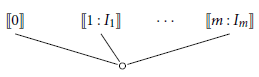
Every node s of C shares the same trace values $\mathrm{Tr}(s) = \{X_1^+, X_1^-, \ldots, X_n^+, X_n^-, R, G_0, \ldots, G_m\}$
. The ‘subtrees’
$\mathrm{Tr}(s) = \{X_1^+, X_1^-, \ldots, X_n^+, X_n^-, R, G_0, \ldots, G_m\}$
. The ‘subtrees’ $[\![ 0 ]\!]$
and
$[\![ 0 ]\!]$
and $[\![ \ell : I_\ell ]\!]$
each comprise of one or two buds whose companion is the root of
$[\![ \ell : I_\ell ]\!]$
each comprise of one or two buds whose companion is the root of $[\![ p ]\!]$
(drawn in white below). We refer to these buds by the names written above them. The
$[\![ p ]\!]$
(drawn in white below). We refer to these buds by the names written above them. The $\mathcal{T}_\mathcal{A}$
-morphisms ‘decorating’ the subtrees’ edges are written next to them. For notational convenience, we often treat
$\mathcal{T}_\mathcal{A}$
-morphisms ‘decorating’ the subtrees’ edges are written next to them. For notational convenience, we often treat $\ell^+$
and
$\ell^+$
and $\ell^-$
as the label
$\ell^-$
as the label $\ell$
.
$\ell$
.
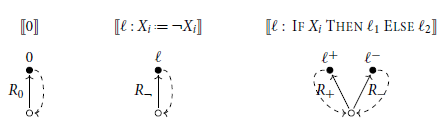
The morphisms are specified below. A dashed line between A and B indicates the pair (A, 0, B), a bold line the pair $(A, \alpha, B)$
and the absence of a connecting line between A and B the absence of all pairs (A, c, B). In
$(A, \alpha, B)$
and the absence of a connecting line between A and B the absence of all pairs (A, c, B). In $R_\neg$
,
$R_\neg$
, $\ell' = \ell + 1 \mod m + 1$
.
$\ell' = \ell + 1 \mod m + 1$
.
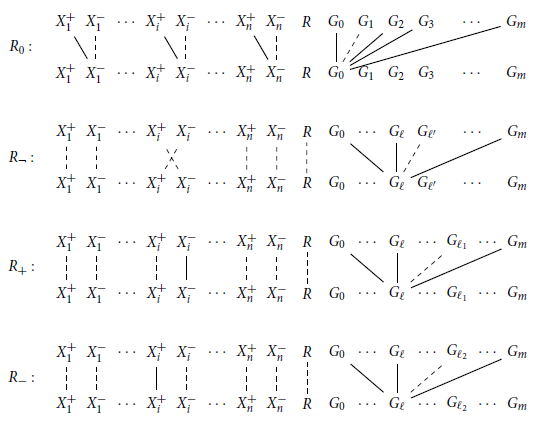
Write B for the set of names for buds of $[\![ p ]\!]$
, that is,
$[\![ p ]\!]$
, that is,

Any path through $[\![ p ]\!]$
corresponds to an infinite sequence
$[\![ p ]\!]$
corresponds to an infinite sequence $\ell \in B^\omega$
describing the sequence in which the buds of
$\ell \in B^\omega$
describing the sequence in which the buds of $[\![ p ]\!]$
are passed to generate said path. For this reason, we treat such sequences and paths
$[\![ p ]\!]$
are passed to generate said path. For this reason, we treat such sequences and paths $P : \mathcal{P}_C \to \mathcal{T}_\mathcal{A}$
interchangeably. The property central to the reduction is that if
$P : \mathcal{P}_C \to \mathcal{T}_\mathcal{A}$
interchangeably. The property central to the reduction is that if  , then $[\![ p ]\!]$
does not satisfy the trace condition. Thus, sequences
$[\![ p ]\!]$
does not satisfy the trace condition. Thus, sequences $\ell \in B^\omega$
representing unsuccessful runs will satisfy the trace condition. The various aspects of the trace maps given in Definition 7.2 can thus be reframed as ensuring certain conditions on such
$\ell \in B^\omega$
representing unsuccessful runs will satisfy the trace condition. The various aspects of the trace maps given in Definition 7.2 can thus be reframed as ensuring certain conditions on such $\ell \in V^\omega$
.
$\ell \in V^\omega$
.
We begin by showing that all sequences $\ell \in B^\omega$ $\ell \in B^\omega$
which eventually diverge or do not even adhere to the control structure of p have progressing traces through R or the
$\ell \in B^\omega$
which eventually diverge or do not even adhere to the control structure of p have progressing traces through R or the $G_i$
s, respectively. For this, we define the control-graph of p as
$G_i$
s, respectively. For this, we define the control-graph of p as $G =(B, E)$
with
$G =(B, E)$
with

where, if  , then pairs $(\ell_1, \ell_2)$
are included as
$(\ell_1, \ell_2)$
are included as $(\ell_1,\ell_2^+)$
and
$(\ell_1,\ell_2^+)$
and $(\ell_1,\ell_2^-)$
. For a sequence
$(\ell_1,\ell_2^-)$
. For a sequence $\ell$
of labels from B (finite or infinite),
$\ell$
of labels from B (finite or infinite), $\ell$
is a path through G, writing
$\ell$
is a path through G, writing $\ell \in G$
, if for each
$\ell \in G$
, if for each $i < \left|\ell\right|$
,
$i < \left|\ell\right|$
, $(\ell_i, \ell_{i +1}) \in E$
.
$(\ell_i, \ell_{i +1}) \in E$
.
Lemma 7.1. Let $\ell \in B^\omega$
be a path through
$\ell \in B^\omega$
be a path through $[\![ p ]\!]$
. Then,
$[\![ p ]\!]$
. Then,
-
(1)
$\ell$
has a progressing trace along R iff eventually 0 never occurs along
$\ell$
. -
(2)
$\ell$
has a progressing trace along the
$G_0, \ldots, G_m$
iff no suffix of
$\ell$
is a path through G.


Proof.
-
(1) Observe that R-traces are interrupted by
$R_0$
whenever a path passes through
$0 \in B$
and are activated when passing through any other bud. -
(2) An activation on a G-trace takes place whenever it ‘jumps incorrectly’. That is, if
$(\ell_i, \ell_{i + 1}) \not\in E$
, then there is an activating trace from
$G_{\ell_i}$
to
$G_{\ell_{i + 1}}$
in the trace maps of the subtree
$[\![ \ell_i ]\!]$
. Thus, a progressing trace through the Gs indicates that such violations take place infinitely often, meaning no suffix of
$\ell$
can be a path through G. Conversely, no suffix of
$\ell$
being a path through G indicates infinitely many violations taking place.


The only paths through $[\![ p ]\!]$
which remain unclassified are of the shape
$[\![ p ]\!]$
which remain unclassified are of the shape $u0u_10u_20u_30\ldots$
where each
$u0u_10u_20u_30\ldots$
where each $u_i0$
describes a potential run of p which at least is a path through the control-graph of p. We continue by analysing the traces on the
$u_i0$
describes a potential run of p which at least is a path through the control-graph of p. We continue by analysing the traces on the $X_i^\bullet$
along such potential runs. Consider a sequence
$X_i^\bullet$
along such potential runs. Consider a sequence $u = \ell_0 \ldots \ell_n \in B^{n + 1}$
and denote by
$u = \ell_0 \ldots \ell_n \in B^{n + 1}$
and denote by $R^i$
the morphism in
$R^i$
the morphism in $[\![ p ]\!]$
from the root to the bud
$[\![ p ]\!]$
from the root to the bud $\ell_i$
. In the following, we denote the trace map of the sequence u by
$\ell_i$
. In the following, we denote the trace map of the sequence u by $R_u:= R^{n - 1} \circ \ldots \circ R^0 \circ R_0$
.
$R_u:= R^{n - 1} \circ \ldots \circ R^0 \circ R_0$
.
Lemma 7.2. Let $u \in (B \setminus \{0\})^+$
with
$u \in (B \setminus \{0\})^+$
with $\left|u\right| = n + 1$
be such that 0 u is a path through G. Then
$\left|u\right| = n + 1$
be such that 0 u is a path through G. Then
-
(1) There is no
$X_j^\bullet \in \mathrm{Tr}(\varepsilon)$
and no activation algebra element c such that
$(X_i^+, c, X_j^\bullet) \in R_{u}$
. -
(2) There are no
$X^\bullet_i, X^\bullet_j \in \mathrm{Tr}(\varepsilon)$
with
$i \neq j$
and
$(X^\bullet_i, c, X^\bullet_j) \in R_{u}$
for any activation algebra element c. -
(3) If
$(\ell_0, \phi) \leadsto^*_{u} (\ell_n, \sigma)$
for some
$\sigma$
then for each
$X_i$
, there is exactly one
$a^+_i$
and exactly one
$a^-_i$
such that
$(X^-_i, a^+_i, X^+_i) \in R_{u}$
and
$(X^-_i, a^-_i, X^-_i) \in R_{u}$
. Furthermore,-
– if
$\sigma(X_i) = 0$
then
$a^+_i = \alpha$
and
$a^-_i = 0$
-
– if
$\sigma(X_i) = 1$
then
$a^-_i = \alpha$
and
$a^+_i = 0$
-
-
(4) If there is no
$\sigma$
such that
$(\ell_0, \phi) \leadsto^*_{u} (\ell_n, \sigma)$
, then there exists some
$X_i$
such that
$(X_i^-, 1, X_i^+), (X_i^-, 1, X_i^-) \in R_{u}$


Proof.
-
(1) Observe that
$R_0$
, the map from the root to 0, interrupts all traces starting at the
$X_i^+$
. -
(2) Observe that all trace maps in
$[\![ p ]\!]$
only ever connect trace values corresponding to the same variable
$X_i$
. -
(3) At the beginning of a
-run, all variables are 0. This is mirrored by
$R_0$
in the sense of (2), as it connects each
$X^{-}_i$
to the
$X^{\bullet}_i$
according to the first clause. We continue by reasoning inductively along the run
$(\ell_0, \phi) \leadsto^*_{u} (\ell_n, \sigma)$
, performing a case distinction on the final transition
$(\ell_{n - 1}, \sigma') \leadsto (\ell_n, \sigma)$
. The negation step inverts the value
$\sigma'(X_i)$
of some variable
$X_i$
. This is mirrored in
$R_{\neg}$
by ‘swapping’ the traces on
$X_i^+$
and
$X_i^-$
which preserves the property. For the -instruction, observe that
$(\ell_{n - 1}, \sigma') \leadsto (\ell_n, \sigma)$
means branch dictated by
$\sigma(X_i)$
is taken (i.e.,
$\ell_{n - 1}$
is some
$\ell^+$
and
$\sigma(X_i) = 1$
). Then the trace of the
$X_i^\bullet$
dual to
$\sigma(X_i)$
is activated (i.e.,
$X_i^-$
if
$\sigma(X_i) = 1$
), preserving the property. -
(4) We again reason inductively on u. If
$\left|u\right| = 1$
, then
$(\ell_0, \phi) \leadsto^*_{u} (\ell_0, \phi)$
, meaning the claim does not apply. Thus,
$u = u'\ell_n$
for some
$u' \in (B \ \{0\})^+$
and we perform a case distinction on whether there exists a
$\sigma$
such that
$(\ell_0, \phi) \leadsto^*_{u'} (\ell_{n - 1}, \sigma)$
. If there exists no such
$\sigma$
, this property holds for
$R_{u'}$
per inductive hypothesis and it is easily observed that any possible choice of
$R^{n - 1}$
preserves the property for
$R_{u'\ell_{n}}$
. If
$(\ell_0, \phi) \leadsto^*_{u'} (\ell_{n - 1}, \sigma)$
then, as
$(\ell_{n - 1}, \ell_n) \in E$
, this must mean that and
$\ell_{n - 1}$
is the ‘incorrect bud’ (i.e.,
$\ell_{n - 1}$
is some
$\ell^+$
and
$\sigma(X_i) = 0$
). In such cases, the
$X_i^\bullet$
corresponding to the value of
$\sigma(X_i)$
is activated by
$R^{n - 1}$
(i.e.,
$X_i^-$
if
$\sigma(X_i) = 0$
). Combining this with what is known about
$R_{u'}$
by property (3), this means that
$(X_i^-, \alpha, X_i^-), (X_i^-, \alpha, X_i^+) \in R_{u}$
.


 -run, all variables are 0. This is mirrored by


 -instruction, observe that


 and
and 


With this classification of the potential runs, we can connect the trace condition on branches not covered by Lemma 7.1 to the runs of the program p.
Lemma 7.3. Let $\ell \in B^\omega$
be a path through
$\ell \in B^\omega$
be a path through $[\![ p ]\!]$
which does not have a progressing trace along R or the
$[\![ p ]\!]$
which does not have a progressing trace along R or the $G_0, \ldots, G_m$
. Then,
$G_0, \ldots, G_m$
. Then, $\ell = u 0 u_1 0 u_2 0 u_3 0 \ldots$
with each
$\ell = u 0 u_1 0 u_2 0 u_3 0 \ldots$
with each $u_i \in (B - \{0\})^+$
. Furthermore,
$u_i \in (B - \{0\})^+$
. Furthermore, $\ell$
does not satisfy the trace condition iff from some
$\ell$
does not satisfy the trace condition iff from some $N \in \omega$
onwards,
$N \in \omega$
onwards, $(1, \phi) \leadsto^*_{u_i} (0, \phi)$
for all
$(1, \phi) \leadsto^*_{u_i} (0, \phi)$
for all $i > N$
.
$i > N$
.
Proof. That $\ell = u 0 u_1 0 u_2 0 \ldots$
follows directly from Lemma 7.1.
$\ell = u 0 u_1 0 u_2 0 \ldots$
follows directly from Lemma 7.1.
First suppose that $(1, \phi) \leadsto^*_{u_i} (0, \phi)$
for
$(1, \phi) \leadsto^*_{u_i} (0, \phi)$
for $i > N$
. As
$i > N$
. As  -programs are deterministic, this means $u_i = u$
for all
$u_i = u$
for all $i > N$
and some fixed u. From Lemma 7.2 (3), it follows that for every
$i > N$
and some fixed u. From Lemma 7.2 (3), it follows that for every $X_j$
we have
$X_j$
we have $(X_j^-, \alpha, X_j^+), (X_j^-, 0, X_j^-) \in R_{u}$
. By Lemma 7.2 (1), the trace on
$(X_j^-, \alpha, X_j^+), (X_j^-, 0, X_j^-) \in R_{u}$
. By Lemma 7.2 (1), the trace on $X_j^+$
is interrupted in
$X_j^+$
is interrupted in $R_0$
. Thus, there can be no progressing trace along any
$R_0$
. Thus, there can be no progressing trace along any $X_j^+,X_j^-$
along the path
$X_j^+,X_j^-$
along the path $0 u 0 u \ldots$
. Then, because of the previous results, there is no progressing trace along any of the elements of
$0 u 0 u \ldots$
. Then, because of the previous results, there is no progressing trace along any of the elements of $\mathrm{Tr}(\varepsilon)$
meaning
$\mathrm{Tr}(\varepsilon)$
meaning $\ell$
does not satisfy the trace condition.
$\ell$
does not satisfy the trace condition.
Conversely, suppose that infinitely many of the $u_i$
did not satisfy
$u_i$
did not satisfy $(1, \phi) \leadsto^*_{u_i} (0, \phi)$
. There are two possibilities for such
$(1, \phi) \leadsto^*_{u_i} (0, \phi)$
. There are two possibilities for such $u_i$
s: either there is some
$u_i$
s: either there is some $\sigma \neq \phi$
with
$\sigma \neq \phi$
with $(1, \phi) \leadsto^*_{u_i}(0, \sigma)$
or not. In the former case, there thus must be some
$(1, \phi) \leadsto^*_{u_i}(0, \sigma)$
or not. In the former case, there thus must be some $X_j$
with
$X_j$
with $\sigma(X_j) = 1$
, meaning
$\sigma(X_j) = 1$
, meaning $(X_j^-, 1, X_j^-) \in R_{u_i}$
. In the latter case, there also must be some
$(X_j^-, 1, X_j^-) \in R_{u_i}$
. In the latter case, there also must be some $X_j$
with
$X_j$
with $(X_j^-, 1, X_j^-)$
. As the traces on
$(X_j^-, 1, X_j^-)$
. As the traces on $X_j^-$
are never interrupted, if infinitely many such ‘deviant’ runs exist along
$X_j^-$
are never interrupted, if infinitely many such ‘deviant’ runs exist along $\ell$
, some
$\ell$
, some $X_j^-$
must be activated infinitely often, as there are only finitely many variables. Then,
$X_j^-$
must be activated infinitely often, as there are only finitely many variables. Then, $\ell$
satisfies the trace condition.
$\ell$
satisfies the trace condition.
Corollary 7.1. For any given  program p,
  iff
iff $[\![ p ]\!]$
does not satisfy the trace condition of
$[\![ p ]\!]$
does not satisfy the trace condition of $\mathcal{T}_\mathcal{A}$
.
$\mathcal{T}_\mathcal{A}$
.
Theorem 7.1. Verifying the trace condition on ACDs in $\mathcal{T}_\mathcal{A}$
for any
$\mathcal{T}_\mathcal{A}$
for any $\mathcal{A}$
is PSPACE-hard.
$\mathcal{A}$
is PSPACE-hard.
Proof. A  -program can be transformed into the ACD given in Definition 7.2 in LOGSPACE. By Corollary 7.1, this constitutes a LOGSPACE-reduction of a PSPACE-hard problem (
 ) to cyclic proof checking in $\mathcal{T}_\mathcal{A}$
for any
$\mathcal{T}_\mathcal{A}$
for any $\mathcal{A}$
.
$\mathcal{A}$
.
Remark 7.1. The PSPACE-hardness result in Theorem 7.1 is only given in terms of a concrete family of trace categories, the activation algebra induced $\mathcal{T}_\mathcal{A}$
. It remains an open question if a more general condition on trace categories can be found which would yield PSPACE-hardness.
$\mathcal{T}_\mathcal{A}$
. It remains an open question if a more general condition on trace categories can be found which would yield PSPACE-hardness.
 -set finiteness of a trace category $\mathcal{T}$
does not entail PSPACE-hardness. For instance, consider a
$\mathcal{T}$
does not entail PSPACE-hardness. For instance, consider a  -set finite trace category $\mathcal{T}$
in which every path satisfies the trace condition and which thus makes checking it trivially O(1). This example also illustrates that
$\mathcal{T}$
in which every path satisfies the trace condition and which thus makes checking it trivially O(1). This example also illustrates that $\omega$
-regularity of the trace condition of
$\omega$
-regularity of the trace condition of $\mathcal{T}$
does not entail PSPACE-hardness.
$\mathcal{T}$
does not entail PSPACE-hardness.
Remark 7.2. Theorem 7.1 does not directly imply that the proof checking of any concrete cyclic proof system is PSPACE-hard, even if its trace condition can be expressed in terms of $\mathcal{A}$
. Instead, Theorem 7.1 only proves that there exist ‘suitably small’ ACDs over
$\mathcal{A}$
. Instead, Theorem 7.1 only proves that there exist ‘suitably small’ ACDs over $\mathcal{A}$
whose GTC satisfaction codes the termination of
$\mathcal{A}$
whose GTC satisfaction codes the termination of  -programs. To extend this result to a concrete cyclic proof system, one must prove that for any
  -program p, there exists a ‘suitably small’ cyclic proof whose (compressed) ACD is $[\![ p ]\!]$
. Usually, this can be accomplished by finding formulas which can produce various traces. For example, for the variables, the following ‘trace gadgets’ are required:
$[\![ p ]\!]$
. Usually, this can be accomplished by finding formulas which can produce various traces. For example, for the variables, the following ‘trace gadgets’ are required:

To conclude PSPACE-completeness, it remains to show that proof checking for $\mathcal{T}_\mathcal{A}$
-ACDs is in PSPACE.
$\mathcal{T}_\mathcal{A}$
-ACDs is in PSPACE.
Lemma 7.4. For a given ACD $D = (C, \mathrm{Tr} : \mathcal{P}_C \to \mathcal{T}_\mathcal{A})$
, the verification whether it constitutes an abstract cyclic proof can be carried out in PSPACE.
$D = (C, \mathrm{Tr} : \mathcal{P}_C \to \mathcal{T}_\mathcal{A})$
, the verification whether it constitutes an abstract cyclic proof can be carried out in PSPACE.
Proof. Following the proof of Theorem 6.1, one can verify whether D is a proof by deciding whether the language of a Büchi-automaton $\frak{A}$
recognising all paths through D is included in the language of a Büchi-automaton
$\frak{A}$
recognising all paths through D is included in the language of a Büchi-automaton $\frak{B}$
recognising all paths consisting of morphisms from Tr which satisfy the trace condition of
$\frak{B}$
recognising all paths consisting of morphisms from Tr which satisfy the trace condition of $\mathcal{T}_\mathcal{A}$
. The language inclusion problem for regular languages is known to be in PSPACE (Kupferman and Vardi Reference Kupferman, Vardi, Alur and Henzinger1996). Thus, it remains to find automata
$\mathcal{T}_\mathcal{A}$
. The language inclusion problem for regular languages is known to be in PSPACE (Kupferman and Vardi Reference Kupferman, Vardi, Alur and Henzinger1996). Thus, it remains to find automata $\frak{A}$
and
$\frak{A}$
and $\frak{B}$
adhering to the aforementioned specifications whose sizes are polynomial in the size of D. The automaton
$\frak{B}$
adhering to the aforementioned specifications whose sizes are polynomial in the size of D. The automaton $\frak{A}$
given in Theorem6.1 is already suitable for this. On the other hand, the automaton
$\frak{A}$
given in Theorem6.1 is already suitable for this. On the other hand, the automaton $\frak{B}$
constructed according to Theorem 6.2 is too large, as its set of states contains the sets
$\frak{B}$
constructed according to Theorem 6.2 is too large, as its set of states contains the sets  for each set X of trace values in the image of Tr, whose size is exponential in the size of X. However, the $\mathcal{T}_\mathcal{A}$
-specific construction for the
$\mathcal{T}_\mathcal{A}$
-specific construction for the $\frak{B}$
given in Wehr (Reference Wehr2021, Proposition 5.11) is of size polynomial to the size of D. Thus, there are suitable automata such that deciding
$\frak{B}$
given in Wehr (Reference Wehr2021, Proposition 5.11) is of size polynomial to the size of D. Thus, there are suitable automata such that deciding $L(\frak{A}) \subseteq L(\frak{B})$
decides whether D is a proof, meaning this can be decided in PSPACE.
$L(\frak{A}) \subseteq L(\frak{B})$
decides whether D is a proof, meaning this can be decided in PSPACE.
Corollary 7.2. The problem of verifying whether an ACD over $\mathcal{T}_\mathcal{A}$
is a proof is PSPACE-complete.
$\mathcal{T}_\mathcal{A}$
is a proof is PSPACE-complete.
The fact that proof checking for $\mathcal{T}_\mathcal{A}$
-ACDs is in PSPACE extends to a concrete cyclic proof system
$\mathcal{T}_\mathcal{A}$
-ACDs is in PSPACE extends to a concrete cyclic proof system $\mathcal{R}$
much more readily than PSPACE-hardness. The only restriction is that the set of trace values of each
$\mathcal{R}$
much more readily than PSPACE-hardness. The only restriction is that the set of trace values of each $\mathcal{R}$
-sequent is of polynomial size and that the trace data of an
$\mathcal{R}$
-sequent is of polynomial size and that the trace data of an $\mathcal{R}$
-pre-proof can be computed in PSPACE. All cyclic proof systems we know of satisfy these properties.
$\mathcal{R}$
-pre-proof can be computed in PSPACE. All cyclic proof systems we know of satisfy these properties.
Lemma 7.5. Let  be a cyclic proof system whose trace condition is given by a trace interpretation $\iota : \mathcal{R} \to \mathcal{T}_\mathcal{A}$
. Suppose that
$\iota : \mathcal{R} \to \mathcal{T}_\mathcal{A}$
. Suppose that $\iota$
is such that for sequents
$\iota$
is such that for sequents  the set $\iota(\Gamma)$
of trace values in
$\iota(\Gamma)$
of trace values in $\Gamma$
is of size polynomial to the size of
$\Gamma$
is of size polynomial to the size of $\Gamma$
and can be computed from
$\Gamma$
and can be computed from $\Gamma$
in PSPACE. Suppose further that for each rule
$\Gamma$
in PSPACE. Suppose further that for each rule $r \in \mathcal{R}$
with
$r \in \mathcal{R}$
with $\rho(r) = (\Gamma, \Delta_1, \ldots, \Delta_n)$
, the maps
$\rho(r) = (\Gamma, \Delta_1, \ldots, \Delta_n)$
, the maps $r_i : \iota(\Gamma) \to \iota(\Delta_i)$
can be computed in PSPACE. Then deciding whether an
$r_i : \iota(\Gamma) \to \iota(\Delta_i)$
can be computed in PSPACE. Then deciding whether an $\mathcal{R}$
-pre-proof is a proof is in PSPACE.
$\mathcal{R}$
-pre-proof is a proof is in PSPACE.
Proof. Given an $\mathcal{R}$
-pre-proof
$\mathcal{R}$
-pre-proof $\Pi = (C, \lambda, \delta)$
, simply compute its induced ACD
$\Pi = (C, \lambda, \delta)$
, simply compute its induced ACD $D = (C, \mathrm{Tr} : \mathcal{P}_C \to \mathcal{T}_\mathcal{A})$
as described in Definition 4.3. By the assumptions about
$D = (C, \mathrm{Tr} : \mathcal{P}_C \to \mathcal{T}_\mathcal{A})$
as described in Definition 4.3. By the assumptions about $\iota$
, D can be computed in PSPACE. Thus, if D is of size polynomial to the size of
$\iota$
, D can be computed in PSPACE. Thus, if D is of size polynomial to the size of $\Pi$
, checking whether
$\Pi$
, checking whether $\Pi$
is an
$\Pi$
is an $\mathcal{R}$
-proof can be carried out in PSPACE as described in Lemma 7.4. As C is simply ‘copied’, it suffices to show that Tr is of polynomial size. Per assumption, each
$\mathcal{R}$
-proof can be carried out in PSPACE as described in Lemma 7.4. As C is simply ‘copied’, it suffices to show that Tr is of polynomial size. Per assumption, each $\mathrm{Tr}(s)$
is
$\mathrm{Tr}(s)$
is $\iota(\lambda(s))$
and thus of polynomial size of the sequent
$\iota(\lambda(s))$
and thus of polynomial size of the sequent $\lambda(s)$
which is accounted for in the size of
$\lambda(s)$
which is accounted for in the size of $\Pi$
. Similarly,
$\Pi$
. Similarly, $\mathrm{Tr}(s \, si) \subseteq \mathrm{Tr}(s) \times \mathcal{A} \times \mathrm{Tr}(si)$
for each
$\mathrm{Tr}(s \, si) \subseteq \mathrm{Tr}(s) \times \mathcal{A} \times \mathrm{Tr}(si)$
for each $s \in C$
and
$s \in C$
and $si \in \mathrm{Chld}(s)$
and is thus of polynomial size to
$si \in \mathrm{Chld}(s)$
and is thus of polynomial size to $\max\{\left|\lambda(s)\right|, \left|\lambda(si)\right|\}$
. As this data suffices to code Tr, D overall is of polynomial size to
$\max\{\left|\lambda(s)\right|, \left|\lambda(si)\right|\}$
. As this data suffices to code Tr, D overall is of polynomial size to $\Pi$
as desired.
$\Pi$
as desired.
Corollary 7.3. Verifying whether a $\mu$
-pre-proof is a proof is in PSPACE.
$\mu$
-pre-proof is a proof is in PSPACE.
8. Conclusion
The derivations of cyclic proof systems, which are finite, directed graphs, rather than finite trees, may not be sound, that is, they might conclude invalid sequents. Thus, cyclic proof systems distinguish between pre-proofs (well-formed derivations) and proofs (sound, well-formed derivations). The most common method is to impose a global trace condition: for a pre-proof to be a proof, all of its infinite branches must satisfy a so-called trace condition. We capture this trace condition in categorical terms: infinite branches are represented by paths, functors $P : \omega \to \mathcal{T}$
from the preorder category on
$P : \omega \to \mathcal{T}$
from the preorder category on $\omega$
to a trace category
$\omega$
to a trace category $\mathcal{T}$
. A trace category
$\mathcal{T}$
. A trace category $\mathcal{T}$
is a category equipped with a trace condition, a predicate on paths through
$\mathcal{T}$
is a category equipped with a trace condition, a predicate on paths through $\mathcal{T}$
which is closed under taking suffixes and internal composition. We further define a family of trace categories
$\mathcal{T}$
which is closed under taking suffixes and internal composition. We further define a family of trace categories $\mathcal{T}_\mathcal{A}$
whose morphisms are relations between finite sets annotated with an activation algebra
$\mathcal{T}_\mathcal{A}$
whose morphisms are relations between finite sets annotated with an activation algebra $\mathcal{A}$
: a finite
$\mathcal{A}$
: a finite $\vee$
-semilattice with a distinguished activation element
$\vee$
-semilattice with a distinguished activation element $\alpha$
. A path through
$\alpha$
. A path through $\mathcal{T}_\mathcal{A}$
satisfies the trace condition if it carries an infinite sequence of connected elements which attains the activation value
$\mathcal{T}_\mathcal{A}$
satisfies the trace condition if it carries an infinite sequence of connected elements which attains the activation value $\alpha$
infinitely often. Almost all notions of trace from the literature can be represented naturally in terms of some
$\alpha$
infinitely often. Almost all notions of trace from the literature can be represented naturally in terms of some $\mathcal{T}_\mathcal{A}$
. Notably, the usual trace condition for the cyclic systems of
$\mathcal{T}_\mathcal{A}$
. Notably, the usual trace condition for the cyclic systems of $\mu$
-calculi is given in terms of the three-value failure algebra
$\mu$
-calculi is given in terms of the three-value failure algebra $\mathbb{F}$
.
$\mathbb{F}$
.
Using this abstracted notion of trace, a pre-proof with underlying graph C may be represented as an annotation of C with maps of a trace category $\mathcal{T}$
. In categorical terms, the latter is a functor
$\mathcal{T}$
. In categorical terms, the latter is a functor $\mathrm{Tr} : \mathcal{P}_C \to \mathcal{T}$
from the category of finite paths through C into
$\mathrm{Tr} : \mathcal{P}_C \to \mathcal{T}$
from the category of finite paths through C into $\mathcal{T}$
. When representing a pre-proof in this manner, all details unrelated to the trace condition are abstracted away, leading us to call such functors abstract cyclic derivation. The requirement of trace conditions being closed under internal composition allows us to prove the following two novel results in cyclic proof theory.
$\mathcal{T}$
. When representing a pre-proof in this manner, all details unrelated to the trace condition are abstracted away, leading us to call such functors abstract cyclic derivation. The requirement of trace conditions being closed under internal composition allows us to prove the following two novel results in cyclic proof theory.
-
• Compression: ACDs may be ‘compressed’ to trace-condition-equivalent ACDs over graphs whose size is linear in the number of simple cycles in C (Theorem 4.1).
-
• Ramsey-style soundness: An ACD
$\mathrm{Tr} : \mathcal{P}_C \to \mathcal{T}$
is a proof (i.e., every path through it satisfies the trace condition) if and only if for every idempotent endomorphism
$R : X \to X$
in the image of Tr, the periodic path
$R^\omega :\omega \to \mathcal{T}$
(which simply repeats R) satisfies the trace condition (Theorem 5.2).


We also prove some well-known results of cyclic proof theory in terms of our abstract notion of trace and derivation in order to demonstrate the adequacy of our notions for tackling questions of cyclic proof theory and connect them to the wider field. In Section 6, we consider trace categories with $\omega$
-regular trace conditions, connecting ACDs with
$\omega$
-regular trace conditions, connecting ACDs with $\omega$
-automata theory. As a result of the Ramsey-style soundness condition, every trace category with finite
$\omega$
-automata theory. As a result of the Ramsey-style soundness condition, every trace category with finite  -sets, including all $\mathcal{T}_{\mathcal{A}}$
, has an
$\mathcal{T}_{\mathcal{A}}$
, has an $\omega$
-regular trace condition. We prove the following results using automata theory.
$\omega$
-regular trace condition. We prove the following results using automata theory.
-
• Decidability: If the trace condition of
$\mathcal{T}$
is
$\omega$
-regular in a ‘computable’ manner, the GTC of ACDs on
$\mathcal{T}$
is decidable (Theorem 6.1). -
• Regularisation: If a proof system is finite (i.e., the set of sequents occurring in a proof is finite), then every sequent provable via a ill-founded proof is provable via a cyclic proof (Theorem 6.3).


In Section 7, we generalise a result about the cyclic proof system for multiplicative-additive linear logic with fixed points ( $\mu$
MALL) by Nollet et al. (Reference Nollet, Saurin, Tasson, Cerrito and Popescu2019) to obtain.
$\mu$
MALL) by Nollet et al. (Reference Nollet, Saurin, Tasson, Cerrito and Popescu2019) to obtain.
-
• PSPACE-completeness: The problem of deciding whether an ACD over
$\mathcal{T}_\mathcal{A}$
satisfies the GTC is PSPACE-complete (Theorem 7.1 & Lemma 7.4).

The above result is proven in such a way that the decision problem being in PSPACE readily transfers to concrete cyclic proof systems with a $\mathcal{T}_\mathcal{A}$
-trace condition. Transferring PSPACE-hardness, however, requires certain assumptions on the concrete cyclic proof system.
$\mathcal{T}_\mathcal{A}$
-trace condition. Transferring PSPACE-hardness, however, requires certain assumptions on the concrete cyclic proof system.
8.1 Related work
Definitions and results in this article originate from Wehr’s Masters thesis (Wehr Reference Wehr2021), although most have undergone significant changes. The thesis contains results that are not presented in this article, including a categorical treatment of a further three cyclic proof systems: cyclic arithmetic (Simpson Reference Simpson, Esparza and Murawski2017), $\mathrm{HFL}_\mathbb{N}$
(Kori et al. Reference Kori, Tsukada, Kobayashi, Baier and Goubault-Larrecq2021) and Grzegorczyk modal logic (Savateev and Shamkanov Reference Savateev and Shamkanov2021).
$\mathrm{HFL}_\mathbb{N}$
(Kori et al. Reference Kori, Tsukada, Kobayashi, Baier and Goubault-Larrecq2021) and Grzegorczyk modal logic (Savateev and Shamkanov Reference Savateev and Shamkanov2021).
To the best of our knowledge, Brotherston (Reference Brotherston2006) is the only previous work on abstracting cyclic proofs. The present article can be viewed as an extension of Brotherston’s in two ways: first, his abstract notion of derivation is closer to the common definition of pre-proofs, being presented in terms of abstract sequents and derivation rules. Crucially, this bars him from considering the composition of trace information, which enabled us to derive the ACD compression result (Theorem 4.1) and the alternative soundness condition (Theorem 5.2). Second, Brotherston only considers trace conditions expressed in terms of the Booleans $\mathbb{B}$
which, as we have remarked, is insufficient to directly express the trace condition of the modal
$\mathbb{B}$
which, as we have remarked, is insufficient to directly express the trace condition of the modal $\mu$
-calculus, a problem our activation algebras alleviate.
$\mu$
-calculus, a problem our activation algebras alleviate.
Lee et al. (Reference Lee, Jones and Ben-Amram2001) propose a termination criterion for first-order programs called the size-change principle. This criterion can be considered an instance of the $\mathcal{T}_\mathbb{B}$
trace condition. The authors give a decision procedure for the size-change principle which is a variant of the decision procedure for the Ramsey trace condition we give in Theorem 5.3, specialised to
$\mathcal{T}_\mathbb{B}$
trace condition. The authors give a decision procedure for the size-change principle which is a variant of the decision procedure for the Ramsey trace condition we give in Theorem 5.3, specialised to $\mathcal{T}_\mathbb{B}$
. They also prove PSPACE-completeness of their criterion by reducing it to
$\mathcal{T}_\mathbb{B}$
. They also prove PSPACE-completeness of their criterion by reducing it to  termination. This argument has been adapted by Nollet et al. (Reference Nollet, Saurin, Tasson, Cerrito and Popescu2019) to the cyclic proof system for multiplicative, additive linear logic with fixed points ( $\mu$
MALL) which we in turn adapted to ACDs in Section 7.
$\mu$
MALL) which we in turn adapted to ACDs in Section 7.
The Ramsey trace condition (Definition 5.1) is not the first application of Ramsey’s theorem in the field of cyclic proof theory. Notably, existing proofs of the equivalence of (extensions of) cyclic arithmetic and (extensions of) Peano arithmetic (Berardi and Tatsuta Reference Berardi and Tatsuta2017; Das Reference Das2020; Simpson Reference Simpson, Esparza and Murawski2017) rely on (arithmetised) variants of Ramsey’s theorem for concluding provability in Peano arithmetic from cyclic provability. In their proofs, it is applied to ‘internalise’ the soundness justification given by the GTC into non-cyclic PA proofs.
Cohen et al. (Reference Cohen, Jabarin, Popescu and Rowe2024) use a variant of Brotherston’s framework, that is, $\mathcal{T}_\mathbb{B}$
in our setting, to carry out a parameterised analysis of the worst-case complexity of various methods for checking soundness of cyclic proofs. The two parameters they considered, presented in terms of an ACD
$\mathcal{T}_\mathbb{B}$
in our setting, to carry out a parameterised analysis of the worst-case complexity of various methods for checking soundness of cyclic proofs. The two parameters they considered, presented in terms of an ACD $(C, \mathrm{Tr} : \mathcal{P}_C \to\mathcal{T}_\mathbb{B})$
with
$(C, \mathrm{Tr} : \mathcal{P}_C \to\mathcal{T}_\mathbb{B})$
with $C = (T, \beta)$
, are vertex count
$C = (T, \beta)$
, are vertex count $n = \left|T\right|$
and vertex width
$n = \left|T\right|$
and vertex width $w = \max_{t \in T} \left|\mathrm{Tr}(t)\right|$
. They find that many checking procedures, such as those based on automata akin to those sketched in Remark 6.2 and the Ramsey decision procedure of Section 5, are polynomial in vertex count n and exponential in vertex width w. They also propose an optimisation to the Ramsey decision procedure, called Order-reduced Transitive Looping procedure, which reduces the exponential degree in the vertex width w. We conjecture that all of their results can be extended to arbitrary
$w = \max_{t \in T} \left|\mathrm{Tr}(t)\right|$
. They find that many checking procedures, such as those based on automata akin to those sketched in Remark 6.2 and the Ramsey decision procedure of Section 5, are polynomial in vertex count n and exponential in vertex width w. They also propose an optimisation to the Ramsey decision procedure, called Order-reduced Transitive Looping procedure, which reduces the exponential degree in the vertex width w. We conjecture that all of their results can be extended to arbitrary $\mathcal{T}_\mathcal{A}$
.
$\mathcal{T}_\mathcal{A}$
.
In some sense, every cyclic proof system in the literature might be considered related work, as one can ask whether its trace condition can be modelled by our formalism. For most cyclic proof system we are aware of, including all those referred to in this article, this seems to be the case with three exceptions: The first is the bouncing-thread trace condition of Baelde et al. (Reference Baelde, Doumane, Kuperberg, Saurin, Baier and Fisman2022) which considers traces that do not reside along the branches of a pre-proof. The second is the limit condition, presented by Hazard and Kuperberg (Reference Hazard, Kuperberg, Manea and Simpson2022) in their system for transfinite word languages, which has traces running through multiple separate pre-proofs. The third are the higher-dimensional trace conditions of the hypersequent calculi of Das and Girlando (Reference Das, Girlando, Blanchette, Kovács and Pattinson2022) and Afshari et al. (Reference Afshari, Leigh, Turata, Klin and Pimentel2023).
Since the publication of the conference version of this article, further work using the proposed framework of $\mathcal{A}$
-activated categories has been carried out by Leigh and Wehr (Reference Leigh and Wehr2023). The article covers reset proof systems, cyclic proof systems with a soundness that can be verified in polynomial time and which have proven fruitful for proof-theoretic investigation (see, e.g., Afshari and Leigh Reference Afshari and Leigh2017; Afshari et al. Reference Afshari, Leigh and Menéndez Turata2021; Marti and Venema Reference Marti, Venema, Das and Negri2021). In the article, it is shown that for each cyclic proof system whose GTC is specified in terms of some
$\mathcal{A}$
-activated categories has been carried out by Leigh and Wehr (Reference Leigh and Wehr2023). The article covers reset proof systems, cyclic proof systems with a soundness that can be verified in polynomial time and which have proven fruitful for proof-theoretic investigation (see, e.g., Afshari and Leigh Reference Afshari and Leigh2017; Afshari et al. Reference Afshari, Leigh and Menéndez Turata2021; Marti and Venema Reference Marti, Venema, Das and Negri2021). In the article, it is shown that for each cyclic proof system whose GTC is specified in terms of some $\mathcal{T}_\mathcal{A}$
, there exists an associated reset proof system which proves the same theorems. To obtain the reset proof system, the original proof system is equipped with an annotation mechanism which is derived from the trace sets and trace maps of the trace interpretation. In this application, the ‘naturality’ of a trace interpretation culminates in a natural reset proof system.
$\mathcal{T}_\mathcal{A}$
, there exists an associated reset proof system which proves the same theorems. To obtain the reset proof system, the original proof system is equipped with an annotation mechanism which is derived from the trace sets and trace maps of the trace interpretation. In this application, the ‘naturality’ of a trace interpretation culminates in a natural reset proof system.
Acknowledgements.
We thank the anonymous referees for their insightful comments and suggestions. This work was supported by the Knut and Alice Wallenberg Foundation [2020.0199, 2015.0179] and the Swedish Research Council [2017-05111, 2016-03502].


 Open access

