





1. Introduction
This paper is dedicated to John Power, long-time friend and collaborator of the authors, whose work in abstract algebra, for example Anderson and Power (Reference Anderson and Power1997), is guided by a concern for practicality led by an understanding of abstract structures that we can only aspire to.
This work forms part of a programme to view logical relations as a structure that arises naturally from interpretations of logic and type theory and to expose the possibility of their use as a wide-ranging framework for formalising links between instances of mathematical structures. See Hermida et al. (Reference Hermida, Reddy and Robinson2014) for an introduction to this. The purpose of this paper is to show how several notions of bisimulation (strong, weak, branching and probabilistic) can be viewed as instances of the use of logical relations. It is not to prove new facts in process algebra. Indeed the work we produce is based on concrete facts, particularly about weak bisimulation, that have long been known in the process algebra community. What we do is look at them in a slightly different light.
Our work is also related to that of the coalgebra community, but is, we believe, quite different in emphasis. The main thrust of the related work there has been on algebraic theories as formalised by monads. In particular, there are abstract notions of bisimulation given in terms of monads and monad liftings. This is a presentation-free approach, which has both advantages and disadvantages. In this paper, though, we are focusing more on presentations of theories and concrete constructions of models. The difference is between presenting a group structure as an algebra for the group monad, and presenting it directly in terms of operations and constants: multiplication, inverse and identity. There is a natural notion of congruence between algebras for this approach, and it is given by logical relations.
The primary thrust of this paper is to test the idea that a presentation of what is in general a many-sorted mathematical structure, given by types and operations, should give a natural notion of congruence between models. We call this the logical relations approach. Our tests consist of looking at some of the larger inhabitants of the zoo of bisimulations produced by the process algebra community. We will show that a number of different notions of bisimulation can be seen as the congruences coming from different ways of modelling state transition systems. This area has also been studied by the coalgebra community, and there are relations between their work and ours that we shall discuss later.
We see there as being advantages in this. A key one is that the concept of bisimulation is incorporated as a formal instance of a framework that also includes other traditional mathematical structure, such as group homomorphisms.
Formally speaking, the theory of groups is standardly presented as an algebraic theory with operations of multiplication ( $.$
), inverse (
$.$
), inverse ( $(\ )^{-1}$
) and a constant (e) giving the identity of the multiplication operation. A group is a set equipped with interpretations of these operations under which they satisfy certain equations. We will not need to bother with the equations here. If G and H are groups, then a group homomorphism
$(\ )^{-1}$
) and a constant (e) giving the identity of the multiplication operation. A group is a set equipped with interpretations of these operations under which they satisfy certain equations. We will not need to bother with the equations here. If G and H are groups, then a group homomorphism $\theta \colon G \longrightarrow H$
is a function
$\theta \colon G \longrightarrow H$
is a function $G \longrightarrow H$
between the underlying sets that respects the group operations. We will consider the graph of this function as a relation between G and H. We abuse notation to conflate the function with its graph, and write
$G \longrightarrow H$
between the underlying sets that respects the group operations. We will consider the graph of this function as a relation between G and H. We abuse notation to conflate the function with its graph, and write $\theta\subseteq G\times H$
for the relation
$\theta\subseteq G\times H$
for the relation $(g,\theta g)$
. Logical relations give a formal way of extending relations to higher types. In particular, the type for multiplication is
$(g,\theta g)$
. Logical relations give a formal way of extending relations to higher types. In particular, the type for multiplication is $[(X\times X)\to X]$
, and the recipe for
$[(X\times X)\to X]$
, and the recipe for $[(\theta\times \theta)\to \theta]$
tells us that
$[(\theta\times \theta)\to \theta]$
tells us that $(._G, ._H) \in [(\theta\times \theta)\to \theta]$
if and only if for all
$(._G, ._H) \in [(\theta\times \theta)\to \theta]$
if and only if for all $g_1,g_2\in G$
and
$g_1,g_2\in G$
and $h_1,h_2\in H$
, if
$h_1,h_2\in H$
, if $(g_1,h_1)\in\theta$
and
$(g_1,h_1)\in\theta$
and $(g_2,h_2)\in\theta$
, then
$(g_2,h_2)\in\theta$
, then $(g_1._G g_2, h_1._H h_2)\in\theta$
. Rewriting this back into the standard functional style, this says precisely that
$(g_1._G g_2, h_1._H h_2)\in\theta$
. Rewriting this back into the standard functional style, this says precisely that $\theta (g_1._G g_2) = (\theta g_1)._H (\theta g_2)$
, the part of the standard requirements for a group homomorphism relating to multiplication. In other words, this tells us that a relation
$\theta (g_1._G g_2) = (\theta g_1)._H (\theta g_2)$
, the part of the standard requirements for a group homomorphism relating to multiplication. In other words, this tells us that a relation $\theta$
is a group homomorphism between G and H if and only if the operations are in the appropriate logical relations for their types and
$\theta$
is a group homomorphism between G and H if and only if the operations are in the appropriate logical relations for their types and $\theta$
is functional:
$\theta$
is functional:
-
• $(._G, ._H) \in [(\theta\times \theta)\to \theta]$
-
•
$((\ )^{-1(G)}, (\ )^{-1(H)}) \in [\theta\to \theta]$
-
•
$(e_G,e_H)\in\theta$
, and -
•
$\theta$
is functional and total.


We get an equivalent characterisation of (strong) bisimulation. We can take a labelled transition system (with labels A and state space S) to be an operation of type $[(A\times S) \to \operatorname{\mathcal P} S]$
, or equivalently
$[(A\times S) \to \operatorname{\mathcal P} S]$
, or equivalently $[A\to [S\to \operatorname{\mathcal P} S]]$
. Let F and G be two such (with the same set of labels, but state spaces S and T), then we show that
$[A\to [S\to \operatorname{\mathcal P} S]]$
. Let F and G be two such (with the same set of labels, but state spaces S and T), then we show that $R\subseteq S\times T$
is a bisimulation if and only if the transition operations are in the appropriate logical relation:
$R\subseteq S\times T$
is a bisimulation if and only if the transition operations are in the appropriate logical relation:
-
•
$(F,G) \in [(A\times R) \to \operatorname{\mathcal P} R]$
, or equivalently -
•
$(F,G) \in [A\to [R \to \operatorname{\mathcal P} R]].$


Since ${{\sf Rel}}$
is a cartesian closed category it does not matter which of these presentations we use, the requirement on R will be the same.
${{\sf Rel}}$
is a cartesian closed category it does not matter which of these presentations we use, the requirement on R will be the same.
In order to do this, we need to account for the interpretation of $\operatorname{\mathcal P}$
on relations and this leads us into a slightly more general discussion of monadic types. This includes some results about monads on
$\operatorname{\mathcal P}$
on relations and this leads us into a slightly more general discussion of monadic types. This includes some results about monads on ${\sf Set}$
that we believe are new, or at least are not widely known.
${\sf Set}$
that we believe are new, or at least are not widely known.
Weak and branching bisimulation can be made to follow. These forms of bisimulation arise in order to deal with the extension of transition systems to include silent $\tau$
actions. It is widely known that weak bisimulation can be reduced to the strong bisimulation of related systems, and we follow this approach. The interest for us is the algebraic nature of the construction of the related system, and we give two such, one of which explicitly includes
$\tau$
actions. It is widely known that weak bisimulation can be reduced to the strong bisimulation of related systems, and we follow this approach. The interest for us is the algebraic nature of the construction of the related system, and we give two such, one of which explicitly includes $\tau$
actions and the other does not. In this case, we get results of the form:
$\tau$
actions and the other does not. In this case, we get results of the form: $R\subseteq S\times T$
is a weak bisimulation if and only if the derived transition operations
$R\subseteq S\times T$
is a weak bisimulation if and only if the derived transition operations $\overline{F}$
and
$\overline{F}$
and $\overline{G}$
are in the appropriate logical relation:
$\overline{G}$
are in the appropriate logical relation:
-
•
$(\overline{F},\overline{G}) \in [A\to [R \to \operatorname{\mathcal P} R]].$

This seems something of a cheat but there is an issue here. The $\tau$
actions form a formal part of the semantic structure, but are not supposed to be visible. You can argue that is also cheating, and that you would really like a semantic structure that does not include mention of
$\tau$
actions form a formal part of the semantic structure, but are not supposed to be visible. You can argue that is also cheating, and that you would really like a semantic structure that does not include mention of $\tau$
, and that is what our second construction does.
$\tau$
, and that is what our second construction does.
Branching and semi-branching bisimulations were introduced to deal with perceived deficiencies in weak bisimulation. We show that they arise naturally out of a variant of the notion of transition system in which the system moves first by internal computations to a synchronisation point, and then by the appropriate action to a new state.
Bisimulations between probabilistic systems are a little more problematic. They do not quite fit the paradigm because, in the continuous case, we have a Markov kernel rather than transitions between particular states. Secondly, there are different approaches to bisimilarity. We investigate these and show that the logical relations approach can still be extended to this setting, and that when we do so there are strong links with these approaches to bisimilarity.
The notion of probabilistic bisimulation for discrete probabilistic systems is due originally to Larsen and Skou (Reference Larsen and Skou1991), with further work in van Glabbeek et al. (Reference van Glabbeek, Smolka and Steffen1995). The continuous case was instead discussed first in Desharnais et al. (Reference Desharnais, Edalat and Panangaden2002), where bisimulation is described as a span of zig-zag morphisms between probabilistic transition systems, there called labelled Markov processes (LMP), whose set of states is an analytic space. The hypothesis of analyticity is sufficient in order to prove that bisimilarity is a transitive relation, hence an equivalence relation. In Panangaden (Reference Panangaden2009), the author defined instead the notion of probabilistic bisimulation on a LMP (again with an analytic space of states) as an equivalence relation satisfying a property similar to Larsen and Skou’s discrete case. For two LMPs with different sets of states, S and S’ say, one can consider equivalence relations on $S+S'$
.
$S+S'$
.
Here we follow the modus operandi of de Vink and Rutten (Reference de Vink and Rutten1999), where they showed the connections between Larsen and Skou’s definition in the discrete case and the coalgebraic approach of the ‘transition-systems-as-coalgebras paradigm’ described at length in Rutten (Reference Rutten2000); then they used the same approach to give a notion of probabilistic bisimulation in the continuous case of transition systems whose set of states constitutes an ultrametric space. In this article, we see LMPs as coalgebras for the Giry functor $\Pi \colon \sf Meas \to \sf Meas$
(hence we consider arbitrary measurable spaces) and a probabilistic bisimulation is defined as a
$\Pi \colon \sf Meas \to \sf Meas$
(hence we consider arbitrary measurable spaces) and a probabilistic bisimulation is defined as a $\Pi$
- bisimulation: a span in the category of
$\Pi$
- bisimulation: a span in the category of $\Pi$
-coalgebras. At the same time, we define a notion of logical relation for two such coalgebras
$\Pi$
-coalgebras. At the same time, we define a notion of logical relation for two such coalgebras $F \colon S \longrightarrow \Pi S$
and
$F \colon S \longrightarrow \Pi S$
and $G \colon T \longrightarrow \Pi T$
as a relation
$G \colon T \longrightarrow \Pi T$
as a relation $R \subseteq S \times T$
such that
$R \subseteq S \times T$
such that $(F,G) \in [R \to \Pi R]$
, for an appropriately defined relation
$(F,G) \in [R \to \Pi R]$
, for an appropriately defined relation $\Pi R$
. It is easy to see that if
$\Pi R$
. It is easy to see that if $S=T$
and if R is an equivalence relation, then the definitions of logical relation and bisimulation of Panangaden (Reference Panangaden2009) coincide. What is not straightforward is the connection between the definition of
$S=T$
and if R is an equivalence relation, then the definitions of logical relation and bisimulation of Panangaden (Reference Panangaden2009) coincide. What is not straightforward is the connection between the definition of $\Pi$
-bisimulation and of logical relation in the general case: here we present some sufficient conditions for them to coincide, obtaining a similar result to de Vink and Rutten, albeit the set of states are not necessarily ultrametric spaces.
$\Pi$
-bisimulation and of logical relation in the general case: here we present some sufficient conditions for them to coincide, obtaining a similar result to de Vink and Rutten, albeit the set of states are not necessarily ultrametric spaces.
A second benefit of this approach using explicit algebraic constructions of models is that placing these constructions in this context opens up the possibility of applying them in more general settings than ${\sf Set}$
, by generalising the constructions to other frameworks. The early work of Hermida (Reference Hermida1993, Reference Hermida1999) shows that logical predicates can be obtained from quite general interpretations of logic, and more recent work of the authors of this paper shows how to extend this to general logical relations. The interpretation of covariant powerset given here is via an algebraic theory of complete sup-lattices opening up the possibility of also extending it to more general settings (though there will be design decisions about the indexing structures allowed). The derived structures used to model weak bisimulation are defined through reflections, and so can be interpreted in categories with the correct formal properties. All of this gives, we hope, a framework that can be used flexibly in a wide range of settings, see e.g. Ghani et al. (Reference Ghani, Johann and Fumex2010).
${\sf Set}$
, by generalising the constructions to other frameworks. The early work of Hermida (Reference Hermida1993, Reference Hermida1999) shows that logical predicates can be obtained from quite general interpretations of logic, and more recent work of the authors of this paper shows how to extend this to general logical relations. The interpretation of covariant powerset given here is via an algebraic theory of complete sup-lattices opening up the possibility of also extending it to more general settings (though there will be design decisions about the indexing structures allowed). The derived structures used to model weak bisimulation are defined through reflections, and so can be interpreted in categories with the correct formal properties. All of this gives, we hope, a framework that can be used flexibly in a wide range of settings, see e.g. Ghani et al. (Reference Ghani, Johann and Fumex2010).
As we have indicated, much of this is based on material well-known to the process algebra community. We will not attempt to give a full survey of sources here.
1.1 Related work
The idea that bisimulation is related to more general notions goes back a long way: at least to Aczel’s theory of non-well-founded sets Aczel (Reference Aczel1988), see also Rutten (Reference Rutten1992). More recently the coalgebra community has engaged heavily with this, both in terms of abstracting the notion to general coalgebras and working on abstractions of weak bisimulation and, quite recently, branching bisimulation, along with forms of probabilistic bisimulation.
Most of these are based on the notion of transition system as coalgebra for a functor that effectively gives the set of possible endpoints for a transition starting at a given input state. If this functor is suitably well-behaved, or has the right additional structure, then we can get an abstract version of, say, weak bisimulation.
In the specific case of weak bisimulation, the basic idea is often to construct the saturation of a transition system with $\tau$
moves and to use strong bisimulation on the result. This idea dates back a long time to the process algebra community around Milner and has to be carried out carefully because expressed as simply as above it will yield the wrong results. This is the basic idea behind the work of, for example, Brengos (Reference Brengos2015), or Sokolova et al. (Reference Sokolova, De Vink and Woracek2009), though in both cases the authors extend the idea significantly. Brengos shows that it can be made to carry through in a very abstract setting (when the coalgebras on a given object are partially ordered and the saturated ones form a reflexive subcategory of that partial order). Similarly much of the content of Sokolova et al. (Reference Sokolova, De Vink and Woracek2009) is that the same abstract approach yields a standard form of bisimulation for certain probabilistic systems.
$\tau$
moves and to use strong bisimulation on the result. This idea dates back a long time to the process algebra community around Milner and has to be carried out carefully because expressed as simply as above it will yield the wrong results. This is the basic idea behind the work of, for example, Brengos (Reference Brengos2015), or Sokolova et al. (Reference Sokolova, De Vink and Woracek2009), though in both cases the authors extend the idea significantly. Brengos shows that it can be made to carry through in a very abstract setting (when the coalgebras on a given object are partially ordered and the saturated ones form a reflexive subcategory of that partial order). Similarly much of the content of Sokolova et al. (Reference Sokolova, De Vink and Woracek2009) is that the same abstract approach yields a standard form of bisimulation for certain probabilistic systems.
We have not, however, found work that compares with our characterisation in terms of lax transition systems. In fact we suggest that this approach departs from ones natural for the coalgebra community. If F is a strong monad on a cartesian closed category $\sf {C}$
, then the internal hom
$\sf {C}$
, then the internal hom $[c\to Fc]$
is a monoid in
$[c\to Fc]$
is a monoid in $\sf {C}$
. We can view an a-labelled transition system as either a morphism
$\sf {C}$
. We can view an a-labelled transition system as either a morphism $a \longrightarrow [c\to Fc]$
, or as a monoid homomorphism
$a \longrightarrow [c\to Fc]$
, or as a monoid homomorphism $a^{\ast} \longrightarrow [c\to Fc]$
, where
$a^{\ast} \longrightarrow [c\to Fc]$
, where $a^{\ast}$
is the free monoid on a. We use this formulation to define the notion of lax transition system.
$a^{\ast}$
is the free monoid on a. We use this formulation to define the notion of lax transition system.
Some very recent independent work on branching bisimulation deserves mention. Beohar and KÜpper (Reference Beohar and KÜpper2017) uses a fairly similar approach to us, but is more abstract and less specific about synchronisation points. Jacobs and Geuvers (Reference Jacobs and Geuvers2021) adopts a completely different approach using apartness.
In Section 6, our digression on monads, we have a short discussion of lifting functors to ${\sf Pred}$
and to
${\sf Pred}$
and to ${\sf Rel}$
. There is a considerable body of work in this area, some quite general and abstract (including Hermida and Jacobs Reference Hermida and Jacobs1998), and we cannot cover the relationships with other work in full detail. This kind of area is central for the coalgebra community, but we are generally working with specific examples, while they are concerned with the abstract properties that make arguments go through. Much of the extant work in the area makes use of some form of image factorisation in order to get round the issue that if
${\sf Rel}$
. There is a considerable body of work in this area, some quite general and abstract (including Hermida and Jacobs Reference Hermida and Jacobs1998), and we cannot cover the relationships with other work in full detail. This kind of area is central for the coalgebra community, but we are generally working with specific examples, while they are concerned with the abstract properties that make arguments go through. Much of the extant work in the area makes use of some form of image factorisation in order to get round the issue that if $R\subseteq A\times B$
is a relation between A and B, and M is a functor, then MR has a canonical map to
$R\subseteq A\times B$
is a relation between A and B, and M is a functor, then MR has a canonical map to $MA\times MB$
, but that map is not necessarily monic. Examples include the early work of Hesselink and Thijs (Reference Hesselink and Thijs2000), and the foundational work of Goubault-Larrecq et al. (Reference Goubault-Larrecq, Lasota and Nowak2008). There is a nice review in Kurz and Velebil (Reference Kurz and Velebil2016). There is also interesting work that employs different techniques: Sprunger et al. (Reference Sprunger, Katsumata, Dubut and Hasuo2018) employs a Kan extension technique, Katsumata and Sato (Reference Katsumata and Sato2015) uses a double orthogonality technique to induce closure, Baldan et al. (Reference Baldan, Bonchi, Kerstan and KÖnig2014) uses quantale-valued relations. Hasuo et al. (Reference Hasuo, Cho, Kataoka and Jacobs2013) uses closure under
$MA\times MB$
, but that map is not necessarily monic. Examples include the early work of Hesselink and Thijs (Reference Hesselink and Thijs2000), and the foundational work of Goubault-Larrecq et al. (Reference Goubault-Larrecq, Lasota and Nowak2008). There is a nice review in Kurz and Velebil (Reference Kurz and Velebil2016). There is also interesting work that employs different techniques: Sprunger et al. (Reference Sprunger, Katsumata, Dubut and Hasuo2018) employs a Kan extension technique, Katsumata and Sato (Reference Katsumata and Sato2015) uses a double orthogonality technique to induce closure, Baldan et al. (Reference Baldan, Bonchi, Kerstan and KÖnig2014) uses quantale-valued relations. Hasuo et al. (Reference Hasuo, Cho, Kataoka and Jacobs2013) uses closure under $\omega$
-sequences, a term closure, to induce liftings. Researchers have developed the basic image factorisation idea in other directions, for example to handle “up to” techniques, Bonchi et al. (Reference Bonchi, KÖnig and Petrisan2018).
$\omega$
-sequences, a term closure, to induce liftings. Researchers have developed the basic image factorisation idea in other directions, for example to handle “up to” techniques, Bonchi et al. (Reference Bonchi, KÖnig and Petrisan2018).
The authors would like to thank Matthew Hennessy for suggesting that weak bisimulation would be a reasonable challenge for assessing the strength of this technology, the referees of an earlier version for pointing us at branching bisimulation as a test case, and referees of this version for helpful suggestions and in particular pressing us to improve the situation of the paper with respect to other work.
2. Bisimulation
The notion of bisimulation was introduced for automata in Park (Reference Park1981), extended by Milner to processes and then further modified to allow internal actions of those processes, Milner (Reference Milner1989). The classical notion is strong bisimulation, defined as a relation between labelled transition systems.
Definition 1. A transition system consists of a set S, together with a function $f:S\longrightarrow \operatorname{\mathcal P} S$
. We view elements
$f:S\longrightarrow \operatorname{\mathcal P} S$
. We view elements $s\in S$
as states of the system, and read f(s) as the set of states to which s can evolve in a single step. A labelled transition system consists of a set A of labels (or actions), a set S of states, and a function
$s\in S$
as states of the system, and read f(s) as the set of states to which s can evolve in a single step. A labelled transition system consists of a set A of labels (or actions), a set S of states, and a function $F: A \longrightarrow [S\to \operatorname{\mathcal P} S]$
. For
$F: A \longrightarrow [S\to \operatorname{\mathcal P} S]$
. For $a\in A$
and
$a\in A$
and $s\in S$
we read Fas as the set of states to which s can evolve in a single step by performing action a.
$s\in S$
we read Fas as the set of states to which s can evolve in a single step by performing action a. $s'\in Fas$
is usually written as
$s'\in Fas$
is usually written as ${s \stackrel{a}{\rightarrow}{{s'}}}$
, using different arrows to represent different F’s.
${s \stackrel{a}{\rightarrow}{{s'}}}$
, using different arrows to represent different F’s.
This definition characterises a labelled transition system as a function from labels to unlabelled transition systems. For each label, we get the transition system of actions with that label. By uncurrying F we get an equivalent definition as a function $A\times S \longrightarrow \operatorname{\mathcal P} S$
.
$A\times S \longrightarrow \operatorname{\mathcal P} S$
.
We can now define bisimulation.
Definition 2. Let S and T be labelled transition systems for the same set of labels, A. Then a relation $R\subseteq S\times T$
is a strong bisimulation if and only if for all
$R\subseteq S\times T$
is a strong bisimulation if and only if for all $a\in A$
, whenever sRt
$a\in A$
, whenever sRt
-
• for all
${s \stackrel{a}{\rightarrow}{s'}}$
, there is t’ such that
${t \stackrel{a}{\rightarrow}{t'}}$
and s’Rt’ -
• and for all
${t \stackrel{a}{\rightarrow}{t'}}$
, there is s’ such that
${s \stackrel{a}{\rightarrow}{s'}}$
and s’Rt’.


3. Logical Relations
The idea behind logical relations is to take relations on base types, and extend them to relations on higher types in a structured way. The relations usually considered are binary, but they do not have to be. Even the apparently simple unary logical relations (logical predicates) are a useful tool. In this paper, we will be considering binary relations except for a few throwaway remarks. We will also keep things simple by just working with sets.
As an example, suppose we have a relation $R_0\subseteq S_0 \times T_0$
and a relation
$R_0\subseteq S_0 \times T_0$
and a relation $R_1\subseteq S_1 \times T_1$
, then we can construct a relation
$R_1\subseteq S_1 \times T_1$
, then we can construct a relation $[R_0\rightarrow R_1]$
between the function spaces
$[R_0\rightarrow R_1]$
between the function spaces $[S_0\rightarrow S_1]$
and
$[S_0\rightarrow S_1]$
and $[T_0\rightarrow T_1]$
. If
$[T_0\rightarrow T_1]$
. If $f:S_0\longrightarrow S_1$
and
$f:S_0\longrightarrow S_1$
and $g:T_0\longrightarrow T_1$
, then
$g:T_0\longrightarrow T_1$
, then $f [R_0\rightarrow R_1] g$
if and only if for all s, t such that
$f [R_0\rightarrow R_1] g$
if and only if for all s, t such that $s R_0 t$
, then
$s R_0 t$
, then $f(s) R_1 g(t)$
.
$f(s) R_1 g(t)$
.
The significance of this definition for us is that it arises naturally out of a broader view of the structure. We consider categories of predicates and relations.
Definition 3. The objects of the category Pred are pairs (P,A) where A is a set and P is a subset of A. A morphism $(P,A) \longrightarrow (Q,B)$
is a function
$(P,A) \longrightarrow (Q,B)$
is a function $f \colon A \longrightarrow B$
such that
$f \colon A \longrightarrow B$
such that $\forall a\in A. a\in P \implies f(a) \in Q$
. Identities and composition are inherited from
$\forall a\in A. a\in P \implies f(a) \in Q$
. Identities and composition are inherited from ${\sf Set}$
.
${\sf Set}$
.
Pred also has a logical reading. We can take (P,A) as a predicate on the type A, and associate it with a judgement of the form $a:A \vdash P(a)$
(read “in the context
$a:A \vdash P(a)$
(read “in the context $a:A$
, P(a) is a proposition”). A morphism
$a:A$
, P(a) is a proposition”). A morphism $t \colon (a:A\vdash P(a)) \to (b:B\vdash Q(b))$
has two parts: a substitution
$t \colon (a:A\vdash P(a)) \to (b:B\vdash Q(b))$
has two parts: a substitution $b\mapsto t(a)$
, and the logical consequence
$b\mapsto t(a)$
, and the logical consequence $P(a) \Rightarrow Q(t(a))$
(read “whenever P(a) holds, then so does Q(t(a))”).
$P(a) \Rightarrow Q(t(a))$
(read “whenever P(a) holds, then so does Q(t(a))”).
Definition 4. The objects of the category ${{\sf Rel}}$
are triples
${{\sf Rel}}$
are triples $(R,A_1,A_2)$
where
$(R,A_1,A_2)$
where $A_1$
and
$A_1$
and $A_2$
are sets and R is a subset of
$A_2$
are sets and R is a subset of $A_1\times A_2$
(a relation between
$A_1\times A_2$
(a relation between $A_1$
and
$A_1$
and $A_2$
). A morphism
$A_2$
). A morphism $(R,A_1,A_2) \longrightarrow (S,B_1,B_2)$
is a pair of functions
$(R,A_1,A_2) \longrightarrow (S,B_1,B_2)$
is a pair of functions $f_1 \colon A_1 \longrightarrow B_1$
and
$f_1 \colon A_1 \longrightarrow B_1$
and $f_2\colon A_2 \longrightarrow B_2$
such that
$f_2\colon A_2 \longrightarrow B_2$
such that $\forall a_1\in A_1, a_2\in A_2. (a_1,a_2)\in R \implies (f_1(a_1),f_2(a_2)) \in S$
. Identities and composition are inherited from
$\forall a_1\in A_1, a_2\in A_2. (a_1,a_2)\in R \implies (f_1(a_1),f_2(a_2)) \in S$
. Identities and composition are inherited from ${\sf Set}\times{\sf Set}$
.
${\sf Set}\times{\sf Set}$
.
 ${\sf Rel}_n$
is the obvious generalisation of
${\sf Rel}_n$
is the obvious generalisation of ${\sf Rel}$
to n-ary relations.
${\sf Rel}$
to n-ary relations. ${\sf Pred}$
has a forgetful functor
${\sf Pred}$
has a forgetful functor $p\colon {\sf Pred} \longrightarrow{\sf Set}$
,
$p\colon {\sf Pred} \longrightarrow{\sf Set}$
, $p(P,A) = A$
, and similarly
$p(P,A) = A$
, and similarly ${{\sf Rel}}$
has a forgetful functor
${{\sf Rel}}$
has a forgetful functor $q\colon {\sf Rel}\longrightarrow{\sf Set}\times{\sf Set}$
,
$q\colon {\sf Rel}\longrightarrow{\sf Set}\times{\sf Set}$
, $q(R,A_1,A_2) = (A_1,A_2)$
, giving rise to two projection functors
$q(R,A_1,A_2) = (A_1,A_2)$
, giving rise to two projection functors $\pi_0$
and
$\pi_0$
and $\pi_1$ ${\sf Rel}\longrightarrow{\sf Set}$
. These functors carry a good deal of structure and are critical to a deeper understanding of the constructions.
${\sf Rel}\longrightarrow{\sf Set}$
. These functors carry a good deal of structure and are critical to a deeper understanding of the constructions.
Moreover, both ${{\sf Pred}}$
and
${{\sf Pred}}$
and ${{\sf Rel}}$
are cartesian closed categories.
${{\sf Rel}}$
are cartesian closed categories.
Lemma 5. Pred is cartesian closed and the forgetful functor $p:{\sf Pred}\to{\sf Set}$
preserves that structure.
$p:{\sf Pred}\to{\sf Set}$
preserves that structure. ${{\sf Rel}}$
is also cartesian closed and the two projection functors
${{\sf Rel}}$
is also cartesian closed and the two projection functors $\pi_0$
and
$\pi_0$
and $\pi_1$
preserve that structure. Moreover the function space in
$\pi_1$
preserve that structure. Moreover the function space in ${{\sf Rel}}$
is given as in the example above.
${{\sf Rel}}$
is given as in the example above.
So the definition we gave above to extend relations to function spaces can be motivated as the description of the function space in a category of relations.
4. Covariant Powerset
We can do similar things with other type constructions. In particular, we can extend relations to relations between powersets.
Definition 6. Let $R\subseteq S\times T$
be a relation between sets S and T. We define
$R\subseteq S\times T$
be a relation between sets S and T. We define $\operatorname{\mathcal P} R\subseteq \operatorname{\mathcal P} S\times \operatorname{\mathcal P} T$
by:
$\operatorname{\mathcal P} R\subseteq \operatorname{\mathcal P} S\times \operatorname{\mathcal P} T$
by: $ U [\operatorname{\mathcal P} R] V $
if and only if
$ U [\operatorname{\mathcal P} R] V $
if and only if
-
• for all
$u\in U$
, there is a
$v\in V$
such that uRv
-
• and for all
$v\in V$
, there is a
$u\in U$
such that uRv


Again this arises naturally out of the lifting of a construction on ${\sf Set}$
to a construction on
${\sf Set}$
to a construction on ${{\sf Rel}}$
. In this case, we have the covariant powerset monad, in which the unit
${{\sf Rel}}$
. In this case, we have the covariant powerset monad, in which the unit $\eta: S \longrightarrow \operatorname{\mathcal P} S$
is
$\eta: S \longrightarrow \operatorname{\mathcal P} S$
is $\eta s = \{ s\}$
, and the multiplication
$\eta s = \{ s\}$
, and the multiplication $\mu: \operatorname{\mathcal P}{}^2 S \longrightarrow \operatorname{\mathcal P} S$
is
$\mu: \operatorname{\mathcal P}{}^2 S \longrightarrow \operatorname{\mathcal P} S$
is $\mu X = {\textstyle \bigcup} X$
.
$\mu X = {\textstyle \bigcup} X$
.
There are two ways to motivate the definition we have just given. They both arise out of constructions for general monads, and in the case of monads on ${\sf Set}$
they coincide.
${\sf Set}$
they coincide.
In ${{\sf Pred}}$
our powerset operator sends (Q,A) to
${{\sf Pred}}$
our powerset operator sends (Q,A) to $(\operatorname{\mathcal P}{Q}, \operatorname{\mathcal P} A)$
with the obvious inclusion. In
$(\operatorname{\mathcal P}{Q}, \operatorname{\mathcal P} A)$
with the obvious inclusion. In ${{\sf Rel}}$
it almost sends
${{\sf Rel}}$
it almost sends $(R, A_1, A_2)$
to
$(R, A_1, A_2)$
to $(\operatorname{\mathcal P} R,\operatorname{\mathcal P}{A_1}, \operatorname{\mathcal P}{A_2})$
, where the “relation” is as follows: if
$(\operatorname{\mathcal P} R,\operatorname{\mathcal P}{A_1}, \operatorname{\mathcal P}{A_2})$
, where the “relation” is as follows: if $U\subseteq R$
(i.e.
$U\subseteq R$
(i.e. $U\in\operatorname{\mathcal P} R$
) then U projects onto
$U\in\operatorname{\mathcal P} R$
) then U projects onto $\mathop{\pi_1} U$
and
$\mathop{\pi_1} U$
and $\mathop{\pi_2} U$
. So for example, if R is the total relation on
$\mathop{\pi_2} U$
. So for example, if R is the total relation on $\{0,1,2\}$
and
$\{0,1,2\}$
and $U=\{(0,1),(1,2)\}$
, then U projects onto
$U=\{(0,1),(1,2)\}$
, then U projects onto $\{0,1\}$
and
$\{0,1\}$
and $\{1,2\}$
. The issue is that there are other subsets that project onto the same elements, e.g.
$\{1,2\}$
. The issue is that there are other subsets that project onto the same elements, e.g. $U'=\{(0,1),(1,1),(1,2)\}$
, and hence this association does not give a monomorphic embedding of
$U'=\{(0,1),(1,1),(1,2)\}$
, and hence this association does not give a monomorphic embedding of $\operatorname{\mathcal P} R$
into
$\operatorname{\mathcal P} R$
into $\operatorname{\mathcal P}{A_1}\times \operatorname{\mathcal P}{A_2}$
.
$\operatorname{\mathcal P}{A_1}\times \operatorname{\mathcal P}{A_2}$
.
Lemma 7. If R is a relation between sets $A_1$
and
$A_1$
and $A_2$
,
$A_2$
, $P_1\subseteq A_1$
and
$P_1\subseteq A_1$
and $P_2\subseteq A_2$
, then the following are equivalent:
$P_2\subseteq A_2$
, then the following are equivalent:
-
(1) there is
$U\subseteq R$
such that
$\mathop{\pi_1} U = P_1$
and
$\mathop{\pi_2} U = P_2$
-
(2) for all
$a_1\in P_1$
there is an
$a_2\in P_2$
such that
$a_1 R a_2$
and for all
$a_2\in P_2$
there is an
$a_1\in P_1$
such that
$a_1 R a_2$
.


The latter is the Egli–Milner condition arising in the ordering on the Plotkin powerdomain, Plotkin (Reference Plotkin1976).
Thus for ${{\sf Rel}}$
we take the powerset of
${{\sf Rel}}$
we take the powerset of $(R,A_1,A_2)$
to be
$(R,A_1,A_2)$
to be $(\operatorname{\mathcal P} R, \operatorname{\mathcal P}{A_1},\operatorname{\mathcal P}{A_2})$
, where
$(\operatorname{\mathcal P} R, \operatorname{\mathcal P}{A_1},\operatorname{\mathcal P}{A_2})$
, where $P_1 (\operatorname{\mathcal P} R) P_2$
if and only if
$P_1 (\operatorname{\mathcal P} R) P_2$
if and only if $P_1$
and
$P_1$
and $P_2$
satisfy the equivalent conditions of Lemma 7.
$P_2$
satisfy the equivalent conditions of Lemma 7.
Covariant powerset as the algebraic theory of complete $\vee$
-semilattices. This form of powerset does not characterise predicates on our starting point. Rather it characterises arbitrary collections of elements of it. To make this precise, consider the following formalisation of the theory of complete sup-semilattices. For each set X, we have an operation
$\vee$
-semilattices. This form of powerset does not characterise predicates on our starting point. Rather it characterises arbitrary collections of elements of it. To make this precise, consider the following formalisation of the theory of complete sup-semilattices. For each set X, we have an operation $\bigvee_X : L^X \longrightarrow L$
. In addition, for any
$\bigvee_X : L^X \longrightarrow L$
. In addition, for any $f:X\longrightarrow Y$
, composition with
$f:X\longrightarrow Y$
, composition with $L^f: L^Y\longrightarrow L^X$
is a substitution that takes an operation of arity X into one of arity Y. These operations satisfy the following equations:
$L^f: L^Y\longrightarrow L^X$
is a substitution that takes an operation of arity X into one of arity Y. These operations satisfy the following equations:
-
(1) given a surjection
$f: X\longrightarrow Y$
,
$\bigvee_X \circ L^f = \bigvee_Y$
. -
(2) given an arbitrary function
$f: X\longrightarrow Y$
,
$\bigvee_Y \circ (\lambda {y\in Y}. \bigvee_{f^{-1}\{y\}}\circ L^{i_y}) = \bigvee_X$
, where
$i_y : f^{-1}\{y\} \longrightarrow X$
is the inclusion of
$f^{-1}\{y\}$
in X.


The first axiom generalises idempotence and commutativity of the $\vee$
-operator. The second says that if we have a collection of sets of elements, take their
$\vee$
-operator. The second says that if we have a collection of sets of elements, take their $\bigvee$
’s, and take the
$\bigvee$
’s, and take the $\bigvee$
of the results, then we get the same result by taking the union of the collection and taking the
$\bigvee$
of the results, then we get the same result by taking the union of the collection and taking the $\bigvee$
of that. A particular case is that
$\bigvee$
of that. A particular case is that $\bigvee_\emptyset$
is the inclusion of a bottom element.
$\bigvee_\emptyset$
is the inclusion of a bottom element.
The fact that this theory includes a proper class of operators and a proper class of equations does not cause significant problems.
Lemma 8. In the category of sets, $\operatorname{\mathcal P} A$
is the free complete sup-semilattice on A.
$\operatorname{\mathcal P} A$
is the free complete sup-semilattice on A.
Proof. (Sketch) Interpreting the $\bigvee$
operators as unions, it is clear that
$\bigvee$
operators as unions, it is clear that $\operatorname{\mathcal P} A$
is a model of our theory of complete sup-semilattices.
$\operatorname{\mathcal P} A$
is a model of our theory of complete sup-semilattices.
Suppose now that $f: A \longrightarrow B$
and B is a complete sup-semilattice. Then we have a map
$f: A \longrightarrow B$
and B is a complete sup-semilattice. Then we have a map $f^{\ast} : \operatorname{\mathcal P} A \longrightarrow B$
defined by
$f^{\ast} : \operatorname{\mathcal P} A \longrightarrow B$
defined by $f^{\ast} (X) = \bigvee_X (\lambda x\in X. f(x))$
. Equation (1) tells us that the operators
$f^{\ast} (X) = \bigvee_X (\lambda x\in X. f(x))$
. Equation (1) tells us that the operators $\bigvee_X$
are stable under isomorphisms of X, and hence we do not need to be concerned about that level of detail. Equation (2) now tells us that
$\bigvee_X$
are stable under isomorphisms of X, and hence we do not need to be concerned about that level of detail. Equation (2) now tells us that $f^{\ast}$
is a homomorphism. Moreover, if
$f^{\ast}$
is a homomorphism. Moreover, if $X\subseteq A$
then in
$X\subseteq A$
then in $\operatorname{\mathcal P} A$
,
$\operatorname{\mathcal P} A$
, $X = \bigvee_X (\lambda x\in X. \{ x \})$
. Hence
$X = \bigvee_X (\lambda x\in X. \{ x \})$
. Hence $f^{\ast}$
is the only possible homomorphism extending f. This gives the free property for
$f^{\ast}$
is the only possible homomorphism extending f. This gives the free property for $\operatorname{\mathcal P} A$
.
$\operatorname{\mathcal P} A$
.
Lemma 9. In Pred, $(\operatorname{\mathcal P} P,\operatorname{\mathcal P} A)$
is the free complete sup-semilattice on (P,A) and in
$(\operatorname{\mathcal P} P,\operatorname{\mathcal P} A)$
is the free complete sup-semilattice on (P,A) and in ${{\sf Rel}}$
,
${{\sf Rel}}$
, $(\operatorname{\mathcal P} R, \operatorname{\mathcal P}{A_1},\operatorname{\mathcal P}{A_2})$
is the free complete sup-semilattice on
$(\operatorname{\mathcal P} R, \operatorname{\mathcal P}{A_1},\operatorname{\mathcal P}{A_2})$
is the free complete sup-semilattice on $(R,A_1,A_2)$
.
$(R,A_1,A_2)$
.
Proof. We start with ${{\sf Pred}}$
. For any set X, (X,X) is the coproduct in Pred of X copies of (1,1), and
${{\sf Pred}}$
. For any set X, (X,X) is the coproduct in Pred of X copies of (1,1), and $(Q^X,B^X)$
is the product of X copies of (Q,B). X-indexed union in the two components gives a map
$(Q^X,B^X)$
is the product of X copies of (Q,B). X-indexed union in the two components gives a map $\bigcup_X : ((\operatorname{\mathcal P}{P})^X,(\operatorname{\mathcal P}{A})^X) \longrightarrow (\operatorname{\mathcal P} P,\operatorname{\mathcal P} A)$
. Since this works component-wise, these operators satisfy the axioms in the same way as in
$\bigcup_X : ((\operatorname{\mathcal P}{P})^X,(\operatorname{\mathcal P}{A})^X) \longrightarrow (\operatorname{\mathcal P} P,\operatorname{\mathcal P} A)$
. Since this works component-wise, these operators satisfy the axioms in the same way as in ${\sf Set}$
.
${\sf Set}$
. $(\operatorname{\mathcal P} P,\operatorname{\mathcal P} A)$
is thus a complete sup-semilattice.
$(\operatorname{\mathcal P} P,\operatorname{\mathcal P} A)$
is thus a complete sup-semilattice.
Moreover, if $f: (P,A) \longrightarrow (Q,B)$
where (Q,B) is a complete sup-semilattice, then we have
$f: (P,A) \longrightarrow (Q,B)$
where (Q,B) is a complete sup-semilattice, then we have $f^{\ast}: \operatorname{\mathcal P} A \longrightarrow B$
and (the restriction of)
$f^{\ast}: \operatorname{\mathcal P} A \longrightarrow B$
and (the restriction of) $f^{\ast}$
also maps
$f^{\ast}$
also maps $\operatorname{\mathcal P} P \longrightarrow Q$
. The proof is now essentially as in
$\operatorname{\mathcal P} P \longrightarrow Q$
. The proof is now essentially as in ${\sf Set}$
.
${\sf Set}$
.
The proof in ${{\sf Rel}}$
is similar.
${{\sf Rel}}$
is similar.
This type constructor has notable differences from a standard powerset. It (obviously) supports collecting operations of union, including a form of quantifier: $\bigcup : \operatorname{\mathcal P} \operatorname{\mathcal P} X \longrightarrow\operatorname{\mathcal P} X$
. However, it does not support either intersection or a membership operator.
$\bigcup : \operatorname{\mathcal P} \operatorname{\mathcal P} X \longrightarrow\operatorname{\mathcal P} X$
. However, it does not support either intersection or a membership operator.
Lemma 10.
-
(1)
$\cap : \operatorname{\mathcal P} X \times \operatorname{\mathcal P} X \to \operatorname{\mathcal P} X$
is not parametric. -
(2)
$\in : X \times \operatorname{\mathcal P} X \to 2 = \{\top,\bot\}$
is not parametric.


Proof. Consider sets A and B and a relation R in which aRb and aRb’ where $b\neq b'$
.
$b\neq b'$
.
-
(1)
$\{a\} \operatorname{\mathcal P} R \{b\}$
and
$\{a\} \operatorname{\mathcal P} R \{b'\}$
, but
$\{a\}\cap\{a\} = \{a\}$
, while
$\{b\}\cap\{b'\} = \emptyset$
, and it is not the case that
$\{a\} \operatorname{\mathcal P} R \emptyset$
. -
(2) aRb’ and
$\{a\} \operatorname{\mathcal P} R \{b\}$
, but applying
$\in$
to both left and right components of this gives different results:
$\in (a,\{a\}) = \top$
, while
$\in (b',\{b\}) = \bot$
.


Hence, $\cap$
and
$\cap$
and $\in$
are not parametric.
$\in$
are not parametric.
Despite the lack of these operations, this type constructor is useful to model non-determinism.
Covariant powerset in ${\sf Rel}$
using image factorisation. Suppose
${\sf Rel}$
using image factorisation. Suppose $Q\subseteq A$
, then
$Q\subseteq A$
, then $\operatorname{\mathcal P} Q\subseteq \operatorname{\mathcal P} A$
, and hence we can easily extend
$\operatorname{\mathcal P} Q\subseteq \operatorname{\mathcal P} A$
, and hence we can easily extend $\operatorname{\mathcal P}$
to Pred. However, if
$\operatorname{\mathcal P}$
to Pred. However, if $R\subseteq A\times B$
, then
$R\subseteq A\times B$
, then $\operatorname{\mathcal P} R$
is a subset of
$\operatorname{\mathcal P} R$
is a subset of $\operatorname{\mathcal P} (A\times B)$
, not
$\operatorname{\mathcal P} (A\times B)$
, not $\operatorname{\mathcal P} A \times \operatorname{\mathcal P} B$
. The consequence is that
$\operatorname{\mathcal P} A \times \operatorname{\mathcal P} B$
. The consequence is that $\operatorname{\mathcal P}$
does not automatically extend to
$\operatorname{\mathcal P}$
does not automatically extend to ${\sf Rel}$
in the same way.
${\sf Rel}$
in the same way.
The second way to get round this is to note that we have projection maps $R \longrightarrow A$
and
$R \longrightarrow A$
and $R\longrightarrow B$
. Applying the covariant
$R\longrightarrow B$
. Applying the covariant $\operatorname{\mathcal P}$
we get
$\operatorname{\mathcal P}$
we get $\operatorname{\mathcal P} R \longrightarrow \operatorname{\mathcal P} A$
and
$\operatorname{\mathcal P} R \longrightarrow \operatorname{\mathcal P} A$
and $\operatorname{\mathcal P} R\longrightarrow \operatorname{\mathcal P} B$
, and hence a map
$\operatorname{\mathcal P} R\longrightarrow \operatorname{\mathcal P} B$
, and hence a map $\phi: \operatorname{\mathcal P} R\longrightarrow (\operatorname{\mathcal P} A \times \operatorname{\mathcal P} B)$
.
$\phi: \operatorname{\mathcal P} R\longrightarrow (\operatorname{\mathcal P} A \times \operatorname{\mathcal P} B)$
. $\phi$
sends
$\phi$
sends $U\subseteq R$
to
$U\subseteq R$
to
 \begin{equation*}(\pi_A (U), \pi_B (U)) = (\{a\in A\ |\ \exists b\in B.\ (a,b)\in U\},\{b\in B\ |\ \exists a\in A.\ (a,b)\in U\})\end{equation*}
This map is not necessarily monic:
Example 11. Let $A=\{0,1\}$
,
$A=\{0,1\}$
, $B=\{x,y\}$
, and
$B=\{x,y\}$
, and $R=A\times B$
. Take
$R=A\times B$
. Take $U=\{(0,x),(1,y)\}$
, and
$U=\{(0,x),(1,y)\}$
, and $V=\{(0,y),(1,x)\}$
. Then
$V=\{(0,y),(1,x)\}$
. Then $\phi U = \phi V = \phi R = A\times B$
, and hence
$\phi U = \phi V = \phi R = A\times B$
, and hence $\phi$
is not monic.
$\phi$
is not monic.
We therefore take its image factorization:

Using this definition, $\overline{\operatorname{\mathcal P} R}$
is
$\overline{\operatorname{\mathcal P} R}$
is
 \begin{equation*}\{ (U,V) \in \operatorname{\mathcal P} A \times \operatorname{\mathcal P} B \ |\ \exists S\subseteq R.\ U=\pi_A S \wedge V = \pi_B S \}\end{equation*}
Now by Lemma 7 we have that this gives the same extension of covariant powerset to relations as the algebraic approach.
Lemma 12. The following are equivalent:
-
(1)
$ U [\operatorname{\mathcal P} R] V $
-
(2) there is
$S\subseteq R$
such that
$\mathop{\pi_A} S = U$
and
$\mathop{\pi_B} S = V$
-
(3) for all
$a \in U$
there is an
$b\in V$
such that a R b and for all
$b \in V$
there is an
$a \in U$
such that a R b.


5. Strong Bisimulation via Logical Relations
This now gives us the ingredients to introduce the notion of a logical relation between transition systems.
Definition 13. Suppose $f : S \longrightarrow \operatorname{\mathcal P} S$
and
$f : S \longrightarrow \operatorname{\mathcal P} S$
and $g: T \longrightarrow \operatorname{\mathcal P} T$
are two transition systems. Then we say that
$g: T \longrightarrow \operatorname{\mathcal P} T$
are two transition systems. Then we say that $R\subseteq S\times T$
is a logical relation of transition systems if (f,g) is in the relation
$R\subseteq S\times T$
is a logical relation of transition systems if (f,g) is in the relation $[R\rightarrow \operatorname{\mathcal P} R]$
. Similarly, if A is a set of labels and
$[R\rightarrow \operatorname{\mathcal P} R]$
. Similarly, if A is a set of labels and $F: A \longrightarrow [S\rightarrow \operatorname{\mathcal P} S]$
and
$F: A \longrightarrow [S\rightarrow \operatorname{\mathcal P} S]$
and $G: A \longrightarrow [T\rightarrow \operatorname{\mathcal P} T]$
are labelled transition systems, then we say that
$G: A \longrightarrow [T\rightarrow \operatorname{\mathcal P} T]$
are labelled transition systems, then we say that $R\subseteq S\times T$
is a logical relation of labelled transition systems if (Fa,Ga) is in the relation
$R\subseteq S\times T$
is a logical relation of labelled transition systems if (Fa,Ga) is in the relation $[R\rightarrow \operatorname{\mathcal P} R]$
for all
$[R\rightarrow \operatorname{\mathcal P} R]$
for all $a\in A$
.
$a\in A$
.
The following lemma is trivial to prove, but shows that we could take our uniform approach a step further to include relations on the alphabet of actions:
Lemma 14.
R is a logical relation of labelled transition systems if and only if (F,G) is in the relation $[\mbox{ Id}_A \rightarrow [R\rightarrow \operatorname{\mathcal P} R]]$
.
$[\mbox{ Id}_A \rightarrow [R\rightarrow \operatorname{\mathcal P} R]]$
.
More significantly, we have
Lemma 15. If $F: A \longrightarrow [S\rightarrow \operatorname{\mathcal P} S]$
and
$F: A \longrightarrow [S\rightarrow \operatorname{\mathcal P} S]$
and $G: A \longrightarrow [T\rightarrow \operatorname{\mathcal P} T]$
are two labelled transition systems, then
$G: A \longrightarrow [T\rightarrow \operatorname{\mathcal P} T]$
are two labelled transition systems, then $R\subseteq S\times T$
is a logical relation of labelled transition systems if and only if it is a strong bisimulation.
$R\subseteq S\times T$
is a logical relation of labelled transition systems if and only if it is a strong bisimulation.
Proof. The proof is simply to expand the definition of what it means to be a logical relation of labelled transition systems. If R is a logical relation and sRt then, applying the definition of logical relation for function space twice, $\{ s' | {s \stackrel{a}{\rightarrow}{s'}} \} \operatorname{\mathcal P} R \{ t' | {t \stackrel{a}{\rightarrow}{t'}} \}$
. So if
$\{ s' | {s \stackrel{a}{\rightarrow}{s'}} \} \operatorname{\mathcal P} R \{ t' | {t \stackrel{a}{\rightarrow}{t'}} \}$
. So if ${s \stackrel{a}{\rightarrow}{s'}}$
, then
${s \stackrel{a}{\rightarrow}{s'}}$
, then $s' \in \{ s' | {s \stackrel{a}{\rightarrow}{s'}} \}$
. Hence, by definition of
$s' \in \{ s' | {s \stackrel{a}{\rightarrow}{s'}} \}$
. Hence, by definition of $\operatorname{\mathcal P} R$
there is a
$\operatorname{\mathcal P} R$
there is a $t' \in \{ t' | {t \stackrel{a}{\rightarrow}{t'}} \}$
such that s’ R t’. In other words,
$t' \in \{ t' | {t \stackrel{a}{\rightarrow}{t'}} \}$
such that s’ R t’. In other words, ${t \stackrel{a}{\rightarrow}{t'}}$
and s’Rt’.
${t \stackrel{a}{\rightarrow}{t'}}$
and s’Rt’.
Conversely, if R is a strong bisimulation, then $\lambda as.\ \{s' | {s \stackrel{a}{\rightarrow}{s'}} \}$
and
$\lambda as.\ \{s' | {s \stackrel{a}{\rightarrow}{s'}} \}$
and $\lambda at.\ \{t' | {t \stackrel{a}{\rightarrow}{t'}} \}$
are in the relation
$\lambda at.\ \{t' | {t \stackrel{a}{\rightarrow}{t'}} \}$
are in the relation $[\mbox{ Id}_A \rightarrow [R\rightarrow \operatorname{\mathcal P} R]]$
. We have to check that if
$[\mbox{ Id}_A \rightarrow [R\rightarrow \operatorname{\mathcal P} R]]$
. We have to check that if $a \mbox{ Id}_A a'$
and sRt then
$a \mbox{ Id}_A a'$
and sRt then $\{s' | {s \stackrel{a}{\rightarrow}{s'}} \} \operatorname{\mathcal P} R \{t' | {t \stackrel{a'}{\rightarrow}{t'}} \}$
But if
$\{s' | {s \stackrel{a}{\rightarrow}{s'}} \} \operatorname{\mathcal P} R \{t' | {t \stackrel{a'}{\rightarrow}{t'}} \}$
But if $a \mbox{ Id}_A a'$
, then
$a \mbox{ Id}_A a'$
, then $a=a'$
, so this reduces to
$a=a'$
, so this reduces to $\{s' | {s \stackrel{a}{\rightarrow}{s'}} \} \operatorname{\mathcal P} R \{t' | {t \stackrel{a}{\rightarrow}{t'}} \}$
. Now Definition 6 says that we need to verify that:
$\{s' | {s \stackrel{a}{\rightarrow}{s'}} \} \operatorname{\mathcal P} R \{t' | {t \stackrel{a}{\rightarrow}{t'}} \}$
. Now Definition 6 says that we need to verify that:
-
• for all
${s \stackrel{a}{\rightarrow}{s'}}$
, there is t’ such that
${t \stackrel{a}{\rightarrow}{t'}}$
and s’Rt’ -
• and for all
${t \stackrel{a}{\rightarrow}{t'}}$
, there is s’ such that
${s \stackrel{a}{\rightarrow}{s'}}$
and s’Rt’.


This is precisely the bisimulation condition.
This means that we have rediscovered strong bisimulation as the specific notion of congruence for transition systems arising out of a more general theory of congruences between typed structures.
6. A Digression on Monads
The covariant powerset functor is an example of a monad, and the two approaches given to extend it to ${\sf Rel}$
at the end of Section 4 extend to general monads. In the case of monads on
${\sf Rel}$
at the end of Section 4 extend to general monads. In the case of monads on ${\sf Set}$
, they are equivalent.
${\sf Set}$
, they are equivalent. ${\sf Set}$
satisfies the Axiom Schema of Separation:
${\sf Set}$
satisfies the Axiom Schema of Separation:
 \begin{equation*} \forall v. \exists w. \forall x. [ x\in w \leftrightarrow x\in v \wedge \phi (x) ] \end{equation*}
This restricted form of comprehension says that for any predicate $\phi$
on a set v, there is a subset of v containing exactly the elements of v that satisfy
$\phi$
on a set v, there is a subset of v containing exactly the elements of v that satisfy $\phi$
. Since this is a set, we can apply functors to it.
$\phi$
. Since this is a set, we can apply functors to it.
Moreover, classical sets have the property that any monic whose domain is a non-empty set has a retraction. It follows that if m is such a monic, then Fm is also monic, where F is any functor.
Lemma 16.
-
(1) Let
$F \colon {\sf Set} \longrightarrow {\sf Set}$
be a functor, and
$i: A\rightarrowtail B$
a monic, where
$A\neq \emptyset$
, then Fi is also monic. -
(2) Let
$M:{\sf Set}\longrightarrow{\sf Set}$
be a monad, and
$i:A\rightarrowtail B$
any monic, then Mi is also monic. -
(3) Let
$M:{\sf Set}\longrightarrow{\sf Set}$
be a monad, then M extends to a functor
${\sf Pred}\longrightarrow {\sf Pred}$
over
${\sf Set}$
.


Proof.
-
(1) i has a retraction which is preserved by F.
-
(2) If A is non-empty, then this follows from the previous remark. If A is empty, then there are two cases. If
$M\emptyset = \emptyset$
, then
$Mi : \emptyset = M\emptyset = M A \longrightarrow MB$
is automatically monic. If
$M\emptyset \neq \emptyset$
, then let r be any map
$B\longrightarrow M\emptyset$
. MB is the free M-algebra on B, and therefore there is a unique M-algebra homomorphism
$r^{\ast} : MB\longrightarrow M\emptyset$
extending this. Mi is also an M-algebra homomorphism and hence so is the composite
$r^{\ast} (Mi)$
. Since
$M\emptyset$
is the initial M-algebra, it must be the identity, and hence Mi is monic. -
(3) Immediate.


This means that we can make logical predicates work for monads on ${\sf Set}$
, though there are limitations we will not go into here. We cannot necessarily do the same for monads on arbitrary categories, and we have already seen that this approach does not work for logical relations. In order to extend to logical relations, we have our algebraic and image factorisation approaches.
${\sf Set}$
, though there are limitations we will not go into here. We cannot necessarily do the same for monads on arbitrary categories, and we have already seen that this approach does not work for logical relations. In order to extend to logical relations, we have our algebraic and image factorisation approaches.
It is widely known that a large class of monads, monads where the functor preserves filtered (or more generally $\alpha$
-filtered) colimits correspond to algebraic theories. However, it is less commonly understood that arbitrary monads can be considered as being given by operations and equations, and that the property on the functor is really only used to reduce the collection of operations and equations down from a proper class to a set.
$\alpha$
-filtered) colimits correspond to algebraic theories. However, it is less commonly understood that arbitrary monads can be considered as being given by operations and equations, and that the property on the functor is really only used to reduce the collection of operations and equations down from a proper class to a set.
Let M be an arbitrary monad on ${\sf Set}$
, and
${\sf Set}$
, and $\theta: MB \longrightarrow B$
be an M-algebra. Let A be an arbitrary set, then any element of MA gives rise to an A-ary operation on B. Specifically, let t be an element of MA. An A-tuple of elements of B is given by a function
$\theta: MB \longrightarrow B$
be an M-algebra. Let A be an arbitrary set, then any element of MA gives rise to an A-ary operation on B. Specifically, let t be an element of MA. An A-tuple of elements of B is given by a function $e: A\longrightarrow B$
, then we apply t to e by composing
$e: A\longrightarrow B$
, then we apply t to e by composing $\theta$
and Me and applying this to t:
$\theta$
and Me and applying this to t: $(\theta\circ (Me))(t)$
. The monad multiplication can be interpreted as a mechanism for applying terms to terms, and we get equations from the functoriality of M and this interpretation of the monad operation.
$(\theta\circ (Me))(t)$
. The monad multiplication can be interpreted as a mechanism for applying terms to terms, and we get equations from the functoriality of M and this interpretation of the monad operation.
We can look at models of this algebraic theory in the category ${\sf Rel}$
and interpret MR as the free model of this theory on R. That is the algebraic approach we followed for the covariant powerset
${\sf Rel}$
and interpret MR as the free model of this theory on R. That is the algebraic approach we followed for the covariant powerset $\operatorname{\mathcal P}$
.
$\operatorname{\mathcal P}$
.
Alternatively we can follow the second approach and use image factorisation.
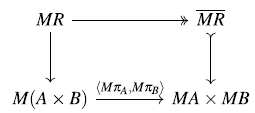
Because of the particular properties of ${\sf Set}$
, monads preserve image factorisation.
${\sf Set}$
, monads preserve image factorisation.
Lemma 17. Let M be a monad on ${\sf Set}$
.
${\sf Set}$
.
-
(1) M preserves surjections: if
$f: A\twoheadrightarrow B$
is a surjection from A onto B, then Mf is also a surjection. -
(2) M preserves image factorisations: if
is the image factorisation of
$f = i\circ p$
, then is the image factorisation of Mf.


Proof.
-
(1) Any surjection in
${\sf Set}$
is split. The splitting is preserved by functors, and hence surjections are preserved by all functors. -
(2) By Lemma 16, M preserves both surjections and monics, hence it preserves image factorisations.

Given any monad M on ${\sf Set}$
,
${\sf Set}$
, $MA\times MB$
is automatically an M-algebra with operation
$MA\times MB$
is automatically an M-algebra with operation $\langle \mu_A\circ (M\pi_{MA}), \mu_B\circ (M\pi_{MB}) \rangle: M(MA\times MB) \longrightarrow MA\times MB$
. Moreover,
$\langle \mu_A\circ (M\pi_{MA}), \mu_B\circ (M\pi_{MB}) \rangle: M(MA\times MB) \longrightarrow MA\times MB$
. Moreover, $\overline{M R}$
is also an M-algebra.
$\overline{M R}$
is also an M-algebra.
Lemma 18. $\overline{MR}$
is the smallest M sub-algebra of
$\overline{MR}$
is the smallest M sub-algebra of $MA\times MB$
containing the image of R.
$MA\times MB$
containing the image of R.
Proof. This follows immediately from the fact that $\overline{M R}$
is an M sub-algebra of
$\overline{M R}$
is an M sub-algebra of $MA\times MB$
.
$MA\times MB$
.

In the diagram above, the bottom horizontal composite is $\langle M\pi_A,M\pi_B\rangle$
, and the top composite is M applied to this. By Lemma 17, M preserves the image factorization in the bottom composite. It is easy to see that the outer rectangle commutes. It follows that there is a unique map across the centre making both squares commute, and hence that
$\langle M\pi_A,M\pi_B\rangle$
, and the top composite is M applied to this. By Lemma 17, M preserves the image factorization in the bottom composite. It is easy to see that the outer rectangle commutes. It follows that there is a unique map across the centre making both squares commute, and hence that $\overline{MR}$
is an M sub-algebra of
$\overline{MR}$
is an M sub-algebra of $MA\times MB$
.
$MA\times MB$
.
The immediate consequence of this is that $\overline{MR}$
is the free M algebra on R in
$\overline{MR}$
is the free M algebra on R in ${\sf Rel}$
and hence the two constructions by free algebra, and by direct image coincide in the case of monads on
${\sf Rel}$
and hence the two constructions by free algebra, and by direct image coincide in the case of monads on ${\sf Set}$
.
${\sf Set}$
.
7. Monoids
Bisimulation is only one of the early characterisations of equivalence for labelled transition systems. Another was trace equivalence. That talks overtly about possible sequences of actions in a way that bisimulation does not. However, the sequences are buried in the recursive nature of the definition.
We extend our notion of transition from A to $A^{\ast}$
, in the usual way. The following is a simple induction:
$A^{\ast}$
, in the usual way. The following is a simple induction:
Lemma 19. If S and T are two labelled transition systems, then $R\subseteq S\times T$
is a bisimulation if and only if for all
$R\subseteq S\times T$
is a bisimulation if and only if for all $w\in A^{\ast}$
, whenever sRt
$w\in A^{\ast}$
, whenever sRt
-
• for all
${s \stackrel{w}{\rightarrow}{s'}}$
, there is t’ such that
${t \stackrel{w}{\rightarrow}{t'}}$
and s’Rt’ -
• and for all
${t \stackrel{w}{\rightarrow}{t'}}$
, there is s’ such that
${s \stackrel{w}{\rightarrow}{s'}}$
and s’Rt’.


In other words, we could have used sequences instead of single actions, and we would have got the same notion of bisimulation (but we would have had to work harder to use it).
Another way of looking at this is to observe that the set of transition systems on S, $[S\rightarrow \operatorname{\mathcal P} S]$
, carries a monoid structure. One way of seeing that is to note that
$[S\rightarrow \operatorname{\mathcal P} S]$
, carries a monoid structure. One way of seeing that is to note that $[S\rightarrow \operatorname{\mathcal P} S]$
is equivalent to the set of
$[S\rightarrow \operatorname{\mathcal P} S]$
is equivalent to the set of ${\textstyle \bigcup}$
-preserving endofunctions on
${\textstyle \bigcup}$
-preserving endofunctions on $\operatorname{\mathcal P} S$
. Another is that it is the set of endofunctions on S in the Kleisli category for
$\operatorname{\mathcal P} S$
. Another is that it is the set of endofunctions on S in the Kleisli category for $\operatorname{\mathcal P}$
.
$\operatorname{\mathcal P}$
.
More concretely, the unit of the monoid is $\mbox{ id} = \eta = \lambda s. \{s\}$
, and the product is got from collection,
$\mbox{ id} = \eta = \lambda s. \{s\}$
, and the product is got from collection, $f_0\cdot f_1 = \lambda s. {\textstyle \bigcup}_{s'\in f_0(s)} f_1(s')$
.
$f_0\cdot f_1 = \lambda s. {\textstyle \bigcup}_{s'\in f_0(s)} f_1(s')$
.
Unsurprisingly, since this structure is essentially obtained from the monad, for any $R\subseteq S\times T$
,
$R\subseteq S\times T$
, $[R\rightarrow \operatorname{\mathcal P} R]$
also carries the structure of a monoid, and the projections to
$[R\rightarrow \operatorname{\mathcal P} R]$
also carries the structure of a monoid, and the projections to $[S\rightarrow \operatorname{\mathcal P} S]$
and
$[S\rightarrow \operatorname{\mathcal P} S]$
and $[T\rightarrow \operatorname{\mathcal P} T]$
are monoid homomorphisms. This means that we could characterise strong bisimulations as relations R for which the monoid homomorphisms giving the transition systems lift to a monoid homomorphism into the relation.
$[T\rightarrow \operatorname{\mathcal P} T]$
are monoid homomorphisms. This means that we could characterise strong bisimulations as relations R for which the monoid homomorphisms giving the transition systems lift to a monoid homomorphism into the relation.
8. Weak Bisimulation
The need for a different form of bisimulation arises when modelling processes. Processes can perform internal computations that do not correspond to actions that can be observed directly or synchronised with. In essence, the state of the system can evolve on its own. This is modelled by incorporating a silent $\tau$
action into the set of labels to represent this form of computation. Strong bisimulation is then too restrictive because it requires a close correspondence in the structure of the internal computations.
$\tau$
action into the set of labels to represent this form of computation. Strong bisimulation is then too restrictive because it requires a close correspondence in the structure of the internal computations.
In order to remedy this, Milner introduced a notion of “weak” bisimulation. We follow the account given in Milner (Reference Milner1989), in which he refers to this notion just as “bisimulation”.
We write A (this is Milner’s Act), for the set of possible actions including $\tau$
and L for the actions not including
$\tau$
and L for the actions not including $\tau$
. So
$\tau$
. So $L = A - \{\tau\}$
and
$L = A - \{\tau\}$
and $A = L + \{\tau\}$
. If
$A = L + \{\tau\}$
. If $w \in A^{\ast}$
, then we write
$w \in A^{\ast}$
, then we write $\hat{w}$
for the sequence obtained from w by deleting all occurrences of
$\hat{w}$
for the sequence obtained from w by deleting all occurrences of $\tau$
. So
$\tau$
. So $\hat{w}\in L^{\ast}$
. For example, if
$\hat{w}\in L^{\ast}$
. For example, if $w=\tau a_0 a_1 \tau \tau a_0 \tau$
, then
$w=\tau a_0 a_1 \tau \tau a_0 \tau$
, then $\hat{w} = a_0 a_1 a_0$
, and if
$\hat{w} = a_0 a_1 a_0$
, and if $w' = \tau\tau\tau$
, then
$w' = \tau\tau\tau$
, then $\hat{w'} = \epsilon$
, the empty string.
$\hat{w'} = \epsilon$
, the empty string.
Definition 20. (Milner 1989) Let S be a labelled transition system for $A = L+\{\tau\}$
, and
$A = L+\{\tau\}$
, and $v\in L^{\ast}$
, then
$v\in L^{\ast}$
, then
 \begin{equation*} \mbox{${s \stackrel{v}{\rightarrow}{s'}}$ iff there is a $w\in A^{\ast} = (L+\{\tau\})^{\ast}$ such that $v=\hat{w}$ and ${s \stackrel{w}{\rightarrow}{s'}}$.} \end{equation*}
We can type $\rightarrow$
as
$\rightarrow$
as $\rightarrow: [L^{\ast} \to [S\to\operatorname{\mathcal P} S]]$
, and we refer to it as the system derived from
$\rightarrow: [L^{\ast} \to [S\to\operatorname{\mathcal P} S]]$
, and we refer to it as the system derived from $\rightarrow$
.
$\rightarrow$
.
Observe that ${s \stackrel{\epsilon}{\rightarrow}{s'}}$
corresponds to
${s \stackrel{\epsilon}{\rightarrow}{s'}}$
corresponds to ${s \stackrel{\tau^{\ast}}{\rightarrow}{s'}}$
. It follows that
${s \stackrel{\tau^{\ast}}{\rightarrow}{s'}}$
. It follows that $\rightarrow$
is not quite a transition system in the sense previously defined. If S is a labelled transition system for A, then the extension of
$\rightarrow$
is not quite a transition system in the sense previously defined. If S is a labelled transition system for A, then the extension of $\rightarrow$
to
$\rightarrow$
to $A^{\ast}$
gives a monoid homomorphism
$A^{\ast}$
gives a monoid homomorphism $A^{\ast} \longrightarrow [S\to\operatorname{\mathcal P} S]$
. However
$A^{\ast} \longrightarrow [S\to\operatorname{\mathcal P} S]$
. However $\rightarrow$
preserves composition but not the identity. We have therefore only a semigroup homomorphism
$\rightarrow$
preserves composition but not the identity. We have therefore only a semigroup homomorphism $L^{\ast} \longrightarrow [S\to\operatorname{\mathcal P} S]$
. This prompts the definition of a lax labelled transition system (Definition 31).
$L^{\ast} \longrightarrow [S\to\operatorname{\mathcal P} S]$
. This prompts the definition of a lax labelled transition system (Definition 31).
We now return to the classical definition of weak bisimulation from Milner (Reference Milner1989).
Definition 21. If S and T are two labelled transition systems for $A = L+\{\tau\}$
, then a relation
$A = L+\{\tau\}$
, then a relation $R\subseteq S\times T$
is a weak bisimulation iff for all
$R\subseteq S\times T$
is a weak bisimulation iff for all $a\in A = L+\{\tau\}$
, whenever sRt
$a\in A = L+\{\tau\}$
, whenever sRt
-
• for all
${s \stackrel{a}{\rightarrow}{s'}}$
, there is t’ such that
${t \stackrel{a}{\rightarrow}{t'}}$
and s’Rt’ -
• and for all
${t \stackrel{a}{\rightarrow}{t'}}$
, there is s’ such that
${s \stackrel{a}{\rightarrow}{s'}}$
and s’Rt’.


The combination of two different transition relations in this definition is ugly, but fortunately it is well known that we can clean it up by just using the derived relation.
Lemma 22.
R is a weak bisimulation iff for all $a\in A = L+\{\tau\}$
, whenever sRt
$a\in A = L+\{\tau\}$
, whenever sRt
-
• for all
${s \stackrel{\overline{a}}{\rightarrow}{s'}}$
, there is t’ such that
${t \stackrel{\overline{a}}{\rightarrow}{t'}}$
and s’Rt’ -
• and for all
${t \stackrel{\overline{a}}{\rightarrow}{t'}}$
, there is s’ such that
${s \stackrel{\overline{a}}{\rightarrow}{s'}}$
and s’Rt’


where for $x \in L$
,
$x \in L$
, $\overline x$
is “x” seen as a one-letter word, and for
$\overline x$
is “x” seen as a one-letter word, and for $x=\tau$
,
$x=\tau$
, $\overline x = \epsilon$
.
$\overline x = \epsilon$
.
We can now extend as before to words in $L^{\ast}$
.
$L^{\ast}$
.
Lemma 23.
R is a weak bisimulation iff for all $v\in L^{\ast}$
, whenever sRt
$v\in L^{\ast}$
, whenever sRt
-
• for all
${s \stackrel{v}{\rightarrow}{s'}}$
, there is t’ such that
${t \stackrel{v}{\rightarrow}{t'}}$
and s’Rt’ -
• and for all
${t \stackrel{v}{\rightarrow}{t'}}$
, there is s’ such that
${s \stackrel{v}{\rightarrow}{s'}}$
and s’Rt’.


Note that we can restrict the underlying alphabet from $A = L+\{\tau\}$
to L because
$A = L+\{\tau\}$
to L because $\epsilon\in L^{\ast}$
is playing the role of
$\epsilon\in L^{\ast}$
is playing the role of $\tau\in A$
.
$\tau\in A$
.
This now looks very similar to the situation for strong bisimulation. But as we have noted above, there is a difference. Previously our transition system was given by a monoid homomorphism $A^{\ast} \longrightarrow [S\rightarrow \operatorname{\mathcal P} S]$
. Here the identity is not preserved and we only have a homomorphism of semi-groups.
$A^{\ast} \longrightarrow [S\rightarrow \operatorname{\mathcal P} S]$
. Here the identity is not preserved and we only have a homomorphism of semi-groups.
Lemma 24. If S is a labelled transition system for A, then for all $v_0,v_1 \in L^{\ast}$
,
$v_0,v_1 \in L^{\ast}$
, ${ \stackrel{{v_0 v_1}}{\Rightarrow}{}} = \ { \stackrel{{v_0}}{\Rightarrow}{}}\cdot { \stackrel{{v_1}}{\Rightarrow}{}}$
.
${ \stackrel{{v_0 v_1}}{\Rightarrow}{}} = \ { \stackrel{{v_0}}{\Rightarrow}{}}\cdot { \stackrel{{v_1}}{\Rightarrow}{}}$
.
In the following sections we present different approaches to understanding weak transition systems.
9. Weak Bisimulation through Saturation
For this section, we enrich our setting. For any S, $\operatorname{\mathcal P} S$
has a natural partial order, and hence so do the transition systems on any set S, given by the inherited partial order on
$\operatorname{\mathcal P} S$
has a natural partial order, and hence so do the transition systems on any set S, given by the inherited partial order on $A \to [S\to \operatorname{\mathcal P} S]$
.
$A \to [S\to \operatorname{\mathcal P} S]$
.
Definition 25. Given transition systems $F: A \longrightarrow [S\to\operatorname{\mathcal P} S]$
and
$F: A \longrightarrow [S\to\operatorname{\mathcal P} S]$
and $G: A \longrightarrow [T\to\operatorname{\mathcal P} T]$
, we say that
$G: A \longrightarrow [T\to\operatorname{\mathcal P} T]$
, we say that $F\leq G$
iff
$F\leq G$
iff $S=T$
and
$S=T$
and $\forall a\in A. \forall s\in S. Fas \leq Gas$
. This gives a partial order A-TS that we can view as a category.
$\forall a\in A. \forall s\in S. Fas \leq Gas$
. This gives a partial order A-TS that we can view as a category.
If $A=L+\{\tau\}$
, where
$A=L+\{\tau\}$
, where $\tau$
is an internal (silent) action, then we shall refer to these as labelled transition systems with internal action and write the partial order as
$\tau$
is an internal (silent) action, then we shall refer to these as labelled transition systems with internal action and write the partial order as $(L{+}\tau)$
-TS.
$(L{+}\tau)$
-TS.
The notion of weak bisimulation applies to transition systems with internal action, while strong bisimulation applies to arbitrary transition systems. Our aim is to find a systematic way of deriving the notion of weak bisimulation from strong.
In the following definition, we make use of the fact that $[S\to \operatorname{\mathcal P} S]$
is a monoid, as noted in Section 7.
$[S\to \operatorname{\mathcal P} S]$
is a monoid, as noted in Section 7.
Definition 26. Let $F: (L+\{\tau\}) \longrightarrow [S\to \operatorname{\mathcal P} S]$
be a transition system with internal action. We say that F is saturated if
$F: (L+\{\tau\}) \longrightarrow [S\to \operatorname{\mathcal P} S]$
be a transition system with internal action. We say that F is saturated if
-
(1)
$\mbox{ id} \leq F(\tau)$
and
$F(\tau).F(\tau) \leq F(\tau)$
and -
(2) for all
$a\in L$
,
$F(\tau).F(a).F(\tau) \leq F(a)$


We write L-Sat-TS for the full subcategory of saturated transition systems with internal actions.
These conditions are purely algebraic, and so can easily be interpreted in more general settings than ${\sf Set}$
.
${\sf Set}$
.
Note that some of the inequalities are, in fact, equalities:
 \begin{equation*}F(\tau) = F(\tau) . \mbox{ id} \leq F(\tau).F(\tau) \leq F(\tau)\end{equation*}
hence $F(\tau).F(\tau) = F(\tau)$
. Similarly
$F(\tau).F(\tau) = F(\tau)$
. Similarly $F(a) = \mbox{ id}.F(a).\mbox{ id} \leq F(\tau).F(a).F(\tau) \leq F(a)$
, therefore
$F(a) = \mbox{ id}.F(a).\mbox{ id} \leq F(\tau).F(a).F(\tau) \leq F(a)$
, therefore $F(\tau).F(a).F(\tau)=F(a)$
.
$F(\tau).F(a).F(\tau)=F(a)$
.
Moreover, if we look at the partial order consisting of unlabelled transition systems on a set S, then the fact that the monoid multiplication preserves the partial order means that $([S\to \operatorname{\mathcal P} S], . , \mbox{ id})$
is a monoidal category. Condition 26.1 says precisely that
$([S\to \operatorname{\mathcal P} S], . , \mbox{ id})$
is a monoidal category. Condition 26.1 says precisely that $F(\tau)$
is a monoid in this monoidal category, and Condition 26.2 that F(a) is an
$F(\tau)$
is a monoid in this monoidal category, and Condition 26.2 that F(a) is an $(F(\tau),F(\tau))$
-bimodule.
$(F(\tau),F(\tau))$
-bimodule.
The notions of weak and strong bisimulation coincide for saturated transition systems.
Proposition 27. Suppose $F\colon (L+\{\tau\})\longrightarrow [S\to\operatorname{\mathcal P} S]$
and
$F\colon (L+\{\tau\})\longrightarrow [S\to\operatorname{\mathcal P} S]$
and $G \colon (L+\{\tau\})\longrightarrow[T\to\operatorname{\mathcal P} T]$
are saturated transition systems with internal actions, then
$G \colon (L+\{\tau\})\longrightarrow[T\to\operatorname{\mathcal P} T]$
are saturated transition systems with internal actions, then $R\subseteq S\times T$
is a weak bisimulation between the systems if and only if it is a strong bisimulation between them.
$R\subseteq S\times T$
is a weak bisimulation between the systems if and only if it is a strong bisimulation between them.
Proof. In one direction, any strong bisimulation is also a weak one. In the other, suppose R is a weak bisimulation, that sRt, and that ${s \stackrel{a}{\rightarrow}{s'}}$
. Then by definition of weak bisimulation there is
${s \stackrel{a}{\rightarrow}{s'}}$
. Then by definition of weak bisimulation there is ${t \stackrel{a}{\Rightarrow}{t'}}$
where s’Rt’. We show that
${t \stackrel{a}{\Rightarrow}{t'}}$
where s’Rt’. We show that ${t \stackrel{a}{\rightarrow}{t'}}$
. There are two cases:
${t \stackrel{a}{\rightarrow}{t'}}$
. There are two cases:
-
•
$a\neq\tau$
: Then, by definition of
${ \stackrel{a}{\Rightarrow}{}}$
, we have
$t ({ \stackrel{\tau{}}{\rightarrow}{^{\ast}}}) { \stackrel{a}{\rightarrow}{}} ({ \stackrel{\tau}{\rightarrow}{}})^{\ast} t'$
. But since F is saturated, this implies
${t \stackrel{a}{\rightarrow}{t'}}$
as required. -
•
$a=\tau$
: Then
$t ({ \stackrel{\tau}{\rightarrow}{}})^{\ast} t'$
, and again since F is saturated, this implies
${{t} \stackrel{\tau}{\rightarrow}{t'}}$
.


Hence, we have ${t \stackrel{a}{\rightarrow}{t'}}$
and tRt’. The symmetric case is identical, so R is a strong bisimulation.
${t \stackrel{a}{\rightarrow}{t'}}$
and tRt’. The symmetric case is identical, so R is a strong bisimulation.
Given any transition system with internal action, there is a least saturated transition system containing it.
Proposition 28. The inclusion ${\mbox{L{-Sat-TS}}}\hookrightarrow{{(L{+}\tau){-TS}}}$
has a reflection:
${\mbox{L{-Sat-TS}}}\hookrightarrow{{(L{+}\tau){-TS}}}$
has a reflection: $\overline{(\cdot)}$
.
$\overline{(\cdot)}$
.
Proof. Suppose $F:(L+\{\tau\}) \longrightarrow [S\to\operatorname{\mathcal P} S]$
is a transition system with internal action. Then F is saturated if and only if
$F:(L+\{\tau\}) \longrightarrow [S\to\operatorname{\mathcal P} S]$
is a transition system with internal action. Then F is saturated if and only if $F(\tau)$
is a monoid, and F(a) is an
$F(\tau)$
is a monoid, and F(a) is an $(F(\tau),F(\tau))$
-bimodule. So we construct the adjoint by taking
$(F(\tau),F(\tau))$
-bimodule. So we construct the adjoint by taking $\overline{F}(\tau)$
to be the free monoid on
$\overline{F}(\tau)$
to be the free monoid on $F(\tau)$
and each
$F(\tau)$
and each $\overline{F}(a)$
to be the free
$\overline{F}(a)$
to be the free $(\overline{F}(\tau),\overline{F}(\tau))$
-bimodule on F(a). This construction works in settings other than
$(\overline{F}(\tau),\overline{F}(\tau))$
-bimodule on F(a). This construction works in settings other than ${\sf Set}$
, but in
${\sf Set}$
, but in ${\sf Set}$
we can give a concrete construction:
${\sf Set}$
we can give a concrete construction:
-
•
$\overline{F}(\tau) = F(\tau)^{\ast}$
-
•
$\overline{F}(a) = \overline{F}(\tau).F(a).\overline{F}(\tau)$
(
$a\neq\tau$
)


Proposition 29. Suppose $F:(L+\{\tau\}) \longrightarrow [S\to\operatorname{\mathcal P} S]$
and
$F:(L+\{\tau\}) \longrightarrow [S\to\operatorname{\mathcal P} S]$
and $G:(L+\{\tau\})\longrightarrow [T\to\operatorname{\mathcal P} T]$
are transition systems with internal actions (not necessarily saturated), then
$G:(L+\{\tau\})\longrightarrow [T\to\operatorname{\mathcal P} T]$
are transition systems with internal actions (not necessarily saturated), then $R\subseteq S\times T$
is a weak bisimulation between F and G if and only if it is a strong bisimulation between
$R\subseteq S\times T$
is a weak bisimulation between F and G if and only if it is a strong bisimulation between $\overline{F}$
and
$\overline{F}$
and $\overline{G}$
.
$\overline{G}$
.
Proof. This is a direct consequence of the concrete construction of the saturated reflection. It follows from Lemma 22, since the transition relation on the saturation is the derived transition relation on the original transition system: ${s \stackrel{a}{\rightarrow}{s'}}$
in
${s \stackrel{a}{\rightarrow}{s'}}$
in $\overline{F}$
if and only if
$\overline{F}$
if and only if ${{s} \stackrel{{\overline{a}}}{\Rightarrow}{s'}}$
with respect to F (and similarly for G).
${{s} \stackrel{{\overline{a}}}{\Rightarrow}{s'}}$
with respect to F (and similarly for G).
Corollary 30. Suppose $F\colon(L+\{\tau\})\longrightarrow [S\to\operatorname{\mathcal P} S]$
and
$F\colon(L+\{\tau\})\longrightarrow [S\to\operatorname{\mathcal P} S]$
and $G\colon(L+\{\tau\})\longrightarrow [T\to\operatorname{\mathcal P} T]$
are transition systems with internal actions, and
$G\colon(L+\{\tau\})\longrightarrow [T\to\operatorname{\mathcal P} T]$
are transition systems with internal actions, and $R\subseteq S\times T$
. Then the following are equivalent:
$R\subseteq S\times T$
. Then the following are equivalent:
-
(1) R is a weak bisimulation between F and G
-
(2)
$\overline{F}$
and
$\overline{G}$
are in the appropriate logical relation:
$(\overline{F},\overline{G})\in[\mbox{ Id}_{L+\{\tau\}}\to [R\to\operatorname{\mathcal P} R]]$
-
(3) R is the state space of a saturated transition system in
${\sf Rel}$
whose first projection is
$\overline{F}$
and whose second is
$\overline{G}$
.


The consequence of this is that we now have two separate ways of giving semantics to transition systems with inner actions. Given $F\colon(L+\tau)\longrightarrow[S\to\operatorname{\mathcal P} S]$
, we can just take F as a transition system. If we then apply the standard logical relations framework to this definition, we get that two such, F and G, are related by the logical relation
$F\colon(L+\tau)\longrightarrow[S\to\operatorname{\mathcal P} S]$
, we can just take F as a transition system. If we then apply the standard logical relations framework to this definition, we get that two such, F and G, are related by the logical relation $[\mbox{ Id}_{(L+\tau)} \to [R\to\operatorname{\mathcal P} R]]$
if and only if R is a strong bisimulation between F and G. If instead we take the semantics to be
$[\mbox{ Id}_{(L+\tau)} \to [R\to\operatorname{\mathcal P} R]]$
if and only if R is a strong bisimulation between F and G. If instead we take the semantics to be $\overline{F}$
, typed as
$\overline{F}$
, typed as $\overline{F}:(L+\tau)\longrightarrow[S\to\operatorname{\mathcal P} S]$
, then
$\overline{F}:(L+\tau)\longrightarrow[S\to\operatorname{\mathcal P} S]$
, then $\overline{F}$
and
$\overline{F}$
and $\overline{G}$
are related by the logical relation
$\overline{G}$
are related by the logical relation $[\mbox{ Id}_{(L+\tau)} \to [R\to\operatorname{\mathcal P} R]]$
if and only if R is a weak bisimulation between F and G.
$[\mbox{ Id}_{(L+\tau)} \to [R\to\operatorname{\mathcal P} R]]$
if and only if R is a weak bisimulation between F and G.
10. Lax Transition Systems
Saturated transition systems still include explicit $\tau$
-actions even though these are supposed to be internal actions only indirectly observable. We can however avoid
$\tau$
-actions even though these are supposed to be internal actions only indirectly observable. We can however avoid $\tau$
’s appearing explicitly in the semantics by giving a relaxed variant of the monoid semantics.
$\tau$
’s appearing explicitly in the semantics by giving a relaxed variant of the monoid semantics.
We recall that for an arbitrary set of action labels A, the set of A-labelled transition systems $A\longrightarrow[S\to\operatorname{\mathcal P} S]$
is isomorphic to the set of monoid homomorphisms
$A\longrightarrow[S\to\operatorname{\mathcal P} S]$
is isomorphic to the set of monoid homomorphisms $A^{\ast}\longrightarrow[S\to\operatorname{\mathcal P} S]$
, and moreover that for any transition systems F and G and relation
$A^{\ast}\longrightarrow[S\to\operatorname{\mathcal P} S]$
, and moreover that for any transition systems F and G and relation $R\subseteq S\times T$
, F is related to G by
$R\subseteq S\times T$
, F is related to G by $[{\mbox{ Id}_A}\to[R\to\operatorname{\mathcal P} R]]$
iff F is related to G as monoid homomorphism by
$[{\mbox{ Id}_A}\to[R\to\operatorname{\mathcal P} R]]$
iff F is related to G as monoid homomorphism by $[{\mbox{ Id}_{A^{\ast}}}\to [R\to\operatorname{\mathcal P} R]]$
iff R is a strong bisimulation between F and G.
$[{\mbox{ Id}_{A^{\ast}}}\to [R\to\operatorname{\mathcal P} R]]$
iff R is a strong bisimulation between F and G.
We can model transition systems with internal actions similarly, by saying what transitions correspond to sequences of visible actions. The price we pay is that, since $\tau$
is not visible, we have genuine state transitions corresponding to the empty sequence. We no longer have a monoid homomorphism.
$\tau$
is not visible, we have genuine state transitions corresponding to the empty sequence. We no longer have a monoid homomorphism.
Definition 31. A lax transition system on an alphabet L (not including an internal action $\tau$
) is a function
$\tau$
) is a function $F:L^{\ast} \longrightarrow [S\to\operatorname{\mathcal P} S]$
such that:
$F:L^{\ast} \longrightarrow [S\to\operatorname{\mathcal P} S]$
such that:
-
(1)
$\mbox{ id}\leq F(\epsilon)$
(reflexivity) -
(2)
$F(vw) = F(v).F(w)$
(composition)


Definition 32. Let $F:(L+\{\tau\})\longrightarrow [S\to\operatorname{\mathcal P} S]$
be a transition system with internal action, then its laxification
$F:(L+\{\tau\})\longrightarrow [S\to\operatorname{\mathcal P} S]$
be a transition system with internal action, then its laxification $\hat{F}:L^{\ast} \longrightarrow [S\to\operatorname{\mathcal P} S]$
is the lax transition system defined by
$\hat{F}:L^{\ast} \longrightarrow [S\to\operatorname{\mathcal P} S]$
is the lax transition system defined by
-
(1)
$\hat{F} (\epsilon) = F(\tau)^{\ast}$
-
(2)
$\hat{F} (a) = F(\tau)^{\ast}. F(a). F(\tau)^{\ast}$
, for any
$a\in L$
. -
(3)
$\hat{F} (vw) = \hat{F} (v) . \hat{F} (w)$
.


It is trivial that $\hat{F}$
is a lax transition system.
$\hat{F}$
is a lax transition system.
Lemma 33. If $F:(L+\{\tau\})\longrightarrow [S\to\operatorname{\mathcal P} S]$
is a transition system with internal action, then its laxification
$F:(L+\{\tau\})\longrightarrow [S\to\operatorname{\mathcal P} S]$
is a transition system with internal action, then its laxification $\hat{F}:L^{\ast}\longrightarrow [S\to\operatorname{\mathcal P} S]$
is a lax transition system.
$\hat{F}:L^{\ast}\longrightarrow [S\to\operatorname{\mathcal P} S]$
is a lax transition system.
We have reproduced the derived transition system.
Note that if G is a lax transition system, then G(w) depends only on $G(\epsilon)$
and the G(a), all other values are determined by composition. Note also that if F is saturated, then
$G(\epsilon)$
and the G(a), all other values are determined by composition. Note also that if F is saturated, then $\hat{F}(\epsilon) = F(\tau)$
and
$\hat{F}(\epsilon) = F(\tau)$
and $\hat{F}(a) = F(a)$
.
$\hat{F}(a) = F(a)$
.
We can also go the other way. Given a lax transition system, $F:L^{\ast}\longrightarrow [S\to\operatorname{\mathcal P} S]$
, then we can define a transition system with inner action:
$F:L^{\ast}\longrightarrow [S\to\operatorname{\mathcal P} S]$
, then we can define a transition system with inner action: $\check{F}:(L+\{\tau\})\longrightarrow [S\to\operatorname{\mathcal P} S]$
where
$\check{F}:(L+\{\tau\})\longrightarrow [S\to\operatorname{\mathcal P} S]$
where
-
•
$\check{F} (\tau) = F(\epsilon)$
-
•
$\check{F} (a) = F(a)$


Lemma 34. If $F:(L+\{\tau\})\longrightarrow [S\to\operatorname{\mathcal P} S]$
is a transition system with internal action, then its saturation
$F:(L+\{\tau\})\longrightarrow [S\to\operatorname{\mathcal P} S]$
is a transition system with internal action, then its saturation $\overline{F}$
can be constructed as
$\overline{F}$
can be constructed as $\check{\hat{F}}$
.
$\check{\hat{F}}$
.
One way of looking at this is that a lax transition system is just a saturated one in thin disguise. But from our perspective it gives us a different algebraic semantics for transition systems with inner action that can also be made to account for weak bisimulation, and this time the $\tau$
actions do not appear in the formal statement.
$\tau$
actions do not appear in the formal statement.
Lemma 35. Suppose $F:(L+\{\tau\})\longrightarrow [S\to\operatorname{\mathcal P} S]$
and
$F:(L+\{\tau\})\longrightarrow [S\to\operatorname{\mathcal P} S]$
and $G:(L+\{\tau\})\longrightarrow [T\to\operatorname{\mathcal P} T]$
are transition systems with internal actions, and
$G:(L+\{\tau\})\longrightarrow [T\to\operatorname{\mathcal P} T]$
are transition systems with internal actions, and $R\subseteq S\times T$
. Then the following are equivalent:
$R\subseteq S\times T$
. Then the following are equivalent:
-
(1) R is a weak bisimulation between F and G
-
(2)
$(\hat{F},\hat{G})\in [\mbox{ Id}_{L^{\ast}}\to [R\to\operatorname{\mathcal P} R]]$
-
(3) R is the state space of a lax transition system in
${\sf Rel}$
whose first projection is
$\hat{F}$
and whose second is
$\hat{G}$
.


11. (Semi-)Branching Bisimulations
In this section, we shall always consider two labelled transition systems $F \colon (L + \{\tau\}) \longrightarrow [ S \to \operatorname{\mathcal P} S]$
and
$F \colon (L + \{\tau\}) \longrightarrow [ S \to \operatorname{\mathcal P} S]$
and $G \colon (L + \{\tau\}) \longrightarrow [T \to \operatorname{\mathcal P} T]$
with an internal action
$G \colon (L + \{\tau\}) \longrightarrow [T \to \operatorname{\mathcal P} T]$
with an internal action $\tau$
. We begin by introducing the following notation: we say that
$\tau$
. We begin by introducing the following notation: we say that $x \overset{\tau^*}{\to} y$
, for x and y in S (or in T) if and only if there is a finite, possibly empty, sequence of
$x \overset{\tau^*}{\to} y$
, for x and y in S (or in T) if and only if there is a finite, possibly empty, sequence of $\tau$
actions
$\tau$
actions
 \begin{equation*}x \overset \tau \to \cdots \overset \tau \to y;\end{equation*}
if the sequence is empty, then we require $x = y$
.
$x = y$
.
We now recall the notion of branching bisimulation, which was introduced in van Glabbeek and Weijland (Reference van Glabbeek and Weijland1996).
Definition 36. A relation $R \subseteq S \times T$
is called a branching bisimulation if and only if whenever s R t:
$R \subseteq S \times T$
is called a branching bisimulation if and only if whenever s R t:
-
•
$s \overset{a}{\to} {s'}$
implies
$\bigl( (\exists t_1,t_2 \in T \ldotp t \overset {\tau^*} \to {t_1} \overset a \to {t_2} \land s R t_1 \land s' R t_2) \text{ or } ( a = \tau \land s' R t) \bigr)$
, -
•
$t \overset{a}{\to} {t'}$
implies
$\bigl( (\exists s_1,s_2 \in S \ldotp s \overset {\tau^*} \to {s_1} \overset a \to {s_2} \land s_1 R t \land s_2 R t') \text{ or } ( a = \tau \land s R t') \bigr)$
.


Remark 37. In particular, if R is a branching bisimulation, s R t and $s \overset \tau \to {s'}$
then there exists
$s \overset \tau \to {s'}$
then there exists $t' \in T$
such that
$t' \in T$
such that $t \overset {\tau^*} \to {t'}$
and s’ R t’.
$t \overset {\tau^*} \to {t'}$
and s’ R t’.
We show how branching bisimulation is also an instance of logical relation between appropriate derived versions of F and G.
Definition 38. The branching saturation of F, denoted by $\overline{F}^b$
, is a function
$\overline{F}^b$
, is a function
 \begin{equation*} \overline{F}^b \colon (L+\{\tau\}) \longrightarrow [ S \to \operatorname{\mathcal P} {\!(S \times S)}] \end{equation*}
defined as follows. Given $s \in S$
and
$s \in S$
and $a \in L + \{\tau\}$
,
$a \in L + \{\tau\}$
,
 \begin{equation*} \overline{F}^b a s = \{ (s_1,s_2) \in S \times S \mid (s \overset {\tau^*} \to s_1 \overset a \to s_2) \text{ or } (a = \tau \text{ and } s=s_1=s_2) \}. \end{equation*}
Theorem 39. Let $R \subseteq S \times T$
. Then R is a branching bisimulation if and only if
$R \subseteq S \times T$
. Then R is a branching bisimulation if and only if $(\overline{F}^b, \overline{G}^b) \in [\mbox{ Id}_{L+\{\tau\}} \to [R \to \operatorname{\mathcal P}{(R \times R)}]]$
.
$(\overline{F}^b, \overline{G}^b) \in [\mbox{ Id}_{L+\{\tau\}} \to [R \to \operatorname{\mathcal P}{(R \times R)}]]$
.
Proof. Let us unpack the definition of the relation $[\mbox{ Id}_{L+\{\tau\}} \to [R \to \operatorname{\mathcal P}{(R \times R)}]]$
. We have that
$[\mbox{ Id}_{L+\{\tau\}} \to [R \to \operatorname{\mathcal P}{(R \times R)}]]$
. We have that $(\overline{F}^b, \overline{G}^b) \in [\mbox{ Id}_{L+\{\tau\}} \to [R \to \operatorname{\mathcal P}{(R \times R)}]]$
if and only if for all
$(\overline{F}^b, \overline{G}^b) \in [\mbox{ Id}_{L+\{\tau\}} \to [R \to \operatorname{\mathcal P}{(R \times R)}]]$
if and only if for all $a \in L+\{\tau\}$
and for all
$a \in L+\{\tau\}$
and for all $s \in S$
and
$s \in S$
and $t \in T$
such that s R t we have
$t \in T$
such that s R t we have $(\overline{F}^b a s) [\!\operatorname{\mathcal P}{(R \times R)}] (\overline{G}^b a t)$
. By definition of
$(\overline{F}^b a s) [\!\operatorname{\mathcal P}{(R \times R)}] (\overline{G}^b a t)$
. By definition of $\operatorname{\mathcal P}{(R \times R)}$
, this means that for all
$\operatorname{\mathcal P}{(R \times R)}$
, this means that for all $(s_1,s_2) \in \overline{F}^b a s$
there exists
$(s_1,s_2) \in \overline{F}^b a s$
there exists $(t_1,t_2)$
in
$(t_1,t_2)$
in $\overline{G}^b a t$
such that
$\overline{G}^b a t$
such that $s_1 R t_1$
and
$s_1 R t_1$
and $s_2 R t_2$
.
$s_2 R t_2$
.
Suppose then that R is a branching bisimulation, consider s R t and take $(s_1,s_2) \in \overline{F}^b a s$
. We have two possible cases to discuss:
$(s_1,s_2) \in \overline{F}^b a s$
. We have two possible cases to discuss: $a = \tau \text{ and } s=s_1=s_2$
, or
$a = \tau \text{ and } s=s_1=s_2$
, or $s \overset {\tau^*} \to s_1 \overset a \to s_2$
. In the first case, consider the pair (t,t): this clearly belongs to
$s \overset {\tau^*} \to s_1 \overset a \to s_2$
. In the first case, consider the pair (t,t): this clearly belongs to $\overline{G}^b a t$
. In the second case, we are in the following situation:
$\overline{G}^b a t$
. In the second case, we are in the following situation:

If $\tau^*$
is the empty list, then
$\tau^*$
is the empty list, then $s=s_1$
, hence
$s=s_1$
, hence $s_1 R t$
: by definition of branching bisimulation, there are indeed
$s_1 R t$
: by definition of branching bisimulation, there are indeed $t_1$
and
$t_1$
and $t_2$
such that:
$t_2$
such that:

hence $(t_1,t_2) \in \overline{G}^b a t$
. If
$(t_1,t_2) \in \overline{G}^b a t$
. If $\tau^*=\tau^n$
, with
$\tau^*=\tau^n$
, with $n \ge 1$
, then by Remark 37 applied to every
$n \ge 1$
, then by Remark 37 applied to every $\tau$
in the list
$\tau$
in the list $\tau^*$
, there exists t’ in T such that
$\tau^*$
, there exists t’ in T such that $t \overset{\tau^*}{\to} t'$
and
$t \overset{\tau^*}{\to} t'$
and $s_1 R t'$
. Now apply again the definition of branching bisimulation for s R t’: we have that there are
$s_1 R t'$
. Now apply again the definition of branching bisimulation for s R t’: we have that there are $t_1$
and
$t_1$
and $t_2$
in T such that:
$t_2$
in T such that:

hence $(t_1,t_2)\in \overline{G}^b a t$
. This proves that if R is a branching bisimulation, then
$(t_1,t_2)\in \overline{G}^b a t$
. This proves that if R is a branching bisimulation, then $(\overline{F}^b, \overline{G}^b) \in [\mbox{ Id}_{L+\{\tau\}} \to [R \to \operatorname{\mathcal P}{(R \times R)}]]$
.
$(\overline{F}^b, \overline{G}^b) \in [\mbox{ Id}_{L+\{\tau\}} \to [R \to \operatorname{\mathcal P}{(R \times R)}]]$
.
Conversely, suppose $(\overline{F}^b, \overline{G}^b) \in [\mbox{ Id}_{L+\{\tau\}} \to [R \to \operatorname{\mathcal P}{(R \times R)}]]$
and that we are in the following situation:
$(\overline{F}^b, \overline{G}^b) \in [\mbox{ Id}_{L+\{\tau\}} \to [R \to \operatorname{\mathcal P}{(R \times R)}]]$
and that we are in the following situation:

Then we have $(s,s') \in \overline{F}^b a s$
, because indeed
$(s,s') \in \overline{F}^b a s$
, because indeed $s \overset {\tau^*} \to s \overset a \to s'$
. By definition of the relation
$s \overset {\tau^*} \to s \overset a \to s'$
. By definition of the relation $\operatorname{\mathcal P}{\!(R \times R)}$
, there exists
$\operatorname{\mathcal P}{\!(R \times R)}$
, there exists $(t_1,t_2) \in \overline{G}^b a t$
such that
$(t_1,t_2) \in \overline{G}^b a t$
such that $s R t_1$
and
$s R t_1$
and $s' R t_2$
. It is immediate to see that this is equivalent to the condition required by Definition 36, hence R is in fact a branching bisimulation.
$s' R t_2$
. It is immediate to see that this is equivalent to the condition required by Definition 36, hence R is in fact a branching bisimulation.
In van Glabbeek and Weijland (Reference van Glabbeek and Weijland1996) also a weaker notion of branching bisimulation was introduced, which we recall now.
Definition 40. A relation $R \subseteq S \times T$
is called a semi-branching bisimulation if and only if whenever sRt:
$R \subseteq S \times T$
is called a semi-branching bisimulation if and only if whenever sRt:
-
•
$s \overset{a}{\to} {s'}$
implies
$\bigl( (\exists t_1,t_2 \in T \ldotp t \overset {\tau^*} \to {t_1} \overset a \to {t_2} \land s R t_1 \land s' R t_2)$
or
$( a = \tau \land \exists t' \in T \ldotp {t \overset {\tau^*} \to t'} \land s R t' \land s' R t') \bigr)$
, -
•
$t \overset{a}{\to} {t'}$
implies
$\bigl( (\exists s_1,s_2 \in S \ldotp s \overset {\tau^*} \to {s_1} \overset a \to {s_2} \land s_1 R t \land s_2 R t')$
or
$( a = \tau \land \exists s' \in S \ldotp {s \overset {\tau^*} \to s'} \land s' R t \land s' R t') \bigr)$
.


Every branching bisimulation is also semi-branching, but the converse is not true. The difference between branching and semi-branching bisimulation is in what is allowed to happen in the $\tau$
-case. Indeed, if
$\tau$
-case. Indeed, if $s \overset{\tau}{\to} s'$
and sRt, in the branching case it must be that either also s’Rt, or t can “evolve” into
$s \overset{\tau}{\to} s'$
and sRt, in the branching case it must be that either also s’Rt, or t can “evolve” into $t_1$
, for
$t_1$
, for $sRt_1$
, by means of zero or more
$sRt_1$
, by means of zero or more $\tau$
actions, and then
$\tau$
actions, and then $t_1$
has to evolve into a
$t_1$
has to evolve into a $t_2$
via a
$t_2$
via a $\tau$
action with
$\tau$
action with $s' R t_2$
. In the semi-branching case, t is always allowed to evolve into t’ with zero or more
$s' R t_2$
. In the semi-branching case, t is always allowed to evolve into t’ with zero or more $\tau$
steps, as long as s is still related to t’, as well as s’ R t’. Figure 1 shows this in graphical terms.
$\tau$
steps, as long as s is still related to t’, as well as s’ R t’. Figure 1 shows this in graphical terms.
Difference between branching (left) and semi-branching (right) case for $\tau$
actions.
$\tau$
actions.

We can prove a result analogous to Theorem 39 for semi-branching bisimulations. To do so, we introduce an appropriate derived version of a labelled transition system $F \colon (L+\{\tau\}) \longrightarrow [S \to \operatorname{\mathcal P}{\!(S\times S)}]$
.
$F \colon (L+\{\tau\}) \longrightarrow [S \to \operatorname{\mathcal P}{\!(S\times S)}]$
.
Definition 41. The semi-branching saturation of F, denoted by $\widetilde{F}$
, is a function
$\widetilde{F}$
, is a function
 \begin{equation*} \widetilde{F} \colon (L+\{\tau\}) \longrightarrow [ S \to \operatorname{\mathcal P}{\!(S \times S)}] \end{equation*}
defined as follows. Given $s \in S$
and
$s \in S$
and $a \in L+\{\tau\}$
,
$a \in L+\{\tau\}$
,
 \begin{equation*} \widetilde{F} a s = \{ (s_1,s_2) \in S \times S \mid (s \overset {\tau^*} \to s_1 \overset a \to s_2) \text{ or } (a = \tau \text{ and } s_1 = s_2 \text{ and } s \overset {\tau^*} \to s_1 \}. \end{equation*}
Notice that Remark 37 continues to hold for semi-branching bisimulations too.
Theorem 42. Let $R \subseteq S \times T$
be a relation. Then R is a semi-branching bisimulation if and only if
$R \subseteq S \times T$
be a relation. Then R is a semi-branching bisimulation if and only if $(\widetilde{F}, \widetilde{G}) \in [\mbox{ id}_{L+\{\tau\}} \to [R \to \operatorname{\mathcal P}{(R \times R)}]]$
.
$(\widetilde{F}, \widetilde{G}) \in [\mbox{ id}_{L+\{\tau\}} \to [R \to \operatorname{\mathcal P}{(R \times R)}]]$
.
Proof. Same argument of the proof of Theorem 39.
12. The Almost-Monad
In Section 7, we observed that $[S \to \operatorname{\mathcal P}{S}]$
enjoys a monoid structure inherited from the monadicity of the covariant powerset
$[S \to \operatorname{\mathcal P}{S}]$
enjoys a monoid structure inherited from the monadicity of the covariant powerset $\operatorname{\mathcal P}{}$
. Sadly, we cannot say quite the same for
$\operatorname{\mathcal P}{}$
. Sadly, we cannot say quite the same for $[S \to \operatorname{\mathcal P}{(S \times S)}]$
. Indeed, consider the functor
$[S \to \operatorname{\mathcal P}{(S \times S)}]$
. Indeed, consider the functor $T(A)=\operatorname{\mathcal P}{(A \times A)}$
:
$T(A)=\operatorname{\mathcal P}{(A \times A)}$
:

where $\operatorname{\mathcal P}{(f\times f)}(S) = \{\bigl(f(x),f(y)\bigr) \mid (x,y) \in S\}$
. We can define two natural transformations
$\operatorname{\mathcal P}{(f\times f)}(S) = \{\bigl(f(x),f(y)\bigr) \mid (x,y) \in S\}$
. We can define two natural transformations $\eta \colon \mbox{ Id}_{\sf Set} \longrightarrow T$
and
$\eta \colon \mbox{ Id}_{\sf Set} \longrightarrow T$
and $\mu \colon T^2 \longrightarrow T$
as follows:
$\mu \colon T^2 \longrightarrow T$
as follows: $\eta_A (a) = \{(a,a)\}$
and
$\eta_A (a) = \{(a,a)\}$
and

It is not difficult to see that $\eta$
and
$\eta$
and $\mu$
are indeed natural, and that the following square commutes for every set A:
$\mu$
are indeed natural, and that the following square commutes for every set A:

However, although the left triangle in the following diagram commutes, the right one fails to do so in general:

Indeed, given $S \subseteq A \times A$
, it is true that
$S \subseteq A \times A$
, it is true that $S \cup S = S$
, but
$S \cup S = S$
, but
 \begin{equation*}\mu_A\bigl(T\eta_A(S)\bigr) = \mu_A\Bigl( \left\{ \bigl( \{(x,x)\}, \{(y,y)\} \bigr) \mid (x,y) \in S \right\} \Bigr) = \bigcup_{(x,y)\in S} \bigl( \{(x,x)\} \cup \{(y,y)\} \bigr) \ne S.\end{equation*}
This means that $(T,\eta,\mu)$
falls short of being a monad: it is only a “left-semi-monoid” in the category of endofunctors and natural transformations on
$(T,\eta,\mu)$
falls short of being a monad: it is only a “left-semi-monoid” in the category of endofunctors and natural transformations on ${\sf Set}$
, in the sense that
${\sf Set}$
, in the sense that $\eta$
is only a left unit for the multiplication
$\eta$
is only a left unit for the multiplication $\mu$
.
$\mu$
.
One can go further, and build up the “Kleisli non-category” associated to $(T,\eta,\mu)$
, following the usual definition for Kleisli category of a (proper) monad, where morphisms
$(T,\eta,\mu)$
, following the usual definition for Kleisli category of a (proper) monad, where morphisms $A \longrightarrow B$
are functions
$A \longrightarrow B$
are functions $A \longrightarrow \operatorname{\mathcal P}{(B \times B)}$
, and composition of
$A \longrightarrow \operatorname{\mathcal P}{(B \times B)}$
, and composition of $f \colon A \longrightarrow \operatorname{\mathcal P}{(B \times B)}$
and
$f \colon A \longrightarrow \operatorname{\mathcal P}{(B \times B)}$
and $g \colon B \longrightarrow \operatorname{\mathcal P}{(C \times C)}$
is the composite in
$g \colon B \longrightarrow \operatorname{\mathcal P}{(C \times C)}$
is the composite in ${\sf Set}$
:
${\sf Set}$
:

This composition law has $\eta$
as a left-but-not-right identity. Whereas the set of endomorphisms on A in the Kleisli category of a proper monad is always a monoid with the multiplication defined as the composition above, here we get that
$\eta$
as a left-but-not-right identity. Whereas the set of endomorphisms on A in the Kleisli category of a proper monad is always a monoid with the multiplication defined as the composition above, here we get that $[A \to \operatorname{\mathcal P}{(A \times A)}]$
is only a left-semi-monoid.
$[A \to \operatorname{\mathcal P}{(A \times A)}]$
is only a left-semi-monoid.
We can define a partial order on $[A \to \operatorname{\mathcal P}{(A \times A)}]$
in a canonical way, by setting
$[A \to \operatorname{\mathcal P}{(A \times A)}]$
in a canonical way, by setting $f \le g$
if and only if for all
$f \le g$
if and only if for all $a \in A$ $f(a) \subseteq g(a)$
; by doing so, we can regard
$f(a) \subseteq g(a)$
; by doing so, we can regard $[A \to \operatorname{\mathcal P}{(A \times A)}]$
as a category. The multiplication
$[A \to \operatorname{\mathcal P}{(A \times A)}]$
as a category. The multiplication $f \cdot g \colon A \longrightarrow \operatorname{\mathcal P}{(A \times A)}$
, defined as
$f \cdot g \colon A \longrightarrow \operatorname{\mathcal P}{(A \times A)}$
, defined as $f \cdot g (a)=\bigcup_{(x,y)\in f(a)} (g(x) \cup g(y))$
, preserves the partial order, therefore
$f \cdot g (a)=\bigcup_{(x,y)\in f(a)} (g(x) \cup g(y))$
, preserves the partial order, therefore $[A \to \operatorname{\mathcal P}{(A \times A)}]$
is a “left-semi-monoidal” category.
$[A \to \operatorname{\mathcal P}{(A \times A)}]$
is a “left-semi-monoidal” category.
13. Branching and Semi-branching Saturated Systems
In this section, we investigate the properties of $\overline{F}^b(\tau)$
and
$\overline{F}^b(\tau)$
and $\widetilde{F}(\tau)$
as elements of
$\widetilde{F}(\tau)$
as elements of $[S \to \operatorname{\mathcal P}{(S \times S)}]$
, for
$[S \to \operatorname{\mathcal P}{(S \times S)}]$
, for $F \colon (A+\{\tau\}) \longrightarrow [S \to \operatorname{\mathcal P}{(S \times S)}]$
, to explore whether it is possible to define an appropriate notion of branching or semi-branching saturated systems, where strong and branching (or semi-branching) bisimulations are the same, cf. weak case in Sections 9 and 10.
$F \colon (A+\{\tau\}) \longrightarrow [S \to \operatorname{\mathcal P}{(S \times S)}]$
, to explore whether it is possible to define an appropriate notion of branching or semi-branching saturated systems, where strong and branching (or semi-branching) bisimulations are the same, cf. weak case in Sections 9 and 10.
Lemma 43. $\eta_S \le \overline{F}^b (\tau)$
, but
$\eta_S \le \overline{F}^b (\tau)$
, but $\overline{F}^b(\tau) \cdot \overline{F}^b(\tau) \nleq \overline{F}^b(\tau)$
in general.
$\overline{F}^b(\tau) \cdot \overline{F}^b(\tau) \nleq \overline{F}^b(\tau)$
in general.
Proof. By definition, the pair (s,s), for $s \in S$
, belongs to
$s \in S$
, belongs to $\overline{F}^b \tau (s)$
, hence
$\overline{F}^b \tau (s)$
, hence $\eta_S \le \overline{F}^b (\tau)$
.
$\eta_S \le \overline{F}^b (\tau)$
.
Let now $(x,y) \in (\overline{F}^b(\tau) \cdot \overline{F}^b(\tau))(s) = \bigcup_{(s_1,s_2) \in \overline{F}^b \tau (s)} \bigl( \overline{F}^b\tau (s_1) \cup \overline{F}^b \tau(s_2) \bigr)$
: we want to check whether
$(x,y) \in (\overline{F}^b(\tau) \cdot \overline{F}^b(\tau))(s) = \bigcup_{(s_1,s_2) \in \overline{F}^b \tau (s)} \bigl( \overline{F}^b\tau (s_1) \cup \overline{F}^b \tau(s_2) \bigr)$
: we want to check whether $(x,y) \in \overline{F}^b \tau (s)$
. Suppose that
$(x,y) \in \overline{F}^b \tau (s)$
. Suppose that $(x,y) \in \overline{F}^b \tau (s_1)$
for some
$(x,y) \in \overline{F}^b \tau (s_1)$
for some $(s_1,s_2) \in \overline{F}^b \tau (s)$
. Then we are in one of the following four situations:
$(s_1,s_2) \in \overline{F}^b \tau (s)$
. Then we are in one of the following four situations:

In cases 1 and 2, we can conclude that

, while in case 4 we get $s=x=y$
, hence
$s=x=y$
, hence $(x,y) \in \overline{F}^b \tau (s)$
. However, if in case 3 we are in the situation whereby
$(x,y) \in \overline{F}^b \tau (s)$
. However, if in case 3 we are in the situation whereby $s \ne s_1$
, then
$s \ne s_1$
, then $(x,y)\notin \overline{F}^b \tau (s)$
, as it is neither the case that
$(x,y)\notin \overline{F}^b \tau (s)$
, as it is neither the case that $s=x=y$
nor
$s=x=y$
nor

It turns out, however, that the semi-branching saturation of F behaves much better than $\overline{F}^b$
.
$\overline{F}^b$
.
Lemma 44. $\widetilde{F} (\tau)$
is a left-semi-monoid in
$\widetilde{F} (\tau)$
is a left-semi-monoid in $[S \to \operatorname{\mathcal P}{(S \times S)}]$
, and
$[S \to \operatorname{\mathcal P}{(S \times S)}]$
, and $\widetilde{F} (a)$
is a left
$\widetilde{F} (a)$
is a left $\widetilde{F} (\tau)$
-module for all
$\widetilde{F} (\tau)$
-module for all $a \in A$
.
$a \in A$
.
Proof. Again, it is immediate to see that $\eta_S \le \widetilde{F}(\tau)$
, because
$\eta_S \le \widetilde{F}(\tau)$
, because

for any s, given that $\tau^*$
can be the empty list of
$\tau^*$
can be the empty list of $\tau$
’s.
$\tau$
’s.
Now we prove that $\widetilde{F} (\tau) \cdot \widetilde{F} (\tau) \le \widetilde{F}(\tau)$
. Let
$\widetilde{F} (\tau) \cdot \widetilde{F} (\tau) \le \widetilde{F}(\tau)$
. Let $s \in S$
and
$s \in S$
and $(x,y) \in (\widetilde{F} (\tau) \cdot \widetilde{F} (\tau))(s)$
. Then there exists a pair
$(x,y) \in (\widetilde{F} (\tau) \cdot \widetilde{F} (\tau))(s)$
. Then there exists a pair $(s_1,s_2) \in \widetilde{F} \tau (s)$
such that
$(s_1,s_2) \in \widetilde{F} \tau (s)$
such that $(x,y) \in \widetilde{F} \tau (s_1)$
or
$(x,y) \in \widetilde{F} \tau (s_1)$
or $(x,y) \in \widetilde{F} \tau (s_2)$
. Suppose that
$(x,y) \in \widetilde{F} \tau (s_2)$
. Suppose that $(x,y) \in \widetilde{F} \tau (s_1)$
, then we are in one of the four following cases:
$(x,y) \in \widetilde{F} \tau (s_1)$
, then we are in one of the four following cases:

In every case, we can conclude that $(x,y) \in \widetilde{F} \tau (s)$
. Thus
$(x,y) \in \widetilde{F} \tau (s)$
. Thus $\widetilde{F}(\tau)$
is a left-semi-monoid.
$\widetilde{F}(\tau)$
is a left-semi-monoid.
Finally, we show that $\widetilde{F} (\tau) \cdot \widetilde{F} (a) \le \widetilde{F}(a)$
for all
$\widetilde{F} (\tau) \cdot \widetilde{F} (a) \le \widetilde{F}(a)$
for all $a \in A$
. Let
$a \in A$
. Let $s \in S$
and consider
$s \in S$
and consider $(x,y) \in (\widetilde{F} \tau \cdot \widetilde{F} a)(s)$
. Then
$(x,y) \in (\widetilde{F} \tau \cdot \widetilde{F} a)(s)$
. Then $(x,y) \in \widetilde{F} a (s_1)$
or
$(x,y) \in \widetilde{F} a (s_1)$
or $(x,y) \in \widetilde{F} a (s_2)$
for some
$(x,y) \in \widetilde{F} a (s_2)$
for some $(s_1,s_2) \in \widetilde{F} \tau (s)$
. In the first case (and similarly for the second), it is
$(s_1,s_2) \in \widetilde{F} \tau (s)$
. In the first case (and similarly for the second), it is

and in both cases we have $(x,y) \in \widetilde{F} a (s)$
, as required.
$(x,y) \in \widetilde{F} a (s)$
, as required.
Remark 45. It is not true, in general, that $\widetilde{F} a \cdot \widetilde{F} \tau \le \widetilde{F} a$
. Indeed, consider
$\widetilde{F} a \cdot \widetilde{F} \tau \le \widetilde{F} a$
. Indeed, consider $s \in S$
and
$s \in S$
and $(x,y) \in (\widetilde{F} a \cdot \widetilde{F} \tau)(s)=\bigcup_{(s_1,s_2) \in \widetilde{F} a (s)} (\widetilde{F} \tau (s_1) \cup \widetilde{F} \tau (s_2))$
. Then the following is one of four possible scenarios:
$(x,y) \in (\widetilde{F} a \cdot \widetilde{F} \tau)(s)=\bigcup_{(s_1,s_2) \in \widetilde{F} a (s)} (\widetilde{F} \tau (s_1) \cup \widetilde{F} \tau (s_2))$
. Then the following is one of four possible scenarios:

where it is clear that $(x,y)\notin \widetilde{F} a (s)$
.
$(x,y)\notin \widetilde{F} a (s)$
.
14. The Category
$\sf Meas$

Our next goal is to discuss bisimulation for continuous Markov processes (see de Vink and Rutten Reference de Vink and Rutten1999; Panangaden Reference Panangaden2009). In order to do this, we need to step cautiously out of the world of sets and functions, and into that of measurable spaces and measurable functions.
We recall that a measurable space $(X,\Sigma)$
is a set X equipped with a
$(X,\Sigma)$
is a set X equipped with a $\sigma$
-algebra,
$\sigma$
-algebra, $\Sigma$
, the algebra of measurable sets. A measurable function
$\Sigma$
, the algebra of measurable sets. A measurable function $f \colon (X,\Sigma_X) \longrightarrow(Y,\Sigma_Y)$
is a function
$f \colon (X,\Sigma_X) \longrightarrow(Y,\Sigma_Y)$
is a function $f\colon X \longrightarrow Y$
such that if U is a measurable set of
$f\colon X \longrightarrow Y$
such that if U is a measurable set of $(Y,\Sigma_Y)$
, then
$(Y,\Sigma_Y)$
, then $f^{-1} U$
is a measurable set of
$f^{-1} U$
is a measurable set of $(X,\Sigma_X)$
. Together these form a category,
$(X,\Sigma_X)$
. Together these form a category, $\sf Meas$
.
$\sf Meas$
.
Lemma 46. $\sf Meas$
has all finite limits and
$\sf Meas$
has all finite limits and $\Gamma = \sf Meas(1,- ):\sf Meas\longrightarrow{\sf Set}$
preserves them.
$\Gamma = \sf Meas(1,- ):\sf Meas\longrightarrow{\sf Set}$
preserves them.
Proof. Let $F:D\longrightarrow\sf Meas$
be a functor from a finite category D. Then
$F:D\longrightarrow\sf Meas$
be a functor from a finite category D. Then $\varprojlim F$
is the measurable space on the set
$\varprojlim F$
is the measurable space on the set $\varprojlim (\Gamma F)$
equipped with the least
$\varprojlim (\Gamma F)$
equipped with the least $\sigma$
-algebra making the projections
$\sigma$
-algebra making the projections $\varprojlim (F) \longrightarrow F d$
measurable.
$\varprojlim (F) \longrightarrow F d$
measurable. $\sf Meas$
has coequalisers. If
$\sf Meas$
has coequalisers. If

is a pair of parallel measurable functions, then their coequaliser is $E: (Y,\Sigma_Y)\longrightarrow (Y/{\sim},\overline\Sigma)$
, where
$E: (Y,\Sigma_Y)\longrightarrow (Y/{\sim},\overline\Sigma)$
, where $\sim$
is the equivalence relation on Y generated by
$\sim$
is the equivalence relation on Y generated by $fx\sim gx$
, and
$fx\sim gx$
, and $\overline\Sigma$
is the largest
$\overline\Sigma$
is the largest $\sigma$
-algebra on
$\sigma$
-algebra on $Y/{\sim}$
making
$Y/{\sim}$
making $Y\longrightarrow Y/{\sim}$
measurable, i.e.
$Y\longrightarrow Y/{\sim}$
measurable, i.e. $\overline\Sigma = \{ V \ |\ e^{-1} V \in \Sigma_Y \}$
.
$\overline\Sigma = \{ V \ |\ e^{-1} V \in \Sigma_Y \}$
.
Corollary 48. A morphism $e:(Y,\Sigma_Y) \longrightarrow (Z,\Sigma_Z)$
in
$e:(Y,\Sigma_Y) \longrightarrow (Z,\Sigma_Z)$
in $\sf Meas$
is a regular epi if and only if
$\sf Meas$
is a regular epi if and only if $\Gamma e$
is a surjection in
$\Gamma e$
is a surjection in ${\sf Set}$
, and
${\sf Set}$
, and $U\in\Sigma_Z$
iff
$U\in\Sigma_Z$
iff $e^{-1}U\in\Sigma_Y$
.
$e^{-1}U\in\Sigma_Y$
.
Corollary 49. Any morphism in $\sf Meas$
factors essentially uniquely as a regular epi followed by a monomorphism.
$\sf Meas$
factors essentially uniquely as a regular epi followed by a monomorphism.
However, $\sf Meas$
is not regular because the pullback of a regular epi is not necessarily regular, as exhibited by this counterexample:
$\sf Meas$
is not regular because the pullback of a regular epi is not necessarily regular, as exhibited by this counterexample:
Example 50. Let $(Y,\Sigma_Y)$
be the measurable space on
$(Y,\Sigma_Y)$
be the measurable space on $Y=\{a_0,a_1,b_0,b_1\}$
with
$Y=\{a_0,a_1,b_0,b_1\}$
with $\Sigma_Y$
generated by the sets
$\Sigma_Y$
generated by the sets $\{a_0,a_1\}$
and
$\{a_0,a_1\}$
and $\{b_0,b_1\}$
. Let
$\{b_0,b_1\}$
. Let $(Z,\Sigma_Z)$
be the measurable space on
$(Z,\Sigma_Z)$
be the measurable space on $Z=\{a'_0,a'_1,b'\}$
, where the only measurable sets are
$Z=\{a'_0,a'_1,b'\}$
, where the only measurable sets are $\emptyset$
and Z. Let
$\emptyset$
and Z. Let $e \colon Y\longrightarrow Z$
be given by
$e \colon Y\longrightarrow Z$
be given by $e(a_i)= a'_i$
, and
$e(a_i)= a'_i$
, and $e(b_i) = b'$
. Then e is a regular epi. Now let
$e(b_i) = b'$
. Then e is a regular epi. Now let $(X,\Sigma_X)$
be the measurable space on
$(X,\Sigma_X)$
be the measurable space on $X=\{a'_0,a'_1\}$
where
$X=\{a'_0,a'_1\}$
where $\Sigma_X = \{\emptyset, X\}$
, and let
$\Sigma_X = \{\emptyset, X\}$
, and let $\colon :X\longrightarrow Z$
be the inclusion of X in Z. Then
$\colon :X\longrightarrow Z$
be the inclusion of X in Z. Then $i^{*}Y = \{a_0,a_1\}$
with
$i^{*}Y = \{a_0,a_1\}$
with $\sigma$
-algebra generated by the singletons, but
$\sigma$
-algebra generated by the singletons, but $i^{*}e$
is not regular epi because
$i^{*}e$
is not regular epi because $(i^{*}e)^{-1}\{a'_0\}=\{a_0\}$
is measurable, but
$(i^{*}e)^{-1}\{a'_0\}=\{a_0\}$
is measurable, but $\{a'_0\}$
is not.
$\{a'_0\}$
is not.
The consequence of this is that $\sf Meas$
has all the apparatus to construct a relational calculus, but that calculus does not have all the properties we expect. Specifically it is not an allegory. Accordingly, when we want to construct logical relations on
$\sf Meas$
has all the apparatus to construct a relational calculus, but that calculus does not have all the properties we expect. Specifically it is not an allegory. Accordingly, when we want to construct logical relations on $\sf Meas$
, we will take the measurable spaces as structures in
$\sf Meas$
, we will take the measurable spaces as structures in ${\sf Set}$
and use the constructs in
${\sf Set}$
and use the constructs in ${\sf Set}$
.
${\sf Set}$
.
15. Probabilistic Bisimulation
We follow the standard approach by defining a continuous Markov process to be a coalgebra for the Giry functor. For simplicity, we will work with unlabelled processes.
Definition 51. Giry monad. Let $(X,\Sigma_X)$
be a measurable space. The Giry functor,
$(X,\Sigma_X)$
be a measurable space. The Giry functor, $\Pi$
, is defined as follows,
$\Pi$
, is defined as follows, $\Pi (X,\Sigma_X) = (\Pi X, \Pi\Sigma_X)$
:
$\Pi (X,\Sigma_X) = (\Pi X, \Pi\Sigma_X)$
:
-
•
$\Pi X$
is the set of sub-probability measures on
$(X,\Sigma_X)$
. -
•
$\Pi\Sigma_X$
is the least
$\sigma$
-algebra on
$\Pi X$
such that for every
$U\in\Sigma_X$
,
$\lambda\pi. \pi(U)$
is measurable.


If $f \colon (X,\Sigma_X) \longrightarrow (Y,\Sigma_Y)$
is a measurable function, then
$f \colon (X,\Sigma_X) \longrightarrow (Y,\Sigma_Y)$
is a measurable function, then $\Pi f (\pi) = \lambda V\in\Sigma_Y. \pi (f^{-1} V)$
.
$\Pi f (\pi) = \lambda V\in\Sigma_Y. \pi (f^{-1} V)$
. $\Pi$
forms part of a monad in which the unit maps a point x to the Dirac measure for x, and the multiplication is defined by integration, Giry (Reference Giry1982).
$\Pi$
forms part of a monad in which the unit maps a point x to the Dirac measure for x, and the multiplication is defined by integration, Giry (Reference Giry1982).
Definition 52. continuous Markov process. A continuous Markov process is a coalgebra in $\sf Meas$
for the Giry functor, i.e. a continuous Markov process with state space
$\sf Meas$
for the Giry functor, i.e. a continuous Markov process with state space $(S,\Sigma_S)$
is a measurable function
$(S,\Sigma_S)$
is a measurable function $F \colon (S,\Sigma_S)\longrightarrow \Pi (S,\Sigma_S)$
. A homomorphism of continuous Markov processes is simply a homomorphism of coalgebras.
$F \colon (S,\Sigma_S)\longrightarrow \Pi (S,\Sigma_S)$
. A homomorphism of continuous Markov processes is simply a homomorphism of coalgebras.
There are now two similar, but slightly different approaches to defining the notion of a probabilistic bisimulation. Panangaden (Reference Panangaden2009) follows Larsen and Skou’s original definition for the discrete case. This begins by enabling a state space reduction for a single process and generates a notion of bisimulation between processes as a by-product. The second is the standard notion of bisimulation of coalgebras, as described in Rutten (Reference Rutten2000).
We begin with Panangaden’s extension of the original definition of Larsen and Skou, Panangaden (Reference Panangaden2009), Larsen and Skou (Reference Larsen and Skou1991).
Definition 53. Strong probabilistic bisimulation. Suppose $F\colon S \longrightarrow \Pi S$
is a continuous Markov process, then an equivalence relation R on S is a (strong probabilistic) bisimulation if and only if whenever sRs’, then for all R-closed measurable sets
$F\colon S \longrightarrow \Pi S$
is a continuous Markov process, then an equivalence relation R on S is a (strong probabilistic) bisimulation if and only if whenever sRs’, then for all R-closed measurable sets $U\in\Sigma_S$
,
$U\in\Sigma_S$
, $F s U = F s' U$
.
$F s U = F s' U$
.
We note that the R-closed measurable sets are exactly those inducing the $\sigma$
-algebra on
$\sigma$
-algebra on $S/R$
, and hence that this definition of equivalence corresponds to the ability to quotient the state space to give a continuous Markov process on
$S/R$
, and hence that this definition of equivalence corresponds to the ability to quotient the state space to give a continuous Markov process on $S/R$
.
$S/R$
.
Lemma 54. An equivalence relation R on $(X,\Sigma_X)$
is a strong probabilistic bisimulation relation if and only if when we equip
$(X,\Sigma_X)$
is a strong probabilistic bisimulation relation if and only if when we equip $X/R$
with the largest
$X/R$
with the largest $\sigma$
-algebra such that
$\sigma$
-algebra such that $X\to X/R$
is measurable,
$X\to X/R$
is measurable, $X/R$
carries the structure of a Giry coalgebra and the quotient is a coalgebra homomorphism in
$X/R$
carries the structure of a Giry coalgebra and the quotient is a coalgebra homomorphism in $\sf Meas$
.
$\sf Meas$
.
This definition assumes that R is total. However, that is not essential. We could formulate it for relations that are symmetric and transitive, but not necessarily total (partial equivalence relations). In this case, we have a correspondence with subquotients of the coalgebra. We do, however, have to be careful that the domain of R is a well-defined sub-algebra.
Panangaden goes on to define a bisimulation between two coalgebras. We simplify his definition as we do not consider specified initial states.
Given a binary relation R between S and T, we extend R to a binary relation on the single set $S+T$
. In order to apply the previous definition, we will want the equivalence relation on
$S+T$
. In order to apply the previous definition, we will want the equivalence relation on $S+T$
generated by R.
$S+T$
generated by R.
Now $(S+T)\times (S+T) = (S\times S) + (S\times T) + (T\times S) + (T\times T)$
, and each of these components has a simple relation derived from R, specifically
$(S+T)\times (S+T) = (S\times S) + (S\times T) + (T\times S) + (T\times T)$
, and each of these components has a simple relation derived from R, specifically $R{R}^\circ $
, R,
$R{R}^\circ $
, R, ${R}^\circ$
and
${R}^\circ$
and ${R}^\circ R$
.
${R}^\circ R$
.
Definition 55. z-closed. $R \subseteq S\times T$
is z-closed iff
$R \subseteq S\times T$
is z-closed iff $R{R}^\circ R \subseteq R$
, in other words, iff whenever
$R{R}^\circ R \subseteq R$
, in other words, iff whenever $sRt \wedge s_1Rt \wedge s_1Rt_1$
then
$sRt \wedge s_1Rt \wedge s_1Rt_1$
then $sRt_1$
.
$sRt_1$
.
Lemma 56. $R \subseteq S \times T$
is z-closed if and only if
$R \subseteq S \times T$
is z-closed if and only if $R^{\ast} = R{R}^\circ + R + {R}^\circ + {R}^\circ R$
is transitive as a relation on
$R^{\ast} = R{R}^\circ + R + {R}^\circ + {R}^\circ R$
is transitive as a relation on $(S+T)\times (S+T)$
. Since
$(S+T)\times (S+T)$
. Since $R^{\ast}$
is clearly symmetric, R is z-closed iff
$R^{\ast}$
is clearly symmetric, R is z-closed iff $R^{\ast}$
is a partial equivalence relation.
$R^{\ast}$
is a partial equivalence relation.
Secondly, given continuous Markov processes F on S and G on T we can define their sum $F+G$
on
$F+G$
on $S+T$
:
$S+T$
:
 \begin{equation*}(F+G) x U = \begin{cases}Fx(U \cap S) & \text{if $x \in S$} \\Gx(U \cap T) & \text{if $x \in T$}\end{cases}\end{equation*}
We can now make a definition that seems to us to contain the essence of Panangaden’s approach:
Definition 57. strong probabilistic bisimulation between processes. R is a strong probabilistic bisimulation between the continuous Markov processes F on S and G on T iff $R^{\ast} = R{R}^\circ + R + {R}^\circ + {R}^\circ R$
is a strong probabilistic bisimulation as defined in Definition 53 on the sum process
$R^{\ast} = R{R}^\circ + R + {R}^\circ + {R}^\circ R$
is a strong probabilistic bisimulation as defined in Definition 53 on the sum process $F+G$
on
$F+G$
on $S+T$
.
$S+T$
.
Note that any such relation will be z-closed. Given that $R^{\ast}$
must be total, it also induces an isomorphism between quotients of the continuous Markov processes.
$R^{\ast}$
must be total, it also induces an isomorphism between quotients of the continuous Markov processes.
This definition corresponds exactly to what we get by taking the obvious logical relations approach.
Logical relations of continuous Markov Processes. Given a measurable space $(S,\Sigma_S)$
, we treat the
$(S,\Sigma_S)$
, we treat the $\sigma$
-algebra
$\sigma$
-algebra $\Sigma_S$
as a subset of the function space
$\Sigma_S$
as a subset of the function space $[S\to 2]$
, and use the standard mechanisms of logical relations in
$[S\to 2]$
, and use the standard mechanisms of logical relations in ${\sf Set}$
to extend a relation
${\sf Set}$
to extend a relation $R\subseteq S\times T$
between two measurable spaces to a relation
$R\subseteq S\times T$
between two measurable spaces to a relation $R_\Sigma$
between
$R_\Sigma$
between $\Sigma_S$
and
$\Sigma_S$
and $\Sigma_{T}$
:
$\Sigma_{T}$
: $UR_\Sigma V$
if and only if
$UR_\Sigma V$
if and only if $\forall s,t. sRt \implies (s\in U \iff t\in V)$
.
$\forall s,t. sRt \implies (s\in U \iff t\in V)$
.
Lemma 58.
-
(1) If R is an equivalence relation then
$UR_\Sigma V$
iff
$U=V$
and is R-closed. -
(2) If R is z-closed, then
$UR_\Sigma V$
iff
$U+V$
is an
$R^{\ast}$
-closed subset of
$S+T$
. -
(3) If R is the graph of a function
$f\colon S\longrightarrow T$
, then
$UR_\Sigma V$
iff
$U=f^{-1}V$
.


Unpacking the definition of the Giry functor, a Giry coalgebra structure on the measurable space $(S,\Sigma_S)$
has type
$(S,\Sigma_S)$
has type $S\longrightarrow [\Sigma_S \to [0,1]]$
, or equivalently
$S\longrightarrow [\Sigma_S \to [0,1]]$
, or equivalently $S \times \Sigma_S \longrightarrow [0,1]$
, where for the purposes of defining logical relations we regard
$S \times \Sigma_S \longrightarrow [0,1]$
, where for the purposes of defining logical relations we regard $\Sigma_S$
as a subset of
$\Sigma_S$
as a subset of $[S\to 2]$
. We again apply the standard machinery to this.
$[S\to 2]$
. We again apply the standard machinery to this.
Definition 59. logical relation of continuous Markov processes. If $R\subseteq S\times T$
is a relation between the state spaces of continuous Markov processes
$R\subseteq S\times T$
is a relation between the state spaces of continuous Markov processes $F\colon S\longrightarrow\Pi S$
and
$F\colon S\longrightarrow\Pi S$
and $G\colon T\longrightarrow\Pi T$
, then R is a logical relation of continuous Markov processes iff whenever sRt and
$G\colon T\longrightarrow\Pi T$
, then R is a logical relation of continuous Markov processes iff whenever sRt and $UR_\Sigma V$
,
$UR_\Sigma V$
, $F s U = G t V$
.
$F s U = G t V$
.
The following lemmas follow readily from the definitions.
Lemma 60. If $R\subseteq S\times T$
is a total and onto z-closed relation between continuous Markov processes
$R\subseteq S\times T$
is a total and onto z-closed relation between continuous Markov processes $F\colon S\longrightarrow\Pi S$
and
$F\colon S\longrightarrow\Pi S$
and $G\colon T\longrightarrow\Pi T$
, then R is a logical relation of continuous Markov processes if and only if R is a strong probabilistic bisimulation.
$G\colon T\longrightarrow\Pi T$
, then R is a logical relation of continuous Markov processes if and only if R is a strong probabilistic bisimulation.
Lemma 61. If $R\subseteq S\times T$
is the graph of a measurable function f between continuous Markov processes
$R\subseteq S\times T$
is the graph of a measurable function f between continuous Markov processes $F\colon S\longrightarrow\Pi S$
and
$F\colon S\longrightarrow\Pi S$
and $G\colon T\longrightarrow\Pi T$
, then R is a logical relation of continuous Markov processes if and only if f is a homomorphism of continuous Markov processes.
$G\colon T\longrightarrow\Pi T$
, then R is a logical relation of continuous Markov processes if and only if f is a homomorphism of continuous Markov processes.
Proof. Observe that f is a homomorphism if and only if for all $s\in S$
and
$s\in S$
and $V\in\Sigma_{T}$
,
$V\in\Sigma_{T}$
, $G (fs) V = F s (f^{-1}V)$
.
$G (fs) V = F s (f^{-1}V)$
.
So logical relations capture both the concept of strong probabilistic bisimulation (given that the candidate relations are restricted in nature), and the concept of homomorphism of systems. But they do not capture everything. $\Pi$
$\Pi$
-bisimulation. Recall from Rutten (Reference Rutten2000) that for a functor $H \colon \sf C \longrightarrow \sf C$
and two H-coalgebras
$H \colon \sf C \longrightarrow \sf C$
and two H-coalgebras $f \colon A \longrightarrow HA$
and
$f \colon A \longrightarrow HA$
and $g \colon B \longrightarrow HB$
, an H-bisimulation between f and g is a H-coalgebra
$g \colon B \longrightarrow HB$
, an H-bisimulation between f and g is a H-coalgebra $h \colon C \longrightarrow HC$
together with two coalgebra-homomorphisms
$h \colon C \longrightarrow HC$
together with two coalgebra-homomorphisms $l \colon C \longrightarrow A$
and
$l \colon C \longrightarrow A$
and $r \colon C \longrightarrow B$
, that is, it is a span in the category of coalgebras for H:
$r \colon C \longrightarrow B$
, that is, it is a span in the category of coalgebras for H:

where the above diagram is required to be commutative.
Definition 62. A $\Pi$
-bisimulation is simply an H-bisimulation in the category
$\Pi$
-bisimulation is simply an H-bisimulation in the category $\sf Meas$
where the functor H is
$\sf Meas$
where the functor H is $\Pi$
.
$\Pi$
.
It is implicit in this definition that a bisimulation includes a coalgebra structure, and is not simply a relation. Where the functor H corresponds to a traditional algebra generated by first-order terms and equations, the algebraic structure on the relation is unique. But that is not the case here.
Example 63. Consider a continuous Markov process $F: { S}\longrightarrow \Pi { S}$
, then
$F: { S}\longrightarrow \Pi { S}$
, then ${S}\times{ S}$
typically carries a number of continuous Markov process structures for which both projections are homomorphisms. For example:
${S}\times{ S}$
typically carries a number of continuous Markov process structures for which both projections are homomorphisms. For example:
-
(1) a “two independent copies” structure given by
\begin{equation*}FF (s,s') (U,U') = (F s U) \times (F s' U')\end{equation*}
-
(2) a “two observations of a single copy” structure given by
\begin{equation*} F^2 (s,s') (U,U') = \begin{cases} F s (U\cap U') & \text{if $s = s'$} \\ F s U \times F s' U' & \text{ if $s \ne s'$} \end{cases} \end{equation*}


Example 64. More specifically, consider the process t modelling a single toss of a fair coin. This can be modelled as a process with three states, $C=\{S,H,T\}$
: Start (S), Head tossed (H) and Tail tossed (T). From S we move randomly to one of H and T and then stay there. The transition matrix is given below. This is a discrete process, and we take all subsets to be measurable.
$C=\{S,H,T\}$
: Start (S), Head tossed (H) and Tail tossed (T). From S we move randomly to one of H and T and then stay there. The transition matrix is given below. This is a discrete process, and we take all subsets to be measurable.
 \begin{equation*}t\mbox{ is given by} \quad\begin{array}{c|ccc} & S & H & T \\ \hline S & 0 & 0.5 & 0.5 \\ H & 0 & 1 & 0\\ T & 0 & 0 & 1 \end{array} \end{equation*}
Now consider the state space $C\times C$
. We define two different process structures on this. The first,
$C\times C$
. We define two different process structures on this. The first, $t^{*}$
, is simply the product of the two copies of C. The transition matrix for this is the tensor of the transition matrix for C with itself: the pairwise product of the entries. This represents the process of two independent tosses of a coin.
$t^{*}$
, is simply the product of the two copies of C. The transition matrix for this is the tensor of the transition matrix for C with itself: the pairwise product of the entries. This represents the process of two independent tosses of a coin.
 \begin{equation*}t^{*}\mbox{ is given by } \quad\begin{array}{c|*{9}{c}} & SS & HH & TT & HT & TH & SH & HS & ST & TS \\ \hline SS & 0 & 0.25 & 0.25 & 0.25 & 0.25 & 0 & 0 & 0 & 0 \\ HH & 0 & 1 & 0 & 0 & 0 & 0 & 0 & 0 & 0\\ TT & 0 & 0 & 1 & 0 & 0 & 0 & 0 & 0 & 0\\ HT & 0 & 0 & 0 & 1 & 0 & 0 & 0 & 0 & 0\\ \ldots\\ TS & 0 & 0 & 0.5 & 0 & 0.5 & 0 & 0 & 0 & 0 \end{array} \end{equation*}
The second, $t^{+}$
is identical except for the first row:
$t^{+}$
is identical except for the first row:
 \begin{equation*}t^{+}\mbox{ is given by } \quad\begin{array}{c|*{9}{c}} & SS & HH & TT & HT & TH & SH & HS & ST & TS \\ \hline SS & 0 & 0.5 & 0.5 & 0 & 0 & 0 & 0 & 0 & 0 \\ \ldots \end{array} \end{equation*}
This is motivated by the process of two observers watching a single toss of a coin.
The projections are homomorphisms for both these structures. For example, the first projection is a homomorphism for $t^{+}$
because for each I, J, K:
$t^{+}$
because for each I, J, K:
 \begin{equation*} t I \{K\} = \sum_L t^{+} IJ \{KL\} \end{equation*}
This means that in order to establish that a relation is a $\Pi$
-bisimulation, we have to define a structure and prove the homomorphisms, and not simply validate some closure conditions.
$\Pi$
-bisimulation, we have to define a structure and prove the homomorphisms, and not simply validate some closure conditions.
Moreover, in contrast to the case for first-order theories, this non-uniqueness of algebra structures implies that we cannot always reduce spans of homomorphisms to relations.
Example 65. Consider the sum of the two algebra structures from Example 63 as an algebra $t^{*} + t^{+}$
on
$t^{*} + t^{+}$
on $(C\times C)+(C\times C)$
. This is a
$(C\times C)+(C\times C)$
. This is a $\Pi$
-bisimulation from C to itself in which the legs of the span are the co-diagonal,
$\Pi$
-bisimulation from C to itself in which the legs of the span are the co-diagonal, $\nabla$
, followed by the projections. The co-diagonal maps
$\nabla$
, followed by the projections. The co-diagonal maps $(C\times C)+(C\times C)$
to its relational image, but is not an algebra homomorphism for any algebra structure on
$(C\times C)+(C\times C)$
to its relational image, but is not an algebra homomorphism for any algebra structure on $C\times C$
. If there were an algebra homomorphism, for an algebra structure
$C\times C$
. If there were an algebra homomorphism, for an algebra structure $\delta$
, say, then we would have that both
$\delta$
, say, then we would have that both $(t^{*}+t^{+})(\operatorname{inl} SS) (\nabla^{-1}\{HT\}) = t^{*} (SS) \{HT\}$
and
$(t^{*}+t^{+})(\operatorname{inl} SS) (\nabla^{-1}\{HT\}) = t^{*} (SS) \{HT\}$
and $(t^{*}+t^{+})(\operatorname{inr} SS) (\nabla^{-1}\{HT\}) = t^{+} (SS) \{HT\}$
would be equal to
$(t^{*}+t^{+})(\operatorname{inr} SS) (\nabla^{-1}\{HT\}) = t^{+} (SS) \{HT\}$
would be equal to $\delta (SS) \{HT\}$
. But the first is
$\delta (SS) \{HT\}$
. But the first is $t^{*} (SS) \{HT\} = 0.25$
, and the second is
$t^{*} (SS) \{HT\} = 0.25$
, and the second is $t^{+} (SS) \{HT\} = 0$
.
$t^{+} (SS) \{HT\} = 0$
.
We now show that, despite these issues, $\Pi$
-bisimulations give rise to logical relations.
$\Pi$
-bisimulations give rise to logical relations.
Theorem 66. Suppose

is a $\Pi$
-bisimulation between the continuous Markov processes F and G. Let
$\Pi$
-bisimulation between the continuous Markov processes F and G. Let $R \subseteq S \times T$
be the relation which is the image of
$R \subseteq S \times T$
be the relation which is the image of $\langle l,r\rangle \colon P \longrightarrow S\times T$
, i.e. sRt iff
$\langle l,r\rangle \colon P \longrightarrow S\times T$
, i.e. sRt iff $\exists p. lp=s \wedge rp=t$
. Then R is a logical relation between F and G.
$\exists p. lp=s \wedge rp=t$
. Then R is a logical relation between F and G.
Proof. Suppose sRt and $UR_\Sigma V$
for
$UR_\Sigma V$
for $U\in\Sigma_S$
and
$U\in\Sigma_S$
and $V\in\Sigma_T$
. We must show that
$V\in\Sigma_T$
. We must show that $F(s)(U) = G(t)(V)$
.
$F(s)(U) = G(t)(V)$
.
We begin by showing that $l^{-1}U = r^{-1}V$
. Suppose
$l^{-1}U = r^{-1}V$
. Suppose $p\in P$
, then (lp)R(rp), and hence
$p\in P$
, then (lp)R(rp), and hence $p\in l^{-1} U$
iff
$p\in l^{-1} U$
iff $lp\in U$
iff
$lp\in U$
iff $rp\in V$
(since
$rp\in V$
(since $UR_\Sigma V$
) iff
$UR_\Sigma V$
) iff $p\in r^{-1}V$
. Hence
$p\in r^{-1}V$
. Hence $l^{-1}U = r^{-1}V$
, as required.
$l^{-1}U = r^{-1}V$
, as required.
Now, since sRt, there is a p such that $lp=s$
and
$lp=s$
and $rp=t$
. Then
$rp=t$
. Then
 \begin{align*} F(s)(U) &= H p (l^{-1} U) &\text{because \textit{l} is a $\Pi$-homomorphism}\\ &= H p (r^{-1} V) &\text{because $l^{-1}U = r^{-1}V$}\\ &= G(t)(V) &\text{because \textit{r} is a $\Pi$-homomorphism}\end{align*}
as required.
Establishing a converse is more problematic. There are a number of issues. One is that $\Pi$
-bisimulations work on spans, not relations. Another is that there might not be much coherence between the relation R and the
$\Pi$
-bisimulations work on spans, not relations. Another is that there might not be much coherence between the relation R and the $\sigma$
-algebras
$\sigma$
-algebras $\Sigma_S$
and
$\Sigma_S$
and $\Sigma_T$
. And a third is the fact that in order to define a
$\Sigma_T$
. And a third is the fact that in order to define a $\Pi$
-algebra structure H on R, we have to define H (s,t) W, where W is an element of the
$\Pi$
-algebra structure H on R, we have to define H (s,t) W, where W is an element of the $\sigma$
-algebra generated by the sets
$\sigma$
-algebra generated by the sets $R\cap (U\times V)$
, where
$R\cap (U\times V)$
, where $U\in\Sigma_S$
and
$U\in\Sigma_S$
and $V\in\Sigma_T$
. It is not clear that such an extension will always exist, and Example 63 shows that there is no canonical way to construct it.
$V\in\Sigma_T$
. It is not clear that such an extension will always exist, and Example 63 shows that there is no canonical way to construct it.
Nevertheless we can show that a logical relation gives rise to a $\Pi$
-bisimulation, unfortunately not on the original algebras, but on others with the same state space but a cruder measure structure.
$\Pi$
-bisimulation, unfortunately not on the original algebras, but on others with the same state space but a cruder measure structure.
The following lemma is immediate.
Lemma 67. Suppose $F \colon (S,\Sigma_S) \longrightarrow \Pi (S,\Sigma_S)$
is a continuous Markov process. Suppose also that
$F \colon (S,\Sigma_S) \longrightarrow \Pi (S,\Sigma_S)$
is a continuous Markov process. Suppose also that $\Sigma'$
is a sub-
$\Sigma'$
is a sub- $\sigma$
-algebra of
$\sigma$
-algebra of $\Sigma_S$
, then F restricts to a continuous Markov process F’ on
$\Sigma_S$
, then F restricts to a continuous Markov process F’ on $(S,\Sigma')$
, and
$(S,\Sigma')$
, and $1_S \colon (S,\Sigma_S) \longrightarrow (S,\Sigma')$
is a homomorphism.
$1_S \colon (S,\Sigma_S) \longrightarrow (S,\Sigma')$
is a homomorphism.
If R is a logical relation between continuous Markov processes F on S and G on T, then R only gives us information about the measurable sets included in $R_\Sigma$
. The following lemmas are immediate from the definitions.
$R_\Sigma$
. The following lemmas are immediate from the definitions.
Lemma 68. If $R\subseteq S\times T$
is a relation between the state spaces of two continuous Markov processes F and G and
$R\subseteq S\times T$
is a relation between the state spaces of two continuous Markov processes F and G and $\pi_{1} \colon R \longrightarrow S$
,
$\pi_{1} \colon R \longrightarrow S$
, $\pi_{2} \colon R \longrightarrow T$
are the two projections, then the following are equivalent for
$\pi_{2} \colon R \longrightarrow T$
are the two projections, then the following are equivalent for $U\subseteq S$
and
$U\subseteq S$
and $V\subseteq T$
:
$V\subseteq T$
:
-
(1)
$U [R\to\{0,1\}] V$
-
(2) U is closed under
$R{R}^\circ$
, and
$UR = V\cap \mathop{\mbox{cod}} R$
-
(3)
$\pi_{1}^{-1} U = \pi_{2}^{-1} V$
.


Lemma 69. If $R\subseteq S\times T$
is a relation between the state spaces of two continuous Markov processes F and G, then the sets linked by
$R\subseteq S\times T$
is a relation between the state spaces of two continuous Markov processes F and G, then the sets linked by $[R\to\{0,1\}]$
have the following closure properties:
$[R\to\{0,1\}]$
have the following closure properties:
-
(1) If
$U [R\to\{0,1\}] V$
then
$U^{\mathsf{c}} \ [R\to\{0,1\}]\ V^{\mathsf{c}}$
-
(2) If for all
$\alpha\in A$
,
$U_\alpha [R\to\{0,1\}] V_\alpha$
then
${\textstyle \bigcup}_{\alpha\in A} U_\alpha\ [R\to\{0,1\}]\ {\textstyle \bigcup}_{\alpha\in A} V_\alpha$
.


Corollary 70. The measurable subsets linked by $[R\to\{0,1\}]$
have the same closure properties and hence the following are
$[R\to\{0,1\}]$
have the same closure properties and hence the following are $\sigma$
-algebras:
$\sigma$
-algebras:
-
(1)
$\Sigma_{R}(S) = \{ U\in \Sigma_S | \exists V\in\Sigma_T. UR_\Sigma V\}$
-
(2)
$\Sigma_{R}(T) = \{ V\in \Sigma_T | \exists U\in\Sigma_S. UR_\Sigma V\}$
-
(3)
$\begin{array}[t]{cl} \Sigma_R & = \{ W\subseteq R | \exists U\in\Sigma_S, V\in\Sigma_T.\ UR_\Sigma V \wedge W=\pi_{1}^{-1} U \}\\ &= \{ W\subseteq R | \exists U\in\Sigma_S, V\in\Sigma_T.\ UR_\Sigma V \wedge W=\pi_{1}^{-1} U = \pi_{2}^{-1} V\}. \end{array}$


Theorem 71. Suppose $R\subseteq S\times T$
is a relation between the state spaces of two continuous Markov processes F and G. If R is a logical relation then there is a
$R\subseteq S\times T$
is a relation between the state spaces of two continuous Markov processes F and G. If R is a logical relation then there is a $\Pi$
-bisimulation:
$\Pi$
-bisimulation:

Proof. Suppose $(s,t)\in R$
and
$(s,t)\in R$
and $W\in\Sigma_R$
, then we need to define H (s,t) W. Suppose
$W\in\Sigma_R$
, then we need to define H (s,t) W. Suppose $U\in\Sigma_{R}(S)$
,
$U\in\Sigma_{R}(S)$
, $V\in\Sigma_{R}(T)$
, such that
$V\in\Sigma_{R}(T)$
, such that $W=\pi_{1}^{-1} U = \pi_{2}^{-1} V$
and
$W=\pi_{1}^{-1} U = \pi_{2}^{-1} V$
and $UR_\Sigma V$
. Then, since R is a logical relation,
$UR_\Sigma V$
. Then, since R is a logical relation, $F(s)(U) = G(t)(V)$
.
$F(s)(U) = G(t)(V)$
.
We claim that this is independent of the choice of U and V. Suppose $U'\in\Sigma_{R}(S)$
,
$U'\in\Sigma_{R}(S)$
, $V'\in\Sigma_{R}(T)$
, such that
$V'\in\Sigma_{R}(T)$
, such that $W=\pi_{1}^{-1} U' = \pi_{2}^{-1} V'$
and
$W=\pi_{1}^{-1} U' = \pi_{2}^{-1} V'$
and $U'R_\Sigma V'$
. Then
$U'R_\Sigma V'$
. Then $\pi_{1}^{-1} U' = \pi_{2}^{-1} V = W$
, and hence
$\pi_{1}^{-1} U' = \pi_{2}^{-1} V = W$
, and hence $U'R_\Sigma V$
, so
$U'R_\Sigma V$
, so $F(s)(U')=G(t)(V)=F(s)(U)$
.
$F(s)(U')=G(t)(V)=F(s)(U)$
.
We now define $H(s,t)(W) = F(s)(U)$
.
$H(s,t)(W) = F(s)(U)$
.
We need to show that this is a $\Pi$
-algebra structure.
$\Pi$
-algebra structure.
First, we show that H(s,t) is a sub-probability measure. We use a slightly non-standard characterisation of measures:
-
(1) Since
$\emptyset\in\Sigma_{R}(S)$
,
$H(s,t)\emptyset=F(s)\emptyset = 0$
. -
(2) For W, W’ in
$\Sigma_R$
, let U and U’ be in
$\Sigma_{R}(S)$
such that
$\pi_{1}^{-1} U = W$
and
$\pi_{1}^{-1} U' = W'$
. Then, since F(s) is a measure:
$F(s)(U) + F(s)(U') = F(s)(U\cup U') + F(s)(U\cap U')$
. Now, since
$\pi_{1}^{-1} {}$
preserves unions and intersections,
$H(s,t)(W) + H(s,t)(W') = H(s,t)(W\cup W') + H(s,t)(W\cap W')$
. -
(3) If
$W_i$
is an increasing chain of elements of
$\Sigma_R$
, then let
$U_i$
be an increasing chain of elements of
$\Sigma_{R}(S)$
such that
$\pi_{1}^{-1} (U_i) = W_i$
. Then
$H(s,t)({\textstyle \bigcup} W_i) = F(s)({\textstyle \bigcup} U_i) = \lim F(s)(U_i) = \lim H(s,t)(U_i)$
.


To complete the proof it suffices to show that for each $W\in\Sigma_R$
,
$W\in\Sigma_R$
, $H(-)(W)$
is a measurable function. Choose
$H(-)(W)$
is a measurable function. Choose $U\in\Sigma_{R}(S)$
and
$U\in\Sigma_{R}(S)$
and $V\in\Sigma_{R}(T)$
such that
$V\in\Sigma_{R}(T)$
such that $UR_\Sigma V$
and
$UR_\Sigma V$
and $W=\pi_{1}^{-1} U = \pi_{2}^{-1} V$
. Now, given
$W=\pi_{1}^{-1} U = \pi_{2}^{-1} V$
. Now, given $q\in [0,1]$
, let
$q\in [0,1]$
, let $U_q = \{s\in S \mid F(s)(U)\leq q\}$
and
$U_q = \{s\in S \mid F(s)(U)\leq q\}$
and $V_q = \{t\in T \mid G(t)(V)\leq q\}$
. Now suppose sRt, then, since R is a logical relation,
$V_q = \{t\in T \mid G(t)(V)\leq q\}$
. Now suppose sRt, then, since R is a logical relation, $F(s)(U)=G(t)(V)$
, hence
$F(s)(U)=G(t)(V)$
, hence $s\in U_q$
iff
$s\in U_q$
iff $t\in V_q$
. Therefore,
$t\in V_q$
. Therefore, $U_q R_\Sigma V_q$
. Moreover,
$U_q R_\Sigma V_q$
. Moreover, $H(s,t)(W)=F(s)(U)=G(t)(V)$
, and hence
$H(s,t)(W)=F(s)(U)=G(t)(V)$
, and hence $H(s,t)(W)\leq q$
iff
$H(s,t)(W)\leq q$
iff $s\in U_q$
iff
$s\in U_q$
iff $t\in V_q$
. It follows that
$t\in V_q$
. It follows that $\{(s,t) | H(s,t)(W)\leq q \}\in\Sigma_R$
, and hence that
$\{(s,t) | H(s,t)(W)\leq q \}\in\Sigma_R$
, and hence that $H(-)(W)$
is measurable as required.
$H(-)(W)$
is measurable as required.
Putting this together we see that if we have a logical relation between F and G, then we get the following diagram, in which the non-horizontal maps in the top section are identities on state spaces:

We can view Theorem 71 as saying that we may be given too fine a measure structure on S and T for a logical relation to generate a $\Pi$
-bisimulation, but we can always get a
$\Pi$
-bisimulation, but we can always get a $\Pi$
-bisimulation with a coarser structure. Just how coarse and how useful this structure might be depends on the logical relation and its relationship with the original
$\Pi$
-bisimulation with a coarser structure. Just how coarse and how useful this structure might be depends on the logical relation and its relationship with the original $\sigma$
-algebras on the state spaces.
$\sigma$
-algebras on the state spaces.
Example 72.
-
• In the contrived examples of 63, we have taken the relation R to be the whole of
$C\times C$
and in effect used the algebra structure to restrict the effect of this. However, since
$R=C\times C$
,
$\Sigma_{R}(C)$
contains only the empty set and the whole of C. As a result, the continuous Markov process we get is not useful: the probability of evolving into the empty set is always 0, and the probability of evolving into something is always 1. -
• In the same examples, we can restrict the state spaces for
$t^{*}$
and
$t^{+}$
. For
$t^{*}$
we take
$R^{*} = \{SS,HH,TT,HT,TH\}$
, reflecting the states accessible from SS. In this case,
$\Sigma_{R}(C) = \{ \emptyset, \{S\}, \{H,T\}, \{S,H,T\}\}$
. For
$t^{+}$
we take
$R^{+} = \{SS,HH,TT\}$
, and
$\Sigma_{R}(C)$
contains all the subsets of C.


Financial support
Edmund Robinson and Alessio Santamaria acknowledge the support of EPSRC grant EP/R006865/1, Interface Reasoning for Interactive Systems. Santamaria also acknowledges the support of the Ministero dell’UniversitÀ e della Ricerca Scientifica of Italy under Grant No. 201784YSZ5, PRIN2017 – ASPRA (Analysis of Program Analyses).
Conflicts of Interests
The authors declare none.


 Open access

