



No CrossRef data available.
Article contents
CONTROLLING LIPSCHITZ FUNCTIONS
Published online by Cambridge University Press: 02 August 2018
Abstract
Given any positive integers  $m$ and $d$, we say a sequence of points $(x_{i})_{i\in I}$ in $\mathbb{R}^{m}$ is Lipschitz- $d$-controlling if one can select suitable values $y_{i}\;(i\in I)$ such that for every Lipschitz function $f\,:\,\mathbb{R}^{m}\,\rightarrow \,\mathbb{R}^{d}$ there exists $i$ with $|f(x_{i})\,-\,y_{i}|\,<\,1$. We conjecture that for every $m\leqslant d$, a sequence $(x_{i})_{i\in I}\subset \mathbb{R}^{m}$ is $d$-controlling if and only if We prove that this condition is necessary and a slightly stronger one is already sufficient for the sequence to be
 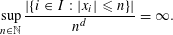 $$\begin{eqnarray}\displaystyle \sup _{n\in \mathbb{N}}\frac{|\{i\in I:|x_{i}|\leqslant n\}|}{n^{d}}=\infty . & & \displaystyle \nonumber\end{eqnarray}$$ $d$-controlling. We also prove the conjecture for $m=1$.
MSC classification
Secondary:
57M20: Two-dimensional complexes
Information
- Type
- Research Article
- Information
- Copyright
- Copyright © University College London 2018
References
Brass, P., Moser, W. and Pach, J., Research Problems in Discrete Geometry, Springer (Heidelberg, 2005).Google Scholar
Erdős, P. and Pach, J., On a problem of L. Fejes Tóth. Discrete Math.
30(2) 1980, 103–109.Google Scholar
Fejes Tóth, L., Remarks on the dual of Tarski’s plank problem. Mat. Lapok (N.S.)
25
1974, 13–20 (in Hungarian).Google Scholar
Kupavskii, A. and Pach, J., Simultaneous approximation of polynomials. In Discrete and Computational Geometry and Graphs
(Lecture Notes in Computer Science 9943
) (eds Akiyama, J., Ito, H., Sakai, T. and Uno, Y.), Springer (Cham, 2016), 193–203.Google Scholar
Makai, E. Jr. and Pach, J., Controlling function classes and covering Euclidean space. Studia Sci. Math. Hungar.
18
1983, 435–459.Google Scholar
McFarland, A., McFarland, J. and Smith, J. T. (eds), Alfred Tarski: Early Work in Poland–Geometry and Teaching, Birkhäuser/Springer (New York, 2014); with a bibliographic supplement, Foreword by Ivor Grattan–Guinness.Google Scholar
Moese, H., Przyczynek do problemu A. Tarskiego: “O stopniu równowaonosci wielokatów”. Parametr
2
1932, 305–309 (A contribution to the problem of A. Tarski, “On the degree of equivalence of polygons”).Google Scholar