


Crossref Citations

This article has been cited by the following publications. This list is generated based on data provided by Crossref.
Batra, Rohit
and
Sankaranarayanan, Subramanian
2020.
Machine learning for multi-fidelity scale bridging and dynamical simulations of materials.
Journal of Physics: Materials,
Vol. 3,
Issue. 3,
p.
031002.
Batra, Rohit
Song, Le
and
Ramprasad, Rampi
2020.
Emerging materials intelligence ecosystems propelled by machine learning.
Nature Reviews Materials,
Vol. 6,
Issue. 8,
p.
655.
Liu, Han
Li, Yipeng
Fu, Zipeng
Li, Kevin
and
Bauchy, Mathieu
2020.
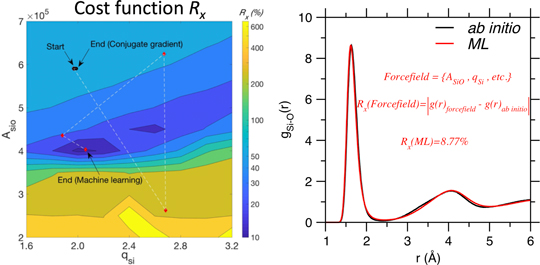
Exploring the landscape of Buckingham potentials for silica by machine learning: Soft vs hard interatomic forcefields.
The Journal of Chemical Physics,
Vol. 152,
Issue. 5,
Avula, Nikhil V. S.
Karmakar, Anwesa
Kumar, Rahul
and
Balasubramanian, Sundaram
2021.
Efficient Parametrization of Force Field for the Quantitative Prediction of the Physical Properties of Ionic Liquid Electrolytes.
Journal of Chemical Theory and Computation,
Vol. 17,
Issue. 7,
p.
4274.
Christensen, Rasmus
Sørensen, Søren S.
Liu, Han
Li, Kevin
Bauchy, Mathieu
and
Smedskjaer, Morten M.
2021.
Interatomic potential parameterization using particle swarm optimization: Case study of glassy silica.
The Journal of Chemical Physics,
Vol. 154,
Issue. 13,
Befort, Bridgette J.
DeFever, Ryan S.
Tow, Garrett M.
Dowling, Alexander W.
and
Maginn, Edward J.
2021.
Machine Learning Directed Optimization of Classical Molecular Modeling Force Fields.
Journal of Chemical Information and Modeling,
Vol. 61,
Issue. 9,
p.
4400.
Yu, Wei
Ji, Chaoyue
Wan, Xuhao
Zhang, Zhaofu
Robertson, John
Liu, Sheng
and
Guo, Yuzheng
2021.
Machine‐learning‐based interatomic potentials for advanced manufacturing.
International Journal of Mechanical System Dynamics,
Vol. 1,
Issue. 2,
p.
159.
Ravinder
Venugopal, Vineeth
Bishnoi, Suresh
Singh, Sourabh
Zaki, Mohd
Grover, Hargun Singh
Bauchy, Mathieu
Agarwal, Manish
and
Krishnan, N. M. Anoop
2021.
Artificial intelligence and machine learning in glass science and technology: 21 challenges for the 21st century.
International Journal of Applied Glass Science,
Vol. 12,
Issue. 3,
p.
277.
Erlebach, Andreas
Nachtigall, Petr
and
Grajciar, Lukáš
2022.
Accurate large-scale simulations of siliceous zeolites by neural network potentials.
npj Computational Materials,
Vol. 8,
Issue. 1,
Bødker, Mikkel L.
Bauchy, Mathieu
Du, Tao
Mauro, John C.
and
Smedskjaer, Morten M.
2022.
Predicting glass structure by physics-informed machine learning.
npj Computational Materials,
Vol. 8,
Issue. 1,
Liu, Han
Smedskjaer, Morten M.
and
Bauchy, Mathieu
2022.
Deciphering a structural signature of glass dynamics by machine learning.
Physical Review B,
Vol. 106,
Issue. 21,
Singh, Jashanpreet
and
Singh, Simranjit
2022.
A review on Machine learning aspect in physics and mechanics of glasses.
Materials Science and Engineering: B,
Vol. 284,
Issue. ,
p.
115858.
Pedone, Alfonso
Bertani, Marco
Brugnoli, Luca
and
Pallini, Annalisa
2022.
Interatomic potentials for oxide glasses: Past, present, and future.
Journal of Non-Crystalline Solids: X,
Vol. 15,
Issue. ,
p.
100115.
Bertani, Marco
Pallini, Annalisa
Cocchi, Marina
Menziani, Maria Cristina
and
Pedone, Alfonso
2022.
A new self‐consistent empirical potential model for multicomponent borate and borosilicate glasses.
Journal of the American Ceramic Society,
Vol. 105,
Issue. 12,
p.
7254.
Liu, Han
Zhao, Zhangji
Zhou, Qi
Chen, Ruoxia
Yang, Kai
Wang, Zhe
Tang, Longwen
and
Bauchy, Mathieu
2022.
Challenges and opportunities in atomistic simulations of glasses: a review.
Comptes Rendus. Géoscience,
Vol. 354,
Issue. S1,
p.
35.
Ge, Yang
Wang, Xueping
Zhu, Qiang
Yang, Yuqin
Dong, Hao
and
Ma, Jing
2023.
Machine Learning-Guided Adaptive Parametrization for Coupling Terms in a Mixed United-Atom/Coarse-Grained Model for Diphenylalanine Self-Assembly in Aqueous Ionic Liquids.
Journal of Chemical Theory and Computation,
Vol. 19,
Issue. 19,
p.
6718.
Liu, Han
Li, Liantang
Wei, Zhenhua
Smedskjaer, Morten M.
Zheng, Xiaoyu Rayne
and
Bauchy, Mathieu
2024.
De Novo Atomistic Discovery of Disordered Mechanical Metamaterials by Machine Learning.
Advanced Science,
Vol. 11,
Issue. 13,
Wang, Guanjie
Wang, Changrui
Zhang, Xuanguang
Li, Zefeng
Zhou, Jian
and
Sun, Zhimei
2024.
Machine learning interatomic potential: Bridge the gap between small-scale models and realistic device-scale simulations.
iScience,
Vol. 27,
Issue. 5,
p.
109673.
Yati
Kokane, Yash
and
Mondal, Anirban
2025.
Active-Learning Assisted General Framework for Efficient Parameterization of Force-Fields.
Journal of Chemical Theory and Computation,
Vol. 21,
Issue. 5,
p.
2638.
Dirindin, Marco
and
Coslovich, Daniele
2025.
Glassy Dynamics and Local Crystalline Order in Two-Dimensional Amorphous Silica.
The Journal of Physical Chemistry B,
Vol. 129,
Issue. 3,
p.
1095.