




No CrossRef data available.
Article contents
Plastic deformation affecting anodic dissolution in electrochemical migration
Published online by Cambridge University Press: 23 May 2019
Abstract
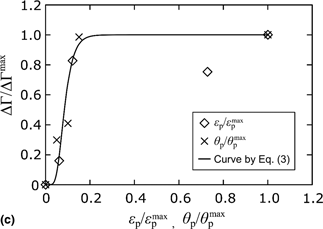
This study investigated the effect of plastic deformation on anodic dissolution in electrochemical migration (ECM) through the growth of deposits. The morphology of deposits synthesized by ECM was analyzed using scanning electron microscopy, where sponge-shaped deposits were observed on the cathode electrode. The mechanism of anodic dissolution was examined by experimentally measuring the variation in the mass of electrodes. The increase and saturation of anodic dissolution in ECM with plastic deformation were observed and were empirically formulated in terms of the change in activation energy. Thus, plastic deformation is proposed as a promising parameter that contributes to controlling ECM.
Information
- Type
- Research Letters
- Information
- Copyright
- Copyright © Materials Research Society 2019
References
1.Djenizian, T., Hanzu, I., Eyraud, M., and Santinacci, L.: Electrochemical fabrication of tin nanowires: a short review. Comptes Rendus Chim. 11, 995 (2008).Google Scholar
2.Motoyama, M. and Prinz, F.B.: Electrodeposition and behavior of single metal nanowire probes. ACS Nano 8, 3556 (2014).Google Scholar
3.Zhang, X., Li, D., Bourgeois, L., Wang, H., and Webley, P.A.: Direct electrodeposition of porous gold nanowire arrays for biosensing applications. ChemPhysChem 10, 436 (2009).Google Scholar
4.Atashbar, M.Z. and Singamaneni, S.: Room temperature gas sensor based on metallic nanowires. Sensors Actuators, B Chem. 111–112, 13 (2005).Google Scholar
5.Takemoto, T., Latanision, R.M., Eagar, T.W., and Matsunawa, A.: Electrochemical migration tests of solder alloys in pure water. Corros. Sci. 39, 1415 (1997).Google Scholar
6.Abbel, R., van de Peppel, L., Kirchner, G., Michels, J.J., and Groen, P.: Lifetime limitations in organic electronic devices due to metal electrochemical migration. MRS Commun. 7, 664 (2017).Google Scholar
7.Aoki, T., Li, Y., and Saka, M.: A proposal of fabrication method for Cu oxide micro-structure using ion migration. In Proceedings of the 2016 Annual Meeting of JSME Tohoku Regional Student Division, 22, 2016, in Japanese.Google Scholar
8.Fukaya, S., Aoki, T., Kimura, Y., and Saka, M.: Enhanced fabrication of hybrid Cu-Cu2O nanostructures on electrodes using electrochemical migration. Mech. Eng. Lett. 4, 17–00604 (2018).Google Scholar
9.Aoki, T., Li, Y., and Saka, M.: Morphology control of hybrid Cu–Cu2O nanostructures fabricated by electrochemical migration. Mater. Lett. 236, 420 (2019).Google Scholar
10.Nakajima, T., Li, Y., and Saka, M.: Study on utilization of ionic migration for fabrication of Ag nanodendrites. In Proceedings of the 2015 Materials and Mechanics Conference of JSME, GS0707, 2015, in Japanese.Google Scholar
11.Nakakura, T. and Saka, M.: Fabrication of large-scale Ag micro/nanostructures using electrochemical migration. Micro Nano Lett. 13, 923 (2018).Google Scholar
12.Despic, A.R., Raicheff, R.G., and Bockris, J.O'M.: Mechanism of the acceleration of the electrodic dissolution of metals during yielding under stress. J. Chem. Phys. 49, 926 (1968).Google Scholar
13.Bockris, J.O'M. and Subramanyan, P.K.: Contributions to the electrochemical basis of the stability of metals. Corros. Sci. 10, 435 (1970).Google Scholar
14.Fryxell, R.E. and Nachtrieb, N.H.: Effect of stress on metal electrode potentials. J. Electrochem. Soc. 99, 495 (1952).Google Scholar
15.Yang, L., Horne, G.T., and Pound, G.M.: Physical Metallurgy of Stress Corrosion Fracture (Interscience Publishers, New York, 1, 1959).Google Scholar
17.Hoar, T.P. and Scully, J.C.: Mechanochemical anodic dissolution of austenitic stainless steel in hot chloride solution at controlled electrode potential. J. Electrochem. Soc. 111, 348 (1964).Google Scholar
18.Raicheff, R.G., Damjanovic, A., and Bockris, J.O'M.: Dependence of the velocity of the anodic dissolution of iron on its yield rate under tension. J. Chem. Phys. 47, 2198 (1967).Google Scholar
19.Gutman, E.M., Solovioff, G., and Eliezer, D.: The mechanochemical behavior of type 316L stainless steel. Corros. Sci. 38, 1141 (1996).Google Scholar
20.Nazarov, A., Vivier, V., Thierry, D., Vucko, F., and Tribollet, B.: Effect of mechanical stress on the properties of steel surfaces: scanning Kelvin probe and local electrochemical impedance study. J. Electrochem. Soc. 164, C66 (2017).Google Scholar
21.Kimura, Y. and Saka, M.: On growth of a micro/nano-material under migration. In Proceedings of the 2017 Autumn Meeting of JSME Tohoku Regional Division, 105, 2017, in Japanese.Google Scholar
22.Murata, T.: Theory of strain electrode and the application to corrosion study (2). Dynamic straining of non-filmed electrode at constant strain rate. Corros. Eng. 22, 133 (1973) in Japanese.Google Scholar
23.Murata, T.: Practical application of strain electrode methods. Tetsu-to-Hagané 60, 580 (1974) in Japanese.Google Scholar
24.Ohtani, N. and Hayashi, Y.: Analysis of crack propagation rate in stress corrosion cracking by a mechanochemical model. J. Jpn. Inst. Met. Mater. 38, 1103 (1974) in Japanese.Google Scholar
25.Appel, F.: Thermally activated dislocation processes in NaCl single crystals (I). Phys. Status Solidi A 25, 607 (1974).Google Scholar