

Hostname: page-component-6766d58669-kl59c Total loading time: 0 Render date: 2026-05-24T11:03:02.174Z Has data issue: false hasContentIssue false

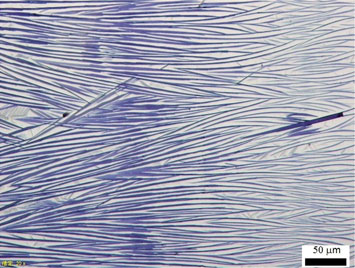
Polydiacetylene ribbons formed using the controlled evaporative self-assembly (CESA) method

Published online by Cambridge University Press:  12 October 2018

E. Van Keuren*
Affiliation:
Department of Physics and Institute for Soft Matter Synthesis and Metrology, Georgetown University, Washington DC 20057, USA
C. Pornrungroj
Affiliation:
Institute of Multidisciplinary Research for Advanced Materials (IMRAM), Tohoku University, 2-1-1 Katahira, Aoba-ku, Sendai 980-8577, Japan
C. Fu
Affiliation:
Institute of Multidisciplinary Research for Advanced Materials (IMRAM), Tohoku University, 2-1-1 Katahira, Aoba-ku, Sendai 980-8577, Japan
X. Zhang
Affiliation:
Department of Physics and Institute for Soft Matter Synthesis and Metrology, Georgetown University, Washington DC 20057, USA
S. Okada
Affiliation:
Graduate School of Organic Materials Science, Yamagata University, 3-16 Jonan, Yonezawa 982-8510, Japan
H. Katsuyama
Affiliation:
Graduate School of Organic Materials Science, Yamagata University, 3-16 Jonan, Yonezawa 982-8510, Japan
K. Kikuchi
Affiliation:
Graduate School of Organic Materials Science, Yamagata University, 3-16 Jonan, Yonezawa 982-8510, Japan
T. Onodera
Affiliation:
Institute of Multidisciplinary Research for Advanced Materials (IMRAM), Tohoku University, 2-1-1 Katahira, Aoba-ku, Sendai 980-8577, Japan
H. Oikawa
Affiliation:
Institute of Multidisciplinary Research for Advanced Materials (IMRAM), Tohoku University, 2-1-1 Katahira, Aoba-ku, Sendai 980-8577, Japan
*
Address all correspondence to E. Van Keuren at erv@georgetown.edu
Get access

Abstract

Methods for the control of molecular deposition and orientation are critical for the development of organic electronic devices. Here, we show the fabrication of ribbons of the optical material polydiacetylene (PDA) using a controlled evaporative self-assembly method. The ability to form these ribbons is highly dependent on both the side groups on the PDA as well as the solvent used in the preparation. Arrays of ribbons of one type of PDA, poly[1,6-di(N-carbazolyl)-2,4-hexadiyne], with widths on the order of 1–2 µm and lengths of 100s of micrometers, could be successfully obtained with good orientation.

Information

Type
Research Letters
Copyright
Copyright © Materials Research Society 2018 

Access options

Get access to the full version of this content by using one of the access options below. (Log in options will check for institutional or personal access. Content may require purchase if you do not have access.)

Article purchase

Temporarily unavailable

Supplementary material: File

Van Keuren et al. supplementary material

Figures S1-S5

Download Van Keuren et al. supplementary material(File)
File 1.2 MB