Contents
Research Article
On the convergence of the zeta function for certain prehomogeneous vector spaces
-
- Published online by Cambridge University Press:
- 22 January 2016, pp. 1-31
-
- Article
-
- You have access
- Export citation
-
Let (G, V) be an irreducible prehomogeneous vector space defined over a number field k, P ∈ k[V] a relative invariant polynomial, and χ a rational character of G such that
 . For
. For  , let Gx be the stabilizer of x, and
  the connected component of 1 of Gx . We define L0 to be the set of
  such that
  does not have a non-trivial rational character. Then we define the zeta function for (G, Y) by the following integral
where Φ is a Schwartz-Bruhat function, s is a complex variable, and dg” is an invariant measure.
 . For
. For  , let
, let  the connected component of 1 of
  such that
  does not have a non-trivial rational character. Then we define the zeta function for (
Surfaces associées au plongement canonique des courbes
-
- Published online by Cambridge University Press:
- 22 January 2016, pp. 33-39
-
- Article
-
- You have access
- Export citation
Rank 2 symmetric hyperbolic Kac-Moody algebras
-
- Published online by Cambridge University Press:
- 22 January 2016, pp. 41-75
-
- Article
-
- You have access
- Export citation
-
Affine Kac-Moody algebras represent a well-trodden and well-understood littoral beyond which stretches the vast, chaotic, and poorly-understood ocean of indefinite Kac-Moody algebras. The simplest indefinite Kac-Moody algebras are the rank 2 Kac-Moody algebras
 (a) (a ≥ 3) with symmetric Cartan matrix
 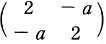 , which form part of the class known as hyperbolic Kac-Moody algebras. In this paper, we probe deeply into the structure of those algebras (a), the e. coli of indefinite Kac-Moody algebras. Using Berman-Moody’s formula ([BM]), we derive a purely combinatorial closed form formula for the root multiplicities of the algebra (a), and illustrate some of the rich relationships that exist among root multiplicities, both within a single algebra and between different algebras in the class. We also give an explicit description of the root system of the algebra (a). As a by-product, we obtain a simple algorithm to find the integral points on certain hyperbolas.
 (
( , which form part of the class known as hyperbolic Kac-Moody algebras. In this paper, we probe deeply into the structure of those algebras
 On compactness of isospectral conformal, metrics of 4-manifolds
-
- Published online by Cambridge University Press:
- 22 January 2016, pp. 77-99
-
- Article
-
- You have access
- Export citation
Units and Cyclotomic Units in Zp -Extensions
-
- Published online by Cambridge University Press:
- 22 January 2016, pp. 101-116
-
- Article
-
- You have access
- Export citation
-
Let p be an odd prime and d be a positive integer prime to p such that d ≢ 2 mod 4. For technical reasons, we also assume that
 . For each integer n ≥ 1, we choose a primitive nth root ζn of 1 so that
  whenever n | m. Let
  be its cyclotomic Zp-extension, where
  is the nth layer of this extension. For n ≤ 1, we denote the Galois group Ga\(Kn/K0 ) by Gn , the unit group of the ring of integers of Kn by En , and the group of cyclotomic units of Kn by Cn . For the definition and basic properties of cyclotomic units such as the index theorem, we refer [6] and [7]. In this paper we examine the injectivity of the homomorphism
  between the first cohomology groups induced by the inclusion Cn → En .
 . For each integer
  whenever
  be its cyclotomic Z
 is the
  between the first cohomology groups induced by the inclusion
 The geometrical constructions lifting tensor fields of type (0,2) on manifolds to the bundles of A-velocities
-
- Published online by Cambridge University Press:
- 22 January 2016, pp. 117-137
-
- Article
-
- You have access
- Export citation
Positive definite hyperfunctions
-
- Published online by Cambridge University Press:
- 22 January 2016, pp. 139-149
-
- Article
-
- You have access
- Export citation
Scalar curvatures of conformal metrics on Sn
-
- Published online by Cambridge University Press:
- 22 January 2016, pp. 151-166
-
- Article
-
- You have access
- Export citation
-
In this paper we consider the following problem: Given a smooth function K on the n-dimensional unit sphere Sn(n ≥ 3) with its canonical metric g0 , is it possible to find a pointwise conformal metric
 which has K as its scalar curvature? This problem was presented by J. L. Kazdan and F. W. Warner. The associated problem for Gaussian curvature in dimension 2 had been presented by L. Nirenberg several years before.
 which has
 A construction of peak functions on locally convex domains in Cn
-
- Published online by Cambridge University Press:
- 22 January 2016, pp. 167-176
-
- Article
-
- You have access
- Export citation
-
Let Ω be a smoothly bounded pseudoconvex domain in Cn and let A(Ω) denote the functions holomorphic on Ω and continuous on
 . A point p ∈ bΩ is a peak point if there is a function f ∈ A(Ω) such that f (p) = 1, and | f(z) | < 1 for z ∉ Ω − {p}.
 . A point
 Front Matter
NMJ volume 140 Cover and Front matter
-
- Published online by Cambridge University Press:
- 22 January 2016, pp. f1-f5
-
- Article
-
- You have access
- Export citation
Back Matter
NMJ volume 140 Cover and Back matter
-
- Published online by Cambridge University Press:
- 22 January 2016, pp. b1-b2
-
- Article
-
- You have access
- Export citation