
We use cookies to distinguish you from other users and to provide you with a better experience on our websites. Close this message to accept cookies or find out how to manage your cookie settings.
View all Google Scholar citations for this article.
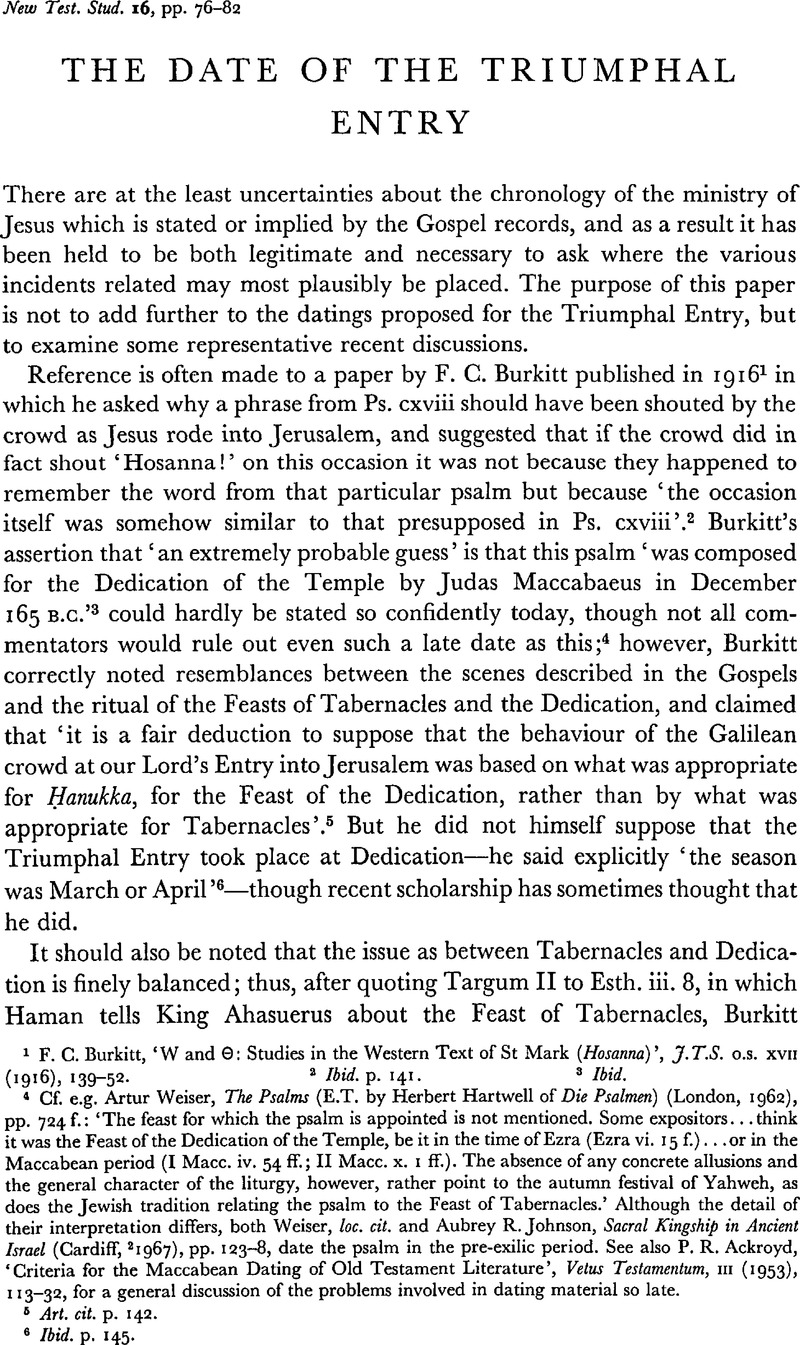
Page 76 note 1 Burkitt, F. C., ‘W and ⊖: Studies in the Western Text of St Mark (Hosanna)’, J.T.S. o.s. XVII (1916), 139–52.
Page 76 note 2 ibid. p. 141.
Page 76 note 3 Ibid.
Page 76 note 4 Cf. e.g. Artur Weiser, The Psalms (E.T. by Herbert Hartwell of Die Psalmen) (London, 1962), pp. 724 f.: ‘The feast for which the psalm is appointed is not mentioned. Some expositors … think it was the Feast of the Dedication of the Temple, be it in the time of Ezra (Ezra vi. 15 f.) … or in the Maccabean period (I Macc. iv. 54 ff.; II Macc. x. 1 ff.). The absence of any concrete allusions and the general character of the liturgy, however, rather point to the antumn festiva of Yahweh, as does the Jewish tradition relating the psalm to the Feast of Tabernacles’. Although the detail of their interpretation differs, both Weiser, loc. cit. and Johnson, Aubrey R., Sacral Kingship in Ancient Israel (Cardiff, 2 1967), pp. 123–8, date the psalm in the pre-exilic period. See also Ackroyd, P. R., ‘Criteria for the Maccabean Dating of Old Testament Literature’, Vetus Testamentum III (1953), 113–32, for a general discussion of the problems involved in dating material so late.
Page 76 note 5 Art. cit. p. 142.
Page 76 note 6 Ibid. p. 145.
Page 77 note 1 Ibid. p. 141.
Page 77 note 2 Ibid. p. 142.
Page 77 note 3 Ibid. p. 143.
Page 77 note 4 Ibid. p. 145.
Page 77 note 5 Ibid.
Page 77 note 6 Tristram, H. B., The Fauna and Flora of Palestine (London, 1884), p. 418. Cf. Post, George E., Flora of Syria, Palestine and Sinai, 2nd edition revised by Dinsmore, J. E., II (Beirut, 1933), 557: ‘east shore of Dead Sea; cult. along the coast and in the Jordan valley’.
Page 78 note 1 Lagrange, M.-J., Évangile selon Saint Jean (Paris, 1936), p. 325.
Page 78 note 2 Hart, H. St J., ‘The Crown of Thorns in John 19, 2–5’, J. T. S. n.s. III (1952), 66–75.
Page 78 note 3 Ibid. p. 72. Cf. Löw, I., Die Flora der Juden (Leipzig, 1924), pp. 306, 308.
Page 78 note 4 Danby, H., The Mishnah (Oxford, 1933), p. 176 n. 3.
Page 78 note 5 I Löw, op. cit. p. 312.
Page 78 note 6 Farmer, W. R., ‘The Palm Branches in John 12, 13’, J. T. S. n. s. III (1952), 62–6; Brown, Raymond E., The Gospel according to John (I-XII) (New York, 1966), pp. 461 f.
Page 79 note 1 W. R. Farmer, art. cit. p. 63.
Page 79 note 2 Reifenberg, A., Ancient Jewish Coins (Jerusalem, 2 1947).
Page 79 note 3 Kadman, L., ‘A Coin Find at Masada’, Israel Exploration Journal, VII (1957), 61–5.
Page 79 note 4 Hart, H. St J., ‘Judaea and Rome: The Official Commentary’, J. T. S. n.s. III (1952), 185 n. 2.
Page 79 note 5 ibid; Kindler, A., ‘The Coinage of the Bar-Kokhba War’, in The Dating and Meaning of Ancient Jewish Coins and Symbols (Jerusalem, 1958), pp. 65 f., suggests that the recurrence in the Second Revolt of many types issued in the First Revolt is intended ‘to symbolize the continuation of the struggle against the Romans’.
Page 79 note 6 Esther Rabbah 9, Sanhedrin 93a. On this whole question see Romanoff, P., Jewish Symbols on Ancient Jewish Coins (Philadelphia, 1944), pp. 16 f., and Klimowsky, E. W., ‘Symbols on Ancient Jewish Coins’, in Dating … of Ancient Jewish Coins …, pp. 96 f. Romanoff, p. 9 and n. 25, says that the palm-tree with two baskets shown on the coins mentioned by Farmer represents the offering of the first-fruits.
Page 80 note 1 Art. cit. p. 64.
Page 80 note 2 Ibid. pp. 64f.
Page 80 note 3 Abel, F. -M., Les Livres des Maccabées (Paris, 1949), p. 247.
Page 80 note 4 E.T., by Slotki, J.J. in Midrash Rabbah: Leviticus (London, 1939), pp. 383 f.
Page 80 note 5 Hart, H. St J., J. T. S. n.s. III (1952), 193.
Page 80 note 6 Op. cit. p. 461.
Page 80 note 7 Charles, R. H., The Testaments of the Twelve Patriarchs (London, 1908), p. 143. The translation of Test. Naph. v. 4 given in the previous sentence is that of Charles, ibid.; cf. also idem, The Greek Versions of the Testaments of the Twelve Patriarchs (Oxford, 1908), p. 152.
Page 81 note 1 Tha palm presented by Alcimus to Demetrius I, together with a gold crown and olive branches (II Macc. xiv. 4), probably has the same significance, though Abel, op. cit. p. 458, thinks this was simply a way of referring to a money payment. Cf. I Macc. xiii. 37, where βάïον is used and not φοïνιξ (as in II Macc. xiv. 4).
Page 81 note 2 Op. cit. pp. 461 f.
Page 81 note 3 Ibid. p. 461. If it is claimed that the presentation of the Triumphal Entry found in the Fourth Gospel could have been developed in the course of the first century in circles where this symbolism was valid, it may still be objected that certain pieces of evidence to which appeal is made are too weak to add much to even a cumulative argument, and that in any case it is more realistic to appeal to the Jewish liturgy.
Page 81 note 4 Yadin, Y., ‘More on the Letters of Bar Kochba’, The Biblical Archaeologist, XXIV (1961), 89–92.
Page 81 note 5 Op. cit. p. 457.
Page 81 note 6 Cf. for example, Cranfield, C. E. B., The Gospel according to Saint Mark (Cambridge, 1959), p. 353; Nineham, D. E., The Gospel of St Mark (Harmondsworth, 1963), p. 294.
Page 82 note 1 Manson, T. W., ‘The Cleaning of the Temple’, Bulletin of the John Rylands Library, XXXIII (1950–1951), 271–82.
Page 82 note 2 Montefiore, C. G., The Synoptic Gospels I (London, 2 1927), 259 f.
Email your librarian or administrator to recommend adding this journal to your organisation's collection.
Full text views reflects the number of PDF downloads, PDFs sent to Google Drive, Dropbox and Kindle and HTML full text views.
Loading metrics...
Abstract views reflect the number of visits to the article landing page.
Loading metrics...
* Views captured on Cambridge Core between September 2016 - 12th June 2018. This data will be updated every 24 hours.