


As human populations grow and we transform undeveloped lands and waterways, human–wildlife conflict inevitably increases, and this is particularly problematic for large predators and the humans who live alongside them (Redpath et al., Reference Redpath, Bhatia and Young2014). Relatively little research has been conducted on one of the most significant predator species involved in adverse encounters with humans, the Nile crocodile Crocodylus niloticus (Shirley et al., Reference Shirley, Vliet, Carr and Austin2013, argued that there are two species of Nile crocodiles but this has yet to be recognized formally). This is despite the prevailing narrative that human–crocodile conflict is uniquely prevalent in Africa, representing a ‘growing threat to rural livelihoods and development’ (Aust et al., Reference Aust, Boyle, Fergusson and Coulson2009).
The IUCN Crocodile Specialist Group (IUCN CSG) asserts ‘It is difficult to estimate the total number of attacks per year [by Nile crocodiles] as many non-fatal attacks go unreported, but it is believed to exceed 300 per year since the year 2000’ (IUCN CSG, 2015). Of these, Fergusson (Reference Fergusson2004) estimated that 63% ‘in mainland Africa’ are fatal. Supporting data are scant (Sideleau & Britton, Reference Sideleau and Britton2013), and such general statements are of limited mitigation utility. Prompted by a preliminary analysis of the first long-term, detailed survey of crocodile attacks in South Africa and Swaziland during 1949–2014 (Pooley, Reference Pooley2015a) I suggest ways of using data to mitigate adverse encounters between humans and crocodiles, and explore the challenges involved.
Three explanations are offered for the marked seasonality of attacks by Nile crocodiles (Pooley et al., Reference Pooley, Hines, Shield and Ross1992). Firstly, in the rainy season crocodiles are widely dispersed. Secondly, crocodiles are ectothermic and are more active (and therefore more hungry) during the hotter months of the year. Thirdly, crocodiles are more dangerous during the breeding season. The problem with these explanations is that they are overlapping (Fig. 1) and little effort has been made to investigate their individual explanatory power.
Seasonal variations in incidence of attacks by Nile crocodiles Crocodylus niloticus, rainfall and temperature in South Africa and Swaziland during 1949–2014. Attack incidence is highly seasonal, and largely coincident with rainfall and temperature in the region. Breeding season in the coastal regions is approximately October–April, and c. 1 month earlier inland.
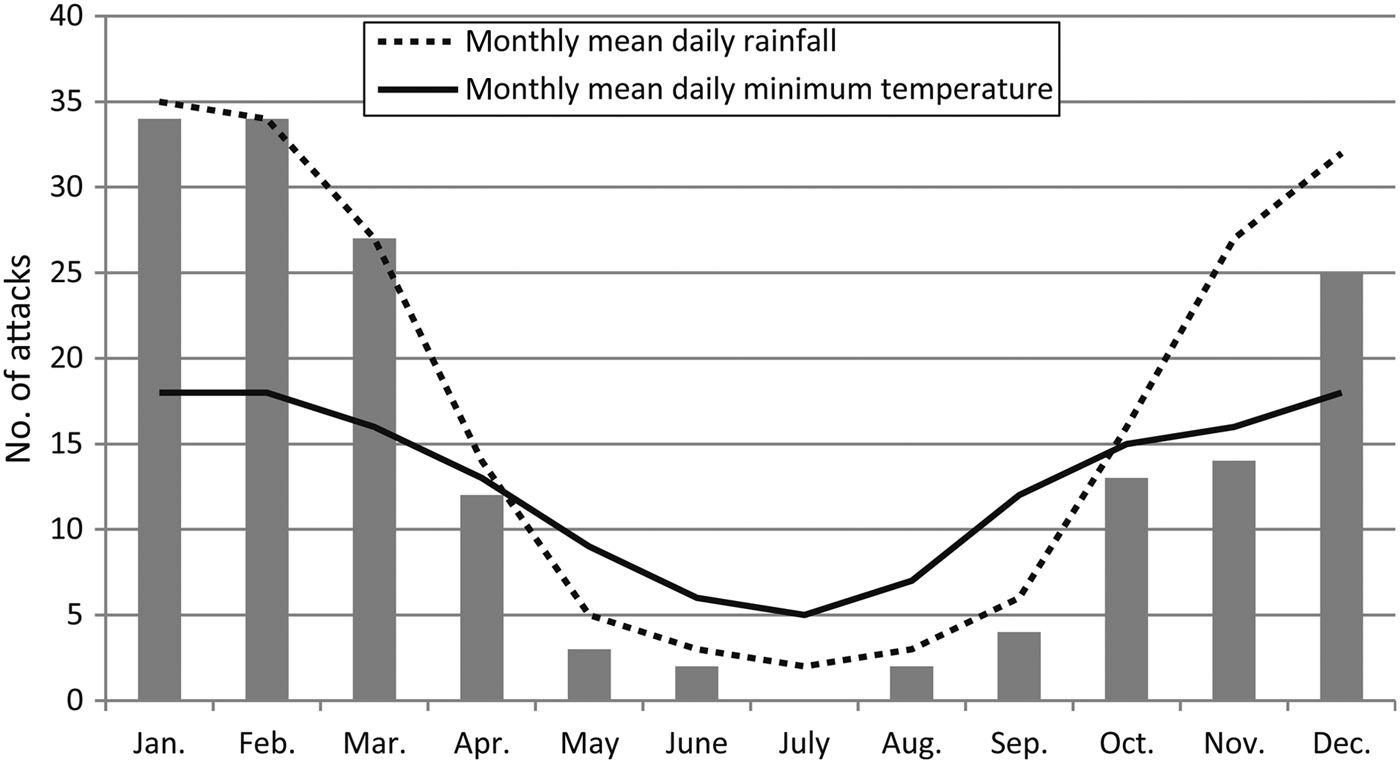
Regarding the breeding-season hypothesis, it is problematic that during the period when the greatest numbers of attacks take place most large adult females are guarding their nests (most within protected areas) and fasting until their hatchlings are ready to emerge. Although male crocodiles are more aggressive to other male crocodiles during this period (Lang, Reference Lang and Ross1992), there is no evidence that they are similarly aggressive to humans unless they are approached, particularly in boats (usually canoes), which crocodiles may interpret as territorial aggression (Caldicott et al., Reference Caldicott, Croser, Manolis, Webb and Britton2005).
For theories linking incidence of attack with biophysical variables, variations in the synchrony or asynchrony of hot months, rainfall and high water levels across the continent make generalizations difficult (cf. Thomas, Reference Thomas2006; Aust et al., Reference Aust, Boyle, Fergusson and Coulson2009; Wallace et al., Reference Wallace, Leslie and Coulson2011). When sufficient data have been collected, these will facilitate region-specific analyses and allow us to disaggregate the influence of these variables in particular places.
An exploratory study of environmental factors affecting the seasonality of attacks in South Africa during 1949–2014 suggested that monthly mean minimum daily temperature is the strongest environmental predictor (Potter, Reference Potter2014). This seems likely in terms of crocodiles’ decreased physiological maintenance costs under cooler conditions and, conversely, increased activity levels and food requirements under warmer conditions (Manolis & Webb, Reference Manolis and Webb2013).
The main shortcoming of these explanations for the seasonality of crocodile attacks is that they do not take overlaps between patterns of human and crocodile activity into account. The activities most associated with attacks (fishing and, in particular, swimming) are seasonal, and data indicate that attacks are concentrated on weekends and holidays. Thus, just as crocodiles vary their movements and activities in response to seasonal changes in temperature and food availability, so do humans. Furthermore, the social, economic and ecological contexts in which human–crocodile interactions occur vary across Africa, and therefore people are exposed to different kinds or levels of risks depending on their location.
An unknown number of incidents (probably more involving minor injuries) are not reported. There is a potential bias towards the reporting of fatal attacks, thus skewing reported fatality rates. Although it is assumed that underreporting is the major problem (e.g. Lamarque et al., Reference Lamarque, Anderson, Fergusson, Lagrange, Osei-Owusu and Bakker2009), overreporting also occurs (e.g. Mbuli, Reference Mbuli1998; Mathye, Reference Mathye2011). Media reports may be sensationalized or manipulated by local people hoping to secure improved services (e.g. piped water, water tanks, or safe access to natural water sources). It is often assumed that people who disappear in rivers or lakes were taken by crocodiles, and crocodiles seen scavenging on dead bodies may be blamed erroneously for killing the victims.
An obvious limitation of attack data as a basis for predictive models is that they are presence-only data. Information on the demographics of victims is useful for disaggregating who is being attacked (age group and gender), where, and what they were doing at the time. However, without knowing the prevalence of the activities practised in an area, it is difficult to estimate the risk associated with each activity. Data on human population size and density over time, settlement patterns, and data on livelihoods and activities disaggregated by gender and age groups are required in problem areas (e.g. Thomas, Reference Thomas2006).
Estimates of the size of crocodiles involved in attacks are useful but notoriously inaccurate. Only measurements of trapped or killed individuals can inform precise analysis. Sexual dimorphism (larger adult males) can provide guidance in identifying the gender of large crocodiles (Ross, Reference Ross2000) but precise information is preferable. In Australia, data indicate that saltwater crocodiles Crocodylus porosus 300–350 cm in length should be targeted for removal from areas used intensively by the public (Fukuda et al., Reference Fukuda, Manolis and Appel2014). Initial data for South Africa indicate that Nile crocodiles > 280 cm should be removed (Pooley, Reference Pooley2015a). The removal of problem crocodiles, and occasionally the destruction of large problem crocodiles that elude capture, is a key mitigation strategy if humans and crocodiles are to continue to co-exist. It is important to record what happens to the crocodiles following adverse encounters with humans (see Dunham et al., Reference Dunham, Ghiurghi, Cumbi and Urbano2010, for a rare study including these data).
We need data on the size and structure of local crocodile populations as well as their seasonal movements and behaviour. Environmental events (droughts, floods) and anthropogenic interventions (e.g. dam building, water pollution, riverbank development) that affect the distribution of crocodiles are also important (Botha et al., Reference Botha, Van Hoven and Guillette2011).
When sufficient data have been gathered for a region it should be possible to develop a rule of thumb for calibrating risk and identifying potential attack hotspots, taking into account prevailing environmental conditions (temperature, rainfall, water conditions), the presence, size and seasonal behaviour of crocodiles, seasonal use of waterways by humans, and the history and trend of attacks in the area.
Long-term data on attacks by crocodiles will always be incomplete, and prediction of future attacks difficult, but we can learn from collecting and analysing attack data. There are three main areas of focus: (1) collecting historical data, improving data collection, and entering data in a standardized format in a freely available database; (2) disaggregating data on human victims by age, gender, location and activity at the time of attack, to facilitate targeted mitigation; (3) analysing long-term ecological and social data on both humans and crocodiles.
Databases updated on an ongoing basis will facilitate the identification of emerging trends and problem areas, and the CrocBITE database is intended to achieve this on local and regional scales (CrocBITE, 2015).
A high incidence of attacks on local residents in Australia and South Africa suggests that proximity to and awareness of the presence of crocodiles does not translate into knowledge of how to live safely alongside crocodiles (Manolis & Webb, Reference Manolis and Webb2013; Pooley, Reference Pooley2015a). Outreach programmes should be focused appropriately for demographic groups; for example, among attack victims in South Africa and Swaziland (1949–2014) most boys were attacked while swimming, most men while fishing and most women while doing domestic chores.
Educating children should be a priority, particularly in identified hotspot areas, and this could be integrated into existing modules of school education. Case studies of local attacks could have considerable impact but would need to be presented carefully to avoid upsetting children or their families. The opportunity to help prevent further attacks may be a positive step for survivors.
In developing countries with a range of pressing social, health and other needs, attacks by crocodiles are unlikely to be considered sufficiently serious on a national scale to attract funds for mitigation. It is more feasible for local authorities to raise funds to create awareness or provide safe access to water in specific locales with a history (or emerging pattern) of attacks, and to link this with other social benefits such as safe drinking water, more hygienic bathing and improved access to fishing.
With seed funding from the Economic and Social Research Council UK and Imperial College London I have developed visualizations of attack data for South Africa and Swaziland (1984–2014), with the intention, in collaboration with Adam Britton and Brandon Sideleau, to roll this out for all CrocBITE data (Imperial College London, 2015). (A 24-page accompanying guide (Pooley, Reference Pooley2015b) for South Africa and Swaziland is available on request.) This interface will allow users to explore the data without requiring research skills. The aim is to motivate conservation managers and the public to collect, contribute and use crocodile attack data.
We need to advance beyond data collection and analysis for publication in journals, which are unlikely to be read by those on the sharp end of human–crocodile conflicts. It is necessary to convert such data into accessible information, to raise awareness and to encourage exploration of this information to generate useful knowledge. This knowledge could then be mobilized to save lives, both human and crocodilian.
Acknowledgements
This paper benefited from comments by E. J. Milner-Gulland and James Perran Ross, and from prior discussions with Charlie Manolis, Alan Woodward, Adam Britton, Brandon Sideleau, Steve Redpath and George H. Burgess. The views are the author's alone. This paper is a contribution to Imperial College London's Grand Challenges in Ecosystems and the Environment initiative, based at Silwood Park.
Biographical sketch
Simon Pooley is an environmental historian with a lifelong interest in crocodiles. His research interests include human–wildlife conflicts, wildfire, biological invasions, conservation history and interdisciplinary research on problems of the environment.


 Open access

