Corrective feedback takes the form of responses to learner utterances
that contain an error. The responses can consist of (a) an indication that
an error has been committed, (b) provision of the correct target language
form, or (c) metalinguistic information about the nature of the error, or
any combination of these.
There has been a growing interest in the role of corrective feedback
in SLA in the last decade. A number of descriptive studies based on data
collected in classrooms (e.g., Panova & Lyster,
2002; Sheen, 2004) and on data collected
in a laboratory-type setting (e.g., Iwashita,
2003; Mackey, Oliver, & Leeman, 2003;
Philp, 2003) have examined the types of
corrective feedback received by learners and the extent to which this
feedback is noticed, or uptaken, or both by the learners. Experimental
studies have attempted to examine the contribution that corrective
feedback makes to acquisition (e.g., Ayoun,
2004; Han, 2002; Leeman, 2003; Lyster, 2004).
This research has addressed, among other issues, the relative efficacy of
implicit and explicit types of corrective feedback.
THEORETICAL ISSUES
A distinction can be drawn between implicit/explicit
learning and implicit/explicit knowledge. In the
case of learning, the term implicit refers to “acquisition
of knowledge about the underlying structure of a complex stimulus
environment by a process that takes place naturally, simply and without
conscious operations,” whereas explicit learning is
“a more conscious operation where the individual makes and tests
hypotheses in search for a structure” (N. Ellis,
1994, p. 2).
In the case of knowledge, the term implicit refers to
knowledge that learners are only intuitively aware of and that is easily
accessible through automatic processing, whereas explicit
knowledge consists of knowledge that learners are consciously aware
of and that is typically only available through controlled processing.
Explicit knowledge might be linked to metalinguistic labels. These two
types of knowledge are not mutually exclusive; that is, speakers can hold
implicit and explicit representations of the same linguistic feature, as,
for example, in the case of linguists who formulate explicit rules on the
basis of their implicit knowledge of a language.
Schmidt (1994) stated that “implicit
and explicit learning and implicit and explicit
knowledge are related but distinct concepts that need to be
separated” (p. 20). It can be argued, for example, that implicit
knowledge is not entirely dependent on implicit learning but can arise as
a product of learners intentionally practicing linguistic forms that they
initially know explicitly (DeKeyser, 2003). It
has also been argued that the development of implicit learning involves at
least some degree of consciousness, as when learners notice specific
linguistic forms in the input (Schmidt).
Corrective feedback differs in terms of how implicit or explicit it
is. In the case of implicit feedback, there is no overt indicator that an
error has been committed, whereas in explicit feedback types, there is.
Implicit feedback often takes the form of recasts, defined by
Long (in press) as
a reformulation of all or part of a learner's
immediately preceding utterance in which one or more non-target like
(lexical, grammatical etc.) items are replaced by the corresponding target
language form(s), and where, throughout the exchange, the focus of the
interlocutors is on meaning not language as an object. (p. 2)
Recasts, therefore, provide positive evidence, but, as Nicholas,
Lightbown, and Spada (2001) noted, it is not
clear whether they provide negative evidence, as learners might have no
conscious awareness that the recast is intended to be corrective. Explicit
feedback can take two forms: (a) explicit correction, in which
the response clearly indicates that what the learner said was incorrect
(e.g., “No, not goed—went”) and thus affords
both positive and negative evidence or (b) metalinguistic
feedback, defined by Lyster and Ranta (1997) as “comments, information, or questions
related to the well-formedness of the learner's utterance” (p.
47)—for example, “You need past tense,” which affords
only negative evidence.
It can also be argued that recasts and explicit corrective strategies
differ in terms of whether they cater to implicit or explicit learning.
For Long (1996), recasts work for acquisition
precisely because they are implicit, connecting linguistic form to meaning
in discourse contexts that promote the microprocessing (i.e., noticing or
rehearsing in short-term memory) required for implicit language learning.
Doughty (2001), building on Long's
rationale for focus-on-form, argued that recasts constitute the ideal
means of achieving an “immediately contingent focus on form”
and afford a “cognitive window” (p. 252) in which learners can
rehearse what they have heard and access material from their
interlanguage. In contrast, explicit corrective feedback strategies, such
as metalinguistic feedback, are more likely to impede the natural flow of
communication and to activate the kind of learning mechanisms that result
in explicit rather than implicit second language (L2) knowledge. However,
such a view is not unproblematic.
First, it is not certain that all recasts are as implicit as Long
(1996) and Doughty (2001) assumed. Some recasts are quite explicitly
corrective. Indeed, the kind of corrective recasts that Doughty and Varela
(1998) employed in their experimental study were
remarkably explicit. They were preceded by a repetition of the
learner's utterance with the erroneous elements highlighted by
emphatic stress. If the learner did not self-correct, recasts with
emphatic stress to draw attention to the reformulated elements followed.
Thus, if the corrective force of the recast becomes self-evident, it is
difficult to argue that it constitutes an implicit or even a relatively
implicit technique. Second, recasts can only work for acquisition if
learners notice the changes that have been made to their own utterances,
and there are reasons to believe that they do not always do so. Lyster
(1998) has shown that the levels of repair in
uptake following recasts are notably lower than those following more
explicit types of feedback. The findings from Lyster's research,
which examined immersion classrooms in Canada, were corroborated by Sheen
(2004), who found that repair occurred less
frequently following recasts than following explicit correction and
metalinguistic feedback in four different instructional contexts
(immersion, Canadian English as a second language [ESL], New
Zealand ESL, and Korean English as a foreign language). Even though repair
cannot be taken as a measure of learning, it is reasonable to assume that
it constitutes a measure of whether learners have noticed the key
linguistic forms (although noticing can occur even if there is no uptake).
Further evidence of the difficulty that learners might experience in
attending to the key forms comes from a study by Mackey, Gass, and
McDonough (2000), which demonstrated that
learners often failed to perceive recasts that contained morphosyntactic
reformulations as corrections. Finally, we cannot be certain that recasts
promote acquisition of implicit knowledge. Indeed, it is entirely possible
that recasts result in explicit knowledge, as demonstrated in Long,
Inagaki, and Ortega (1998); in this study, all
eight students who had learned the target structure (Spanish adverb word
order) through recasts were able to explicitly and correctly formulate an
explanation of the rule. Thus, there are some doubts as to how effective
recasts are in promoting learning as well as to what kind of learning and
knowledge they cater.
A case can also be made for the contribution of corrective strategies
that are self-evidently corrective to learning. Carroll's (2001) autonomous induction theory posits that feedback
can only work for acquisition if the corrective intentions of the feedback
are recognized by the learner. Additionally, learners must be able to
locate the error; Carroll noted that “most of the indirect forms of
feedback do not locate the error” (p. 355). Recasts do not overtly
signal that an error has been made and might assist in locating the error
depending on whether the recast is full (i.e., the whole erroneous
utterance is reformulated) or partial (i.e., only the erroneous part of
the utterance is reformulated), as Sheen's (in
press) study indicates. In contrast, explicit types of feedback not
only make the corrective force clear to the learner but also give clues as
to the exact location of the error. As such, they might be more likely to
induce learners to carry out the cognitive comparison between their error
and the target form (R. Ellis, 1994), which is
believed to foster acquisition (Schmidt,
1994).
Connectionist models also lend support to explicit error correction.
N. C. Ellis (2005) distinguished between the
mechanisms of conscious and unconscious learning, emphasizing the role of
attention and consciousness in the former and of connectionist learning in
the latter. He proposed the learning sequence in (1).
Ellis went on to suggest that “conscious and unconscious
processes are dynamically involved together in every cognitive task and in
every learning episode” (p. 340). Although he did not suggest that
explicit corrective feedback is the ideal mechanism for achieving this
continuous synergy (indeed, his discussion of feedback is restricted to
recasts), it would seem that the metalinguistic time-outs from
communicating afforded by explicit correction constitute a perfect context
for melding the conscious and unconscious processes involved in learning.
Within the context of a single interactional exchange, such a time-out
creates an opportunity for learners to traverse the learning sequence
sketched out in (1). Of course, no single exchange can guarantee that the
targeted form will enter implicit memory, but repeated
exchanges—directed at the same linguistic form—might be
expected to do so. Thus, according to such a theoretical perspective,
explicit corrective feedback caters not just to explicit learning and
explicit memory but also to implicit learning and implicit memory.
PREVIOUS RESEARCH ON CORRECTIVE
FEEDBACK
This review will focus on studies that have compared the effects of
implicit and explicit corrective feedback on L2 acquisition and will
address, in particular, methodological issues in keeping with the theme of
this special issue.1
Other studies have
examined the relationship between implicit/explicit feedback and
learner uptake (e.g., Oliver & Mackey,
2003), but these are not included in this review, which focuses
exclusively on the effects of feedback on L2 acquisition as measured in
posttests. The extent to which uptake constitutes a measure of acquisition
is controversial, with many researchers, including ourselves, preferring
to view it as evidence of noticing.
There have been a number of
other studies that investigated separately whether either implicit or
explicit corrective feedback facilitates acquisition. Nicholas et al.
(
2001), Long (
in
press), and Ellis and Sheen (
in press)
provided reviews of the research on recasts. In general, the recast
studies demonstrated that implicit feedback of this kind can have a
beneficial effect on acquisition, especially when the recasts are more
explicit in nature (as in
Doughty & Varela,
1998). Other studies demonstrated that explicit feedback is of
value. Carroll, Roberge, and Swain (
1992), for
example, found that a group that received explicit corrective feedback
directed at two complex French noun suffixes (
–age and
–ment) outperformed a group that received no feedback,
although no generalization of learning to nouns not presented during the
treatment occurred. Thus, the recast and explicit feedback studies
demonstrated that both types of feedback can be effective.
Table 1 summarizes 11 studies that have
compared implicit and explicit corrective feedback. It is not easy to come
to clear conclusions about what these studies reveal due to a number of
factors. First, whereas some of the studies are experimental in nature
(e.g., Carroll, 2001; Carroll
& Swain, 1993; Lyster, 2004; Rosa & Leow, 2004), others are not (e.g., DeKeyser, 1993; Havranek &
Cesnik, 2003), as this second group of researchers investigated
corrective feedback through post hoc analyses of normal classroom lessons.
Second, the studies vary in terms of whether they involved laboratory,
classroom, or computer-based interaction. Third, the nature of the
treatment activities performed by the learners in these studies differed
considerably. In some cases, the activities involved fairly mechanical
exercises (e.g., Carroll; Carroll & Swain; Nagata,
1993), in others they involved communicative tasks (e.g., Leeman, 2003; Muranoi, 2000;
Rosa & Leow), and in others they involved a mixture of the two
(DeKeyser). Fourth, the treatment also differed in terms of whether it
involved output processing (the vast majority of the studies) or input
processing (Rosa & Leow; Sanz, 2003). Fifth,
the studies vary considerably in how they operationalized implicit and
explicit feedback. Given the importance of this variable, it is discussed
in greater detail later in this section. Sixth, variation is evident in
how learning was measured: Some studies utilized metalinguistic judgments
(e.g., Muranoi), selected response, or constrained constructed response
formats (e.g., Havranek & Cesnik; Rosa & Leow), all of which might
be considered to favor the application of explicit knowledge, whereas
others opted for a free constructed response format (e.g., Leeman), which
is more likely to tap implicit knowledge. Finally, the studies differ in
another important respect: Some included an explicit explanation of the
grammatical target prior to the practice activity (e.g., Lyster; Muranoi),
whereas others did not (e.g., Leeman; Sanz). These differences in design
reflect the different purposes of the studies, not all of which were
expressly intended to compare implicit and explicit corrective
feedback.
Studies comparing the effects of different types of corrective
feedback
(Continued)Rosa and Leow's (2004) study also involved other experimental
conditions. These depended on whether there was a prior grammatical
explanation of the target feature. The feedback conditions summarized in
Table 1 did not include any prior explanation.
Implicit feedback in these studies has typically taken the form of
recasts (Carroll, 2001; Carroll & Swain, 1993; Kim
& Mathes, 2001; Leeman, 2003; Lyster, 2004). However, Muranoi (2000) employed both recasts and requests for
repetition. Sanz (2003) made use of only
requests for repetition (“Sorry, try again.”). In Havranek and
Cesnik's (2003) classroom study, which
investigated naturally occurring corrective feedback, a variety of more or
less implicit forms were identified, including recast, rejection + recast,
and recast + repetition. This bears out the claims of Nicholas et al.
(2001) and Ellis and Sheen (in press) that recasts actually vary considerably in
how implicit or explicit they are. It should be noted, therefore, that the
recasts used in the different studies might not have been equivalent in
their degree of implicitness versus explicitness.
Explicit feedback has also been operationalized in very different
ways. A minimal form of explicit feedback consists of simply indicating
that an error has been committed (e.g., Carroll &
Swain's, 1993, explicit rejection or Leeman's, 2003, negative evidence). Rosa
and Leow's (2004) implicit
condition actually consisted of indicating whether the learners'
answers were right or wrong and, thus, might have been more accurately
labeled semiexplicit. Carroll (2001),
Carroll and Swain, Nagata (1993), and DeKeyser
(1993) distinguished between a form of minimal
explicit feedback, involving some specification of the nature of the
error, and extensive corrective feedback, involving more detailed
metalinguistic knowledge. Lyster's (2004)
prompts consisted of clarification requests, repetitions (with
the error highlighted suprasegmentally), metalinguistic clues, and
elicitation of the correct form. Therefore, in Lyster's sense,
prompts include both implicit and explicit forms of feedback. The
nonexperimental classroom studies (DeKeyser; Havranek
& Cesnik, 2003) inevitably involved a variety of explicit forms
of correction. All of these studies examined explicit correction provided
online immediately following learner utterances that contained errors. In
contrast, Muranoi's (2000) study
investigated the effects of providing an explicit grammar explanation
after the treatment task had been completed.
Given the substantial differences in the purposes and designs of these
studies, care needs to be taken in any attempt to generalize the findings.
However, overall, the results point to an advantage for explicit over
implicit corrective feedback in studies in which the treatment involved
production. Carroll and Swain (1993) and Carroll
(2001) reported that the group that received
direct metalinguistic feedback outperformed all of the other groups in the
production of sentences involving dative verbs and noun formation and that
this type of feedback aids generalization to novel items. Muranoi (2000) found that the group that received formal
debriefing (which included metalinguistic information) outperformed the
group that received meaning-focused debriefing, although only on the
immediate posttest. Havranek and Cesnik (2003)
found that bare recasts were the least effective form of feedback in their
classroom study. Lyster (2004) reported that the
group that received prompts (which included metalinguistic feedback)
performed better than the group that received recasts on both immediate
and delayed posttests. There is also some evidence that a comparison
between two types of explicit feedback will show that the more detailed
metalinguistic feedback works better (Nagata,
1993; Rosa & Leow, 2004). It is also
worth noting that the two studies that asked learners about what type of
feedback they preferred (Kim & Mathes, 2001;
Nagata) reported a clear preference for more explicit feedback.
However, not all of the studies point to an advantage for explicit
feedback. DeKeyser (1993) found no difference
between the group that received extensive explicit feedback and the group
that received limited explicit feedback. Nevertheless, his study indicated
that when individual difference factors, such as the learners'
proficiency and language aptitude, were taken into account, the more
explicit feedback was of greater benefit to the more able learners. Kim
and Mathes (2001), in a study that replicated
that of Carroll and Swain (1993), also failed to
find any statistically significant differences in the scores of the
explicit and implicit groups. Explicit feedback that consists of simply
indicating that a problem exists does not appear to be helpful (Leeman, 2003). In the one study that examined feedback
as part of input-processing instruction (Sanz,
2003), explicit metalinguistic feedback did not confer any
advantage. It is also important to recognize that these studies provide
evidence that implicit methods of feedback can assist learning. The
implicit groups in Carroll and Swain, Carroll (2001), Muranoi (2000),
Leeman, and Lyster (2004) all scored higher than
the control groups on the posttests.
The main limitation of the research to date lies in the method of
testing. As noted previously, most of the studies did not include tests
that can be considered valid measures of implicit knowledge (i.e., tests
that call on learners to access their linguistic knowledge rapidly
online). The kinds of test used (grammaticality judgment tests, sentence
completion, picture prompt tests, translation tests) favored the use of
explicit knowledge. It can be argued, therefore, that they were biased in
favor of explicit corrective feedback. The studies that included a test
likely to measure implicit knowledge did not provide clear comparisons of
the effects of explicit and implicit feedback. For example, Muranoi (2000) did not examine online feedback; in his study,
feedback was provided after the treatment tasks were completed. Leeman
(2003), as already pointed out, did not examine
explicit feedback that contained metalinguistic explanations. Lyster
(2004) did not examine metalinguistic clues
separately from other types of nonexplicit feedback designed to elicit the
negotiation of form.
The study reported in this article investigated the following research
question:
Do learners learn more from one type of corrective feedback
than from another type?
This study was designed to provide a precise comparison between
implicit and explicit corrective feedback by operationalizing these
constructs in terms of (a) partial recasts of those portions of
learners' utterances that contained an error and (b) metalinguistic
explanations in which the learner's error was repeated and followed
by metalinguistic information about the target language rule but the
correct target language form was not provided. The effects of the
corrective feedback on learning were assessed by means of tests designed
to measure learning of both implicit and explicit L2 knowledge.
METHOD
The present study compares the effectiveness of two types of
corrective feedback: explicit error correction in the form of
metalinguistic information and implicit error correction in the form of
recasts. Group 1 received implicit feedback (recast group), group 2
received explicit feedback (metalinguistic group), and group 3 (a testing
control) had no opportunity to practice the target structure and, thus,
received no feedback. The relative effectiveness of both types of feedback
was assessed on an oral elicited imitation test, a grammaticality judgment
test, and a test of metalinguistic knowledge. There were three testing
times: a pretest, an immediate posttest, and a delayed posttest. The
target grammatical structure was past tense –ed.
Participants
The study was conducted in a private language school in New Zealand.
Three classes of students (n = 34) were involved. The school
classified these classes as lower intermediate, according to scores on a
placement or a previous class achievement test. Information obtained from
a background questionnaire showed that the majority of learners (77%) were
of East Asian origin. Most of them had spent less than a year in New
Zealand (the mean length of stay was just over 6 months). The mean age of
all participants was 25 years. The learners indicated that they had been
formally engaged in studying English for anywhere from 8 months to 13
years, with an average length of time of 7 years. Around 44% of
participants indicated that their studies had been mainly formal
(grammar-oriented) in nature, whereas 30% had received mainly informal
instruction, and the rest had received a mixture of both formal and
informal instruction.
The teaching approach adopted by the school placed emphasis on
developing communicative skills in English. Learners received between 3
and 5 hr of English language instruction a day, for which they were
enrolled as part-time or full-time students. Classes were arbitrarily
assigned to one of the two treatment options (group 1 = 12 students, group
2 = 12 students) or to the control group option (group 3 = 10
students).
Target Structure
Regular past tense –ed was chosen as the target
structure for two reasons. First, learners at the lower intermediate level
are likely to already be familiar with and have explicit knowledge of this
structure. Our purpose was not to examine whether corrective feedback
assists the learning of a completely new structure, but whether it enables
learners to gain greater control over a structure they have already
partially mastered. Pretesting demonstrated that this was indeed the case:
On the grammaticality judgment test, the learners scored a mean of 75% on
past tense –ed. The second reason was that past tense
–ed is known to be problematic for learners and to cause
errors (e.g., Doughty & Varela, 1998); thus,
it was hypothesized that although learners at this level would have
explicit knowledge of this structure, they would make errors in its use,
especially in a communicative context and especially in oral production
(oral production poses a problem because of Asian learners'
phonological difficulties in producing consonant clusters with final
[t] or [d]). Once again, pretesting demonstrated that
this was indeed the case: On the oral elicited imitation test, which
served as a measure of unplanned language use, the learners scored a mean
of 30% on regular past tense –ed.
Regular past tense –ed is typically introduced in
elementary and lower intermediate textbooks, but it is not among the
morphemes acquired early (Dulay & Burt,
1974; Makino, 1980). It is acquired after
such morphemes as articles, progressive –ing, and plural
–s but before such morphemes as long plural
(–es) and third person –s. The typical error
made by learners is the use of the simple or present form of the verb in
place of V-ed: *Yesterday I visit my sister. Hawkins
(2001) noted that some L2 learners “have
difficulty in establishing the regular pattern (for past tense) at
all” (p. 65).
Instructional Materials
For the purposes of the study, each experimental group received the
same amount of instruction (i.e., a total of 1 hr over 2 consecutive days
during which they completed two different half-hour communicative tasks).
The control group continued with their normal instruction. They did not
complete the tasks and did not receive any feedback on past tense
–ed errors.
The tasks were operationalized according to R. Ellis' (2003) definition of tasks; that is, they
included a gap, they required learners to focus primarily on meaning and
to make use of their own linguistic resources, and they had a clearly
defined outcome. They constituted what Ellis called focused
tasks; in other words, they were designed to encourage the use of
particular linguistic forms and, to this end, learners were provided with
certain linguistic prompts (see the description of each task).
Task 1 (Day 1)
Learners were assigned to four triads. Each triad was given the same
picture sequence, which narrated a short story. They were also given one
of four versions of a written account of the same story. Each version
differed in minor ways from the others. Learners were told that they would
have only a couple of minutes to read the written account of the story and
that they needed to read it carefully because they would be asked to
retell it in as much detail as possible. They were not allowed to make any
written notes. The stories were removed and replaced with the list of
verbs in (2) that learners were told they would need in order to retell
the story.
Learners were given about 5 min to plan the retelling of their story.
They were told that they would not be able to use any prompts other than
the picture sequence and verb list. The opening words of the story were
written on the board, to clearly establish a context for past tense:
“Yesterday, Joe and Bill. …” Learners were then asked
to listen to each triad's collective retelling of the story. They
were also told that each triad had been given a slightly different version
of the same story and that they were to listen carefully to identify what
was different.
Task 2 (Day 2)
Learners were once again assigned to triads. Each triad was given a
picture sequence depicting a day in the life of one of two characters
(Gavin or Peter). Each picture sequence was different. Pictures were
chosen to depict actions that would require the use of verbs with regular
past tense –ed forms. Learners were given 5 min to prepare
for recounting the day of either Gavin or Peter. Again, they were not
allowed to take any written notes.
Each triad was told to begin their account with “Yesterday
Peter/Gavin had a day off.” Learners in the other triads who
were listening to the narrated story were provided with an empty grid and
pictures that they were to place on the grid in the appropriate sequence,
according to the narration. One picture card did not fit, and learners
were told they would be asked to identify which card remained.
Instructional Procedures
The same instructor—one of the researchers—was responsible
for conducting both tasks. The learners had not met the instructor prior
to the first treatment session. An observer sat in the classroom during
each session to manually record on paper all instances of the use of the
target structure and each instance of corrective feedback. The treatment
sessions were also audio-recorded.
The learners received corrective feedback while they performed the
tasks. Group 1 received implicit feedback in the form of recasts, as in
(3).
The recasts were typically declarative and of the partial type and, as
such, might be considered to lie at the explicit end of the
implicit-explicit continuum for recasts (see Sheen, in
press). Nevertheless, because they intruded minimally into the flow
of the discourse, they might not have been very salient to the
learners.
The learners in group 2 received explicit feedback in the form of
metalinguistic information, as in (4).
In this example, which was typical of the corrective feedback episodes
in this study, the instructor first repeated the error and then supplied
the metalinguistic information. It is important to note that although
corrective feedback was directed at individual learners, the task was
designed to ensure that the attention of the whole class was focused as
much as possible on the speaker at these times.
Table 2 indicates the number of target forms
that were elicited during each task and the total number of incorrectly
produced forms. The number of instances of feedback is also given.
Number of target forms elicited and instances of
feedback
Testing Instruments and Procedures
Five days prior to the start of the instructional treatments, the
learners involved in the study signed the consent forms, as required by
the University of Auckland Human Participants Ethics Committee, and
completed all of the pretests. The immediate posttesting was completed the
day after the second (and last) day of instruction, and the delayed
posttesting was completed 12 days later. During each testing session,
three tests were administered in the following order: untimed
grammaticality judgment test, metalinguistic knowledge test, oral
imitation test. The oral imitation test (Erlam, in
press) was intended to provide a measure of the learners'
implicit knowledge, whereas the untimed grammaticality judgment test
(especially the ungrammatical sentences in this test; see R. Ellis, 2005) and the metalinguistic test were
designed to provide measures of learners' explicit knowledge.
R. Ellis (2004, 2005) discussed the theoretical grounds for these
claims. He argued that tests of implicit knowledge need to elicit use of
language where the learners operate by feel, are pressured to perform in
real time, are focused on meaning, and have little need to draw on
metalinguistic knowledge. In contrast, tests of explicit knowledge need to
elicit a test performance in which the learners are encouraged to apply
rules, are under no time pressure, are consciously focused on form, and
have a need to apply metalinguistic knowledge. The oral imitation test was
designed to satisfy the criteria for tests of implicit knowledge, whereas
the untimed grammaticality judgment test and the metalinguistic test were
designed to meet the criteria for tests of explicit knowledge. The tests
are described in detail in the following subsections.
Oral Imitation Test
This test consisted of a set of 36 belief statements. Statements were
grammatically correct (n = 18) or incorrect (n = 18).
They consisted of 12 statements that targeted simple past tense
–ed, 12 that targeted comparative adjectives (a focus of
another study), and 12 distracter items. Examples of the past tense
–ed items are given in (5).
Statements included target items introduced during the instructional
treatments (old items) and new items. The statements containing new items
were designed to test whether learners were able to generalize what they
had learned to new vocabulary items. Eight of the 12 statements targeting
past tense –ed presented the target structure in the
context of new items.
Each statement was presented orally, one at a time, on an audiotape:
Test-takers were required to first indicate on an answer sheet whether
they agreed with, disagreed with, or were not sure about the statement.
They were then asked to repeat the statement orally in correct English.
Pretest training presented learners with both grammatical and
ungrammatical statements (not involving past tense –ed) to
practice with, and they were given the correct responses to these items.
Learners' responses to all items were audio-recorded. These were then
analyzed to establish whether obligatory occasions for use of the target
structure had been established. Errors in structures other than the target
structure were not considered. Each imitated statement was allocated a
score of either 1 (the grammatically correct target structure was
correctly imitated or the grammatically incorrect target structure was
corrected) or 0 (the target structure was avoided, the grammatically
correct target structure was attempted but incorrectly imitated, or the
grammatically incorrect target structure was imitated but not corrected).
If a learner self-corrected, then only the initial incorrect production
was scored, as it was felt that this would provide the better measure of
learners' implicit knowledge. Scores were expressed as percentage
correct. Three versions of the test were created for use over the three
testing sessions; in each, the same statements were used but presented in
a different order. Reliability (Cronbach's alpha) for the pretest was
.779. For more information about the theoretical rationale for this test
and its design, see Erlam (in press).
Grammaticality Judgment Test
This was a pen-and-paper test consisting of 45 sentences. Fifteen
sentences targeted past tense –ed, and the remainder
targeted 30 other structures. Of the 15 sentences, 7 were grammatically
correct and 8 were grammatically incorrect. Sentences were randomly
scrambled in different ways to create three versions of the test.
Test-takers were required to (a) indicate whether each sentence was
grammatically correct or incorrect, (b) indicate the degree of certainty
of their judgment (as proposed by Sorace, 1996)
by typing a score on a scale marked from 0% to 100% in the box provided,
and (c) self-report whether they used a rule or feel for each sentence.
Learners were given six sentences to practice on before beginning the
test. Each item was presented on a new page, and test-takers were told
that they were not allowed to turn back to look at any part of the test
that they had already completed. For past tense –ed, 7 of
the 15 statements presented the target structure in the context of new
vocabulary and 8 presented the target structure in the context of
vocabulary included in the instruction. Learners' responses were
scored as either correct (1 point) or incorrect (0 points). In addition to
the total score, separate scores for grammatical and ungrammatical test
items and also for new and old verb items were calculated. Reliability
(Cronbach's alpha) for the pretest was .63. Test-retest reliability
(Pearson's r) was calculated for the control group
(n = 10) only. For the pretest and immediate posttest, it was .65
(p < .05), and for the pretest and delayed posttest, it was
.74 (p < .05).
Metalinguistic Knowledge Test
Learners were presented with five sentences and were told that they
were ungrammatical. Two of the sentences contained errors in past tense
–ed. The part of the sentence containing the error in each
example was underlined. Learners were asked to (a) correct the error and
(b) explain what was wrong with the sentence (in English, using their own
words). They were shown two practice examples. As in the previous test,
each item was presented on a new page and test-takers were told that they
were not allowed to turn back. Learners were scored one point for
correcting the error and one point for a correct explanation of the error.
A percentage accuracy score was calculated.
Analysis
Descriptive statistics for the three groups on all three tests were
calculated. On the oral imitation test and the grammaticality judgment
test, (a) total scores, (b) separate scores for grammatical and
ungrammatical items, and (c) separate scores for old and new items were
calculated. The decision to examine grammatical and ungrammatical items
separately was motivated by previous research (see R.
Ellis, 2005), which showed that these might measure different types
of knowledge (i.e., ungrammatical sentences provide a stronger measure of
explicit knowledge). The decision to examine old items (i.e., items that
tested verbs included in the instructional treatment) versus new items
(i.e., verbs not included in the instructional treatment) was motivated by
the wish to examine whether the instruction resulted only in item learning
or whether there was also evidence of system learning.
The t-tests showed that there were statistically significant
differences among the groups on the oral imitation and grammaticality
judgment pretests. To take account of this difference, analyses of
covariance (ANCOVAs; with pretest scores as the covariate) were computed
to investigate to what extent group differences on the two posttests were
statistically significant.
RESULTS
Oral Imitation Test
The descriptive statistics for regular past tense on the imitation
test (see Table 3) show a range in overall
accuracy from 24% to 39% on the pretest. The scores increase on both
posttests. The ungrammatical items have lower accuracy scores than the
grammatical items.
The results of the ANCOVAs reveal that there is a significant
difference between the groups on their pretest scores. Once these
differences are taken into account, there is no effect for group on the
immediate posttest, F(2, 34) = 0.961, p = .394; however,
there is on the delayed posttest, F(2, 34) = 7.975, p
< .01. The post hoc contrasts for the delayed posttest show that the
metalinguistic group differed significantly from the recast and control
groups. There was also a tendency toward a significant difference between
the recast and control groups.
The analysis of the grammatical and ungrammatical items showed no
significant group differences on the immediate posttest for either the
grammatical, F(2, 34) = 0.853, p = .436, or
ungrammatical items, F(2, 34) = 0.753, p = .480.
However, on the delayed posttest, there were significant differences on
both the grammatical, F(2, 34) = 6.697, p < .01, and
ungrammatical items, F(2, 34) = 4.769, p < .05, with
the metalinguistic group differing significantly from the control on both.
Additionally, the metalinguistic group differed significantly from the
recast group on the grammatical items, with a similar trend toward
significance for metalinguistic over recasts on the ungrammatical
items.
Untimed Grammaticality Judgment Test
The descriptive statistics for regular past tense on the
grammaticality judgment test (see Table 4) show
relatively high levels of accuracy on the pretest, ranging from 69% to
78%. These accuracy scores generally increased over both posttests.
Grammaticality judgment test results
The ANCOVAs show overall that there is no difference for group on the
immediate posttest, F(2, 34) = 0.714, p = .498, although
there is for the delayed posttest, F(2, 34) = 4.493, p
< .05. The post hoc contrasts for the delayed posttest showed that the
metalinguistic group differed significantly from the recast group and that
there was a trend toward significance for metalinguistic over the
control.
The ANCOVAs do not reveal any group differences on the immediate
posttest for the grammatical F(2, 34) = 1.482, p = .243,
or ungrammatical items F(2, 34) = 0.092, p = .912.
Additionally, there were no differences on the delayed posttest for the
ungrammatical items, F(2, 34) = 0.900, p = .417.
However, there were significant differences on the delayed posttest for
the grammatical items, F(2, 34) = 5.194, p < .05,
with the post hoc contrasts showing that the metalinguistic group differed
significantly from the recast group, and the control differed
significantly from the recasts.
The Metalinguistic Test
The results from the metalinguistic test (see Table
5) show that all three groups had high accuracy scores on the
pretest and that these generally remained high over the two posttests. Due
to the small number of test items (n = 2), inferential statistics
were not calculated for the metalinguistic test.
Metalinguistic test results
Old versus New Items
Tables 6 and 7
present the descriptive statistics for test performance on past tense
verbs that appeared in the treatment tasks (i.e., old items) and for past
tense verbs that were not the object of feedback (i.e., new items). If the
effect of the treatment were only evident on the old items, this would
suggest that corrective feedback caters only to item learning; if the
effect could be shown to extend to new items, this would constitute
evidence of generalization (i.e., system learning).
Imitation: new/old item results
Grammaticality judgment test: new/old item results
The results of the ANCOVAs reveal that there were significant
differences between the groups on the pretest oral imitation scores. Once
these differences are taken into account, there were no differences for
the new items on the immediate posttest, F(2, 34) = 0.397,
p = .676; however, there were differences on the delayed
posttest, F(2, 34) = 8.943, p < .01. The post hoc
contrasts show that the metalinguistic group is significantly more
accurate than both the recast and control groups. Similarly, for the old
items, there was no difference on the immediate posttest, F(2,
34) = 1.211, p = .312, but there was on the delayed posttest,
F(2, 34) = 3.188, p = .056, with the post hoc contrasts
showing that the metalinguistic group was significantly more accurate than
the control group. Thus, the results reported for the oral imitation test
as a whole apply equally to old and new items.
The results of the ANCOVAs for the grammaticality judgment test reveal
that there were significant differences between the groups on the pretest
scores. Once these differences are taken into account, there was no
difference among the groups for the old items on either the immediate
posttest, F(2, 34) = 0.452, p = .640, or the delayed
posttest, F(2, 34) = 0.817, p = .451, nor for the new
items on the immediate posttest, F(2, 34) = 0.467, p =
.632. However, there was a significant difference for the new items on the
delayed posttest, F(2, 34) = 4.295, p < .05, which
showed the metalinguistic group to be significantly more accurate than the
recast group as well as a trend toward metalinguistic group over the
control group.
Summary
Table 8 summarizes the main results,
focusing on the statistically significant differences in the pairwise
comparisons.
Summary of statistically significant differences
DISCUSSION
An inspection of the pretest oral imitation test scores suggests that
all of the learners initially had only limited implicit knowledge of past
tense –ed. This was especially apparent in their inability
to produce the correct forms when asked to imitate and correct sentences
containing errors in structure. In contrast, the grammaticality judgment
pretest scores were high (i.e., above 70% in the two experimental groups).
It is also noticeable that scores on the ungrammatical sentences were
higher than on the grammatical sentences. If the ungrammatical sentences
are taken as affording a better measure of explicit knowledge than the
grammatical sentences, as suggested by R. Ellis (2004) and demonstrated in R. Ellis (2005), this might explain the higher scores on the
ungrammatical sentences. Also, the metalinguistic test indicated a high
level of explicit knowledge of past tense –ed. Thus, the
pretest scores can be interpreted as showing that the learners generally
possessed a high level of explicit knowledge of past tense
–ed but were lacking in implicit knowledge.
The descriptive statistics in Table 3 and
the results of the ANCOVAs show that the corrective feedback resulted in
significant differences among the groups on the oral imitation test for
past tense –ed, but these differences were only evident on
the delayed posttest. Corrective feedback also led to gains on the
grammaticality judgment test. However, the gains were almost entirely due
to improved performance on the grammatical sentences, which R. Ellis
(2004, 2005) argued
tap more into implicit knowledge.
These results suggest that corrective feedback has an effect on the
learning of implicit knowledge. Indeed, overall, the feedback appears to
have had a greater effect on the learners' implicit knowledge than on
their explicit knowledge, although this might simply reflect the fact that
the learners possessed ceiling levels of explicit knowledge at the
beginning of the study. It is possible, of course, that the treatments
increased learners' awareness of the grammatical targets of the oral
imitation test, thus encouraging them to monitor their output using their
explicit knowledge. However, we do not believe that this occurred. First,
when asked at the end of the final test if they were aware of which
grammatical structures the test was measuring, only one learner was able
to identify past tense. Second, as Table 9
shows, there is no clear evidence that the experimental groups were
monitoring more than the control group or more in the posttests than in
the pretest. If the learners were attempting to use their explicit
knowledge in this test, we would have expected a much higher incidence of
self-correction.3
When scoring the oral
imitation test, self-corrections were discounted.
Number of instances of participant self-correction during the oral
imitation test
Further evidence that the corrective feedback induced changes in
learners' implicit knowledge can be found in the fact that the
effects of the experimental treatments on the oral imitation test scores
were more evident 2 weeks after the instruction than 1 day after. This
finding reflects previous research (e.g., Mackey,
1999), which has also shown that the effects of instruction become
more apparent in delayed tests that tap the kind of language use likely to
measure implicit knowledge. The enhanced accuracy evident in the oral
imitation delayed posttest is indicative of the learners' successful
incorporation of the target structure into their interlanguage
systems.
The main purpose of the study was to investigate the relative effects
of explicit and implicit corrective feedback on the acquisition of both
types of knowledge. In this study, explicit corrective feedback was
operationalized as metalinguistic information, and implicit corrective
feedback was operationalized as recasts. The results point to a distinct
advantage for metalinguistic information despite the fact that the
learners in the recast group received substantially more corrective
feedback than those in the metalinguistic group (see Table 2). Nor was the advantage found for the
metalinguistic group only evident in the grammaticality judgment test: It
was also clearly evident in the oral imitation test. Also, metalinguistic
feedback (but not recasts) was found to result in learning that
generalized to verbs not included in the treatment, which suggests that
system learning took place.
How can we explain the general superiority of explicit feedback over
implicit feedback? In the earlier discussion of theoretical issues
relating to corrective feedback, we noted that in connectionist models of
L2 acquisition, explicit corrective feedback in the context of
communicative activity can facilitate the conversion of explicit knowledge
into implicit knowledge.4
A reviewer of a
draft version of this paper pointed out that the results could be
explained in terms of the learners' having automatized their
declarative knowledge of past tense –ed as a result of the
treatment. This interpretation draws on the distinction between
declarative and procedural knowledge, which informs skill-building
theories of the kind advocated by DeKeyser (1998). However, we have chosen to frame the paper in
terms of the implicit/explicit distinction, noting with Eysenck (2001) that recent changes in the definitions of both
pairs of terms have brought them closer together, making it
“increasingly difficult to decide on the extent to which different
theories actually make significantly different predictions” (p.
213).
Explicit feedback is more likely than implicit feedback to
be perceived as overtly corrective, as the examples in (6) and (7)
suggest. In both episodes, the teacher's feedback move overlaps with
the learner's preceding move, but because the metalinguistic feedback
is longer (six words as opposed to one), it might have been better
attended to and perceived as overtly corrective. In both episodes,
however, the learner successfully repairs the error following the feedback
move, but, again, there is evidence of greater awareness that repair is
needed in the metalinguistic episode. Whereas in (6) the learner simply
repeats the reformulated past tense verb, in (7) the learner's
“yes” seems to overtly acknowledge that repair was required.
Thus, metalinguistic feedback—in comparison to recasts—seems
more likely to lead to greater depth of awareness of the gap between what
was said and the target norm, thereby facilitating the acquisition of
implicit knowledge. It is also important to recognize that the
metalinguistic feedback, as illustrated in (7), does not intrude unduly in
the communicative flow of the activity. It constitutes a brief time-out
from communicating, which allows the learner to focus explicitly but
briefly on form. The effectiveness of the metalinguistic feedback,
therefore, might derive in part from the high level of awareness it
generates and in part from the fact that it is embedded in a communicative
context.
The superiority of the metalinguistic feedback only reached
statistical significance in the delayed oral imitation and grammaticality
judgment posttests. However, gains from pretest to the immediate posttest
were also evident. Thus, the general pattern of the results was: pretest
scores < immediate posttest scores < delayed posttest scores; that
is, the benefits of the metalinguistic feedback became more evident as
time passed. This finding supports the claims of R. Ellis (1994) and N. C. Ellis (2005)
that explicit L2 knowledge can enhance the processes involved in the
development of implicit knowledge (e.g., noticing and cognitive
comparison); that is, the awareness generated by metalinguistic feedback
promotes the kind of synergy between explicit and implicit knowledge that
is hypothesized to underlie L2 learning.
The relatively weak effect found for either type of feedback on the
ungrammatical sentences in the grammaticality judgment test reflects the
fact that the learners possessed the explicit knowledge required for
judging such sentences from the beginning, which was clearly evident from
their high pretest scores on the ungrammatical sentences on the
grammaticality judgment test and near-perfect scores on the metalinguistic
test.
One final comment is in order. All of the learners in this study
demonstrated partial implicit knowledge of past-tense –ed,
as demonstrated by their performance on the oral imitation pretest. It is
possible that for corrective feedback of any kind to have an effect on
learning, the structures must be at least partially established in the
learners' interlanguages. Further research is needed to establish
whether corrective feedback is effective in enabling learners to acquire
completely new grammatical structures.
CONCLUSION
This study demonstrates that explicit feedback in the form of
metalinguistic information is, overall, more effective than implicit
feedback (in the form of recasts) and contributes to system as well as
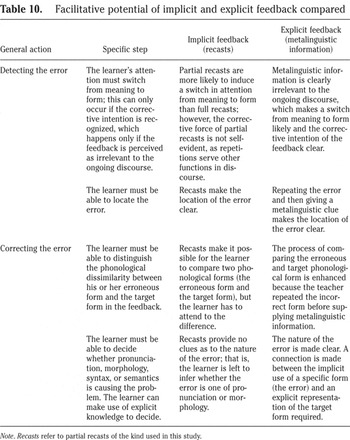
item learning. Table 10 summarizes the actions
that learners are hypothesized to carry out in order to process feedback
for acquisition (based on Carroll's, 2001,
account of corrective feedback), and the extent to which the two types of
feedback engage these processes. It illustrates how both implicit and
explicit types of feedback might facilitate these actions and it
demonstrates why explicit feedback might do so more effectively than
implicit feedback. In particular, explicit feedback seems more likely to
promote the cognitive comparison that aids learning.
Facilitative potential of implicit and explicit feedback
compared
The study reported in this paper incorporated a number of unique
methodological features. To the best of our knowledge, this is the first
experimental study that has compared the effects of online explicit
corrective feedback in the form of metalinguistic explanations and
implicit corrective feedback in the form of recasts in classroom-based
instruction. Other studies that have compared explicit and implicit
corrective feedback (see Table 1) have either
examined other forms of corrective feedback or have been laboratory based,
or both. We argue that metalinguistic explanation and recasts constitute
the best exemplars of explicit and implicit corrective feedback, as both
are supported by previous research that shows them to be effective in
promoting learning. We also argue that from a pedagogical perspective, it
is important to examine corrective feedback within the classroom context.
We do not believe that it is easy to extrapolate the results obtained from
laboratory studies that involve one-on-one interactions to classrooms in
which the teacher interacts with the whole class. In our view, ecological
validity can only be achieved through classroom-based research.
Another unique feature is that the corrective feedback occurred in the
context of learners performing communicative tasks. In Long's (1991) terms, therefore, the feedback constituted
focus-on-form. In the majority of studies listed in Table 1, the feedback was part of a focus-on-forms.
The importance of the study reported in the preceding sections is that it
demonstrates that when learners receive explicit feedback on their
attempts to communicate, acquisition takes place. Thus, the study supports
Long's claims about focus-on-form. In the view of the teacher who
taught the lessons and of the researchers who inspected the transcripts of
the corrective feedback episodes, the learners were engaged with
performing the tasks and the primary focus was on meaning, not form. The
study demonstrates that metalinguistic feedback does not detract unduly
from the communicative flow of a lesson.
A third unique feature of the study is to be found in the instruments
used to measure learning. These measures were based on prior research
designed to develop relatively separate measures of implicit and explicit
knowledge (R. Ellis, 2005; Erlam, in press). These measures enable us to consider
whether the effects of the corrective feedback were related to implicit as
well as explicit knowledge. The results reported earlier suggest that
corrective feedback results in gains in implicit knowledge. As such, they
constitute evidence against the claims that have been advanced by some
theorists (Krashen, 1982; Schwartz, 1993) that corrective feedback plays no part
in the development of implicit knowledge.
As in all classroom studies, there are inevitable limitations. First,
the sample size for this study was small. Also, we were forced to use
intact groups, with the result that the groups were not equivalent at the
commencement of the study, thus obligating the use of ANCOVA. Second,
because our main aim was to compare the relative effectiveness of the two
types of corrective feedback, we only included a testing group as a
control group (i.e., we did not have a control group that completed the
communicative tasks without any corrective feedback). Third, the length of
the treatments was very short (approximately 1 hr). It is possible that
with a longer treatment, recasts would have proved more effective. Fourth,
the structure we chose for study was a structure that the learners had
already begun to acquire. In one respect, this can be considered a
strength, as it enabled us to examine which type of corrective feedback
works best for structures already partially acquired. However, in another
respect, it constitutes a weakness, in that we are unable to say whether
corrective feedback (and what type of corrective feedback) is effective in
establishing new knowledge. As always, further research is needed.