





All adults should be given an equal opportunity to learn second or additional languages (L2/A) and feel that they can learn an L2/A reasonably well. Yet, people with neurodivergent profiles, such as attention-deficit/hyperactivity disorder (ADHD), may feel less confident learning an L2/A, as reflected in their self-reported lower L2 knowledge or reduced confidence in speaking L2/A compared to neurotypical controls (Paling, Reference Paling2020).Footnote 1 Research related to this topic is only just emerging, with some studies focusing on language teaching methods that may be more favorable for learners with ADHD (e.g., Castro, Reference Castro2002; Leons et al., Reference Leons, Herbert and Gobbo2009) and other studies examining whether L2/A poses difficulties for learners diagnosed with ADHD (e.g., Sparks et al., Reference Sparks, Philips and Javorsky2003, Reference Sparks, Javorsky and Philips2004, Reference Sparks, Javorsky and Philips2005). Importantly, although this line of research is still sparse and provides somewhat mixed results, several of the studies have not supported the assumption that L2/A is impacted by ADHD (e.g., Sparks et al., Reference Sparks, Philips and Javorsky2003, Reference Sparks, Javorsky and Philips2004, Reference Sparks, Javorsky and Philips2005). Regardless of whether different learning outcomes are evidenced, previous research has not yet examined whether L2/A learning is underpinned by similar cognitive mechanisms in individuals with ADHD as compared to individuals with neurotypical cognition, even though potential cognitive effects of ADHD on L2/A learning have been noted (Kałdonek-Crnjaković, Reference Kałdonek-Crnjaković2018; Köder et al., Reference Köder, Rummelhoff and Garraffa2024).
Specifically, to our knowledge, there are currently no studies that have looked at the relationship between L2/A learning in individuals diagnosed with ADHD and cognitive abilities in working memory and two long-term memory systems—declarative and procedural memory, even though these types of memory have been hypothesized and empirically supported to play a role in L2/A learning (Morgan-Short et al., Reference Morgan-Short, Hamrick, Ullman, Li, Hiver and Papi2022; Ullman, Reference Ullman, VanPatten, Keating and Wulff2020; Wen, Reference Wen, Wen, Mota and McNeill2015). Our study addresses this gap in the literature through a laboratory-based experimental study that allows for control of intervening variables that may affect L2/A learning.
ADHD and L2/A
ADHD is the most widely found behavioral disorder in children (Felt et al., Reference Felt, Biermann, Christner, Kochhar and Harrison2014) that often also persists in adolescents and adults (McGough, Reference McGough2014). Specifically, it is a neurodevelopmental disorder that involves impaired attention, lack of organizational skills, and/or hyperactivity-impulsivity (American Psychiatric Association, 2013). ADHD is also associated with impairments in various cognitive domains, including (a) attention, where one can observe issues with monitoring attentional sources; (b) memory, where the greatest impairments are found in the working memory domain; and (c) executive functions, which, for example, might be manifested in poor inhibitory control (e.g., Alderson et al., Reference Alderson, Kasper, Hudec and Patros2013; Fuermaier et al., Reference Fuermaier, Tucha, Koerts, Aschenbrenner, Kaunzinger, Hauser, Weisbrod, Lange and Tucha2015; Gupta & Kar, Reference Gupta and Kar2010).Footnote 2 Overall, impairments and symptoms associated with ADHD (Skodzik et al., Reference Skodzik, Holling and Pedersen2017) might cause students to face difficulties in academic settings in general, which might include L2/A classes. Thus, it is important to understand the potential impact of ADHD on L2/A learning.
Unfortunately, research on ADHD and L2/A learning is sparse, and studies that have focused on this relationship have yielded mixed results (Ferrari & Palladino, Reference Ferrari and Palladino2007; Leons et al., Reference Leons, Herbert and Gobbo2009; Paralik et al., Reference Paralik, Sınal and Orhan2024; Sparks et al., Reference Sparks, Philips and Javorsky2003, Reference Sparks, Javorsky and Philips2004, Reference Sparks, Javorsky and Philips2005). Of note, studies that find a negative relationship between ADHD and L2/A either have not accounted for participants’ clinical diagnosis of ADHD or have examined ADHD participants who attended institutions dedicated to individuals with learning disabilities and ADHD. For example, relying on parent and/or teacher surveys rather than on clinical diagnoses of ADHD, both Ferrari and Palladino (Reference Ferrari and Palladino2007) and Paralik et al. (Reference Paralik, Sınal and Orhan2024) found negative associations between L2/A classroom achievement and reported ADHD-like behavior. Another study focused on students with either learning disabilities or ADHD who studied at a postsecondary institution serving students with these disorders (Leons et al., Reference Leons, Herbert and Gobbo2009) and observed improvement in students’ L2/A level of proficiency. Although these studies have contributed to the overall literature on ADHD and L2/A, their findings are indirect, perhaps somewhat subjective, and specific to children or to a specialized postsecondary learning context.
Another set of studies conducted by Sparks and colleagues (reviewed in Sparks, Reference Sparks2024) provided more direct evidence about ADHD and L2/A learning. In general, these studies have not revealed significant difficulties associated with L2/A in learners with an ADHD diagnosis. For instance, it was found that students who have comorbid ADHD/learning disability could pass an L2/A course (Sparks et al., Reference Sparks, Philips and Javorsky2003). Moreover, Sparks et al. (Reference Sparks, Javorsky and Philips2004) found that students with ADHD did not struggle with L2/A learning and achieved grades that were within the average or higher-than-average range, even though only 32% of students utilized learning accommodations in the L2/A class. Although these studies by Sparks and colleagues provide some data that show that students with ADHD do not have impairments in L2/A learning, they also warrant further investigations. For example, the studies did not include comparison groups. Also, although this research has high ecological validity because the authors examined learning in L2/A classroom contexts, they did not experimentally control potential confounding variables such as the initial L2/A proficiency levels that the students had before the class. Likewise, their conclusions were based on the grades achieved in classes, which might reflect not only the language learning success but also other factors, such as attendance or class participation.
Taken together, the studies reviewed above have largely focused on school contexts and provide mixed data concerning the relationship between L2/A and ADHD. Importantly, to our knowledge, previous research also has not yet accounted for the cognitive mechanisms that contribute to L2/A learning in individuals diagnosed with ADHD. The current study aims to examine this question in regard to the memory systems that are known to play a role in L2/A learning: working memory (WM), declarative memory (DM), and procedural memory (PM).
L2/A, working memory, and ADHD
One of the memory systems that underpins L2/A learning is WM, which is generally defined as a system that supports the storage and processing of the information needed to perform a wide range of cognitive tasks (Baddeley et al., Reference Baddeley, Hitch and Allen2019; Cowan, Reference Cowan2017). WM has been shown to play a significant role in L2/A learning. For example, Linck et al.’s (Reference Linck, Osthus, Koeth and Bunting2014) meta-analysis found a positive relationship between WM and L2/A processing and proficiency. Wen’s (Reference Wen, Wen, Mota and McNeill2015) review showed that WM has a facilitative effect on both L2/A vocabulary (phonological forms) and grammar (morphosyntactic forms) learning. However, not all individual studies find a connection between WM and L2/A learning. For instance, artificial language learning studies, which in part motivated the current project (Antoniou et al., Reference Antoniou, Ettlinger and Wong2016; Ettlinger et al., Reference Ettlinger, Bradlow and Wong2014), did not observe any association between WM and L2/A grammar learning. However, due to WM’s overall facilitative role on L2/A learning, we should consider how WM may be impacted in ADHD and, in turn, how any impact may moderate L2/A learning.
As for the relationship between WM and ADHD, the results of multiple meta-analyses suggest that ADHD may be associated with poor WM performance in people of different age groups (e.g., Alderson et al., Reference Alderson, Kasper, Hudec and Patros2013; Kasper et al., Reference Kasper, Alderson and Hudec2012; Martinussen et al., Reference Martinussen, Hayden, Hogg-Johnson and Tannock2005; Ramos et al., Reference Ramos, Hamdan and Machado2020). For example, Kasper et al. (Reference Kasper, Alderson and Hudec2012) observed that children with ADHD exhibited poorer performance on tasks that involved specific components of WM compared to neurotypical children. Ramos et al. (Reference Ramos, Hamdan and Machado2020) conducted a meta-analysis of studies that focused on children (from 6 years of age) and adolescents (up to 18 years of age). They found that participants with ADHD had lower scores compared to the neurotypical controls but that difficulties associated with verbal WM performance lessened with the increase in the participants’ age. Focusing on adults, Alderson et al. (Reference Alderson, Kasper, Hudec and Patros2013) found that individuals diagnosed with ADHD performed moderately worse on the phonological and visuospatial WM tasks than neurotypical controls. Overall, given the evidence of WM impairment in ADHD (which might decrease with age) and the attested role of WM in L2/A learning, it is possible that WM deficits may moderate learning in L2/A.
L2/A, declarative memory, and ADHD
DM is another memory system that plays a role in L2/A learning (e.g., Morgan-Short et al., Reference Morgan-Short, Hamrick, Ullman, Li, Hiver and Papi2022) and may be impaired in ADHD (e.g., García et al., Reference García, Estévez and Junqué2001). It is a type of long-term neurocognitive memory system that relies on the medial temporal lobe and associated neural circuits (Ullman, Reference Ullman, VanPatten, Keating and Wulff2020) and that supports learning, storage, and processing of idiosyncratic information, such as knowledge about facts and events that are related to the world and to oneself (Tulving, Reference Tulving1983). In L2/A, DM is expected to support the learning of idiosyncratic linguistic forms, including vocabulary and irregular grammatical forms (Ullman, Reference Ullman, VanPatten, Keating and Wulff2020), as well as “non-idiosyncratic, rule-governed aspects of language” (p. 140), particularly at the early stages of L2/A development. Therefore, at least some rule-governed grammatical forms may be learned through DM, even though grammatical forms are expected to be learned through PM over time. The role of DM in L2/A learning has been supported by recent empirical research. For example, the meta-analysis by Hamrick et al. (Reference Hamrick, Lum and Ullman2018) revealed a positive relationship between DM and grammar, particularly at the early stages of learning, and a systematic review by Morgan-Short et al. (Reference Morgan-Short, Hamrick, Ullman, Li, Hiver and Papi2022) suggested a role of DM across different linguistic domains (e.g., grammar, vocabulary, and phonology). Consistent with these overall findings, previous research with the artificial language learning paradigm adopted in the current study found that DM facilitated the learning of complex analogical forms of grammar (Antoniou et al., Reference Antoniou, Ettlinger and Wong2016; Ettlinger et al., Reference Ettlinger, Bradlow and Wong2014).
Because DM plays a role in L2/A learning, it is important to consider whether it is impacted in ADHD. A few studies provide indirect evidence as to whether individuals with the disorder have impaired DM. For example, Prehn-Kristensen, Göder, et al. (Reference Prehn-Kristensen, Göder, Fischer, Wilhelm, Seeck-Hirschner, Aldenhoff and Baving2011) found that children with ADHD showed reduced sleep-associated consolidation of DM memory in comparison with controls. Verster et al. (Reference Verster, Bekker, Kooij, Buitelaar, Verbaten, Volkerts and Olivier2010) observed that DM performance was affected in individuals with ADHD who did not take any particular medication compared to those who did. Other studies provide more direct evidence about DM in ADHD. The meta-analysis by Lobato-Camacho & Faísca (Reference Lobato-Camacho and Faísca2024) reported worse object recognition memory performance in children and adolescents with ADHD than in the neurotypical controls. García et al., (Reference García, Estévez and Junqué2001) found that adolescents with ADHD exhibited deficits in DM as compared to controls. Sindiani et al. (Reference Sindiani, Korman and Karni2022) explored text recall, which would rely on DM, and found that, overall, neurotypical controls performed better than participants with ADHD. In sum, although evidence about DM in ADHD is not abundant, the results suggest that DM may be affected in individuals with ADHD, which may, in turn, moderate L2/A learning.
L2, procedural memory, and ADHD
Another type of long-term memory that is associated with L2/A learning is PM. This long-term neurocognitive memory system relies on the basal ganglia and associated neural circuits (Ullman, Reference Ullman, VanPatten, Keating and Wulff2020) and supports the learning and processing of cognitive and motor functions, such as skills that are learned with experience (Knowlton et al., Reference Knowlton, Siegel, Moody and Byrne2017). In L2/A learning, PM is expected to underlie the learning of the implicit sequences and rules, especially at later learning stages (Ullman, Reference Ullman, VanPatten, Keating and Wulff2020). Thus, it subserves grammar learning and other types of implicit language learning, e.g., learning word boundaries in a continuous speech stream. These predictions have been supported by Hamrick et al.’s (Reference Hamrick, Lum and Ullman2018) meta-analysis, which found a relationship between PM and L2/A grammar learning at higher levels of experience, and by Morgan-Short et al.’s (Reference Morgan-Short, Hamrick, Ullman, Li, Hiver and Papi2022) systematic review, which reported links between PM and syntax (at later learning stages), morphophonology (for affixational forms), and morphosyntax. Of note, Antoniou et al. (Reference Antoniou, Ettlinger and Wong2016) and Ettlinger et al. (Reference Ettlinger, Bradlow and Wong2014) found that PM was predictive of simple affixed grammar learning in an artificial language, and Ettlinger et al. (Reference Ettlinger, Bradlow and Wong2014) also observed that high PM contributed to either above or below chance performance on complex analogical grammar learning.
Because PM facilitates L2/A learning, it is also important to consider the impact of ADHD on PM. However, there are only a handful of relevant studies. For instance, Fabio et al. (Reference Fabio, Rizzotto and Colombo2020) revealed that young adults with ADHD exhibited deficits in WM and PM. Merikanto et al. (Reference Merikanto, Kuula, Makkonen, Halonen, Lahti, Heinonen, Räikkönen and Pesonen2019) observed that elevated ADHD symptoms based on a self-reported scale could be linked to poor performance on overnight procedural learning. Mohammadkhanloo et al. (Reference Mohammadkhanloo, Pooyan, Sharini and Yousefpour2025) found different levels of functional connectivity between brain regions associated with the PM network in adults with ADHD compared to healthy controls. Other studies, however, provide evidence that individuals with ADHD have preserved PM. For example, Sanjeevan, Cardy, et al.’s (Reference Sanjeevan, Cardy and Anagnostou2020) meta-analysis found no significant difference in the performance of ADHD and neurotypical control groups on a procedural sequence learning task, regardless of the participants’ age group (either children or adults). Also, Sanjeevan, Hammill, et al. (Reference Sanjeevan, Hammill, Brian, Crosbie, Schachar, Kelley, Liu, Nicolson, Iaboni, Day Fragiadakis, Ristic, Lerch and Anagnostou2020) discovered no differences in the neural structures that underpin PM in children with and without ADHD. Takács et al. (Reference Takács, Shilon, Janacsek, Kóbor, Tremblay, Németh and Ullman2017) revealed that children with ADHD and both ADHD and comorbid Tourette syndrome have preserved PM sequence learning. Furthermore, García et al., (Reference García, Estévez and Junqué2001) did not find any difference in the PM learning ability in adolescents between participants with ADHD and controls. Another interesting finding was observed in a sleep-oriented study by Prehn-Kristensen, Molzow, et al. (Reference Prehn-Kristensen, Molzow, Munz, Wilhelm, Müller, Freytag, Wiesner and Baving2011), who found a positive effect of sleep on PM (assessed by the button-box task) in children with ADHD, which was surprisingly not present in the neurotypical controls. Relatedly, Korman et al. (Reference Korman, Levy and Karni2017) found that participants with ADHD had lower overnight gains on a finger-to-thumb opposition sequence tapping task when trained in the morning but had equally effective performance when trained in the evening. Although the results largely suggest that PM is not impaired in ADHD, this is still an under-researched topic, and the potential relationship between PM and ADHD could also have an effect on L2/A learning.
Therefore, it might be important to explore the association between PM, ADHD, and L2/A learning in greater detail.
Motivation for the study and research questions
Based on the evidence that (a) WM and two long-term memory systems seem to play a significant role in adult L2/A acquisition, and (b) adults with ADHD seem to have impaired DM (e.g., Verster et al., Reference Verster, Bekker, Kooij, Buitelaar, Verbaten, Volkerts and Olivier2010) and WM (e.g., Martinussen et al., Reference Martinussen, Hayden, Hogg-Johnson and Tannock2005) but might have intact PM (e.g., Fabio et al., Reference Fabio, Rizzotto and Colombo2020), it is important to investigate the role that individual differences in these memory systems play in L2/A learning in individuals with ADHD (considering both the diagnosis and symptomatology of ADHD). The present study aims to address this question in order to contribute to our understanding of the nature of ADHD and its impact on L2/A learning. We pose the following research questions:
First, we will examine whether ADHD has effects on L2/A learning (as compared to neurotypical controls). Thus, our first research question (RQ1) is: Does ADHD affect L2/A learning?
Given previous research, we expect either (a) no statistically significant differences between participants with ADHD and neurotypical controls or (b) differences in performance that are minimal (with controls scoring slightly higher than participants with ADHD; see Supplementary Materials [SM] Appendix A for a summary of predictions). This prediction is based on the fact that most of the studies that looked at L2/A learning and ADHD did not find impaired L2/A learning in students with ADHD (e.g., Sparks et al., Reference Sparks, Philips and Javorsky2003, Reference Sparks, Javorsky and Philips2004, Reference Sparks, Javorsky and Philips2005). The few studies that found impaired performance either assessed ADHD only based on the parent and/or teacher evaluations (Ferrari & Palladino, Reference Ferrari and Palladino2007) or concentrated on the performance of the students who also had learning difficulties (Leons et al., Reference Leons, Herbert and Gobbo2009). Thus, in a more controlled experimental setting in which participants self-report whether they were clinically diagnosed with ADHD, differences between the two groups may not be observed. However, given that previous research on L2/A and ADHD is still scarce, we do not consider this to be a strong prediction.
Second, we will examine whether the contribution that memory systems make to L2/A learning varies based on ADHD symptomatology, as measured by a commonly used ADHD questionnaire (BAARS-IV; Barkley, Reference Barkley2011). Thus, our second research question (RQ2) is: Does the role of working, declarative, and procedural memory for L2/A learning differ based on ADHD symptomatology?
Regarding this research question, we expect that, in general, learners with higher ADHD symptomatology may rely less on WM and DM since these memory systems might be impaired in ADHD (e.g., Alderson et al., Reference Alderson, Kasper, Hudec and Patros2013; García et al., Reference García, Estévez and Junqué2001; Kasper et al., Reference Kasper, Alderson and Hudec2012), and more on PM, which may potentially not be impacted in ADHD (Sanjeevan, Cardy, et al., Reference Sanjeevan, Cardy and Anagnostou2020). More specifically (see SM Appendix A), for simple, suffixed structures (which have previously been shown to rely on PM; e.g., Antoniou et al., Reference Antoniou, Ettlinger and Wong2016), we expect that learners with higher ADHD symptomatology who have better PM will achieve higher L2/A accuracy compared to learners with lower ADHD symptomatology. Also, for complex analogical structures (which have previously been shown to rely on DM and WM; e.g., Antoniou et al., Reference Antoniou, Ettlinger and Wong2016), we expect that learners with higher ADHD symptomatology who have (a) better WM and DM will not achieve higher L2/A accuracy, and (b) better PM may achieve higher L2/A accuracy to a greater extent than learners with lower ADHD symptomatology. Note that our prediction for the role of PM may not bear out in this particular study, as PM is generally expected to play a larger role at later stages of L2/A learning, and our study is relatively short, lasting only one day (Ullman, Reference Ullman, VanPatten, Keating and Wulff2020).
Participants
Two hundred and two participants from a large Midwestern university were recruited for participation in the research.Footnote 3 Data from 154 participants were included in the current study (see participant exclusion criteria in the Analysis section). These participants had been recruited either from an introductory psychology course for class credit (all control participants and 27 ADHD participants) or were recruited from flyers posted around campus and were monetarily compensated (18 ADHD participants) for their participation. Participants from both the ADHD and control groups had various native languages, with most participants reporting English as their first language (ADHD group, 96%; control group, 80%). Most participants also reported being bilingual (ADHD group, 78%; control group, 87%; see SM Appendix B for a full list of participant languages).
The control group consisted of 109 undergraduate students (71 female, 38 male) who reported that they were not clinically diagnosed with ADHD. The ADHD group consisted of 45 participants (42 undergraduate students, 3 graduate students; 29 female, 12 male, 4 no report of sex) who self-reported being clinically diagnosed with ADHD. Note that age and ADHD symptomatology (i.e., BAARS-IV scores), but not depression (PHQ scores) or number of L2/As, were higher for the ADHD group than the control group. The BAARS-IV scores for the ADHD group fell within the range for the clinical diagnosis based on the BAARS-IV scale (see ADHD Measure section below). See Table 1 for descriptives of the participant characteristics.
Descriptive scores of participant characteristics

Note: Reliability for BAARS-IV is α = 0.93. Reliability for PHQ-9 is α = 0.86.
Materials and procedure
The current study was conducted in one experimental session. Participants first provided informed consent and then completed a verbal DM task and an artificial language learning task. This was followed by a nonverbal DM task, a background survey, and a depression questionnaire. Finally, participants completed a PM task, an ADHD questionnaire, and WM tasks. Each task is described in more detail below.
L2/A learning task
We adopted an artificial language learning task (Antoniou et al., Reference Antoniou, Ettlinger and Wong2016) that has been shown to have ecological validity for L2/A classroom learning (Ettlinger et al., Reference Ettlinger, Morgan-Short, Faretta-Stutenberg and Wong2016). Artificial languages also allow for a higher level of experimental control than in classrooms (e.g., controlling for previous proficiency levels and exposure to the target form) while being learnable in a relatively short amount of time (Morgan-Short, Reference Morgan-Short2020). For this task, participants learned the morphophonology of an artificial language that consists of 12 nouns denoting animals. In this language, all the nouns are monosyllabic and have the following structure: consonant-vowel-consonant (e.g., [gif], “horse”). Each noun can be used in four forms, including singular, diminutive singular, plural, and diminutive plural forms. There are two types of rules used to derive these forms from the singular form. For words with i- and a-stems, a new word is formed by simple affixation with the suffix [-il] to create the plural form, the prefix [ka-] to create the diminutive form, and both the suffix and prefix to create the diminutive plural form (e.g., the singular word [gif], “horse” becomes [gif-il] “horses,” [ka-gif] “little horse,” or [ka-gif-il] “little horses”). This simple affixation rule is posited to rely on PM (Antoniou et al., Reference Antoniou, Ettlinger and Wong2016). For words with e-stems, a new word is formed through complex analogy with the addition of an affix and a change of the vowel in the stem and/or affix to create the diminutive form, plural, and diminutive plural forms (e.g., the singular word [mez] “cow” becomes [mez-el] “cows,” [ka-maz] “little cow,” or [ka-maz-el] “little cows”). Because of the complexity of these combined rules, these forms are assumed to be learned by analogy, which is posited to rely on DM (Antoniou et al., Reference Antoniou, Ettlinger and Wong2016).
To train participants in the artificial language, we first exposed them to pairings of pictures and spoken words. Participants were told that they would “see some pictures and hear the word associated with these pictures in this new language.” They were instructed to “pay particular attention to the vowels in the words and the vowels in the suffixes,” but they were not provided with any information about the rules of the language. All 12 nouns were presented in their four possible forms, creating a block of 48 items. This block was repeated four times for a total of 192 trials overall. For each pairing of pictures and spoken words, the picture denoting a noun was displayed on the screen for 500 ms and remained on the screen as the corresponding spoken word was played for 1500 ms, after which time participants saw a blank screen for 500 ms before the next picture-noun pair was introduced.
Next, participants completed practice with the morphophonological rules (48 practice items). First, a picture denoting a trained noun was displayed on the screen for 500 ms. The picture remained on the screen as two possible words were played, with the first word presented for 1500 ms. Then, the second word was played with the picture displayed on the screen for up to 5 s. During this time, participants had to choose the word that corresponded to the picture. Immediately following their response, the participants were told if they were correct or not, and the correct word was played. Participants repeated this training and practiced a second time.
Finally, participants were tested on their generalizable knowledge of the morphophonological rules (48 testing items). In particular, they were presented with a picture of a novel, untrained noun that was singular and non-diminutive. The picture was displayed on the screen for 500 ms and then remained on the screen as the corresponding novel spoken word was played for 1500 ms. Then, after a 500 ms blank screen, a picture of the novel untrained noun was displayed in either its singular or diminutive form (or both) for 500 ms and remained on the screen as two spoken words were produced sequentially. As in the practice phase, participants had up to 5 s to choose the word that corresponded to the picture, but they were not given any feedback regarding their choice. Accuracy of the responses from the testing phase was analyzed as the dependent variable for the study.
Declarative memory task—Declearn
In order to assess participants’ nonverbal DM learning ability, the Declearn task (Hedenius et al., Reference Hedenius, Ullman, Alm, Jennische and Persson2013) was used. Similar tasks have been shown to “engage the network of brain structures underlying declarative memory” (Hedenius et al., Reference Hedenius, Ullman, Alm, Jennische and Persson2013, p. 50), and recent evidence showed that the Declearn task loaded onto a DM factor and showed acceptable reliability (Buffington et al., Reference Buffington, Demos and Morgan-Short2021). The Declearn task is a nonverbal task, which ensures that the links between performance on the task and L2/A learning can be associated with the domain-general DM learning abilities (Buffington et al., Reference Buffington, Demos and Morgan-Short2021).
The Declearn task consists of an encoding and a recognition stage. First, for the incidental encoding stage, participants were presented with a set of black-and-white images of real and made-up objects (64 trials total) and were asked to decide whether the object was real or not. A 10-minute break followed the encoding stage. Then, for the recognition stage, participants were shown the same set of objects along with 64 new objects and were asked to indicate whether they recognized having seen each object before or not (128 trials total). During both stages, participants were given 500 ms to view each image and up to 4500 ms to make their response. The d-prime score for the recognition block was computed to represent nonverbal DM learning ability.
Declarative memory task—Modern Language Aptitude Test, Part V
To assess participants’ verbal DM learning ability, we used the Modern Language Aptitude Test, Part V (MLAT-V; Carroll & Sapon, Reference Carroll and Sapon1959), which was found to have acceptable reliability and a positive association with the Declearn task (Buffington et al., Reference Buffington, Demos and Morgan-Short2021). This verbal task reveals associations between L2/A learning and DM within a verbal domain. For the MLAT-V, participants had to memorize 24 pseudo-Kurdish words that were presented with the English equivalents. Participants were given 2 minutes to learn the words and 2 minutes to practice using the words by writing the corresponding pseudo-Kurdish equivalents to the 24 written English words. When working on this activity, participants could look at a handout that had the words written in both English and Kurdish. After participants finished the practice, they were given 4 minutes to work on a multiple-choice test to match an English equivalent to a Kurdish word, which included all 24 items. Each question had five options. The accuracy score was analyzed to represent verbal DM learning ability. Finally, for the overall DM learning ability score used in the analyses, we averaged the standardized scores from the Declearn and the MLAT-V tasks.
Procedural memory task
Participants’ PM learning abilities were assessed using the Serial Reaction Time (SRT) task (Lum et al., Reference Lum, Conti-Ramsden, Page and Ullman2012; Nissen & Bullemer, Reference Nissen and Bullemer1987), which was found to have acceptable reliability and a positive association with another PM learning task (Buffington et al., Reference Buffington, Demos and Morgan-Short2021). For the SRT task, participants were presented with a smiling face image that appeared in one of four positions on the screen following a sequence. Participants were instructed to “press the button on the game pad that matches the location of the smiley face on the computer screen.” However, they were not told about the repeating sequence. This sequence was repeated for four blocks with 60 trials each, after which a fifth final block was presented in which the stimulus (smiling face) appeared in the four positions randomly. This task is considered to measure PM learning ability as participants’ responses become faster and more accurate with practice during the four sequenced blocks and then slow down on the random block, even when participants do not become aware of the sequence (Walker et al., Reference Walker, Monaghan, Schoetensack and Rebuschat2020). In order to calculate a PM learning ability score, participants’ median response time score from the fifth random block was subtracted from the fourth sequenced block. A larger difference score reflects more PM learning.
Working memory tasks
Three shortened versions of the complex WM span tasks (Oswald et al., Reference Oswald, McAbee, Redick and Hambrick2015) that were shown to be both valid and reliable measures of WM were utilized in the current study.
Operation-span. For the Ospan task, participants were presented with simple math equations and solutions to them (e.g., (1*2) + 1 =3). The participants’ task was to identify whether the provided solution was correct or wrong. After being presented with each math problem, participants were shown a letter that they were asked to recall in the order of presentation after the end of each trial. Two trial sets of 4, 5, and 6 letters were administered, which resulted in 6 trials and a maximum score of 30.
Reading-span. For the Rspan task, participants were presented with logical and illogical sentences that contained 10–15 words. The participants’ task was to decide whether the given sentences made sense or not (e.g., “Andy was stopped by the policeman because he crossed the yellow heaven” or “During winter you can get a room at the beach for a very low rate”). After making decisions on each sentence, participants were presented with a letter that they were later asked to recall in the order of presentation at the end of each trial. Two trial sets of 4, 5, and 6 letters were administered, which resulted in 6 trials and a maximum score of 30.
Symmetry-span. For the Sspan task, participants were shown 8*8 grids of black and white squares. Their task was to judge whether the placement of the black squares was symmetrical around the vertical axis. After making each symmetry judgment, participants were presented with a 4*4 grid that contained a single red square. Participants were asked to recall the location of the red square in the order of presentation at the end of each trial. Two trial sets of 3, 4, and 5 squares were presented, which resulted in 6 trials total and a maximum score of 24.
For assessing WM, first, a partial accuracy score (following Oswald et al., Reference Oswald, McAbee, Redick and Hambrick2015) based on correct recall for each span task was calculated. Then, a summed composite WM score was calculated that was used as a predictor variable in the models.
ADHD measure
To measure ADHD symptomatology, participants completed the BAARS-IV questionnaire (Barkley, Reference Barkley2011), which has been shown to be a reliable and valid measure of ADHD (Silverman, Reference Silverman2012). For our study, we only utilized the self-report form of the scale, which includes 30 items. Participants responded to 27 of the items using a 4-point Likert scale (never = 1, sometimes = 2, often = 3, very often = 4) reflecting the frequency of the ADHD symptoms they experienced during the last 6 months. The questions were divided into four sections with the focus on inattention (9 statements, e.g., “easily distracted by extraneous stimuli or irrelevant thoughts”), hyperactivity (5 statements, e.g., “fidget with hands or feet or squirm in seat”), impulsivity (4 statements, e.g., “have difficulty awaiting my turn”), and sluggish cognitive tempo (9 statements, e.g., “underactive or have less energy than others”). The last three questions evaluate the onset of the symptoms and the spheres that are most affected by them. For the current study, we totaled the Likert scale scores for the symptoms for the inattention, hyperactivity, and impulsivity sections. A total score that falls within the 93rd percentile or higher (39–72 total points on three sections) is considered to be indicative of ADHD (Barkley, Reference Barkley2011).
Depression measure
Since depression can be comorbid with ADHD, participants completed the PHQ-9 questionnaire that evaluates depressive symptoms (Kroenke & Spitzer, Reference Kroenke and Spitzer2002). Participants were asked about nine problems they might have experienced during the last 2 weeks (e.g., “Little interest or pleasure in doing things”). The occurrence of each problem was based on the 4-point Likert scale (not at all = 0, several days = 1, more than half the days = 2, nearly every day = 3). If there are at least four “more than half the days” or “nearly every day” responses (or if participants indicated “several days” to “Thoughts that you would be better off dead or of hurting yourself”), depression would be indicated. The total summed score indicates the severity of depression, where 1–4 points are indicative of minimal depression and 20–27 points are indicative of severe depression.
Analysis
Our first research question—Does ADHD influence L2/A learning?—is focused on overall group differences. Thus, we considered ADHD a categorical variable based on whether participants self-reported a clinical diagnosis of ADHD. To test for group differences following our preregistered analysis plan, found at https://osf.io/ncgyh/, two Welch two-sample t-tests were conducted—one with the L2 accuracy score on the simple forms and one with the L2 accuracy score on the complex forms. Here, performance on the L2 task of the participants with a reported diagnosis of ADHD and controls was compared. Thus, ADHD was quantified categorically based on a self-reported clinical diagnosis.
The second research question—Does the role of working, declarative, and procedural memory for L2/A learning differ based on ADHD symptomatology?—is focused on variability in ADHD symptomatology, which is measured as a continuous variable with BAARS-IV. To examine this research question following our preregistration, two logistic mixed-effects models were run—one for simple affixed structures and one for complex analogical structures. For both models, the accuracy score on the L2 learning task was treated as a dependent variable. ADHD symptomatology and individual differences in WM, DM, and PM were treated as predictor variables. The models also contained interactions between ADHD and each of the individual difference measures. Finally, the following variables were entered as covariates: (a) age and sex, which may vary for ADHD, memory, and L2 (McGough, Reference McGough2014; Ullman, Reference Ullman, VanPatten, Keating and Wulff2020); (b) depression, which is known to covary with ADHD (McGough, Reference McGough2014); and (c) number of languages that participants reported to know, which might affect ADHD symptomatology and L2 learning (Bialystok, Reference Bialystok2017). For the random effects, we included a random intercept of participant and a random intercept of stimulus.
Following our preregistered exclusion criteria, we excluded participants who had a missing score on at least one of the tasks (n = 12), participants who had less than ~75% recorded data on the L2 task (n = 35), and participants whose data were not properly recorded on the first administration of any task (n = 1). We did not need to exclude any participant for scoring less than 60% accuracy on average on the processing portion of the three working memory complex span tasks. For the SRT task, we also removed observations that were 3 SD above average or lower than 100 ms.
Results
RQ 1: ADHD and L2/A learning
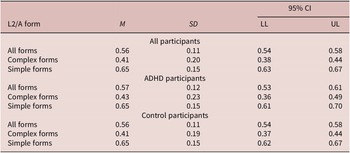
Before conducting the analysis for our first research question—Does ADHD influence L2/A learning?—we examined the overall pattern of learning for the artificial language learning paradigm (see Table 2). We observed that participants evidenced above-chance learning for simple affixed forms based on 95% confidence intervals that did not overlap with chance level (i.e., 50%). However, their performance on the complex analogical forms was below chance.
Descriptive scores on the artificial language task for complex analogical and simple affixed forms

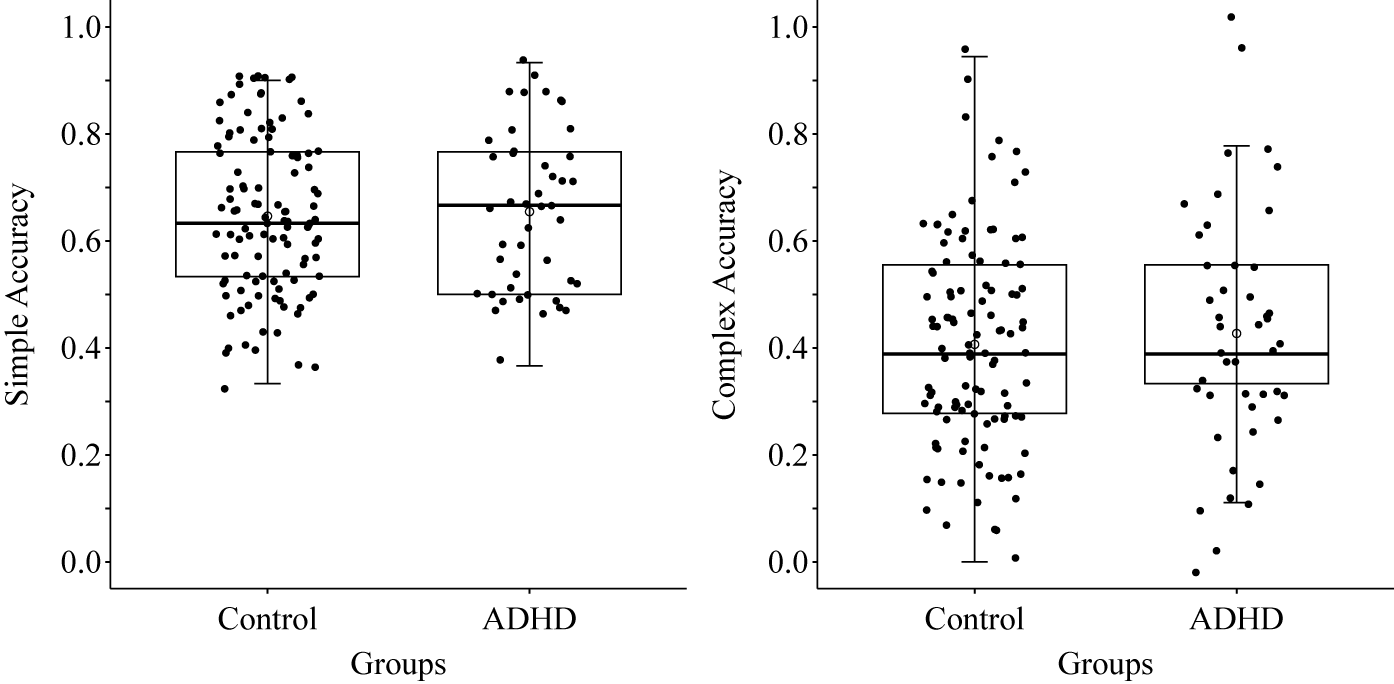
In order to address our research question, as per our preregistration, we ran two Welch two-sample t-tests to compare learners with and without self-reported diagnosed ADHD based on their accuracy scores for the complex analogical forms and the simple affixed forms (see Figure 1). The results showed that, for complex analogical forms, the difference in L2/A learning between the ADHD and the control group was not statistically significant, t(71.84) = 0.53, p = .60, d = 0.10. For simple affixed forms, the difference in L2/A learning between the ADHD and the control group was also not statistically significant, t(81.83) = 0.32, p = .75, d = 0.06. Thus, no differences between the ADHD and control groups were detected on the measures of L2/A learning.Footnote 4
Box plots of the scores for complex and simple forms for ADHD and control groups.
Note: Each filled circle represents a score for an individual participant. Unfilled circles represent the mean for the group.

To further explore whether the groups performed similarly to each other, we ran the TOST procedure (Lakens, Reference Lakens2017), which is a test to establish equivalency between groups. The independent samples Welch’s equivalence test with high and low equivalence bounds of d = –0.5 and 0.5 (following Hui et al., Reference Hui, Wong and Au2022) confirmed that the performance was equivalent for both simple (t(81.83) = 2.50, p < .01) and complex (t(71.84) = 2.20, p < .05) forms. This serves as evidence that the learners in the ADHD and control groups performed at similar levels.
RQ 2: ADHD, L2/A learning, and memory
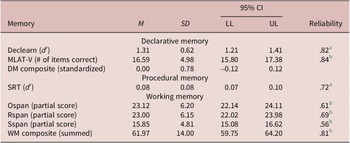
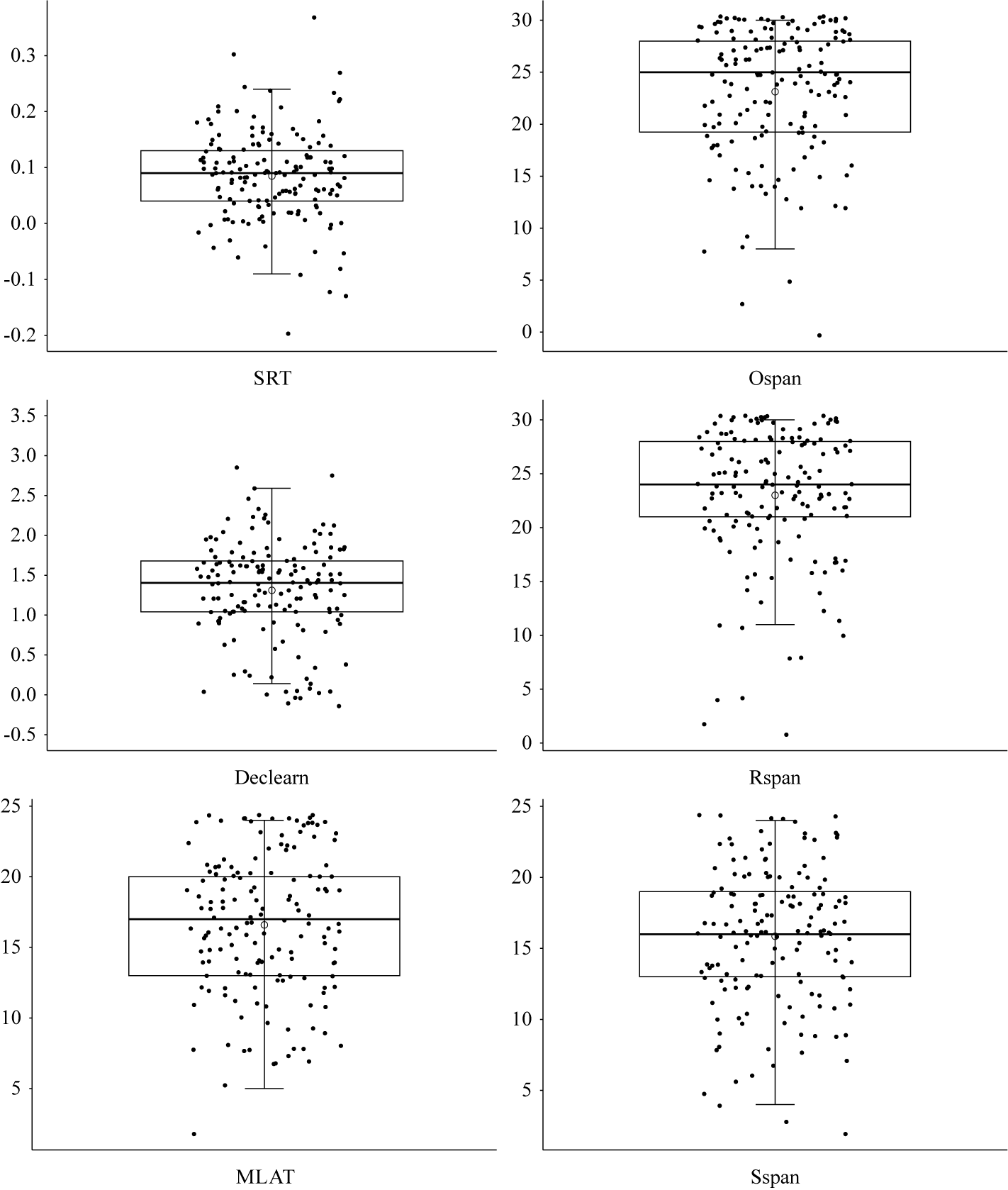
Before addressing our second research question—Does the role of working, declarative, and procedural memory for L2/A learning differ based on ADHD symptomatology?—we looked at the learning effects on the cognitive tasks. Learning was observed on DM and PM tasks with above-chance performance on Declearn, MLAT-V, and SRT, based on 95% confidence intervals that did not overlap with chance level (i.e., 0 d′ for Declearn and SRT and 6 items for MLAT-V, respectively; see Table 3 and Figure 2; also see SM Appendix D for separate descriptive scores for ADHD and control participants). Participants’ performance on the WM tasks was also satisfactory and showed variation.
Descriptive scores on the cognitive tasks

a Reliability based on split-half analysis.
b Reliability based on alpha.
Box plots of score distributions on the cognitive tasks.
Note: Each filled circle represents a score for an individual participant. Unfilled circles represent the mean for the group.

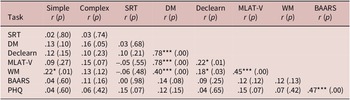
To observe general patterns of association in the data, a correlational analysis was run (see Table 4). The correlations showed that overall, there was a statistically significant small positive relationship between the accuracy score on the simple affixed forms and the WM composite score (r(152) = .22, p = .01) and a small positive relationship between the accuracy score on the complex analogical forms and the DM composite score (r(152) = .16, p = .053) that was approaching significance. Separate correlations for ADHD and control participants are provided in SM Appendix E.
Correlations between simple and complex analogical scores and cognitive tasks (all participants)

Note: * p < .05, *** p < .001
To answer our research question, as per our preregistration, we conducted our logistic mixed effects models by running the glmer function (Bates et al., Reference Bates, Mächler, Bolker and Walker2015) in R. The accuracy score on the L2/A artificial learning task was the dependent variable. The fixed factors included the PM score, the composite standardized score for DM, the composite summed score for WM, the continuous ADHD symptomatology score (BAARS), and the interactions between each memory type and ADHD. Scores for depression, age, and sex were also included as fixed factors. The intercepts for participant and stimulus served as random factors. Before running the models, we also grand-mean centered and scaled scores on PM, WM, ADHD symptomatology, depression, age, and sex.
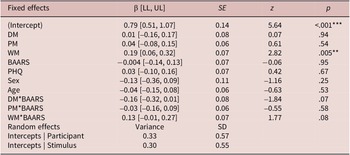
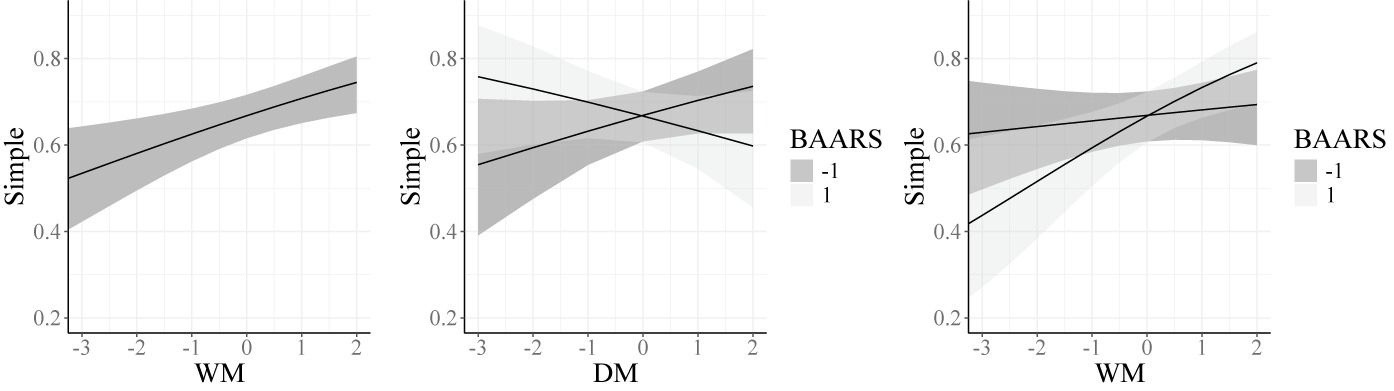
For simple affixed rules (see Table 5), we found a significant effect of WM (β = 0.19, z = 2.82, p = .005, see Figure 3), showing that participants with higher WM scores got higher scores on the simple affixed rules. We also note that there was a nonstatistically significant interaction between DM and BAARS (β = –0.16, z = –1.84, p = .07, see Figure 3), revealing the following pattern: When participants had higher ADHD symptomatology, they scored more accurately on simple affixed forms if they had lower DM, and when participants had lower ADHD symptomatology, they scored more accurately if they had higher DM. We also observed a nonstatistically significant interaction between WM and BAARS (β = 0.13, z = 1.77, p = .08, see Figure 3), revealing the following pattern: When participants had higher ADHD symptomatology, they scored more accurately on simple affixed forms if they had higher WM, and when participants had lower ADHD symptomatology, accuracy was not much higher if they had higher WM as compared to lower WM. For complex analogical rules (see Table 6), no significant effects were observed. Thus, overall, the results indicated some role for individual differences in WM in L2/A learning and two potential interactions between DM and ADHD symptomatology as well as between WM and ADHD symptomatology.Footnote 5
Results for mixed-effects model: [Accuracy_Simple ~ PHQ + Age + Sex + DM*BAARS + PM*BAARS + WM*BAARS + (1|Participant) + (1|Stimulus)]

** p < .01, *** p < .001
Graphs of the main effect of WM and the interaction between DM and BAARS in the simple affixed forms.
Note: Gray-shaded areas represent confidence intervals. On the DM graph, dark grey lines represent lower ADHD symptomatology (–1 SD), and light grey lines represent higher ADHD symptomatology (1 SD) for illustrative purposes.

Results for mixed-effects model: [Accuracy_Complex ~ PHQ + Age + Sex + DM*BAARS + PM*BAARS + WM*BAARS + (1|Participant) + (1|Stimulus)]

** p < .01
Discussion
Our study aimed to investigate the relationship between ADHD and memory systems in L2/A learning in participants who reported a clinical diagnosis of ADHD and in neurotypical control participants. Overall, in the L2/A task, we found that both ADHD and control participants evidenced learning for simple affixed forms but not for complex analogical forms. In regard to our first research question, we examined whether ADHD affects L2/A learning and predicted no difference or minimal differences between ADHD and control participants. Our results supported this prediction as we did not find any evidence that ADHD affected L2/A learning of morphophonological rules. Indeed, post hoc equivalency testing also demonstrated that the groups performed similarly: Both the control and ADHD groups seem to have learned simple affixed forms (their performance was above chance) and did not learn complex analogical forms (their performance was below chance, which indeed suggests that they might have applied the rule for the simple affixed forms (without vowel changes) to the complex analogical forms (which required vowel changes).
Such results support our original hypothesis and are consistent with much previous research (Leons et al., Reference Leons, Herbert and Gobbo2009; Sparks et al., Reference Sparks, Philips and Javorsky2003, Reference Sparks, Javorsky and Philips2004, Reference Sparks, Javorsky and Philips2005). These previous studies showed that L2/A learning in individuals with ADHD may be intact, which was evident in ADHD students’ ability to pass L2/A classes (Sparks et al., Reference Sparks, Philips and Javorsky2003, Reference Sparks, Javorsky and Philips2004, Reference Sparks, Javorsky and Philips2005) or to improve their L2/A proficiency as measured by an oral proficiency test (Leons et al., Reference Leons, Herbert and Gobbo2009). Our results extend these previous college classroom-based findings to a laboratory setting where more variables between ADHD and control participants are controlled (e.g., amount of exposure to the L2/A), allowing for interpretations of the results to more tightly reflect effects of ADHD rather than other potential confounding factors (e.g., classroom distractions, teacher expertise).
However, our findings do not align with the results obtained by Ferrari and Palladino (Reference Ferrari and Palladino2007) and Paralik et al. (Reference Paralik, Sınal and Orhan2024), who found a negative relationship between ADHD and L2/A performance in class. This discrepancy could be explained by the fact that both Ferrari and Palladino (Reference Ferrari and Palladino2007) and Paralik et al. (Reference Paralik, Sınal and Orhan2024) did not examine students who were clinically diagnosed with ADHD, as the researchers solely relied on the subjective perceptions of parents and/or teachers. In contrast, in our study, we examined participants for whom we had an indication of a clinical diagnosis of ADHD, which was also true of Sparks and colleagues’ research (Sparks et al., Reference Sparks, Philips and Javorsky2003, Reference Sparks, Javorsky and Philips2004, Reference Sparks, Javorsky and Philips2005).
In regard to our second research question, which investigated whether the role of WM, DM, and PM for L2/A learning differs based on ADHD symptomatology, we had predicted that participants with higher ADHD symptomatology might rely less on WM and DM, which seems to be impaired in ADHD (e.g., Alderson et al., Reference Alderson, Kasper, Hudec and Patros2013; Kasper et al., Reference Kasper, Alderson and Hudec2012), and might rely more on PM, which seems to be intact in ADHD (e.g., Sanjeevan, Cardy, et al., Reference Sanjeevan, Cardy and Anagnostou2020). Overall, we did not find evidence to support this prediction: There was no statistically significant indication that WM, DM, or PM played different roles for students with a higher or lower ADHD symptomatology for either simple affixed or complex analogical forms. However, a hint of a differing role emerged for both DM and WM for simple affixed forms, although these were only statistical trends. We tentatively interpret the pattern between the ADHD symptomatology and DM as generally consistent with our prediction in that learners with higher ADHD symptomatology scored better when their DM learning ability was lower, possibly leading them to rely less on DM during L2/A morphophonological learning. The pattern of the relationship between the ADHD symptomatology and WM contradicts our prediction because we did not expect that learners with higher ADHD symptomatology would score better when their WM learning ability was higher, possibly suggesting that WM may be compensatory when ADHD symptomatology is high.
In understanding the results related to ADHD, memory, and L2/A learning, we are not able to turn to previous experimental research because (to our knowledge) there is no research specific to this question. However, more generally, we consider why higher ADHD symptomatology did not moderate the role of the memory systems in our learners. One potential reason could be that our predictions about the moderating effects of ADHD symptomatology are only relevant to learners with ADHD and do not apply to a broader population. Note that we developed our predictions based on research specific to ADHD and memory, but we tested them with statistical models that included a broad range of participants based on ADHD symptomatology.
Another reason why we did not find a moderating effect of ADHD on memory in L2/A learning may be that our participants with ADHD may not be representative of the larger ADHD population. All of our participants were college students who arguably had developed effective learning strategies as they were academically successful enough to have been admitted to college. Hence, they may have applied learning strategies to compensate for any memory challenges that they may have had. Our participants with ADHD also seem to differ somewhat from descriptions of ADHD related to memory in that they scored just as well as the control group for all three types of memory tested here (see SM Appendix D). Thus, perhaps our predictions would be upheld for learners for whom WM or DM is impaired.
Additional findings related to memory and L2/A learning
Overall, whereas we did not find any relationship between memory and ADHD in L2/A learning specifically, we did observe some more general relationships between memory and L2/A scores. First, in the correlation analysis, we observed a trend toward a positive association between DM and complex analogical forms, which would be consistent with the same association found in previous research that used the same version of the L2/A learning paradigm (e.g., Antoniou et al., Reference Antoniou, Ettlinger and Wong2016; Buffington & Morgan-Short, Reference Buffington and Morgan-Short2018; Ettlinger et al., Reference Ettlinger, Bradlow and Wong2014). Indeed, if we look specifically at the control participants (see SM Appendix E Table E2), we observe a statistically significant, small, positive correlation between DM and learning of complex analogical forms.
Second, in the mixed model analysis, we found that better WM predicted higher scores on simple affixed rules. Although WM was not moderated by ADHD symptomatology in the mixed-effects model, this result seems to be driven by the control participants, who evidenced a statistically significant, small positive correlation for WM, which was not found for the participants with ADHD (see SM Appendix E Table E1). This is a novel finding for this paradigm because the previous studies that investigated WM did not find any relationship between L2/A learning for both types of rules and WM (e.g., Antoniou et al., Reference Antoniou, Ettlinger and Wong2016; Buffington & Morgan-Short, Reference Buffington and Morgan-Short2018; Ettlinger et al., Reference Ettlinger, Bradlow and Wong2014). However, Antoniou et al. (Reference Antoniou, Ettlinger and Wong2016) and Ettlinger et al. (Reference Ettlinger, Bradlow and Wong2014) used an auditory WM task, which is different from the complex span WM tasks that we utilized. Nevertheless, such findings support a facilitative role of WM in L2/A learning, as attested to in a previous meta-analysis (Linck et al., Reference Linck, Osthus, Koeth and Bunting2014).
Limitations
It is also important to consider the limitations of our study. First, our results could have been influenced by the visual and written modality of our tasks. Because the L2/A learning paradigm was visual and auditory, it could be useful in the future to administer auditory versions of the memory tasks, for example, auditory WM. Second, our results reflect a sample of Midwestern college students who were from diverse linguistic backgrounds and were mostly female. Thus, further research with different samples learning in different contexts should be conducted to improve the generalizability of the findings. Third, future research may want to gather more information about ADHD diagnoses, experiences, medication, and comorbidities beyond depression. Fourth, although the levels of learning in the present study fell within the range of scores in previous research with this paradigm (Antoniou et al., Reference Antoniou, Ettlinger and Wong2016; Buffington & Morgan-Short, Reference Buffington and Morgan-Short2018; Ettlinger et al., Reference Ettlinger, Bradlow and Wong2014), the levels of L2/A learning were not high. Perhaps different results would be found for larger L2/A learning effects. Fifth, an additional analysis following Ettlinger et al. (Reference Ettlinger, Bradlow and Wong2014) based on different categories of learners (i.e., learners, nonlearners, and simplifiers who applied the simple rule to complex forms) might provide more insight into the role of memory. Finally, future research should conduct a priori power analyses to ensure that the study is appropriately powered to find the predicted effects.
Conclusion
In conclusion, our findings provide evidence that students with ADHD and neurotypical students performed similarly on an L2/A morphophonological learning task administered within a lab setting. Also, the results did not provide clear evidence that memory systems played a different role in learning based on ADHD symptomatology. However, further research may be called for specifically with DM and WM, given the nonstatistically significant patterns in the data for simple affixed forms that suggested that participants with higher ADHD symptomatology scored more accurately if they had lower DM or higher WM. More generally, our study found a relationship between DM and learning complex analogical forms as well as between WM and learning simple affixed forms. These findings contribute to the growing body of research that suggests that learners with ADHD can be successful in learning L2/A and may not differ in regard to the cognitive underpinnings of learning.
Supplementary material
The supplementary material for this article can be found at http://doi.org/10.1017/S0272263125101277.
Data availability statement
Our preregistered analysis plan as well as all data and analysis scripts are available on the Open Science Framework (OSF) at https://osf.io/edz97.
Acknowledgments
This work emerged from Marina Ridchenko’s Master’s thesis. A previous iteration of the work was presented at the 64th Annual Meeting of the Psychonomic Society, at which we received helpful feedback. We are grateful for the formative comments and discussion from Dr. Eric D. Leshikar and Dr. Michael Meinzer, who served on Marina Ridchenko’s Master’s thesis committee. We also acknowledge Dr. Ryne Estabrook for his invaluable advice on data analyses. Finally, we extend our appreciation to Victor A. Hernandez and Jessica Sakalas for their assistance with data collection and project management and to all members of the Cognition of Second Language Acquisition laboratory for their valuable comments about the research. Any remaining errors are our own. We have no conflicts of interest to disclose.



 Open access

