





Introduction
Fluridone is classified as a group 12 herbicide by the Herbicide Resistance Action Committee and Weed Science Society of America and was launched for use on rice use in 2023 by SePRO Corporation (Anonymous 2023). Fluridone is the first herbicide belonging to group 12 to be registered for use in rice production, offering a promising option to complement rice weed control programs. Fluridone controls a broad spectrum of weeds by inhibiting the phytoene desaturase enzyme, which prevents the formation of carotenoids, ultimately resulting in plant bleaching and death (Bartels and Watson Reference Bartels and Watson1978; Chamovitz et al. Reference Chamovitz, Pecker and Hirschberg1991; Sandmann et al. Reference Sandmann, Schmidt, Linden and Böger1991). Fluridone is a residual herbicide used in cotton (Gossypium hirsutum L.) production in the United States, and several studies highlight its effectiveness and safety on the crop (Banks and Merkle Reference Banks and Merkle1979; Grichar et al. Reference Grichar, Dotray and McGinty2020; Hill et al. Reference Hill, Norsworthy, Barber and Gbur2016; Waldrep and Taylor Reference Waldrep and Taylor1976). However, due to its recent release, limited research has explored its safety on rice.
Research has demonstrated that fluridone should be applied with postemergence herbicides, because fluridone will not control weeds that have emerged before treatment (Anonymous 2023; Hill et al. Reference Hill, Norsworthy, Barber and Gbur2016; King et al. Reference King, Norsworthy, Butts, Barber, Drescher and Godar2024; Waldrep and Taylor Reference Waldrep and Taylor1976). Herbicide mixtures broaden the spectrum of control, and they may enhance the management of resistant biotypes by incorporating distinct sites of action that effectively control the target weed species (Dhanda et al. Reference Dhanda, Kumar, Geier, Currie, Dille, Obour, Yeager and Holman2023; Hydrick and Shaw Reference Hydrick and Shaw1994; Miller and Norsworthy Reference Miller and Norsworthy2018; Zhang et al. Reference Zhang, Hamill and Weaver1995). While herbicide mixtures may not eliminate the need for multiple applications, they decrease the frequency of such applications by providing improved control and reducing total costs. Furthermore, using multiple sites of action in a spray mixture helps prevent the evolution of target-site resistance to herbicides (Diggle et al. Reference Diggle, Neve and Smith2023; Norsworthy et al. Reference Norsworthy, Ward, Shaw, Llewellyn, Nichols, Webster, Bradley, Frisvold, Powles, Burgos and Witt2012).
The success of herbicide mixtures partly depends on the interaction between products. When two or more herbicides are combined, the interaction can be additive, synergistic, or antagonistic, which can significantly influence weed control efficacy and crop response (Colby Reference Colby1967; Zhang et al. Reference Zhang, Hamill and Weaver1995). For instance, a mixture of quizalofop with propanil, imazethapyr, bispyribac-sodium, or penoxsulam resulted in an antagonistic effect on a barnyardgrass [Echinochloa crus-galli (L.) P. Beauv.] biotype that was resistant to propanil and quinclorac (Lancaster et al. Reference Lancaster, Norsworthy, Scott, Gbur and Norman2019). Additionally, mixtures of imazethapyr with varying rates of propanil resulted in antagonistic interactions for barnyardgrass and hemp sesbania [Sesbania herbacea (Mill.) McVaugh] control, but synergistic effects for red rice (Oryza sativa L.) (Webster et al. Reference Webster, Teló, Blouin and McKnight2018). In addition to weed control effects, herbicide mixtures can increase crop phytotoxicity (Barbieri et al. Reference Barbieri, Young, Dayan, Streibig, Takano, Merotto and Avila2022). Thus, prior knowledge of potential interactions and effects on target weed species and crop tolerance is foundational when applying herbicide mixtures.
The growth stage at the time of application is another critical factor influencing crop tolerance to herbicides. Bond and Walker (Reference Bond and Walker2011) observed delayed rice maturity and reduced grain yield when imazamox was applied 14 d after panicle initiation or at the boot stage compared with applications at panicle initiation. Zhang et al. (Reference Zhang, Webster and Blouin2005) reported that microencapsulated clomazone caused more bleaching in rice when applied preplant incorporated or as a delayed preemergence treatment than when applied preemergence.
The current fluridone label prohibits applications before the 3-leaf stage in rice (Anonymous 2023). Although fluridone was recently labeled for use on rice, little to no literature has addressed the optimal application timing of this herbicide to the crop. Additionally, no research has explored fluridone mixtures with standard rice herbicides. Therefore, this study aimed to evaluate rice tolerance to fluridone at various application timings and in combination with commonly used rice herbicides.
Materials and Methods
Application Timing Experiment
A field experiment was conducted in the 2022 and 2023 growing seasons at the Rice Research and Extension Center near Stuttgart, AR (34.465556°N, 91.400833°W). The soil was a Dewitt silt loam (19% sand, 64% silt, and 17% clay), with 1.2% organic matter, pH 5.7. The cultivar PVL02 was planted on May 20, 2022, and May 2, 2023, at 72 seeds m−1 of row and a 1.3-cm depth using a small-plot drill with rows spaced 19 cm apart. Before the experimental setup, the seedbed was prepared via conventional tillage in both years. Plots were 1.8 m by 5.2 m. The experiment was a randomized complete block design with four replications, with treatments consisting of fluridone at 168 g ai ha−1 (label rate) applied at 10 application timings. The application timings were 20 and 10 d (±2) preplant, preemergence on the day of planting, delayed preemergence within 6 d after planting, 1-leaf, 2-leaf, 3-leaf, 4-leaf, tillering, and postflood (1 to 2 d after flood establishment). The plots treated postflood were in individual bays to avoid herbicide dispersion across plots. A treatment without fluridone (nontreated control) was included for comparison.
The fields were maintained free of weeds using quinclorac (Facet® L; BASF, Research Triangle Park, NC) on the planting date in both years and hand-weeded when needed to prevent being impacted by factors other than the treatments. Quizalofop (Provisia®; BASF) and bentazon (Basagran®; UPL Limited, King of Prussia, PA) with 10 mL L−1 crop oil concentrate (Helena Chemical Company, Collierville, TN) were applied when the rice reached the 2-leaf growth stage in 2023. All herbicides were applied using a CO2-pressurized backpack sprayer equipped with four AIXR 110015 nozzles (TeeJet Technologies, Glendale Heights, IL), calibrated to deliver 140 L ha−1 at a speed of 4.8 kph. Agronomic practices and fertility followed the University of Arkansas System Division of Agriculture guidelines for direct-seeded, delayed-flood rice production (Henry et al. Reference Henry, Daniels, Hamilton and Hardke2021; Roberts et al. Reference Roberts, Slaton, Wilson and Norman2016). Rice emergence and flood establishment occurred on May 26 and June 22, respectively, in 2022, and on May 11 and May 31, respectively, in 2023. A nearby weather station monitored rainfall events and air temperature in both years (Figure 1).
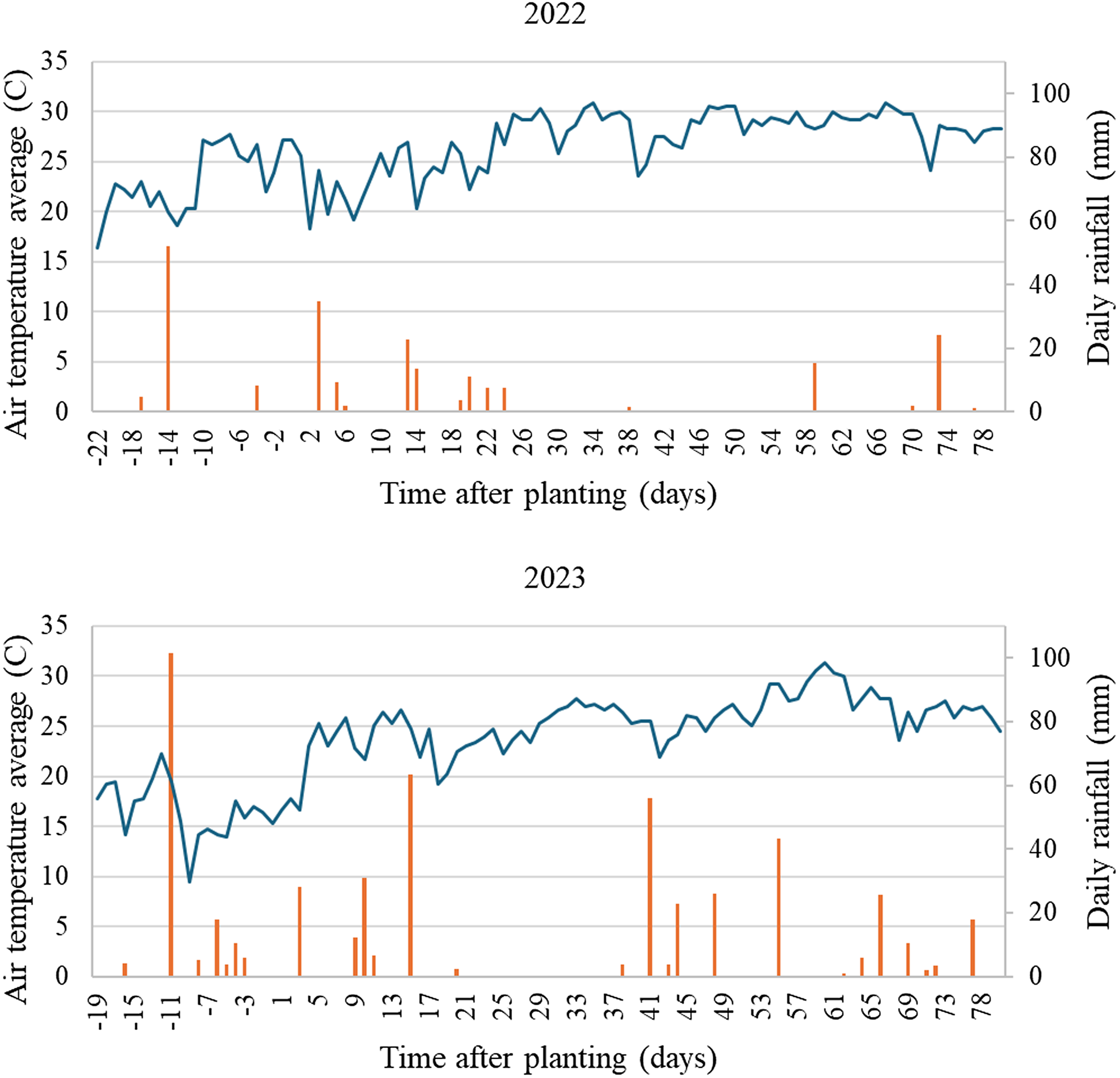
Figure 1. Daily results of observed average air temperature (C) and rainfall (mm) over 24 h, from the planting until the last injury assessment at the Rice Research and Extension Center, near Stuttgart, AR, in 2022 and 2023. Planting occurred on day zero. The blue line represents the daily average air temperature, and the orange bars indicate daily rainfall.
Tank-Mixture Experiment
A field experiment was initiated in 2022 and repeated in the 2023 and 2024 growing seasons at the Pine Tree Research Station (PTRS) near Colt, AR (35.120833°N, 90.957222°W) on a Calhoun silt loam soil with 1.4% organic matter and pH of 8.0, 8.1, and 7.7, respectively. In 2024, an additional location was established at the University of Arkansas Pine Bluff (UAPB) Small Farm Outreach Center near Lonoke, AR (34.783333°N, 91.881944°W) on an Immanuel silt loam (14% sand, 72% silt, 14% clay), with 1.3% organic matter, pH 5.4. The experiment was designed to assess rice tolerance to fluridone alone or in a mixture with commonly used rice herbicides applied at the 3-leaf growth stage over a range of environments. Rice was seeded at a 1.3-cm depth with a spacing of 19 cm between each row, following conventional tillage at all sites. Plots were 1.8 and 1.5 m wide by 5.2 and 7.6 m long at the PTRS and UAPB locations, respectively. The cultivar RTv7231 MA was planted in all locations at 52 seeds m−1 of row on May 12, 2022, April 11, 2023, and April 18, 2024, at PTRS and on May 16, 2024, at UAPB.
The experiment was a randomized, complete block design with a two-factor factorial treatment structure and four replications. Factor A was the presence or absence of fluridone. Factor B consisted of herbicide partners mixed with or without fluridone, including fenoxaprop, quizalofop, propanil, saflufenacil, penoxsulam, bispyribac-sodium, and quinclorac (Table 1). Rice received the treatments at the 3-leaf growth stage. Experimental fields were over-sprayed with a preemergence application of clomazone (Command® 3ME; FMC Corporation, Philadelphia, PA) at 336 g ai ha−1 and a preflood application of quizalofop (Highcard®; ADAMA, Raleigh, NC) at 120 g ai ha−1 to keep the fields free of weeds. Halosulfuron + prosulfuron (Gambit®; Gowan Company, Yuma, AZ), halosulfuron (Permit®; Gowan), or florpyrauxifen-benzyl (Loyant®; Corteva Agriscience, Indianapolis, IN) were used if needed to control broadleaf weeds and sedge species. All herbicides were applied with a CO2-pressurized backpack sprayer equipped with four TeeJet AIXR 110015 nozzles calibrated to deliver 140 L ha−1 at a speed of 4.8 kph at PTRS and with a multiboom, tractor-mounted sprayer equipped with AIXR 110015 nozzles delivering 94 L ha−1 at 6.4 kph at UAPB. Agronomic practices and fertility followed the University of Arkansas System Division of Agriculture guidelines for direct-seeded, delayed-flood rice production (Henry et al. Reference Henry, Daniels, Hamilton and Hardke2021; Roberts et al. Reference Roberts, Slaton, Wilson and Norman2016). A nearby weather station monitored air temperature and daily rainfall (Figure 2).
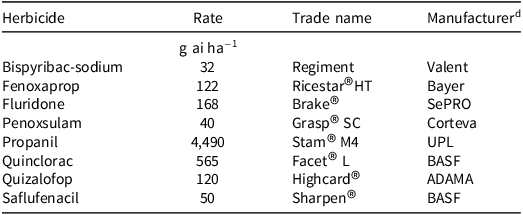
a Crop oil concentrate at 10 mL L−1 was added in applications with penoxsulam, quinclorac, quizalofop, and saflufenacil.
b Oil-based adjuvant (Dyne-A-Pak; Helena Chemical Co., Collierville, TN) was added at 25 mL L−1 in applications with bispyribac-sodium.
c The tank-mixture experiment conducted at the Pine Tree Research Station, near Colt, AR, and at the University of Arkansas Pine Bluff Small Farm Outreach Center near Lonoke, AR.
d Manufacturer locations: ADAMA, Raleigh, NC; BASF Corporation, Research Triangle Park, NC; Bayer CropScience, St. Louis, MO; Corteva Agriscience, Indianapolis, IN; SePRO Corporation, Carmel, IN; UPL Limited, King of Prussia, PA; Valent, San Ramon, CA.

Figure 2. Daily results of observed average air temperature (C) and rainfall (mm) over 24 h, from the 3-leaf application until the last injury assessment at the Pine Tree Research Station (PTRS), near Colt, AR, in 2022, 2023, and 2024; and at the University of Arkansas Pine Bluff Small Farm Outreach Center (UAPB) near Lonoke, AR, in 2024. The blue line represents the daily average air temperature, and the orange bars indicate daily rainfall.
Data Collection
Visible crop injury was evaluated on a scale of 0 to 100, with 0 being no injury and 100 representing crop death (Frans et al. Reference Frans, Talbert, Marx, Crowley and Methods1986) at preflood, 2 wk after flooding (WAF), and late season (5 and 13 d before rice reaching 50% heading across treatments in 2022 and 2023, respectively) in the application timing experiment and at 2 and 4 wk after treatment (WAT) in the herbicide mixture experiment. Aerial images were taken at 6 WAF at RREC and 4 WAT at PTRS using a small unmanned aerial system (Mavic Air 2S; DJI Technology Co., Nanshan, Shenzhen, China) from a height of approximately 60 m in 2022, with an image covering 12 plots in width and four plots in length. In 2023, images were captured from a height of 30 m, covering nine plots in width and four plots in length. In 2024, stitched images were collected from a height of approximately 40 m. The groundcover percentage for each plot was quantified by green pixel counts from overhead images using Field Analyzer (Green Research Services, LLC, Fayetteville, AR). Groundcover data were not collected at UAPB. Shoot density and days to 50% heading were assessed only in the application timing experiment. Shoot density was collected in two 1-m sections of row per plot at 3 and 2 wk after rice emergence in 2022 and 2023, respectively, on all soil-applied treatments (20 and 10 d preplant, preemergence, and delayed preemergence) and the nontreated control. Days for rice to reach 50% heading were recorded for each plot and reported relative to the nontreated control. Rough rice grain yield was harvested from the center four rows of all plots using a small-plot combine and adjusted to 12% moisture.
Data Analysis
Data were analyzed using R statistical software (v. 4.3.3; R Core Team 2023). A generalized linear mixed model was fit to all data using the glmmTMB function (glmmTMB package; Brooks et al. Reference Brooks, Kristensen, van Benthem, Magnusson, Berg, Nielsen, Skaug, Mächler and Bolker2017). Assumptions of normality were assessed using the Shapiro-Wilk and Levene’s tests. Beta (injury and groundcover) and negative binomial (rough rice yield) distributions were used if the data did not meet the assumptions of normality (Gbur et al. Reference Gbur, Stroup, McCarter, Durham, Young, Christman, West and Kramer2012; Stroup Reference Stroup2015).
In the application timing experiment, application timing and year were considered fixed effects and block was a random effect. The mixture experiment aimed to evaluate rice tolerance to commonly used herbicides alone or in combination with fluridone across various environments. Therefore, site-year and block nested within site-year were considered random effects. Fluridone presence/absence and herbicide partners were treated as fixed effects.
All data were subjected to a Type III Wald chi-square analysis of variance using the car package (Fox and Weisberg Reference Fox and Weisberg2019). Following this analysis, treatment-estimated marginal means were assessed using the emmeans package (Lenth Reference Lenth2022; Searle et al. Reference Searle, Speed and Milliken1980) and adjusted for multiple comparisons using Tukey’s honestly significant difference (α = 0.05). Differences among treatments were visualized through a compact letter display, created with the multcomp:cld function (Hothorn et al. Reference Hothorn, Bretz and Westfall2008).
Results and Discussion
Application Timing Experiment
The interaction between year and application timing was significant (P < 0.05) for all variables evaluated in the application timing experiment. Therefore, all data in this experiment were analyzed by year. Rainfall accumulation at the experimental sites totaled 65 mm and 149 mm from 20 d before the preplant application to planting in 2022 and 2023, respectively (Figure 1). Visible rice injury in 2022 was less than 5% for all treatments before flood establishment and as much as 28% at the final evaluation (Table 2). In 2023, up to 30% injury was observed before flood establishment, and up to 42% at 2 WAF. By the final evaluation, no treatment caused more than 14% injury to rice, except for the preemergence treatment, which resulted in 37% injury in 2023.
Table 2. Visible rice injury following fluridone treatment for the application timing experiment in 2022 and 2023.a–g
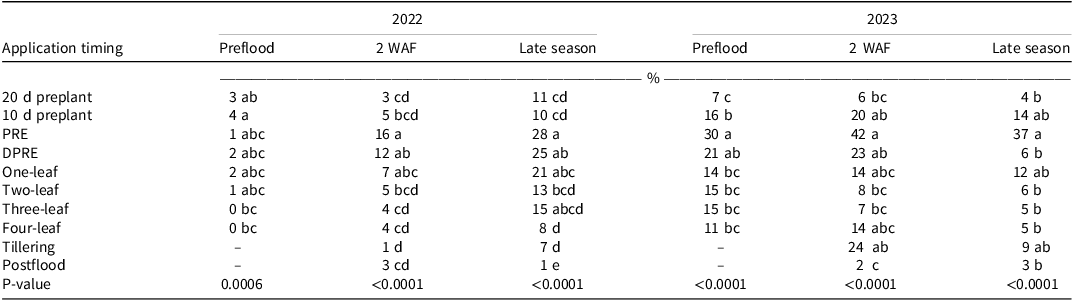
a Abbreviations: DPRE, delayed-preemergence; PRE, preemergence; WAF, weeks after flooding.
b Fluridone was applied at 168 g ai ha−1 in all treatments besides the nontreated control.
c Postflood treatments were applied 1 and 2 d after flood establishment in 2022 and 2023, respectively.
d Preflood evaluations were assessed on the day of flood establishment in 2022 and 2 d after flood establishment in 2023.
e Late-season evaluations were assessed 5 and 13 d prior to rice reaching 50% heading across treatments in 2022 and 2023, respectively.
f Dashes (–) indicate the treatments have not been applied at the time of evaluation.
g Means within a column followed by the same letter are not different according to Tukey’s honestly significant difference test (α = 0.05).
h The application timing experiment was conducted at the Rice Research and Extension Center, near Stuttgart, AR.
Fluridone has low water solubility, and its adsorption coefficient (Koc) ranges from 350 to 2,460 mL/g, depending on organic matter content, soil texture, and pH (Banks et al. Reference Banks, Ketchersid and Merkle1979; Malik and Drennan Reference Malik and Drennan1990; Schroeder and Banks Reference Schroeder and Banks1986; Shaner Reference Shaner2014; Shea and Weber Reference Shea and Weber1983; Waldrep and Taylor Reference Waldrep and Taylor1976; Weber et al. Reference Weber, Shea and Weed1986). After adhering to soil sediments, fluridone gradually desorbs into the water (Shaner Reference Shaner2014). Previous research indicates that fluridone availability increases following irrigation, resulting in increased rice injury (Butts et al. Reference Butts, Souza, Norsworthy, Barber and Hardke2024; Martin et al. Reference Martin, Norsworthy, Scott, Hardke and Lorenz2018). Likewise, the elevated phytotoxicity in the preflood assessment in 2023 compared to 2022 is likely associated with the higher moisture content from rainfall accumulation. Furthermore, Martin et al. (Reference Martin, Norsworthy, Scott, Hardke and Lorenz2018) reported that injury to rice from fluridone increases with flood establishment. In the present study, an increase in injury following the establishment of the flood was observed for only a few treatments in both years by 2 WAF, whereas the final evaluation in 2022 showed an increase of up to 27 percentage points compared to the preflood assessment.
A similar trend occurred in both years with applications near planting generally causing more injury to rice (Table 2). Previous research reported comparable results, where fluridone applied preemergence caused more injury to rice than applications at the 3-leaf growth stage in an herbicide program containing clomazone and/or florpyrauxifen-benzyl (King et al. Reference King, Norsworthy, Butts, Barber, Drescher and Godar2024). Reduced injury with later fluridone applications is attributed to diminished postemergence activity, resulting in greater rice tolerance (Waldrep and Taylor Reference Waldrep and Taylor1976).
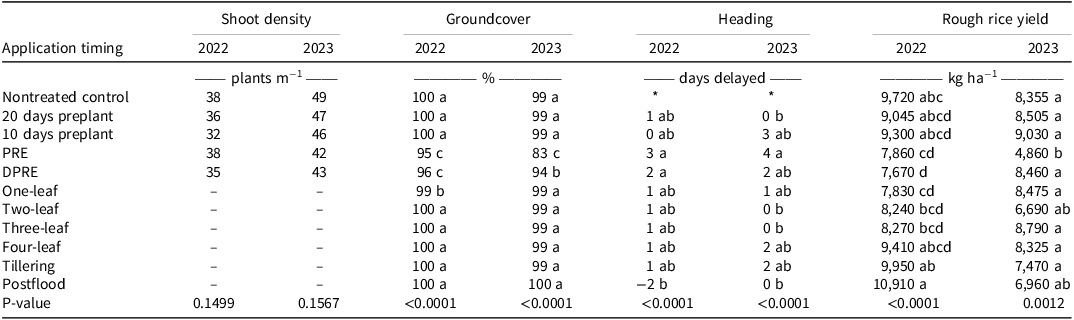
Shoot density was assessed 1 wk before the preflood evaluation (3 and 2 wk after emergence in 2022 and 2023, respectively). Although injury levels at this evaluation differed between years, no difference in shoot density was detected among treatments in either year, indicating that fluridone did not cause stand loss early in the season (Table 3). However, rice groundcover by 6 WAF was reduced when fluridone applied preemergence, delayed preemergence, and at the 1-leaf stage in 2022 and preemergence and delayed preemergence in 2023. Rice groundcover is a predictor of grain yield (Wan et al. Reference Wan, Cen, Zhu, Li, Zhu, Sun, Weng and He2019). Therefore, a reduction in groundcover is likely to result in a yield penalty. Other research has shown that rice treated with fluridone at the 3-leaf stage in a precision-leveled field had a groundcover reduction at 6 and 8 wk after treatment, but the crop recovered by 10 wk after application (Butts et al. Reference Butts, Souza, Norsworthy, Barber and Hardke2024). However, a previous study indicated that rice cultivars respond differently to fluridone (Souza et al. Reference Souza, Norsworthy, Carvalho-Moore, Godar, Fernandes and Butts2025). In the same study, the cultivar DG263L exhibited reduced chlorophyll content and yield reduction when fluridone was applied at the labeled rate of 168 g ai ha−1 when treated at the 3-leaf stage, while most of the other cultivars did not experience reduced yield, emphasizing the importance of selecting tolerant cultivars when using fluridone for weed management in rice.
Table 3. Rice shoot density, groundcover, and rough rice yield following fluridone treatment for the application timing experiment in 2022 and 2023.a–h
a Abbreviations: DPRE, delayed-preemergence; PRE, preemergence.
b Groundcover was assessed 6 wk after flood establishment (9 and 20 d before rice reaching 50% heading across treatments in 2022 and 2023, respectively).
c Shoot density was assessed 3 and 2 wk after rice emergence in 2022 and 2023 for the soil-applied treatments and the nontreated control.
d Fluridone was applied at 168 g ai ha−1 in all treatments besides the nontreated control.
e Postflood treatments were applied 1 and 2 d after flood establishment in 2022 and 2023, respectively.
f Dashes (–) indicate shoot density was not assessed.
g Asterisks (*) represent nontreated control delay in heading as zero.
h Means within a column followed by the same letter are not different according to Tukey’s honestly significant difference test (α = 0.05).
h The application timing experiment was conducted at the Rice Research and Extension Center, near Stuttgart, AR.
A delay in rice maturity, as indicated by the 50% heading date, was no more than 4 d relative to the nontreated control in both years (Table 2). In 2022, rice in the postflood treatment reached 50% heading 2 d earlier than the nontreated control. The preemergence and delayed preemergence treatments caused similar levels of rice injury, groundcover reduction, and maturity delay in 2022. However, only the delayed preemergence application caused a yield penalty, with a 21% reduction compared with the control. Furthermore, no statistical difference was detected among the nontreated, preemergence, and 1-leaf treatments in 2022; however, the yield difference between delayed preemergence and either preemergence or 1-leaf was 190 kg ha−1 or less. In 2023, the high injury levels associated with decreased rice groundcover and a delay in heading resulted in a 42% yield loss to rice treated at preemergence compared with the control. Although the delayed preemergence application caused injury of up to 23% and rice groundcover was reduced, no yield loss resulted from this treatment in 2023, and further research is needed to understand rice response when treated with fluridone delayed preemergence. Similarly to the results of this study, a rough rice yield reduction of 20% occurred following a preemergence application of fluridone at 224 g ai ha−1 on Dewitt and Calhoun silt loam soils (Martin et al. Reference Martin, Norsworthy, Scott, Hardke and Lorenz2018). As observed here, fluridone applied to 3-leaf rice at the same rate on a precision-leveled Sharkey-Steele clay soil did not cause a yield decrease, even though almost 30% visible injury resulted after herbicide treatment (Butts et al. Reference Butts, Souza, Norsworthy, Barber and Hardke2024).
Herbicide Partners Experiment
There was an interaction between fluridone and herbicide partners for visible injury at 2 and 4 WAT (Table 4). Saflufenacil, with and without fluridone, generally caused the most injury (up to 23%) at 2 WAT. By 4 WAT, there was no more than 14% injury, and only rice in the treatments that contained saflufenacil exhibited ≥10% injury. Similarly, saflufenacil plus imazethapyr applied to 2- to 3-leaf imazethapyr-resistant rice caused 16% to 50% injury 2 WAT (Camargo et al. Reference Camargo, Senseman, McCauley and Guice2012). When applied alone to 4- and 6-leaf rice, saflufenacil caused no more than 14% injury by 18 d after treatment (Camargo et al. Reference Camargo, Senseman, McCauley and Guice2011). In the present study, adding fluridone to the standard rice herbicides seldom caused an increase in rice injury, and even when elevated injury occurred, the increase was no more than eight percentage points.
Table 4. Visible rice injury following herbicide applications alone or with fluridone for the tank-mixture experiment, averaged over 4 total site-years in 2022, 2023, and 2024.a–d

a Abbreviation: WAT, weeks after treatment.
b A dash (–) in the Fluridone column indicates herbicides were applied alone. A plus symbol (+) indicates herbicides were applied with fluridone.
c Means within a column followed by the same letter are not different according to Tukey HSD (α = 0.05).
d Experiments were conducted at the Pine Tree Research Station, near Colt, AR, and at the University of Arkansas Pine Bluff Small Farm Outreach Center near Lonoke, AR.
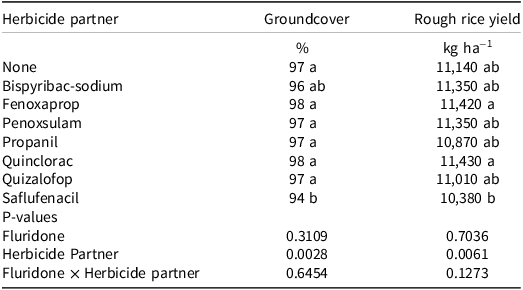
For groundcover and rough rice yield, only the main effect of herbicide partner was significant (Table 5). Therefore, data were pooled over the main effect of fluridone presence or absence. Rice treated with saflufenacil displayed the greatest groundcover reduction besides bispyribac-sodium at 4 WAT. Saflufenacil was the only treatment that resulted in a yield penalty.
Table 5. Rice groundcover and rough rice yield following herbicide partner treatments for the tank-mixture experiment, averaged over site-years and fluridone tank-mixture inclusion in 2022, 2023, and 2024.a–d
a Groundcover was assessed four weeks after treatment.
b Experiments were conducted at the Pine Tree Research Station, near Colt, AR, and at the University of Arkansas Pine Bluff Small Farm Outreach Center near Lonoke, AR.
c Groundcover was not assessed at the University of Arkansas Pine Bluff Small Farm Outreach Center.
d Means within a column followed by the same letter are not different according to Tukey’s honestly significant difference test (α = 0.05).
Practical Implications
According to the results of this study, fluridone applications from the 3-leaf or later stages of rice are suitable to cause minimal rice injury, as indicated by the product label (Anonymous 2023). Although postflood applications are not permitted, fluridone caused no more than 3% visible injury when applied at this time and appears to pose minimal risk to rice. Fluridone applied near planting, especially preemergence and delayed preemergence, was too injurious to rice, similar to results from previous research (King et al. Reference King, Norsworthy, Butts, Barber, Drescher and Godar2024; Martin et al. Reference Martin, Norsworthy, Scott, Hardke and Lorenz2018). Further research is necessary to evaluate the influence of early-season fluridone applications in a furrow irrigation system on rice response, because rice in this system is grown under nonflooded conditions in most of the field, with a frequent water supply. Furthermore, using fluridone in mixtures with standard rice herbicides poses little to no risk of crop injury, and it does not negatively affect groundcover or grain yield. Hence, fluridone can be safely applied with other postemergence herbicides to enhance weed control in rice.
Acknowledgments
We thank the graduate students, faculty, and staff at the University of Arkansas for their valuable contributions to this study.
Funding
SePRO Corporation and the Arkansas Rice Research and Promotion Board provided partial support for this research.
Competing Interests
The authors declare they have no competing interests.


 Open access

