There are growing concerns that food advertising is contributing to the obesity epidemic that is adversely affecting individuals and societies and is forecast to drain nations’ health-care budgets(1–Reference Harris, Brownell and Bargh3). Much of the focus on addressing obesity is centred on child obesity because of the difficulty of treating obesity once it is established and the tendency for child overweight to continue into adulthood(Reference Katan4, Reference Magarey, Daniels and Boulton5). Major reviews have concluded that the marketing of energy-dense, nutrient-poor (EDNP) foods is an important contributor to an environment that promotes child obesity(Reference Cairns, Angus and Hastings6–Reference Zimmerman9). In response, in some countries public policy makers have enacted legislation to limit children's exposure to advertising for EDNP foods and the food industry has introduced voluntary codes of conduct that prevent signatory organisations from promoting EDNP foods to children(Reference Hawkes10).
In Australia, the context of the present study, a combination of mandatory and voluntary regulations applies to food advertising. The coverage of these regulations relates mainly to television advertising. The mandatory Children's Television Standards(11) specify times at which advertising can be shown and nominate conditions under which food and beverage products can be advertised. They stipulate that no advertising can be broadcast during ‘P’ programming, which encompasses programmes designed for pre-school children, and limit the quantity and nature of advertisements that can be broadcast during ‘C’ programming, which includes programmes designed for children up to 14 years of age. For example, during ‘C’ programmes alcoholic beverages cannot be advertised and any promotion of food products cannot provide misleading information about the nutritional profile of the products.
In addition, two voluntary codes of conduct were implemented by the food industry in 2009: the Responsible Children's Marketing Initiative(12) and the Australian Quick Service Restaurant Industry Initiative for Responsible Advertising and Marketing to Children(13). These codes commit signatory organisations to promoting only healthy foods to children up to 12 and 14 years of age, respectively. Evaluation studies conducted since their implementation suggest that these voluntary codes have been unsuccessful in substantially reducing Australian children's exposure to television advertising for EDNP foods(Reference Hebden, King and Grunseit14, Reference King, Hebden and Grunseit15).
The focus of regulations on television advertising in Australia is similar to the situation in other countries, with the outcome being that other media remain largely unregulated around the world(Reference Hawkes10, Reference Chapman, Kelly and King16–Reference Shaw18). While television continues to dominate the advertising strategies of food marketers(Reference Calvert19, 20), the mass popularisation of the Internet and the associated migration of a growing proportion of advertising budgets to this medium necessitate more extensive consideration of Internet advertising(Reference McGinnis, Gootman and Kraak7, Reference Calvert19). In line with other forms of advertising, Internet advertising has been found to be able to attract attention(Reference Hervert, Guerard and Tremblay21), enhance brand recognition and awareness(Reference Dreze and Hussherr22) and increase the probability of repeat purchase(Reference Manchanda, Dube and Goh23). Specifically in terms of food marketing, however, there is little evidence to date of the absolute and relative effectiveness of Internet advertising, and this lack of evidence constrains policy making(Reference Harris, Brownell and Bargh3, Reference Chapman, Kelly and King16, Reference Calvert19, Reference Grier and Kumanyika24, Reference Montgomery, Chester and Grier25). Given the amount of time children now spend on the Internet and the greater blurring of boundaries between content and advertising in online contexts, it has been argued that Internet food advertising requires particular attention in efforts to address the negative effects of EDNP food marketing(Reference Harris, Brownell and Bargh3, Reference Calvert19, Reference Montgomery, Chester and Grier25–Reference Harris, Speers and Schwartz27).
Existing advertising regulations are based on evidence that food advertising can influence children's food preferences and choices(28). Specifically, higher levels of television viewing and exposure to food advertising among children have been found to be associated with more favourable attitudes to EDNP foods(Reference Dixon, Scully and Wakefield29) and greater intake of EDNP foods and lower intakes of fruits and vegetables(Reference Andreyeva, Kelly and Harris30–Reference Harrison and Liechty32). It has been noted that calls for interventions to protect children from advertising typically assume that children will be able to withstand the coercive effects of advertising once their cognitive defences mature and hence that they only need protection until they can understand the nature and intent of advertising(Reference Harris, Brownell and Bargh3, Reference Seiders and Petty33). However, even an understanding of persuasive intent can fail to protect older children from experiencing increased desire for products as a result of advertising exposure(Reference D'Alessio, Laghi and Baiocco34, Reference Rozendaal, Buijzen and Valkenburg35).
Adults, by comparison, are typically considered to be ‘competent consumers’ who are sceptical of advertising and hence able to activate appropriate cognitive defences(Reference Grier and Kumanyika24). However, there is a growing body of work demonstrating that advertisements for EDNP foods can also influence adults’ perceptions of the desirability and appropriateness of such foods(Reference Dixon, Scully and Wakefield36, Reference Grier, Mensinger and Huang37). Like children, adults can fail to activate the cognitive resources necessary to prevent automatic acceptance of the messages conveyed (for a review see Harris et al.(Reference Harris, Brownell and Bargh3)). This is likely to be at least partially attributable to the subconscious effects of advertising that occur through exposure and repetition rather than deliberate cognitive processing(Reference Chartrand and Fitzsimons38, Reference Fitzsimons, Chartrand and Fitzsimons39).
The effect of food advertising on adults is important because of the implications for the weight status of both parents and the children who are dependent upon their food choices. Parents influence their children's diets through their critical roles as food providers and modellers of food consumption(Reference Birch and Fisher40, Reference Gribble, Falciglia and David41). More research is needed to elucidate the effects of food advertising on both children and their parents to ensure that both groups are appropriately catered for in the development and implementation of relevant public policies(Reference Harris, Brownell and Bargh3, Reference Seiders and Petty33).
In summary, there are knowledge deficits in the areas of parents’ and children's susceptibility to food marketing and the relative effectiveness of food advertising on television and the Internet. The present study addresses these knowledge gaps by investigating the effects of television and Internet food advertising on both parents and children in the Australian context.
Experimental methods
Sample
The population of interest was children aged 8 to 14 years and their parents. The minimum age of 8 years for the children reflected the need for respondents to be capable of responding to an online questionnaire. The maximum age of 14 years was based on John's(Reference John42) proposition that up until this age children may be unable to activate the cognitive defences required to withstand advertising effects. Parents could be of any age, as long as they had children within the specified age range. Only one child per parent was invited to participate in the study.
Respondents were sourced from an online panel provider with access to a large number of Australians of varying demographic profiles. Panel members with children in the nominated age group were invited to participate in the survey. Quota sampling was then used to achieve equal representation of children by gender and age over the entire child sample and between the intervention and control groups.
Materials and procedure
Six versions of the questionnaire were developed – three for the parents and three for the children. One parent and one child questionnaire featured four television food advertisements, one parent and one child questionnaire featured Internet advertisements for the same four products, and one parent and one child questionnaire showed pictures of the food products that served as the control condition. The four branded food products featuring in all six questionnaires were fried chicken, popcorn, a snack bar and confectionery. These products were selected to cover a broad range of advertised foods that are likely to be popular with children and that have high levels of fat, sugar and/or salt (as per UK Food Standards Agency thresholds(43)).
The stimuli for the television advertisements were 30 s advertisements that had aired on television during the previous 12 months. The fried chicken advertisement depicted a family eating the chicken together at dinner, the popcorn advertisement showed a mother making popcorn for her child who was playing outside on a trampoline, the snack bar advertisement showed children eating the product at school, and the confectionery advertisement depicted an athlete eating the sweets after a training session and talking about her enjoyment of them. The stimuli for the Internet advertisements were webpages featuring each of the products. The fried chicken Internet advertisement was a Facebook page that included a picture of the product and comments from fans paying tribute to it. The popcorn webpage showed images of the product and a child playing outside on a trampoline, the snack bar advertisement showed multiple pictures of the product along with text that emphasised the taste and ‘fun’ attributes of the product, and the confectionery webpage featured an image of an athlete (the same person depicted in the television advertisement) eating the sweets along with written endorsements from athletes and sporting organisations. The stimuli for the control group were static pictures, identical in size, of each food product.
The items included in the questionnaires were based on those used in Grier et al.'s(Reference Grier, Mensinger and Huang37) study of parental perceptions of fast-food advertising and Jones and Fabrianesi's(Reference Jones and Fabrianesi44) study of children's and parents’ perceptions of advertising. They included items relating to desire for the advertised products (‘Would you like to have this food to eat?’; three response options for both parents and children: 1 = ‘not at all’, 2 = ‘a little’, 3 = ‘a lot’) and perceived appropriate frequency of consumption (‘How often is it okay for people to have this product?’; five response options for parents ranging from 1 = ‘never’ to 5 = ‘daily’ and three response options for children: 1 = ‘never’, 2 = ‘a little’, 3 = ‘a lot’). Demographic questions asked of parents included gender, age, income, education, family structure (one- or two-parent household) and self-reported weight and height (to enable calculation of BMI). Children were only asked to report gender and age.
Each parent–child dyad was exposed to the same media (television advertisement, Internet advertisement or picture) and to a total of four advertisements, one for each food product. All respondents were shown one advertisement/picture and then asked a series of questions about the extent to which they would like to consume the food, their perceptions of appropriate consumption frequency and their evaluations of the food across multiple criteria (e.g. taste and healthiness). They were then shown the next advertisement/picture and asked the same series of questions, and so on. The parents and children were asked largely the same questions, varying somewhat in wording to cater to the different cognitive and language abilities of the two groups.
Prior to administration, the questionnaire items were tested for suitability in six focus groups comprising varying combinations of parents and children (n 64). Two of the groups included only children (one group of boys and one group of girls), two groups included only parents (one group of mothers and one group of fathers) and two groups combined parents and children (one group of mothers and their children and one group of fathers and their children). During the groups, the participants completed a version of the questionnaire and then each item was discussed to assess how it was interpreted and whether there was any confusion about its meaning or relevance. The focus group findings indicated that the items were interpreted correctly, and only minor modifications were made to some of the items to enhance comprehension.
The online survey was conducted in December 2010. Ethics clearance for the study was obtained from the University of Western Australia Human Research Ethics Committee. Parents agreeing to participate in the study were asked to complete their questionnaire before passing the computer over to their children, who were also asked for consent prior to commencing. It was necessary for each item to be addressed before the respondent could progress to the next page, resulting in a complete data set from all respondents.
Analysis
Several measures were developed for the present study. To estimate parents’ and children's desire to consume foods (‘Would you like to have this food to eat?’), the answer scores across the four food products were summed and then divided by the number of products included. A similar process was used to create an aggregate measure for respondents’ perceptions about appropriate consumption frequency (‘How often is it okay for people to have this product?’). Finally, parents were asked to rate each product on the five attributes of healthy, tasty, fun, new and convenient, while children were asked to rate the products on four of these attributes, with the exclusion of convenient which was considered to be less relevant for children. A product evaluation measure was created for each food product by summing the scores across various attributes and then dividing by the number of attributes. These aggregate measures allowed estimation of the overall effects of advertising across the range of foods products included in the study.
Data were analysed using the ANOVA method whereby one-way factorial ANOVA were performed to identify differences in the desire to consume the advertised products, perceived appropriate consumption frequency and product evaluations between the television and Internet exposure groups and the control group. Differences in responses depending on the type of exposure were also examined separately for boys and girls and children belonging to the same age category (one-way factorial ANOVA). The analyses were performed using the statistical software package SPSS version 17·0.
Results
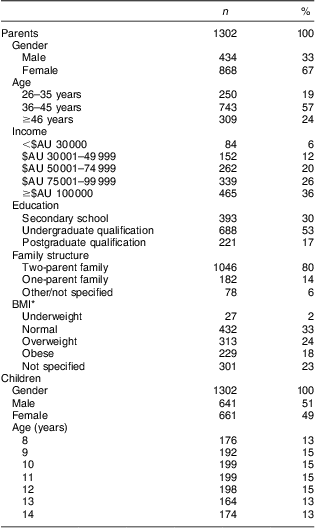
The sample profile is shown in Table 1. In total, 2604 respondents participated in the survey, with 33 % completing the television questionnaire (n 852), 34 % completing the Internet questionnaire (n 900) and 33 % completing the control questionnaire (n 852). Half of the respondents to each questionnaire were parents and half were their children. A good spread across demographic variables was achieved for both parents and children. There were no significant differences in composition of the control and intervention subgroups for any of the demographic variables for both the parent and child samples (P > 0·05).
Sample composition: parents (n 1302) and their children (n 1302) aged 8–14 years participating in an online web panel survey, Australia, December 2010

*Calculated by dividing weight by height squared, then assigning to established categories(Reference Lobstein, Baur and Uauy56).
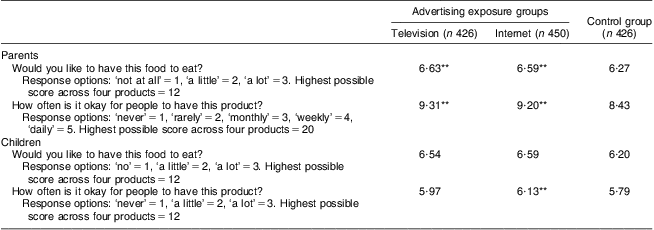
Respondents’ desire to consume the advertised food products and their perceptions of appropriate consumption frequency are shown in Table 2. For both parents and children, the desire to consume the products was stronger among those in the advertising exposure conditions, although the effect was significant only among the parents (F (2, 1299) = 6·82, P = 0·00, η 2 = 0·01). However, as expected from the single exposure, the effect size was small. Significant differences in perceived appropriate consumption frequency by exposure were found for parents (F (2, 1299) = 18·21, P = 0·00, η 2 = 0·03). For children, this was limited to those exposed to the Internet advertisements (F (2, 1299) = 6·719, P = 0·00, η 2 = 0·01). Importantly, no significant differences were found in relation to desire to consume the products and appropriate consumption frequency between the Internet and television groups, indicating that advertisements in these media are equally capable of influencing adults and children. In addition, there were no significant differences in children's responses by age (8 to 10 years: F (2, 564) = 0·672, P = 0·09; 11 to 12 years: F (2, 394) =0·05, P = 0·95; 13 to 14 years: F (2, 335) = 0·24, P = 0·79) or gender (girls: F (2, 658) = 0·51, P = 0·60; boys: F (2, 638) = 1·47, P = 0·23).
Advertising effects aggregated across four food products (fried chicken, popcorn, snack bar, confectionery): parents (n 1302) and their children (n 1302) aged 8–14 years participating in an online web panel survey, Australia, December 2010
**Mean difference between exposure and control groups significant at the 0·01 level.
Given the apparent influence of a single exposure on parents’ desire to consume the products, further analyses were conducted to identify demographic characteristics that were associated with this effect. Females (F (2, 865) = 8·47, P = 0·00, η 2 = 0·02) and those living in two-parent families were more likely to have higher levels of desire for the advertised foods (F (2, 1043) = 7·34, P = 0·00, η 2 = 0·01). The effect of education was unclear – across all education levels there was a stronger desire to consume the product in the exposure conditions, but the differences were statistically significant only for parents with undergraduate degrees (undergraduate: F (2, 685) = 4·76, P = 0·00, η 2 = 0·01; secondary school: F (2, 390) = 2·21, P = 0·11; postgraduate: F (2, 218) =0·48, P = 0·62). Across all BMI levels, desire was higher in the exposure parent groups relative to the control group, although the difference was significant among only those of normal BMI (F (2, 429) = 4·81, P = 0·01, η 2 = 0·02). However, overall levels of desire were generally stronger with increasing BMI, indicating that higher base levels may have prevented effects from being apparent among the overweight and obese groups (see Table 3).
Parents’ desire to consume advertised food products by exposure type and demographic attributes: parents (n 1302) of children aged 8–14 years participating in an online web panel survey, Australia, December 2010

*Mean difference between exposure and control groups significant at the 0·05 level.
**Mean difference between exposure and control groups significant at the 0·01 level.
Respondents’ evaluations of the four food products were assessed across multiple attributes and aggregated as shown in Table 4. In all instances, the evaluations were more favourable among the advertising exposure groups relative to the control group. The differences in product evaluations between the exposure groups and control group were significant for all four products for the parents (fried chicken: F (2, 1299) = 7·24, P = 0·00, η 2 = 0·01; snack bar: F (2, 1299) = 18·08, P = 0·00, η 2 = 0·03; popcorn: F (2, 1299) = 7·03, P = 0·00, η 2 = 0·01; confectionery: F (2, 1299) = 7·62, P = 0·00, η 2 = 0·01) and for one of the products for the children (F (2, 1299) = 6·10, P = 0·00, η 2 = 0·01). Again, there were no statistically significant differences between the television and Internet groups, indicating that both conditions were similarly capable of influencing product evaluations.
Product evaluations† by exposure type: parents (n 1302) and their children (n 1302) aged 8–14 years participating in an online web panel survey, Australia, December 2010

*Mean difference between exposure and control groups significant at the 0·05 level.
**Mean difference between exposure and control groups significant at the 0·01 level.
†Parents’ evaluations related to the five attributes of healthy, tasty, fun, new and convenient (four response options, highest possible score = 20). Children's evaluations related to same attributes, excluding convenient (three response options, highest possible score = 12).
Discussion
Adults are perceived to have greater immunity to advertising effects relative to children due to their greater cognitive processing abilities(Reference John42). As a result, existing food advertising regulations are focused primarily on limiting children's exposure to advertisements for EDNP foods. The outcome is that these regulations do not consider the broader influence of the sheer quantity of advertisements for EDNP foods that has the potential to normalise EDNP food consumption patterns at a societal level(Reference Grier, Mensinger and Huang37, Reference Schwartz and Puhl45). The results of the present study indicate that advertising can lead both parents and children to evaluate products more favourably and influence their perceptions of the desirability and acceptability of food products. On the basis of a single exposure to each advertisement, product evaluations were more favourable and ratings of product desirability and appropriate consumption frequency were higher. Parents appeared to be more affected than children across these variables. Of note is that there were no significant differences in effects of advertising exposure by children's age, further suggesting that current assumptions relating to the impact of cognitive development on children's ability to withstand advertising may be inadequate to explain real-world phenomena(Reference D'Alessio, Laghi and Baiocco34, Reference Rozendaal, Buijzen and Valkenburg35).
In terms of family dynamics, exposure to television advertising has been found to be associated with children's purchase requests, which in turn are related to higher levels of family conflict(Reference Buijzen and Valkenburg46). Active parental mediation involving communicating with children about the nature of advertising has been found to reduce such effects of advertising on children(Reference Buijzen, Schuurman and Bomhof31, Reference Buijzen and Valkenburg47, Reference Moschis and Moore48). However, this is less likely to be useful where parents themselves are vulnerable to advertising and underestimate its effects. Further work is needed to investigate the extent to which parents’ granting of purchase requests for EDNP foods is related to their own susceptibility to advertising.
In their proposed food marketing defence model, Harris et al.(Reference Harris, Brownell and Bargh3) posit that in order to withstand the persuasive appeal of advertisements, individuals need to be aware that they are being targeted, understand how they may be affected by exposure and be able and motivated to resist. While focused specifically on the effects of advertising on children, the model incorporates psychological theories developed on adult samples and thus also has relevance to the parents involved in the present study. For example, the model takes non-conscious advertising effects(Reference Chartrand and Fitzsimons38, Reference Fitzsimons, Chartrand and Fitzsimons39) into consideration to highlight the importance of awareness in triggering the activation of effective defence mechanisms. The results of the present study indicate that while parents are likely to recognise advertisements, their understanding of the advertising effect process and hence their ability and motivation to resist may be compromised. Where understanding can be enhanced through education, this suggests a need to advise parents of the extent to which exposure and repetition can alter their perceptions and intentions below the level of conscious processing. However, should future work demonstrate that an enhanced understanding of the subconscious effects of advertisements fails to prevent ability and motivation from being compromised, greater regulatory restrictions on advertising would appear to be a more effective approach.
Regulatory restrictions would also seem justified by a growing body of work showing that Australian parents are very concerned about the promotion of unhealthy foods to children(Reference Kelly, Chapman and Hardy49, Reference Pettigrew, Pescud and Rosenberg50). Kelly et al.(Reference Kelly, Chapman and Hardy49) found that parents were considerably more concerned about television advertising (82 %) than Internet advertising (36 %), which means they are likely to be underestimating the effects of Internet advertising as found in the present study. While parental concern could be expected to result in scepticism of and resistance to advertising for unhealthy foods, the greater effects on parents relative to children in the present study suggest that negative attitudes to unhealthy food advertising cannot be assumed to increase immunity. There is thus a need to consider upstream interventions such as more restrictive regulatory frameworks, especially in relation to Internet advertising.
The study results have implications for the limited coverage of current advertising regulations. The apparent ability of Internet advertising to influence evaluations of food products and enhance perceptions of desirability and acceptability demonstrates the need for effective regulatory frameworks to include this medium explicitly. Such an approach would recognise that integrated marketing across multiple media is routinely used in food promotion and hence that the full spectrum of promotional strategies should be assessed for impact(Reference Calvert19). The combination of television and Internet advertising is recognised to be particularly important to achieving marketing objectives(Reference Wang51), making these two media among the top priorities for policy makers. Complicating the issue is the borderless accessibility of Internet advertising, which will necessitate international agreements to effectively regulate exposure(Reference Harris, Bargh and Brownell26).
The present study has several limitations. In the first instance, social desirability effects(Reference King and Bruner52) are likely to have dampened the responses to the evaluation, desire and social norms items. Second, exposure to the food pictures is likely to have had some influence on respondents in the control group. It was necessary to provide the pictures to ensure respondents were fully aware of the products referred to in the questionnaire, but viewing the pictures would have constituted a level of priming greater than complete non-exposure(Reference Janiszewski53). Given the possibility that exposure to the pictures influenced respondents, it seems likely that the effects of exposure to the television and Internet advertisements are underestimated in the study results.
Third, the advertisements varied in the extent to which they are likely to appeal to parents and children. For example, the snack bar advertisement featured only children, while the confectionery advertisement showed a lone adult athlete. The other two advertisements depicted both adults and children. This may go some way towards explaining why the snack bar advertisement was the only one to produce a significant effect on product evaluations among child respondents. Future research could include an initial advertisement classification stage that involves assessing the extent to which appeals used in the advertisements are more child or adult focused.
Fourth, height and weight data were collected only for the parents, preventing the calculation of BMI for the children. This decision was taken to avoid parents having to interrupt questionnaire completion to measure their children's height and weight, which could have served as a deterrent to completion. By comparison, they would have been more likely to have known their own measurements due to greater stability of these attributes in adulthood. Future research could investigate whether advertising effectiveness is related to children's weight status to add to the limited body of knowledge on the complex relationship between food advertising, children's food preferences and children's weight status(Reference Harris, Brownell and Bargh3).
Finally, the present study did not include children over 14 years of age. While previously it was thought that beyond this age children are likely to understand persuasive intent and be capable of activating defensive mechanisms to reduce their vulnerability(Reference John42), more recent research suggests that adolescents lack the self-regulatory mechanisms required to withstand advertising for highly palatable foods(Reference Harris and Graff54). In addition, the identity work of adolescents may make them especially susceptible to advertisements for products that can assist them in developing and communicating a sense of self(Reference Pechmann, Levine and Loughlin55). Future research could include older children to investigate the relative effectiveness of advertising in different media among members of this group compared with younger children and parents.
Conclusion
Exposure to food advertising can favourably influence product evaluations, enhance the desire to consume advertised products and increase perceptions of their social acceptability. While previous work has focused on such effects among children, the present study demonstrates that parents can be also, if not more, susceptible. If meaningful improvements are to be made to the current obesogenic environment, the ability of food advertising to increase product preference and increase perceptions of acceptability at a population level needs to be recognised. In particular, given their key roles in influencing children's food preferences and diets, parents should be a specific focus of future research that aims to better understand how advertising can normalise suboptimal food consumption patterns among those who have primary care responsibility for children. Importantly, the present study also reveals for the first time the equal influence of non-traditional marketing communication approaches, making the inclusion of emerging online strategies used to promote EDNP foods a cause for concern and a necessary focus of scrutiny by researchers and policy makers.
Acknowledgements
Source of funding: This research was supported under the Australian Research Council's Linkage Projects funding scheme (project number LP0991615). Funding was also provided by Cancer Council New South Wales and Cancer Council South Australia. Conflicts of interest: The authors declare that they have no conflicts of interest. Authors’ contributions: S.P. and M.R. conceptualised the study and managed data collection. L.T. conducted the statistical analysis. S.P. drafted the paper. P.Q., K.C. and K.M. provided expert input at all stages.