




Introduction
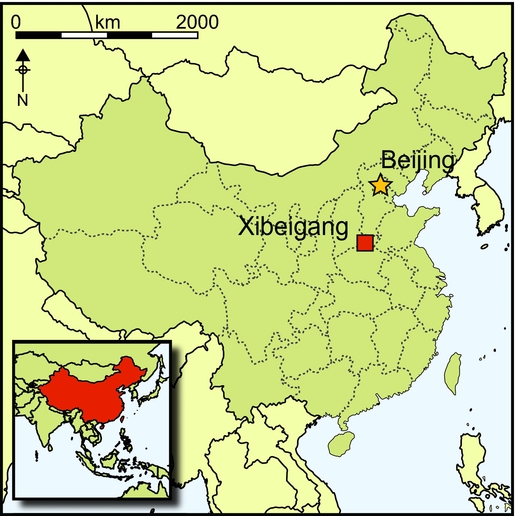
The Shang (商) ‘Dynasty’, as an example of an ‘early civilisation’, has attracted significant international research (e.g. Chang Reference Chang1980; Trigger Reference Trigger2003; Yoffee Reference Yoffee2005). From 1935–1937, the Institute of History and Philology of Academia Sinica excavated the ‘royal tombs’ at the Xibeigang (the official excavation reports describe it as Hsi-Pei-Kang, abbreviated as HPKM) 西北岡 cemetery of Anyang-Yinxu 安陽殷墟 (Figure 1). Although heavily robbed, the tombs yielded invaluable evidence that has allowed archaeologists to investigate the successive late Shang kings, their genealogical relationships and the ritual-based system of governance (e.g. Chang Reference Chang1977: 282–85, Reference Chang1980). Comparison of the outcomes of the investigation of the royal tombs with that of the study of so-called ‘oracle bones’ bearing scripts written in primitive Chinese characters has also illuminated aspects of the workings of an early state (e.g. Chang Reference Chang1977: 282–85, Reference Chang1980; Barnes Reference Barnes2015).
General plan of the Xibeigang cemetery, Anyang Yinxu (after Liang & Gao Reference Liang and Gao1962, Reference Liang and Gao1965, Reference Liang and Gao1967, Reference Liang and Gao1968, Reference Liang and Gao1970, Reference Liang and Gao1974, Reference Liang and Gao1976, Reference Liang and Gao1996; Anyang Archaeological Team IA CASS 1987; IA CASS 1994).

By examining spatio-temporal evidence at cemetery sites, Mizoguchi (e.g. Reference Mizoguchi1993, Reference Mizoguchi2005, Reference Mizoguchi2013, Reference Mizoguchi2014, Reference Mizoguchi, Renfrew, Boyd and Morley2015) has developed a methodological framework for reconstructing the strategies adopted by those who planned and performed ancient mortuary practices. Through this perspective, Mizoguchi noted complex spatial relationships between the Xibeigang tombs, which strongly suggested the careful strategic placement of tombs in relation to pre-existing tombs, with the intention of making socio-political statements. Meanwhile, Uchida has studied the ‘Gu-si’ 骨柶 ritual spatulas made from animal bone, excavated from the Xibeigang tombs. By correlating their stylistic changes over time to that of other artefacts from the tombs, it has become possible to date the construction of the respective tombs accurately and to reconstruct the formation process of the Xibeigang cemetery (Namba Reference Namba [Uchida]1990, Reference Namba [Uchida]1995a & Reference Namba [Uchida]b; see also the online supplementary material (OSM)).
By combining these approaches, it is possible to investigate the socio-symbolic strategies adopted by those who constructed the tombs and designed and conducted funeral ceremonies, and to reconstruct the meanings, such as respect paid to the previously buried ‘ancestors’ in the same cemetery, designed to be generated through funeral ceremonies. It is hoped that the results will illuminate how authority and power were negotiated and reproduced through the mortuary practice of the Shang ruling figures and their factions (cf. Brumfiel & Fox Reference Brumfiel and Fox2003).
Material and methods
This investigation of late Shang royal tombs of the Xibeigang cemetery takes a social-interpretative archaeological perspective. Here, social-interpretative archaeology centres upon the reconstructive investigation of the intention and strategy adopted by those who conducted certain social practices (cf. Tilley Reference Tilley1994). Such intentions and strategies are ‘chosen’ from a repository of memories or customs that are preserved mostly in the form of ‘practical consciousness’ (i.e. internalised or embodied memories from which we decide how to handle certain social settings; see Giddens Reference Giddens1984: 41–45).
To identify the archaeological evidence for such practical consciousness, we must situate the available evidence in the flow of time. The material traces of those past funerary occasions would have helped to preserve internalised memories, would have been referred to and would have been symbolically used in various manners and for various purposes in the practice (e.g. Mizoguchi Reference Mizoguchi1993; Parker Pearson Reference Parker Pearson1999: 193–97).
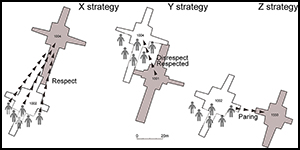
At the Xibeigang cemetery, a ‘royal tomb’ is comprised of a rectangular main burial chamber with a sloping ramp attached to each of the four sides (Figures 1 & 2). Some tombs were built immediately in front of the designated ‘front’ of a pre-existing tomb (the ‘front’ being marked by the southern ramp in each case (strategy X). Those who participated in the funeral would have faced towards a specific pre-existing tomb, thereby effectively paying respect to both the person buried in that tomb and the person being buried (Figure 2). Interestingly, other tombs were constructed immediately behind the ‘rear’ of a pre-existing tomb. In those cases, the mourners turned their backs on the deceased, literally showing disrespect to the occupant (strategy Y), or putting themselves in the position of being respected by the deceased of the pre-existing tomb (strategy Y') (Figure 2). Y and Y' strategies have vastly different intentions behind them and we must, where possible, differentiate them from one another. In most cases, however, it may be difficult to specify which is which.
Three mortuary strategies demonstrating manipulation in the positioning of funeral participants and the direction(s) to which their gazes were directed. Arrows indicate the direction that participants were orientated.
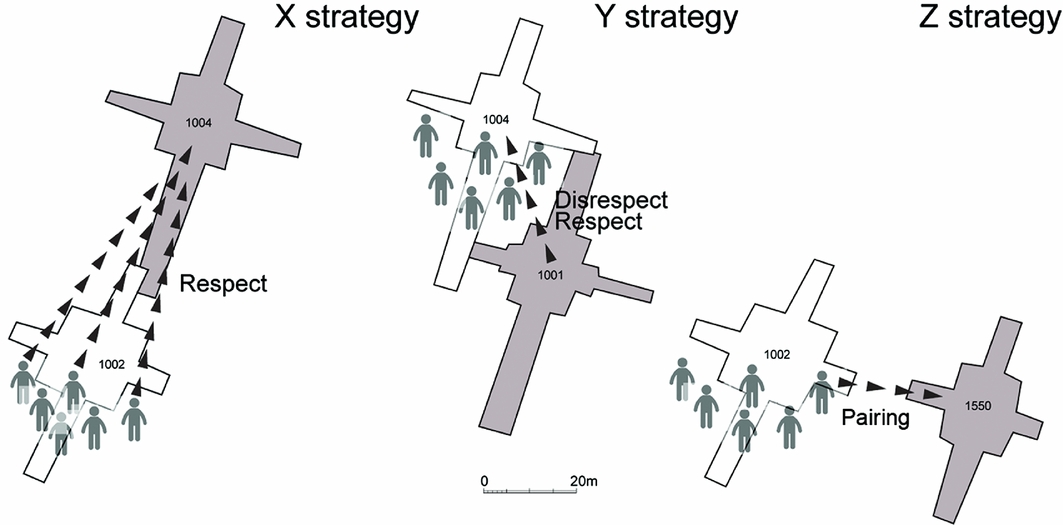
There were also tombs located as if they were pairing with one another, although there must have been a gap between their construction. Here, it can be inferred that those who conducted the funeral at the later tomb intended to portray the person that they were burying as ‘equal’ to the person buried in the earlier grave (strategy Z) (Figure 2). Such strategic placement of the later tombs was made possible by the probable presence of an ancestral shrine. An ancestral shrine structure (F1) was excavated on the tomb of Fu-Hao 婦好, and is assumed to be the ‘shrine of Mother Xin’—the posthumous name of Fu-Hao, recorded in oracle bone scripts (IA CASS 1980). Markers, such as low earthen platforms, probably also indicated the location of the main burial pit and the four ramps of the pre-existing tombs. Furthermore, as the edges of at least one of the ramps of a newly built tomb often overlap slightly with those of a pre-existing tomb (Figures 1 & 2), it is probable that the strategies were very carefully designed and pre-planned. It is, however, virtually impossible to prove whether it was the kings themselves who designed or planned such strategies prior to their death, or if it was those who conducted the funerary rituals. Through examination of the available evidence, we will attempt to verify this inferential hypothesis regarding the importance of ancestors and the cultic reproduction of kingly authority (Keightley Reference Keightley, Loewe and Shaughnessy1999).
Analysis: reconstructing the chronology of the Xibeigang cemetery
Previous attempts to reconstruct the chronology of the Xibeigang royal tombs have relied mainly on the examination of partial overlaps between some of the tombs (e.g. Li Reference Li1959; Kane Reference Kane1975; Anonymous 1977; Chang Reference Chang1980: 117–19; Yang Reference Yang1981, Reference Yang1991). The tombs were heavily robbed and most of the datable artefacts (such as bronze items) that could be attributed to specific phases of the typo-chronological sequence were lost (Liang & Gao Reference Liang and Gao1962, Reference Liang and Gao1965, Reference Liang and Gao1967, Reference Liang and Gao1968, Reference Liang and Gao1970, Reference Liang and Gao1974, Reference Liang and Gao1976, Reference Liang and Gao1996; cf. Namba Reference Namba [Uchida]1990; IA CASS 1994). Such overlaps, however, are present only between tombs 1001 and 1550 (the latter was constructed later than the former), between 1001, 1004 and 1002 (constructed in that order), and between 1500 and 1217 (the latter constructed later than the former) (Figure 1). Neither 1003 nor 1400 display such overlapping (Figure 1). Thus, the previous interpretations failed to locate tombs 1003 and 1400 convincingly in the Xibeigang sequence (see Table 1).
Comparing the dates (Li, Yang & Yang and Mizoguchi & Uchida) of the royal tombs of Xibeigang.
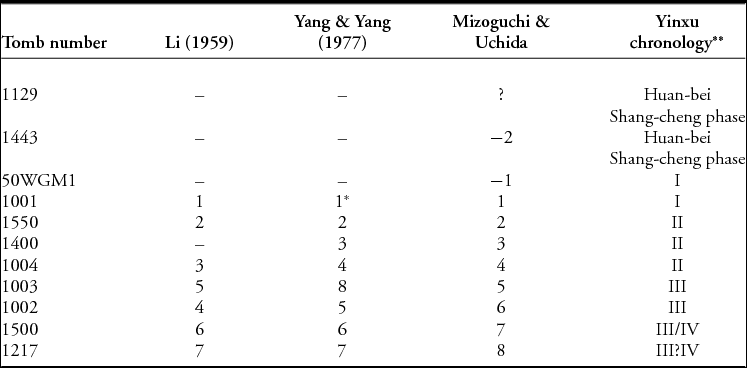
* Yang and Yang (Reference Yang and Yang1977) believe this to be the tomb of Wu-Ding.
** See the OSM and Yang (Reference Yang1991).
Since the 1950s, a relative chronology has been developed using Anyang pottery vessels, and is informed by the classification of bronzes and other items. The result of this is the four-phase Anyang Yinxu chronology (IA CASS 1994). Yinxu tomb 5 (the tomb of Fu-Hao, a wife of the twenty-second Shang ruler Wu-Ding) in the palace complex at Xiaotun 小屯 Village had not been robbed, and yielded a grave assemblage typical of the second phase of the chronological scheme (IA CASS 1980). Amongst the large tombs of the Xibeigang cemetery, 1443 and 50WGM1 are thought to pre-date the first phase, and, importantly, are probably contemporaneous with Huanbei Shangcheng 洹北商城, located immediately north-east of Yinxu, and dating from the Middle Shang period (Tang Reference Tang1999). Tombs 1550, 1400 and 1004 are contemporaneous with the Fu-Hao tomb, and hence date to the second phase. These are the only tombs that can be convincingly situated in the Yinxu chronological system.
Study of the ritual bone ‘Gu-si’ spatulas decorated with carved symbolic motifs has, however, enabled Uchida to construct a chronological system that allows the temporal positions of all the royal tombs at the Xibeigang cemetery to be determined. Steady diachronic change can be recognised in the following attributes of these spatulas (Figure 3) (Namba Reference Namba [Uchida]1990, Reference Namba [Uchida]1995a & Reference Namba [Uchida]b; see also the OSM):
‘Gu-si’ 骨柶 and its typo-chronological sequence. A) Parts and names used in the text (213mm in length, and 65mm in width; after Umehara Reference Umehara1940: fig. 82); B) specimens from respective tombs, presented in chronological order (Institute of History and Philology, Academia Sinica).

1) Morphology: the earliest specimens preserve the original shape of the cattle rib and leg bones from which they are formed. They are large in size and curved in cross section. Over time they become rectangular and plate-like, and gradually smaller, straighter in cross section, with concave long sides.
2) Carving: the initially large number of design units comprising the whole design gradually decreases. Carving is initially in relief but gradually changes to flatter modes with incised motifs (Figure 3).
3) Design: motifs fall into two main traditions (see Figure S1 in the OSM), each of which shows a distinct process of economisation and simplification in terms of the carving technique and design employed.
4) The original bone crest tends to be left unworked in the earlier specimens but is increasingly worked over time; the top is flattened and certain design motifs are incised in it (Figure 3a).
These gradual and continuous changes allow ritual bone spatulas to be classified into well-defined types. Examination of each specimen excavated from the different tombs has hence enabled us to determine the relative position of each tomb in the overall chronology of Xibeigang. This analysis shows that tomb 1001 is the oldest in the sequence (Figure 3b). The spatulas from this tomb include large painted specimens, with a wide range of motifs carved in relief. The western ramp of tomb 1550 cuts the southern ramp of tomb 1001 (Figure 1), thus suggesting that 1001 pre-dates 1550. The spatulas from tomb 1550 still include large painted specimens, but the design motifs are in shallower relief (Figure 3b).
The eastern and southern ramps of tomb 1004 cut the northern and western ramps (respectively) of tomb 1001 (Figure 1). Large painted spatulas are absent from tomb 1004, and the design motifs of the spatulas from this tomb are less sophisticated and flatter in their execution than that of tomb 1550 (Figure 3b). Tomb 1004 was therefore probably constructed after tomb 1550.
Tomb 1003 was probably constructed after tomb 1004, as the spatulas are flatter in cross section, the main design elements are in shallower relief and the background to the design fields is left unfilled (Figure 3b). These changes imply a further simplification of design.
Tomb 1002 was probably constructed after tomb 1003, as the main motif of the background to the design fields (spirals) begins to be replaced by parallel lines (Figure 3b). In tomb 1500 the spiral motifs have been completely replaced by sets of parallel lines, suggesting that it was constructed after 1002.
The northern ramp of tomb 1217 overlaps the southern ramp of tomb 1500, and the spatulas from this tomb have incised line designs with no relief elements (Figure 3b). Combined, this evidence suggests that tomb 1217 is later than both tombs 1002 and 1500, placing it at the end of the whole cemetery sequence (with the exception of unfinished tomb 1576).
This investigation allows us to reconstruct the chronology of the Xibeigang royal tombs as follows:
 $$\begin{equation*}
1001 \to 1550 \to 1004 \to 1003 \to 1002 \to 1500 \to 1217
\end{equation*}$$
$$\begin{equation*}
1001 \to 1550 \to 1004 \to 1003 \to 1002 \to 1500 \to 1217
\end{equation*}$$
The available evidence suggests that tomb 1400 (Figure 1) was built between the construction of tombs 1550 and 1004. The bronze vessels excavated from tomb 1400 date to the Yinxu II phase (Namba Reference Namba [Uchida]1990, Reference Namba [Uchida]1995a & Reference Namba [Uchida]b; IA CASS 1994; see also the OSM), whereas the vessels from tomb 1001 date to the late Yinxu I phase and the vessels from tomb 1550 date to the Yinxu II phase. Those from tomb 1400, however, display traits chronologically later than those from tomb 1550 (see also the OSM). This further indicates that tomb 1400 was constructed after tomb 1550. It should also be added that a bronze halberd and a Gu vessel from tomb 1004 date from the late Yinxu II phase (Namba Reference Namba [Uchida]1990, Reference Namba [Uchida]1995a & Reference Namba [Uchida]b; see also the OSM).
These observations point to the following sequence of tomb construction:
 $$\begin{equation*}
1001 \to 1550 \to 1400 \to 1004 \to 1003 \to 1002 \to 1500 \to 1217
\end{equation*}$$
$$\begin{equation*}
1001 \to 1550 \to 1400 \to 1004 \to 1003 \to 1002 \to 1500 \to 1217
\end{equation*}$$
Tombs 1129, 1443 and 50WGM1 (which may represent the royal tombs of three Middle Shang kings), located in the eastern half of the cemetery, have only two ramps attached to the north and south sides of the main burial pit (Figure 1). Tomb 1129 did not yield any datable artefacts. Tomb 1443 yielded jade artefacts dating to the Middle Shang period, while tomb 50WGM1 yielded bronze items dating to the Yinxu I phase. This evidence suggests that these tombs mark the beginning of the use of this location as a cemetery for high-ranking individuals. The unfinished nature of tomb 1576 and its location in the middle of a cluster of other royal tombs suggests that it marks the end of the use of the location as a royal cemetery. These inferences thus create the sequence
 $$\begin{eqnarray*}
1443 & \to & 50{\rm{WGM}}1 \to 1001 \to 1550 \to 1400 \to 1004 \to 1003 \to 1002\\
& \to & 1500 \to 1217 \to 1576
\end{eqnarray*}$$
$$\begin{eqnarray*}
1443 & \to & 50{\rm{WGM}}1 \to 1001 \to 1550 \to 1400 \to 1004 \to 1003 \to 1002\\
& \to & 1500 \to 1217 \to 1576
\end{eqnarray*}$$
Table 1 summarises the analysis and argument, and compares Li's (Reference Li1959) and Yang and Yang's (Reference Yang and Yang1977) sequences with ours. The positions of the respective tombs are also compared with the four phases of the Yinxu chronological scheme (see also the OSM).
Interpretation
A. Social strategies and their implications
The phasing of the Xibeigang royal tombs (Figure 1) followed a relatively complex pattern (Figure 4), suggesting that social messages were expressed by locating the burial of an individual in a certain spatial relationship to those who had been buried previously (cf. Mizoguchi Reference Mizoguchi2005). Such ‘constructed relationships’ include the previously mentioned X (respectful), Y (disrespectful or being respected) and Z (pairing) strategies. Additionally, competition between groups or lineages can be recognised. Although previous studies of the oracle bone scripts have attempted to define these ‘groups’, it is sufficient here to identify them as factions based upon kin affiliations, including both genuine and fictive (see Chang Reference Chang1980: 158–89; for the concept of ‘factions’, see Brumfiel & Fox Reference Brumfiel and Fox2003). The current analysis focuses on the strategies adopted by such faction(s) in each funerary event throughout the sequence.
Chronology of the Xibeigang cemetery. X, Y, Z and respective arrows: mortuary strategies and intended references (see too, Figure 2).
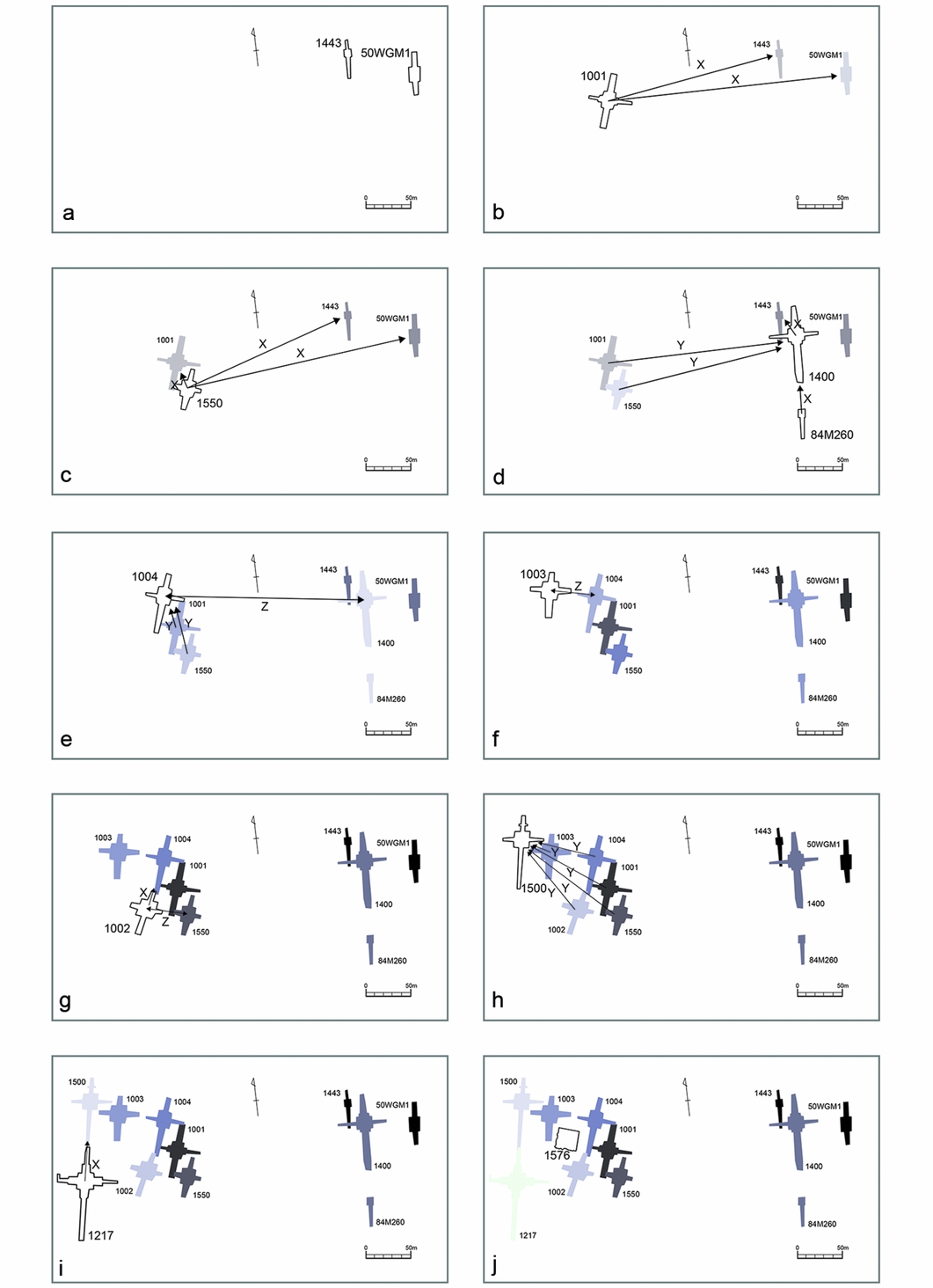
When tombs 1001 and 1550 in the western zone and tomb 1400 in the eastern zone were built, tombs 1443 and 50WGM1 were already extant (Figure 4a–d). As tomb 1129 (see Figure 1) did not yield any datable artefacts, it is omitted from the following study. It is important to note that tombs 1001, 1550 and 1400 were placed slightly to the south of those two pre-existing tombs (Figures 1 & 4b–d). Each of the three tombs had their main entrance on the southern side, suggesting that 1001, 1550 and 1400 were built in a position that naturally caused the mourners to X to pay respect to the deceased of 1443 and 50WGM1. In the case of 1550, the mourners were also made to pay respect to the deceased of 1001 (Figure 4c). This strategy is particularly clear in the relationship between tombs 1443 and 1400 (Figures 1 & 4d): a participant at the funeral of 1400 would have had tomb 1443—probably represented by an ancestral shrine or a very low platform—within view. This suggests that the royal cemetery was initially located here with the intention of paying respect to, and effectively emphasising the deceased's connection with, ancestors buried in tombs 1443 and 50WGM1.
It should also be noted that tomb 1400 in the eastern zone was positioned so as to be paid respect by those buried in 1001 and 1550—an example of strategy Y (Figure 4d). Tomb 84M260 was situated immediately in front of the southern ramp of 1400, thereby compelling the mourners to pay respect to the individual buried within 1400; this is an example of strategy X (Figure 4d).
Tomb 1004 was constructed to the north-west of 1001, as if deliberately placing the deceased so as to be paid respect by the occupants of 1001 and 1550—an example of strategy Y (Figure 4e). Tomb 1004 was also placed with the clear intention of displaying the genealogical proximity of its occupant to 1001. The strategic intention of the mourners of tomb 1004 was, therefore, to situate the occupant as the genealogical successor to that of 1001, and simultaneously to demonstrate the higher social status/position of the individual buried in 1004 (Figure 4e). Interestingly, the main burial pit of 1004 was situated at almost the same latitudinal position as 1400 (Figure 4e). This suggests that the mourners who constructed tomb 1004 tried to locate the deceased in an equivalent pairing position to that of 1400—an example of strategy Z.
As suggested, tomb 1003 was constructed after 1004 and before 1002 (Figures 1 & 4f). It can be concluded that tombs 1003, 1500 and 1217 formed a distinct sub-cluster (Figure 1), not only because of their mutual proximity, but also through sharing an identical longitudinal axis (Figure 1). Tomb 1003 was similarly placed as if designed to be paired (strategy Z) with 1004 (Figure 4f). Tombs 1001, 1550, 1004 and 1002 formed a cluster, but 1003 was not built to be a part of it (Figure 1). These observations suggest that the mourners of 1003 intended to position the deceased as the equal of, and successor to, the occupant of 1004, although the deceased of 1003 belonged to a different lineage.
The construction of tomb 1002 followed that of 1003, which was further followed by 1500 (Figure 4g–h). What makes 1002 particularly remarkable is that it was situated as if the occupant was to be paired with 1550 (strategy Z); a considerable length of time must have passed between the construction of 1550 and 1002 (Figures 1 & 4g). In their longitudinal axes and size of their main burial pits, the tombs were identical and their front ramps were much shorter than those of 1001 and 1004. They also were much shorter than those of 1500 and 1217 (Figure 1). Regardless, the mourners of 1002 did not try to ‘outdo’ the funeral of 1003; they showed their respect to (strategy X), and the close genealogical relationship with, the individual buried in 1004 (Figure 4g).
The chronology of the ritual bone spatulas confirms that tomb 1500 post-dates tomb 1002 (Figure 4h). Tomb 1500 was given the northernmost position of the entire Xibeigang cemetery, effectively placing its deceased to be respected by all of those buried in the preceding graves—the execution of strategy Y on a grand scale (Figure 4h).
Tomb 1217 post-dates tomb 1500 (Figure 4i), and was also situated so as to express its respect to (strategy X), and genealogical succession from, 1500. The northern ramp of 1217 also overlaps the southern ramp of 1500 (Figure 4i). Interestingly, however, 1217 had longer ramps and its burial pit was of similar shape to those of 1001 and 1400, the two oldest royal tombs of Xibeigang (Figure 1). This suggests that the mourners of 1217 intended to portray the deceased not only as having a close genealogical tie with 1500, but also as reviving the old tradition by emulating the shape of the main burial pits of 1001 and 1400. This may accrue more significance if we consider that tomb 1576, which post-dates tomb 1217 (Figure 4j), was abandoned, unfinished. It is tempting to argue that the mourners of the occupant of 1217 felt that continuation of the lineage (or lineages) of the elite was in danger. Accordingly, they tried to revitalise their faction(s) and their genealogical continuity by emulating or reviving the manner and style in which the founders of the lineage, or lineages (i.e. the ancestors buried in 1001 and 1400), were buried. Despite their highly symbolic effort, the lineage (or lineages) did indeed come to an end.
B. Comparing the outcome to historical sources
The dynastic genealogy of the late Shang kings ruling from the capital at Yin 殷 (Anyang) is documented in the well-known Shiji 史記 and Zhúshū Jìnián 竹書紀年 (the Bamboo annals). It is thought that Wu-Ding (武丁) moved the capital to Yinxu at around 1250 BC (Xia Shang Zhou Chronology Project Team 2000). Ten successive kings then ruled the domain before the last Shang king, Di-Xin (帝辛), was killed and Shang rule was ended by the Zhou Dynasty in 1046 BC (Xia Shang Zhou Chronology Project Team 2000). The kings documented in Shiji and in the oracle bone scripts coincide fairly well, although some of the reigns recorded in Shiji (written some 800 years later) are too long to be feasible. The Shiji entries that coincide with descriptions in the oracle bone scripts, however, can be trusted. Importantly, King Lin-Xin's (廩辛) enthronement is in doubt because his name does not appear in the oracle bone records, although the Shiji includes him. If Lin-Xin is removed from the dynastic genealogy, the number of the royal tombs and that of the kings recorded in these documents match perfectly (Figure 5):
Late Shang ‘kings’, their genealogy according to Shiji and relevant oracle bones, and their attributed tombs.
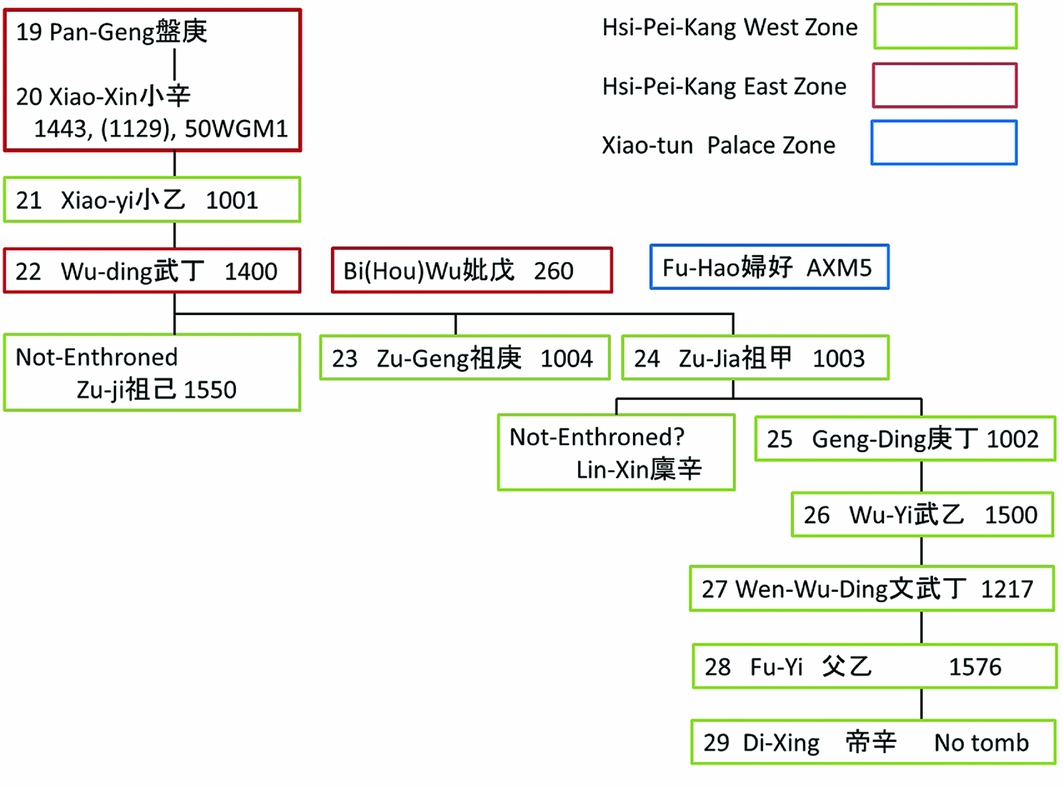
1001 = Xiao-Yi (小乙) → 1550 = Zu-ji (祖己) → 1400 = Wu-Ding (武丁) → 1004 = Zu-Geng (祖庚) → 1003 = Zu-Jia (祖甲) → 1002 = Geng-Ding (庚丁) → 1500 = Wu-Yi (武乙) → 1217 = Wen-Wu-Ding (文武丁) (Figure 5; also see Figures 1 & 4).
It is widely recognised that the number of late Shang kings coincides with the nine large tombs excavated at the Xibeigang cemetery (e.g. Chang Reference Chang1980: 110–19, Yang Reference Yang and Chang1986: 52). As previously mentioned, however, the lack of a precise chronology has made it difficult to attribute convincingly each tomb to any particular king. As tomb 84M260 (see Figure 1), which yielded the famous Si-Mu-Wu (司母戊 or 后母戊: Anyang Archaeological Team IA CASS 1987) ding vessel, is most probably the burial place of Bi-Wu (妣戊: Yang & Yang Reference Yang and Yang1977: 14), the lawful wife of King Wu-Ding, it can be inferred that the king himself was buried in tomb 1400. Intriguingly, tomb 86M260 is placed so as to pay respect to (strategy X) the occupant of tomb 1400 (Figure 4d). Further evidence for this attribution comes from the tomb of Fu-Hao (wife of Wu-Ding), in the palace complex at Xiaotun. Her tomb yielded the assemblage that characterises the earliest stage of the Yinxu II phase (IA CASS 1980: 228). Tomb 1001—the inferred tomb of Xiao-Yi—dates to the final stage of the Yinxu I phase, and tomb 1550 dates to the earliest stage of the Yinxu II phase. Tomb 1400, according to the bronze items excavated from it, dates to the Yinxu II phase (see also the OSM). This evidence indicates that Wu-Ding (probably buried in tomb 1400) organised the funeral ceremonies and buried Kings Xiao-Yi and Zu-Ji. As the Shiji does not record the latter's enthronement, it is speculated that he died young while still a prince. The oracle bone scripts, however, record various commemorative rituals routinely performed at his tomb. These observations allow us to attribute tombs 1001 and 1550 to Xiao-Yi and Zu-Ji, respectively (Figures 4b–d). This enables the tombs in the reconstructed sequence to be matched to the kings one by one: 1004 (Zu-Geng) → 1003 (Zu-Jia) → 1002 (Geng-Ding) → 1500 (Wu-Yi) → 1217 (Wen-Wu-Ding) (see Figures 4e–i & 5).
According to the Shiji, Wu-Ding (1400) was the son of Xiao-Yi (1001), and Zu-Ji (1550), Zu-Geng (1004) and Zu-Jia (1003) were the sons of Wu-Ding. Geng-Ding (1002) was the son of Zu-jia (1003). Wu-Yi (1500) was the son of Geng-Ding, and Wen-Wu-Ding (1217) was the son of Wu-Yi (Figure 5). This shows that Wu-Ding's sons were successively enthroned, effectively making Wu-Ding the founder of a new dynasty. He also founded the Yin capital. This might explain the location of tomb 1400, situated apart from tombs 1001 and 1550 (Figures 1 & 4d); Wu-Ding himself, or his mourners, intended his spatial location to express his role as dynastic founder, worthy of a distinguished position. This would also explain why tombs 1001, 1550 and 1004 form a cluster (Figures 1 & 4e). The occupant of 1004 (Zu-Geng), and those who buried him, would have attempted to give him equal status to Wu-Ding, by positioning his tomb in a pairing position with 1400 (Figure 4e), while simultaneously placing him as rightful successor to the predecessors of Wu-Ding (i.e. Xiao-Yi in tomb 1001, and Zu-Ji in 1550). Following strategy Z, Zu-Geng and Zu-Jia were buried side by side in tombs 1004 and 1003: a fitting treatment for kingly brothers (Figures 1, 4f & 5).
Following this, Geng-Ding (tomb 1002), the son of Zu-Jia, was buried via strategy X, paying respect to his uncle, King Zu-Geng (1004) (Figures 1 & 4g). That he was not buried in a position paying respect to his father suggests that the decision was a highly strategic one and might have related to competition between the faction(s) supporting the line of tombs of 1001, 1550, 1004 and 1002, and the faction(s) supporting the line of 1003, 1500 and 1217.
Geng-Ding's (1002) son Wu-Yi (1500) was buried in a position that effectively received respect from all the previous kings (strategy Y) except Wu-Ding (1400) (Figures 1 & 4h). This suggests that he or his followers may have attempted to position him highest in the entire genealogical hierarchy represented at the cemetery. Interestingly, from Wu-Yi onwards, unilineal male succession is recorded in Shiji until the end of the dynasty (Figure 5), suggesting that Wu-Yi attempted to renew kingly authority and power.
It is interesting to note that Wen-Wu-Ding (tomb 1217), or his faction, chose not only to construct the largest tomb in terms of ramp length, but also to make the main burial pit identical in form to those of tombs 1001 and 1400—the latter most probably the tomb of Wu-Ding, founder of the late Shang dynasty (Figures 1 & 4i). Wu-Yi's and Wen-Wu-Ding's reigns were characterised by the revival of old ritual traditions, which Dong Zuo-bin describes as the ‘Old School’ (Tung Reference Tung and Kawade1956) formerly practised by Wu-Ding, also described as “the Wen Wu Ting ‘revival’ of Wu Ting institutions” (Chang Reference Chang1980: 187). (It must be noted, however, that this proposal by Dong Zuo-bin is currently under scrutiny.) That this took place immediately before the demise of the Shang dynasty suggests that Wen-Wu-Ding attempted to revitalise power and authority by connecting himself to the founding ancestor, Wu-Ding, in response to the dynastic decline.
Chang (Reference Chang1980: 176, 187–88, Reference Chang1982: 121–26) hypothesised that ‘Ding’ and ‘Yi’, repeatedly used as a part of kings’ names, represented two royal descent groups: the Ding (later to become the Zhao in the Zhou period), and the Yi (later to become the Mu). Chang assigned four kings to the former group, and seven to the latter, and argued that they coincided with the number of large tombs in the western and eastern zones of the Xibeigang cemetery. The subsequent Zhou system enthroned kings alternately from the Zhao and Mu groups, and Chang inferred that such a system had already been practised in the Shang period (Chang Reference Chang1982). Our chronological reconstruction of the Xibeigang cemetery reveals that his model is not sustainable: the tombs were not constructed alternately in the eastern and western zones (Figure 4) (Chang Reference Chang1982).
Why, then, is there a clear spatial division between these zones? Before the construction of the first royal tomb (1001) in the western zone, tombs 1443 and 50WGM1 (probably belonging to the Middle Shang kings residing at Huɑnbei Shɑnɡchenɡ 洹北商城; Tang Reference Tang1999) had already been built in the eastern zone. The eastern zone was hence already designated as the ancestral burial ground, and became a location for rituals as indicated by the continuous sequence of sacrificial pits and burials. Wu-Ding, who probably organised the mortuary rituals of Xiao-Yi (tomb 1001) and Zu-Ji (tomb 1550), and was effectively the head of a new dynasty, founded the new burial ground in the western zone. When Wu-Ding died, he was commemorated as both the founder of the new dynasty and as the legitimate successor of the Middle Shang kings; his burial, in the eastern zone, also sought to glorify the ancestors. The tombs of Wu-Ding's sons and their successors, by contrast, were placed in the western zone that Wu-Ding had designated as the new royal burial ground, while ancestor rituals continued to be conducted in the eastern zone. Ultimately, we find it significant that the results of archaeological investigation coincide with those of expert analysis of the historical records.
Concluding remarks
The detailed chronological reconstruction of the Xibeigang cemetery has allowed us to recreate the strategic decisions of the mourners who constructed the royal tombs and left material traces of funeral ceremonies. The richness of the late Shang archaeological record includes sophisticated bronze ritual vessels and large urban settlements, as well as the royal tombs of Xibeigang, and offers important material for comparison with other early civilisations, including those of Egypt, Mesopotamia and the Indus (e.g. Trigger Reference Trigger2003). That very richness allows us to study the social organisation and institutions of the Shang in detail, and offers detailed insight into the social practices of individuals and groups of varying membership at various scales. A number of case studies have demonstrated that our understanding of the organisational characteristics of a society can be significantly improved by examining how individuals and groups pursued the social practices that contributed to the maintenance and transformation of its institutions (e.g. von Falkenhausen Reference Falkenhausen2006). The present study has applied this approach to the archaeology of the Shang period, thereby illuminating the ways in which the Shang ruling class organised themselves, competed with one another and attempted to maintain and enhance their power and authority.
Acknowledgements
We thank Gina Barnes and Lothar von Falkenhausen for their extensive, insightful and encouraging comments. We also wish to thank Yu-yun Lin and Zhi-hua Xie for allowing us to study and make detailed notes and sketches of the artefacts used for the chronological reformulation undertaken in this paper. This work was supported by JSPS KAKENHI grant JP17K03211.
Supplementary material
To view supplementary material for this article, please visit https://doi.org/10.15184/aqy.2018.19


 Open access

