


1. Introduction
Given the extensive threats caused by the COVID-19 pandemic, college students’ mental health and career planning have become critical priorities across university campuses. Due to the novelty of this pandemic, little has been investigated on the relationship between coronavirus-related anxiety and young adults’ career decision making. Mahmud et al. (Reference Mahmud, Talukder and Rahman2020) found that fear of COVID-19 impacts career decisions through its inherent depression issues. This coincides with other empirical findings that show (a) young adults are more anxious about their careers, and (b) this anxiety has an impact on future career plans (Campagna & Curtis, Reference Campagna and Curtis2007; Mojgan et al., Reference Mojgan, Kadir and Soheil2011). Furthermore, Işik’s (Reference Işik2012) study showed there is a significantly negative relationship between career decision-making self-efficacy and trait anxiety. Together, these studies indicate that anxiety affects both young adults and college students with their careers, which is why we examine whether coronavirus anxiety affects both career planning and indecision. Career measures, like the career decision-making difficulty questionnaire (CDDQ) and the career decision-making self-efficacy scale (short form) (CDSE-SF) are widely used psychometric assessments, but how researchers quantify young adults’ attitudes regarding career planning has scarcely been explored (Gati et al., Reference Gati, Krausz and Osipow1996; Gray et al., Reference Gray, Lee, Kim and Lee2020; Lee et al., Reference Lee, Kim, Mendoza and McDonough2018; Tomaszek & Muchacka-Cymerman, Reference Tomaszek and Muchacka-Cymerman2020).
2. Objective
Psychometric assessment has an important role in health assessment and research. We created the 8-item college student planning scale (CSPS) to better quantify these variables. CSPS examines college students’ career plans to identify those affected with the pandemic’s uncertainty with most issues, including occupations and careers. We also investigated the degree to which CSPS relates to pre-existing and validated measures (i.e., the coronavirus anxiety scale [CAS], CDDQ, general procrastination scale [GPS], and the career decision self-efficacy scale [CDSE-SF]) during the recent pandemic. We examined the CSPS’s factorial structure and internal validity to better establish psychometric validation of the measure.
3. Methods
Participants (N =101) were originally recruited at small, liberal arts colleges in southeast Arkansas and southern California, except that one failed to answer some questions—which was excluded. Each participant voluntarily participated in the study, which was approved by the Institutional Review Board (IRB) at the University of Arkansas at Monticello and carried out with APA ethical standards. All participants received a copy of the consent form at the beginning of the study, and we provided debriefing after its completion. They completed the CSPS, CDDQ, GPS, and CDSE-SF in an online format and received extra credit for their involvement. The order of each questionnaire was randomized per participant to avoid an order effect. One-hundred participants were included for data analysis (M = 22.25, SD = 6.6; 77 females and 22 males). There were 25 Black (or African-American), 67 White, and 7 identifying with “others.” Four were listed as college freshmen, 34 were sophomores, 26 were juniors, and 33 were seniors enrolled full-time. Two listed having post-baccalaureate degrees.
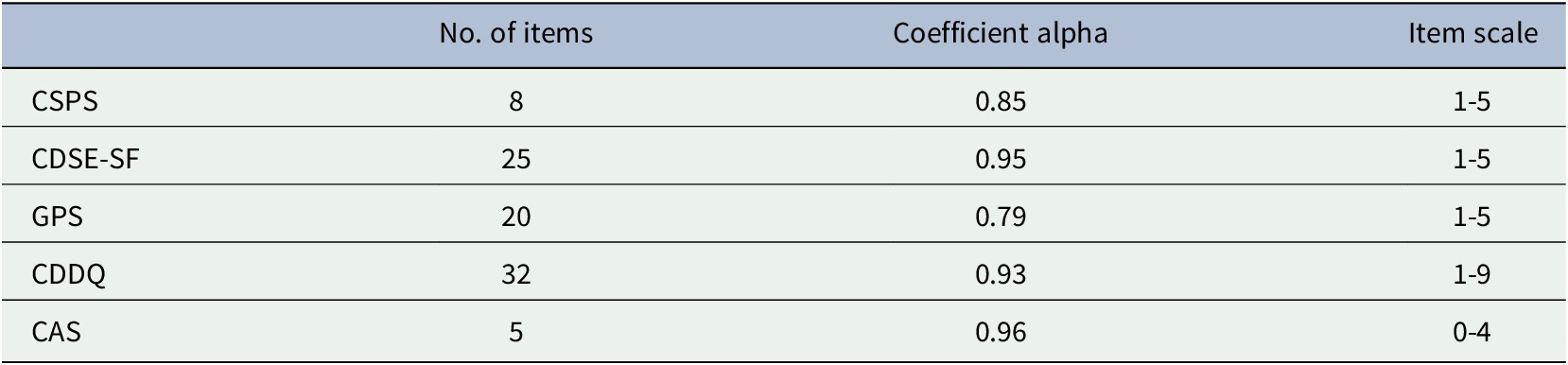
A simple regression analysis was conducted to see how CSPS relates to CDDQ and CDSE-SF. The coefficient alpha of CSPS was 0.85, which is a desirable value as a measure, according to Cortina (Reference Cortina1993). The CSPS’ significant correlation coefficients used solid planning (r = .29, p < .01) and management (r = .28, p < .01) showing potential validity evidence of its content, whether it is valid to the extent of planning management. After assessing reliability and validity of the CSPS, a regression analysis was conducted for the impact of CAS on CSPS. Two simple regressions of the CSPS were conducted to see the impact of the CDDQ and CDSE-SF.
4. Results
In all analyses, data from the CSPS, CAS, CDDQ, GPS, and CDSE-SF were used as continuous variables. Correlation coefficients among variables are shown in Table 1. CAS consists of 5 items, so we assume the measure has a tendency to assess anxiety related to COVID-19. Results of the first simple linear regression indicates that the effect between the CAS and CSPS was insignificant. The skewness value, 3.24, indicates a positively skewed response trend. Significant findings were assessed when examining the CSPS’s correlations with CDDQ, GPS, and CDSE (see Table 1).
Correlations between CSPS, CDSE-SF, GPS, and CAS

p < .001 ‘***’, p < .01 ‘**’, p < .05 ‘*’
We also examined the factor structure among the given measures. Table 2 shows the item-level descriptive scale and internal consistency estimates among CSPS, CDSE-SF, GPS, CDDQ, and CAS. In the two regression analyses for CSPS, the new measure had a strong impact on CDDQ and CDSE-SF. The first CSPS simple linear regression indicated a significant effect on CDSE-SF, (F(1, 98) = 37.19, p < .001, R2 = .28) and how CSPS was a strong predictor (t = 6.1, p < .001) of the model. The second CSPS-SF simple linear regression concluded there was a similarly significant effect on CDDQ, (F(1, 98) = 27.67, p < .001, R2 = .22) and that CSPS was also a significant predictor (t = -5.3, p < .001) of the model.
Internal consistency estimates of CSPS, CDSE-SF, GPS, CDDQ, and CAS
5. Discussion
The current study examined the correlation between CSPS, CAS, CDDQ, GPS, and CDSE-SF. We first examined how COVID-19 anxiety affects college students and career planning; however, no correlation was shown between them. The results suggest that CAS is case-sensitive, so we caution against its use as a measure of anxiety for the general population. The CAS was newly developed in April 2020 when COVID-19 peaked and participants were a bit older (Lee, Reference Lee2020). Previous literature shows a relationship between anxiety and career indecision (Campagna & Curtis, Reference Campagna and Curtis2007; Işik, Reference Işik2012; Mojgan et al., Reference Mojgan, Kadir and Soheil2011; Tomaszek & Muchacka-Cymerman, Reference Tomaszek and Muchacka-Cymerman2020), so future research must focus on the correlation between generalized anxiety and career planning. More independent studies that investigate the psychometric properties of the CSPS are also necessary to establish the scientific rigor of this research.
No significant relationship was found between the CAS and CSPS, but our findings suggest moderate-sized correlations between CSPS-SF and CDDQ, and GPS and CDSE. A significant negative correlation was found between CSPS and CDDQ (r = -.47, p < .001). This suggests that college students will face fewer career difficulties if they plan for their future careers, possibly with some backup vocations. We found that the CSPS is negatively correlated with the GPS (r = -.27, p < .001), suggesting that factors related to procrastination may instigate career planning as well as decision difficulties. A significant positive relationship was found between the CSPS and CDSE-SF (r = .52, p < .001), indicating how adequate planning for a future career may allow college students to feel more confident about this decision. Overall, our study shows that CSPS can be a reliable, unidimensional construct for career planning in university samples, along with the general population.
6. Conclusion and Future Directions
This study serves as a psychometric analysis of the CSPS during the COVID-19 pandemic. Coronavirus-related anxiety has been a serious issue affecting young adults’ career planning and decisions, so we attempted to assess if COVID-19 anxiety affects the relationship between CSPS, CDDQ, GPS, and CDSE-SF among U.S. college students. The CAS was created for researchers and health professionals to identify anxiety and uncertainty in this growing pandemic, so the quality of our measures will hopefully provide solid evidence of how these measures were in fact examined, helping researchers select the best assessment plan.
One possible explanation about not finding a significant relationship between CAS and CSPS could be that young adults do not have an excessive fear of death, on which the 5 items of CAS specifically focus. All items ask about one’s physiologically-based anxiety reaction to COVID-19-related symptoms, which many young adults may not experience. Future studies will examine generalized anxiety with these measures about whether generalized anxiety is predictive of the actual population, rather than their current involvement with the recent pandemic.
We found interesting relationships between the CSPS and other measures in this study (i.e., the CDDQ, GPS, and CDSE-SF). In conclusion, the CSPS is a promising measure with relevance to college students. The higher scores of the CDSE correspond to higher levels of CSPS, which may contribute to growing mental symptoms, suggesting that without proper planning, this can lead to distraction in daily situations, such as college learning.
The current study represents a measurement of career planning, which will help us conduct future research related to college students’ mental health and professional development, with a mediation-based personality theory and career framework. The assessment of psychometric properties promotes the selection of valid and reliable instruments, so that researchers can ensure the internal validity of their results. An empirical investigation on how COVID-19-related anxiety impacts college students and their career plans should contribute to the current literature and to future researchers involved with the COVID-19 pandemic.
Acknowledgements
We thank Drs. Jennifer Miller and Hyowon Ban for assistance with data collection, as well as Dr. Carol Zurcher for carefully reviewing and editing the manuscript. We are deeply grateful to them for their encouragement and support.
Conflict of interest
The authors declare no conflicts of interest.
Funding information
This work was supported by the Arkansas Department of Higher Education as a form of student undergraduate research fellowship [SURF] (MG & SL, grant number 544060-2100-212111).
Author contributions
MG, MK, and SL conceived and designed the study. MG and SL conducted data collection, MG and MK performed statistical analysis, and MG, MK, and SL wrote the article.
Data availability statement
Data for the experiments that is reported here is available upon request. The experiment was not preregistered.
Compliance with ethical standards
The authors assert that all procedures contributing to this work comply with the ethical standards of the relevant national and institutional committees on human experimentation and with the Helsinki Declaration of 1975, revised in 2008.


 Open access


Comments
Comments to the Author: Thank you for focusing your research question on such a timely and applied problem. I could see several clear uses and implications of these findings. Nevertheless, I have a few hesitations about the current draft as outlined below.
Introduction
-Given the brevity of the article, I think the introduction as written is fairly successful in justifying the study and providing background.
Methods:
-Further details about the participants would be helpful (e.g., age, gender, class they were enrolled in or college majors, etc.). This could be included as a table to spare the word count.
-Were the questions randomized or asked in a fixed order? I ask because it could impact an order effect.
-Since part of the aim of this paper is to examine the factor structure, it would be great to see information about the item-level scale descriptives and internal consistency estimates.
Conclusion
-I am not sure what this sentence means and was hoping for a further explanation, perhaps with a citation: “No significant relationship between CAS and our newly developed measure (i.e., the CSPS) was found due to the time sensitivity of CAS.
Minor:
-Some grammatical issues here and there. For example,
--“CSPS leans toward questions...” I think should read, “CSPS leans towards questions…”
--“CAS developed by Lee (2020) is also relative to a new measure,…” I think should read, “CAS developed by Lee (2020) is also a relaively new measure…”