

Introduction
Forced labour is still an important problem today, not only in developing countries, but also in developed ones, as recent reports by the ILO point out.Footnote 1 As a result, economic debate on unfree labour is open, and much of the argument concerns not only the measures to be taken in order to put an end to such labour exploitation,Footnote 2 but also the theoretical implications of its persistence in our understanding of capitalism. This debate, moreover, is not only related to contemporary reality, but also to historical dynamics, being a source of important controversies within the literature on development and labour relations.Footnote 3 In fact, economists and historians have underlined the persistence of different modalities of unfree labour relationships during the past two centuries, closely related to the historical dynamics of capitalism.Footnote 4 As a result, historiography focusing on the importance of forced and unfree labour for economic development has faced two main, complementary and almost always overlapping challenges: the first, mainly related to public policies and to the role of the state, is to identify the legal framework of the different modalities of unfree labour, while the second draws our attention to explaining its economic logic.
The first challenge, analysed below, is closely linked to the difficulty of giving a definition of forced labour valid for different times and places. Although coercion, both for entering into such work or to prevent workers leaving it, has long been regarded as the main factor in defining forced labour,Footnote 5 several historians have pointed out the necessity of broader approaches to understand the history of labour relations.Footnote 6 Recently, the taxonomy established by the Global Collaboratory on the History of Labour Relations at the International Institute of Social History has given us a very useful tool for furthering comparative studies on forced labour.Footnote 7
This project, where the state plays an important role in shaping labour relations, as conqueror, employer, or redistributor, enables us to approach the history of labour relations by taking into account political factors. These factors include the structure of political domination over the colonies, the penitentiary system, policies towards the dissident population in the framework of a civil war, or the regulation of migratory flows. They are also essential to understanding the mechanisms shaping forced labour supply; that is, the creation of social groups susceptible to being employed in work on the margins of mercantile mechanisms. With that purpose in mind, and in order to better understand the role of the state and the global implications of imperialism for labour relations, we will analyse forced labour within Spain’s legal borders during each period, including the empire.
In section three, we will deal with the second challenge, focused on two driving factors encouraging the demand for unfree labour. The first is the relative shortage of labour, something that was pointed out by Domar in his seminal article and that has been the source of several debates.Footnote 8 The second relates to the possibility of increasing profits thanks to changes in the labour market that reduce the cost of labour, always keeping in mind that the margins of such profit, their relation to the levels of productivity, and their centrality in the cycles of capital accumulation remain open questions that are the subject of debate.Footnote 9 Thus, what is set out here should be understood as a contribution to ongoing global debates that must necessarily be revised or enriched in the future as new studies are carried out.
Political Regimes and Main Modalities of Forced Labour in Spain (1812–2014)
In spite of recent research, we still lack an overall view of the persistence of forced labour in Spanish economic development. The only attempt to estimate the relative importance of the different categories of labour relations established by the Global Collaboratory on the History of Labour Relations has been made by Lana for 1797, 1900, and 2001.Footnote 10 However, Lana takes today’s territory as a reference, and so labour relations in the colonial sphere are not included. Moreover, category 11 (tributary slaves, in this case prisoners of war in concentration camps) does not figure, as the opening and closure of concentration camps in the twentieth century falls outside these temporal cross sections; nor is today’s debt bondage (category 15) included, as Lana uses official data that do not reflect these illegal situations.Footnote 11
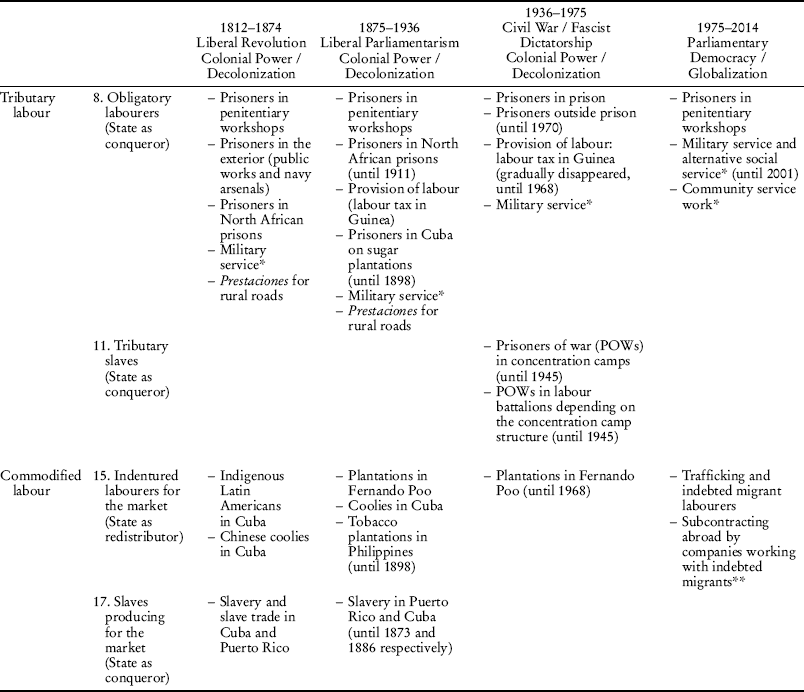
For the purposes of this article, and in order to identify different modalities of forced or unfree labour, we will take as a basis the taxonomy established by the Global Collaboratory on the History of Labour Relations and consider categories 8 (obligatory labourers),Footnote 12 11 (tributary slaves),Footnote 13 15 (indentured labourers),Footnote 14 and 17 (slaves who produce for the market)Footnote 15 in our analysis of forced labour, as seen in Table 1.
Liberal revolution and the golden age of colonial slavery (1812–1874)
From 1812, when the first liberal constitution was passed in Cádiz, to 1874, when a coup restored the monarchy, liberal reforms were progressively passed in Spain. Regarding labour relations, serfdom and slavery were under discussion, but while the former had disappeared during the eighteenth century slavery continued in these decades, during which Spain lost most of its American colonial empire.
In spite of this colonial decline, slavery became more widespread during the first half of the nineteenth century, linked to the expansion of sugar production in the framework of what Tomich has termed the “second slavery”.Footnote 16 For Spanish colonies, the Cuban case is the most important and well documented, owing to its role in Spanish capital accumulation.Footnote 17 In spite of the agreement between England and Spain, which made the slave trade illegal after 1817, slavery in Cuba was carried out in conditions of consensual secrecy. This agreement was no obstacle to over 500,000 Africans being landed on the island in the first half of the nineteenth century and a further 163,947 being landed in the following sixteen years, with the result that, at the end of the 1860s, there were about 400,000 slaves on the island,Footnote 18 while the island’s economy depended on their work in the flourishing sugar industry.Footnote 19
Within the framework of that process of economic growth, immigration through contract and the indenture of settlers from China, the so-called coolies, was also set in motion; their number reached 120,000 between 1847 and 1874.Footnote 20 These were workers who remained tied to their employers for a fixed period until they managed to meet the debt contracted for the journey, as well as the costs of their upkeep.Footnote 21
With respect to convict labour, the liberal revolution meant that deprivation of liberty was established as a fundamental punishment and prison as the place for its fulfilment. There was thus a progressive elimination of sentencing to forced labour that was more typical of the ancien régime, such as sentencing to the galleys (abolished in 1803), work in the navy’s arsenals (abolished in 1835, when this was reserved for military prisoners), or work in the mercury mines of Almadén (terminated in 1800).Footnote 22 So, although in the peninsula there were cases in which convicts continued to be used in public works, this practice was eliminated in the Penal Code of 1870. As a result, throughout the century, the main experiment in captive labour took place inside the prisons, in workshops.Footnote 23 The reality was quite different in the colonial territories,Footnote 24 since outdoor work continued in CubaFootnote 25 and in northern Morocco, mainly in the special prisons, the so called presidios, where such work generally involved constructing and maintaining military buildings and defence infrastructures.Footnote 26
Finally, we also should take into account the survival of some labour-tax systems for different communities during the transition to the liberal regime. One of these systems, the mita, was essential for the exploitation of silver mines in Potosí during colonial rule.Footnote 27 But it should be remembered that such work was not only a colonial practice; in Spain’s rural mainland, much of the work involved in repairing roads was carried out under a system of obligatory community work (the prestaciones), which was avoided by medium and large landowners who could afford to pay the corresponding daily wage. This system, created in 1845, was continued in some localities until the first half of the twentieth century.Footnote 28
Industrialization, empire, and liberal parliamentarism (1875–1936)
The period between the signing of the law that outlawed the slave trade in Cuba in 1867 and the abolition of slavery in 1886 was marked by anxiety among landowners, which led to the promotion of other modalities of forced labour, including the indebted immigration of Asians, American Indians, and even Africans under a system of contracts. Despite the attempts of public authorities, that strategy ended in failure as a global solution for labour shortages owing to the inadequate number of workers who finally arrived on the island and to the political instability prior to independence in 1898.Footnote 29
Subsequently, the sugar cycle was somehow replaced in the colonies by another much more limited one, also dependent on forced forms of labour, that of cocoa, cultivated on the island of Bioko (Fernando Poo), in the Gulf of Guinea. In this case, there was considerable pressure from plantation owners to establish mechanisms to force the local population to provide labour.Footnote 30 These mechanisms consisted of a labour tax, the prestaciones,Footnote 31 on the communities, and various private contractual formulas through which workers transferred from the continent to the island were left in the hands of the landowners.Footnote 32 According to Nerín, in 1917 the number of workers sent to the island was 7,233, the majority of them transferred or held against their will.Footnote 33
With respect to convict labour, it is necessary to analyse the case of colonial Cuba in the context of the abolition of slavery. Here, besides their direct use in quarries and public works benefiting the state, the leasing system, through which the state “rented” prisoners to landowners, was adopted through a decree signed in 1883 that accepted the work of prisoners on plantations, thus setting in motion their use in the sugar mills. In fact, in 1886 over half of the 393 convicts working outside the prison of La Habana did so in mills.Footnote 34
On the other side of the Atlantic at the end of the century, the dismantling of the northern African prisons was the subject of a debate, in which concern was raised over what was to be done with some 3,000 prisoners who had been used for fortification and infrastructure in the north of Africa.Footnote 35 The reality was that, in spite of plans to use convicts for internal colonization,Footnote 36 convict labour was carried out indoors, with around a third of prisoners working in the first few years of the twentieth century and around fifty per cent in the early 1920s (accounting for 0.06 per cent of the active population in 1901).Footnote 37 The last attempt to promote work as punishment was the Vagrancy Act of 1933, but it did not result in the development of a specific system of forced labour.Footnote 38
Spanish Civil War and Francoist dictatorship
After the failed coup d’etat of 1936, the ensuing civil war made possible extensive mobilization and the capture of an enormous number of prisoners of war, who had started to be used as cheap labour in non-frontline parts of Europe since World War I.Footnote 39 In the zone loyal to the Republic, three modalities of forced labour were implanted at the same time as the breakdown of the penitentiary reforms guaranteeing more rights for prisoners, which had been promoted in the early 1930s.Footnote 40 In December 1936, the Ministry of Justice opened the first of a series of labour camps for right-wing prisoners, to which would be added the creation of disciplinary battalions in the army itself and the opening in 1938 of six labour camps in Catalonia run under the auspices of the Military Intelligence Service (SIM – Servicio de Inteligencia Militar), in which captives of various origins were incarcerated.Footnote 41 In total, the number of people working in captivity on the Republican side can be estimated at between 20,000 and 25,000.Footnote 42
In contrast, much more important in number and economic impact was the implementation by the Francoist side of the largest system of work in captivity seen in twentieth-century Spain, starting in spring 1937 with the creation of the Concentration Camp Inspectorate for Prisoners of War (ICCP – Inspección de Campos de Concentración de Prisioneros) and the publication of the Decree on the Concession of the Right to Work to Prisoners and Prisoners of War, which heralded the two great modalities of forced labour during the dictatorship.Footnote 43
The first of these, numerically more significant although more short-lived, was structured on the basis of battalions depending on the ICCP and comprising POWs classified as being opposed to the regime or of doubtful loyalty. These were named Workers’ Battalions (BBTT – Batallones de Trabajadores) between 1938 and 1940, and Disciplinary Battalions of Worker-Soldiers (BDST – Batallones Disciplinarios de Soldados Trabajadores) from 1940 until they were disbanded, the majority in 1942 and the rest in 1945. At their highpoint, at the end of the war, the BBTT included some 90,000 POWs, although the number fell to about 40,000 between 1939 and 1942.Footnote 44
The second modality began to be constituted in 1938, with the System of Punishment Redemption through Work for prisoners who had previously been tried. This system encompassed not only the new prison workshops, but also modalities of extramural work, such as the Militarized Penitentiary ColoniesFootnote 45 or the Penal Detachments.Footnote 46 The number of convict workers peaked at 24,844 in 1943, from when it started to fall in line with the decline in the size of the prison population, remaining below 10,000 in the 1950s. Following a boom in exterior work in the early years after the civil war, under Francoism forced labour was progressively withdrawn to the interior of the prisons. As noted, the system regulating this work was basically Punishment Redemption, but the 1946 Regulation on Penitentiary Work nonetheless left the door open to work of a compulsory character, with the result that the Francoist prisons housed a growing percentage of working captives.Footnote 47
If we analyse these figures in terms of the long-term evolution of captive labour in Spain, we must emphasize that it was in the immediate aftermath of the civil war, in 1940, that convict labour was at its most important, with 108,781 prisoners and POWs working, 1.16 per cent of the total active population.Footnote 48
Finally, and in relation to imperial policies prior to decolonization, we must note that, although declining in importance, the labour-tax system of prestaciones was maintained by the dictatorship, while the main efforts of colonial rulers focused on encouraging indentured and contract migration networks.Footnote 49
Unfree labour in parliamentary democracy within a globalizing context
For post-Francoist Spain, we must take account of contemporary forms of unfree labour in the framework of globalization and the formation of global supply and value networks.Footnote 50 These forms, which some authors have conceptualized as “new slavery”,Footnote 51 involve millions of workers all over the world, many of them in situations of indentured labour, often as a result of clandestine migratory movements.Footnote 52
Within the previously explained category 8 of the Collaboratory’s taxonomy, the end of compulsory military service in 2001 meant that work in prisons was the only type of labour relationship. In fact, it was not completely compulsory, but different testimonies and research have pointed out that refusing work in prison adversely affected a prisoner’s chances of being granted parole.Footnote 53 Thus, what should be included in the totals provided by LanaFootnote 54 for category 8 in 2001 is the total number of prisoners working in the prisons, which that year totalled 9,566, accounting for 0.05 per cent of the active population.Footnote 55 The majority of the 16,246 prisoners working in Spanish prisons in 2013 were doing so in the maintenance services of the prison itself, although over 3,000 did so in workshops of private companies established within the prisons.Footnote 56 One of the great methodological difficulties and challenges facing researchers is having precise data on company participation in penitentiary workshops, since the official memoranda do not provide them, and we have only partial information through the denunciations of prisoners and solidarity collectives, for both the 1970sFootnote 57 and the present.Footnote 58
Outside the prisons, in the Spanish case situations of “new slavery” are basically linked to processes of indebtedness of migrants, the number of which Bales estimates at around 6,116 in 2009.Footnote 59 With respect to sectors of work, there are no monographic studies, but there is information on forced labour practices in agriculture,Footnote 60 in the building industry,Footnote 61 in domestic service,Footnote 62 and in prostitution.Footnote 63
Finally, although the deployment of forced labourers is today generally considered only within the context of Spain’s borders, we must also consider the use of forced labour by Spanish companies operating internationally – and which is therefore beyond the scope of Spanish legislation. There are, once again, methodological difficulties in clarifying this question owing to the opacity of subcontracting systems and the lack of validity of commitments made, as in the case of Inditex,Footnote 64 a company publicly accused of using immigrant workers under debt bondage in workshops in ArgentinaFootnote 65 and Brazil.Footnote 66 Moreover, cases have also been confirmed in fishing companies,Footnote 67 and in the building sector by one of the subcontractors for the Spanish company OHL, which is involved in construction work on the stadiums being used for the Football World Cup in Qatar.Footnote 68 Clearly, these are all isolated cases, but they reveal the existence of a submerged global economy that Spanish multinational companies are also taking advantage of, in the framework of the new global value and supply chains.Footnote 69
The Driving Forces Behind Demand: Relative Scarcity and Accumulation Cycles
The relative scarcity of labour power
Labour scarcity is considered a key factor for understanding the recourse to forced labour.Footnote 70 Nonetheless, this has also been questioned by many authors, not only because in some specific situations labour shortage does not serve as an explanatory factor,Footnote 71 but also because on occasions it is precisely an element that facilitates a dissolution of coercive bonds specific to labour because of the effects of the option to abandon the work, the so-called outside option effect.Footnote 72 In any case, all these approaches stress that scarcity must be understood in a relative way, something that is confirmed, too, in the Spanish case.
In the case of the so-called second slavery in colonial Cuba, it is beyond dispute that this recourse to slavery was the way to implement a process of expansion that required – in keeping with the process of sugar-mill mechanization and the logic of economies of scale – an extensive use of labour that was not available on the island at that time.Footnote 73 We must consider, as we shall see later when analysing accumulation strategies, that other types of alternative were ruled out, due precisely to their greater cost. A similar situation took place on the cocoa plantations of Fernando Pó at the end of the nineteenth century, although on a much smaller scale. Here, too, recourse to the imposition of forced labour was linked to complaints on the part of plantation owners about the need for labourers for the cocoa harvest; those plantation owners formed a pressure group, which pushed the Spanish government to retain the continental territory of Muni as a labour reserve for the island.Footnote 74
Secondly, attention must be paid to the only period of modern Spanish history when it is possible to speak of a shortage of labour in a strict sense: the period of the Spanish Civil War, in the framework of global mobilization, repression, and exile, when the Spanish economy suffered a great loss of human capital.Footnote 75 There was a very different intensity in the use of forced labour on the two sides during the war, which once again leads us to diminish the significance of this factor. Recent research has shown that in specific situations a scarcity of labour acted as a key element in the demand for forced workers while, in an opposite sense, the end of such scarcity led some companies to actually request that forced workers be replaced by other, free workers. Examples include some mining companies in Biscay and the MZA railway company. The latter initially justified its request for prisoners as being due to the “scarcity of our own workers”, while months later, once the war had ended, it requested the replacement of a Workers’ Battalion by free workers, arguing that the latter were more productive.Footnote 76 This overall shortage of labour ended with the war, not so much because losses in terms of demography or human capital were recovered, but because of the lack of economic dynamism and the slow pace of economic recovery.Footnote 77
Thirdly, account must be taken of the spectacular demand for labour in the last expansive cycle of the Spanish economy, between 1996 and 2007. This was a period when new jobs were created at a much higher pace in Spain than in Europe as a whole, due to the labour-intensive and natural resource-intensive character of the country’s economic growth, which was linked to property expansion and construction work.Footnote 78 In this context, the growing demand for labour, concentrated in more precarious and less well-paid jobs, was largely satisfied thanks to one of the spaces most favourable to forced labour: illegal immigration.Footnote 79
These cases show us that, in reality, scarcity must be analysed in relative rather than absolute terms, in terms of the elasticity of demand for labour being higher than the elasticity of supply, while other options that could clearly be costlier to employers must also be analysed. This applies not only to the three situations set out, but also to others in which relative scarcity must be understood according to seasonal, sectoral, territorial, or legal criteria.
The scarce population of certain regions has also been used as a factor explaining the recourse to forced labour, due to the extra costs that could be involved for companies or the state in transferring population to those zones. Internal colonization in areas with a low population density was one option considered at the start of the twentieth century for relocating convicts in African prisons,Footnote 80 and it appears subsequently as one reason for deploying forced labour during the Spanish Civil War.Footnote 81 Moreover, the opening up of transport infrastructures in sparsely populated regions was a significant problem during the Francoist dictatorship, so recourse was made to Workers’ Battalions to open up roads in parts of the Pyrenees, and also to prisoners to open up railway lines.Footnote 82
Relative scarcity combined with seasonality is another factor that must be taken into account when explaining the recourse to coercion. Agriculture has always been a sector strongly marked by seasonality in the distribution of labour, and that continues to be the case today. This means that it is a sector conducive to the use of labour supply chains for ensuring the presence of workers at the required time owing to its particular characteristics and the existence of highly labour-intensive tasks for short periods of time.Footnote 83 It is precisely in special situations, like the harvest, that cases of exploitation of immigrants have been found to border on forced labour.Footnote 84 The influence of the greater demand for labour in summer has historically meant that during this season other sectors can be negatively affected by a scarcity of labour or a rise in wages. In fact, in the account of the virtues of work in the Memorandum of the General Directorate of Prisons (DGP) it is explained that recourse to convict labour also served to stabilize the number of workers in the construction sector “at critical seasonal times”.Footnote 85
Finally, regarding labour shortage we must consider the relationships between qualification levels and the intensity of work. Indeed, the case of one Basque province, Bizkaia, shows, as in most of the cases that appear in Table 1, that forced labourers were deployed mainly in low-qualification and effort-intensive tasks,Footnote 86 such as mining and construction, where the presence of captive workers in industry was much lower. Nevertheless, when necessary those industries requested prisoners or POWs with very specific skills.Footnote 87
Modalities of forced labour in Spain (1812–2014) in different political and global contexts.
* Neither analysed, nor calculated in this article.
** This kind of labour contract should not be included in this article if we apply the territorial criterion mentioned previously. Nevertheless, we mention it due to its importance in understanding the new accumulation cycle linked to contemporary globalization.
Another peculiarity, in this case related to the low elasticity of supply for labour, is that of illegal activities, where forced labour provides an easy solution to variations in demand.Footnote 88 Therefore, we must again emphasize that scarcity, though central to understanding the demand for forced labour, must be analysed also taking into account a number of other economic and political factors.
Forced labour and cycles of capital accumulation
As we have seen in the previous section, the option of forced labour must not be seen as something necessary, but as arising from the balance of forces between labour and capital in different legal frameworks that make it easier for the latter to impose a modality of forced labour, yielding it greater profits or ensuring labourers that would otherwise have been more difficult, or more expensive, to find.Footnote 89 Put another way, it is necessary to consider these coercive mechanisms of labour recruitment not only as something characteristic of primitive accumulation prior to capitalism, but also as one of the options used intermittently over the course of its historical development in new cycles of accumulation, as proposed by Brass in the concept of “deproletarianization”.Footnote 90
With respect to the Spanish case, I believe that there were three great cycles of capital accumulation during the past two centuries that were based to a certain (and different) extent on the utilization of forced labour: colonial slavery, forced labour under Francoism, and the appearance of new forms of forced labour within the framework of the upward cycle of 1996–2008.
In the case of slavery, the Cuban experience provides a good example of how relations of slavery can be immersed within the cycle of production and accumulation linked to a new world division of labour, not only in the stages prior to capitalist industrialization, as proposed by Williams, but also during the process of industrialization.Footnote 91 Moreover, profits generated by slave labour were not only reinvested in the sugar economy, but also used to further the industrializing process in the metropolis, especially in Catalonia. This was the case both during the central decades of the nineteenth century and after 1898, when Spain underwent a great investment cycle principally motivated by the arrival of capital from Cuba and other areas of Latin America.Footnote 92 The central role of forced labour with respect to capital accumulation was such that the Cuban elites made an effort to extract the greatest possible output from the system, even when slavery was about to be abolished.Footnote 93
The second cycle in which we can relate capital accumulation and forced labour is the Spanish Civil War and the initial period of Francoism. While capital accumulation and the fall in wages must be framed in terms of the transformation of the labour market and the political repression of the time,Footnote 94 forced labour, in spite of the productivity problems it entailed, also contributed to that capital accumulation,Footnote 95 while functioning at the same time as a key tool to discipline the working population.Footnote 96 With respect to the private sector, forced labour made possible direct profits for the companies that used it, and this has also been conceptualized by Sánchez Albornoz as being similar in a certain sense to primitive accumulation.Footnote 97 While, in principle, companies had to pay the state the same wage as that stipulated for free workers in each locality, there were different mechanisms for drawing additional profit from convict workers: paying a lower salary than that paid to free workers in remote areas; the possibility of redirecting foodstuffs intended for the prisoners to the black market; lengthening the working day; or even, in some cases, refusing to pay the state for the use of captive workers.Footnote 98 In addition, it is necessary to include as private profit the irrigation of substantial areas of land belonging to large landowners by means of forced labour, as was the case with the Guadalquivir Canal.Footnote 99 For its part, the public sector also obtained significant profits as the main employer of forced workers. On the one hand, due to work on public infrastructure such as roads and railways, which involved the work of thousands of POWs and, on the other, due to the money the state Treasury received from the companies that used prisoners. In the case of the Biscayan mining companies, PastorFootnote 100 has calculated that the state made a profit of 55.3 per cent on company payments, while the memoranda of the DGP in 1939 raised this figure to 76 per cent.Footnote 101
The third cycle of Spanish accumulation in which unfree labour has played a significant role is linked to the property and construction expansion of recent decades. While new studies are still needed that could confirm what was indicated by Romero,Footnote 102 immigration involving debt and the situation of illegality have enabled a substantial accumulation of profits thanks to the existence of a pocket of workers in a precarious, irregular, or illegal situation. They have been willing to work in conditions worse than those stipulated by law, and also, in some cases, in a situation of provisional servitude until the contracted debt is paid off. With respect to work in prison, it is once again necessary to refer to a double type of profit. On the one hand, public, as the tendency to replace free work by captive work in maintaining prisons has demonstrated,Footnote 103 and on the other, private, in the search for especially cheap labour. In fact, the administration itself underscores the advantages that prison workshops offer companies, as recently pointed out by the manager of CIRE:Footnote 104 “in many cases we are an alternative to delocalization” of manufacturing to other places with lower wages.Footnote 105 Although in the Spanish case it makes no sense to speak of what has been defined – not without controversy – in the USA as the prison industrial complex,Footnote 106 some trade unions and parliamentary groups are starting to criticize prison work as unfair competition based on dumping.Footnote 107 To conclude, it is even more difficult to estimate the role that might be played in the already mentioned global value chains by the utilization of subcontracting that uses forced labour in the Global South. Such difficulty is due to the illegality of such practices and the company fragmentation within which global production networks move. The implication of Inditex, one of the fastest-growing Spanish companies in recent years, leads me to think that this is not an unusual practice, and the denunciations made in Brazil and Argentina indicate that this practice was well known to company managers.Footnote 108
Conclusion: The Complementarity of Supply- and Demand-Side Approaches
Throughout these pages we have been able to confirm that in Spain, like in most regions in the world, the development of capitalism did not mean the total triumph of free wage labour; instead, its spread was compatible with the maintenance or creation of modalities of unfree labour.
Taking as a basis the categories established by the Global Collaboratory on the History of Labour Relations, we have been able to see how these modalities show clearly the centrality of the institutional and political framework when it comes to understanding the persistence of forced labour. There is a very evident shift from one period to the next regarding the main categories of unfree labour relations deployed during each of them. First, we must underline the centrality of slavery (category 17) for the decades of liberal revolution and colonial empire until 1874. During the next period, that of liberal parliamentarism, labour relations included in category 8, such as labour taxes for colonial ethnic groups and obligatory work for convicts in African prisons, predominated, with unfree labour being much more important for colonial political and economic control than for the mainland, where unfree labour experienced a clear decline. This reality changed with the civil war and the fascist dictatorship, when political repression enabled the deployment of thousands of prisoners and mostly POWs (category 11). The civil war and its aftermath is precisely the period when forced labour as a proportion of the active population peaked in mainland Spain. Finally, we must remark that during neoliberal globalization unfree labour was found mainly in prisons (category 8) and in the form of indentured migration (category 15).
Moreover, the research so far suggests that the demand for forced labour was also linked in different ways to the two main reasons identified in the historiography: on the one hand, the relative scarcity of workers, and on the other the pressure to increase profits by cutting labour costs. Nevertheless, historical research has shown that those demand-side factors do not operate in a simple or unilateral way, and that several other elements, such as variations in productivity, level of qualification, living conditions, as well as questions related to the agency of workers (resistance, response to incentives, for example), were essential for explaining why enterprises had recourse to, or rejected, forced labour. Moreover, it is still a challenge for research to be able to determine more precisely the exact contribution of this modality of labour relations to the cycles of capital accumulation and economic growth, as well as the exact proportion of free/unfree labour in different sectors and situations. In addition, one of the main conclusions of this article is that none of these economic factors that help us understand the demand side of forced labour can be correctly understood if we do not also take into account supply-side explanations, those related to public policies.
We will need more micro-level research in order to better understand the political and economic reasons that explain the survival of unfree labour, not only within historical capitalist development, but also for the disturbing contemporary reality, when unfree labour remains one of the mechanisms underpinning the growing inequality in most parts of the world.



