



Although Guatemala has one of the highest burdens of chronic malnutrition in the world (47 %)( 1 ), 4·7 % of children under 5 years and 36·8 % of school-aged children are overweight or obese( 2 ). In addition, sugar-sweetened beverage consumption among school-aged children (60·4 %) is alarming( 2 ). Front-of-package marketing is defined as the presence of spokes-characters, cartoons, celebrities, or health-related images, words, claims or endorsements on beverage packaging. Among other strategies, front-of-package marketing is associated with higher food and sugar-sweetened beverage consumption and, consequently, risk of obesity( Reference Chandon 3 ).
Packaging design targeting children relies heavily on visual stimuli, such as bright colours, cartoon characters and spokes-characters( Reference Mehta, Phillips and Ward 4 ). The package is designed to capture the child’s attention and to portray a sense of fun( Reference Elliott 5 ). In addition, marketing strategies encourage children to repeatedly request advertised foods and beverages from parents (‘nag factor’)( Reference Henry and Borzekowski 6 ). Child-oriented foods and beverages often use front-of-package colours, health-related images (e.g. pictures of fruit) and health claims to make a product appear healthy to school-aged children (6–12 years old)( Reference Elliott and Brierley 7 ). These strategies influence preferences and result in children pressing their parents to purchase these less healthy products( Reference Henry and Borzekowski 6 ). Thus, as a recommendation to prevent childhood obesity, the WHO has urged countries to implement policies restricting all types of unhealthful food and beverage marketing (including front-of-package) to children( 8 , 9 ).
Health claims make foods and beverages appear healthier and parents are more likely to purchase them( Reference Williams 10 ). These claims create a ‘health halo’ and encourage consumption among adults( Reference Kaur, Scarborough and Rayner 11 ). International guidelines for the use of health claims are defined by the Codex Alimentarius and allow for health claims that are evidence-based( 12 ). However, there is debate about the usefulness of health claims without appropriate consumer education( Reference Williams 10 ). While some agree that these claims will inform and affect consumer behaviour, others argue that they will not improve food choices without a supportive educational environment.
Health-related endorsements are front-of-package symbols that identify products that have been certified by professional health organizations( Reference Raats, Royce and Stockley 13 ). Some consumers use endorsements as a replacement for reading the nutrition facts label( Reference Ducrot, Julia and Mejean 14 ). The prevalence of health-related endorsements and other front-of-packaging marketing strategies on child-oriented beverages in low- and middle-income countries is yet unknown( 15 ). Therefore, we sought to describe the nutritional value, front-of-package marketing strategies and related endorsements on children’s beverages in Guatemala, a lower-middle-income country.
Methods
We visited three conveniently selected convenience stores and one supermarket in a middle-to-high socio-economic status area in Guatemala City( 16 ). The parameters of convenience for this sample were safety and the walking distance between each store. Although stores included in our sample were located in a middle/high-income area, convenience stores and supermarkets in Guatemala purchase from a small group of beverage suppliers and sell a similar mix of beverages across socio-economic areas. In each store, we purchased a census of each single-serving, child-oriented ready-to-drink beverage. To be included as a child-oriented ready-to-drink beverage, the package needed to include two or more of the following attributes: bright colours, spokes-characters or licensed cartoon characters, animals, celebrities, childish script, sports references, ‘sippy’ lid or straw, lunch box-sized packaging, or designed to fit into a child’s hand( Reference Mehta, Phillips and Ward 4 , Reference Hunter 17 ).
The data collection tool was adapted from Chacon et al.( Reference Chacon, Letona and Barnoya 18 ). After purchasing the products, we recorded each beverage’s name, brand, price, net weight and child-oriented packaging strategies. We also recorded front-of-package marketing strategies, which included: (i) presence of licensed characters or spokes-characters; (ii) health-related images, including pictures of fruits, vegetables, plants or fields, based on previous studies where children identified images associated with healthy snacks( Reference Elliott 5 ); (iii) health (e.g. ‘With Vitamin C’) and function claims (e.g. ‘Better bone health’) as defined by the US Food and Drug Administration and the Codex Alimentarius of the FAO( 12 , 19 ); (iv) health-related endorsements from national or international professional health associations (e.g. Asociacion Pediátrica de Guatemala (Guatemalan Pediatric Association)); and (v) references to harmful substances (e.g. ‘without preservatives’), the words ‘natural’, ‘pure’ or ‘kid’, sports references, and health visual cues (e.g. checkmarks).
To assess nutritional quality, we used the Nutrient Profile Model (NPM), which was developed in the UK( Reference Rayner, Scarborough and Lobstein 20 ) to regulate children’s food television advertising and has been previously used in Guatemala( Reference Chacon, Letona and Barnoya 18 , Reference Soo, Letona and Chacon 21 ). The NPM uses the amount of energy, saturated fat, sodium, sugar, percentage fruit juice, fibre and protein in 100 g of a food product. Therefore, it was necessary to convert from beverage volume to weight using the FAO’s INFOODS Density Database Version 2.0( 22 ). The nutritional information needed to calculate the NPM score was recorded from the packaging label. Beverages with an NPM score of 1 or higher are deemed to be less healthy( 23 ). Less healthy beverages had higher NPM scores.
Marketing strategies were coded as dichotomous (present or absent) variables for each beverage. An overall description of the frequency of each strategy was calculated. We calculated median (25th–75th percentile) beverage price in $US by marketing strategy and beverage type. Fisher’s exact test was used to compare the median NPM score of beverages with front-of-package marketing to beverages without.
Results
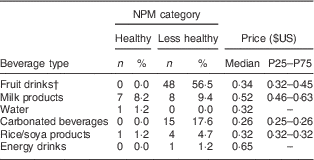
Eighty-nine child-oriented ready-to-drink beverages were purchased during January 2016: thirty-nine from convenience stores and fifty from the supermarket. Most (n 52, 58 %) were fruit drinks, followed by milk (n 15, 17 %), carbonated beverages (n 15, 17 %), rice/soya products (n 5, 6 %), water (n 1, 1 %) and energy drinks (n 1, 1 %).
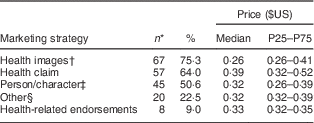
The most common marketing strategies (each package could have more than one strategy) were health images (n 67, 75 %) and claims (n 57, 64 %; primarily vitamin and mineral contents) and cartoon characters, spokes-characters or celebrities (n 45, 51 %; Table 1). Health-related endorsements were found on eight (9 %) beverages (most were less healthy). Three organizations were represented in this sample: Guatemalan Pediatric Association (Asociación Pediátrica de Guatemala), Institute of Nutrition of Central America and Panama (Instituto de Nutrición de Centro América y Panamá) and Costa Rican Public Health Association (Asociación Costarricense de Salud Pública).
Frequency and price of beverages, by common marketing strategy, in a sample of child-oriented beverages (n 89) purchased during January 2016 from three convenience stores and one supermarket in a middle/high-income area of Guatemala City
P25–P75, 25th–75th percentile.
* Beverages commonly employ more than one strategy.
† Pictures of fruit, vegetables, plants or fields.
‡ Spokes-characters, cartoons, licensed characters and celebrities.
§ Sports references, promotions, checkmarks, and the words ‘natural’, ‘pure’ or ‘kid’.
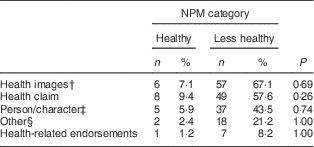
Nine beverages (11 %) were classified as healthy (Table 2). No marketing strategy was significantly associated with the NPM score (Table 3). Within health claims, the presence of vitamins (P=0·03), function claims (P<0·01) and presence of the word ‘natural’ or ‘pure’ (P<0·01) were associated with lower NPM scores.
Beverage type, by UK Nutrition Profiling Model (NPM) categoryFootnote * and price, in a sample of child-oriented beverages (n 89) purchased during January 2016 from three convenience stores and one supermarket in a middle/high-income area of Guatemala City
P25–P75, 25th–75th percentile.
* Four beverages (fruit drinks) did not contain nutrition information to calculate NPM score, n 85.
† Fruit-flavoured drinks.
Marketing strategies, by UK Nutrition Profiling Model (NPM) categoryFootnote *, in a sample of child-oriented beverages (n 89) purchased during January 2016 from three convenience stores and one supermarket in a middle/high-income area of Guatemala City
* Four beverages did not contain nutrition information to calculate NPM score, n 85.
† Pictures of fruit, vegetables, plants or fields.
‡ Spokes-characters, cartoons, licensed characters and celebrities.
§ Sports references, promotions, checkmarks, and the words ‘natural’, ‘pure’ or ‘kid’.
Median (25th–75th percentile) price for all beverages was $US 0·34 (0·27–0·48). There was a non-significant trend towards more expensive beverages (>$US 0·34) having lower NPM scores (P=0·09). Beverages with health claims were the most expensive, $US 0·39 (0·32–0·52; Table 1).
Discussion
According to our findings, beverages are using front-of-package health claims and health-related endorsements as marketing strategies on child-oriented packages. Most beverages in our sample had health claims, but few were classified as healthy. These healthy beverages were primarily milk-based products. All fruit drinks or juices were classified as less healthy. Of the fruit drinks and juices most had healthy images, which suggests to children a healthier drink option( Reference Elliott 5 , Reference Maher 24 ).
Promotional characters, specifically brand-specific spokes-characters, were a common feature in our sample and such characters have similarly been used to advertise snack foods in Guatemala( Reference Chacon, Letona and Barnoya 18 ). Characters create brand awareness in young children and promote consumption( Reference Garretson and Niedrich 25 ). Our results agree with prior studies finding that characters are used to promote less healthy foods and beverages to children( Reference Hebden, King and Kelly 26 – Reference Alvy and Calvert 28 ). Evidence-based polices restricting their use should be considered as strategies to control the obesity epidemic( Reference Letona, Chacon and Roberto 29 – Reference Robinson, Borzekowski and Matheson 31 ).
Health claims could distract consumers from other nutritional aspects (e.g. energy content) of foods and can lead to selection of unhealthy foods and beverages( Reference Chandon 3 ). Furthermore, consumers are prone to overeating when a food is perceived as healthy( Reference Chandon 3 ). This is also likely to be the case when a beverage is perceived as healthy. Guidelines on nutrition labelling and health claims in Guatemala are overseen by the Department of Food Regulation and Control of the Ministry of Health, in accordance with the US Food and Drug Administration regulations( 12 , Reference Hawkes 32 ). In most countries, health claims are generally allowed, but their use is restricted( Reference Hawkes 32 ). Therefore, we suggest prohibiting the use of health claims on beverages unless they meet evidence-based nutritional standards, as determined by local governments. The NPM or the Pan American Health Organization Nutrient Profile Model could be used to classify beverages as healthy or less healthy based on constituents (e.g. sugar or salt)( 33 ).
Professional health associations aim to promote research and improve public health. These associations advocate on behalf of patients (or consumers) and health professionals to better inform policy makers and governments. Credibility of package labelling systems is enhanced by health-related endorsements from professional health and science associations( Reference Vyth, Steenhuis and Mallant 34 ). Of the products with endorsements in our sample, only one was deemed healthy. As these endorsements give a general ‘stamp of approval’ for a product, it seems prudent that the product ought to meet nutritional standards. Therefore, similar to health claims, endorsements on beverages should be limited to those beverages that meet established nutritional standards.
The presence of health-related endorsement logos on food and beverage packages represents a source of revenue for health associations. For instance, the American Heart Association offers the Heart-Check Food Certification Program for food companies to include a red and white check mark on food packages. According to the American Heart Association’s website, after the company is approved to be part of the Program and the product’s nutrition profile has met a certain nutrition standard, the company pays a fee to certify each product( 35 ). Information on the certification process, revenue from endorsements and nutrition standards for the endorsements could be publicly available for consumers. Collaborations between the food industry and professional health associations may lead to conflict of interest, particularly when an exchange of money is involved( Reference Nestle 36 ). Health-related endorsements on less healthy beverages are misleading, reduce the professional health association’s credibility and may increase consumption of less healthy beverages.
Our study has strengths and limitations. To the best of our knowledge, it is the first study evaluating health claims and endorsements on beverages in a lower-middle-income country. Our study is cross-sectional and is not intended to represent all the beverages in Guatemala. Therefore, we cannot draw conclusions about how these strategies evolve over time or if they are different in other parts of the country. However, it is unlikely that we would find a difference since beverages are produced and distributed in large scale. Although we conveniently selected four stores in a middle/high-income area in Guatemala City, it is likely that they are similar to others located in low-income areas because nearly all stores from the informal economy purchase from the same small group of beverage suppliers and likely provide the same beverages across socio-economic areas. Therefore, it is likely that they have similar products.
Conclusion
In this sample of beverages in Guatemala City, most child-oriented beverages were less healthy despite having front-of-package health claims or health-related endorsements. Our findings highlight the need to regulate these two marketing strategies used to promote child-oriented beverages in Guatemala.
Acknowledgements
Financial support: This work was supported by the Forum for International Health and Tropical Medicine at Washington University in St. Louis School of Medicine. J.B. receives additional support from The Foundation for Barnes-Jewish Hospital. The funders had no role in the design, analysis or writing of this article. Conflict of interest: None. Authorship: A.P. was responsible for study design, data collection, analysis and interpretation, and led the manuscript writing. V.C. made substantial contributions to study design, data analysis and manuscript writing. J.B. made substantial contributions to the study design, data collection and analysis, and critically revised the manuscript for important intellectual content. All authors approved the final version of the manuscript. Ethics of human subject participation: Not applicable.



