


As part of the rapid socio-cultural transition observed in Arctic Inuit populations, several studies have reported that the reliance on a traditional, marine diet decreased over the last decades for the benefit of a more Western diet(Reference Blanchet, Dewailly, Ayotte, Bruneau, Receveur and Holub1, Reference Kuhnlein, Receveur, Soueida and Egeland2, Reference Pars, Osler and Bjerregaard3, Reference Murphy, Schraer and Thiele4), especially in youth(Reference Blanchet, Dewailly, Ayotte, Bruneau, Receveur and Holub1, Reference Kuhnlein, Soueida and Receveur5, Reference Nobmann, Ponce and Mattil6).
The traditional Arctic diet contains high levels of n-3 fatty acids. On the other hand, trans-fatty acids (TFA) mainly originate from commercially hydrogenated vegetable oils, as well as from dairy and meat fats. Margarine, shortenings and frying fats have traditionally contained up to 40–50 % of industrially produced TFA (IP-TFA), elaidic acid (trans-9-18 : 1) and trans-10-18 : 1 being the predominant isomers. In contrast, ruminant fats contain 1–8 % TFA, mainly in the form of vaccenic acid (trans-11-18 : 1)(Reference Craig-Schmidt, Holzer and Chow7). IP-TFA are likely to be found in Arctic store-bought foods since they confer practical qualities that are valuable to the food supply of remote communities; namely, solidity, storability at room temperature and a longer shelf-life. In Northern Alaska, the Genetics of Coronary Artery Disease in Alaska Natives (GOCADAN) survey reported median intakes of total TFA ranging from 5·2 to 6·6 g per d(Reference Nobmann, Ponce and Mattil6), as compared with 3–4 g/d in North America and from 1·4 to 5·4 g/d in Europe(Reference Craig-Schmidt8).
Apart from the percentage of energy derived from store-bought v. country foods, we thus propose an alternative means of exploring the Inuit dietary transition in the assessment of the intakes of n-3 fatty acids and TFA.
Moreover, those fatty acids are of significant importance in relation to CVD so that their intakes may also be indirectly indicative of the ongoing Inuit health transition. The potential health benefits of n-3 fatty acids have been extensively studied following the proposition that Greenland Inuit experienced less fatal coronary artery diseases than the general population in Denmark(Reference Dyerberg, Bang and Hjørne9). Among the Northern Québec Inuit (Nunavik), the consumption of marine country foods rich in EPA and DHA was shown to positively affect some cardiovascular risk factors(Reference Dewailly, Blanchet, Lemieux, Sauvé, Gingras, Ayotte and Holub10), which could contribute to the low incidence of circulatory diseases observed in Canadian Inuit populations in the 1980s(Reference Young, Moffatt and O'Neil11), although recent analyses question these findings(Reference Bjerregaard, Young and Hegele12, Reference Hooper, Thompson and Harrison13). On the other hand, a meta-analysis of four prospective cohort studies showed that a 2 % increase in energy intake from TFA (equivalent to 5 g/d) was associated with a 23 % increase in the incidence of CHD(Reference Mozaffarian, Katan, Ascherio, Stampfer and Wilett14). Sudden cardiac death(Reference Lemaitre, King, Raghunathan, Pearce, Weinmann, Knopp, Copass, Cobb and Siscovick15) and diabetes(Reference Salmeron, Hu, Manson, Stampfer, Colditz, Rimm and Willett16) have also been related to the intake of moderate amounts of TFA.
The objective of the present study was to determine the generational and possibly sex-related differences in the respective supply of n-3 fatty acids and TFA in two Inuit groups living in Nunavik and Greenland using erythrocyte (RBC) membrane phospholipids' fatty acid composition as a surrogate measure of intakes (half-life of RBC around 120 d)(Reference Katan, Deslypere, van Birgelen, Penders and Zegwaard17, Reference Arab18). The dietary situation in northern communities is changing in a very complex way. The present study was thus not intended to measure temporal trends, but rather to evaluate how the ratio of country and imported food, as well as the nutritional quality of the latter, affects the content of the Inuit diet in terms of the fatty acid of potential health relevance.
Methods
General study design
The baseline survey of the Inuit Health in Transition Study was conducted in Nunavik and Greenland respectively in 2004 and 2005. People aged 18 years and over were interviewed during the same 3–4 h visit, including a 24 h dietary recall in Nunavik and a FFQ in Greenland, went through paraclinical examinations and had a blood sample drawn.
Ethics
The survey was approved by the Comité d'éthique à la recherche de l'Université Laval and the Comité d'éthique de santé publique du Québec in Nunavik and by the ethical review board of the Committee for Scientific Research in Greenland. Participation was voluntary and subject to written consent.
Study samples
In Nunavik, a complex two-stage stratified random sampling plan was applied to select a representative sample of the fourteen Inuit communities in the framework of the Nunavik Health Survey 2004. Response rate varied from 40·0 % (24 h dietary recall) to 54·1 % (venous blood puncture). Among the 1006 participants, 929 agreed to be part of the Inuit Health in Transition Cohort Study. A total of 888 Inuit who had a blood sample drawn and 640 who completed a 24 h recall were included in the analysis. In Greenland, a random sample of 597 Inuit from the Disko Bay area in West Greenland participated (response rate 65·9 %). As the biochemical analyses are still under process, the dataset presently has information from 524 participants.
Dietary questionnaires
In Nunavik, the relative contribution of country v. store-bought foods to energy intakes the day before the survey was assessed from one 24 h dietary recall, while usual energy intakes could be derived from the quantitative FFQ used in Greenland (twenty-three country foods and forty-four store-bought foods).
Biochemical analyses
The fatty acid composition of phospholipids of RBC membranes was measured after total lipid extraction with chloroform/methanol mixture, phospholipid separation by thin layer chromatography(Reference Shaikh and Downar19) and methylation of fatty acids(Reference Lepage and Roy20), followed by capillary GLC using a DB-23 column (39 m × 0·25 mm i.d. × 0·25 μm thickness) or a HP-88 column (for TFA, 100 m × 0·25 mm internal diameter × 0·20 μm thickness, Agilent Technologies) in a HP-Packard GC chromatograph. This standard method is currently used at the Québec Lipid Research Centre where all the biochemical analyses were performed. Ten trans-isomers and eight n-3-cis-isomers were detected (see Table 1).
Composition of erythrocyte membrane phospholipids (as percentage of total fatty acids) in Greenland (Disko Bay) and Nunavik (fourteen communities) Inuit recruited in the Inuit Health in Transition Cohort Study, baseline survey*

n-3 FA, cis-n-3 fatty acids; TFA, trans-fatty acids.
* For details of subjects and procedures, see Methods.
† The total of n-3 FA was calculated as the sum of: cis-4, cis-7, cis-10, cis-13, cis-16, cis-19-22 : 6 (DHA)+cis-5, cis-8, cis-11, cis-14, cis-17-20 : 5 (EPA)+cis-13, cis-16, cis-19-22 : 3+cis-8, cis-11, cis-14, cis-17-20 : 4 (eicosatetraenoic acid)+cis-11, cis-14, cis-17-20 : 3+cis-6, cis-9, cis-12, cis-15-18 : 4+cis-9, cis-12, cis-15-18 : 3 α-linolenic acid+cis-7, cis-10, cis-13, cis-16, cis-19-22 : 5 (docosapentaenoic acid).
‡ The total of TFA was calculated as the sum of: trans-9-14:1+trans-9-16 : 1+trans-6-18 : 1+trans-9-18 : 1+trans-11-18 : 1+trans-9, trans-12-18 : 2+trans-9, cis-12-18 : 2+cis-9, trans-12-18 : 2+trans-9, trans-12, trans-15-18 : 3+trans-11-20 : 1.
Statistical analyses
In Nunavik, all analyses were performed with the Statistical Analysis Systems software package version 9.1 (SAS Institute, Cary, NC, USA) on a weighed dataset, i.e. a bootstrap approach was applied in order to account for the complex sampling design and non-response rate. In Greenland, SPSS v. 15.0 was used on a non-weighted dataset.
Results
The present results derived from dietary questionnaires indicate a high consumption of store-bought foods that currently provided on average 77·5 % and 83·5 % energy intakes in Greenland and Nunavik Inuit participants. Moreover, youth tended to get a higher proportion of energy from store-bought foods than their elders in both groups, with only 10·6 % energy derived from country foods in people aged 18–24 years as compared with 27·9 % in people aged 65 years and over in Greenland, and respectively 9·8 % in youth v. 32·2 % and 28·2 % in the 55–64 and 65 years and over age groups in Nunavik.
As shown in Table 1, mean n-3 fatty acid levels consistently tended to be slightly higher in Greenlanders (12·1 % of RBC membrane phospholipids) than in Nunavik Inuit (9·4 %) and increased with age in both groups (P < 0·001). In spite of a comparable contribution of store-bought foods to energy intakes, we observed distinctive geographic TFA patterns. Average TFA levels were nearly thrice as high in Nunavik as in Greenland, reaching respectively 1·20 % and 0·43 % of RBC membrane phospholipids. Furthermore, they decreased with age in Nunavik (from 1·33 % in the 18–24 year group to 0·76 % in the 65 years and more group, P < 0·0001). In Greenland, TFA levels were homogeneous across age groups (P = 0·51). Males had significantly higher levels of TFA (P = 0·02) and lower levels of n-3 fatty acids (P < 0·0001) as compared with women in Nunavik. No sex difference was observed in Greenland (P = 0·68 for TFA, P = 0·56 for n-3 fatty acids).
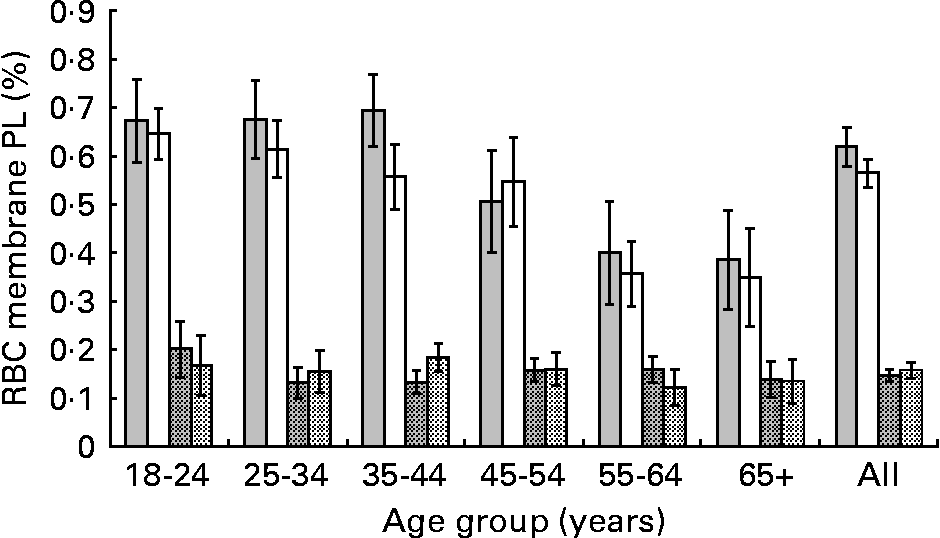
Fig. 1 reports respective levels of two individual trans-monoenes according to location and age group. In Greenland, the percentage of elaidic and vaccenic acid in RBC phospholipids did not significantly vary with age. The mean levels of elaidic and vaccenic acid were overall comparable and reached respectively 0·15 % and 0·16 %. In Nunavik, however, elaidic acid was found in higher proportions in younger age groups (0·67 % in the 18–24 year-old group v. 0·39 % in the 65 years and older group, global P < 0·0001); so did vaccenic acid (0·65 % in the 18–24 year-old group v. 0·35 % in the 65 years and older group, global P < 0·0001). The difference of elaidic and vaccenic acid levels was close to significance in Nunavik (0·62 v. 0·56 %, P = 0·05).
Average biological levels of the two most common trans-monoenes in Greenland (Disko Bay, n 524) and Nunavik (fourteen communities, n 888) Inuit according to age. Values are presented as means and 95 % CI. Plain, Nunavik; dotted, Greenland.  , Elaidic acid (trans-9-18 : 1); □, vaccenic acid (trans-11-18 : 1). RBC, erythrocyte; PL, phospholipid.
Discussion
In Greenland, the percentage of energy derived from country food is in accordance with a recent study by Deutch et al. (Reference Deutch, Dyerberg, Pedersen, Asmund, Møller and Hansen21), while in Nunavik it is consistent with a previous study conducted in eighteen Inuit communities of Canada (Northwest Territories, Nunavut and Nunatsiavut)(Reference Kuhnlein, Receveur, Soueida and Egeland2), in spite of the availability of only one 24 h dietary recall. This confirms the dietary transition shared by these two groups. The present results also corroborate the generational trend towards younger Inuit now depending more on store-bought foods than their parents, which has been linked to the change in occupational patterns from hunting/small-scale fishing to an increase in wage earning(Reference Curtis, Kvernmo and Bjerregaard22). These repeated observations call for actions to rehabilitate and recover access to country foods throughout the Arctic.
Interestingly, biological levels of TFA found in Greenlanders were low and comparable in every age group in spite of a high reliance on store-bought foods. This finding, together with the equal proportions reported for ruminant and IP-TFA, may reflect low intakes of foods that contain both types of TFA. Alternatively, the current results could be interpreted in light of the availability of good quality store-bought foods, at least as far as trans-fats are concerned. Most industrial foods sold in Greenland are actually imported from Denmark, where a maximum content of 2 g/100 g fat was imposed on IP-TFA in 2003(Reference Leth, Jensen, Mikkelsen and Bysted23). This is bound to have had a positive impact on the IP-TFA intakes of Greenland Inuit populations.
By contrast, the thrice higher TFA levels found in Nunavik indicate the consumption of TFA-rich imported foods. The distribution of exposures was comparable with those found by Sun et al. (Reference Sun, Ma, Campos, Hankinson, Manson, Stampfer, Rexrode, Willett and Hu24) and linked to an increase in the risk of CHD. Noticeably, relatively high levels of vaccenic acid were found as compared with Greenland, which could be due to differences in intakes of dairy and meat products or, as suggested by elaidic levels, to a higher consumption of products rich in commercially hydrogenated vegetable oils. Indeed, there is a considerable overlap of TFA isomers in fats of ruminant origin and commercially hydrogenated vegetable oils, with many isomers in common(Reference Pfeuffer and Schrezenmeir25). It is interesting to note that vaccenic acid was found to contribute, on average, to 43·2 % (min 14·0 %; max 71·7 %) of TFA in milk fat and also to 13·4 % (min 6·1 %; max 21·1 %) of the total TFA content of margarines(Reference Precht and Molkentin26).
In any case, Nunavik Inuit, and especially youth, still ate store-bought foods of relatively low-fat quality in 2004. Since then, mandatory labelling was introduced in 2005 in Canada. In June 2006, Health Canada's Trans Fat Task Force issued further recommendations to the Minister of Health to regulate TFA. The food supply is thus changing rapidly and some trans-fat free alternatives of typically TFA-rich food categories are already available on the market. Yet, there is some fear among Inuit representatives and their scientific partners that Northern communities could be the last to benefit from the transformation of the food supply. The Northern food distribution system is actually subject to specific constraints and IP-TFA-rich food products with a long shelf-life are likely to be found everywhere in Northern Canada as they combine ease of transportation and longer shelf-life. Moreover, snacking more closely approximates how many Inuit are socialized to eat, that is, to satisfy their own hunger according to their own biological rhythms, and Inuit people usually highly appreciate easy-to-eat products(Reference Searles27). For both reasons, Nunavik Inuit representatives took the initiative to call the Nunavik Regional Board of Health and Social Services for a ban on IP-TFA in June 2007. This seems to be a first step towards the improvement of accessibility of healthy imported foods that are not part of the traditional northern diet.
Acknowledgements
The Inuit Health in Transition Study was funded in Nunavik by the Québec Ministry of Health, Nunavik Regional Board of Health and Social Services, the Canadian Institutes for Health Research, the Northern Contaminants Program (Indian and Northern Affairs Canada) as well as the ArcticNet network. In Greenland, the project was supported by Karen Elise Jensen's Foundation, the Greenland Home Rule Government, NunaFonden, and the Medical Research Council of Denmark. The authors declare no conflict of interest.



