

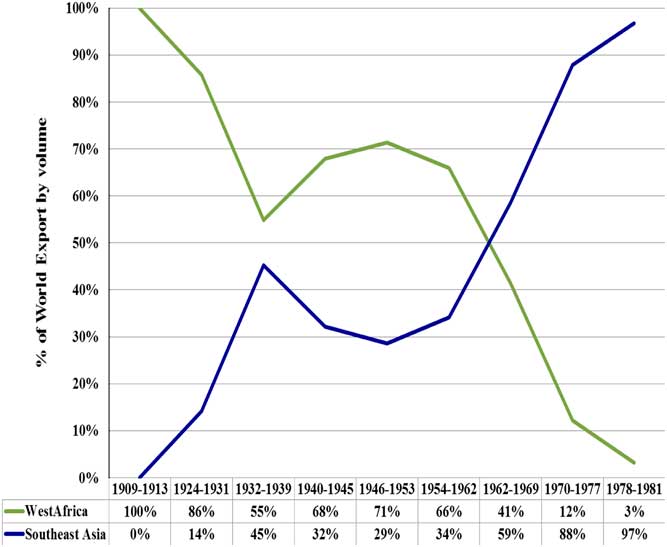
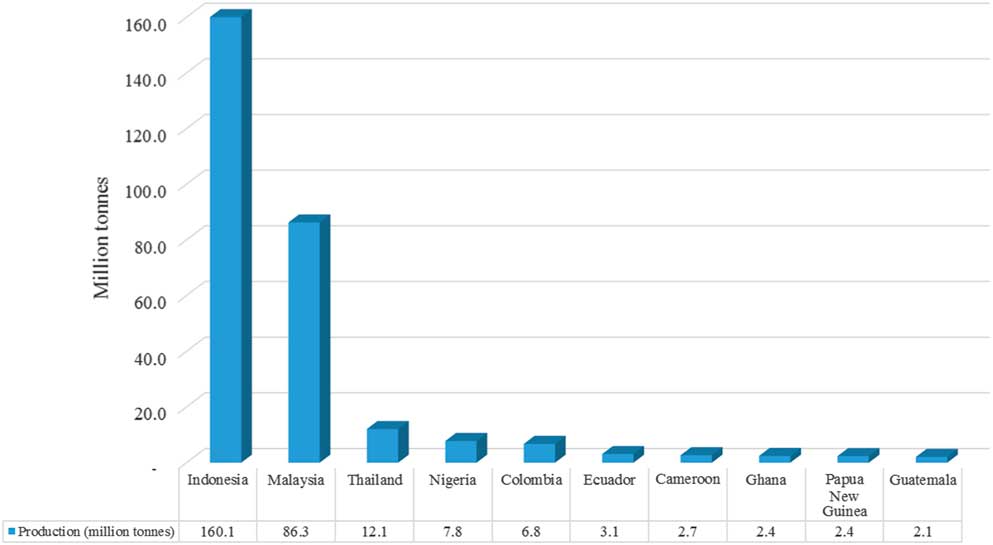
The transfer of agricultural crops across the tropics, from politically unstable locations to colonially controlled ones, has been a common strategy for foreign traders, to counter the risk attached to investing in volatile, underdeveloped territories.Footnote 1 The introduction to Southeast Asia of the rubber tree and the oil palm, from the forests of the Amazon and West Africa respectively, supported the rise of the automotive industry in the early twentieth century, and of oil-based products in the interwar period. When demand for these commodities boomed, the Southeast Asian location outcompeted both locations of origin, thanks to a more efficient organization of production and a favourable ecological environment. Unlike the Amazon, whose rubber exports quickly lost competitiveness, in the case of palm oil the two cluster locations coexisted as global suppliers for more than fifty years (see Figure 1). The dynamics of knowledge exchange and competition between these two agricultural poles explain the rise of palm oil as global commodity. From the 1970s, palm oil surfaced as one of the major vegetable oils in terms of volume, and today is primarily produced in Malaysia and Indonesia (see Figure 2).
Shares of palm oil world export by cluster (Southeast Asia and West Africa). Source: data from: P. B. Tinker and R. H. V. Corley, The oil palm, Hoboken, NJ: Wiley-Blackwell, 2016.
Ranking of palm oil-producing countries in 2016 (million tonnes). Source: FAO Statistics, http://www.fao.org/faostat/en/#rankings/countries_by_commodity (consulted 16 February 2018).
This article is situated at the intersection of global history, economic geography, and international business studies. It draws from contributions on knowledge formation and transmission in cluster studies, as well as from the literature on communities of experts (or practice), to show how the global palm oil industry developed through competition between similar clusters in colonial territories.Footnote 2 The bulk of studies on industrial agglomeration conceive of clusters as self-contained production centres, characterized by a high degree of specialization and location-specific institutions.Footnote 3 Industrial concentration facilitates knowledge transfer and positive externalities, which Marshall famously defined as ‘industrial atmosphere’.Footnote 4 However, especially when directed to export, clusters are also highly connected via a mobile community of experts, notably businessmen, scientists, and, in some cases, colonial officials.
The fact that palm oil is a fairly standardized product and that the trees grow exclusively in an equatorial climate, approximately 14 degrees of latitude around the equator, enables a comparison of the performance of its major suppliers, Africa and Southeast Asia, both organized in clusters (see Table 1 for a list of cluster institutions in the two locations). In light of this, the common phenomenon of the transfer of agricultural crops can be interpreted as clusters being replicated or ‘moving’ from one location to another, more suitable area, and competing against each other. While the existing historiography on palm oil concentrates on local dynamics, this study shows the evolution of the industry as the result of a broader interaction within different colonial and postcolonial environments.
Major cluster players in Africa and Southeast Asia during the period under study
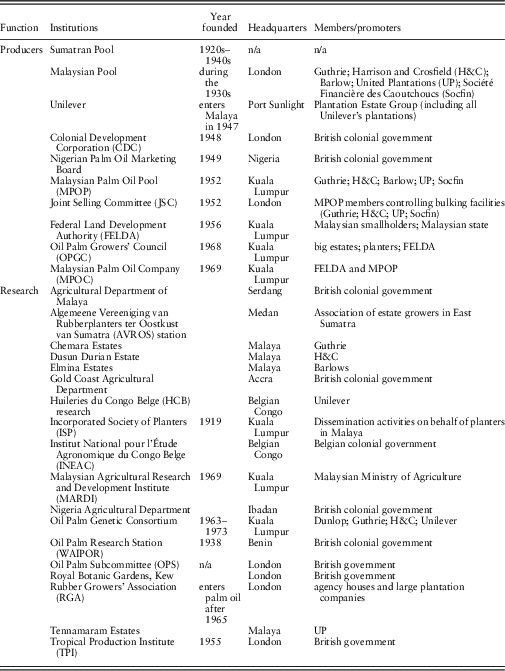
Sources: Compilation of archival material (TNA, LMA, BC, UL) and secondary sources (Tate, RGA history; Martin, UP saga; White, British business).
In this article, the dynamics of cluster competition are interpreted as the result of the relationship and knowledge exchange between communities of experts and investors in these different locations over time. The analysis is based on five major public and private archives in the UK, as well as on fieldwork material collected in Singapore and Malaysia in 2014. Part of the material concerns the primary cluster members involved in palm oil production at the time: the Harrison and Crosfield papers in the London Metropolitan Archives; the Guthrie papers in the library of SOAS, University of London; the Barlow Collection in Cambridge University Library; and the Unilever archives in Port Sunlight. In addition, public records were consulted in the Rubber Growers’ Association (RGA) and Colonial Office collections held at The National Archives of the United Kingdom, and in the London Metropolitan Archives.
The next section reviews the literature on communities of practice and knowledge creation in relation to cluster competition, and illustrates how this research contributes to the existing scholarship on the palm oil industry, clusters, and communities of experts. Sections three to six present the historical analysis in chronological order: the third section compares palm oil production in the two locations, and sets the scene in the colonial period; the fourth section studies the exchange of knowledge among the community of oil palm experts in the interwar period, when the Southeast Asian cluster emerged to threaten African leadership in palm oil exports; the fifth section describes the developments in the aftermath of the Second World War; and the sixth section examines the rise of Malaysia as the dominant palm oil exporter during the 1950s and 1960s. The last section summarizes the findings and concludes.
Communities of experts across competing clusters
The phenomenon of clustering, namely the sectorial and spatial concentration of specialized firms, is an established line of research across the social sciences.Footnote 5 Departing from Marshall’s seminal work on industrial agglomerations (or districts), Porter coined the term ‘clusters’ to define a ‘geographically proximate group of interconnected companies and associated institutions on a particular field linked by commonalities and externalities’.Footnote 6 Specifically, clusters are characterized by geographical focus (namely country, region, or climatically homogeneous area), product specialization, and supportive business environment (physical infrastructure and institutions).Footnote 7 In Porter’s view, clusters help regions and nations to foster economic growth via higher productivity, and to improve their export competitiveness.Footnote 8 The idea that industrial concentration and product specialization drive local development has been studied in different fields.Footnote 9
However, because of their emphasis on local dynamics, studies on clusters, even in historical perspective, have been repeatedly accused of underplaying the role of locations’ external links, and of being excessively ‘self-contained’ in looking at sources of economic success in these locations.Footnote 10 For instance, most literature on the history of palm oil tends to concentrate on how production clustered either in Asia or in Africa, instead of providing an overarching perspective on its global development.Footnote 11 In contrast, this article argues that studying clusters, specifically the ones centring on commodities produced in colonial territories, helps to understand how the global economy has been formed.Footnote 12 Global capitalism expanded geographically according to the logics of imperialism, with international trade flows connecting industrialized imperial powers to a system of primarily extractive clustered activities in colonial territories, providing natural resources and agricultural commodities. This system was institutionalized through the creation of stable channels of exchange, also theorized as global commodity or value chains. According to this scholarship, ‘lead firms’, often major multinationals, coordinated resources and power relations along the nodes of the chains.Footnote 13 A vast literature in the field of globalization and development studies, rooted in Wallerstein’s world systems theory, has argued that developing countries could grow by joining these chains via specialized clusters, often the product of foreign investment.Footnote 14
Similarly, research in business history and global history abundantly documented the relevance of dynamics of co-location and knowledge exchange across the world, as the result of the activity of specific actors and organization within transnational networks.Footnote 15 Charles Jones introduced the notion of a ‘cosmopolitan bourgeoisie’, ethnically heterogeneous networks of families and trading communities concentrated in a wide net of hubs (mostly port locations) for global trade, to document the social structures behind the genesis and expansion of the global economy, which underlay the British empire during the nineteenth century.Footnote 16
A further body of work concentrated on the activity of ‘communities of experts’, also called ‘epistemic communities’, ‘communities of interest’, or ‘communities of practice’.Footnote 17 These are defined as cohesive ‘groups of knowledge-driven agents linked together by a common goal, a common cognitive framework and a shared understanding of their work’.Footnote 18 They often recognize common practices, formalize their network through associations or institutions, and condense their specialist knowledge through ‘manifesto publications’. In the colonial period, these communities comprised mostly Western-educated staff of both private and public institutions. These scientists, researchers, and business people spent their formative years in the colonies, and often moved around the empire during their career. Being part of a white elite, experts, government officials, and business people experienced, de jure or de facto, racial segregation in the colonial context. As they all frequented the same places for ‘expats’, such as golf or country clubs for social gatherings, they would create durable contacts and dense transnational communities.Footnote 19
The literature widely acknowledged that communities of practice primarily operated on a local or regional scale, often connected to geographically concentrated industrial poles, such as clusters.Footnote 20 For example, Christophe Bonneuil extensively studied the collaboration between scientists in Africa.Footnote 21 His work documented the fact that scientists’ involvement often went beyond their area of expertise in companies and public institutions, as they participated in designing policy and directed administrative initiatives that shaped the development of colonial territories. Akami showed that the League of Nations encouraged the cooperation of ‘national’ public health experts across intercolonial networks, and involved them directly in processes of policy design, institution building, and policy implementation, at both regional and global levels.Footnote 22 This research shows that experts’ mobility and connectivity favoured the upgrade and exchange of knowledge within broader transnational networks. However, it does not sufficiently appreciate the fact that the increased mobility and stronger connections of these experts often translated into more options for their personal and professional development.
The palm oil story highlights how interaction within the network of businesses, experts, and colonial officials contributed to the advancement and the partial homogenization of institutions in the two clusters, but this article takes the story a step further. After considering the collaborative impact of increased linkages, mobility, and cohesion among these communities, it evaluates competitive outcomes ensuing from interaction across the two palm oil clusters. Indeed, while improving palm oil production, knowledge exchange between Africa and Asia also fostered competition between the two locations.
This analysis helps to present clusters as backbones of the expansion of global capitalism and as a legacy of colonialism. The case study shows that, rather than being simply vehicles of competitiveness, clusters historically facilitated foreign-managed extractive activities in territories with poor infrastructure. Owing to its more collaborative environment among different parties, such as foreign estate companies, government officials, research institutions, and a dynamic smallholder sector, Southeast Asia emerged as a major threat to the African industry, where the introduction of large-scale foreign estates and collaboration with local farmers were long resisted.
Elæis guineensis between Africa and Asia, 1900s–1920s
The Second Industrial Revolution fostered an increasing appetite for resources, which became a vital objective of the colonial powers’ strategic and political agendas. As a consequence, the second half of the nineteenth century saw a steep increase in the transfer of crops across oceans. Early episodes of what was later controversially named ‘biopiracy’ were the taking of tea plants and seedlings from China to India by Robert Fortune in 1852, the movement of cinchona (the source of quinine) from the Andean forests by Robert Cross and Richard Spruce in 1860, and the smuggling of Hevea brasiliensis from the Amazon by Henry Wickham in 1876.Footnote 23 These acquisitions allowed European companies, and especially British ones, to expand the cultivation of these commodities in colonial territories with similar climatic features, establishing agricultural clusters in direct competition with locations of origin.
At the end of the nineteenth century, a cluster based on large-scale estates emerged in Southeast Asia following the commercial adaptation of Hevea rubber seedlings from the Amazon.Footnote 24 This was followed by the rapid development of rubber smallholdings.Footnote 25 In less than two decades, Sumatra in the Netherland Indies, and the British-controlled Malay Peninsula, accounted for more than 50% of global rubber exports.Footnote 26 By the end of the First World War, the Asian cluster had whittled Brazil’s rubber market share down to less than 10%.Footnote 27
Several elements explain the rapid success of Southeast Asia. Attempts to domesticate the rubber crop for estate or farming agriculture in South America had failed on multiple occasions. For instance, Henry Ford infamously tried to vertically integrate his tyre production by creating estates in Brazil in the 1920s.Footnote 28 His failure was primarily due to ‘leaf blight’, a fungus attacking young Hevea trees and destroying them before they reached maturation.Footnote 29 By some miracle, the fungus was never transferred overseas, which paved the way for the rise of rubber cultivation in hospitable Southeast Asian soils and climate.Footnote 30
The major advantage of Southeast Asia was a long tradition in export agriculture of several crops such as sugar, tobacco, coffee, and rice, which meant that rubber producers could make use of the existing physical infrastructure and research institutions. Moreover, in Singapore, the regional commercial centre, a cosmopolitan business community comprising Western, Chinese, Indian, and Hadhrami Arab traders managed the inflow of finance, equipment, and contract labour, and provided producers with specialized services, such as banking, insurance, logistics, marketing, and legal consulting.Footnote 31 In the 1910s, the major Western trading houses vertically integrated into commercial estates. Meanwhile, dynamic non-Western entrepreneurs supported smallholders’ development, especially in Sumatra, to expand rubber manufacturing in Singapore.Footnote 32 In this way, the city became the major rubber processing and trading hub, linking the surrounding production areas with international markets and fostering the globalization of regional agriculture.Footnote 33
Finally, planting ventures could benefit from the presence of both public and private research institutions, such as the Singapore Botanical Gardens, the Malayan Agricultural Department, and the AVROS station in Sumatra.Footnote 34 Although large corporations benefited from government support and regulations penalizing smallholdings, colonial institutions generally adopted a laissez-faire approach towards indigenous farmers, and Dutch authorities also developed public research for smallholders over time. These facilitated the process of adaptation of wild crops to settled farming, and supported the sharing and development of agricultural knowledge. Scientific and business institutions, created to domesticate Hevea, were then repurposed for the introduction of the oil palm as an alternative to rubber.Footnote 35
When rubber prices plummeted in the 1920s, the oil palm proved a lucky diversification option, as it was biologically similar to rubber, had a large range of commercial applications, and could be grown in existing rubber estates, which at the time were suffering increased competition from more efficient smallholdings.Footnote 36 At the downstream level, palm oil products proved to be an equally valid substitute, as shipping companies could use existing bulking and shipping infrastructure for liquid products to store and transport palm oil.Footnote 37
Native to the ‘Palm Belt’ of Africa (from The Gambia to Angola), the oil palm or Elæis guineensis was a major income staple for local populations.Footnote 38 Two types of oil can be extracted from the fruit of the oil palm tree: palm oil from the pulp, which has similar uses to soybean and rapeseed oil, and palm-kernel oil from the kernel, which is a substitute for coconut oil.Footnote 39 The tapping of semi-wild oil palm groves was an integral part of the Belt’s economy and society. Oil extraction and nut collection were village activities, employing the whole family. Men harvested and transported the fruit, while women extracted the oil. Locals consumed palm oil as food or ointment, tapped sap for palm wine, used the trees’ trunk and leaves as construction materials, and burned the exterior of the kernels for fuel. In Nigeria, the oil palm had its own deity, Edjokpa, protecting locals during the extraction phase.Footnote 40
In the nineteenth century, oil palm products sourced from semi-wild groves surfaced as the major export from British West Africa, and were the main regional source of revenue after the abolition of the slave trade.Footnote 41 In Europe, palm products were initially used as industrial lubricants; later, on a larger scale, they were employed in the production of soap, candles, margarine, and cooking fats.Footnote 42
The oil palm reached the Amsterdam Botanical Gardens from Africa in the 1830s. Then the Dutch introduced the first four oil palm specimens in the Botanic Gardens in Buitzentorg (now Bogor), Java, in 1848, from seedlings held in Amsterdam and Mauritius. The first oil palm arrived in British Malaya at the Kew Gardens of Singapore in 1875, either from London seedlings via Ceylon, or from the Javanese progeny.Footnote 43 Although Elæis had reached Southeast Asia earlier than Hevea, the crop long remained relegated as a decorative element, planted in avenues.Footnote 44 This was due to the stagnating prices of vegetable oils in European markets in late nineteenth century, the prevalence of rubber and other crops in Southeast Asia, and the leadership of African locations as major palm oil exporters.Footnote 45
A Belgian agronomist and entrepreneur, Adrien Hallet, was the first to spot the potential of the oil palm as an estate crop in Asia. The founder of the Hallet Group, and later a major shareholder in the plantation company Socfin (Société Financière des Caoutchoucs), Hallet initially worked with oil palms in the Congo Free State (later Belgian Congo) from 1885.Footnote 46 Then, at the turn of the century, as a ‘rubber mania’ developed, he invested in rubber estates in Sumatra and Malaya.Footnote 47 Reckoning that oil palms would thrive in the region, Hallet launched the first oil palm estate in the Sumatran province of Deli in 1911. He also made contact with two French planters, Franck Posth and Henri Fauconnier, and supported the listing of their oil palm estate in Selangor, the first in Malaya, which started operations in 1917.Footnote 48 Taking advantage of the Dutch ‘open-door policy’ to foreign investment in Sumatra, and of the rubber institutions and infrastructure, Hallet was able to advance domestication faster in Asia, bypassing the difficulties of plantations in Africa.Footnote 49
In Southeast Asia, agricultural production had long been based on estates and efficient smallholdings oriented to export.Footnote 50 However, the palm was a stranger crop, associated with colonial influence, while the locals preferred coconut oil for cooking, and tapped different palms for alcohol and sugar.Footnote 51 Conversely, in Africa, palm oil was a major source of revenue and sustenance, and the domestic market absorbed about half of local production.Footnote 52 Foreign involvement in monocrop estates in Africa was seen as a threat to smallholdings.
As for the organization of production, African locations lagged behind in terms of labour supply and infrastructure.Footnote 53 In Southeast Asia, several public and private institutions managed a continuous inflow of migrant ‘coolies’ from India, China, and Java to work in estates.Footnote 54 Many of these workers would then disengage from estates, using their experience to start their own plots.Footnote 55 In Africa, local people associated plantation work with slave labour and sourced the oil independently from semi-wild groves, which posed a major hurdle to the private recruitment of harvesters.Footnote 56 Historically, the territory had been exploited as a reservoir of slaves, and therefore it lacked infrastructure, such as roads and railways, to transport agricultural produce in bulk, and to set up large-scale operations.Footnote 57
As a major palm oil buyer, the British soap manufacturer William Lever (later Lord Leverhulme) sought to obtain exclusive land concessions in British West Africa. From 1906, his company, Lever Brothers, started lobbying to establish estates, which in turn would support investment in local processing mills.Footnote 58 While the colonial government had been fairly supportive of foreign investment in plantation in Southeast Asia,Footnote 59 in British West Africa (especially Nigeria) scepticism towards Lord Lever’s endeavours combined with a widespread opposition to plantation schemes among colonial officials through the 1930s.Footnote 60
Despite lobbying to obtain large-scale estates, Lever Brothers was only able to secure planting concessions and processing facilities in a few scattered locations before the Second World War.Footnote 61 The company obtained the former German ’Ndian oil estate (2,300 ha) in the Cameroons as auctioned enemy property in 1924, and Sapele and Calabar oil palm estates (4,800 ha in total) were added to existing (rubber) estates in Nigeria in the early 1930s. Despite these land concessions, colonial officials remained generally wary of any plan forcing local people out ‘from their present status of free producers to that of labourers for wages’, and refused to grant purchasing monopolies over vast land tracts.Footnote 62
In 1911, Lever enjoyed better luck in the Belgian Congo, where he obtained vast concessions and launched his palm oil subsidiary, Huileries du Congo Belge (HCB).Footnote 63 Yet in this period, Congo was no less of a challenging business environment than the British colonies, as Africans were highly mobile within the concessions, tended to be hostile towards foreign investors, and were reluctant to serve consistently as plantation workers.Footnote 64 Thus, although exports steadily increased, thanks to the colonial government’s support, HCB had to rely primarily on natural palm groves, which affected profitability until the post-war period.Footnote 65 The lack of wage labour and the inadequate infrastructure also constrained Socfin’s expansion in Belgian Congo, whose operations were deemed ‘less of an asset’ compared to those in Southeast Asia.Footnote 66 The company’s subsidiary, Palmeraies Congolaises, struggled to hire a workforce for their large concessions in Upper Congo, as skilled harvesters, when available, ‘preferred to work their own crops to being employed for low wage’.Footnote 67
In contrast, in Asia, oil palm development could benefit from the synergies offered by the rubber cluster in terms of collaboration within the industry and with the government, ensuring a more fluid circulation of knowledge and sharing of best practice.Footnote 68 Further, through mechanical processing, Sumatran producers were able to obtain higher-quality oil, with a lower content of fatty acid.Footnote 69 In sum, while Southeast Asian agriculture was already organized for export, the original cluster in Africa presented structural hurdles for profitable investment in palm oil, in terms of infrastructure, labour recruitment, and government attitudes. In 1924 the major US oil buyers switched from the African oil to the higher-quality Sumatran product and by the mid 1920s British government officials in West Africa started referring to Southeast Asia’s growing palm oil exports as ‘the Eastern menace’.Footnote 70
Communities of experts and palm oil knowledge exchange, 1920s–1940s
Despite direct competition between the two clusters, during the interwar period the development of palm oil production was carried out in both locations via continuous contact and knowledge exchange among businessmen and scientists. This laid the foundations for a transnational community of palm oil experts, operating in both private and public organizations. Information travelled both ways, as Asian advances could be enriched by African knowledge on palm varieties and experience in downstream phases of the supply chain.
In the 1920s, faced with the steep erosion of West Africa’s share of palm oil exports in the world, the British colonial government started debating how to include foreign investors to promote development.Footnote 71 While supporting the introduction of mechanical presses for oil extraction, and the intensification of research, the government resisted supplementary requests to assist foreign-managed plantations.Footnote 72 The colonial strategy instead focused on initiatives to improve farmer productivity, such as the provision of improved seedlings and the partial mechanization of oil extraction.
In 1926, C. G. Auchinleck and H. B. Waters, officers of the agricultural departments of Gold Coast and Nigeria respectively, were sent to visit Sumatra, Java, and Malaya, with the explicit purpose of studying how to improve the oil palm industry. Coordination among experts across colonies facilitated easy access to information in both Malaya and the Netherland Indies. As mentioned in a dispatch to the Foreign Office from the Consul in East Sumatra: ‘Both Officers spoke highly of the courteous assistance offered to them by the Dutch Officials and the technical experts, with whom they came in contact.’Footnote 73 Moreover, in his report of the visit, Auchinleck highlighted an inclusive research environment in Southeast Asia, where knowledge circulated among scientists across Southeast Asian colonial territories.Footnote 74 Through this visit, the experts from Africa liaised with the Southeast Asian network of planters, such as the leading AVROS researchers Dr A. W. K. de Jong and Dr A. L. Rutgers, and Socfin’s chief researcher M. Ferrand.
This same kind of coordination and exchange of scientific research proved more difficult across different colonial jurisdictions in Africa. British West Africa and the Belgian Congo hosted several state-sponsored research centres such as the agricultural departments of Nigeria and the Gold Coast, the Institut National pour l’Étude Agronomique du Congo Belge (INEAC) in Mongana and Yangambi, and the local botanical gardens, which launched programs on palm progeny and seed selection from the mid 1920s. In 1927, the first West African agricultural conference took place in Ibadan.Footnote 75
However, in 1929, the Nigerian government rejected the proposal of establishing an oil palm research station, although the UK was funding agricultural research in several imperial locations.Footnote 76 Meredith considers that the scale of ‘research was modest during the 1920s and virtually non-existent in the 1930s’.Footnote 77 Agricultural departments started carrying out ‘serious research’ only in 1928, and ‘the scale of operations was negligible until 1937’.Footnote 78 Direct cooperation between scientists in British territories and in the Belgian Congo only took off in the late 1930s, when the Malayan Agricultural Department sent its oil palm botanist F. W. Toovey to visit the research facilities and organization of the industry in Belgian Congo. Meanwhile Unilever’s local arms, the United Africa Company (UAC) (created from the consolidation of Lever’s West African interest in 1929) and HCB, only started exchanging research findings in the early 1940s.Footnote 79
In the 1930s, colonial governments realized the urgency of improving native farmers’ productivity and oil quality, without imposing plantations.Footnote 80 Thus, they started linking smallholder schemes to mechanization.Footnote 81 UAC provided seeds free of charge to the colonial government, and attempted to fund replanting schemes, in the hope of obtaining further estate concessions.Footnote 82 However, attempts at introducing oil presses and quality control in villages mostly failed, because of high prices of equipment and fierce opposition from local women, who found themselves deprived of their major source of revenue and independence.Footnote 83 Similarly, the government started to push palm-planting schemes at the same time as it introduced direct taxation. Local producers saw a connection between the two, and responded with scepticism and resistance.Footnote 84 By the 1940s, large-scale estates in Nigeria still accounted for only 2.3% of exports.Footnote 85
Overall, these efforts did not automatically translate into higher yields, greater engagement of indigenous farmers, or improved exports from British West Africa compared to competitors. However, in Cameroon, the African and Eastern Trade Corporation’s estates proved successful early on, as they ‘had eyes on the Far East, and had taken up all ideas of plant breeding, improved agricultural methods and manuring’.Footnote 86
Unlike Southeast Asia, where research was constantly tested on estates and easily passed on to the private sector, in Africa there was no systematic way of implementing research upstream, or spreading it consistently among farmers. This was due to a lack of sound collaboration and communication across different cluster stakeholders, as farmers, the colonial government, and European merchants all remained suspicious of each other, having their own ideas on how to improve the industry.Footnote 87
Conversely, oil palms made great strides in the Asian cluster. Socfin, together with the agency house Guthrie and the small Danish estate company United Plantations (UP) in Malaya, employed several scientists, initially working on rubber, to pioneer research projects on oil palm seed selection and processing techniques. Moreover, they could call on the support and informal coordination of the two leading agricultural research centres, AVROS in Sumatra and the Serdang Agricultural Department in Malaya.Footnote 88 The results of this research activity were then collected, codified, and made widely available by the Incorporated Society of Planters (ISP) in Kuala Lumpur, through publications and its scientific journal, The Planter, which became the preferred outlet for the dissemination of specialized knowledge on the oil palm crop from 1923. During the 1920s, the ISP organized its first conference, inviting leading agronomists such as C. D. V. Georgi and B. Bunting, members of the Serdang team.Footnote 89 This interrelation and proximity between public and private spheres in Asia yielded a cohesive community of practice at the regional level, with strong links with London and Africa.
As a result, some of the innovations developed in Africa found quicker and more efficient application in Asia. The issue of palm progeny is illustrative in this regard. The most popular palm in Africa was the Dura variety, which typically had a large shell and a thin pericarp. Most oil palms that reached Southeast Asia were of this kind: particularly fleshy and vigorously fruitful. Early selection work in the Sumatran Deli province had produced a variety with a tender shell and a richer pulp, called ‘Deli-Dura’. Before the Second World War research stations in both Africa and Asia carried out breeding programmes to select easier-to-harvest dumpy palms, yielding fruits with larger flesh to kernel proportions, and a softer shell. In the early 1920s, AVROS ran several propagation programmes based on seeds of Tenera palms, a rarer variety with thin shell and pulpy fruit, obtained from the Eala Botanical Gardens in Congo.Footnote 90 Being a major player in both regions, Socfin could channel knowledge in both directions.Footnote 91 In his report, Auchinleck mentions that Socfin ‘has kindly undertaken to forward 200 seeds, from selected [Sumatran] bunches … for trial in the Gold Coast’ and that it imported selected seed for small-scale planting in the Ivory Coast.Footnote 92 In the 1930s, the doyens of oil palm breeding, Dr A. Beirnaert and R. Vanderweyen at the INEAC in Yangambi (Belgian Congo), ran a three-year programme on Tenera progeny, reaching the path-breaking conclusion that the variety was a cross between the popular Dura and the rare shell-less Pisifera.Footnote 93 These breakthroughs were immediately incorporated in Asia, where planters scrambled to obtain Pisifera seeds.Footnote 94 In general, despite the quality of research personnel and facilities in Africa, palm seeds ended up being sent to Asia for further selection, breeding, and most importantly testing, and only eventually came back to Africa.Footnote 95
African innovations proved very successful in Asia at other stages of the supply chain. In the 1920s, Socfin was the first to open a bulking facility for shipment to Europe in Belawan (Sumatra), introducing a tank system for palm oil storage, modelled on the one devised by Unilever for its Congo operations.Footnote 96 Headed up by Guthrie, Malaysian producers followed suit, financing a joint bulking facility in Singapore in 1932.Footnote 97
Overall, the African cluster suffered from the rise of a better organized and more price-efficient Asian cluster, in a time of fierce competition in oil markets (including whale oil) and laissez-faire attitudes in the UK.Footnote 98 In British West Africa the bulk of farmers’ production was directed to the domestic market, while the colonial administration long remained wary of foreign involvement in upstream palm oil production.Footnote 99 In Congo, when HCB shifted to nominal control by UAC in 1933, the company was developing commercial estates.Footnote 100 While by 1931 HCB’s holdings ‘were not real plantations yet’, the company could call on the large scope of action of UAC in the region and its research cooperation with the cutting edge work of the INEAC team.Footnote 101 Only in 1937, did HCB obtain the green light to develop 100,000 acres of oil palm estates before the mid 1950s.
Meanwhile, in 1936, Sumatra surpassed Nigeria in palm oil exports and, together with Malaya, came to account for half of global exports in 1939.Footnote 102 This could have marked the end of the African industry, but two elements concurred to prolong the coexistence of the two clusters. First, the Japanese occupation of Southeast Asia, and the subsequent decolonization process in Indonesia, downsized Sumatran and Malaysian capacity, if only temporarily, and reversed their recently achieved global dominance as palm oil exporters. This created renewed pressure for more efficient smallholder agriculture in Africa, to secure food provisions in Britain.Footnote 103 On the internal front, the fact that West Africa’s farmer production concentrated on kernels, while Asia specialized in oil from palm fruit, helped the location of origin to keep a foothold in international markets.Footnote 104 In this context, Unilever’s subsidiaries seized the opportunity to scale up their estate operations after four decades of substantial investment in palm oil research.Footnote 105
The uncertain fate of palm oil after the Second World War, mid 1940s–mid 1950s
The Second World War marked a watershed in the global competitive dynamics of palm oil production. Between 1941 and 1945, the Japanese army occupied both the Malay Peninsula and the Netherland Indies. They redirected much land to food production, maintaining about 44% of rubber estates under Asian management to supply their war effort.Footnote 106 In the post-war period, knowledge spread primarily through private actors and independent research stations. Asian colonial institutions lost influence, as European powers funded them less following the war. Prior to the war, colonial institutions, Western corporations, and service-oriented cities, such as Singapore and London, had coordinated the exchange of financial capital, technology, and agricultural knowledge from Africa to Southeast Asia, and vice versa.
Independently, Singapore lost ground to Malaya. This was partly due to a contraction in global trade, but also to increasing nationalism in the region. Agricultural supplies from the city’s strategic source of trading, Sumatran smallholders, also decreased, following political turmoil in Indonesia and President Sukarno’s radical economic policies.Footnote 107 In contrast, Malaya, which in 1938 had accounted for only 10% of global palm oil exports, found itself in a middle-ground position. Between 1946 and 1952, the British Ministry of Food committed to buying all palm oil supplies from its former colonies, favouring those few rubber producers that had started diversifying into palm oil before the war, grouped into the Malaysian Palm Oil Pool.Footnote 108 The Serdang Department, directed by the energetic Erik Rosenquist, launched a promising breeding programme, based on West African Tenera seeds, and distributed planting material among Rosenquist’s personal network of foreign planters. However, the outburst of civil conflict, the ‘Emergency’, made Western estates targets of guerrilla attacks up to the mid 1950s, retarding the resumption of export agriculture.
In this period, the oil palm did not have a specialized research station in Malaya. The Rubber Research Institute of Malaya could not allocate funds to research non-rubber crops, as by that time it was investing all its resources in countering the threat from synthetic rubber. Further, owing to political instability and the declining means available to the Serdang Department from the early 1950s, Rosenquist resigned to join Guthrie’s independent station in 1954.Footnote 109 Hence, Southeast Asia temporarily lost its leadership in palm oil exports, leaving room for African ‘pilot’ plantations and local farmers to catch up.
During the 1940s, Nigeria regained its primacy in palm oil export markets and its role of global pole for palm oil experts (see Figure 1). In 1938, the Oil Palm Research Station (WAIPOR) had been established in Benin to complement the work of the Nigerian Agricultural Department in Ibadan.Footnote 110 In 1949 the Nigerian Oil Palm Produce Marketing Board was established, and it granted WAIPOR continued financing through the 1950s. In 1949 WAIPOR also hosted the first oil palm conference, reuniting leading scientists and palm oil experts employed in UAC facilities and public research centres in both West Africa and Congo.Footnote 111 Of representatives from other continents, the only ones invited were B. S. Gray, a palm oil expert at Guthrie’s Chemara estates, and two Dutch researchers.
The increased productivity of smallholder agriculture and the novel government support for estates created a more cohesive environment in the African cluster. Seeing its long-time ambition finally materializing, in the early 1940s UAC launched the Pioneer Oil Mills project, donating a small processing plant to the government for the use of local farmers. Although the government expansion of UAC’s initiative led to improved oil quality, after a decade the Pioneer Mills had shown a disappointing rate of progress, representing only 5% of Nigeria’s exports in 1953.Footnote 112 Equally disappointing was the attempt by the British-sponsored Colonial Development Corporation to launch estate schemes in the Nigerian Calabar division, which in the 1950s started reporting problems of cooperation with settlers.Footnote 113
Nevertheless, between 1946 and 1957 local farmers’ palm oil production more than doubled, from 101,000 tons to 208,000 tons. This was due to improved regulatory incentives, combined with a general shift in mentalities. The Marketing Board gave maximum priority to improved oil quality.Footnote 114 Thus, in 1951 it introduced differential pricing for palm oil grades, similar to the system long in use in Asia.Footnote 115 Moreover, after the war, farmers started to see mechanization as a sign of modernization, recognizing the value of mills in producing higher-quality oil and in enhancing the welfare of the villages where they were in use.Footnote 116
In sum, between the 1940s and the mid 1950s, while West Africa regained ground as a stronghold of palm oil production, in Malaya the fate of the commodity was still uncertain. At this stage, the two locations seemed to be competing on equal terms. Despite the feeling of insecurity during the Emergency, Malaya presented a more collaborative institutional environment, stronger linkages with services, and higher yields.Footnote 117 However, the territory was still a novice in palm oil production.
In Africa, notwithstanding post-war progress, the business environment left much to be desired, especially in the eyes of investors accustomed to operating in Asia. Nonetheless, amid post-war insecurity, British companies with estates in Asia started looking for new investment opportunities in Africa. For instance, in the early 1950s, Barlow invested in rubber estates in Nigeria, but soon recognized the disadvantages of the location. In a letter to J. H. Tovey, the director of Barlow’s estates in Malaya, John Barlow compared the two locations: ‘we do not know how lucky we are in Malaya … the thing that impressed me the most was the tremendous advantages of planting in Malaya where you have good labour and excellent subordinate staff’. In contrast, he lamented that, in Nigeria:
I was disappointed to note the general lack of faith in the country. Interest rates for long-term development seem to me to be prohibitive … The territory has been promised independence in 1956 and, so far, the local politicians show no signs of being competent to accept this responsibility … The corruption and bribery which goes on throughout the country is most disturbing.Footnote 118
At the same time, the major estate companies in Malaya took steps to resume their oil palm research and their pre-war links with African institutions. Since the mid 1940s, Guthrie and UP had established informal communication with HCB in Congo.Footnote 119 In the early 1950s, Harrison and Crosfield (H&C) was the first to convert its coastal rubber estates to oil palms. In 1955, it created an independent oil palm research station at the Dusun Durian estate in Selangor, working on non-rubber crops in close contact with the experienced planter Tom Fleming, at H&C’s surviving Sumatran estates.Footnote 120
Despite the advantage achieved during the war, Africa was still a difficult environment for multinationals to operate in. Unilever had scaled up its investment in research in its African locations on all stages of planting and processing, but its long-time ambition of large-scale estates did not materialize.Footnote 121 Thus, the company opted for diversifying geographically towards Asia. In 1947, the corporation acquired 4,000 acres in Kluang, in Malaya’s Johore State, and it eventually expanded its Asian presence over the decade, adding an additional 6,000 acres, and cultivating new land in Sabah.Footnote 122
By 1960, Unilever’s oil palm estates covered 11,400 acres, around 10% of the total acreage on the Malay Peninsula, but less than 10% of its combined (semi-wild) acreage in Congo (140,000 acres) and Nigeria (34,000 acres).Footnote 123 As a point of reference, in 1957 the total acreage in Malaya was already 7,000 acres, 15% of the company’s total world acreage; in 1964 it was 12,000 acres.
In Southeast Asia, Unilever could test and improve the result of its long-standing African research and development investment, and even use it to carve out a leadership position in the still resurrecting region. As reported in the minutes from meetings of Unilever’s special committee:
Mr. de Blank [the head of research] had come away with the impression that neither the Dutch nor the British in Malaya were in advance of our research and technical practice in the Congo and Nigeria with the exception of the money being spent on fertilizing. … [W]hile this was satisfactory from one point of view it was disappointing to the extent that we had hoped to learn something from them.Footnote 124
Indeed, as John Barlow observed, UAC had been ‘very secretive’ about the condition of their estates in Nigeria, whereas, once in Asia, the company traded its know-how to establish a foothold in the region.Footnote 125 For instance, Unilever researched production and storage of palm oil in collaboration with INEAC, and made the findings of the resulting Mongana report widely available in Southeast Asia.Footnote 126 Thanks to its liaison with B. S. Gray, the corporation employed the major palm oil producer in Malaya, Guthrie, as managing agent and consultant, cooperating with the company’s Chemara research facilities. The transfer of knowledge across locations further improved after 1955, when Unilever aggregated all its agribusiness investments under the umbrella of a single organization, the Plantation Group, managed by the executive D. L. Martin.Footnote 127
Unilever and the Southeast Asian palm oil boom, 1950s–1960s
Whereas in the immediate post-war period Africa drove the development of palm oil production, after Malaysia’s independence from Britain in 1957, leadership shifted to the Asian cluster, with Malaysia emerging as the primary global producer of palm oil. Although Malaysia went through significant turbulence at the regional level in the early 1960s, the new government remained officially supportive of foreign investment.Footnote 128 Simultaneously, the political situation in Congo and Nigeria quickly deteriorated, leading to a sharp decline in estate output. Unilever’s Plantation group had been channelling knowledge and resources from Africa to Asia for more than a decade, but Malaysia’s relative political stability and stronger institutions were the key factors that led to its global dominance as palm oil exporter. By 1958, all the big rubber producers on the Malay Peninsula had realized the potential of opening up oil palm estates on a large scale in the region, and were converting their rubber acreage.Footnote 129
In 1956, the Malayan government established the Federal Land Development Authority (FELDA), a public agency linking the privately controlled estate system to the indigenous farmers. FELDA was in charge of the distribution of available land to local farmers, the subsequent development of smallholdings for different crops, and the provision of specialized services to connect them with international markets.Footnote 130 Finally, in 1959, the Colonial Development Corporation launched a pilot programme similar to the Nigerian one, cooperating with the local government for the development of oil palm smallholdings.Footnote 131 This collaboration was to favour increasing interaction between the foreign estate companies and FELDA.
The growing appeal of palm oil also triggered increased interest in the crop among leading research institutions, such as the Royal Botanic Gardens at Kew, and the Tropical Production Institute (TPI) in London, through knowledge exchange between the two cluster locations and the creation of a global forum for palm oil experts.Footnote 132 In the late 1950s the TPI established a special unit, the Oil Palm Subcommittee, carrying out comparative research on Nigerian and Malaysian estates;Footnote 133 in 1964 and 1965 it hosted the international Palm Oil Conference in London;Footnote 134 and from 1966 it sponsored the Oil Palm News, a specialized publication intended to compile all updates on the crop and make them available to the international community of practice.
Furthermore, the increasing competitiveness of palm oil against other vegetable oils pushed cluster companies to cooperate towards improving its quality. As reported in the minutes of the special committee of the Unilever Plantation Executive in 1958:
owing to the length of time taken in plantation development for theories to be tested and knowledge to be gained, it could only be to the advantage of all concerned for a close relationship to be fostered and the results of research to be made mutually available. He [Mr. de Blank] suggested that it might be worthwhile to have some central direction for research programmes into oil palm development. Mr. Martin said that he had had some such thought in mind for some time, and it might be possible for the members of Rubber Research Institute to extend their activities to include oil palms.Footnote 135
Initially, experts from Unilever had worked with Guthrie’s researchers on pollination techniques, importing the rare Pisifera pollen from Africa to produce Teneras, while depending on the agency house for brokering services, and research on fertilizers.Footnote 136 As the 1960s approached, keen to expand its acreage in Asia, Unilever hired an increasing number of engineers with experience of Africa to carry out multiple collaborative projects. It also started negotiating with the Malaysian government the terms of its collaboration with FELDA, for the development of oil palm smallholdings.
At the same time, Unilever’s representatives were exchanging information with Dunlop, H&C, and the Rubber Research Institute.Footnote 137 In 1962, the Plantation Executive instigated the formation of the Oil Palm Genetic Consortium, a joint initiative funded together with Guthrie, H&C, and Dunlop to improve the Malaysian planting material. In 1963, the Consortium created the Oil Palm Genetic Laboratory.Footnote 138 The project was under the direction of the geneticist J. J. Hardon, who reached Malaysia in 1964 after an extensive tour of Unilever’s African operations.Footnote 139 In 1963 the various findings were supplemented by the Belgian scientist A. Wolversperges’ article in The Planter on the application of expeller presses to the process of palm oil extraction.Footnote 140 This led to the diffusion of the new technology across all Asian estates during the 1960s.Footnote 141
Unilever’s engagement in Asia grew as political stability in Malaysia improved relative to African locations, where independence was generally accompanied by a rapid deterioration in local business conditions. In 1960, after very poor performance for several years, the estates in the former Gold Coast (Ghana) were substituted by a new acquisition in the Borneo province of Sabah.Footnote 142 In the same year, the Congo venture started reporting losses, as independence was followed by instability and a civil conflict, until General Mobutu seized power through a military coup in 1965, posing further challenges to economic activity.Footnote 143
In Nigeria, major public investment in plantations during the transition to independence, in the early 1960s, failed to produce the expected increase in employment.Footnote 144 Thus, palm oil never achieved the status of scalable entrepreneurial activity, nor the reputation. In fact, locals associated oil production with poor living conditions in villages, while the new generation expected their children to accomplish more than tapping banga (palm fruit).Footnote 145 This was further aggravated by the eruption of the Biafran secession war in 1967, leading to an almost 80% drop in palm oil production. By that time, Malaysia had achieved global leadership in palm oil production and export.Footnote 146
Despite the sudden African downturn, the shift of leadership from Africa to Asia occurred through a gradual migration of palm oil experts to Asia, and a changed influence of the institutions connecting the two clusters. The TPI in London is a good example of how knowledge formation progressively shifted towards Asia, often transitioning through the UK. In 1963, C. W. S. Hartley, the editor of Oil Palm News and a major authority in palm oil studies, returned as senior researcher at the Malayan Agricultural Department, where he had spent his early career in the 1930s, working with Rosenquist.Footnote 147 During the war, he had moved to West Africa, and had been the director of the WAIOPR in Nigeria for around a decade.Footnote 148
In 1959, the Oil Palm Subcommittee gathered together all the key oil palm researchers of the time: Dr J. A. Cornelius, W. D. Raymond from TPI, T. A. Russel from Kew Gardens, Dr P. B. H. Tinker from WAIOPR, and Martin and De Blank from Unilever.Footnote 149 From 1966, the committee, now called the Oil Palm Bureau, featured the same members from Unilever and TPI, but also included Hartley and, on the insistence of Martin, one representative from the association of the major plantation companies in Southeast Asia, the RGA, as well as one scientist from the Malaysian cluster on a rotational basis.Footnote 150 These same people, together with experts who had been employed for the long term in Asia, such as (now) H&C’s B. S. Gray and Chemara’s R. A. Bull, are acknowledged in the preface of the first edition of Hartley’s influential publication The oil palm, resembling a directory of the community of practice specializing in the crop.Footnote 151
Hence, with the emergence of Malaysia as the leading palm oil producer, institutions such as the RGA and the ISP, traditionally associated with the Malaysian rubber cluster, readjusted their focus on the new crop, and contributed to advance the knowledge on the oil palm. In 1966, the RGA extended its focus to crops other than rubber, and in 1967 and 1968 the ISP hosted the Malaysian Palm Oil Conference in Kuala Lumpur.Footnote 152 In 1968, the Malaysian prime minister announced the creation of the Malaysian Agricultural Research and Development Institute (MARDI) to integrate the work of the TPI with local research and to support FELDA’s oil palm acreage extension.Footnote 153 Through these measures, and by hiring engineers and scientists previously employed in West Africa, the Malaysian cluster companies were able to catalyse the process of knowledge generation from Africa to Southeast Asia, de facto sealing their dominance over the location of origin.
Whereas in Africa the public sector had struggled to disseminate research among local farmers, the Malaysian government played a crucial role in using the cluster and the experts within it to expand the smallholding sector and to foster local development. By the end of the 1960s, FELDA had facilitated the integration of smallholders into the cluster organization.Footnote 154 By involving the private sector in designing a model for oil palm schemes, the government had buttressed the gradual transformation of FELDA into an agribusiness corporation in its own right.Footnote 155
Unlike in Africa, where Unilever had long lobbied for establishing large-scale monocrop estates, in Malaysia a whole organization, preceding the entrance of the multinational, was in place to absorb and refine any fresh piece of information into both estates and small holdings. Hence, cluster companies and institutions were able to exploit the cooperation with Unilever to apply the existing rubber infrastructure to the needs of the new oil palm crop. From the mid 1960s this cooperation accrued further significance for the old British plantation houses such as Guthrie and H&C. Teaming up on research and smallholding schemes strengthened their position with respect to the government, as they started feeling the threat of acquisition from rising ethnic Chinese companies.Footnote 156
As for the public sector, the Malaysian government proved more effective than its African counterparts. Instead of obstructing foreign investment in estate development, it concentrated on creating incentives for foreign incumbents to cooperate with FELDA, such as granting new land contingent upon private-sector participation in joint smallholding schemes.Footnote 157 For example, H&C’s and Guthrie’s palm oil experts, B. S. Gray and P. T. Gunton, sat as advisors on the agency’s board. Similarly, several estate companies ran regular training courses for FELDA staff.Footnote 158
Conclusion
In sum, Southeast Asia emerged as a major palm oil exporter after 1955 thanks to its stronger public–private cooperation and its ability to attract the community of experts working on palm oil. However, the African cluster managed to maintain its leadership for almost fifty years after the oil palm was first domesticated in Asia. Political conditions and social trends in the context of decolonization ultimately affected the competition between the two clusters.
While historiography on palm oil has focused primarily on the local industries of Africa and Asia, this analysis shows how the industry advanced through a constant interplay of collaboration and rivalry between the two major producing regions. Foreign multinationals and communities of experts mediated the process of knowledge transfer between the two cluster locations, in the context of colonialism. Figure 1 offers an overview of the described competitive positions of the two palm oil locations, based on their relative export account, during the period under study. The two clusters coexisted for more than fifty years, until Southeast Asia reached a dominant share of global exports from the mid 1960s onwards. In 2016, Malaysia and Indonesia accounted for more than 80% of global exports (see Figure 2).
In terms of Porter’s definition, both Southeast Asia (specifically, the Malay Peninsula, Sumatra, and Borneo), and the African Palm Oil Belt qualified as clusters. They were both circumscribed regions, presenting soil and climatic features suitable for the cultivation of the oil palm; palm oil was a major source of revenue in both territories during the period; and both presented specialized institutions facilitating research and commercialization of the crop (see Table 1).
However, these two clusters differed in terms of organization of production and internal cohesion. In Africa, palm oil production was a common village activity, which had been adapted for export. In Southeast Asia the existing rubber system, based on estates and smallholders, was repurposed to grow oil palms, initially on estates under foreign ownership, and later including smallholders. In Africa, within each colony, different interest groups long remained suspicious of each other. For example, in Nigeria, colonial officials feared the quasi-monopolistic position of UAC, and the potential social backlash from introducing foreign-managed estates. Cooperation among different colonial jurisdictions (British and Belgian) remained limited. Conversely, ownership was more fragmented in Southeast Asia and colonial governments were more supportive of foreign involvement in agriculture, while still adopting a laissez-faire approach towards local rubber smallholders. The geography of maritime Southeast Asia, and the presence of a major service hub in Singapore, facilitated the cluster’s regional cohesiveness. As a result, knowledge and information flowed freely between Malaya and the Dutch East Indies, creating a strong ‘co-operative spirit’.Footnote 159
In line with the scholarship on communities of experts, palm oil production became more efficient through linkages between scientists and professionals. These engineers, botanists, agronomists, and so forth created close networks with hybrid figures, such as government officials, entrepreneurs, and executives. They constituted a transnational community between British West Africa, the Belgian Congo, and Southeast Asia. Further, they shared information and practices, and transferred specialized knowledge scattered across the two clusters, via a series of recurrent and durable institutions, constituting the cluster’s ecosystem, such as botanical gardens, public research stations, international conferences and exhibitions, and international magazines and journals (see Table 1).
After stressing the benefits of experts’ cooperation across locations, the article has explored the less well researched theme of competitive outcomes, resulting from the presence of a transnational community of practice. Indeed, the same distant interactions that enabled knowledge exchange also produced increased rivalry between the two clusters. Competition unfolded through migration within the community of practice, as resources and talent gradually shifted from Africa to Southeast Asia in the post-war period. This article has illustrated that rising competition from the more extractive Southeast Asian cluster increased the pressures on African locations to adapt their institutions to the Asian model. Local farmers were under pressure to reorganize their production to abide by the rules of globalization, although the extent of change remained relatively small.
In the context of developing economies, individual and corporate decisions on where to locate depended on the depth of the network, the quality of the business environment, and relative political stability. The last proved particularly important during the whole period. In the case of palm oil, the Netherland Indies had emerged as the global palm oil leader in less than two decades prior to the Second World War, seriously threatening African producers. Yet, sudden military and political crises in Southeast Asia favoured renewed investment in Africa, despite its less efficient organization. Similarly, the difficulties experienced by African locations after independence must be factored in when evaluating the success of the Malaysian palm oil cluster during the 1960s.
Finally, looking at the development of palm oil across its two producing poles sheds light on the role of commodity clusters as constitutive elements in the expansion of global capitalism, and not only as ways to organize production more effectively at the local level. In the context of colonialism, clustering facilitated resource extraction by multinationals, limiting the need to invest in infrastructure and easing the mobilization of resources in case of political turmoil.
Valeria Giacomin was Newcomen Fellow for the year 2017–2018 at Harvard Business School. Her research focuses on business history in emerging markets and on the history of clusters, global cities, and global commodity chains.



