


Introduction
Sea turtles play a crucial role in maintaining marine ecosystem structure and function (Mazaris et al., Reference Mazaris, Schofield, Gkazinou, Almpanidou and Hays2017), their extensive migratory routes facilitate energy transfer between marine systems (Bouchard and Bjorndal, Reference Bouchard and Bjorndal2000). Therefore, the global decline in sea turtle populations poses a threat to numerous marine and coastal ecosystems (Bjorndal and Jackson, Reference Bjorndal and Jackson2002). Human activities have significantly contributed to this decline, with primary threats including ghost fishing and marine pollution (Ferreira et al., Reference Ferreira, Martins, Bolten, Santos and Erzini2011; Mazaris et al., Reference Mazaris, Schofield, Gkazinou, Almpanidou and Hays2017; Cantor et al., Reference Cantor, Barreto, Taufer, Giffoni, Castilho, Maranho and Domit2020). Ghost fishing involves entanglement in longline fishers' lines or nets, drifting in high-sea areas, or getting caught in coastal trawler nets. Marine pollution poses another significant hazard, with threats such as ingestion and entanglement of plastic debris (Nelms et al., Reference Nelms, Duncan, Broderick, Galloway, Godfrey, Hamann, Lindeque and Godley2016; Nicolau et al., Reference Nicolau, Marçalo, Ferreira, Sá, Vingada and Eira2016; Panagopoulou et al., Reference Panagopoulou, Meletis, Margaritoulis and Spotila2017; Pham et al., Reference Pham, Rodríguez, Dauphin, Carriço, Frias, Vandeperre, Otero, Santor, Martins, Bolten and Bjorndal2017). These threats impact all life stages of sea turtles, with juveniles particularly vulnerable due to their tendency to spend most of their time in high-use areas that coincide with commercial fisheries (Peckham et al., Reference Peckham, Diaz, Walli, Ruiz, Crowder and Nichols2007). Consequently, all sea turtle species are listed on the Red List of the World Conservation Union (GETM-IUCN, 2020). In North Atlantic waters, where Tenerife Island (Canary Islands, Spain) is located and this study places, five species of sea turtles either inhabit or transit through the area: Green (Chelonia mydas) (Linnaeus, 1758), Hawksbill (Eretmochelys imbricata) (Linnaeus, 1766), Leatherback (Dermochelys coriacea) (Vandelli, 1761), Olive Ridley (Lepidochelys olivacea) (Escholtz, 1829), and Loggerhead (Caretta caretta) (Linnaeus, 1758) (Lutz et al., Reference Lutz, Musick and Wyneken2002).
Benefits of utilizing stranded sea turtle data in North Atlantic waters
Studies have shown that sea turtle hatchlings depart from nesting areas along the southeastern coast of the United States and follow the current system in the North Atlantic. They pass through the Azores, Madeira, and the Canary Islands, before returning to the American coast once they reach sexual maturity (Lutz et al., Reference Lutz, Musick and Wyneken2002). Consequently, the Canary Islands serve as a foraging area primarily for juvenile sea turtles (Musick, Reference Musick, Lutz and Musick2013). Despite these previous studies, there is still limited information available on the spatial–temporal distribution of juvenile sea turtles in the eastern Atlantic Ocean.
Since the 1990s, the wildlife recovery centre of La Tahonilla Centre (CRFS La Tahonilla) in Tenerife has been diligently recording the number of stranded sea turtles, both alive and deceased. The primary objective of this centre is to care for stranded sea turtles with the ultimate goal of releasing them back into the sea. Research conducted in other regions underscores the importance of quantifying the impact of human activities on these endangered species. Such quantification provides valuable insights for developing management strategies aimed at mitigating adverse impacts. Therefore, stranding events and local knowledge serve as crucial resources for inferring critical aspects of sea turtle ecology in the Canary Islands, providing essential information regarding regional occurrence, health status, mortality rates, and potential threats to conservation efforts (Peckham et al., Reference Peckham, Maldonado-Diaz, Koch, Mancini, Gaos, Tinker and Nichols2008; Casale et al., Reference Casale, Affronte, Insacco, Freggi, Vallini, Pino d'Astore, Basso, Paolillo, Abbate and Argano2010; Schuyler et al., Reference Schuyler, Hardesty, Wilcox and Townsend2014; Kühn et al., Reference Kühn, Bravo Rebolledo, Van Franeker, Bergmann, Gutow and Klages2015; Sönmez, Reference Sönmez2018; Cantor et al., Reference Cantor, Barreto, Taufer, Giffoni, Castilho, Maranho and Domit2020; Himpson et al., Reference Himpson, Dixon and Le Berre2023).
Interactions between fishing activities and sea turtle populations
The commercial fishing fleet on Tenerife Island consists mainly of small-scale fishing boats under 12 m, using artisanal methods such as harpoons, small longlines, and traps. The main target species include both demersal and pelagic species (Pascual-Fernández et al., Reference Pascual-Fernández, De la Cruz-Modino, Chuenpagdee and Jentoft2018). Sea turtles are not intentionally caught as they are not target species and exists strict regulations (Council Directive 92/43/EEC and Law 42/2007 on Natural Heritage and Biodiversity). The fishing grounds are located close to the coast, approximately 1 mile away, and small-scale fishers return to the port daily. Ten cofradías or fishers' guilds regulate fishing activities in their respective coastal areas of influence jointly the Canarian Government (Bavinck et al., Reference Bavinck, Jentoft, Pascual-Fernández and Marciniak2015).
In addition, fleets from the Mediterranean Sea and other Atlantic ports temporarily fish in these waters. These fleets use surface longlines more extensively in their fishing operations. Previous studies in the western Mediterranean Sea by Valeiras and Camiñas (Reference Valeiras and Camiñas2001) demonstrated that the Spanish surface long-liner fleet, which targets swordfish (Xiphias gladius), accidentally catches at least two sea turtle species: C. caretta and D. coriacea (Valeiras and Camiñas, Reference Valeiras and Camiñas2001). Furthermore, studies conducted on the neighbouring archipelagos of Madeira and Azores (Portugal) highlighted that longline fisheries can accidentally capture sea turtles (Dellinger and Encarnaçao, Reference Dellinger, Encarnaçâo, Kalb and Wibbels2000). The impact of the Azores swordfish on sea turtle populations has also been examined (Ferreira et al., Reference Ferreira, Martins, Bolten, Santos and Erzini2011). However, there is currently a lack of studies monitoring the actions of these external fleets and the impacts of longline fishing on sea turtles have been carried out in the Canary archipelago, resulting in the absence of both ghost fishing and bycatch statistics for this region.
Based on the information provided, the main objective of this study was to compile and analyse sea turtle stranding data in Tenerife from 1998 to 2021 to understand the frequency, spatial distribution, and potential causes of strandings. Additionally, we investigated sea turtle interactions with commercial fisheries and local fishers' perceptions. By combining scientific data with local knowledge, we aimed to enhance our understanding of sea turtle ecology in Tenerife (Gilman et al., Reference Gilman, Gearhart, Price, Eckert, Milliken, Wang, Swimmer, Shiode, Abe, Peckham, Chaloupka, Hall and Mangel2010; Panagopoulou et al., Reference Panagopoulou, Meletis, Margaritoulis and Spotila2017; Acuña-Marrero et al., Reference Acuña-Marrero, De la Cruz-Modino, Smith, Salinas-de-León, Pawley and Anderson2018; Early-Capistrán et al., Reference Early-Capistrán, Sáenz-Arroyo, Cardoso-Mohedano, Garibay-Melo, Peckham and Koch2018; Pascual-Fernández et al., Reference Pascual-Fernández, De la Cruz-Modino, Chuenpagdee and Jentoft2018).
Material and methods
This study combines quantitative and qualitative methods, integrating data on sea turtle strandings in Tenerife with interviews of small-scale fishers. During the first stage of the study, we analysed 1875 sea turtle strandings recorded by the CRFS La Tahonilla. In the second stage we conducted structured face-to-face interviews with 76 small-scale fishers (n = 76) and open-ended interviews (n = 4) with key stakeholders, such as official fishing managers, fishing store managers, and the only semi-industrial fishing boat with a homeport on the island.
Study area
The island of Tenerife is situated in the northeast of the Atlantic Ocean, and is approximately 100–450 km off the northwest coast of Africa (Figure 1). Its geographical position, running perpendicular to the African coast, creates an obstruction for marine and atmospheric current circulation. Moreover, the archipelago lies in the path of the Canary Current, which is a unique and ecologically significant ecosystem known for its rich marine biodiversity. The general circulation that affects the Macaronesia Archipelagos is known as the ‘North Atlantic subtropical gyre,’ the southern branch of the Gulf Stream (Valdés and Déniz-González, Reference Valdés and Déniz-González2015). These factors, along with trade winds, volcanic origins, and exceptional oceanographic characteristics, create diverse habitats for various marine autochthonous and migrant species, including sea turtles (Santos et al., Reference Santos, Hawkins, Monteiro, Alves and Isidro1995).
Map of the study area; Macaronesia region (A) formed by the Canary archipelago (B) and the archipelagos of the Azores, Madeira, Salvajes, and Cape Verde. Tenerife Island with the ten small-scale fishing cofradías marked with blue dots and the CRFS La Tahonilla with green.

Tenerife is the archipelago's largest island (2034 km2 and up to 3718 m asl). The majority of the population is concentrated along the coast. The southern part of Tenerife has become a major tourist hub, with numerous resorts and various activities attracting visitors (Morales and Pérez, Reference Morales and Pérez2000). Despite the increased human presence and development, sea turtles are frequently observed in these areas. In particular, C. caretta lives in open seas in temperate areas and feeds on different crustaceans and invertebrates, and C. mydas lives in seagrass beds, such as Cymodocea nodosa (Brito, Reference Brito1999).
Historical database review and analyses performed
CRFS La Tahonilla provided us with a database of live and dead sea turtle strandings, which was compiled over a period of 23 years, from January 1998 to February 2021. This comprehensive record includes turtles found stranded alive with some injuries and those found stranded deceased, totaling 1875 registered cases along the coast or near harbours in the open sea. These stranding events were reported to public authorities, police forces, and various entities, such as diving clubs, sports clubs, and fishers' associations, by concerned citizens, who found them floating adrift and/or with problems. CRFS La Tahonilla, operating year-round, collected these animals at the location of contact. Initial assessments involved visual observations and biometric data collection, followed by thorough check-ups by veterinarians upon arrival at the centre. In cases where the turtles were found deceased, necropsies were performed to identify the cause of death. The objects that arrived with the stranded turtle (e.g., hooks, nets, plastic) were stored and then analysed.
The final database was created using the information provided by the citizens and businesses of the sea. Therefore, the database is based on the number of users reporting sea turtle strandings at each location and time, which may vary depending on the time of year and the accessibility of the different locations on the island. To address potential biases, each stranding record was subjected to a meticulous review of inconsistencies and missing data. Records lacking information on stranding causes were excluded, resulting in a reliable database of 965 sea turtle strandings, comprising 51.47% of the total records. This new database includes 16 variables: the registration number, municipality, and local place where the turtle was stranded, the collection date of the turtle, the season, species, and common name. It also includes straight carapace length (SCL), curved carapace length (CCL), weight (W), stranding principal and secondary cause, initial conditions in which the turtle was found (alive or dead), whether the turtle was released or not after its entry, whether it died or not, its final outcome (released, dead, killed, or euthanized), and the original circumstance at the time of collection. It was published in the Mendeley data repository in open access (Hurtado-Pampín et al., Reference Hurtado-Pampín, De la Cruz-Modino and Hernández2022) and used to conduct the retrospective analysis.
Primary stranding causes were classified into seven categories: fishing gear, plastics (ingestion or entanglement), trauma, infectious disease, crude oil, other causes (such as bites by other animals and wounds), and undetermined causes. Within the fishing gear category, six sub-causes were identified: hooks, nets, lines or nylon materials, fish and shrimp traps, fish traps for morays, and harpoons. The determination of stranding causes relied on anthropogenic materials associated with the turtles upon stranding and veterinary examinations conducted at CRFS La Tahonilla. These veterinary assessments involved microchip scanning, injury detection, X-ray, ultrasounds, fungal detection using Wood's lamp, buoyancy observation, and food response testing. Finally, accurate biometric data were taken and all of the individuals underwent at least 48 h of observation. The extracted nets and hooks were meticulously studied, photographed, and measured to classify them according to typical fishery usage. Additionally, the level of oxidation was analysed based on the surface percentage.
A descriptive analysis was initially carried out to obtain an overview of the data, followed by an analysis of variance (ANOVA) to examine in turtle strandings across different years. Additionally, a generalized linear model (GLM) using the gamma family and a logarithmic link function was employed to explore the temporal trend in sea turtle stranding frequencies from 1999 to 2020, adhering to the DHARMA assumption (Hartig, Reference Hartig2022). Out of the four species recorded (C. caretta, C. myda, E. imbricata, and D. coriacea), with detailed descriptive analyses conducted specifically for C. caretta and C. mydas, due to their higher stranding records. Seasonal and geographical analyses were performed for these two species to determine when the specimens were collected and in which areas of the island. Additionally, the study aimed to estimate the life cycle stage of specimens (Yearling, Small Juvenile, Large Juvenile or Sub/Adult) by employing the straight carapace length (SCL) method to determine the size range at which they were collected, considering subadult/adult stage as sexually mature (Mansfield et al., Reference Mansfield, Wyneken and Luo2021).
Small-scale fishers' perceptions of interactions with sea turtles and data analysis
Qualitative interviews, conducted from March to June 2021, aimed to understand fishers' perceptions about sea turtle population status in Tenerife and fisheries' interactions, including strandings (Panagopoulou et al., Reference Panagopoulou, Meletis, Margaritoulis and Spotila2017; Early-Capistrán et al., Reference Early-Capistrán, Sáenz-Arroyo, Cardoso-Mohedano, Garibay-Melo, Peckham and Koch2018). At the beginning of the interview, informed consent was obtained from all interviewees, and the characteristics of the study were explained. The questionnaire did not include personal questions; it focused on fishing gear employed and other aspect related to the fishing journey. Data obtained remains confidential, following the University protection data protocol policy, with computer files stored in the workspace under institutional access (Appendix A).
The interviews with the fishers were carried out employing a snowball sampling method, which involved expanding the network of interviews through referrals from initial interviewees (Babbie, Reference Babbie2013). Random sampling was not feasible due to difficulties in accessing this specific group of fishers and their relatively small population size. Therefore, initially, we visited the ten cofradías and the two largest producers' cooperatives on the island to gather crucial information concerning their primary fisheries, fishing territories, and fleet characteristics, and to identify the fishermen who would serve as our primary informants.
A semi-structured questionnaire (Appendix A) was designed to quantify fishers' knowledge (Mancini and Koch, Reference Mancini and Koch2009). Most interviews were conducted at fishing harbours face-to-face. However, some questionnaires were self-completed online due to COVID-related restrictions that persisted during 2021. The questionnaire included open-ended (qualitative) and closed-ended (quantitative) questions and was divided into sections. The first section aimed to characterize the fishing activity, including fishing areas and the fishing gears. The second section contained questions about encounters with sea turtles (alive, dead, and stranded). The third section focused on encounters with stranded sea turtles. Finally, different questions were asked regarding fishers' knowledge of sea turtle conservation on the island. To analyse responses to open-ended questions, we coded the responses, and any additional qualitative comments provided were grouped into themes (Panagopoulou et al., Reference Panagopoulou, Meletis, Margaritoulis and Spotila2017).
A first exploratory analysis was performed with Microsoft Excel 2007, followed by statistical analyses using the package PRIMER v7 (Clarke and Gorley, Reference Clarke and Gorley2006). Multivariate analysis of variance (Permutational ANOVA) was used to analyse data from questionnaire-based surveys of public attitudes (Anderson et al., Reference Anderson2001). A two-way design was used, considering the fixed factor ‘Fishing gear’ with four levels (Hooks, fish and shrimp traps, traps for moray eels, and nets). It was, secondly, considering the fixed factor ‘Season’ with four levels: Winter (January–March), Spring (April–June), Summer (July–September), and Autumn (October–December). The Monte Carlo test was used due to a few possible permutations. The variable used was ‘frequency of sea turtle encounters’.
Additionally, regarding the nets and hooks found with the stranded sea turtles an effort was made to identify their origin. Specifically, for the hooks we consulted different sport fishing shops and professional longline fishers working in Canary waters to estimate the provenance of hooks and fishing gear, depending on the form and size of the hook (Appendix B).
Results
Analysis of the database
After analysing a dataset of 965 cases of stranded sea turtles that arrived at CRFS La Tahonilla, we detected that the highest number of strandings involved C. caretta and C. mydas. C. caretta had more records (n = 924; 95,75%) than C. mydas (n = 39;4%). There was only one record of a D. coriacea stranding. In this case, the sea turtle was enmeshed in the holes of a fish trap. Fortunately, this sea turtle was released alive. Likewise, for the E. imbricata, there was only one stranding record, which occurred when the sea turtle entered the harbour by itself and was successfully released (Figure 2).
Annual stranding cases recorded by CRFS La Tahonilla from 1999 to March 2021.

The analyses show no statistically significant differences in the number of strandings across the evaluated years (P-value = 0.444). Additionally, the GLM analysis found no meaningful impact of the ‘year’ variable on the recorded number of turtles strandings (Estimate = −0.009, P-value = 0.438). This suggests a lack of connection between ‘year’ and the number of strandings observed (Figure 2).
In the island's southeastern part, the highest number of strandings was observed in Adeje, where 37% of the total recorded strandings were collected (Figure 3). The descriptive seasonal analysis for C. caretta and C. mydas highlighted that summer was the season with most sea turtle strandings, consistent over all studied years.
Heatmap of the distribution of sea turtle stranding in the municipalities of Tenerife. Tenerife Island with the 10 cofradías marked with blue dots, the CRFS La Tahonilla with green and the percentage of sea turtle strandings marked on a red heat scale indicating the locations where there are more strandings with darker shades.

Of the seven categories into which strandings were classified, interaction with fishing gear was the main cause, showing the highest percentages (390/914; 43% for C. caretta and 19/39; 49% for C. mydas). The other causes were less common, with the second leading cause being disease for C. caretta (240/390; 26%) and trauma for C. mydas (16/39; 41%). Additionally, plastic pollution is a significant cause of strandings for these animals, with one of the main issues being plastic mesh sacks used in local agriculture. Other classifications of stranding causes were less common (Figure 4) (Appendix C).
Percentages of main causes of strandings from 1999 to March 2021. The left analysis was conducted for C. caretta and the right for C. mydas.

Studying the fishing gear that CRFS La Tahonilla had stored from stranded sea turtle cases, most of them corresponded to drifting fishing gear and not accidental captures. Most cases of stranding due to this cause involved the sub-causes nets (70%) and hooks (30%). For C. caretta, highlighting that all hooks corresponded to the additional presence of fishing line. Nevertheless, for C. mydas, the secondary cause was hooking (74%), with a higher incidence compared to nets, which had a lower incidence (11%). It should be clarified that not all nets and hooks observed in stranded sea turtles were stored and analysed: exclusively a total of 30 nets and 31 hooks were analysed in a representative way. Also, most of the analysed hooks belonged to surface longlines (17/31; 58.62%). Hooks from bottom longlines accounted for only (3/31; 10.34%) of the analysed hooks. Furthermore, 77.42% of them had a high degree of oxidation, meaning that 50% or more of the hook surface was covered by rust. This indicates that they probably also were hooks on which the sea turtle was caught but had been travelling with them for some time or hooks that broke off and were left adrift in the waters until the sea turtle got hooked (Figure 5) (Appendix B).
Classification of hooks taken from stranded sea turtles at CRFS La Tahonilla.

The descriptive analysis conducted on sea turtle biometric data revealed that, for C. caretta, the individuals collected measured between 20 and 60 cm in SCL, with an average was 36.8 cm. For C. mydas, individuals measured between 30 and 70 cm, averaging 52.14 cm.
A descriptive analysis of sea turtle rehabilitated at CRFS La Tahonilla showed that more than 70% of the sea turtles of both species were rehabilitated and were released into their natural environment. Specifically, for C. carreta 776 individuals were rehabilitated (776/924; 84%), 15% died at the CRFS La Tahonilla, and 8% arrived dead. While for C. mydas 37 individuals were rehabilitated (37/39; 95%), 23% arrived dead, and only 5% died at the CRFS La Tahonilla. Regarding these findings, it should be considered that this monitoring of strandings has been carried out through the citizen reporting, so there exists a potential bias towards reporting live stranded animals rather than those found in a decomposed state. This bias could influence the data collected and should be taken into consideration when interpreting the results. Additionally, we studied the causes of death of these sea turtles. The principal cause of mortality of C. caretta was interaction with fishing gear (40%, n = 86), followed by disease (30%, n = 65) and trauma (14%, n = 30). By contrast, for C. mydas, the main cause of mortality was trauma (73%, n = 8), followed by the interaction with fishing gear (18%, n = 2) and disease (9%, n = 1). These three causes: fishing gear, disease, and trauma resulting from collisions seem to be the main threats for sea turtles, as other causes of death were below 6%. It was considered a cause due to disease when the stranding was exclusively due to that, if the disease was due to one of the other six causes described, the stranding was classified by those causes. Thus, the causes of disease were due 29% to the viral appearance of epizootics, 22% to cachexia, 20% to buoyancy and 19% to septicaemia, according to the diagnosis provided by the veterinary team at the centre.
Analyses of fishers' perceptions of fishing interactions with sea turtles
Seventy-six fishers were interviewed from different island coastal areas (Figure 1). These represent 5% of the officially registered fishers on the island (Ribeiro and Ribeiro, Reference Ribeiro and Ribeiro2016). However, due to the impact of the COVID-19 situation, there are currently not more than 400 active fishermen, as many were on temporary labour force adjustment plans.
Of the 76 interviews, 73 interviewees had encountered sea turtle strandings on the sea that were not a result of bycatch with their fishing gear, or found healthy sea turtles around their gear. All participants were male and engaged in professional fishing. The majority fell within the age range of 36–55 years old. The main fishing methods employed were shrimp and fish traps (65.8%) and hook gears (e.g. line, longline) (52.6%), in lesser ways they employed moray traps (18.4%) and small gillnets (15.8%).
Responses were divided into five levels depending on the frequency of respondents encountering sea turtles during their working day: never, very sporadic, in a few cases, often and very often. The most common response was Often (36.8%), second highest level of frequency. Respondents highlighted the perception that sea turtle populations had increased in recent years, reporting turtles as Increased (53.4%), Same (24.7%), Decreased (13.7%), and I do not know (8.2%).
Statistical analyses showed significant differences in the frequency of respondents encountering sea turtles in relation to different fishing gears (P-value = 0.0002) (Table 1). The comparative pairwise test was carried out for four fishing gears (hook, fish, and shrimp traps, fish traps for moray eels and nets) to observe where these differences occurred. This analysis manifested significant differences between hooks concerning fish traps for moray eels and nets but not for fish and shrimp traps. In turn, fish and shrimp traps showed substantial differences from fish traps for morays and nets. Thus, respondents observed more or fewer sea turtles depending on the fishing gear used.
Results of the permutational ANOVA analysis showing the influence of fishing gear on the frequency of turtle sightings by fishermen. In addition, posteriori pairwise comparison analyses of the different fishing gears and the different seasons are shown

Significant values (P < 0.05) are shown in bold.
Some respondents caught sea turtles while fishing for bait, as sea turtles were attracted to the nets to feed the small pelagic fish like sardines and mackerels. However, they never become entangled, as these nets are not left soaking, but are rapidly lifted and raised (Pascual-Fernández et al., Reference Pascual-Fernández, Pita, Bavinck, Pascual-Fernández, Pita and Bavinck2020). This procedure enables fishermen to detect when a turtle enters the net and remove it without causing mortalities. Furthermore, encounters between sea turtles and respondents increased with tuna and shrimp fisheries. In the north of the island, many fishers from the cofradías reported encountering broken traps on multiple occasions, attributing this damage to sea turtles. According to their explanations, they set the traps at night, and the next day, they would find some sea turtles entangled in the buoy ropes. These entanglements were minimal due to the short duration the traps remained in place. Sea turtles were attracted to the buoys to feed on cirripedes and other small crustaceans found in the area. It is worth noting that among artisanal fishers, the most commonly used fishing gear is fish and shrimp traps, followed by hooks. Consequently, sea turtles are frequently observed around these fishing gears, as depicted in Figure 6A.
Frequency of sea turtle sightings depending on fishing gear on the top (A) and frequency of sea turtle sightings depending on season on the bottom (B).

An analysis of the relationship between the frequency of sea turtle sightings and year season showed significant differences (P-value = 0.0002) (Table 2). A pairwise comparison of the four seasons highlighted notable differences between winter and both spring and summer, but no significant difference was observed for autumn. Additionally, spring exhibited significant differences compared to the other three seasons. These findings are illustrated in Figure 6B. According to the data collected from interviews, sea turtle encounters were reported to be more abundant during the summer (65.8%) and spring (26%), especially in the open ocean (76.7%). Some interviewees noticed the presence of resident sea turtles at some dive points. Qualitative answers stated that it could be related to ‘feeding’ by scuba divers. Also, some respondents talked about sea turtles inside the harbours for long periods. On the other hand, some respondents agreed that sea turtles were seen more frequently during the jellyfish breeding season (March–April).
Results of the permutational ANOVA analysis showing the influence of the season on the frequency of turtle sightings
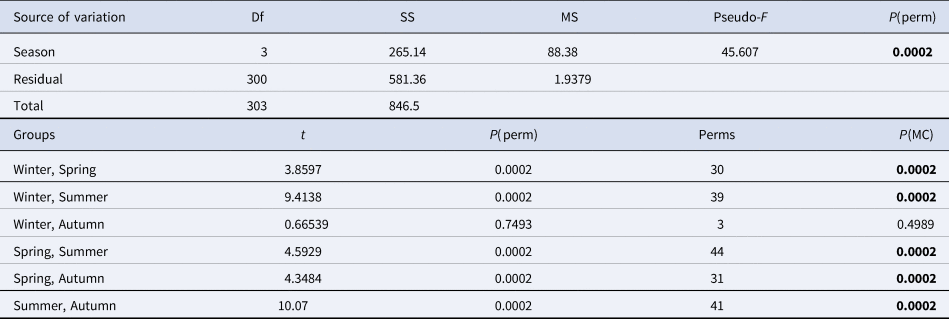
In addition, posteriori pairwise comparison analyses of the different fishing gears and the different seasons are shown. Significant values (P < 0.05) are shown in bold.
Secondly, even though most encounters were sightings of healthy sea turtles basking on the surface to thermoregulate, their encounters with stranded sea turtles were due to entanglements with fishing gear and plastics (Appendix D). The causes of trauma, disease, and hydrocarbons were mentioned with a low frequency, inferring that they were not this sector's main form of encounter.
Regarding their reactions, many respondents (64.4%) assisted the sea turtles in trouble and released them into the ocean without first calling any competent unit. Only 13.7% of interviewees took the sea turtle ashore to contact a qualified department or unit to treat the animal. A small percentage (19.2%) said they did nothing. Many respondents raised the problem of bringing sea turtles into port due to the small boat size, the difficulty of catching them, and the fact that it could be detrimental to their day's work. Only 52.6% of respondents knew of sea turtle recovery centres on the island. Some interviewees talked about other organizations, such as SEPRONA (Nature Protection Service), the Spanish Oceanographic Institute, harbour workers, and ‘Loro Park’ (a famous zoo in Tenerife). A high percentage (75%) was interested in obtaining more information on properly handling a stranded sea turtle and how to act in these situations. In this regard, most interviewees agreed that the cofradía was the best place to be informed. In addition, some respondents would be willing to participate in workshops to help them when facing a stranded sea turtle. For this purpose, in 2022, a series of informative workshops was held in the guilds on how to act during strandings and encounters with sea turtles; between January and June.
Discussion
Analysis of the sea turtle stranding data
This study represents the first systematic review of sea turtle stranding records carried out in Tenerife, a passage and feeding ground for several species of sea turtles in the Atlantic Ocean. Stranding records only existed for four sea turtle species: C. caretta, C. mydas, E. imbricata, and D. coriacea. The primary species recorded in the stranding data were C. caretta and C. mydas, with a higher incidence of smaller, juvenile sea turtles. This life stage is crucial and complex in their life cycle (Ferreira et al., Reference Ferreira, Martins, Silva and Bolten2001; Bolten, Reference Bolten, Bolten and Witherington2003; Marco et al., Reference Marco, Abella, Liria-Loza, Martins, López, Jiménez-Bordón, Medina, Oujo, Gaona, Godley and López-Jurado2012). Moreover, considering C. caretta and C. mydas are endangered species (GETM-IUCN, 2020); the study area Tenerife, which has a perimeter of 398 km, is not a nesting area where a large population congregates, but a transit area; although not an exhaustive study, since it is based on records obtained from the island's population and companies, the number of sea turtle strandings on the island was considered high in comparison to other exhaustive stranding studies where the study area was larger and/or involved nesting areas with a larger sea turtle congregations (Peckham et al., Reference Peckham, Maldonado-Diaz, Koch, Mancini, Gaos, Tinker and Nichols2008; Cantor et al., Reference Cantor, Barreto, Taufer, Giffoni, Castilho, Maranho and Domit2020; Mghili et al., Reference Mghili, Benhardouze, Aksissou and Tiwari2023; Read et al., Reference Read, Farman, Vivier, Avril, Gossuin and Wantiez2023). The very low number of records for the other two species (E. imbricata, and D. coriacea) suggests that their appearance in the waters of Tenerife is occasional or that they avoid common stranding causes.
The database analysis showed that the data reliability was limited, since only half of the total data were considered reliable records and selected for the study. This observation calls for the urgent need to implement correct data collection soon (i.e. systematic daily monitoring, database with all stranding information including veterinarian procedure results, latitude and longitude for each stranding, etc.), with the aim of impacts mitigation and conservation actions. Even though half of the raw data were incomplete, we could use 965 informative strandings recorded on Tenerife. Sea turtles' main threat was incidental capture in fishing gear, nets and hooks: due to drifting gears sea turtles may have been caught in other points and released with the hooks. None of those gears found in the stranded turtles included in this study were employed by the local small-scale fishers but rather by the larger industrial fishing from other regions. This observation indicates that we should focus our conservation efforts and future studies on the industrial fishing fleets surrounding the Canarian waters, alongside the assessment of the recreational and illegal fishing activities around the island.
Distribution of sea turtle strandings over time and space
The sea turtles frequently observed in Tenerife are C. caretta and C. mydas due to the oceanographic characteristics of the area (Santos et al., Reference Santos, Hawkins, Monteiro, Alves and Isidro1995). C. caretta lives in open seas feeding and growing (Putman et al., Reference Putman, Bane and Lohmann2010; Valdés and Déniz-González, Reference Valdés and Déniz-González2015), and C. mydas live in seagrass beds, located in the south-east and south-west of Tenerife (Brito, Reference Brito1999). C. caretta is more frequently sighted by fishers and tourist companies who work in the open sea (e.g., whale watching). On the contrary, C. mydas is mostly sighted near the coast by diving centres. According to their distribution, database analysis showed sea turtle strandings on the island were primarily located in the South of Tenerife. We should note that fishers and marine tourism companies work mainly in this area all year round due to the good sea conditions. However, during the different interviews, fishers from the north of the island stated that they have also seen sea turtles, especially in the less populated coastal areas of Anaga, at the northeastern tip of the island. These differences in the distribution of strandings on the island, which are also reflected in seasonality, should be contrasted with field monitoring of the populations around the island. Therefore, caution is advised when talking about seasonality and the distribution of the sea turtle population because only stranding records have been studied. In other words, the higher activity on the south of the island is linked to the higher percentage of strandings found in the south sector of the island.
Besides that, the highest number of strandings in the database occurred during summer and spring, coinciding with the results of the interviews. These catch rates of sea turtle strandings correspond to the period where there are more observers at sea due to tourism and better fishing conditions. The study by Varo-Cruz et al. (Reference Varo-Cruz, Bermejo, Calabuig Miranda, Cejudo, Godley, López-Jurado, Pikesley, Matthew and Hawkes2016) demonstrated similar results for seasonality in the Canary Islands, they claim that some stranded sea turtles could have remained in the area without moving to other regions (Varo-Cruz et al., Reference Varo-Cruz, Bermejo, Calabuig Miranda, Cejudo, Godley, López-Jurado, Pikesley, Matthew and Hawkes2016).
Analysis of the sea turtle stranding causes
As in many other parts of the world, sea turtles are threatened by important anthropogenic causes in the eastern North Atlantic (Gilman et al., Reference Gilman, Gearhart, Price, Eckert, Milliken, Wang, Swimmer, Shiode, Abe, Peckham, Chaloupka, Hall and Mangel2010; Nelms et al., Reference Nelms, Duncan, Broderick, Galloway, Godfrey, Hamann, Lindeque and Godley2016; Nicolau et al., Reference Nicolau, Marçalo, Ferreira, Sá, Vingada and Eira2016; Panagopoulou et al., Reference Panagopoulou, Meletis, Margaritoulis and Spotila2017; Pham et al., Reference Pham, Rodríguez, Dauphin, Carriço, Frias, Vandeperre, Otero, Santor, Martins, Bolten and Bjorndal2017). The effects on juvenile C. caretta in East Atlantic waters could severely affect important colonies from both sides of the Atlantic (USA, Mexico, Brazil, and Cape Verde) (Marco et al., Reference Marco, Abella, Liria-Loza, Martins, López, Jiménez-Bordón, Medina, Oujo, Gaona, Godley and López-Jurado2012). The north-eastern Atlantic region, mainly consisting of the Canary Islands and Madeira archipelagos, is an area of fishing interest for the Spanish surface longline fleet (García-Barcelona et al., Reference García-Barcelona, Báez, Ortiz de Urbina, Gómez-Vives and Macías2013). Our analyses have evidence that the main cause of strandings of sea turtles in Tenerife is interaction with fishing gear, usually due to entanglement. Our results coincide with those obtained by Calabuig Miranda and Liria Loza (Reference Calabuig Miranda and Liria Loza2007), who showed that the main stranding causes in the Canary Islands were entanglement in nets, plastics, ropes, and other floating debris. Sea turtles approach these objects thinking it is food or eating the small barnacles attached to them (Calabuig Miranda and Liria Loza, Reference Calabuig Miranda and Liria Loza2007). For this reason, another important cause of stranding observed was due to entanglement with drifting plastics (Nelms et al., Reference Nelms, Duncan, Broderick, Galloway, Godfrey, Hamann, Lindeque and Godley2016; Pham et al., Reference Pham, Rodríguez, Dauphin, Carriço, Frias, Vandeperre, Otero, Santor, Martins, Bolten and Bjorndal2017). Similarly, as described in Calabuig Miranda and Liria Loza (Reference Calabuig Miranda and Liria Loza2007) disease and trauma were another important cause of strandings. In this sense, water pollution can be an indirect threat, as it negatively affects the health of these animals by causing the appearance of opportunistic diseases (Calabuig Miranda and Liria Loza, Reference Calabuig Miranda and Liria Loza2007; Tagliolatto et al., Reference Tagliolatto, Goldberg, Godfrey and Monteiro-Neto2020). In the Canary Islands, water pollution has been demonstrated due to the presence of underwater emissaries, human activity, and aquaculture cages (Gutiérrez et al., Reference Gutiérrez, Sánchez, González, Armendáriz and De La Torre2009; Lozano et al., Reference Lozano, Alcázar, Bardera, Sánchez, Marí and Alduán2016). Nevertheless, there limited understanding exists regarding pollution levels within marine turtle populations in the Canary Islands. Only a handful of studies have been conducted, primarily focusing on loggerhead turtles inhabiting the islands of Gran Canaria and Fuerteventura (Camacho et al., Reference Camacho, Orós, Henríquez-Hernández, Silvi, Formigaro, López, Zumbado and Luzardo2014). There is a dearth on long-term epidemiological studies on sea turtle diseases spanning over a decade (Chaloupka et al., Reference Chaloupka, Work, Balazs, Murakawa and Morris2008; Casale et al., Reference Casale, Affronte, Insacco, Freggi, Vallini, Pino d'Astore, Basso, Paolillo, Abbate and Argano2010). On the other hand, sea turtles are stranded due to trauma often resulting from collisions or shark predation, consequently leading to the death of these animals (Orós et al., Reference Orós, Montesdeoca, Camacho, Arencibia and Calabuig Miranda2016).
Additionally, our study revealed that the main cause of strandings among C. caretta due to fishing gear was attributed to nets and hooks, while for C. mydas, it was predominantly only hooks. This variation between the two species could be attributed to their habitats on the island and the corresponding fishing practices. Specifically, C. mydas tends to inhabit coastal areas where nets are less commonly deployed. These results support the hypothesis that sea turtles' interaction with anthropogenic activities is the main cause of strandings in this region. Only a small number of fishermen utilize nets, specifically trammel nets, and those who employ them adhere to seasonal closures. Upon examining the net mesh sizes associated with the stranded turtles at CRFS La Tahonilla, it was evident that these nets did not align with the type utilized by local artisanal fishermen. Instead, they correlated with larger, more robust nets typically employed by larger commercial fleets. This observation was further corroborated by interviews with the island's fishers and supported by existing literature (Pascual-Fernández et al., Reference Pascual-Fernández, Chinea-Mederos and De la Cruz-Modino2015, Reference Pascual-Fernández, Pita, Bavinck, Pascual-Fernández, Pita and Bavinck2020; Falcón et al., Reference Falcón, Santamaría, Jiménez, Pascual-Fernández, Villegas and González2017). Within this field, Mendoza et al., Reference Mendoza, Dorta, Brito and Hernández2018, demonstrated that bycatch rates recorded in the Canary Islands were lower than those reported in other studies in the Iberian Peninsula (Mendoza et al., Reference Mendoza, Dorta, Brito and Hernández2018). The same convergence of currents and trade winds that facilitate the arrival of multiple marine species, also carry a lot of drifting debris (Álvarez-Hernández et al., Reference Álvarez-Hernández, Cairós, López-Darias, Mazzetti, Hernández-Sánchez, González-Sálamo and Hernández-Borges2019; Reinold et al., Reference Reinold, Herrera, Hernández-González and Gómez2020; Hernández-Sánchez et al., Reference Hernández-Sánchez, González-Sálamo, Díaz-Peña, Fraile-Nuez and Hernández-Borges2021). The study of Herrera et al., Reference Herrera, Asensio, Martínez, Santana, Packard and Gómez2018, highlighted that the origin of the marine pollution found in the Canary Islands was not local, but came mainly from the open sea via the Canary Current (Herrera et al., Reference Herrera, Asensio, Martínez, Santana, Packard and Gómez2018). Consequently, a notable portion of the nets in which sea turtles become entangled are composed of marine debris. Therefore, our study indicated that regional currents influence the arrival of sea turtles in these waters, as these animals navigate through these currents. However, these currents carry marine debris, including drifting fishing gear and floating waste, which could be harmful to sea turtles. Our results demonstrated that this marine debris significantly contributes to the stranding of sea turtles in the Canary Islands. Consequently, regional currents have both positive and negative effects on these animals, as they not only bring them into the waters of the islands but also introduce potential threats.
On the other hand, in the study of Calabuig Miranda and Liria Loza, Reference Calabuig Miranda and Liria Loza2007, similar to our observations, it was found that most of these hooks were rusty, causing serious chronic injuries and suggesting that these hooks were the same ones used in the Azores and Madeira archipelagos for swordfish fishing, thus confirming that these sea turtles were indeed stranded on these islands (Calabuig Miranda and Liria Loza, Reference Calabuig Miranda and Liria Loza2007). Our results have also shown that half of the deaths resulted from hooks for both species. These hooks are the same as those used in surface longline fishing for swordfish in the archipelagos of Azores and Madeira (Ferreira et al., Reference Ferreira, Martins, Silva and Bolten2001, Reference Ferreira, Martins, Bolten, Santos and Erzini2011; Valeiras and Camiñas, Reference Valeiras and Camiñas2001). In the Canary Islands, artisanal fishers do not use surface longlines, only bottom longlines, and swordfish fishing is not allowed because of the ciguatera disease (Pascual-Fernández et al., Reference Pascual-Fernández, Chinea-Mederos and De la Cruz-Modino2015, Reference Pascual-Fernández, Pita, Bavinck, Pascual-Fernández, Pita and Bavinck2020; Falcón et al., Reference Falcón, Santamaría, Jiménez, Pascual-Fernández, Villegas and González2017; Anadon et al., Reference Anadon, Ares, Martinez, Martinez-Larranaga, Martinez and Tsatsakis2021). Moreover, the northeastern Atlantic region is an area of interest for the Spanish surface longline fleet (García-Barcelona et al., Reference García-Barcelona, Báez, Ortiz de Urbina, Gómez-Vives and Macías2013). Accordingly, many of these hooks probably come from the Mediterranean and Atlantic fishing fleets, which employ longlines extensively near the archipelagos. This serves as another example of how the regional current affects sea turtles.
Previous studies have detected increased sea turtle catch rates during the swordfish season and fishing gear targeting blue sharks (Ferreira et al., Reference Ferreira, Santos, Martins, Bolten, Isidro, Giga and Bjorndal2003). The swordfish season in the Azores and Madeira is from May to December (Ferreira et al., Reference Ferreira, Martins, Bolten, Santos and Erzini2011); this includes late spring, summer, and autumn which coincide with the most sea turtle-stranding records in our study. Thus, sea turtles could be stranded off the Canary Islands because they may have been caught and released with hooks near (Azores and Madeira) by longline fishing boats. These sea turtles would be weak and carried on the Gulf Stream, reaching Canary Island waters. Regulating shark and swordfish fisheries and increasing fishers' awareness of sea turtle conservation could significantly and quickly reduce the impact of long-line fishing on these populations. In this field, Ferreira et al. (Reference Ferreira, Martins, Bolten, Santos and Erzini2011) have suggested bycatch mitigation policies for vessels, such as moving away from fishing areas with high turtle bycatch rates, identifying the key areas and periods of sea turtle aggregation, and longline fishing temporary prohibition (e.g. between July and November inside the protective Areas in the Azores). Additionally, oceanographic monitoring could help the fleet locate sea turtles' feeding grounds and reduce the likelihood of encounters with loggerhead turtles (Ferreira et al., Reference Ferreira, Martins, Bolten, Santos and Erzini2011). However, sea turtles feeding grounds and fishing grounds often coincide, making this management recommendation very controversial.
Biometric analysis of stranded sea turtles
Almost all the C. caretta population of Tenerife had a SCL between 20 and 60 cm and an average of 36.8 cm. This size class of turtles belongs to juveniles, leaving the oceanic stage to forage in neritic water, as the oceanic stage ranges from 15 to 60 cm SCL. This stage is extremely relevant for the survival of Atlantic populations (Bjorndal et al., Reference Bjorndal, Bolten and Martins2000). After emerging from their nests, C. caretta from the east coast of the United States migrate to reach the open ocean (Salmon and Wyneken, Reference Salmon and Wyneken1987). These turtles spend approximately the first decade of their lives inhabiting the North Atlantic Gyre, spending part of their life cycle in the Canary Islands (Bolten et al., Reference Bolten, Bjorndal, Martins, Dellinger, Biscoito, Encalada and Bowen1998). Bolten (Reference Bolten, Bolten and Witherington2003) observed that individuals found in the Canary Islands presented an average size of 36 cm, smaller than the C. caretta recorded in USA waters (Bolten, Reference Bolten, Bolten and Witherington2003) but larger than the sea turtles found in the Azores archipelago. In the Canary Islands, similar sizes to those found in the waters of Madeira were recorded. These sizes suggest that Madeira and the Canary Islands are in a transitional stage off the coast of Morocco and Western Sahara (Bolten, Reference Bolten, Bolten and Witherington2003). Measurements for C. mydas ranged from 30 to 70 cm, and the average was 52.14 cm. These sea turtles are usually larger than C. caretta, but these measurements also pertain to juvenile individuals of this species (Lutz et al., Reference Lutz, Musick and Wyneken2002). Mansfield et al. (Reference Mansfield, Wyneken and Luo2021) suggested that both species undergo an ontogenetic shift at approximately the same age but could have differing growth rates (C. caretta grows faster than C. mydas). Our findings may indicate differences in the sizes of these animals when they approach the coast, with C. mydas indeed actively orienting to seagrass beds. This suggests that C. caretta may also opportunistically utilize these habitats. Additionally, we observed that the juvenile C. mydas encountered in this study were larger than C. caretta, potentially indicating slower growth (Mansfield et al., Reference Mansfield, Wyneken and Luo2021)
Regarding the rehabilitation of individuals admitted to CRFS La Tahonilla, we observed that the results were high compared to other studies (Lutz et al., Reference Lutz, Musick and Wyneken2002; Peckham et al., Reference Peckham, Maldonado-Diaz, Koch, Mancini, Gaos, Tinker and Nichols2008; Casale et al., Reference Casale, Affronte, Insacco, Freggi, Vallini, Pino d'Astore, Basso, Paolillo, Abbate and Argano2010; Schuyler et al., Reference Schuyler, Hardesty, Wilcox and Townsend2014; Baker et al., Reference Baker, Edwards and Pike2015; Kühn et al., Reference Kühn, Bravo Rebolledo, Van Franeker, Bergmann, Gutow and Klages2015; Sönmez, Reference Sönmez2018; Himpson et al., Reference Himpson, Dixon and Le Berre2023). Only 15% of individuals died in the centre for C. caretta and 5% of individuals for C. mydas. This could be explained by the fact that Tenerife is an island where many sea extractive activities are carried out, consequently, the probability of encountering these stranded animals is notably heightened. Thus, animals with any problem or anomaly can be found rapidly by these sea operators, which may affect the probability of post-release survival (Snoddy et al., Reference Snoddy, Landon, Blanvillain and Southwood2009; Nelms et al., Reference Nelms, Duncan, Broderick, Galloway, Godfrey, Hamann, Lindeque and Godley2016). Furthermore, it should be considered that the citizen can be more inclined to call on authorities if the animal is alive in good conditions, rather than decomposed. This may have led to the fact that we do not have a good record of all the animals that arrived stranded already dead.
Dead C. caretta specimens measured around 40 cm, and C. mydas between 40 and 70 cm. These results, like previous studies, highlight that juvenile-stage individuals usually get trapped and have higher mortality rates (Ferreira et al., Reference Ferreira, Martins, Silva and Bolten2001; Bolten, Reference Bolten, Bolten and Witherington2003). During the juvenile stage, as epipelagic animals, they feed in the initial metres of the water column, where there is a lot of floating marine debris and lost fishing gear (Bolten, Reference Bolten, Bolten and Witherington2003; Marco et al., Reference Marco, Abella, Liria-Loza, Martins, López, Jiménez-Bordón, Medina, Oujo, Gaona, Godley and López-Jurado2012). Therefore, they often mistake marine debris for food or feed on the fauna associated with these objects (Peckham et al., Reference Peckham, Diaz, Walli, Ruiz, Crowder and Nichols2007).
Analysis of the fishermen's perception of sea turtle population
According to the perceptions of most artisanal fishers interviewed, they have observed an increase in sea turtle populations in recent years. Some previous studies have also shown positive trends concerning sea turtle populations in some locations. For instance, the study of nesting sites by Mazaris et al. (Reference Mazaris, Schofield, Gkazinou, Almpanidou and Hays2017) manifested a long-term increase in female abundance and nest numbers and a decline in local extinctions over the last ten years (Mazaris et al., Reference Mazaris, Schofield, Gkazinou, Almpanidou and Hays2017). Peckham et al. (Reference Peckham, Maldonado-Diaz, Koch, Mancini, Gaos, Tinker and Nichols2008) also describe several recent conservation success stories for sea turtles worldwide, with increased population sizes of C. mydas (Peckham et al., Reference Peckham, Maldonado-Diaz, Koch, Mancini, Gaos, Tinker and Nichols2008). Another study by Hall et al. (Reference Hall, Nakano, Clarke, Thomas, Molloy, Peckham, Hall and Kennelly2007) demonstrated that sea turtle by-catch levels in Hawaii were lower than in the past. These positive trends coincide with fishers' observations and could be linked to effective conservation programmes. Most sea turtles entering the centre heal and return to their natural environment. These findings highlight the importance of continued conservation and monitoring efforts (Duarte et al., Reference Duarte, Agusti, Barbier, Britten, Castilla, Gattuso, Robinson, Hughers, Knowlton, Lovelock, Lotze, Predragovic, Poloczanska, Roberts and Worm2020).
Despite their limitations, interviews with fishers provided complementary information for our analysis. For instance, we have detected that they saw more or fewer sea turtles depending on the fishing gear used by the fishers. They observed an increased presence of sea turtles when employing hooks or fish and shrimp traps, whereas a decreased occurrence was noted when utilizing nets or fish traps for moray (Figure 6A). This difference arises from the utilization of bait in both hooks and fish and shrimp traps, a feature absent in the other two gear types. The attractiveness of this bait is what entices sea turtles to approach these two specific gears. Furthermore, fishers remarked that sea turtles are often found near buoys and lines, sometimes getting entangled. Sea turtles tend to feed on easily accessible prey, such as shrimps or barnacles found on buoys. Their circular mobility of fins can result in entanglement in certain types of fishing gear. To minimize the mortality of sea turtles, it is crucial for fishers to regularly check their gear within a short period. Additionally, steps can be taken to avoid gear loss or drift, which can also contribute to reducing sea turtle injuries. Proper tracking and management of deployed buoys can be instrumental in achieving this goal (Peckham et al., Reference Peckham, Lucero-Romero, Maldonado-Díaz, Rodríguez-Sánchez, Senko, Wojakowski and Gaos2016). In addition, awareness campaigns and bycatch mitigation measures could be good management tools for a long-term fisher-led community-based conservation programme (Hall et al., Reference Hall, Nakano, Clarke, Thomas, Molloy, Peckham, Hall and Kennelly2007).
An observed lack of knowledge exists among fishermen regarding whom to contact during a stranding event and the appropriate actions to take in such instances. This lack of understanding has resulted in limited collaboration from this significant sector due to insufficient awareness about the situation and proper handling of turtles. This underscores the importance of comprehending the sector's specific needs in this context to address the situation in an effective and mutually beneficial manner. Future studies will be essential to ascertain if the information obtained through the study questionnaires has influenced any changes in their response and participation during stranding events.
Conclusions
Using a systematic review of stranding records, the most common stranded sea turtle species on Tenerife are C. caretta and C. mydas, with a higher incidence of juveniles. The primary problem faced by sea turtles in Tenerife is stranding due to fishing gear, particularly nets and hooks. It has been determined that this fishing gear comes from other fleets larger than the island's artisanal fleet. Stranded sea turtles are influenced by surface longlines from other islands from the East Atlantic and the Iberian Peninsula. The recovery rate for sea turtles admitted to the CRFS La Tahonilla is high with a considerable percentage being successfully released back into their natural environment.
Moreover, incorporating local knowledge of the main sea users, such as fishers, is very important for conserving these animals. Fishers possess valuable and extensive knowledge that can contribute to finding effective and commercially viable solutions to mitigate problematic by-catch issues. Developing such solutions requires a detailed understanding of the fisheries involved and the ecology of affected species. Involving fishers in conservation planning can result in better solutions that account for fishers' needs and incorporate their vast local knowledge (Hall et al., Reference Hall, Nakano, Clarke, Thomas, Molloy, Peckham, Hall and Kennelly2007). Furthermore, as the sector that spends the most time at sea, fishers are ablest to report and respond to sea turtle strandings. Beach monitoring programmes dedicated to research are conducted at specified intervals, whereas fishermen operate daily at sea, providing a broader scope of observations. Thus, it is important to understand the sector's needs and therefore be able to address the situation in the best and most mutually beneficial way.
Supplementary material
The supplementary material for this article can be found at https://doi.org/10.1017/S0025315424000638
Acknowledgements
The authors would like to thank the small-scale and commercial fishers who participated in this work, as the secretaries and leaders of the ten cofradías of Tenerife and the ISLATUNA producers' organization. We would also like to acknowledge the island government, Cabildo de Tenerife, and especially Agustín Espinosa and the managers of CRFS La Tahonilla for their essential contribution as experts and their advice and encouragement. We also acknowledge Anais Comabella for her support during the writing process and Beatriz Alonso for the skill maps. Additionally, we would like to thank Cristina Durán Montes for creating and authoring the illustrations featured in two of our figures.
Author Contributions
CHP, RCM, JCH. Data curation: CHP, JCH. Formal analysis: CHP, RCM, JCH. Funding acquisition: CHP, RCM. Investigation: CHP, RCM, JCH. Methodology: CHP, RCM, JCH. Project administration: CHP, RCM. Writing – original draft: CHP. Writing – review and editing: CHP, RCM, JCH.
Financial Support
This study was partially funded by Grupo de Acción Costera de Tenerife (GAC) through the project ‘Outreach and awareness actions on sea turtle populations in the waters of Tenerife’ (A21100087/21100077). CHP and RCM received financial support from the Agencia Canaria de Investigación, Innovación y Sociedad de la Información (ACIISI) through the project Identification of synergies for the development of blue tourism in the Natura 2000 Network sites, supported by the Smart Specialization Strategy of the Canary Islands RIS-3 co-financed by the Operational Program FEDER Canarias 2014–2020 under Grant PROID2021010029. This research is framed in the thesis of CHP financed by the Canary Islands Agency for Research, Innovation and the Information Society, the Regional Ministry of Universities, Science, Innovation and Culture, and the European Social Fund Plus (ESF+) under the Integrated Operational Programme of the Canary Islands 2021–2027, Axis 3, Priority Theme 74 (85%).
Competing interests
The authors declare no conflict of interest, the research was conducted in the absence of any commercial or financial relationships that could be construed as a potential conflict of interest.
Ethical Standards
Ethical review and approval were not required for the study on human participants following the local legislation and institutional requirements. The investigators obtained informed consent from all interviewees. At the beginning of the interview, the characteristics of the study were explained, and we explicitly asked for its acceptance.
Data Availability
The raw data supporting the conclusions of this article are partially available at Hurtado-Pampín, Claudia; de La Cruz-Modino, Raquel; Hernandez, José Carlos (2022), ‘Sea Turtle Strandings data in Tenerife (Canary Islands)’, Mendeley Data, V2, doi: 10.17632/p6wmtv6t5g.2
Interviews data remain confidential following the ULL protection data protocol policy, which is available at the following address: https://www.ull.es/servicios/dpd/.


 Open access

