

“Reference is constantly made, in the press and in public utterances, to the American standard of living, as though it were a standard as definite and well known as the foot, the pound, or the peck measure.”
Royal Meeker, United States Commissioner of Labor Statistics, 1919Footnote 1What is an American standard of living? This forum represents the culmination of several conversations over the past two years, but it builds on years of scholarship. In the summer of 2024, Axel Schäfer and Anja-Maria Bassimir organized a workshop on Migration and Consumption at the Obama Institute for Transnational American Studies at Johannes Gutenberg University Mainz, in Germany.Footnote 2 That theme originated in Axel’s brilliant observation, hiding in the plain sight of historians, that the ages of mass immigration and the birth of mass consumption were coincident. The pieces that follow make it clear that these events were co-constitutive as well.
The migration and consumption workshop was part of a collaborative research project that examined “bureaucratic practices of human differentiation in migration and welfare systems and policies in the United States especially between the two world wars.”Footnote 3 In the summer of 2024, I was honored to serve as a visiting fellow as part of the project. While in Mainz I visited Schӓfer’s related graduate course and attended the workshop later that month, among whose participants were Lizabeth Cohen, Jan Logemann, and Joel Perlmann, as well as the other authors in this roundtable: Anja-Maria, Axel, Rosanne Currarino, Atiba Pertilla, and Ylva Kreye. In April 2025 we re-convened at a panel sponsored by the Society for Historians of the Gilded Age and Progressive Era (SHGAPE) at the Organization of American Historians (OAH) conference in Chicago. For the collection we added Ylva Kreye, whose essay complements ours.
Mass migration and mass consumption—combined with agitation from the labor movement—incubated the idea of the American standard of living. Scholars such as Lawrence Glickman, Robert J. Gordon, and Marina Moskowitz have examined the American standard of living in relation to industrial labor, economic growth, race, and gender.Footnote 4 Immigrants and immigration have been present in some of these analyses, and yet a startlingly basic fact has been neglected: The moment when economists and social thinkers were devising the concept of the American standard of living is the exact era of European and later Mexican mass immigration, from 1882 to 1924. The first date, 1882, also stands out as the year of the passage of the Chinese Exclusion Act, and the second date, 1924, as a moment that set new heights for consumerism and xenophobia in the United States, with the easy consumer credit of the Roaring Twenties, the passage of the national-origins quotas (in the Johnson-Reed Act), and the creation of the U.S. Border Patrol.
Each aspect of the American standard of living captures the zeitgeist of the Progressive Era. First, there is the American in an age of mass migration and rise of nationalism. The Lost Cause was binding up the wounds of war for white Americans, inventing pageants, anthems, and co-reunions of northern and southern veterans to forge a new nationalism nostalgic for an imagined past. Theodore Roosevelt proclaimed there was no room in the nation for what he called hyphenated Americans. Meanwhile, even on its website today, the American Legion takes credit for the term “100 percent Americanism,” which, it explains “arose from the founding of The American Legion to build national pride, advance patriotism, promote U.S. citizenship, educate young people (mentally and physically alike), promote the U.S. Constitution and to counter threats to freedom, democracy, law and order.”Footnote 5 The American whose standard was being used was a native-born, Protestant, white American.
A standard needs to be measured against something. Here is where immigrants and science come in. A standard seems remarkably—and illusorily—scientific. Economists coined the phrase at a moment when the social sciences were being invented, differentiated, professionalized, and promulgated as objective. They were of course anything but these things, notwithstanding claims to science (and notwithstanding science not being objective either).
I turn to the Oxford English Dictionary for more clarity. The “standard” in the American standard of living seems to fit a few of its definitions: first, dating to 1424, “an accepted norm against which something can be compared.” Second, “a generally accepted exemplar of correctness or perfection, with regard to something; a perfect or representative model of a quality, type, or attribute.” In later use also: “that which is generally considered to be the most common, usual, or typical.” Finally, the OED offers as a definition “principles of acceptable conduct or behaviour, informed by ideas of morality, decency, etc.” This last one captures the judginess endemic to Progressive Era reformers, and because its first examples in the OED date from 1893, suggests the usage’s evolution in the era these essays describe.Footnote 6
Finally, the phrase’s last word: “living.” At first obvious (alive, breathing, surviving, according to one of its oldest meanings), but a second examination, in light of the coinciding events of immigration and consumption, gets at something deeper. This was a moment when mass consumption and the idea of a social surplus allowed the possibility of not just surviving, but thinking about what good living means. Consider living “with reference to personal conditions, status, or quality of life,” or as meaning “to survive long enough to be or to do something,” or “in an emphatic sense: to experience life fully; to enjoy or make the most of one’s life.”Footnote 7 Such a living could be imagined by progressive social thinkers who wanted, as it were, to spread the wealth.
In an age of surplus, who gets the surplus, and what does a good life—or a good living—have to do with it, given the labor movement’s emphasis on a family wage as the key to the American standard of living? As Roseanne Currarino’s essay shows, influential economist E. R. A. Seligman identified in the Progressive Era the “socialization of luxury,” and a belief that democracy meant that “leisure and culture will no longer be the possessions of the favored few.” It meant, in other words, a good living, in an era of immigration and social science, at an American standard; it meant, in Currarino’s words, “a really good dinner.” Atiba Pertilla’s essay suggests that immigrants could use thrift to advance their standard of living, even if they did not save in the way that reformers and government officials hoped. Ylva Kreye brings us the concept of “migrant knowledge” to show how newcomers used the postal savings banks that Pertilla describes.
Two suggestions before you read any further: none of the essays here mentions by name Thorstein Veblen or his 1899 theory of the leisure class, or the concept of conspicuous consumption.Footnote 8 I suggest that readers, however, keep him firmly in mind, not just because he helps us understand the leviathan unleashed by easy money and the expansion of the economy in the Progressive Era and the 1920s, but because Veblen was trained as an economist (even though now he is thought of as a sociologist), in that era in which the disciplines were not clearly defined. In that sense, his expansive theories match the boundary-blurring of economists popping off about “American standards.” Second, enjoy the way that the authors offer mini-biographies of several under-sung figures in the Progressive Era. Each one contributes to a rich sense of the intellectual firepower and discipline of the era, among both men and women, immigrant and native.
Now to the essays. Axel Schӓfer sets the table for us, in showing “how closely intertwined the highly racialized and ethnicized discourse on immigration was with large-scale changes in the political economy, specifically the transition to consumer capitalism.” He emphasizes “the emergent knowledge economy of the ‘age of abundance.’” In this context, “categories such as ‘race’ and ‘ethnicity’ are part of constructing the figure of the consumer and the politics of consumption.”
Ylva Kreye also deploys data and experts, examining how economist and Russian Jewish immigrant Isaac Rubinow thought about the American standard of living as he examined the data of the Bureau of Labor Statistics. She shows that Rubinow’s “migrant knowledge” offered a quite different, and more generous take, on the role and rights of immigrants in an empire of statistics. Yet his work, as was often the case with progressive reformers, had an ironic outcome: “Rubinow—the immigrant socialist concerned with workers’ well-being regardless of their race or nationality—helped normalize the American standard of living and contributed to the epistemological tools used to measure and manage it.”
Next is Rosanne Currarino. In her mini-biography of Seligman, Currarino gets at the fundamental optimism of progressive thinkers, in this case one who embraced “the socialization of luxury.” Although some of the classic interpretations of the Progressive Era emphasize the fear of change that some reformers had, I have always thought it more useful to think of their literal positivism and their confidence that human ingenuity and expertise could improve the human condition. That is to say, too many progressive reformers were snooty and wrong-headed, but their belief in progress and improvement was, to modern reading, pretty refreshing.
Anja-Maria Bassimir brings us the birth of food science, how it was gendered, and how similar concepts adhered to standards of health in both animals and humans. In introducing us to Ellen Swallow Richards, Edward Atkinson, and Wilbur Olin Atwater, she shows us how ideas about food mapped onto climatic schemas about race as well.
Finally, Atiba Pertilla examines thrift as a way of maintaining one’s own self-defined standards. At first blush, his essay seems to cover different ground than those focused on consumption. But read alongside the other essays, Pertilla’s demonstrates that immigrants were, when it came to consumption, damned if they did and damned if they didn’t. If they engaged in “undesirable financial habits” like “the ‘hoard’—money immigrants had earned but kept out of the formal financial system by keeping it on their persons, or in hiding places,” they were stingy. If they did not save, they were lazy, irresponsible spendthrifts. That there could be some goldilocks ideal for immigrants’ consumption patterns was, frankly, a fairy tale.
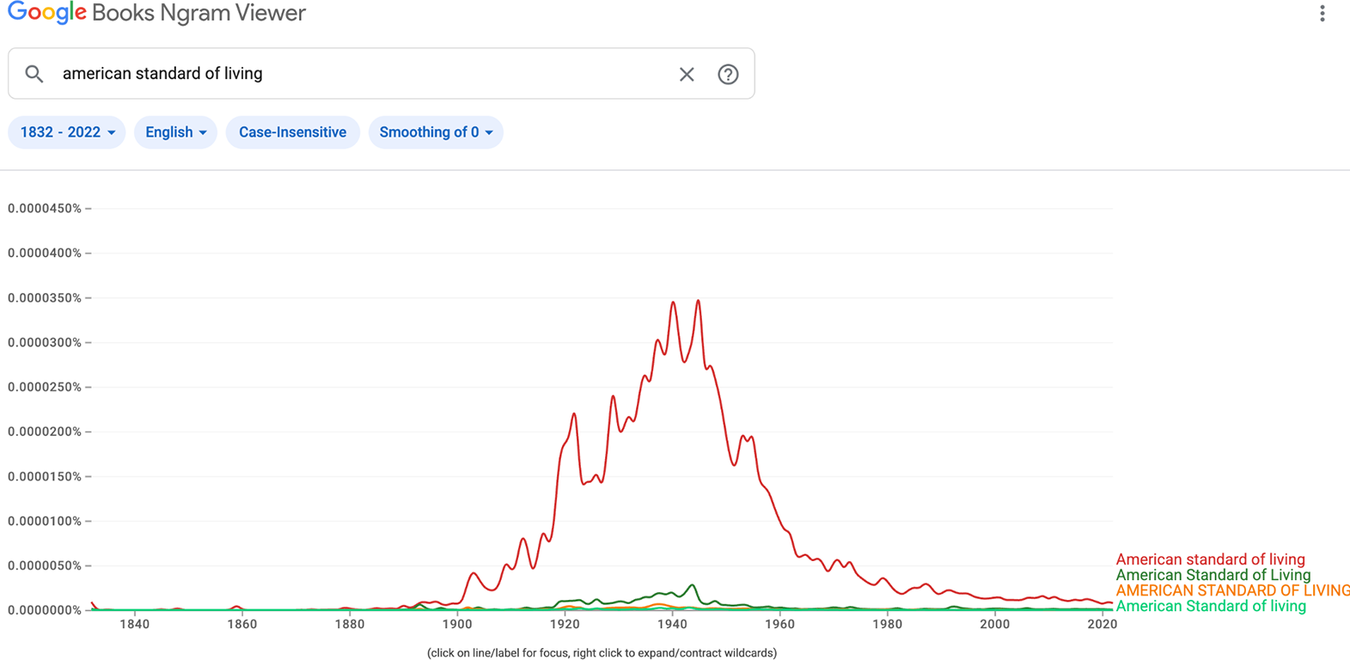
A Google n-gram, which tracks words and phrases in books digitized by Google, shows the first appearance of the phrase “American standard of living” in 1832, a sharp rise in the Progressive Era, and the apogee of its popularity in the World War II period (See Figure 1). This chronology makes perfect sense. When I first read the early versions of these papers, in the margin of every single one, I wrote, “like Freedom From Want”? Each piece—but especially Bassimir’s and Currarino’s—associates food, consumerism, and abundance in some way. Norman Rockwell’s popular painting, and its ties to both the New Deal and World War II, raises the question of what happened to these ideals over time. As I write this essay in late 2025, a set of Rockwell sketches that hung outside the Oval Office depicting ordinary Americans visiting the president are being auctioned off to the highest bidder, who will need to be very wealthy.Footnote 9 More seriously, President Donald Trump’s refusal to release SNAP (Supplemental Nutrition Assistance Program) funds during the longest government shutdown in U.S. history delayed food benefits to 41.7 million people, about 12.3 percent of the population (incidentally almost the same proportion of the U.S. population who were foreign-born in 1920), for several weeks. So much for dinner, much less a really good dinner.
Google n-gram, showing the historical rise and fall of the phrase “American standard of living.”
For many people, the American standard of living, even as defined by the federal government, is not provided by the government. Very few immigrants receive SNAP benefits—only about one in twenty-five recipients is an immigrant—whether or not they are hungry. Undocumented immigrants are not eligible for SNAP. Many more immigrants will soon lose access. A new U.S. Department of Agriculture rule, passed as part of the One Big Beautiful Bill Act of 2025, denies food assistance even to refugees, those legally seeking asylum, “victims of human trafficking, … [and] certain survivors of domestic violence.”Footnote 10
Moreover, an ongoing effort to police what SNAP recipients eat—banning, for example, junk food and sugary drinks—means forbidding hungry Americans from eating what might be considered, ironically, the most American parts of their diet, thus denying a momentary pleasure or sweetness, a small-scale “surplus of satisfactions” in which other Americans are free to indulge, and brings to mind the calorie-counting and immigrant-minding that Bassimir describes.Footnote 11 Bassimir finds that reformers thought that “most workers ate too much (even according to the more lenient American standard), and especially too much meat and too many sweets.” President Trump can gild the Oval Office and hold sumptuous banquets, while others starve. It would seem that in the Trump Era, we have rules for thee, but not for me. One might be forgiven for accidentally, momentarily, admiring some aspects of the Progressive Era.

 Open access

