




1 Introduction
When are two theories the same? Are there reasonable ways of abstracting away from the precise choice of the signature? The notions of synonymy (or: definitional equivalence) and bi-interpretability provide two good answers to these questions.
The notion of synonymy was introduced by de Bouvère in 1965 (see [Reference de Bouvère2, Reference de Bouvère, Addison, Henkin and Tarski3]). It appears to be the strictest notion of sameness of theories except strict identity of signature and set of theorems. Two theories U and V are synonymous iff there is a theory W that is both a definitional extension of U and of V (where we allow the signatures of U and V to be made disjoint). Equivalently, U and V are synonymous iff there are interpretations $K\mathop {:}U\to V$
and
$K\mathop {:}U\to V$
and $M\mathop {:}V\to U$
, such that V proves that the composition
$M\mathop {:}V\to U$
, such that V proves that the composition $K\circ M$
is the identity interpretation on V and such that U proves that the composition
$K\circ M$
is the identity interpretation on V and such that U proves that the composition $M\circ K$
of is the identity interpretation on U. (Thus, synonymy is isomorphism in an appropriate category
$M\circ K$
of is the identity interpretation on U. (Thus, synonymy is isomorphism in an appropriate category $\mathsf {INT}_0$
of theories and interpretations.) There are many familiar examples of synonymy. First, a theory is synonymous with a definitional extension. For example, Peano Arithmetic with
$\mathsf {INT}_0$
of theories and interpretations.) There are many familiar examples of synonymy. First, a theory is synonymous with a definitional extension. For example, Peano Arithmetic with $0$
, S,
$0$
, S, $+,$
and
$+,$
and $\times $
is synonymous with its extension with
$\times $
is synonymous with its extension with $<$
and the additional axiom
$<$
and the additional axiom $x < y \leftrightarrow \exists z\; x+\mathsf {S}z =y$
. Then, we have examples that are considered by mathematicians to be trivial alternative formulations like the theory of weak partial order and the theory of strong partial order. Finally, there are more substantial examples. For example, Peano Arithmetic, PA, is synonymous with an appropriate theory of strings and concatenation. See [Reference Corcoran, Frank and Maloney5] and, for a slightly weaker classical result, [Reference Van Orman and Quine25].Footnote
1
$x < y \leftrightarrow \exists z\; x+\mathsf {S}z =y$
. Then, we have examples that are considered by mathematicians to be trivial alternative formulations like the theory of weak partial order and the theory of strong partial order. Finally, there are more substantial examples. For example, Peano Arithmetic, PA, is synonymous with an appropriate theory of strings and concatenation. See [Reference Corcoran, Frank and Maloney5] and, for a slightly weaker classical result, [Reference Van Orman and Quine25].Footnote
1
The notion of bi-interpretability was introduced by Alhbrandt and Ziegler in 1986 (see [Reference Ahlbrandt and Ziegler1] and, also, [Reference Hodges9]). Two theories U and V are bi-interpretable iff there are interpretations $K:U\to V$
and
$K:U\to V$
and $M:V\to U$
, such that there is a V-definable function F, such that V proves that F is an isomorphism between
$M:V\to U$
, such that there is a V-definable function F, such that V proves that F is an isomorphism between $K\circ M$
and the identity interpretation on V and such that there is a U-definable function G, such that U proves that G is an isomorphism between
$K\circ M$
and the identity interpretation on V and such that there is a U-definable function G, such that U proves that G is an isomorphism between $M\circ K$
and the identity interpretation on U. (Thus, bi-interpretability is isomorphism in an appropriate category
$M\circ K$
and the identity interpretation on U. (Thus, bi-interpretability is isomorphism in an appropriate category $\mathsf {INT}_1$
of theories and interpretations.)
$\mathsf {INT}_1$
of theories and interpretations.)
In terms of models, the notion of bi-interpretability takes the following form. We note that an interpretation $K:U\to V$
gives us a uniform construction of an internal model
$K:U\to V$
gives us a uniform construction of an internal model $\widetilde {K}(\mathcal M)$
of U in a model
$\widetilde {K}(\mathcal M)$
of U in a model $\mathcal M$
of V. We find that U and V are bi-interpretable iff, there are interpretations
$\mathcal M$
of V. We find that U and V are bi-interpretable iff, there are interpretations $K:U\to V$
and
$K:U\to V$
and $M:V\to U$
and formulas F and G, such that, for all models
$M:V\to U$
and formulas F and G, such that, for all models $\mathcal M$
of V, the formula F defines in
$\mathcal M$
of V, the formula F defines in $\mathcal M$
an isomorphism between
$\mathcal M$
an isomorphism between $\mathcal M$
and
$\mathcal M$
and $\widetilde {M}\widetilde {K}(\mathcal M)$
, and, for all models
$\widetilde {M}\widetilde {K}(\mathcal M)$
, and, for all models $\mathcal N$
of U, the formula G defines in
$\mathcal N$
of U, the formula G defines in $\mathcal N$
an isomorphism between
$\mathcal N$
an isomorphism between $\mathcal N$
and
$\mathcal N$
and $\widetilde {K}\widetilde {M}(\mathcal N)$
.
$\widetilde {K}\widetilde {M}(\mathcal N)$
.
Bi-interpretability has a lot of good properties. For example, it preserves automorphism groups, $\kappa $
-categoricity, finite axiomatizability, etc. Still the stricter notion of synonymy preserves more. For example, synonymy preserves the action of the automorphism group on the domain of the model. Bi-interpretability (without parameters) does preserve the automorphism group modulo isomorphism but does not necessarily preserve the action on the domain. See §7 for an example illustrating this difference. An example of a property of theories that is not preserved under bi-interpretability (not even under definitional equivalence) is having a computable model (see [Reference Pakhomov19]).
$\kappa $
-categoricity, finite axiomatizability, etc. Still the stricter notion of synonymy preserves more. For example, synonymy preserves the action of the automorphism group on the domain of the model. Bi-interpretability (without parameters) does preserve the automorphism group modulo isomorphism but does not necessarily preserve the action on the domain. See §7 for an example illustrating this difference. An example of a property of theories that is not preserved under bi-interpretability (not even under definitional equivalence) is having a computable model (see [Reference Pakhomov19]).
Surprisingly, it is not easy to provide natural examples of pairs of theories that are bi-interpretable but not synonymous. For example, Peano Arithmetic PA is prima facie bi-interpretable with an appropriate theory of the hereditarily finite sets. However, on closer inspection, these theories are also synonymous (see §6.3). In §7, we give a verified example of two finitely axiomatized sequential theories that are bi-interpretable but not synonymous.
Our interest in this paper is in the relationship between synonymy and bi-interpretability for a special class of theories, the sequential theories. These are theories that have coding of sequences. Examples of sequential theories are Buss’s theory $\mathsf {S}^1_2$
, Elementary Arithmetic EA or EFA,
$\mathsf {S}^1_2$
, Elementary Arithmetic EA or EFA, $\mathrm {I}\Sigma _1$
, ZF, ZFC. We explain in detail what sequential theories are in §3.
$\mathrm {I}\Sigma _1$
, ZF, ZFC. We explain in detail what sequential theories are in §3.
We will show that, for identity-preserving interpretations between sequential theories, synonymy and bi-interpretability coincide (§5). In fact the proof works for a somewhat wider class: the conceptual theories. This last class was just defined here to pin down (more) precisely what is needed for the theorem.
A central ingredient of our proof is the Schröder–Bernstein Theorem that turns out to hold under surprisingly weak conditions. We give the proof of the Schröder–Bernstein Theorem under these weak conditions in §4.
1.1 Historical remark
The first preprint of this paper came out in the Logic Group Preprint Series of Utrecht University in 2014. On August 4, 2023, Albert Visser received an e-mail from Leszek Kołodziejczyk reporting that his team found a counter-example to Theorem 5.4 of the preprint and, on September 6, 2023, Visser received an e-mail from Tim Button that he found a mistake in the proof of Theorem 5.4 with suggestions on how to fix it. Fortunately, none of the further results of the paper rested on the mistaken Theorem, but only on the correct Corollary 5.5. So, we eliminated the mistaken theorem. Corollary 5.5 of the earlier version is Theorem 5.3 of the present version.
2 Basic notions
In this section, we formulate the basic notions employed in the paper. We keep the definitions here at an informal level. More detailed definitions are given in Appendix A.
2.1 Theories
The primary focus in this paper is on one-sorted theories of first-order predicate logic of relational signature. We take identity to be a logical constant. Our official signatures are relational, however, via the term-unwinding algorithm, we can also accommodate signatures with functions. Many-sorted theories appear as an auxiliary in the study of one-sorted theories. We will only consider theories with a finite number of sorts.
The results of the paper that are stated for one-sorted theories can be lifted to the many-sorted case in a fairly obvious way. We choose to restrict ourselves to the one-sorted case to keep the presentation reasonably light.
In this paper, no restriction is needed on the complexity of the set of axioms of a theory or on the size of the signature.
2.2 Interpretations
We describe the notion of an m-dimensional interpretation for a one-sorted language. An interpretation $K:U\to V$
is given by the theories U and V and a translation
$K:U\to V$
is given by the theories U and V and a translation $\tau $
from the language of U to the language of V. The translation is given by a domain formula
$\tau $
from the language of U to the language of V. The translation is given by a domain formula $\unicode{x3b4} (\vec x\,)$
, where
$\unicode{x3b4} (\vec x\,)$
, where $\vec x$
is a sequence of m variables, and a mapping from the predicates of U to formulas of V, where an n-ary predicate P is mapped to a formula
$\vec x$
is a sequence of m variables, and a mapping from the predicates of U to formulas of V, where an n-ary predicate P is mapped to a formula $A(\vec x_0,\ldots ,\vec x_{n-1})$
, where the
$A(\vec x_0,\ldots ,\vec x_{n-1})$
, where the $\vec x_j$
are appropriately chosen pairwise disjoint sequences of m variables. We lift the translation to the full language in the obvious way, making it commute with the propositional connectives and quantifiers, where we relativize the translated quantifiers to the domain
$\vec x_j$
are appropriately chosen pairwise disjoint sequences of m variables. We lift the translation to the full language in the obvious way, making it commute with the propositional connectives and quantifiers, where we relativize the translated quantifiers to the domain $\unicode{x3b4} $
. We demand that V proves all the translations of theorems of U.
$\unicode{x3b4} $
. We demand that V proves all the translations of theorems of U.
We can compose interpretations in the obvious way. Note that the composition of an n-dimensional interpretation with an m-dimensional interpretation is $m \times n$
-dimensional.
$m \times n$
-dimensional.
A one-dimensional interpretation is identity preserving if translates identity to identity. A one-dimensional interpretation is unrelativized if its domain consists of all the objects of the interpreting theory. A one-dimensional interpretation is direct if it is unrelativized and preserves identity. Note that all these properties are preserved by composition.
Each interpretation $K\mathop {:}U\to V$
gives us an inner model construction that builds a model
$K\mathop {:}U\to V$
gives us an inner model construction that builds a model $\widetilde {K}(\mathcal M)$
of U out of a model
$\widetilde {K}(\mathcal M)$
of U out of a model $\mathcal M$
of V. Note that
$\mathcal M$
of V. Note that $\widetilde {(\cdot )}$
behaves contravariantly.
$\widetilde {(\cdot )}$
behaves contravariantly.
If we want to use interpretations to analyze sameness of theories, we will need, as we will see, to be able to say when two interpretations are ‘equal’. Strict identity of interpretations is too fine grained. It depends too much on arbitrary choices like the selection of bound variables. We specify a first notion of equality between interpretations: two interpretations are equal when the target theory thinks they are. Modulo this identification, the operations identity and composition give rise to a category $\mathsf {INT}_0$
, where the theories are objects and the interpretations arrows.Footnote
2
$\mathsf {INT}_0$
, where the theories are objects and the interpretations arrows.Footnote
2
Let MOD be the category with as objects classes of models and as morphisms all functions between these classes. We define $\textsf {Mod}(U)$
as the class of all models of U. Suppose
$\textsf {Mod}(U)$
as the class of all models of U. Suppose $K\mathop {:}U\to V$
. Then,
$K\mathop {:}U\to V$
. Then, $\textsf {Mod}(K)$
is the function from
$\textsf {Mod}(K)$
is the function from $\textsf {Mod}(V)$
to
$\textsf {Mod}(V)$
to $\textsf {Mod}(U)$
given by:
$\textsf {Mod}(U)$
given by: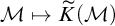 $\mathcal M \mapsto \widetilde {K}({\mathcal M})$
. It is clear that Mod is a contravariant functor from
$\mathcal M \mapsto \widetilde {K}({\mathcal M})$
. It is clear that Mod is a contravariant functor from $\mathsf {INT}_0$
to MOD.
$\mathsf {INT}_0$
to MOD.
2.3 Sameness of interpretations
For each sufficiently good notion of sameness of interpretations, there is an associated category of theories and interpretations: the category of interpretations modulo that notion of sameness. Any such a category gives us a notion of isomorphism of theories which can function as a notion of sameness.
We present a basic list of salient notions of sameness. For all items in the list, it is easily seen that sameness is preserved by composition. Our list does not have any pretence of being complete. For example, we omitted notions of sameness based on Ehrenfeucht games.
2.3.1 Equality
The interpretations $K,K':U\to V$
are equal when V ‘thinks’ K and
$K,K':U\to V$
are equal when V ‘thinks’ K and $K'$
are identical. By the Completeness Theorem, this is equivalent to saying that, for all V-models
$K'$
are identical. By the Completeness Theorem, this is equivalent to saying that, for all V-models $\mathcal M$
,
$\mathcal M$
, $\widetilde {K}({\mathcal M}) = \widetilde {K'}({\mathcal M})$
. This notion gives rise to the category
$\widetilde {K}({\mathcal M}) = \widetilde {K'}({\mathcal M})$
. This notion gives rise to the category $\mathsf {INT}_0$
. Isomorphism in
$\mathsf {INT}_0$
. Isomorphism in $\mathsf {INT}_0$
is synonymy or definitional equivalence.
$\mathsf {INT}_0$
is synonymy or definitional equivalence.
2.3.2 i-Isomorphism
An i-isomorphism between interpretations $K,M:U\to V$
is given by a V-formula F. We demand that V verifies that “F is an isomorphism between K and M”, or, equivalently, that, for each model
$K,M:U\to V$
is given by a V-formula F. We demand that V verifies that “F is an isomorphism between K and M”, or, equivalently, that, for each model $\mathcal M$
of V, the function
$\mathcal M$
of V, the function $F^{\mathcal M}$
is an isomorphism between
$F^{\mathcal M}$
is an isomorphism between $\widetilde {K}(\mathcal M)$
and
$\widetilde {K}(\mathcal M)$
and $\widetilde {M}(\mathcal M)$
.
$\widetilde {M}(\mathcal M)$
.
Two interpretations $K,K':U\to V$
, are i-isomorphic iff there is an i-isomorphism between K and
$K,K':U\to V$
, are i-isomorphic iff there is an i-isomorphism between K and $K'$
. Wilfrid Hodges calls this notion: homotopy (see [Reference Hodges9, p. 222]).
$K'$
. Wilfrid Hodges calls this notion: homotopy (see [Reference Hodges9, p. 222]).
We can also define the notion of being i-isomorphic semantically. The interpretations $K,K':U\to V$
, are i-isomorphic iff there is V-formula F such that for all V-models
$K,K':U\to V$
, are i-isomorphic iff there is V-formula F such that for all V-models $\mathcal M$
, the relation
$\mathcal M$
, the relation $F^{\mathcal M}$
is an isomorphism between
$F^{\mathcal M}$
is an isomorphism between $\widetilde {K}({\mathcal M})$
and
$\widetilde {K}({\mathcal M})$
and $\widetilde {K'}({\mathcal M})$
.
$\widetilde {K'}({\mathcal M})$
.
In case the signature of U is finite, being i-isomorphic has a third characterization. The interpretations $K,K':U\to V$
, are i-isomorphic iff, for every V-model
$K,K':U\to V$
, are i-isomorphic iff, for every V-model $\mathcal M$
, there is an
$\mathcal M$
, there is an $\mathcal M$
-definable isomorphism between
$\mathcal M$
-definable isomorphism between $\widetilde {K}({\mathcal M})$
and
$\widetilde {K}({\mathcal M})$
and $\widetilde {K'}({\mathcal M})$
(see Theorem A.1).
$\widetilde {K'}({\mathcal M})$
(see Theorem A.1).
Clearly, if $K,K'$
are equal in the sense of the previous section, they will be i-isomorphic. The notion of i-isomorphism gives rise to a category of interpretations modulo i-isomorphism. We call this category
$K,K'$
are equal in the sense of the previous section, they will be i-isomorphic. The notion of i-isomorphism gives rise to a category of interpretations modulo i-isomorphism. We call this category $\mathsf {INT}_1$
. Isomorphism in
$\mathsf {INT}_1$
. Isomorphism in $\mathsf {INT}_1$
is bi-interpretability.
$\mathsf {INT}_1$
is bi-interpretability.
2.3.3 Isomorphism
Our third notion of sameness of the basic list is that K and $K'$
are the same if, for all models
$K'$
are the same if, for all models $\mathcal M$
of V, the internal models
$\mathcal M$
of V, the internal models $\widetilde {K}({\mathcal M})$
and
$\widetilde {K}({\mathcal M})$
and $\widetilde {K'}({\mathcal M})$
are isomorphic. We will simply say that K and
$\widetilde {K'}({\mathcal M})$
are isomorphic. We will simply say that K and $K'$
are isomorphic. Clearly, i-isomorphism implies isomorphism. We call the associated category
$K'$
are isomorphic. Clearly, i-isomorphism implies isomorphism. We call the associated category $\mathsf {INT}_2$
. Isomorphism in
$\mathsf {INT}_2$
. Isomorphism in $\mathsf {INT}_2$
is iso-congruence.
$\mathsf {INT}_2$
is iso-congruence.
2.3.4 Elementary equivalence
The fourth notion is to say that two interpretations K and $K'$
are the same if, for each
$K'$
are the same if, for each $\mathcal M$
, the internal models
$\mathcal M$
, the internal models $\widetilde {K}({\mathcal M})$
and
$\widetilde {K}({\mathcal M})$
and $\widetilde {K'}({\mathcal M})$
are elementarily equivalent. We will say that K and
$\widetilde {K'}({\mathcal M})$
are elementarily equivalent. We will say that K and $K'$
are elementarily equivalent. By the Completeness Theorem, this notion can be alternatively defined by saying that K is the same as
$K'$
are elementarily equivalent. By the Completeness Theorem, this notion can be alternatively defined by saying that K is the same as $K'$
iff, for all U-sentences A, we have
$K'$
iff, for all U-sentences A, we have $V\vdash A^K\leftrightarrow A^{K'}$
.
$V\vdash A^K\leftrightarrow A^{K'}$
.
We call the associated category $\mathsf {INT}_3$
. Isomorphism in
$\mathsf {INT}_3$
. Isomorphism in $\mathsf {INT}_3$
is elementary congruence or sentential congruence.
$\mathsf {INT}_3$
is elementary congruence or sentential congruence.
2.3.5 Identity of source and target
Finally, we have the option of abstracting away from the specific identity of interpretations completely, simply counting any two interpretations $K,K':U\to V$
the same. The associated category is
$K,K':U\to V$
the same. The associated category is $\mathsf {INT}_4$
. This is simply the structure of degrees of one-dimensional interpretability. Isomorphism in
$\mathsf {INT}_4$
. This is simply the structure of degrees of one-dimensional interpretability. Isomorphism in $\mathsf {INT}_4$
is mutual interpretability.
$\mathsf {INT}_4$
is mutual interpretability.
2.4 The many-sorted case
Interpretability can be extended to interpretability between many-sorted theories. However to do that properly, we would need to develop the notion of piecewise interpretation. Since this notion is not needed in the present paper, we just describe interpretations of many-sorted theories in one-sorted theories. These are precisely what one would expect: the interpretation K does not specify just one domain, but, for each sort $\mathfrak a$
, a domain
$\mathfrak a$
, a domain $\unicode{x3b4} _{\mathfrak a}$
. We allow a different dimension for each sort. The translation of a quantifier
$\unicode{x3b4} _{\mathfrak a}$
. We allow a different dimension for each sort. The translation of a quantifier $\forall x^{\mathfrak a}$
is
$\forall x^{\mathfrak a}$
is $\forall \vec x\,(\unicode{x3b4} _{\mathfrak a}(\vec x\,) \to {\cdots })$
. We translate a predicate P of type
$\forall \vec x\,(\unicode{x3b4} _{\mathfrak a}(\vec x\,) \to {\cdots })$
. We translate a predicate P of type ${\mathfrak a}_0,\ldots ,{\mathfrak a}_{n-1}$
to a formula
${\mathfrak a}_0,\ldots ,{\mathfrak a}_{n-1}$
to a formula $A(\vec x_0,\ldots \vec x_{n-1})$
, where the target theory verifies, for
$A(\vec x_0,\ldots \vec x_{n-1})$
, where the target theory verifies, for $i<n$
, the formula
$i<n$
, the formula $A(\vec x_0,\ldots \vec x_{n-1}) \to \unicode{x3b4} _{{\mathfrak a}_i}(\vec x_i)$
.Footnote
3
$A(\vec x_0,\ldots \vec x_{n-1}) \to \unicode{x3b4} _{{\mathfrak a}_i}(\vec x_i)$
.Footnote
3
We will consider theories with a designated sort $\mathfrak o$
of objects. An interpretation of such a theory into a one-sorted theory is
$\mathfrak o$
of objects. An interpretation of such a theory into a one-sorted theory is $\mathfrak o$
-direct iff it is one-dimensional for sort
$\mathfrak o$
-direct iff it is one-dimensional for sort $\mathfrak o$
, and has
$\mathfrak o$
, and has $\unicode{x3b4} _{\mathfrak o}(x) := (x=x)$
and translates identity on
$\unicode{x3b4} _{\mathfrak o}(x) := (x=x)$
and translates identity on $\mathfrak o$
to identity simpliciter. In other words, the interpretation is direct when we restrict our attention to the single sort
$\mathfrak o$
to identity simpliciter. In other words, the interpretation is direct when we restrict our attention to the single sort $\mathfrak o$
.
$\mathfrak o$
.
2.5 Parameters
We can extend our notion of interpretation to interpretation with parameters as follows. Say our interpretation is $K:U\to V$
. In the target theory, we have a parameter domain
$K:U\to V$
. In the target theory, we have a parameter domain $\alpha (\vec z\,)$
, which is V-provably non-empty. The definition of interpretation remains the same but for the fact that the parameters
$\alpha (\vec z\,)$
, which is V-provably non-empty. The definition of interpretation remains the same but for the fact that the parameters $\vec z$
. Our condition for K to be an interpretation becomes:
$\vec z$
. Our condition for K to be an interpretation becomes:
 $$\begin{align*}U\vdash A \;\; \Rightarrow \;\; V\vdash \forall \vec z\;(\alpha(\vec z\,) \to A^{K,\vec z}\,).\end{align*}$$
We note that an interpretation $K:U\to V$
with parameters provides a parametrized set of inner models of U inside a model of V.
$K:U\to V$
with parameters provides a parametrized set of inner models of U inside a model of V.
3 Sequentiality and conceptuality
We are interested in theories with coding. There are several ‘degrees’ of coding, like pairing, sequences, etc. We want a notion that allows us to build arbitrary sequences of all objects of our domain. The relevant notion is sequentiality. We also define a wider notion conceptuality. This last notion is proof-generated: it gives us the most natural class of theories for which our proof works. All sequential theories are conceptual, but not vice versa.
We have a simple and elegant definition of sequentiality. A theory U is sequential iff it directly interprets adjunctive set theory AS. Here AS is the following theory in the language with only one binary relation symbol.
-
AS1. $\vdash \exists x\,\forall y\;\, y\not \in x$
,
$\vdash \exists x\,\forall y\;\, y\not \in x$
, -
AS2.
$\vdash \forall x,y \,\exists z\, \forall u\,(u\in z \leftrightarrow (u\in x \vee u=y))$
.


So the basic idea is that we can define a predicate $\in ^\star $
in U such that
$\in ^\star $
in U such that $\in ^\star $
satisfies a very weak set theory involving all the objects of U. Given this weak set theory, we can develop a theory of sequences for all the objects in U, which again gives us partial truth-predicates, etc. In short, the notion of sequentiality explicates the idea of a theory with coding.
$\in ^\star $
satisfies a very weak set theory involving all the objects of U. Given this weak set theory, we can develop a theory of sequences for all the objects in U, which again gives us partial truth-predicates, etc. In short, the notion of sequentiality explicates the idea of a theory with coding.
Remark 3.1. To develop the notion of sequentiality in a proper way for many-sorted theories, we would need the idea of a piecewise interpretation. We do not develop the idea of piecewise interpretation here. Fortunately, one can forget the framework and give the definition in a theory-free way. It looks like this. Let U be a theory with sorts $\mathcal S$
. The theory U is sequential when we can define, for each
$\mathcal S$
. The theory U is sequential when we can define, for each $\mathfrak a,\mathfrak b\in \mathcal S$
, a binary predicate
$\mathfrak a,\mathfrak b\in \mathcal S$
, a binary predicate $\in ^{\mathfrak {ab}}$
of type
$\in ^{\mathfrak {ab}}$
of type $\mathfrak {ab}$
such that:
$\mathfrak {ab}$
such that:
-
a.
$U \vdash \bigvee _{\mathfrak a\in \mathcal S}\exists x^{\mathfrak a}\, \bigwedge _{\mathfrak b \in \mathcal S}\forall y^{\mathfrak b}\, y^{\mathfrak b}\not \in ^{\mathfrak {ba}} x^{\mathfrak a}$
, -
b.
$U \vdash \bigwedge _{\mathfrak {a,b} \in \mathcal S}\forall x^{\mathfrak a},y^{\mathfrak b} \, \bigvee _{\mathfrak c \in \mathcal S}\exists z^{\mathfrak c}\,\bigwedge _{\mathfrak d \in \mathcal S} \forall u^{\mathfrak d}\, (u^{\mathfrak d}\in ^{\mathfrak {dc}} z^{\mathfrak c} \leftrightarrow (u^{\mathfrak d}\in ^{\mathfrak {da}} x^{\mathfrak a} \vee u^{\mathfrak d}=^{\mathfrak {db}}y^{\mathfrak b}))$
.


Here ‘ $=^{\mathfrak {db}}$
’ is not really in the language if
$=^{\mathfrak {db}}$
’ is not really in the language if $\mathfrak d \neq \mathfrak b$
. In this case, we read
$\mathfrak d \neq \mathfrak b$
. In this case, we read $u^{\mathfrak d}=^{\mathfrak {db}}y^{\mathfrak b}$
simply as
$u^{\mathfrak d}=^{\mathfrak {db}}y^{\mathfrak b}$
simply as $\bot $
.
$\bot $
.
It’s a nice exercise to show that, e.g., $\mathsf {ACA}_0$
and GB are sequential.
$\mathsf {ACA}_0$
and GB are sequential.
Closely related to AS is adjunctive class theory ac. We define this theory as follows. The theory ac is two-sorted with sorts $\mathfrak o$
(of objects) and
$\mathfrak o$
(of objects) and $\mathfrak c$
(of classes). We have an identity for every sort and one relation symbol
$\mathfrak c$
(of classes). We have an identity for every sort and one relation symbol $\in $
between objects and classes, i.e., of type
$\in $
between objects and classes, i.e., of type $\mathfrak {oc}$
. We let
$\mathfrak {oc}$
. We let $x,y,\ldots $
range over objects and
$x,y,\ldots $
range over objects and $X,Y,\ldots $
range over classes. We have the following axioms:
$X,Y,\ldots $
range over classes. We have the following axioms:
-
ac1.
$\vdash \exists X\,\forall x\;\, x \not \in X$
, -
ac2.
$\vdash \forall Y,y\,\exists X\;\forall x\;(x\in X \leftrightarrow (x\in Y \vee x =y))$
, -
ac3.
$\vdash X= Y \leftrightarrow \forall z\;(z\in X \leftrightarrow z\in Y)$
.



Note that extensionality is cheap since we could treat identity on classes as defined by the relation of extensional sameness. The theory ac is much weaker than AS, since it admits finite models. The following theorem is easy to see.
Theorem 3.2. A theory U is sequential iff there is an $\mathfrak o$
-direct interpretation of ac in U that is one-dimensional in the interpretation of classes.
$\mathfrak o$
-direct interpretation of ac in U that is one-dimensional in the interpretation of classes.
A theory U is conceptual iff there is an $\mathfrak o$
-direct interpretation of ac in U. We note that there are conceptual theories that are not sequential. For example, sequential theories always have an infinite domain, but there are conceptual theories with finite models. Note also that AS is sequential, but ac is not conceptual (not even in the appropriate many-sorted formulation).
$\mathfrak o$
-direct interpretation of ac in U. We note that there are conceptual theories that are not sequential. For example, sequential theories always have an infinite domain, but there are conceptual theories with finite models. Note also that AS is sequential, but ac is not conceptual (not even in the appropriate many-sorted formulation).
For more information on sequentiality and conceptuality, see Appendix B.
4 The Schröder–Bernstein theorem
We start with a brief story of the genesis of our version of the Schröder–Bernstein theorem. The first step was taken by Harvey Friedman who saw that sequential theories should satisfy a version of the Schröder–Bernstein Theorem,Footnote 4 which would lead to the desired result on the coincidence of synonymy and bi-interpretability.Footnote 5 Albert Visser subsequently wrote down a proof, discovering that one needs even less than sequentiality: the thing to use is adjunctive class theory. Allan van Hulst verified Visser’s version of the proof in Mizar as part of his master’s project under Freek Wiedijk in 2009. After hearing a presentation by Allan van Hulst, Tonny Hurkens found a simplification of the proof. Hurkens’ proof is shorter and conceptually simpler. In our presentation here, we include Hurkens’ simplification. We thank Tonny for his gracious permission to do so.
Our proof differs from the usual proofs to keep the demand on resources low. The reader may find it instructive to compare it with a more standard proof of the Schröder–Bernstein theorem (see, e.g., [Reference Levy14, pp. 85–86]).
We work in the theory SB which is ac extended with two unary predicates on objects: A and B and four binary predicates on objects: $\mathsf {E}_{\mathsf {A}}$
,
$\mathsf {E}_{\mathsf {A}}$
, $\mathsf {E}_{\mathsf {B}}$
, F, and G, plus axioms expressing that
$\mathsf {E}_{\mathsf {B}}$
, F, and G, plus axioms expressing that $\mathsf {E}_{\mathsf {A}}$
is an equivalence relation on A,
$\mathsf {E}_{\mathsf {A}}$
is an equivalence relation on A, $\mathsf {E}_{\mathsf {B}}$
is an equivalence relation on B, F is an injection from
$\mathsf {E}_{\mathsf {B}}$
is an equivalence relation on B, F is an injection from $\mathsf {A}/\mathsf {E}_{\mathsf {A}}$
to
$\mathsf {A}/\mathsf {E}_{\mathsf {A}}$
to $\mathsf {B}/\mathsf {E}_{\mathsf {B}}$
, and G is an injection from
$\mathsf {B}/\mathsf {E}_{\mathsf {B}}$
, and G is an injection from $\mathsf {B}/\mathsf {E}_{\mathsf {B}}$
to
$\mathsf {B}/\mathsf {E}_{\mathsf {B}}$
to $\mathsf {A}/\mathsf {E}_{\mathsf {A}}$
. We construct a formula H that SB-provably defines a bijection between
$\mathsf {A}/\mathsf {E}_{\mathsf {A}}$
. We construct a formula H that SB-provably defines a bijection between $\mathsf {A}/\mathsf {E}_{\mathsf {A}}$
and
$\mathsf {A}/\mathsf {E}_{\mathsf {A}}$
and $\mathsf {B}/\mathsf {E}_{\mathsf {B}}$
.
$\mathsf {B}/\mathsf {E}_{\mathsf {B}}$
.
We will employ the usual notations like: $\emptyset $
,
$\emptyset $
, $\{ x_0,\ldots ,x_{n-1} \}$
,
$\{ x_0,\ldots ,x_{n-1} \}$
, $\subseteq $
.
$\subseteq $
.
Our definition of what it means that F is a function includes: if $x\mathsf {E}_{\mathsf {A}}x'\mathsf {F}y' \mathsf {E}_{\mathsf {B}} y$
, then
$x\mathsf {E}_{\mathsf {A}}x'\mathsf {F}y' \mathsf {E}_{\mathsf {B}} y$
, then $x\mathsf {F}y$
. Similarly for G. We will treat A as a virtual class and write
$x\mathsf {F}y$
. Similarly for G. We will treat A as a virtual class and write $x\in \mathsf {A}$
, etc.
$x\in \mathsf {A}$
, etc.
-
• A pair of classes
$(X,Y)$
is downwards closed if,-
1.
$X\subseteq \mathsf {A}$
and
$Y \subseteq \mathsf {B}$
, -
2. if
$v\mathsf {G}u $
and
$u\in X$
, then there is a
$v'\in Y$
such that
$v'\mathsf {G} u $
, -
3. if
$u\mathsf {F}v$
and
$v\in Y$
, then there is a
$u' \in X$
such that
$u' \mathsf {F} v$
.
-
-
• We say that
$(X,Y)$
is an x-switch if-
i.
$(X, Y)$
is downwards closed, -
ii. x is a member of X,
-
iii. each member of X is in the range of G.
-
-
•
$x\mathsf {H}y$
iff (there is no x-switch and
$x\mathsf {F}y$
) or (there is an x-switch and
$y\mathsf {G}x$
).


Lemma 4.1 (SB).
H is a function from $\mathsf {A}/\mathsf {E}_{\mathsf {A}}$
to
$\mathsf {A}/\mathsf {E}_{\mathsf {A}}$
to $\mathsf {B}/\mathsf {E}_{\mathsf {B}}$
.
$\mathsf {B}/\mathsf {E}_{\mathsf {B}}$
.
Proof. We prove that H preserves equivalences. Suppose $x\mathsf {E}_{\mathsf {A}} x'$
,
$x\mathsf {E}_{\mathsf {A}} x'$
, $y\mathsf {E}_{\mathsf {B}} y'$
and
$y\mathsf {E}_{\mathsf {B}} y'$
and $x\mathsf {H}y$
. Suppose there is an x-switch
$x\mathsf {H}y$
. Suppose there is an x-switch $(X,Y)$
. It is easy to see that
$(X,Y)$
. It is easy to see that $(X\cup \{ x' \},Y)$
is an
$(X\cup \{ x' \},Y)$
is an $x'$
-switch. It is now immediate that
$x'$
-switch. It is now immediate that $x'\mathsf {H}y'$
. Similarly, if we are given an
$x'\mathsf {H}y'$
. Similarly, if we are given an $x'$
-switch, we may conclude that there is an x-switch. The remaining case where there is neither an x-switch nor an
$x'$
-switch, we may conclude that there is an x-switch. The remaining case where there is neither an x-switch nor an $x'$
-switch is again immediate.
$x'$
-switch is again immediate.
We prove that H is functional. Suppose $x\mathsf {H}y$
and
$x\mathsf {H}y$
and $x\mathsf {H}y'$
. If there is an x-switch, we have
$x\mathsf {H}y'$
. If there is an x-switch, we have $y\mathsf {G}x$
and
$y\mathsf {G}x$
and $y'\mathsf {G}x$
. So, we are done by the injectivity of G. If there is no x-switch, we have
$y'\mathsf {G}x$
. So, we are done by the injectivity of G. If there is no x-switch, we have $x\mathsf {F}y$
and
$x\mathsf {F}y$
and $x\mathsf {F}y'$
. So, we are done by the functionality of F.
$x\mathsf {F}y'$
. So, we are done by the functionality of F.
We prove that H is total on A. Consider any x in A. If there is no x-switch, we are done, since x is in the domain of F. If there is an x-switch, then x is in the range of G, and, again, we are done.
Lemma 4.2 (SB).
H is injective from $\mathsf {A}/\mathsf {E}_{\mathsf {A}}$
to
$\mathsf {A}/\mathsf {E}_{\mathsf {A}}$
to $\mathsf {B}/\mathsf {E}_{\mathsf {B}}$
.
$\mathsf {B}/\mathsf {E}_{\mathsf {B}}$
.
Proof. Suppose $x\mathsf {H}y$
and
$x\mathsf {H}y$
and $x'\mathsf {H}y$
.
$x'\mathsf {H}y$
.
If in both cases the same clauses in the definition of H are active, we are easily done.
Suppose there is no x-switch and there is an $x'$
-switch, say
$x'$
-switch, say $(X',Y')$
. By the definition of H, we have
$(X',Y')$
. By the definition of H, we have $x\mathsf {F}y\mathsf {G}x'$
. By the downwards closure of
$x\mathsf {F}y\mathsf {G}x'$
. By the downwards closure of $(X',Y')$
, the injectivity of G (viewed as a relation between
$(X',Y')$
, the injectivity of G (viewed as a relation between $\mathsf {B}/\mathsf {E}_{\mathsf {B}}$
and
$\mathsf {B}/\mathsf {E}_{\mathsf {B}}$
and $\mathsf {A}/\mathsf {E}_{\mathsf {A}}$
), and the functionality of F (viewed as a relation between
$\mathsf {A}/\mathsf {E}_{\mathsf {A}}$
), and the functionality of F (viewed as a relation between $\mathsf {A}/\mathsf {E}_{\mathsf {A}}$
and
$\mathsf {A}/\mathsf {E}_{\mathsf {A}}$
and $\mathsf {B}/\mathsf {E}_{\mathsf {B}}$
), we may conclude that
$\mathsf {B}/\mathsf {E}_{\mathsf {B}}$
), we may conclude that $x\mathsf {E}_{\mathsf {A}} x"$
, for some
$x\mathsf {E}_{\mathsf {A}} x"$
, for some $x"$
in
$x"$
in $X'$
. Hence,
$X'$
. Hence, $(X'\cup \{ x \},Y')$
is an x-switch. A contradiction.
$(X'\cup \{ x \},Y')$
is an x-switch. A contradiction.
Lemma 4.3 (SB).
H is surjective.
Proof. Consider any $y\in \mathsf {B}$
. First, suppose y is not in the range of F. Let
$y\in \mathsf {B}$
. First, suppose y is not in the range of F. Let $y\mathsf {G}x$
. Then,
$y\mathsf {G}x$
. Then, $(\{ x \},\{ y \})$
is an x-switch, and we have
$(\{ x \},\{ y \})$
is an x-switch, and we have $x\mathsf {H}y$
.
$x\mathsf {H}y$
.
Next, suppose $x\mathsf {F}y$
and there is no x-switch. In this case,
$x\mathsf {F}y$
and there is no x-switch. In this case, $x\mathsf {H}y$
.
$x\mathsf {H}y$
.
Finally, suppose $x\mathsf {F}y$
and there is an x-switch
$x\mathsf {F}y$
and there is an x-switch $(X,Y)$
. Let
$(X,Y)$
. Let $y\mathsf {G}x'$
. Then, we find that
$y\mathsf {G}x'$
. Then, we find that $(X\cup \{ x' \}, Y\cup \{ y \})$
is an
$(X\cup \{ x' \}, Y\cup \{ y \})$
is an $x'$
-switch. Hence,
$x'$
-switch. Hence, $x'\mathsf {H}y$
.
$x'\mathsf {H}y$
.
Thus, in all cases, y is in the image of H.
We have proved the following theorem.
Theorem 4.1. In SB, we can construct a bijection H between $\mathsf {A}/\mathsf {E}_{\mathsf {A}}$
and
$\mathsf {A}/\mathsf {E}_{\mathsf {A}}$
and $\mathsf {B}/\mathsf {E}_{\mathsf {B}}$
.
$\mathsf {B}/\mathsf {E}_{\mathsf {B}}$
.
Example 4.2. Consider a model of SB. We write A for the interpretation of A, etc. We note that the function H constructed by the proof of the theorem depends on our choice of classes. Suppose, e.g., that our objects are the integers, A is the set of even integers, B is the set of odd integers, our equivalence relations are identity on the given virtual class, F is the successor function domain-restricted to A, and G is the successor function domain-restricted to B. In the case that our classes are all possible classes of numbers, the pair of the class of all even numbers and all odd numbers is an a-switch, for each even a. So $H = G^{-1}$
, i.e., the predecessor function domain-restricted to A. In the case that our classes are the finite classes, there is no a-switch for any even a. So,
$H = G^{-1}$
, i.e., the predecessor function domain-restricted to A. In the case that our classes are the finite classes, there is no a-switch for any even a. So, $H=F$
.
$H=F$
.
For us, the following obvious corollary is relevant.
Corollary 4.1. Let T be a conceptual theory. Suppose we have formulas $Ax$
,
$Ax$
, $By$
,
$By$
, $E_A$
,
$E_A$
, $E_B$
, F, G, where T proves that
$E_B$
, F, G, where T proves that $E_A$
is an equivalence relation on
$E_A$
is an equivalence relation on $\{ x \mid Ax \}$
, that
$\{ x \mid Ax \}$
, that $E_B$
is an equivalence relation on
$E_B$
is an equivalence relation on $\{ y \mid By \}$
, that F is an injection from
$\{ y \mid By \}$
, that F is an injection from $\{ x \mid Ax \}/E_A$
to
$\{ x \mid Ax \}/E_A$
to $\{ y \mid By \}/E_B$
, and that G is an injection from
$\{ y \mid By \}/E_B$
, and that G is an injection from $\{ y \mid By \}/E_B$
to
$\{ y \mid By \}/E_B$
to $\{ x \mid Ax \}/E_A$
. Then we can find a formula H that T-provably defines a bijection between the virtual classes
$\{ x \mid Ax \}/E_A$
. Then we can find a formula H that T-provably defines a bijection between the virtual classes $\{ x \mid A x \}/E_A$
and
$\{ x \mid A x \}/E_A$
and $\{ y \mid By \}/E_B$
.
$\{ y \mid By \}/E_B$
.
Our corollary can be rephrased as follows. Suppose that T is conceptual and we have one-dimensional interpretations $K,M:\mathsf {EQ}\to T$
, where EQ is the theory of equality. Suppose further that
$K,M:\mathsf {EQ}\to T$
, where EQ is the theory of equality. Suppose further that $F:K\to M$
and
$F:K\to M$
and $G: M \to K$
are injections. Then we can find a bijection
$G: M \to K$
are injections. Then we can find a bijection $H:K\to M$
, and, thus, K and M are i-isomorphic.
$H:K\to M$
, and, thus, K and M are i-isomorphic.
We note that if T is sequential, we can drop the demand that K and M are one-dimensional, since every interpretation in a sequential theory is i-isomorphic with a one-dimensional interpretation.
5 From bi-interpretability to synonymy
In this section, we prove our main result. If two theories are bi-interpretable via identity-preserving interpretations, then they are synonymous.
Theorem 5.1. Let U and V be any theories with $K:U\to V$
and
$K:U\to V$
and $M:V\to U$
. Suppose that, for any model
$M:V\to U$
. Suppose that, for any model $\mathcal M$
of V, we have
$\mathcal M$
of V, we have $\widetilde M \widetilde K(\mathcal M)= \mathcal M$
(in other words,
$\widetilde M \widetilde K(\mathcal M)= \mathcal M$
(in other words, $K\circ M = \mathsf {id}_V$
in
$K\circ M = \mathsf {id}_V$
in $\mathsf {INT}_0$
). Suppose further that, for any model
$\mathsf {INT}_0$
). Suppose further that, for any model $\mathcal N$
of U, the model
$\mathcal N$
of U, the model $\widetilde K \widetilde M(\mathcal N)$
is elementarily equivalent to
$\widetilde K \widetilde M(\mathcal N)$
is elementarily equivalent to $\mathcal N$
(in other words,
$\mathcal N$
(in other words, $M\circ K = \mathsf {id}_U$
in
$M\circ K = \mathsf {id}_U$
in $\mathsf {INT}_3$
). Then U and V are synonymous.
$\mathsf {INT}_3$
). Then U and V are synonymous.
Here is a different formulation: if $K,M$
witness that V is an
$K,M$
witness that V is an $\mathsf {INT}_0$
-retract of U and that U is an
$\mathsf {INT}_0$
-retract of U and that U is an $\mathsf {INT}_3$
-retract of V, then U and V are synonymous.
$\mathsf {INT}_3$
-retract of V, then U and V are synonymous.
Proof. Consider any model $\mathcal N$
of U. We have
$\mathcal N$
of U. We have $\widetilde K \widetilde M\widetilde K\widetilde M(\mathcal N) = \widetilde K \widetilde M(\mathcal N)$
. Let
$\widetilde K \widetilde M\widetilde K\widetilde M(\mathcal N) = \widetilde K \widetilde M(\mathcal N)$
. Let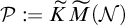 $\mathcal P :=\widetilde K \widetilde M(\mathcal N)$
. So,
$\mathcal P :=\widetilde K \widetilde M(\mathcal N)$
. So,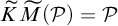 $\widetilde K \widetilde M(\mathcal P) = \mathcal P$
. We note that the identity of
$\widetilde K \widetilde M(\mathcal P) = \mathcal P$
. We note that the identity of $\widetilde K \widetilde M(\mathcal P)$
and
$\widetilde K \widetilde M(\mathcal P)$
and $\mathcal P$
is witnessed by such statements as
$\mathcal P$
is witnessed by such statements as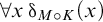 $\forall x\,\unicode{x3b4} _{M\circ K}(x)$
and
$\forall x\,\unicode{x3b4} _{M\circ K}(x)$
and $\forall \vec x\,(P_{M\circ K}\vec x \leftrightarrow P\vec x\,)$
. Since
$\forall \vec x\,(P_{M\circ K}\vec x \leftrightarrow P\vec x\,)$
. Since $\mathcal P$
is elementarily equivalent to
$\mathcal P$
is elementarily equivalent to $\mathcal N$
, we have
$\mathcal N$
, we have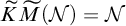 $\widetilde K \widetilde M(\mathcal N) = \mathcal N$
. So
$\widetilde K \widetilde M(\mathcal N) = \mathcal N$
. So $M\circ K = \mathsf {id}_U$
in
$M\circ K = \mathsf {id}_U$
in $\mathsf {INT}_0$
.
$\mathsf {INT}_0$
.
There is, of course, also a model-free proof of the result.
Theorem 5.2. Suppose that $K: U \to V$
and
$K: U \to V$
and $M:V\to U$
witness that V is an
$M:V\to U$
witness that V is an $\mathsf {INT}_1$
-retract of U and that U is an
$\mathsf {INT}_1$
-retract of U and that U is an $\mathsf {INT}_3$
-retract of V. Suppose further that M is direct. Then U and V are synonymous.
$\mathsf {INT}_3$
-retract of V. Suppose further that M is direct. Then U and V are synonymous.
Proof. Since M is direct, it follows that, in V, we have $\unicode{x3b4} _{K\circ M} = \unicode{x3b4} _K$
. We replace K by a definably isomorphic direct interpretation
$\unicode{x3b4} _{K\circ M} = \unicode{x3b4} _K$
. We replace K by a definably isomorphic direct interpretation $K'$
. Suppose F is the promised isomorphism between
$K'$
. Suppose F is the promised isomorphism between $K\circ M$
and
$K\circ M$
and $\mathsf {id}_V$
. We take, for P of arity n, in the signature of U:
$\mathsf {id}_V$
. We take, for P of arity n, in the signature of U:
-
•
$P_{K'}(v_0,\ldots ,v_{n-1}) :\leftrightarrow \exists \vec u_0\mathbin {\in }\unicode{x3b4} _K,\ldots , \exists \vec u_{n-1}\mathbin {\in }\unicode{x3b4} _K$
$\qquad\qquad\qquad\qquad\qquad\qquad\qquad\qquad (\bigwedge _{i<n} \vec u_i \mathop {F} v_i \wedge P_K(\vec u_0,\ldots , \vec u_{n-1}))$
.


Clearly, we have an isomorphism $F':K\to K'$
, based on the same underlying formula as F. Hence
$F':K\to K'$
, based on the same underlying formula as F. Hence $K',M$
witness that U is an
$K',M$
witness that U is an $\mathsf {INT}_3$
-retract of V.
$\mathsf {INT}_3$
-retract of V.
We note that $K'\circ M$
is direct. Suppose R is an m-ary predicate of V. The theory T proves:
$K'\circ M$
is direct. Suppose R is an m-ary predicate of V. The theory T proves:

Thus, we find: $K'\circ M = \mathsf {id}_V$
in
$K'\circ M = \mathsf {id}_V$
in $\mathsf {INT}_0$
, in other words, V is an
$\mathsf {INT}_0$
, in other words, V is an $\mathsf {INT}_0$
-retract of U. We apply Theorem 5.1 to
$\mathsf {INT}_0$
-retract of U. We apply Theorem 5.1 to $K',M$
to obtain the desired result that U and V are synonymous (Figure 1).
$K',M$
to obtain the desired result that U and V are synonymous (Figure 1).
We are mainly interested in the following corollary.
Corollary 5.1. Suppose U and V are bi-interpretable and one of the witnessing interpretations is direct. Then U and V are synonymous.
Illustration of the Proof of Theorem 5.2.

We now prove our main theorem.
Theorem 5.3. Suppose V is conceptual and that $K:U \to V$
and
$K:U \to V$
and $M:V\to U$
form a bi-interpretation of U and V. Let K and M both be identity-preserving. Then, U and V are synonymous.
$M:V\to U$
form a bi-interpretation of U and V. Let K and M both be identity-preserving. Then, U and V are synonymous.
Proof. We note that, in V, $\unicode{x3b4} _K$
is a (virtual) subclass of the full domain. Hence, we have a definable injection from
$\unicode{x3b4} _K$
is a (virtual) subclass of the full domain. Hence, we have a definable injection from $\unicode{x3b4} _K$
to the full domain.
$\unicode{x3b4} _K$
to the full domain.
Again $\unicode{x3b4} _{K\circ M}= \unicode{x3b4} ^K_M \cap \unicode{x3b4} _K$
is a (virtual) subclass of
$\unicode{x3b4} _{K\circ M}= \unicode{x3b4} ^K_M \cap \unicode{x3b4} _K$
is a (virtual) subclass of $\unicode{x3b4} _K$
. Moreover, we have a definable bijection F between the full domain and
$\unicode{x3b4} _K$
. Moreover, we have a definable bijection F between the full domain and $\unicode{x3b4} _{K\circ M}$
. Hence, we have a definable injection from the full domain into
$\unicode{x3b4} _{K\circ M}$
. Hence, we have a definable injection from the full domain into $\unicode{x3b4} _K$
.
$\unicode{x3b4} _K$
.
We apply the Schröder–Bernstein Theorem to the full domain and $\unicode{x3b4} _K$
providing us with a bijection G between the full domain and
$\unicode{x3b4} _K$
providing us with a bijection G between the full domain and $\unicode{x3b4} _K$
. We define a new interpretation
$\unicode{x3b4} _K$
. We define a new interpretation $K':U\to V$
, by setting:
$K':U\to V$
, by setting:
-
•
$P_{K'}(v_0,\ldots ,v_{n-1}) :\leftrightarrow \exists w_0\mathbin {\in } \unicode{x3b4} _K,\ldots , \exists w_{n-1}\mathbin {\in } \unicode{x3b4} _K$
.
$\qquad\qquad\qquad\qquad\qquad\qquad\quad\qquad(\bigwedge _{i<n} v_i \mathop G w_i \wedge P_K(w_0,\ldots ,w_{n-1}))$
.


Clearly, $K'$
is direct and isomorphic to K, so
$K'$
is direct and isomorphic to K, so $K'$
and M form a bi-interpretation of U and V. By Corollary 5.1, we may conclude that U and V are synonymous (Figure 2).
$K'$
and M form a bi-interpretation of U and V. By Corollary 5.1, we may conclude that U and V are synonymous (Figure 2).
Illustration of the Proof of Theorem 5.3.

We note that in the circumstances of Theorem 5.3, it follows that U is also conceptual.
In §7, we provide an example to illustrate that one cannot drop the demand of identity preservation for any of the two interpretations. We provide two finitely axiomatised sequential theories that are bi-interpretable, but not synonymous. One of the two witnesses of the bi-interpretation is identity preserving.
6 Applications
In this section, we provide a number of applications of Theorem 5.3.
6.1 Natural numbers and integers
The theory $\mathsf {PA}^-$
is the theory of the non-negative part of a discretely ordered commutative ring (see Richard Kaye’s book [Reference Kaye12, chap. 2] and Emil Jeřábek paper [Reference Jeřábek10] Let DOCR be the theory of a discretely ordered commutative rings. The theories
$\mathsf {PA}^-$
is the theory of the non-negative part of a discretely ordered commutative ring (see Richard Kaye’s book [Reference Kaye12, chap. 2] and Emil Jeřábek paper [Reference Jeřábek10] Let DOCR be the theory of a discretely ordered commutative rings. The theories $\mathsf {PA}^-$
and DOCR are bi-interpretable. The interpretation of
$\mathsf {PA}^-$
and DOCR are bi-interpretable. The interpretation of $\mathsf {PA}^-$
in DOCR is restriction to the non-negative part. Kaye uses the well-known pairs construction as an interpretation of DOCR in
$\mathsf {PA}^-$
in DOCR is restriction to the non-negative part. Kaye uses the well-known pairs construction as an interpretation of DOCR in $\mathsf {PA}^-$
. This construction is two-dimensional and employs an equivalence relation. As shown by Jeřábek in [Reference Jeřábek10], we have a polynomial pairing function
$\mathsf {PA}^-$
. This construction is two-dimensional and employs an equivalence relation. As shown by Jeřábek in [Reference Jeřábek10], we have a polynomial pairing function ${\langle \cdot ,\cdot \rangle }$
in
${\langle \cdot ,\cdot \rangle }$
in $\mathsf {PA}^-$
. We can define our domain as
$\mathsf {PA}^-$
. We can define our domain as ${\langle 0,x \rangle }$
, (representing the non-positive numbers) and
${\langle 0,x \rangle }$
, (representing the non-positive numbers) and ${\langle x,0 \rangle }$
, for all x, representing the non-negative numbers.Footnote
6
Since,
${\langle x,0 \rangle }$
, for all x, representing the non-negative numbers.Footnote
6
Since, $\mathsf {PA}^-$
has the subtraction axiom, we can define the desired operations as a matter of course. Moreover, the verification that we defined an identity preserving bi-interpretations is immediate. Thus, by Theorem 5.3, we may conclude that
$\mathsf {PA}^-$
has the subtraction axiom, we can define the desired operations as a matter of course. Moreover, the verification that we defined an identity preserving bi-interpretations is immediate. Thus, by Theorem 5.3, we may conclude that $\mathsf {PA}^-$
and DOCR are synonymous.
$\mathsf {PA}^-$
and DOCR are synonymous.
6.2 Natural numbers and rational numbers
Julia Robinson, in her seminal paper [Reference Robinson22], shows that the natural numbers are definable in $\mathbb Q$
, the field of the rationals. This gives us an identity preserving interpretation of
$\mathbb Q$
, the field of the rationals. This gives us an identity preserving interpretation of $\mathsf {Th}(\mathbb N)$
in
$\mathsf {Th}(\mathbb N)$
in $\mathsf {Th}(\mathbb Q)$
. Conversely, we can find an identity preserving interpretation of
$\mathsf {Th}(\mathbb Q)$
. Conversely, we can find an identity preserving interpretation of $\mathsf {Th}(\mathbb Q)$
in
$\mathsf {Th}(\mathbb Q)$
in $\mathsf {Th}(\mathbb N)$
by using the Cantor pairing and by just considering pairs
$\mathsf {Th}(\mathbb N)$
by using the Cantor pairing and by just considering pairs ${\langle m,n \rangle ,}$
where m and n have no common divisor except 1. Addition and multiplication are defined in the usual way. We can easily define internal isomorphisms witnessing that these interpretations form an identity preserving bi-interpretation. Hence,
${\langle m,n \rangle ,}$
where m and n have no common divisor except 1. Addition and multiplication are defined in the usual way. We can easily define internal isomorphisms witnessing that these interpretations form an identity preserving bi-interpretation. Hence, $\mathsf {Th}(\mathbb N)$
in
$\mathsf {Th}(\mathbb N)$
in $\mathsf {Th}(\mathbb Q)$
are synonymous by Theorem 5.3.
$\mathsf {Th}(\mathbb Q)$
are synonymous by Theorem 5.3.
6.3 Finite sets and numbers
We consider the theory $\mathsf {ZF}^+_{\mathsf {fin}}:=(\mathsf {ZF}-\mathsf {INF})+\neg \,\mathsf {INF}+\mathsf {TC}$
. This is ZF in the usual formulation minus the axiom of infinity, plus the negation of the axiom of infinity and the axiom TC that tells us that every set has a transitive closure. Kaye and Wong in their paper [Reference Kaye and Wong13] provide a careful verification that
$\mathsf {ZF}^+_{\mathsf {fin}}:=(\mathsf {ZF}-\mathsf {INF})+\neg \,\mathsf {INF}+\mathsf {TC}$
. This is ZF in the usual formulation minus the axiom of infinity, plus the negation of the axiom of infinity and the axiom TC that tells us that every set has a transitive closure. Kaye and Wong in their paper [Reference Kaye and Wong13] provide a careful verification that $\mathsf {ZF}^+_{\mathsf {fin}}$
and PA are synonymous. By Theorem 5.3, it is sufficient to show that the Ackermann interpretation of
$\mathsf {ZF}^+_{\mathsf {fin}}$
and PA are synonymous. By Theorem 5.3, it is sufficient to show that the Ackermann interpretation of $\mathsf {ZF}^+_{\mathsf {fin}}$
in PA and the von Neumann interpretation of PA in
$\mathsf {ZF}^+_{\mathsf {fin}}$
in PA and the von Neumann interpretation of PA in $\mathsf {ZF}^+_{\mathsf {fin}}$
form a bi-interpretation. For further information about the related theory
$\mathsf {ZF}^+_{\mathsf {fin}}$
form a bi-interpretation. For further information about the related theory $\mathsf {ZF}_{\mathsf {fin}} = (\mathsf {ZF}-\mathsf {INF})+\neg \,\mathsf {INF}$
, see [Reference Enayat, Schmerl, Visser, Kennedy and Kossak7].
$\mathsf {ZF}_{\mathsf {fin}} = (\mathsf {ZF}-\mathsf {INF})+\neg \,\mathsf {INF}$
, see [Reference Enayat, Schmerl, Visser, Kennedy and Kossak7].
6.4 Sets with or without urelements
Benedikt Löwe shows that a certain version of ZF with a countable set of urelements is synonymous with ZF (see [Reference Löwe15]. Again this result is easily obtained using Theorem 5.3.
7 Frege meets Cantor: An example
In this section, we provide an example of two finitely axiomatized, sequential theories that are bi-interpretable but not synonymous. One of the two interpretations witnessing bi-interpretability is identity preserving. The example given is meaningful: it is the comparison of a Frege-style weak set theory and a Cantor-style weak set theory.Footnote 7
The theory $\mathsf {ACF}_\flat $
is the one-sorted version of adjunctive class theory with Frege relation.Footnote
8
Our theory has unary predicates ob and cl, and binary predicates
$\mathsf {ACF}_\flat $
is the one-sorted version of adjunctive class theory with Frege relation.Footnote
8
Our theory has unary predicates ob and cl, and binary predicates $\in $
and F. Here F is the Frege relation.
$\in $
and F. Here F is the Frege relation.
We will write $x\mathop {:}\mathsf {ob}$
for
$x\mathop {:}\mathsf {ob}$
for $\mathsf {ob}(x)$
,
$\mathsf {ob}(x)$
, $\forall x\mathop {:}\mathsf {ob} \cdots $
for
$\forall x\mathop {:}\mathsf {ob} \cdots $
for $\forall x\,(\mathsf {ob}(x) \to \cdots )$
,
$\forall x\,(\mathsf {ob}(x) \to \cdots )$
, $\exists x\mathop {:}\mathsf {ob} \cdots $
for
$\exists x\mathop {:}\mathsf {ob} \cdots $
for $\exists x\,(\mathsf {ob}(x) \wedge \cdots )$
. Similarly for cl. We have the following axioms:
$\exists x\,(\mathsf {ob}(x) \wedge \cdots )$
. Similarly for cl. We have the following axioms:
-
ACF ♭1.
$\vdash \forall x\, (x:\mathsf {ob} \vee x\mathop {:}\mathsf {cl})$
, -
ACF ♭2.
$\vdash \forall x\, \neg \,(x\mathop {:}\mathsf {ob} \wedge x\mathop {:}\mathsf {cl})$
, -
ACF ♭3.
$\vdash \forall x,y\, (x\in y \to (x\mathop {:}\mathsf {ob} \wedge y\mathop {:}\mathsf {cl}))$
, -
ACF ♭4.
$\vdash \forall x,y \, (x\mathsf {F}y \to (x\mathop {:}\mathsf {ob} \wedge y\mathop {:}\mathsf {cl}))$
, -
ACF ♭5.
$\vdash \exists x\mathop {:}\mathsf {cl}\; \forall y\mathop {:}\mathsf {ob}\;\; y \not \in x$
, -
ACF ♭6.
$\vdash \forall x\mathop {:}\mathsf {cl}\;\forall y\mathop {:}\mathsf {ob} \;\exists z\mathop {:}\mathsf {cl} \;\forall w\mathop {:}\mathsf {ob}\; (w\in z \leftrightarrow (w\in x \vee w=y))$
. -
ACF ♭7.
$\vdash \forall x,y\mathop {:}\mathsf {cl}\; (\,\forall z\mathop {:}\mathsf {ob}\; (z\in x \leftrightarrow z \in y) \to x=y)$
. -
ACF ♭8.
$\vdash \forall x\mathop {:}\mathsf {ob}\; \exists y\mathop {:}\mathsf {cl} \; x\mathsf {F}y$
, -
ACF ♭9.
$\vdash \forall x\mathop {:}\mathsf {ob}\;\forall y,y'\mathop {:}\mathsf {cl}\; ((x\mathsf {F}y \wedge x\mathsf {F}y' ) \to y=y')$
, -
ACF ♭10.
$\vdash \forall x\mathop {:}\mathsf {cl}\; \exists y\mathop {:}\mathsf {ob}\; y\mathsf {F}x$
.










We provide one-dimensional interpretations witnessing that AS and $\mathsf {ACF}_\flat $
are bi-interpretable. Note that by Theorem B.1, it follows that
$\mathsf {ACF}_\flat $
are bi-interpretable. Note that by Theorem B.1, it follows that $\mathsf {ACF}_\flat $
is sequential.
$\mathsf {ACF}_\flat $
is sequential.
In the context of AS, we write:
-
•
$\mathsf {pair}(x,y,z) :\leftrightarrow \exists u,v\,\forall w\, ((w\in u \leftrightarrow w = x) \wedge \\ (w\in v \leftrightarrow (w=x\vee w=y)) \wedge (w\in z \leftrightarrow (w=u \vee w = v)))$
, -
•
$\mathsf {Pair}(x) :\leftrightarrow \exists y,z\,\mathsf {pair}(y,z,x)$
, -
•
$\pi _0(z,x) :\leftrightarrow \exists y\,\mathsf {pair}(x,y,z)$
,
$\pi _1(z,y) :\leftrightarrow \exists x\,\mathsf {pair}(x,y,z)$
, -
•
$\mathsf {empty}(x) :\leftrightarrow \forall y\,y\not \in x$
,
$\mathsf {inhab}(x) :\leftrightarrow \neg \,\mathsf {empty}(x)$
, -
•
$x\approx y :\leftrightarrow \forall z\,(z\in x \leftrightarrow z\in y)$
.







We can verify the usual properties of pairing. The $\pi _i$
are functional on Pair. We will write them using functional notation. We should remember that they are undefined outside Pair. We first define an interpretation
$\pi _i$
are functional on Pair. We will write them using functional notation. We should remember that they are undefined outside Pair. We first define an interpretation $L:\mathsf {ACF}_\flat \to \mathsf {AS}$
.
$L:\mathsf {ACF}_\flat \to \mathsf {AS}$
.
-
•
$\unicode{x3b4} _L(x) :\leftrightarrow \mathsf {Pair}(x)$
, -
•
$\mathsf {ob}_L(x) :\leftrightarrow \mathsf {Pair}(x) \wedge \mathsf {empty}(\pi _0(x))$
, -
•
$\mathsf {cl}_L(x) :\leftrightarrow \mathsf {Pair}(x) \wedge \mathsf {inhab}(\pi _0(x))$
, -
•
$x=_L y :\leftrightarrow (x,y\mathop {:}\mathsf {ob}_L \wedge \pi _1(x)=\pi _1(y)) \vee (x,y\mathop {:}\mathsf {cl}_L\wedge \pi _1(x) \approx \pi _1(y))$
, -
•
$x \in _L y :\leftrightarrow x\mathop {:}\mathsf {ob}_L \wedge y\mathop {:}\mathsf {cl}_L \wedge \pi _1(x)\in \pi _1(y)$
, -
•
$ x\mathop {\mathsf {F}_{L}}y \mathop {:}\leftrightarrow x:\mathsf {ob}_L \wedge y\mathop {:}\mathsf {cl}_L \wedge \pi _1(x) \approx \pi _1(y)$
.






It is easy to see that the specified translation does carry an interpretation of $\mathsf {ACF}_\flat $
in AS, as promised. Next, we define an interpretation
$\mathsf {ACF}_\flat $
in AS, as promised. Next, we define an interpretation $K:\mathsf {AS}\to \mathsf {ACF}_\flat $
.
$K:\mathsf {AS}\to \mathsf {ACF}_\flat $
.
-
•
$\unicode{x3b4} _K(x) :\leftrightarrow x\mathop {:}\mathsf {ob}$
, -
•
$x =_K y \leftrightarrow x,y\mathop {:}\mathsf {ob} \wedge x=y$
, -
•
$x\in _K y \leftrightarrow x,y\mathop {:}\mathsf {ob} \wedge \exists z\mathop {:}\mathsf {cl}\, (x\in z \wedge y\mathsf {F}z ) $
.



We note that K is identity preserving. The verification that our interpretations do indeed specify a bi-interpretation is entirely routine. For completeness’ sake, we provide the computations involved in Appendix C.
We show that AS and $\mathsf {ACF}_\flat $
are not synonymous—not even when we allow parameters. We build the following model
$\mathsf {ACF}_\flat $
are not synonymous—not even when we allow parameters. We build the following model $\mathcal M$
of AS. The domain is inductively specified as the smallest set M such that if X is a finite subset of M, then
$\mathcal M$
of AS. The domain is inductively specified as the smallest set M such that if X is a finite subset of M, then ${\langle 0,X \rangle }$
and
${\langle 0,X \rangle }$
and ${\langle 1,X \rangle }$
are in M. Let
${\langle 1,X \rangle }$
are in M. Let $m,n,\ldots $
range over M. We define:
$m,n,\ldots $
range over M. We define: $m\in ^\star n$
iff
$m\in ^\star n$
iff $n={\langle i,X \rangle }$
and
$n={\langle i,X \rangle }$
and $m\in X$
. It is easily seen that
$m\in X$
. It is easily seen that $\mathcal M$
is indeed a model of AS. Clearly, for any finite subset
$\mathcal M$
is indeed a model of AS. Clearly, for any finite subset $X_0$
of
$X_0$
of $M,$
we can find an automorphism
$M,$
we can find an automorphism $\sigma $
of
$\sigma $
of $\mathcal M$
of order 2 that fixes
$\mathcal M$
of order 2 that fixes $X_0$
and fixes only finitely many elements of M.
$X_0$
and fixes only finitely many elements of M.
Suppose AS and $\mathsf {ACF}_\flat $
were synonymous. Let
$\mathsf {ACF}_\flat $
were synonymous. Let $\mathcal N$
be the internal model of
$\mathcal N$
be the internal model of $\mathsf {ACF}_\flat $
in
$\mathsf {ACF}_\flat $
in $\mathcal M$
given by the synonymy. Say the interpretation is P, involving a finite set of parameters
$\mathcal M$
given by the synonymy. Say the interpretation is P, involving a finite set of parameters $X_0$
. Let
$X_0$
. Let $\sigma $
be an automorphism of order 2 on
$\sigma $
be an automorphism of order 2 on $\mathcal M$
that fixes
$\mathcal M$
that fixes $X_0$
and that fixes at most finitely many objects. Consider the classes
$X_0$
and that fixes at most finitely many objects. Consider the classes $\{ p,\sigma p \}^{\mathcal N}$
, where p is in
$\{ p,\sigma p \}^{\mathcal N}$
, where p is in $\mathsf {ob}^{\mathcal N}$
. (Note that
$\mathsf {ob}^{\mathcal N}$
. (Note that $\sigma $
must send
$\sigma $
must send $\mathcal N$
-objects to
$\mathcal N$
-objects to $\mathcal N$
-objects.) Clearly there is an infinity of such classes. By extensionality, these classes are fixed by
$\mathcal N$
-objects.) Clearly there is an infinity of such classes. By extensionality, these classes are fixed by $\sigma $
. This contradicts the fact that
$\sigma $
. This contradicts the fact that $\sigma $
has only finitely many fixed points.
$\sigma $
has only finitely many fixed points.
It is well known that if two models are bi-interpretable (without parameters) then their automorphism groups are isomorphic. Our example shows that the action of these automorphism groups on the elements can be substantially different.
A Definitions
In this appendix, we provide detailed definitions of translations, interpretations and morphisms between interpretations.
A.1 Translations
Translations are the heart of our interpretations. In fact, they are often confused with interpretations, but we will not do that officially. In practice, it is often convenient to conflate an interpretation and its underlying translation.
A proto-formula is a $\unicode{x3bb} $
-term
$\unicode{x3bb} $
-term $\unicode{x3bb} \vec x. A(\vec x)$
, where the variables of the formula A are among those in
$\unicode{x3bb} \vec x. A(\vec x)$
, where the variables of the formula A are among those in $\vec x$
. We will think of proto-formulas modulo
$\vec x$
. We will think of proto-formulas modulo $\alpha $
-conversion and we will follow the conventions of the
$\alpha $
-conversion and we will follow the conventions of the $\unicode{x3bb} $
-calculus for substitution, where we avoid variable-capture by renaming the bound variables. The arity is a proto-formula is the length of
$\unicode{x3bb} $
-calculus for substitution, where we avoid variable-capture by renaming the bound variables. The arity is a proto-formula is the length of $\vec x$
.
$\vec x$
.
We define more-dimensional, one-sorted, one-piece relative translations without parameters. Let $\Sigma $
and
$\Sigma $
and $\varTheta $
be one-sorted signatures. A translation
$\varTheta $
be one-sorted signatures. A translation $\tau :\Sigma \to \varTheta $
is given by a triple
$\tau :\Sigma \to \varTheta $
is given by a triple ${\langle m,\unicode{x3b4} ,F \rangle }$
. Here
${\langle m,\unicode{x3b4} ,F \rangle }$
. Here $\unicode{x3b4} $
will be an m-ary proto-formula of signature
$\unicode{x3b4} $
will be an m-ary proto-formula of signature $\varTheta $
. The mapping F associates to each relation symbol R of
$\varTheta $
. The mapping F associates to each relation symbol R of $\Sigma $
with arity n an
$\Sigma $
with arity n an $m\times n$
-ary proto-formula of signature
$m\times n$
-ary proto-formula of signature $\varTheta $
.
$\varTheta $
.
We demand that predicate logic proves $F(R)(\vec x_0,\ldots ,\vec x_{n-1}) \to (\unicode{x3b4} (\vec x_0) \wedge \cdots \unicode{x3b4} (\vec x_{n-1}))$
. Of course, given any candidate proto-formula
$F(R)(\vec x_0,\ldots ,\vec x_{n-1}) \to (\unicode{x3b4} (\vec x_0) \wedge \cdots \unicode{x3b4} (\vec x_{n-1}))$
. Of course, given any candidate proto-formula $F(R)$
not satisfying the restriction, we can obviously modify it to satisfy the restriction.
$F(R)$
not satisfying the restriction, we can obviously modify it to satisfy the restriction.
We translate $\Sigma $
-formulas to
$\Sigma $
-formulas to $\varTheta $
-formulas as follows:
$\varTheta $
-formulas as follows:
-
•
$(R(x_0,\ldots ,x_{n-1}))^\tau := F(R)(\vec x_0,\ldots , \vec x_{n-1} )$
. We use sloppy notation here. The single variable
$x_i$
of the source language needs to have no obvious connection with the sequence of variables
$\vec x_i$
of the target language that represents it. We need some conventions to properly handle the association
$x_i\mapsto \vec x_i$
. We do not treat these details here. We demand that the
$\vec x_i$
are fully disjoint when the
$x_i$
are different. -
•
$(\cdot )^\tau $
commutes with the propositional connectives; -
•
$(\forall x\,A)^\tau := \forall \vec x\,(\unicode{x3b4} (\vec x\,)\to A^\tau )$
; -
•
$(\exists x\,A)^\tau := \exists \vec x\,(\unicode{x3b4} (\vec x\,)\wedge A^\tau )$
.





Here are some convenient conventions and notations.
-
• We write
$\unicode{x3b4} _\tau $
for ‘the
$\unicode{x3b4} $
of
$\tau $
’ and
$F_\tau $
for ‘the F of
$\tau $
’. -
• We write
$R_\tau $
for
$F_\tau (R)$
. -
• We write
$\vec x\in \unicode{x3b4} _\tau $
for:
$\unicode{x3b4} _\tau (\vec x\,)$
.


There are some natural operations on translations. The identity translation $\mathsf {id}:=\mathsf {id}_\varTheta $
is one-dimensional and it is defined by:
$\mathsf {id}:=\mathsf {id}_\varTheta $
is one-dimensional and it is defined by:
-
•
$\unicode{x3b4} _{\mathsf {id}}:= \unicode{x3bb} x.(x=x)$
, -
•
$R_{\mathsf {id}}:= \unicode{x3bb} \vec x. R\vec x$
.


We can compose relative translations as follows. Suppose $\tau $
is an m-dimensional translation from
$\tau $
is an m-dimensional translation from $\Sigma $
to
$\Sigma $
to $\varTheta $
, and
$\varTheta $
, and $\nu $
is a k-dimensional translation from
$\nu $
is a k-dimensional translation from $\varTheta $
to
$\varTheta $
to $\varXi $
. We define:
$\varXi $
. We define:
-
• We suppose that with the variable x we associate under
$\tau $
the sequence
$x_0,\ldots , x_{m-1}$
and under
$\nu $
we send
$x_i$
to
$\vec x_i$
.
$\unicode{x3b4} _{\tau \nu }(\vec x_0,\ldots , \vec x_{m-1}) := (\unicode{x3b4} _\nu (\vec x_0) \wedge \cdots \wedge \unicode{x3b4} _\nu (\vec x_{m-1}) \wedge (\unicode{x3b4} _\tau (x))^\nu )$
, -
• Let R be n-ary. Suppose that under
$\tau $
we associate with
$x_i$
the sequence
$x_{i,0},\ldots ,x_{i,m-1}$
and that under
$\nu $
we associate with
$x_{i,j}$
the sequence
$\vec x_{i,j}$
. We take:
$R_{\tau \nu }(\vec x_{0,0},\ldots \vec x_{n-1,m-1}) = \unicode{x3b4} _\nu (\vec x_{0,0}) \wedge \cdots \wedge \unicode{x3b4} _\nu (\vec x_{n-1,m-1}) \ \wedge (R_\tau (x_0,\ldots ,x_{n-1}))^\nu $
.









A one-dimensional translation $\tau $
preserves identity if
$\tau $
preserves identity if $(x=_\tau y) = (x=y)$
. A one-dimensional translation
$(x=_\tau y) = (x=y)$
. A one-dimensional translation $\tau $
is unrelativized if
$\tau $
is unrelativized if $\unicode{x3b4} _\tau (x) = (x=x)$
. A one-dimensional translation
$\unicode{x3b4} _\tau (x) = (x=x)$
. A one-dimensional translation $\tau $
is direct if it is unrelativized and preserves identity. Note that all these properties are preserved by composition.
$\tau $
is direct if it is unrelativized and preserves identity. Note that all these properties are preserved by composition.
Consider a model $\mathcal M$
with domain M of signature
$\mathcal M$
with domain M of signature $\varTheta $
and k-dimensional translation
$\varTheta $
and k-dimensional translation $\tau :\Sigma \to \varTheta $
. Suppose that
$\tau :\Sigma \to \varTheta $
. Suppose that $N:=\{ \vec m\mathbin {\in } M^k\mid \mathcal M \models \unicode{x3b4} _\tau \vec m \}$
. Then
$N:=\{ \vec m\mathbin {\in } M^k\mid \mathcal M \models \unicode{x3b4} _\tau \vec m \}$
. Then $\tau $
specifies an internal model
$\tau $
specifies an internal model $\mathcal N$
of
$\mathcal N$
of $\mathcal M$
with domain N and with
$\mathcal M$
with domain N and with $\mathcal N \models R(\vec m_0,\ldots ,\vec m_{n-1}) $
iff
$\mathcal N \models R(\vec m_0,\ldots ,\vec m_{n-1}) $
iff $\mathcal M \models R_\tau (\vec m_0,\ldots ,\vec m_{n-1})$
. We will write
$\mathcal M \models R_\tau (\vec m_0,\ldots ,\vec m_{n-1})$
. We will write $\widetilde {\tau }(\mathcal M)$
for the internal model of
$\widetilde {\tau }(\mathcal M)$
for the internal model of $\mathcal M$
given by
$\mathcal M$
given by $\tau $
. We treat the mapping
$\tau $
. We treat the mapping $\tau ,\mathcal M \mapsto \widetilde {\tau }{\mathcal M}$
as a partial function that is defined precisely if
$\tau ,\mathcal M \mapsto \widetilde {\tau }{\mathcal M}$
as a partial function that is defined precisely if $\unicode{x3b4} _\tau ^{\mathcal M}$
is non-empty. Let
$\unicode{x3b4} _\tau ^{\mathcal M}$
is non-empty. Let $\textsf {Mod}$
or
$\textsf {Mod}$
or $\widetilde {(\cdot )}$
be the function that maps
$\widetilde {(\cdot )}$
be the function that maps $\tau $
to
$\tau $
to $\widetilde {\tau }$
. We have:
$\widetilde {\tau }$
. We have:
 $$\begin{align*}\textsf{Mod}(\tau\circ \rho)(\mathcal M) = (\textsf{Mod}(\rho)\circ\textsf{Mod}(\tau))(\mathcal M).\end{align*}$$
So, Mod behaves contravariantly.
A.2 Relative interpretations
A translation $\tau $
supports a relative interpretation of a theory U in a theory V, if, for all U-sentences A,
$\tau $
supports a relative interpretation of a theory U in a theory V, if, for all U-sentences A, $U\vdash A \Rightarrow V\vdash A^\tau $
. Note that this automatically takes care of the theory of identity and assures us that
$U\vdash A \Rightarrow V\vdash A^\tau $
. Note that this automatically takes care of the theory of identity and assures us that $\unicode{x3b4} _\tau $
is inhabited. We will write
$\unicode{x3b4} _\tau $
is inhabited. We will write $K={\langle U,\tau ,V \rangle }$
for the interpretation supported by
$K={\langle U,\tau ,V \rangle }$
for the interpretation supported by $\tau $
. We write
$\tau $
. We write $K:U\to V$
for: K is an interpretation of the form
$K:U\to V$
for: K is an interpretation of the form ${\langle U,\tau ,V \rangle }$
. If M is an interpretation,
${\langle U,\tau ,V \rangle }$
. If M is an interpretation, $\tau _M$
will be its second component, so
$\tau _M$
will be its second component, so $M={\langle U,\tau _M,V \rangle }$
, for some U and V.
$M={\langle U,\tau _M,V \rangle }$
, for some U and V.
Par abus de langage, we write ‘ $\unicode{x3b4} _K$
’ for
$\unicode{x3b4} _K$
’ for $\unicode{x3b4} _{\tau _K}$
; we write ‘
$\unicode{x3b4} _{\tau _K}$
; we write ‘ $R_K$
’ for
$R_K$
’ for $R_{\tau _K}$
and we write ‘
$R_{\tau _K}$
and we write ‘ $A^K$
’ for
$A^K$
’ for $A^{\tau _K}$
, etc. Here are the definitions of three central operations on interpretations.
$A^{\tau _K}$
, etc. Here are the definitions of three central operations on interpretations.
-
• Suppose T has signature
$\Sigma $
. We define:
$\mathsf {id}_T:T\to T$
is
${\langle T,\mathsf {id}_\Sigma ,T \rangle }$
. -
• Suppose
$K:U\to V$
and
$M:V\to W$
. We define:
$M\circ K:U\to W$
is
${\langle U,\tau _M\circ \tau _K,W \rangle }$
.







It is easy to see that we indeed correctly defined interpretations between the theories specified.
A.3 Equality of interpretations
Two interpretations are equal when the target theory thinks they are. Specifically, we count two interpretations $K,K':U\to V$
as equal if they have the same dimension, say m, and:
$K,K':U\to V$
as equal if they have the same dimension, say m, and:
-
•
$V\vdash \forall \vec x\;( \unicode{x3b4} _K(\vec x\,)\leftrightarrow \unicode{x3b4} _{K'}(\vec x\,))$
, -
•
$V \vdash \forall \vec x_0,\ldots ,\vec x_{n-1}\mathbin {\in } \unicode{x3b4} _K \; (R_K(\vec x_0,\ldots ,\vec x_{n-1})\leftrightarrow R_{K'}(\vec x_0,\ldots ,\vec x_{n-1}))$
.


Modulo this identification, the operations identity and composition give rise to a category $\mathsf {INT}_0$
, where the theories are objects and the interpretations arrows.Footnote
9
$\mathsf {INT}_0$
, where the theories are objects and the interpretations arrows.Footnote
9
Let MOD be the category with as objects classes of models and as morphisms all functions between these classes. We define $\textsf {Mod}(U)$
as the class of all models of U. Suppose
$\textsf {Mod}(U)$
as the class of all models of U. Suppose $K:U\to V$
. Then,
$K:U\to V$
. Then, $\textsf {Mod}(K)$
is the function from
$\textsf {Mod}(K)$
is the function from $\textsf {Mod}(V)$
to
$\textsf {Mod}(V)$
to $\textsf {Mod}(U)$
given by:
$\textsf {Mod}(U)$
given by: $\mathcal M \mapsto \widetilde {K}({\mathcal M}) := \widetilde {\tau _K}({\mathcal M})$
. It is clear that Mod is a contravariant functor from
$\mathcal M \mapsto \widetilde {K}({\mathcal M}) := \widetilde {\tau _K}({\mathcal M})$
. It is clear that Mod is a contravariant functor from $\mathsf {INT}_0$
to MOD.
$\mathsf {INT}_0$
to MOD.
A.4 Maps between interpretations
Consider $K,M\mathop {:}U\to V$
. Suppose K is m-dimensional and M is k-dimensional. A V-definable, V-provable morphism from K to M is a triple
$K,M\mathop {:}U\to V$
. Suppose K is m-dimensional and M is k-dimensional. A V-definable, V-provable morphism from K to M is a triple ${\langle K,F,M \rangle }$
, where F is an
${\langle K,F,M \rangle }$
, where F is an $m+k$
-ary proto-formula.Footnote
10
We write
$m+k$
-ary proto-formula.Footnote
10
We write $\vec x\mathrel {F}\vec y$
for
$\vec x\mathrel {F}\vec y$
for $F(\vec x,\vec y\,)$
. We demand that F has the following properties:
$F(\vec x,\vec y\,)$
. We demand that F has the following properties:
-
•
$V\vdash \vec x\mathrel {F}\vec y \to (\vec x \in \unicode{x3b4} _K \wedge \vec y \in \unicode{x3b4} _M)$
. -
•
$V\vdash \vec x=_K \vec u\mathrel {F} \vec v=_M\vec y \to \vec x\mathrel {F}\vec y$
. -
•
$V\vdash \forall \vec x \mathbin {\in } \unicode{x3b4} _K\,\exists \vec y\mathbin {\in } \unicode{x3b4} _M\; \vec x\mathrel {F} \vec y$
. -
•
$V\vdash (\vec x\mathrel {F}\vec y \wedge \vec x\mathrel {F}\vec z\,) \to \vec y=_M \vec z$
. -
•
$V\vdash (\vec x_0F\vec y_0 \wedge \cdots \wedge \vec x_{n-1}F\vec y_{n-1} \wedge R_K(\vec x_0,\ldots ,\vec x_{n-1})) \to R_M(\vec y_0,\ldots ,\vec y_{n-1})$
.





We will call the arrows between interpretations: i-maps or i-morphisms. We write $F\mathop {:}K\to M$
for:
$F\mathop {:}K\to M$
for: ${\langle K,F,M \rangle }$
is a V-provable, V-definable morphism from K to M. Remember that the theories U and V are part of the data for K and M. We consider
${\langle K,F,M \rangle }$
is a V-provable, V-definable morphism from K to M. Remember that the theories U and V are part of the data for K and M. We consider $F,G\mathop {:}K\to M$
as equal when they are V-provably the same.
$F,G\mathop {:}K\to M$
as equal when they are V-provably the same.
An isomorphism of interpretations is easily seen to be a morphism with the following extra properties:
-
•
$V\vdash \forall \vec y\mathbin {\in } \unicode{x3b4} _M\,\exists \vec x\mathbin {\in } \unicode{x3b4} _K\; \vec x\mathrel {F}\vec y$
, -
•
$V\vdash (\vec x\mathrel {F}\vec y\wedge \vec z\mathrel {F}\vec y\,) \to \vec x=_K\vec z$
, -
•
$V\vdash (\vec x_0F\vec y_0 \wedge \cdots \wedge \vec x_{n-1}F\vec y_{n-1} \wedge R_M(\vec y_0,\ldots ,\vec y_{n-1})) \to R_K(\vec x_0,\ldots ,\vec x_{n-1})$
.



We call such isomorphisms: i-isomorphisms. By a simple compactness argument, one may prove the following.
Theorem A.1. Suppose the signature of U is finite. Consider $K,M:U\to V$
. Suppose that, for every model
$K,M:U\to V$
. Suppose that, for every model $\mathcal N$
of V, there is an
$\mathcal N$
of V, there is an $\mathcal N$
-definable isomorphism between
$\mathcal N$
-definable isomorphism between $\widetilde {K}({\mathcal N})$
and
$\widetilde {K}({\mathcal N})$
and $\widetilde {M}({\mathcal N})$
. Then, K and M are i-isomorphic.
$\widetilde {M}({\mathcal N})$
. Then, K and M are i-isomorphic.
A.5 Adding parameters
We can add parameters in the obvious way. An interpretation $K:U\to V$
with parameters will have a k-dimensional parameter domain
$K:U\to V$
with parameters will have a k-dimensional parameter domain $\alpha $
(officially a proto-formula), where
$\alpha $
(officially a proto-formula), where $V\vdash \exists \vec x\;\alpha \vec x$
. We allow the extra variables
$V\vdash \exists \vec x\;\alpha \vec x$
. We allow the extra variables $\vec x$
to occur in the translations of the U formulas. We have to take the appropriate measures to avoid variable-clashes. The condition for K to be an interpretation changes into:
$\vec x$
to occur in the translations of the U formulas. We have to take the appropriate measures to avoid variable-clashes. The condition for K to be an interpretation changes into: $V \vdash \forall \vec x\;(\alpha \vec x \to A^{K,\vec x})$
, where A is a theorem of U.
$V \vdash \forall \vec x\;(\alpha \vec x \to A^{K,\vec x})$
, where A is a theorem of U.
We note that, in the presence of parameters, the function $\widetilde K$
associates a class of models of U to a model of V.
$\widetilde K$
associates a class of models of U to a model of V.
Similar adaptations are needed to define i-isomorphisms with parameters.
B Background for sequentiality and conceptuality
The notion of sequential theory was introduced by Pavel Pudlák in his paper [Reference Pudlák20]. Pudlák uses his notion for the study of the degrees of local multi-dimensional parametric interpretability. He proves that sequential theories are prime in this degree structure. In [Reference Pudlák21], sequential theories provide the right level of generality for theorems about consistency statements.
The notion of sequential theory was independently invented by Friedman who called it adequate theory (see Smoryński’s survey [Reference Smoryński, Harrington, Morley, Scedrov and Simpson23]). Friedman uses the notion to provide the Friedman characterization of interpretability among finitely axiomatized sequential theories (see also [Reference Visser and Petkov26, Reference Visser27]). Moreover, he shows that ordinary interpretability and faithful interpretability among finitely axiomatized sequential theories coincide (see also [Reference Visser28, Reference Visser30]).
The story of the weak set theory AS can be traced in the following papers: [Reference Collins and Halpern4, Reference Montagna and Mancini16, Reference Nelson18, Reference Pudlák21, Reference Szmielew and Tarski24], [Reference Mycielski, Pudlák and Stern17, appendix III], [Reference Visser32, Reference Visser33]. The connection between AS and sequentiality is made in [Reference Mycielski, Pudlák and Stern17, Reference Pudlák21].
For further work concerning sequential theories, see, e.g., [Reference Hájek and Pudlák8, Reference Joosten and Visser11, Reference Visser28–Reference Visser30, Reference Visser, Cégielski, Cornaros and Dimitracopoulos34]. The paper [Reference Visser, Cégielski, Cornaros and Dimitracopoulos34] gives surveys many aspects of sequentiality.
A theorem that is relevant in this paper is Theorem 10.7 of [Reference Visser, Enayat, Kalantari and Moniri31].
Theorem B.1. Sequentiality is preserved to $\mathsf {INT}_1$
-retracts for one-dimensional interpretations. In other words: if V is sequential and if U is a one-dimensional retract in
$\mathsf {INT}_1$
-retracts for one-dimensional interpretations. In other words: if V is sequential and if U is a one-dimensional retract in $\mathsf {INT}_1$
of V, then U is sequential.
$\mathsf {INT}_1$
of V, then U is sequential.
Proof. Suppose $K:U\to V$
and
$K:U\to V$
and $M:V\to U$
are one-dimensional and
$M:V\to U$
are one-dimensional and $M\circ K$
is i-isomorphic to
$M\circ K$
is i-isomorphic to $\mathsf {id}_U$
via F. Let
$\mathsf {id}_U$
via F. Let $\in ^\star $
be the V-formula witnessing the sequentiality of V. We define the U-formula
$\in ^\star $
be the V-formula witnessing the sequentiality of V. We define the U-formula $\in ^\ast $
witnessing the sequentiality of U by:
$\in ^\ast $
witnessing the sequentiality of U by: $x\in ^\ast y$
iff y is in
$x\in ^\ast y$
iff y is in $\unicode{x3b4} _M$
and, for some z with
$\unicode{x3b4} _M$
and, for some z with $z\mathop {F}x$
, we have
$z\mathop {F}x$
, we have $(z\in ^\star y)^M$
.
$(z\in ^\star y)^M$
.
This result holds only for one-dimensional interpretability. There are examples of non-sequential theories that are bi-interpretable with a sequential theory. Since bi-interpretablity is such a good notion of sameness of theories, one could argue that the failure of closure of sequential theories under bi-interpretability is a defect and that we need a slightly more general notion to fully reflect the intuitions that sequentiality is intended to capture. For an elaboration of this point, see [Reference Visser, Cégielski, Cornaros and Dimitracopoulos34].
We can easily adapt Theorem B.1, to obtain the following.
Theorem B.2. Conceptuality is preserved to $\mathsf {INT}_1$
-retracts.
$\mathsf {INT}_1$
-retracts.
C Verification of bi-interpretability
We verify that the interpretations K and L of §7 do indeed form a bi-interpretation. We first compute $M:=(L\circ K):\mathsf {AS} \to \mathsf {AS}$
. We find:
$M:=(L\circ K):\mathsf {AS} \to \mathsf {AS}$
. We find:
-
•
$\unicode{x3b4} _M(x) \leftrightarrow (\unicode{x3b4} _L(x) \wedge (x\in \unicode{x3b4} _K)^L) \leftrightarrow (x:\mathsf {Pair} \wedge \mathsf { empty}(\pi _0(x)))$
, -
• We have (using the contextual information that x and y are in
$\unicode{x3b4} _M$
):
$$ \begin{align*} x=_M y & \leftrightarrow (x=_Ky)^L \\ & \leftrightarrow \pi_1(x) = \pi_1(y). \end{align*} $$
-
• We have (using the contextual information that x and y are in
$\unicode{x3b4} _M$
):
$$ \begin{align*} x \in_M y & \leftrightarrow (\exists z{:}\mathsf{cl}\, (x\in z \wedge y\mathsf{F}z ))^L \\ & \leftrightarrow \exists z{:}\mathsf{pair}\,(\mathsf{inhab}(\pi_0(z)) \wedge \pi_1(x)\in\pi_1(z) \wedge \pi_1(y) \approx \pi_1(z)) \\ & \leftrightarrow \pi_1(x) \in \pi_1(y). \end{align*} $$



Clearly $\pi _1$
is the desired isomorphism from M to
$\pi _1$
is the desired isomorphism from M to $\mathsf {id}_{\mathsf {AS}}$
.
$\mathsf {id}_{\mathsf {AS}}$
.
In the other direction, let $N:= (K \circ L):\mathsf {ACF}_\flat \to \mathsf {ACF}_\flat $
. We first note a simple fact about K. Since F is functional on classes we will use functional notation for it. We have, for
$N:= (K \circ L):\mathsf {ACF}_\flat \to \mathsf {ACF}_\flat $
. We first note a simple fact about K. Since F is functional on classes we will use functional notation for it. We have, for $u,v:\mathsf {ob}$
,
$u,v:\mathsf {ob}$
,
 $$ \begin{align*} u\approx_K v & \leftrightarrow \forall w\,(w\in_K u \leftrightarrow w \in_K v) \\ & \leftrightarrow \forall w\,(w\in \mathsf{F}(u) \leftrightarrow w\in\mathsf{F}(v)) \\ & \leftrightarrow \mathsf{F}(u)=\mathsf{F}(v). \end{align*} $$
We have:
-
•
$\unicode{x3b4} _N(x) \leftrightarrow (x \in \unicode{x3b4} _K(x) \wedge (\unicode{x3b4} _L(x))^K) \leftrightarrow (x:\mathsf {ob} \wedge \mathsf {Pair}^K(x))$
, -
•
$\mathsf {ob}_N(x) \leftrightarrow (\mathsf {empty}(\pi _0(x)))^K$
, -
•
$\mathsf {cl}_N(x) \leftrightarrow (\mathsf {inhab}(\pi _0(x)))^K$
, -
•
$x =_N y \leftrightarrow ((\mathsf {ob}_N(x) \wedge \mathsf {ob}_N(y) \wedge \pi _1^K(x)=\pi ^K_1(y)) \vee \\ (\mathsf {cl}_N(x) \wedge \mathsf {cl}_N(y) \wedge \mathsf {F}(\pi _1^K(x))=\mathsf {F}(\pi ^K_1(y))))$
, -
•
$x\in _N y \leftrightarrow (\mathsf {ob}_N(x) \wedge \mathsf {cl}_N(y) \wedge \pi ^K_1(x)\in _K\pi ^K_1(y))$
. -
•
$x\mathop {\mathsf {F}_{N}}y :\leftrightarrow (\mathsf {ob}_N(x) \wedge \mathsf {cl}_N(y) \wedge \mathsf {F}(\pi ^K_1(x))=\mathsf { F}(\pi ^K_1(y)))$
.






We define $G:N\to \mathsf {id}_{\mathsf {ACF}_\flat }$
as follows:
$G:N\to \mathsf {id}_{\mathsf {ACF}_\flat }$
as follows:
-
•
$x\mathrel {G} y :\leftrightarrow (\mathsf {ob}_N(x) \wedge \mathsf {ob}(y) \wedge \pi _1^K(x)=y) \vee (\mathsf {cl}_N(x) \wedge \mathsf { cl}(y) \wedge \mathsf {F}(\pi _1^K(x)) =y)$
.

We note that K is identity preserving. Thus, e.g., we find that $\mathsf {pair}^K$
is a true pairing on ob. It is easy to see that, in
$\mathsf {pair}^K$
is a true pairing on ob. It is easy to see that, in $\mathsf {ACF}_\flat $
, the virtual classes
$\mathsf {ACF}_\flat $
, the virtual classes $\mathsf {ob}_N$
and
$\mathsf {ob}_N$
and $\mathsf {cl}_N$
form a partition of
$\mathsf {cl}_N$
form a partition of $\unicode{x3b4} _N$
. It is now trivial to check that G is indeed an isomorphism.
$\unicode{x3b4} _N$
. It is now trivial to check that G is indeed an isomorphism.
Acknowledgments
We thank Tonny Hurkens who simplified our proof of the Schröder–Bernstein Theorem. We present his version here with his permission.
We thank Allan van Hulst who verified our proof of the Schröder–Bernstein Theorem in Mizar.
We are grateful to Peter Aczel, Ali Enayat, and Wilfrid Hodges for stimulating conversations and/or e-mail correspondence. We thank the anonymous referee for his helpful reports.
We are grateful to Piotr Gruza and Leszek Kołodziejczyk who spotted a mistake in an earlier version of this paper and to Tim Button who, independently, spotted the same mistake.
Funding
H.M.F.’s research on this paper was partially supported by the John Templeton Foundation grant ID no. $ 36297$
. The opinions expressed here are those of the author and do not necessarily reflect the views of the John Templeton Foundation.
$ 36297$
. The opinions expressed here are those of the author and do not necessarily reflect the views of the John Templeton Foundation.


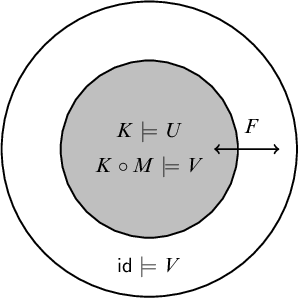
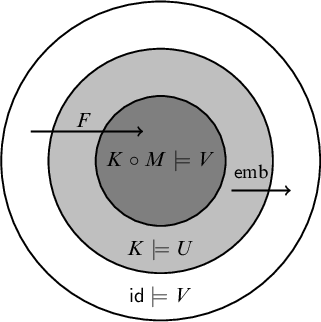

 Open access

