





Introduction
The agricultural sector plays a crucial role in the economies of many developing countries as a source of income and foreign exchange earnings (Kuntashula et al., Reference Kuntashula, Chabala and Mulenga2014). However, as highlighted by von Loeper et al. (Reference von Loeper, Musango, Brent and Drimie2016), agriculture, which constitutes a third of the planet's surface, has resulted in environmental and ecosystem degradation, such as soil erosion and biodiversity loss. These have negative implications on crop yields and are exacerbated by droughts and floods. Abdulai and Huffman (Reference Abdulai and Huffman2014) pointed out that these lower yields often lead to severe food shortages and welfare losses, particularly among smallholder farming households in Sub-Saharan Africa.
Mango et al. (Reference Mango, Siziba and Makate2017) further indicated that very few farmers in Sub-Saharan Africa employ soil conservation farming practices, trapping farmers in a vicious circle of poverty and hunger due to soil degradation. With the global imperatives of attaining sustainable development goals (SDGs), such as ending poverty in all its forms (SDG 1) and zero hunger (SDG 2), the promotion and adoption of good agricultural practices are paramount to achieving these goals, especially in developing countries.
Conservation agriculture (CA) is considered an ideal system for sustainable, climate-smart agriculture through which smallholder farmers can improve soil health and the environment, attain higher levels of crop yields and food security, and achieve higher net income returns (Mango et al., Reference Mango, Siziba and Makate2017; Swanepoel et al., Reference Swanepoel, Swanepoel and Smith2018; Lehman, Reference Lehman2019; GrainSA, 2021). Although CA includes crop diversification (CD), minimum tillage (MT) and soil cover, this study focuses only on CD and MT. Specific features in South Africa, including low rainfall, limited agricultural land area and a larger proportion of smallholder farmers, necessitate the implementation of CA (Lehman, Reference Lehman2019).
The findings on the impact of CA on welfare outcomes from previous studies are quite mixed, showing a positive impact, negative impact or no impact at all. As such, the findings cannot be generalized across different locations, owing to other influential factors at play. For instance, Abdulai and Huffman (Reference Abdulai and Huffman2014) suggest that factors, such as variations in wealth, size of landholdings and differences in soil conditions, make it difficult to generalize the adoption patterns of new agricultural technologies in Sub-Saharan Africa. Moreover, there are limited studies on the assessment of the impact of adopting CA on smallholder farmers' income or net returns; this study aims to fill this research gap.
The research seeks to achieve this by addressing two research questions: (1) What are the factors influencing the farmer's choice of CA practices? and (2) Have the practices of CA improved the income of smallholder (small-scale) farmers in the Mpumalanga Province of South Africa? Addressing these research questions can inform policy on which strategies to promote, given the effects on the income of smallholder farmers. As a result, financial and extension resources can be efficiently channeled toward the promotion of the strategies that are the most economically and environmentally beneficial.
The rest of the paper proceeds as follows. Section ‘Impact of CA and related technologies adoption on welfare parameters’ provides a brief review of the literature on the impact of CA on income and other welfare parameters such as food security. Section ‘Materials and methods’ presents the methodological approach adopted in the paper. The empirical results are presented and discussed in the “Results and discussion” section. The paper ends with some conclusions and policy recommendations in the “Conclusions and policy implications” section.
Impact of CA and related technologies adoption on welfare parameters
For any given technology or intervention, it is always imperative to assess the impact it has on the welfare of the supposed beneficiaries in order to inform policy. For instance, in this case, it is important to understand the effects of engaging in CA on the welfare of smallholder farmers. To achieve this, a number of previous empirical studies are reviewed to understand the impact of the adoption of CA and other related technologies on a number of outcome variables, including yields, income, employment creation and food security.
Osewe et al. (Reference Osewe, Mwungu and Liu2020) studied the impact of MT on the welfare of smallholder farmers in Southern Tanzania. They focused on the effects of MT adoption on households' per capita net crop income and labor demand. Their findings revealed positive and significant impacts of MT adoption on smallholder households' per capita net crop income. The authors further reported a significant reduction in total household labor demands that allow family members to engage in other off-farm income-generating activities.
Similarly, Abdulai and Huffman (Reference Abdulai and Huffman2014) examined the factors that influence the adoption of soil and water conservation technology, as well as the impact of adoption on yields and net returns among rice farmers in northern Ghana. Their results showed that farmers who adopted these technologies had significantly higher rice yields and net returns compared to the non-adopters. In China, Yang et al. (Reference Yang, Yin, Mugera and Wang2021) assessed the determinants of the adoption of five mutually exclusive soil conservation practices (SCPs) and their impact on rice yield and chemical fertilizer use. The results showed significantly higher rice yield and decreased chemical fertilizer usage among farmers that adopted SCPs as a package.
Another study by Mango et al. (Reference Mango, Siziba and Makate2017) used a sample of 1623 households in Zimbabwe, Malawi and Mozambique (Africa) to determine the impact of CA adoption on food security among smallholder farmers. The results showed no significant impact of CA adoption on the Food Consumption Score of farmers in Zimbabwe and Malawi. Contrasting results were reported in Mozambique, where CA was found to significantly improve the Food Consumption Score for farmers who adopted the technology.
Kuntashula et al. (Reference Kuntashula, Chabala and Mulenga2014) studied the impact of MT and crop rotation on maize yields and incomes for farmers adopting these strategies in Zambia. Their findings revealed that while both strategies improved maize productivity, only MT significantly improved gross income.
Another critical implication of CA is its influence on employment creation particularly in the rural areas where employment opportunities are limited. Hence, it is important to understand how the adoption of CA influences employment within farming households. Several studies present contradicting but interesting discussions on this issue. As mentioned earlier in this section, Osewe et al. (Reference Osewe, Mwungu and Liu2020) found that the adoption of MT in Southern Tanzania had a significant reduction in labor demand thereby affording the household members more time for other non-farm income opportunities. In a similar vein, Johansen et al. (Reference Johansen, Haque, Bell, Thierfelder and Esdaile2012) highlight that CA reduce labor demands when planting is mechanized, and herbicides are applied to control weeds.
Contrary to Osewe et al. (Reference Osewe, Mwungu and Liu2020), other authors (Montt and Luu, Reference Montt and Luu2018) looked at how CA influences labor requirements in Ethiopia, Kenya, Malawi, Mozambique and Tanzania. Their findings showed that CA increases farms' labor input requirements, especially during the harvesting and threshing stages. However, they realized that these labor requirements are fulfilled by household labor (unpaid work) and not hired labor, shifting the farming workload toward women (as compared to men) and children. This has policy implications on gender dynamics given the alterations in the agriculture landscape owing to CA adoption. Wekesah et al. (Reference Wekesah, Mutua and Izugbara2019) also pointed out that CA increases workloads, income, household food security, employment opportunities and health risks for women.
As alluded to earlier, the reviewed studies display mixed results on the impact of technology adoption on various welfare parameters, depending on specific circumstances in different study sites. Hence, a ‘blanket approach’ in promoting adoption of high-yielding technologies among smallholder farmers will not yield favorable results. Thus, extra caution needs to be taken not to generalize findings across different sites.
Materials and methods
Study area
The study was conducted in the Gert Sibande District Municipality in Mpumalanga Province of the Republic of South Africa. Gert Sibande District is a Category C municipality and is the largest of the three districts in the province, measuring 31,841 km2 in area, which covers almost half (40%) of Mpumalanga Province's total land mass of 76,495 km2. The district, which accounts for about 6.5% of South Africa's land surface, consists of seven local municipalities: Govan Mbeki, Chief Albert Luthuli, Msukaligwa, Dipaleseng, Mkhondo, Lekwa and Dr Pixley ka Isaka Seme. Figure 1 shows the district and its local municipalities. The major towns are Amersfoort, Amsterdam, Balfour, Bethal, Breyten, Carolina, Charl Cilliers, Chrissiesmeer, Davel, Ekulindeni, Embalenhle, Empuluzi, Ermelo, Evander, Greylingstad, Grootvlei, Kinross, Leandra, Lothair, Morgenzon, Perdekop, Secunda, Standerton, Trichardt, Volksrust, Wakkerstroom, eManzana and eMkhondo (Piet Retief).
Map of Gert Sibande District, Mpumalanga Province of South Africa.
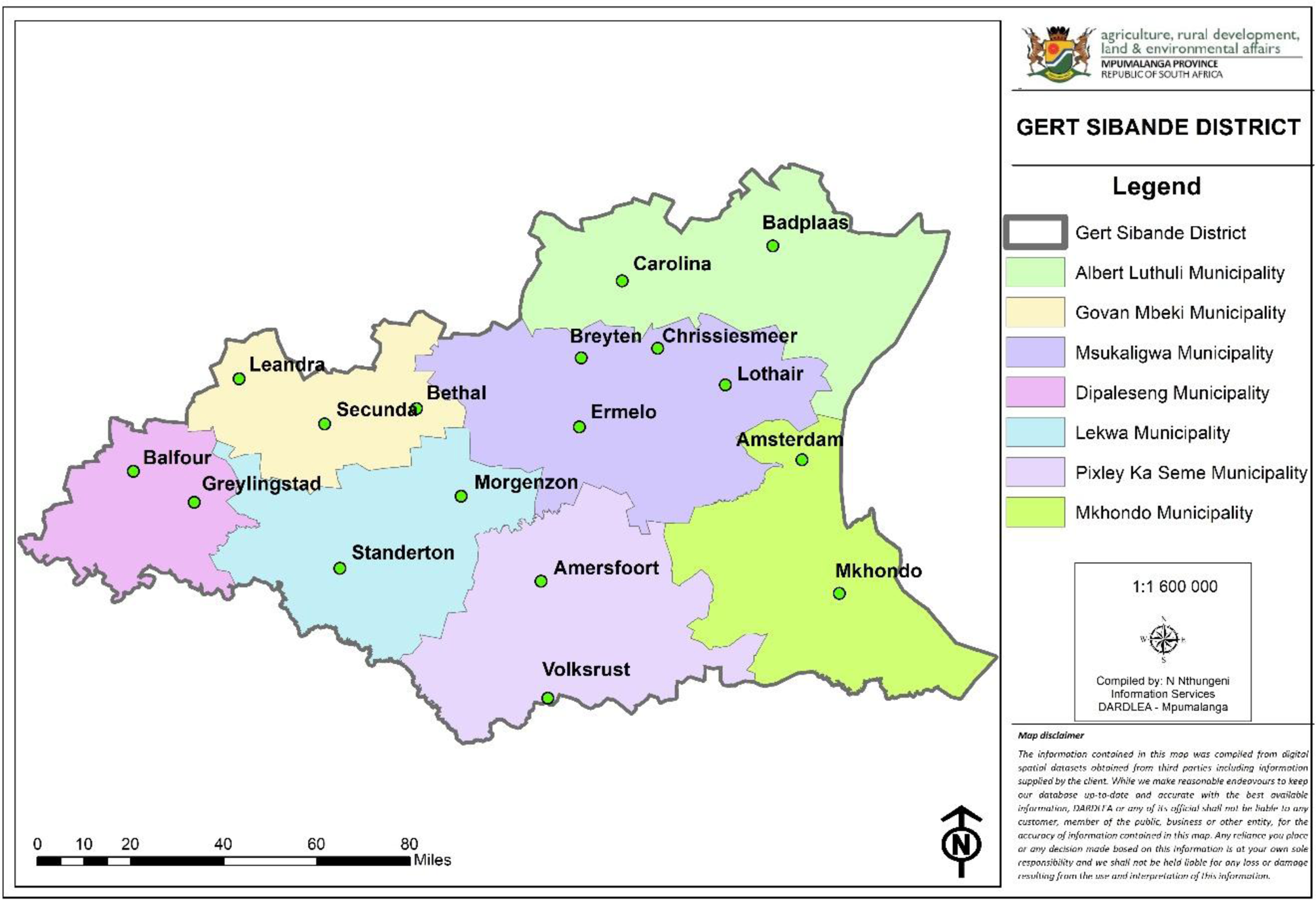
This area was chosen because of its high concentration of subsistence farmers which accounted for about 2000 farmers (Mngqawa et al., Reference Mngqawa, Mangena-Netshikweta and Katerere2016). The area between Carolina, Bethal and Ermelo produces the most sheep and wool in South Africa, which indicates the region's significance to agriculture in South Africa. Also, the area is known for its high maize production. Despite its size, in 2018, Gert Sibande District contributed only 2.06% to the GDP of South Africa, or 27.68% to the Mpumalanga Province's total GDP of R 363 billion, ranking it the lowest relative to all the regional economies in the Mpumalanga Province (SA Stat, 2018). The district was part of the mapping area where CA adoption was introduced, and it is one of the top three maize producing regions in South Africa, accounting for 23.5% of the total maize production in South Africa (Greyling and Pardey, Reference Greyling and Pardey2019). The major economic sectors are mining, agriculture, energy and manufacturing.
Sampling technique and data collection
Farm-level cross-sectional survey data were collected between December 2019 and August 2020 from smallholder maize farmers in the Gert Sibande District of Mpumalanga Province, South Africa, using a semi-structured survey questionnaire validated by two agricultural economists. A test of reliability was performed on the questionnaire to establish its use. The questionnaire contained logic flow questions aimed at farmers' socio-economic characteristics, farm-based characteristics, CA adoption and knowledge about CA. The survey was conducted through 40 min face-to-face interviews with the help of four trained enumerators who received training on CA and related information. The questionnaire was translated into local languages that the farmers can understand for better interpretation and accuracy. Consent from the farmers and approval from the ethical department of the University of South Africa was obtained before the commencement of the questionnaire administration, dated 19 February 2020. A representative sample size (250 maize farmers) was determined from the population of 710 smallholder maize farmers, using Slovin's formula, given in Equation (1), after which a total number of 250 questionnaires were administered to the maize farmers in the district, using a proportionate random sampling technique. Following Oduniyi (Reference Oduniyi2018), this was achieved by adopting a quantitative model, as presented below:

where n is the sample size; N equals the total population of maize farmers in the seven local municipalities across the district; e equals maximum variability or margin of error, estimated at 5% (0.05); 1 equals the probability of the event occurring, and 250 equals the number of respondents sampled or sample size. Table 1 shows the distribution of sample size collected according to each municipality or stratum. The data collected were analyzed using STATA 15.
Sample size taken in each municipality (stratum)

Source: Author's computation (2021).
A conceptual framework and empirical/estimation techniques
A smallholder farmer's decision to adopt CA practices is a behavioral response, where farmers choose or adopt components of the CA practices that increase their utility or expected profit subject to constraints. The constraints are where the polychotomous adoption decision depends on several factors, such as socio-economic characteristics, available CA information and the benefits of CA. The adoption of any of the components of CA is modeled within the random utility framework (Ali and Abdulai, Reference Ali and Abdulai2010; Kassie et al., Reference Kassie, Marenya, Tessema, Jaleta, Zeng, Erenstein and Rahut2018). A farmer may decide to adopt either a single CA practice or a combination of CA practices, such as MT variety, CD or a combination of minimum tillage and crop diversification (MTCD) if the expected profit from adoption is higher than the expected profit from non-adoption. See Table 2, which explains the different CA choices.
Adoption of conservation agricultural (CA) strategies and sample distribution

Source: Author's computation (2021).
Thus, the adoption of CA practices is based on individual choices and may be correlated with unobservable characteristics that could also affect farmers' income. However, a simple comparison of income groups may lead to an inaccurate result. To account for both endogeneity and sample selection, a MESR (multinomial endogenous switching regression) framework was used. More specifically, following Dubin and McFadden (Reference Dubin and McFadden1984), we apply a selective corrected MESR treatment effect approach and use the method by Bourguignon et al. (Reference Bourguignon, Ferreira and Walton2007) to correct for selection bias.
According to Kumar et al. (Reference Kumar, Mishra, Saroj and Joshi2019), MESR has the advantage of evaluating both individual and alternative combinations of practices. MESR also captures both self-selection bias and the interactions between choices of alternative practices (Wu and Babcock, Reference Wu and Babcock1998; Mansur et al., Reference Mansur, Mendelsohn and Morrison2008) as well as unobserved heterogeneity associated with economic evaluations of the non-random adoption of CA practices. The model involves two stages. In the first stage, the maize farmers' choice of combination of CA practices was modeled using a multinomial logit selection model while identifying the interrelations among the CA choices. In the second stage, the impacts of each choice of CA practices on the outcome variable were estimated using ordinary least squares (OLS) with a selectivity correction term from the first stage. Similarly, for identification, a variable named the number of extension visits was used as an instrumental variable.
Multinomial logit (adoption) selection model
Following Kumar et al. (Reference Kumar, Mishra, Saroj and Joshi2019) and Danso-Abbeam and Baiyegunhi (Reference Danso-Abbeam and Baiyegunhi2018), it is assumed that smallholder maize farmer i aims to maximize his/her net returns, πi, by comparing the positive return from different choices of CA practices, k, (k = 1,2,3,4) over any alternative practice, m, which is given as

where πik ∗ is a latent variable defining the expected net benefits a maize farmer derives from the adoption of CA choices k, which is determined by both observed and unobserved characteristics. Xi represents a vector of observed exogenous or covariates variables, and ɛik is an error term accounting for unobserved characteristics.
Assuming J is the index that signifies maize farmers' choices of CA practices k, such that

In Equation (2) above, the index function suggests that maize farmers will adopt CA practice k, if they derive or expect a greater benefit or net returns from other CA practices m.

Assuming that the error term (ɛ) is identical, and Gumbel is distributed independently, then the probability that maize farmer i with characteristics Xi will adopt CA practice k can be expressed by the use of a multinomial logit model (McFadden, Reference McFadden and Zarembka1973).

The parameters of the latent variable model are then estimated with a maximum likelihood function.
Multinomial endogenous switching regression (MESR)
The use of MESR was explored in the second stage where the relationship between the outcome variables and a set of exogenous variables is assessed for the adopted CA practices. The model estimated the parameters of the impacts of CA choice sets k (MT0CD0 = non-adopters as reference category; MT1CD0 = adopters of MT practices; MT0CD1 = adopters of crop rotation practices; MT1CD1 = adopters of both MT practices and crop rotation practices) on the outcome variables. The outcome equation for each possible regime j is given as

where Yik represents the outcome variable of the ith maize farmer associated with the selected regime k, Xi represents a vector of explanatory variables or exogenous covariates, β is the vector of parameters, and ɛik and ɛi 1 are random disturbance terms. Yik is observed if, and only if, CA practice k is adopted, which occurs when πik ∗ > maxm ≠k (πim ∗). However, if the ɛk and ɛ1 are not independent, OLS estimates obtained from Equation (4) will be biased. Thus, consistent estimation of Xi requires the inclusion of the selection bias correction terms of the alternative CA practices m in Equation (4). It is assumed that the linear assumption of the DM (Dubin and McFadden, Reference Dubin and McFadden1984) is given as

With this assumption, the MESR in the equation above can be expressed as

where σk is the covariance between the error terms δ in Equation (1) and ɛ in Equation (4); φ's are the error terms with an expected value of zero, and λk is the Inverse Mills ratio computed from the MESR estimate in Equation (2).

where ρ k defines the correlation coefficient of the three error terms, ɛ, ẟ and φ. However, the heteroscedasticity problem, which could arise from the generated regressor λk, was accounted for by the use of bootstrap errors.
Conditional expectations and estimation of average treatment effects
MESR was used to compute the treatment effect. This framework can compute both the average treatment effect on the treated (ATT) and on the untreated (ATU). This was done by comparing the expected outcome value of the treated (each choice of CA adopted) and the untreated (non-adopters) in actual and counterfactual scenarios. Following Di Falco and Veronesi (Reference Di Falco and Veronesi2013), the ATT in the actual and counterfactual situation can be expressed as
Adopters with adoption (actual expectations observed in the sample):


Adopters, had they decided not to adopt (counterfactual expected outcomes):


Equations (8a) and (8b) represent the real expectations observed in the sample. Similarly, Equations (9a) and (9b) represent the counterfactual expected outcome. In order to compute the average treatment effect on the treated (ATT), the difference between Equations (8a) and (9a) was calculated. This could be expressed as

Correspondingly, the average treatment effect on the untreated (ATU) is the difference between Equations (8b) and (9b), given as

Results and discussion
Summary of the descriptive statistics
Table 3 shows the data measurement and the expected sign. The summary statistics are presented in Tables 4 and 5 in which the mean income of the non-adopter (MT0CD0) is R9674.29 ($618.95) per farm hectare of maize cultivated and the average income for all the farmers together is R16867.18 ($1079.15) per farm hectare of maize cultivated. The mean age of the smallholder maize farmers in the study area is about 48 years, the average farm experience is 11 years, the average farm size is 123 hectares and the years spent in school is 10 years. Note that farm size is not the total cultivated land for maize production, as farmers do not cultivate the whole farmland perhaps due to a lack of resources, that is, not the whole farmland is cultivated. Most of the farmers are male (52.4%), with 83.65% having access to extension services and 80.8% having access to agricultural inputs. Of the total sample, 47.2% of farmers have access to credit facilities and 80.4% are cooperative members.
Variables description and expected sign

Source: Author's computation (2021).
Summary statistics of the variables used in the analysis

Source: Author's computation (2021).
a Denotes dummy variables.
Summary statistics of the variables used in the analysis

Source: Author's computation (2021).
Denotes dummy variables.
Factors influencing the adoption of CA
The result of the multinomial logit estimate is presented in Table 6. As stated by Danso-Abbeam and Baiyegunhi (Reference Danso-Abbeam and Baiyegunhi2018), the explanation of coefficient parameters does not provide a better interpretation of the magnitudes in probability models. However, providing the values of the marginal effect specifies the direction of the influence of the covariates on the dependent variables and reveals the magnitude of the effect on the predicted probability. Thus, the study provides the marginal effect values alongside the multinomial estimates. The results show that the estimated coefficients differ significantly across the different choices of adoption of CA practices.
Multinomial logit estimates of adoption of conservative agriculture (CA) practices

Source: Author's computation (2021).
Note: *, ** and *** denote statistical significance at 1, 5 and 10% levels, respectively.
Base group farmers are those who didn't adopt any CA practices (MT0CD0).
The gender of the household head significantly affects the adoption of CA practices. Across the three options of CA practices, decisions of the male household head farmer are positive and statistically significant in influencing the adoption of MT (P < 0.01), CD (P < 0.01) and both MTCD (P < 0.1), respectively. Male-headed households are more likely than female-headed households to adopt CA practices across the three choices of CA practices. This is not surprising as male-headed households have a higher tendency to take chances in adopting innovations compared to female-headed households. In Africa, and mostly in rural areas, the involvement of male farmers is felt more in agricultural farming, which provides male farmers more opportunities and the predisposition to try innovations than their female counterparts. This result is consistent with many studies on gender differences in agriculture. For example, Belay et al. (Reference Belay, Recha, Woldeamanuel and Morton2017) and Marie et al. (Reference Marie, Yirga, Haile and Tquabo2020) reported that male-headed households are more likely to have access to innovations than are female-headed households. Male farmers are in a better position to practice diverse adaptation strategies than their female counterparts. Similarly, Gebre et al. (Reference Gebre, Isoda, Rahut, Amekawa and Nomura2019) pronounced that intensity of the adoption of improved maize varieties (an example of innovation) is lower for female-headed households compared to male-headed households where decisions are made jointly. However, Yang et al. (Reference Yang, Yin, Mugera and Wang2021) and Oduniyi (Reference Oduniyi2021) were of a contrary opinion and reported that female-headed households are more likely to adopt the combination of the three SCPs.
Access to extension services was found to have a significant and negative impact on the decision to adopt MT (MT 1CD 0). In other words, farmers who do not have access to extension services are more likely to adopt MT out of the three CA practices. Although it is expected that access to information by the extension officer is crucial in increasing the adoption rate, this was not the case in this study. The plausible explanation could be those extension officers were unable to deliver quality and accurate information needed by the farmers in order to adopt CA practices. Many times, the extension officers failed to comprehend farmers' problems and priorities, leading to poor adoption of the recommended innovations. Masere (Reference Masere2015) reported that most of the technologies disseminated by the extension officer are the ‘one-size-fit-all’ approach to different farmer groups with different needs and problems. Besides, MT has been widely practiced in the past, which serves more as a traditional method for the farmers. Hence, in the absence of no or lack of accurate information, it is easier for farmers to continue with what they know. Contrary to this result, Akhter and Rahut (Reference Akhter and Rahut2013) and Abdulai and Huffman (Reference Abdulai and Huffman2014) found that the impact of agricultural extension services plays a significant role in the adoption of improved agricultural technologies and SCPs, respectively.
There was a positive relationship between being a member of a farmer cooperative group and the adoption of MT (MT 1CD 0) and CD (MT 0CD 1). This suggests that farmers who belong to a cooperative group (farmers' group, social network) are more likely to have access to information that informed their decision to adopt two options of CA practices. This is not surprising as farmers may share information or experiences about successful production practices and adaptations to existing practices during their meetings. This result is supported by Wossen et al. (Reference Wossen, Abdoulaye, Alene, Haile, Feleke, Olanrewaju and Manyong2017), showing that cooperative membership has a positive and statistically significant effect on technology adoption and household welfare. Similarly, this result is consistent with Bandiera and Rasul (Reference Bandiera and Rasul2006), who avowed that social capital and farmers' groups are essential factors influencing the adoption of SCPs.
The impact of the adoption of CA on farmers' net returns
The impact of CA adoption on the farmers' net returns from maize production is explained in this section. Table A1 (see Appendix) shows the first stage of the selectivity corrected MESR method after which the estimated average net returns (income) from the adoption of CA practices are calculated for both the ATT and ATU (counterfactual) effects (see Table 7). Remarkably, in all three choices of CA practices, ATT and ATU effects are positive, suggesting that regardless of the choices of CA practices adopted by the maize farmers, the income realized is higher for adopters than for non-adopters of CA practices. For example, the average treatment effect on the treated MT 1CD 1 adopters increases by 60.31% (R15575.99/$996.88USD) compared to the non-adopters. Farmers who adopted MT 1CD 0 and MT 0CD 1 had a 50.32% (R12612.33/$806.11USD) and 46.01% (R9287.83/$593.62USD) increase in their income, respectively, compared with the non-adopters. This result is supported by Yang et al. (Reference Yang, Mugera, Yin and Wang2018) and Varma (Reference Varma2019), whose studies found a positive relationship between agricultural technology adoption and yield.
Average expected income from maize cultivation/farming (Rand)

Source: Author's computation (2021).
Note: *, ** and *** denote statistical significance at 1, 5 and 10% levels, respectively.
Sample size is 250, and 500 simulation draws were used. The baseline category is non-adoption of CA practices.
Furthermore, the counterfactual effect measured what would have happened to the adopters in the absence of the CA practices. In all the counterfactual (ATU) cases, the smallholder maize farmers who adopted CA practices would have had lower incomes had they not adopted any of the CA practices (see Table 7). For example, for farmers who did not adopt any CA practices (MT 0CD 0), their income would have increased by R5722.09 ($366.19USD) had they adopted MT 1CD 0. Farmers who adopted MT 0CD 1 and MT 1CD 1 increased their income by R6731.26 ($430.90USD) and R13403.85 ($858.05USD), respectively. Consequently, the results obtained from both the ATT and ATU situations indicate that farmers obtained a significantly higher income by adopting MT 1CD 0, MT 0CD 1 and MT 1CD 1 compared to non-adopters.
Conclusions and policy implications
A better understanding of the impact of CA on smallholder farm income and the factors that affect the adoption of these practices is imperative to improving food security in the developing world, as well as improving farm income and reducing agriculture's negative effect on the environment. Cross-sectional survey data from 250 smallholder maize farmers were used to investigate the impact of the adoption of three CA strategies on the income of smallholder farmers in the Gert Sibande District Municipality in Mpumalanga Province, South Africa: MT, CD and both. A MESR model was employed to determine the impact of adopting conservation agricultural practices on the income of smallholder maize farmers.
We find that adopting CA practices significantly increases the income of smallholder farmers in the region, ranging from a low of 37.17% (or R5722/$366.29USD) for MT only to a high of 58.08% (or R13404/$855.87USD) for a combination of both MT and CD, relative to not adopting either practice. Further, we find that male farmers are significantly more likely to adopt all three CA strategies and that those who are members of cooperatives are significantly more likely to adopt MT or CD but not both on maize fields. The effect of cooperative membership is not surprising since we know that farmers are more likely to use the information they receive from other farmers and social networks (Prokopy et al., Reference Prokopy, Floress, Klotthor-Weinkauf and Baumgart-Getz2008). Conversely, maize farmers who had access to extension services were significantly less likely to adopt MT (though at the 10% level) and while not significantly different from zero, was negatively correlated with the use of CD as well.
These findings are promising for CA adoption in Sub-Saharan Africa and other arid regions where soil and water conservation are imperative to increase agricultural productivity and where agriculture is a primary means to both food and income security. We provide empirical evidence that combining practices increase income at much higher rates than single CA practice adoption. If the environmental benefits from simultaneous adoption are greater than single practice adoption, the total benefits (private and social) may far outweigh the costs. With only 18% of the sample adopting both practices, there is potential to increase farm income and environmental benefits through simultaneous CA adoption.
We know that farmers who adopt one CA practice are more likely to adopt additional practices than those who do not adopt any practices (Upadhyay et al., Reference Upadhyay, Young, Wang and Wandschneider2003). Policies that try to improve farm income while also improving environmental benefits could first target the 34% of farmers who adopt single practices before attempting to convince those who have not yet adopted any practices. These campaigns could provide subsidies to use both practices simultaneously and to disseminate information and training through cooperatives and other farmers via the training of trainers approach. Many farmers may choose not to use CD and MT simultaneously because they are unaware of the best crop mix to use to reduce fertilizer and other input costs, improve weed management and receive target market prices. Subsidies could help pay for new technology and farm equipment, supplement income in seasons when the non-maize crop does not offer high enough prices (in the case of CD) and ease the risk of trying new CA practices.
Paying farmers in developing countries to adopt CA practices that are shown to provide them with financial benefits will be difficult where money could be spent on basic infrastructure, health, social welfare and education. Research shows that farmers are reluctant to try new practices, even if they are more profitable than the current practices (Baumgart-Getz et al., Reference Baumgart-Getz, Prokopy and Floress2012). Additional subsidy incentives are required to convince many farmers to switch practices. This may be the case for the 34% of farmers who are already using one CA practice and those in the 47% who do not use any of the two CA practices. More effort is needed to promote the adoption of CA strategies among non-adopters given their impact on income, a welfare parameter that has direct implications on food security and poverty reduction.
Our findings related to extension officers are concerning. The study shows that extension can play an important role in education, problem-solving, identifying resources and disseminating information in general. Extension agents are familiar with local issues and are better able to reach territories that other government agents cannot. They could play an important role in the success of any new CA policy. There may be an opportunity for extension agents to leverage involvement in cooperatives to work more closely with farmers and help them navigate programs or policies designed to increase conservation acres and practices in the region.
Conflict of interest
None.
Appendix
Validation of selection instrument

Second-stage parameter estimates of income from multinomial endogenous switching regression model (MESR)


 Open access

