

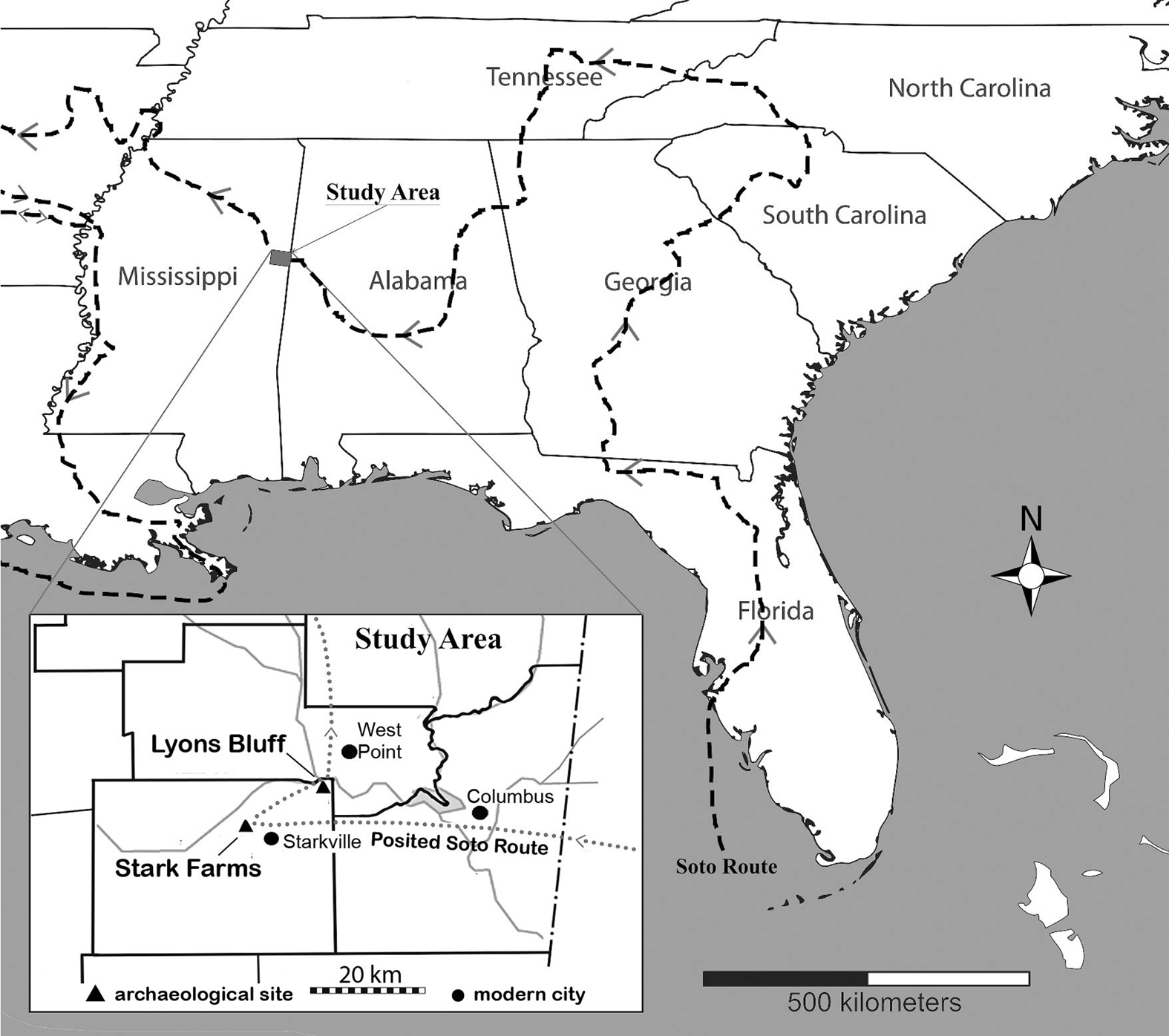
Our research on a cluster of sites in Mississippi, USA, known collectively as Stark Farms, has yielded a distinctive assemblage of metal artifactsFootnote 1 likely linked to Hernando de Soto's sixteenth-century expedition (1539–1543) in southeastern North America (hereafter, Southeast; Figure 1). In our studies, we have faced a conundrum of how best to conceptualize and interpret these objects, many of which were modified by Native Americans. Given the swirling debates over hybridity and related concepts, how do we best fill in the blank for the process by which horseshoe fragments became scrapers, barrel bands became celts, and copper-alloy fragments became tubular beads? Was it hybridity? Creolization? Entanglement? Does it matter what we call it? By adopting a specific term for the material melding of different cultural traditions, have we taken a stake in a theoretical perspective, opening some avenues for interpretation while closing others?
Stark Farms vicinity (inset) and projected route of Soto, 1540–1541 (prepared by Timothy D. Pieper, South Carolina Institute of Archaeology and Anthropology).

The assessments of hybridity and related concepts are varied, and there are several useful reviews in the literature (e.g., Card Reference Card and Card2013; Liebmann Reference Liebmann2015; Palmié Reference Palmié2013; Silliman Reference Silliman and Card2013, Reference Silliman2015; VanValkenburgh Reference VanValkenburgh2013; Werbner Reference Werbner, Werbner and Modood1997). Although the caveats are wide ranging, in condensed form, three interrelated strands have emerged that seem to be of particular significance to our study: ontology, epistemology, and history. First, the ontological inquiry reflects a concern with a priori assumptions about the purity of objects, assemblages, or social entities before they came together as putative hybrids (Palmié Reference Palmié2013; Stockhammer Reference Stockhammer2013:13; VanValkenburgh Reference VanValkenburgh2013:306). Following this critique, cultures are always engaged in a dynamic churn of borrowing and innovation; by definition they are hybrid (Bakhtin Reference Bakhtin, Emerson and Hosquist1981; Bhaba Reference Bhabha1994; Latour Reference Latour1991; Palmié Reference Palmié2013:468). Consequently, to define something as hybrid because it seems to embody two or more distinct traditions is to create boundary conditions that are just as likely to be a function of observer bias as they are a classification imposed by those who created or used the hybrid. As Palmié (Reference Palmié2013) asks, where (and why) do we make the cut?
Second, these points are interwoven with debates over the relative theoretical merits and drawbacks of hybridity versus alternative concepts. “Entanglement” has gained favor in recent years because its advocates argue that it is less prone to the failings of essentialism and biological metaphors (cf. Jordan Reference Jordan, Ferris, Harrison and Wilcox2014; Silliman Reference Silliman, Der and Fernandini2016; Stockhammer Reference Stockhammer2013). Some proponents of hybridity have found “entanglement” unsatisfactory because, they argue, the term is denatured of a connection to the relations of inequality that frame colonialism (Liebmann Reference Liebmann and Card2013; Silliman Reference Silliman2015). A similar charge has been leveled against creolization (Mullins and Paynter Reference Mullins and Paynter2000). These debates raise a fundamental issue: what do we really want to know when we highlight the hybrid characteristics of an object or an assemblage? The most consistent—and in our opinion, valid—support for addressing hybridity in colonial contexts is its linkage with relations of power (Liebmann Reference Liebmann2015:322; Loren Reference Loren2013; Silliman Reference Silliman2015:282). In other words, it seems to be a particularly compelling concept when it evokes “competing visions of reality and political struggles” between aspiring colonizers and those whom they aspire to colonize (VanValkenburgh Reference VanValkenburgh2013:312).
Our third point follows directly from the second. The larger spatiotemporal context of hybridity in the era of European colonialism mediates the ways in which belonging and power are phrased. Many of the seminal theoretical works on hybridity have been situated within an arena of advanced colonialism. This is a period when major cultural, political, and economic transformations had already been underway for at least one to two centuries and when colonial regimes were often well established, even if their dominance was problematic. But this interval represents only a slice of the colonial experience. The postcolonial engagement with the power subtleties of earlier forms of European expansion has been slight in comparison to the latter age of empires (Ehrhardt Reference Ehrhardt and Card2013:370; Voss Reference Voss, Voss and Casella2011:15). Moreover, because the oft-cited luminaries of hybridity (e.g., Bakhtin Reference Bakhtin, Emerson and Hosquist1981; Bhabha Reference Bhabha1994; Latour Reference Latour1991) largely draw their observations from contexts of late-European colonialism or globalization, the forms of hybridity they address are typically ubiquitous due to a long-established, widespread circulation of goods, media, peoples, and ideas. As a result, they emphasize the theoretical dilemma of understanding how “[h]ybridity is celebrated as powerfully interruptive and yet theorized as commonplace and pervasive” (Werbner Reference Werbner, Werbner and Modood1997:1). The conditions of early-European colonialism, however, often run counter to these two themes: it is a time when structures and institutions of domination were still embryonic, when relations of power were highly heterogeneous, when the geopolitical status of European incursions was precarious, and when material forms of cultural mixing may have been relatively novel. As ethnohistorians have demonstrated (e.g., DuVal Reference DuVal2006; White Reference White1991), a number of Native American peoples in eastern North America exercised a considerable degree of autonomy and territorial control for centuries after the arrival of the first Europeans. The shifting power interactions between and among these groups confound generalizations about the nature of hybrid practices.
Our ensuing study emphasizes how historical context complicates the ontology and epistemology of cultural mixing and the methods employed to address it. Even if the concept of hybridity is narrowed down to an examination of relations of power, “colonial” is far too broad of a notion—socially, culturally, and temporally—for outlining a study. We must ask not only what a hybrid is but when a hybrid is: “Under what socially and historically specifiable conditions do any of them [hybrids] emerge, become ratified or contested, eventually normalized, suppressed, or transformed, with all the potential violence any of these options may imply?” (Palmié Reference Palmié2013:472). As we will argue, the acquisition, transformation, and use of objects of European origin in the 1500s to early 1600s in the interior American Southeast seem to have followed a distinct cultural trajectory of hybrid practices before European imperial projects began to make significant inroads in the region.
We note that we first published a descriptive analysis of a portion of the metal artifact assemblage (Legg et al. Reference Legg, Blanton, Cobb, Smith, Lieb and Boudreaux2019) in a comparative study with the contemporary Glass site (Georgia) to demonstrate that mechanisms in addition to gifting may have been an important factor in the occurrence of metal objects on sixteenth-century Indigenous sites. In a more recent study (Legg et al. Reference Legg, Cobb, Boudreaux, Lieb, DePratter, Smith and Mathers2020), we provided a more thorough descriptive analysis of the assemblage and its context to make the argument that it was probably linked to the Hernando do Soto entrada. In this article, we provide our first theoretical and methodological assessment of the hybrid dimensions of the metal tools, alongside our argument for the necessity of situating the spatiotemporal context of hybrid practices.
Situating Sixteenth-Century Colonialism in the American Southeast
European colonialism was an ensemble of highly heterogenous projects and agendas. It changed dramatically over the course of time as evolving attitudes toward the Other, shifting geopolitical fortunes, ongoing philosophical changes (Renaissance to Enlightenment to post-Enlightenment), economic transformations (mercantilism to industrialism), and other trends all transformed the contours of colonial aspirations. In turn, the responses of Indigenous peoples to European encroachments, coupled with their own ambitions, profoundly shaped and reshaped the colonial terrain over the centuries. Furthermore, the variable spatial encroachments of colonialism led to a complicated mix of European and Indigenous peoples that was distinctive to any given locale, thereby making it difficult to extrapolate conditions from one region to another except in a very general way. Consequently, outlining a study in the context of European colonialism requires a number of qualifiers denoting time, region, and relevant peoples because these all factor into the calculus of the logic and effects of hybridity (Thomas Reference Thomas1994:48).
Debates in Native American literary criticism and cultural studies have taken up this issue, faulting postcolonial scholarship for failing to parse colonial histories more finely (Carpenter Reference Carpenter2008; Rifkin Reference Rifkin2017; Sexton Reference Sexton2016; Vizenor Reference Vizenor1999; Weaver et al. Reference Weaver, Womack and Warrior2006). This line of research has attempted to model the progression of European colonialism in two crosscutting ways: to emphasize that it qualitatively changed through time (even if in a time-transgressive manner globally) while at the same time recognizing that it was never a strictly linear nor totalizing enterprise. Mark Rifkin (Reference Rifkin2017), for example, distinguishes colonialism—the early stages of attempting to dominate Indigenous peoples—from settler colonialism, which is where colonials have occupied Indigenous landscapes and are actively working to remove both the presence and memory of their original inhabitants. But he recognizes that both can co-occur in the same region and even be articulated with one another. For his part, Gerald Vizenor (Reference Vizenor1999:109) relies on “paracolonialism” to characterize what is commonly referred to as advanced or settler colonialism. In contrast, the notion of “pericolonial” has been employed for an even more advanced and pervasive settler colonialism that, for Indigenous peoples, “must be “gotten around, under, or through” (Weaver et al. Reference Weaver, Womack and Warrior2006:39). This kind of thinking has been condensing for some time among a number of archaeologists. They have called for demarcating settings where the ripples of European colonialism may have been present but where colonization had yet to be achieved either because it was in its formative stages or because Indigenous societies were successful at fending off European incursions (e.g., Bayman Reference Bayman2009; Cobb Reference Cobb and Cobb2003; Ehrhardt Reference Ehrhardt and Card2013; Gosden Reference Gosden2004; Hauser et al. Reference Hauser, Armstrong, Wallman, Kelly and Honychurch2019; Jordan and Gerard-Little Reference Jordan, Gerard-Little, Pezzarossi and Sheptak2019; Silliman Reference Silliman2005).
Stephen Acabado (Reference Acabado2017) addresses these circumstances within the Ifugao highlands at the onset of Spanish penetration in the northern Philippines in the eighteenth and early nineteenth centuries. He rephrases the notion of pericolonialism somewhat to describe regions such as this that may have been impacted by advanced colonial interactions or incursions in adjoining areas yet still remained relatively unfettered from the military and administrative dominance of a European colony. Whereas the adjoining coastal lowland region came under Spanish control, the archaeological record is suggestive of important transformations in the highlands in the absence of direct Spanish presence. These include the appearance of porcelain and stoneware ceramics, an increased abundance of pig and water buffalo, and the adoption of intensive rice-farming field techniques to produce larger surpluses. Acabado attributes these changes largely to trade opportunities introduced by Spanish enclaves in bordering areas, although the Spanish crown exerted minimal influence in the highlands. Sarah Trabert (Reference Trabert2018) sees similar processes at work in the migration of a Puebloan group from northern New Mexico to western Kansas in the mid-1600s. Although Spanish encroachments in the Southwest propelled this move, the Puebloan peoples—once established in their new territory—appear to have been peacefully accommodated by the local Ndee peoples. Patterns of material hybridity are expressed in several ways, including the mingling of Pueblo and Ndee pottery technology and style traditions. For both cases, cultural mixing was prompted by relatively indirect forces of colonialism. Spanish activities may have influenced trade networks in the upland Philippines and propelled populations into western Kansas, but in neither case were Spaniards living within the respective localities and attempting to bend Indigenous peoples to their will.
At a time when colonization efforts in nearby Mexico and portions of the Caribbean were rapidly intensifying—that is, the AD sixteenth and seventeenth centuries—the American Southeast witnessed a highly uneven history of nascent and settler colonialism. The interior region in particular was only sporadically visited by Spanish explorers and hopeful colonizers in the 1500s. Then, it became relatively isolated again following European withdrawal from intensive efforts at settlement until the late 1600s. Rather than a steady arc of increasing colonial control, the first centuries of European forays were characterized by numerous advances and retreats as well as oscillating interactions between Indigenous groups and colonials. This checkered history under Spain began with the initial expedition of Ponce de León in 1513, followed by a 50-year interval during which exploratory expeditions followed by settlement efforts large and small failed—sometimes disastrously—to build a permanent presence in the region. Two colonizing efforts by the French crown in the 1560s also miscarried. The establishment of St. Augustine in 1565 in peninsular Florida by Pedro Menéndez de Avilés represented the first successful effort to maintain a settlement. In sum, the colonial Southeast in the sixteenth century comprised a narrative of disentanglements (see Semerari Reference Semerari2017) as well as entanglements, nonlinearity as well as linearity (see Howey Reference Howey2011). Histories of southeastern hybridity must be viewed in this flickering light.
Prior to the founding of St. Augustine, Hernando de Soto's 1539–1543 Southeast entrada stands as one of the most well-known Spanish forays in North America, one that has widely sparked popular imagination and drawn considerable scholarly interest. Archaeologists and historians have found the first- and secondhand accounts (Clayton et al. Reference Clayton, Knight and Moore1993)—despite the usual panoply of embellishments and biases—to be particularly important for depicting an impressive variety of Native American societies at “first contact.” Soto and his entourage never established any permanent settlements, and their length of stay with Indigenous communities varied from brief overnight stops to winter encampments of several months’ duration. Despite landing in the Tampa, Florida, region with a sizable (if steadily dwindling) force of over 600 individuals that eventually traveled west of the Mississippi River, secure archaeological signatures of any of their layovers have been frustratingly elusive. The first winter encampment (1539–1540) in present-day Tallahassee, Florida, represents the only site location that most archaeologists seem to agree can be attributed to Soto's party (Ewen and Hann Reference Ewen and Hann1998).
Our investigations over the past five years in northeastern Mississippi at several archaeological loci known collectively as Stark Farms have recovered a sizable assemblage of metal artifacts that we believe can be attributed in part to a violent encounter between the Soto expedition and a town referred to in the Spanish accounts as Chikasha (Legg et al. Reference Legg, Blanton, Cobb, Smith, Lieb and Boudreaux2019).Footnote 2 Chikasha was the location of the second winter encampment, which is where Soto had received permission from the leader of the surrounding polity to keep his troops in the eponymous primary town (December 1540–March 1541). He and his men soon fell into their predictable pattern of alienating their hosts through violence and constant demands for resources, precipitating a surprise attack by the Chikasha following Spanish demands for hundreds of burden bearers just before the expedition was due to depart in the spring. Soto's forces escaped, but only after a brief yet violent skirmish that left at least a dozen Europeans dead, a significant store of supplies captured or burned after the Chikashans set the town on fire, and scores of horses and pigs lost in the conflagration (Robertson Reference Robertson, Clayton, Knight and Moore1993:107; Worth Reference Worth, Clayton, Knight and Moore1993a:297, Reference Worth, Clayton, Knight and Moore1993b:237).
Following the establishment of St. Augustine, much of the Spanish crown's efforts went into establishing an extensive mission system in the Florida peninsula and southeastern Georgia (McEwan Reference McEwan1993; Milanich Reference Milanich1999). Although there were occasional explorations into the interior in the 1600s, they were of greatly limited scope. This retrenchment led to a period of almost 150 years of relative documentary silence that has been referred to as “the forgotten centuries” (Hudson and Tesser Reference Hudson, Tesser, Hudson and Tesser1994). Although Jamestown, Virginia, was settled by England in 1607, the few expeditions undertaken from there halted at the Appalachian Mountains. Renewed European interactions with the interior only surged when England founded Carolina in 1670 and France founded Louisiana in 1699, igniting a three-way competition to gain the favor of powerful Native American polities throughout the Southeast.
Prior to the renewed burst of colonizing enthusiasm in the late 1600s, Native American communities in the Southeast interior enjoyed a distant colonial relationship with European powers, primarily the Spanish colony of La Florida. Under these circumstances, there were a variety of ways by which Indigenous groups may have acquired objects of European origin. Smith and Hally (Reference Smith, Hally and Mathers2020) postulate six such mechanisms: formal gifts from European explorers, barter, trophy-taking through battle, theft, scavenging, and shipwreck salvage. No matter how acquired, however, in sixteenth-century contexts, European objects often seem to have been highly valued: they usually occur in modest numbers at a site, display little to no modification, and are frequently interred in burials (Atkinson Reference Atkinson1979; Hally Reference Hally2008; Little Reference Little2008:44, 73; Mitchem Reference Mitchem1989; Smith Reference Smith1987:26–27). With only a few possible exceptions (e.g., Blanton Reference Blanton2020), not until well into the 1600s did such objects begin to find a place in the communities of Native Americans on a regular basis.
Archaeology at Stark Farms
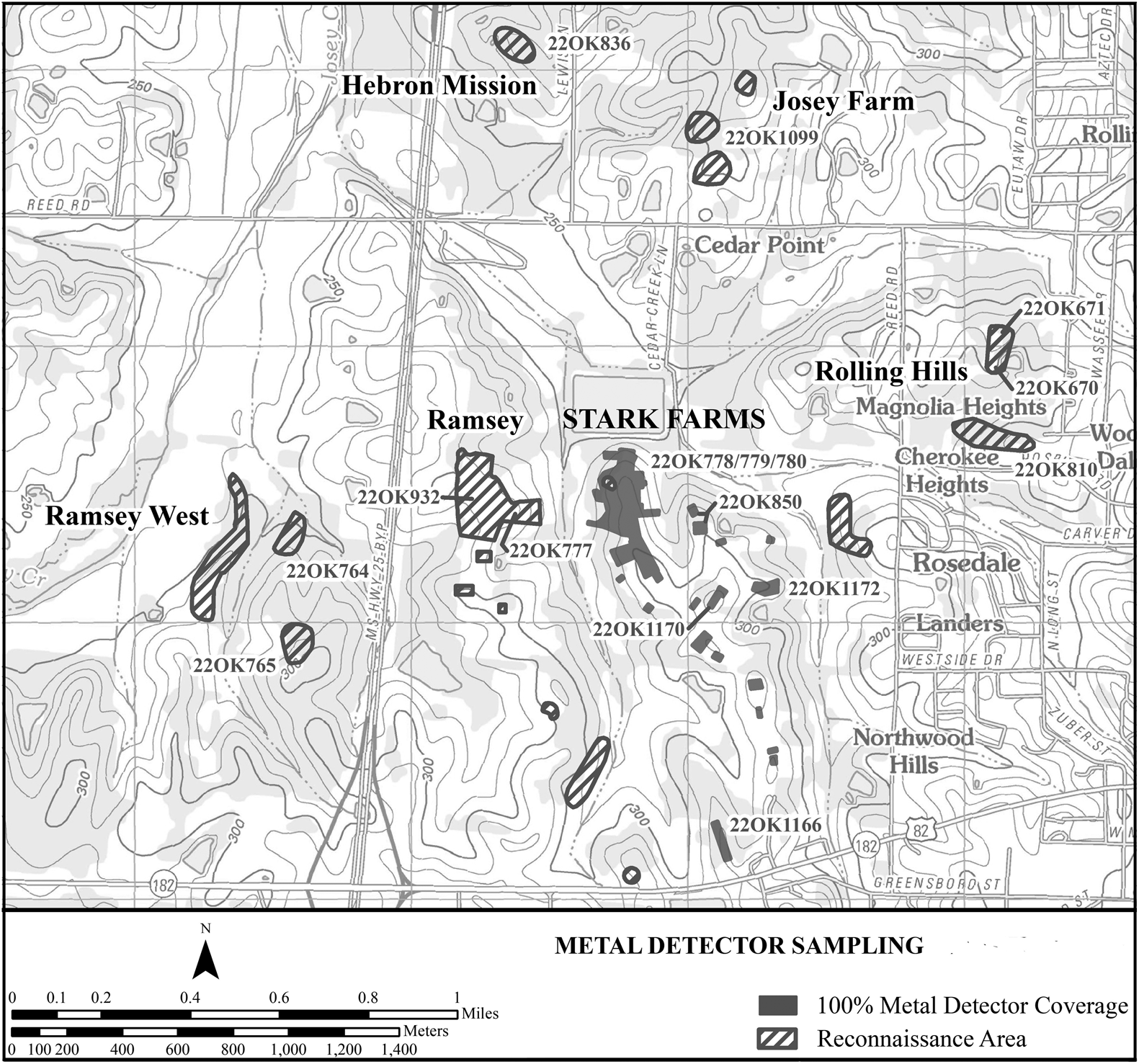
In 2015, the Chickasaw Nation conceived a long-term project with the dual goals of identifying ancestral sites in their traditional territory in northern Mississippi and providing Chickasaw college students an opportunity to reconnect with their cultural heritage through collaborative archaeological fieldwork experiences in the Chickasaw Explorers Program (Thomas Reference Thomas2017).Footnote 3 The Stark Farms cluster (Figure 2), documented in a cultural resource management shovel-test survey in 2014, seemed particularly promising because it had yielded ceramic types broadly dating to the European contact era—or AD 1400s–1600s—although no metal artifacts had been recovered (RabbySmith et al. Reference RabbySmith, Creswell and Pritchard2015). Archaeological investigations suggest that Stark Farms represents a dispersed town or loosely aggregated house groups spread across a substantial upland prairie ridge system. With the onset of our metal detector survey in 2015 at the largest of the Stark Farms sites, 22OK778, we almost immediately discovered iron celts, reworked Biscayan-style axes, rolled sheet copper-alloy beads, and other metal artifacts (Legg et al. Reference Legg, Blanton, Cobb, Smith, Lieb and Boudreaux2019). These finds instigated five seasons (2015–2019) of fieldwork at Stark Farms, with the Chickasaw Nation leading a consortium consisting of the Universities of Mississippi, South Carolina, and Florida. Block excavations in feature-rich locations were complemented by 100% metal-detector survey coverage in core site areas of Stark Farms (Figure 3). The survey consisted of archaeologists detecting in marked blocks along overlapping transects, approximately 1.5 m wide. Over repeated seasons, many blocks were resurveyed multiple times, especially the heart of 22OK778. Point proveniences were recorded for all premodern metal objects. In addition, we conducted reconnaissance metal detector surveys on surrounding landforms and at previously recorded, outlying sites suspected to date to the same time period. Except for the Ramsey site, located just to the west of the Stark Farms complex (Figure 3), these forays did not recover any early-European metal objects.
Stark Farms complex, showing sites positive for metal artifacts and quantities by site (U.S. Geological Survey, USGS quadrangle 7.5-minute map for Starkville, MS 2018).

Metal detector coverage at Stark Farms and outlying sites (prepared by Tamara S. Wilson, South Carolina Institute of Archaeology and Anthropology; U.S. Geological Survey, USGS quadrangle 7.5-minute map for Starkville, MS 2018).
Our research has revealed that, in many respects, Stark Farms sites are typical of late pre-European-contact to contact period sites located in the Blackland Prairie—an arc of agriculturally rich, upland prairie running across Mississippi and Alabama. These sites were dispersed hamlets and towns strongly reliant on maize agriculture, where residents inhabited round-to-apsidal single-set-post structures. Signatures of social hierarchy through mortuary interments are slight. Although these settlements seem to be related to the Mississippian phenomenon, with the exception of the Lyons Bluff site about 15 km east of Stark Farms, there is no evidence of the aggregated towns with earthen platform mounds that are typical of contemporary sites in the nearby Tombigbee River Valley about 40 km to the east (Blitz Reference Blitz1993). If not for the Soto accounts describing a number of sizable polities in the prairie region, archaeologists would be hard put to identify political entities such as Chikasha based on traditional material correlates. An unusually dense cluster of fifteenth- to seventeenth-century sites (including Stark Farms) known as the Starkville Archaeological Complex (SAC) is found in the locality of the modern city of Starkville (Clark Reference Clark2017). There have been documented cases of early-European materials recovered in mortuary contexts in sites in the Rolling Hills vicinity of the SAC (see Figure 3), but these are very rare (Atkinson Reference Atkinson1979). Very few SAC sites have been excavated and reported in detail (e.g., Hogue and Peacock Reference Hogue and Peacock1995; Peacock Reference Peacock1995; Rafferty Reference Rafferty2001; Rafferty and Hogue Reference Rafferty and Hogue1999). As a result, the notion of a “complex” is still a poorly understood catchall for Mississippian through contact period sites in the area, and it is difficult to place Stark Farms within a local or regional comparative framework.
Nevertheless, site 22OK778 does bear a distinctive imprint for the region (Boudreaux et al. Reference Boudreaux, Cobb, Clark, DePratter, Legg, Lieb, Smith, Smith, Boudreaux, Maureen Meyers and Johnson2020). It is larger than most contemporary sites in the area, and it contains the bulk of the recovered metal artifacts. Furthermore, the ridgetop that is the core of the site has an unusually dense welter of posts that speaks to considerable building activity. Within one large, single-set-post structure, we have identified a prepared, cross-shaped clay hearth embodying four-corner, sacred fire symbolism, leading us to suspect that this was a central public building. Several daub pits on the site—large borrow pits where clay was removed for building construction—contained rich assemblages of flora, fauna, ceramics, and lithics. The AMS dates for Starks Farms, along with the ceramic types, support an occupation from the 1300s to mid-1600s (Boudreaux et al. Reference Boudreaux, Cobb, Clark, DePratter, Legg, Lieb, Smith, Smith, Boudreaux, Maureen Meyers and Johnson2020; Clark Reference Clark2017; Johnson Reference Johnson1996). Unfortunately, the radiocarbon curve for the sixteenth century has multiple intercepts, so it is not possible to confirm mid-sixteenth-century contexts via chronometric methods.
Systematic metal detector coverage across the Stark Farms sites has yielded at least 83 metal artifacts that seem to be of sixteenth-century European vintage (Table 1).Footnote 4 It should be emphasized that archaeologists recognize only a few metal artifact types with a narrow, sixteenth-century association in the Southeast (crossbow bolt tips being one example). However, members of our research team's (Legg and DePratter) long-term involvement with archaeological investigations at the major sixteenth-century Spanish settlement of Santa Elena in South Carolina, combined with comparative reviews of other sites in this time horizon in the Southeast (e.g., Blanton Reference Blanton2013; Little Reference Little2008; Rodning et al. Reference Rodning, Beck, Moore, Legg, Beck, Rodning and Moore2016), suggest to us that certain metal artifacts are likely sixteenth-century diagnostics, particularly when they co-occur with other likely sixteenth-century types. At Stark Farms, these items include expedient celts probably made from barrel bands, rolled copper-alloy beads, and Biscayan-style axes—the last having been common to the sixteenth century, if not limited to it. The horseshoe fragments recovered at Stark Farms are typical of late Medieval forms. Finally, the Stark Farms assemblage is distinctive from late seventeenth-century and later assemblages in the Southeast—when objects of European origin were far more common—by the complete lack of domestic types of artifacts, such as scissors, kettles, thimbles, and buckles.
Objects of European Origin from the Stark Farms Site.

That said, we do not believe that Stark Farms is Chikasha itself. Because the descriptions of local river crossings and the general terrain in the region seem to correspond with the Soto accounts, archaeologists and historians have agreed for some time that Chikasha was likely in the larger area where Stark Farms is located (Atkinson Reference Atkinson1987:63–68; Ethridge Reference Ethridge2010:11; Johnson and Sparks Reference Johnson, Sparks, Dye and Brister1986; Marshall Reference Marshall, Dye and Brister1986:84–87). Nevertheless, our investigations have not revealed any signs of the widespread burning reported for the town. Nor have our substantial faunal collections provided any of the horse or pig elements one might anticipate with the loss of so many of these animals. Furthermore, our investigations have yet to yield any European ceramics, which might be anticipated with a Spanish encampment. Instead, we believe Stark Farms represents part of the dispersed settlement of the Chikasha province at some distance from the Spanish encampment, which took advantage of Soto's catastrophe to gather exotic goods following the hasty departure of his retinue. Consequently, we hypothesize that the metal objects derived from a combination of small-scale trade with the overwintering Spaniards along with mining of the battle site for objects of value. In light of the Smith and Hally (Reference Smith, Hally and Mathers2020) taxonomy, the context and content of the assemblage seem to reflect a mixture of objects taken in battle and through barter and scavenging.
The Stark Farms Metal Artifact Assemblage
To date, we have recovered 83 objects of iron, copper or copper alloy, and lead that we believe are likely candidates for a sixteenth-century origin (Table 1). Although the majority have been recovered at 22OK778, they are distributed across several of the Stark Farms sites (see Figure 2). There are several attributes of this assemblage that make it stand out from contemporary sites in the Southeast that have yielded similar items. First is the sheer abundance. Except for communities or outposts actually established by Europeans in the 1500s, the quantity of metal artifacts is unusually high compared to contemporary sites in the Southeast. Second, this abundance seems to be limited to the Stark Farms complex. We have conducted metal detecting at numerous recorded sites and open lots in the region without success in finding additional metal artifacts (Smith and Legg Reference Smith and Legg2020; Figure 3). Third, most metal artifacts have been discovered from plow zone contexts by metal detecting, although we have recovered two iron objects in excavations: one iron celt associated with a posthole feature and an unusual tiny, perforated iron sphere—perhaps a bead—from a daub pit. Of course, we wish we had tight contexts for all of these objects. At the very least, however, given that no graves have been encountered in our work at Stark Farms, we believe that the metal artifacts derived mainly from domestic or mundane contexts spread throughout the dispersed settlement; they were not restricted to higher-status individuals as was so often the case elsewhere. Fourth, it is widely believed that most European metal artifacts occurring at Indigenous sixteenth-century sites in the Americas were deposited as relatively intact goods that were only rarely subjected to any significant modification (Berman and Gnivecki Reference Berman, Gnivecki, Hofman and Keehnen2019:33; Cipolla Reference Cipolla and Cipolla2017:18; Mathers Reference Mathers, Hofman and Keehnen2019). In contrast, many of the Stark Farms artifacts display evidence for light to heavy reworking in the hands of Native Americans (Legg et al. Reference Legg, Blanton, Cobb, Smith, Lieb and Boudreaux2019, Reference Legg, Cobb, Boudreaux, Lieb, DePratter, Smith and Mathers2020, as summarized below).
Overall, the metal artifacts fall into several arbitrary categories of hybridity: Unmodified Assemblage Inclusions, Modified Utilitarian, Skeuomorphs, Ornaments, and Iberian hybridity. One of the challenges of research on hybridity is moving away from traditional classifications that may create the false illusion of ontological difference and subsequent melding. We do not claim to have overcome this difficulty in our system, and we will concede that it is polythetic rather than uniform. But, rather than defining groups simply in terms of traditional attributes of raw material (e.g., iron, lead) or European form/function (e.g., reworked axes, modified horseshoes), our classification relies on dimensions that we propose are useful for highlighting various aspects of function, manufacture, and use that are relatively—if not completely—consistent within categories.
Unmodified Assemblage Inclusions
There is some question as to whether the simple inclusion of a “foreign” object into a traditional assemblage constitutes hybridity (Deagan Reference Deagan and Card2013:262; Liebmann Reference Liebmann2015:325). Yet, to limit the boundaries of hybrid practices to the object itself would seem to elide arbitrarily the possibility of networked relations between objects of different origin as a form of “relational entanglement” (Stockhammer Reference Stockhammer2013:16–17). In the sixteenth-century Southeast, this is most clearly manifested in the interment of European objects with Indigenous burials in the South Appalachian and Florida regions. These objects perhaps were analogous to the indexical items found in sacred bundles, which may serve to endow an associated assemblage with enhanced spiritual power (Zedeño Reference Zedeño2009).
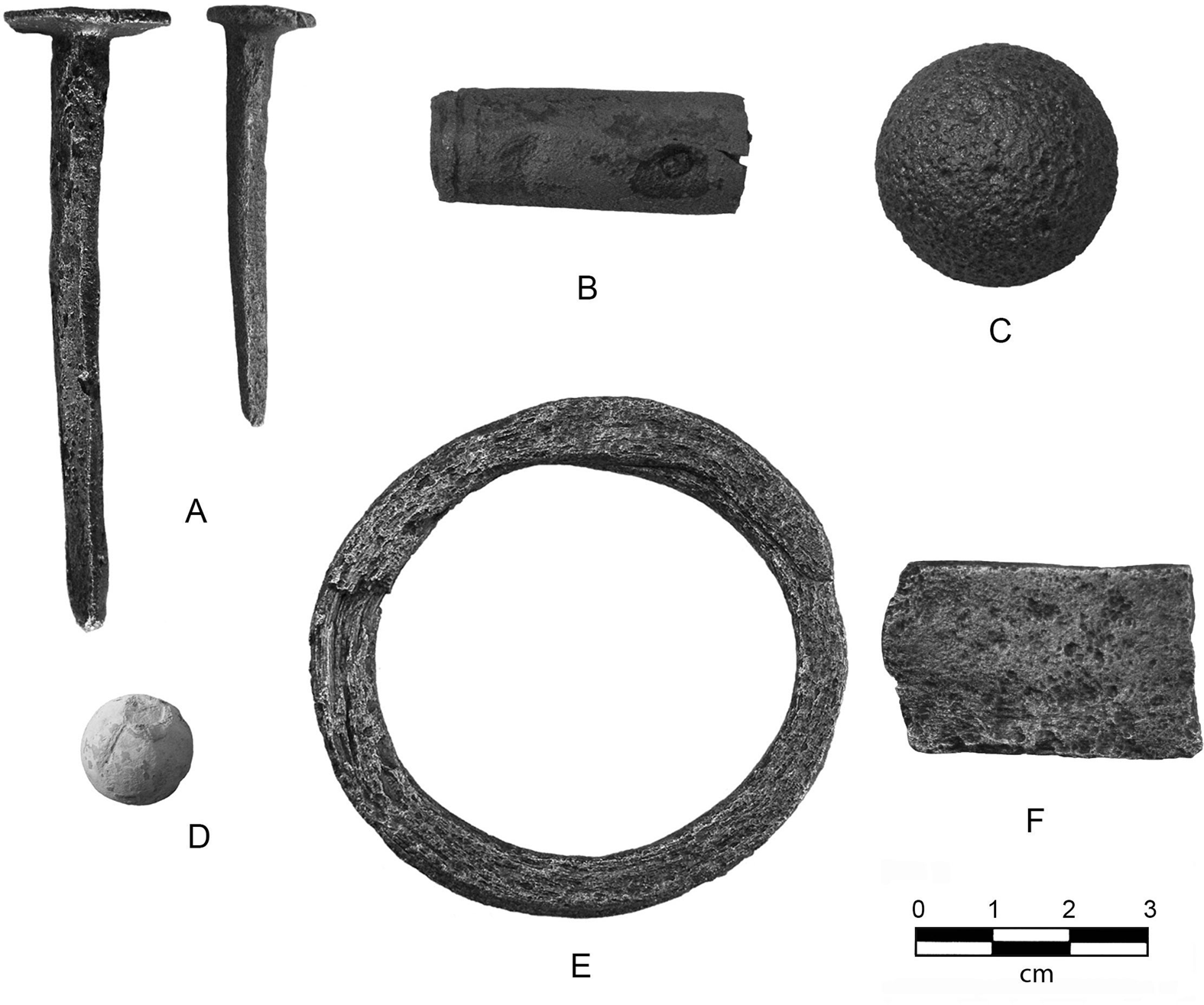
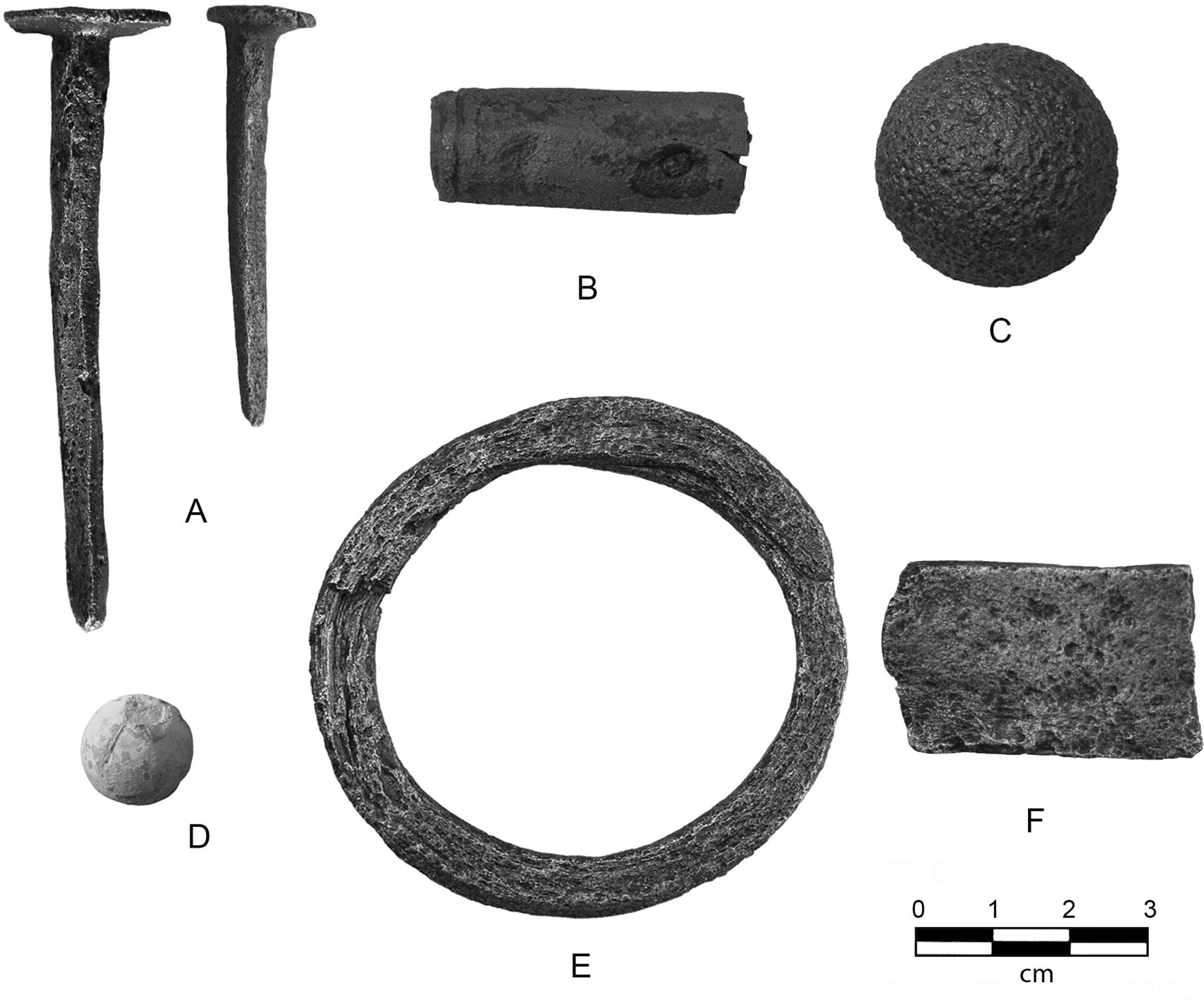
Given the variety of unmodified objects that derive from plow-zone contexts at Stark Farms, we posit that many were somehow incorporated into households (Figure 4). These include several lead shot in the caliber range of an arquebus; a cast-iron ball (122.5 g), perhaps a small cannon (verso) shot (such artillery pieces are reported for the Soto expedition [Shelby Reference Shelby, Clayton, Knight and Moore1993:264–265, 373; Worth Reference Worth, Clayton, Knight and Moore1993a:257]); a copper-alloy ramrod tip; wrought-iron nails consistent with those recovered at Spanish Santa Elena (1566–1587) in South Carolina (South et al. Reference South, Skowronek and Johnson1988:33–57); a mouth harp; and a perforated medallion displaying a gold-gilt cross that is probably a bridle-bit boss (Figure 5). The diversity of items in this category and the occurrence of unusual military items not normally found as trade objects (e.g., the cannon shot and ramrod tip) are two of the reasons we believe that the assemblage results in part from mining a battle site that was also a winter encampment.
Nonmodified metal artifacts: (A) wrought-iron nails, (B) ramrod tip, (C) cast-iron shot, (D) lead shot, (E) crudely forged harness ring, (F) barrel band section (South Carolina Institute of Archaeology and Anthropology).
Possible bridle boss (South Carolina Institute of Archaeology and Anthropology).

Finally, there are some artifacts that may reflect the compromises of the Soto expedition. Notably, we recovered what appear to be three harness rings manufactured by very crude forging and flattening. It is likely that this kind of expedient retooling became increasingly common through the course of the entrada's passage across the Southeast.
Modified Utilitarian
A number of metal artifacts were recycled from their original (European) use into functional implements analogous to Native American tools. In many cases, the artifacts were so modified that it was not possible to ascertain the original source object or stock. We have assigned functional categories to them where possible based on general shape and working-edge characteristics, although it is conceivable that they had multiple practical applications. We place these in a utilitarian category, but we readily recognize that this is not the only meaning that may have been attributed to what surely were viewed as unusual and exotic raw materials and forms.
Generic cutting and scraping tools are the most common type in this category. With the exception of one piece of sharply ground copper-alloy sheet metal, all of these items were iron. Two of these were likely knife blades, displaying additional evidence for grinding or resharpening of the edge. The others were largely expedient—mainly fragments of iron sheet metal with a ground edge. Some objects showed evidence of what appeared to be preparation for further modification into some kind of cutting tool, but without being completed. For instance, one horseshoe fragment exhibits a broken edge initiated by metal fatigue from repeated bending. This was surely a laborious process and one reflecting a lack of access to metal-cutting tools. But no further modification or use was evident.
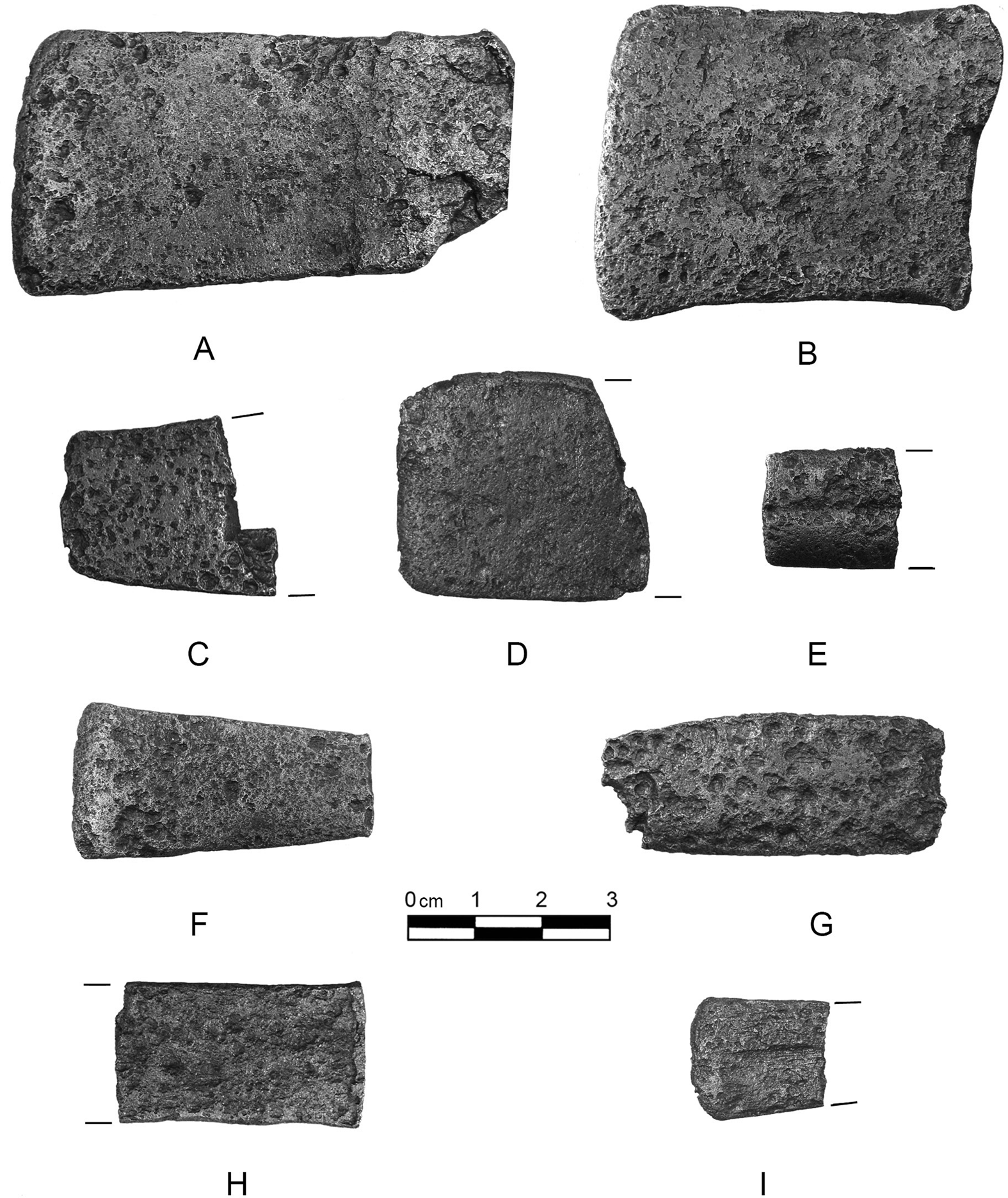
Iron celts (or possibly adzes) are another common recycled type (Figure 6). They were often manufactured from axes. The so-called Biscayan axe type has been identified at other sixteenth-century Southeast sites (Blanton Reference Blanton2013:21–22; Linden Reference Linden2013:33, 35), although it is found in later contexts as well. Axe blades, minus the hafting eye, generally have a shape that would encourage celt manufacture. In some cases, the hafting-eye portion was formed into a celt by flattening into a rectangular panel. Two axes exhibit evidence that the hafting eyes were removed with bend breaks, whereas the blade itself notably shows no additional alteration or recycling. Some axe sections had grinding of broken edges, battering and flattening of thick blade portions to turn them into serviceable edges, and battering on polls in a matter analogous to hammers (Figure 7). Celts also were manufactured from horseshoe fragments, sections of what appear to be rapier blades, and other thin pieces of modified stock (Figure 6).
Celt forms: (A, B) axe eye sections, (C, D) horseshoe fragments, (E, I) possible rapier blade fragments, (F, H) likely barrel bands, (G) possible axe blade (South Carolina Institute of Archaeology and Anthropology).

Axes in varying states of modification (South Carolina Institute of Archaeology and Anthropology).

Finally, the assemblage contained a number of recycled objects that are unique or do not easily conform to standard taxonomies. As one example, a piece of iron wire stock—likely chain link—had one end battered into an awl-like tip. In another case, portions of the edge of an iron knife blade were deliberately blunted by battering, whereas the rest of the edge was carefully thinned and bifacially sharpened. One horseshoe fragment had grinding on two margins, but it was not an obvious tool.
Skeuomorphs
There are two examples, both ground iron celts, of skeuomorphs (see Card Reference Card and Card2013:8; Howey Reference Howey2011), which are intentional hybrids created from an imported material to replicate an Indigenous form. The first is virtually a replica of a traditional hardstone celt, smooth and symmetrically ground over the entire surface (Figure 8a). The second is somewhat unusual in that it has a narrowing or waist in plan view (perhaps for hafting), but in side view, it has the classic celt shape (Figure 8b). These objects would have required a large source piece of iron stock, and by all appearances, their manufacture was labor intensive.
Skeuomorph celts (South Carolina Institute of Archaeology and Anthropology). (Color online)

Iberian Hybridity
Silliman (Reference Silliman2015) suggests that there needs to be more emphasis on European contributions to hybrid forms and practices in colonial settings. Heather Trigg (Reference Trigg2020) has made this case in her study of seventeenth-century Spanish households in northern New Mexico, where hybrid forms of architecture, pottery, and culinary regimes speak to the intermingling of Indigenous and European peoples sharing the same spaces on Spanish ranches and farms. The assemblage from Stark Farms emphasizes that even this category of hybridity is characterized by important variation in that Soto expedition members may have been purposefully making metal forms shaped to Indigenous tastes rather than for their own consumption.
Specifically, iron barrel bands were used to manufacture flat, rectangular iron celts or adzes (Figures 6f and 6h). As implied by the name, these were fragments cut from the iron bands normally used to hold barrel staves in place. Barrel bands of the early colonial era were heavy, wrought-iron pieces rather than sheet metal, representing a particularly flexible source of raw stock for tool manufacture. Typically, barrel band celts have bifacially ground bits. Their occurrence at other sixteenth-century Southeast sites (e.g., Blanton Reference Blanton2013:22–23; DePratter and Smith Reference DePratter, Smith and Dobyns1980:74–76) suggests that they may have been made specifically for gifting and trade with Native Americans. In particular, the consistent size of examples from some of these sites is suggestive of mass production by Spanish blacksmiths (Legg et al. Reference Legg, Cobb, Boudreaux, Lieb, DePratter, Smith and Mathers2020:53). It is interesting that the examples from Stark Farms are generally smaller than those reported in contemporary sites to the east. This may indicate that the Soto expedition was attempting to conserve a diminishing store of such supplies.
Ornaments
Given a deep history of copper use in the Southeast, copper or copper alloy is the one raw material carried by the Soto expedition with which Native Americans would have had some familiarity. What is unusual is that the colonial influx of copper alloy into the Southeast appears to have initiated a new repertoire of forms and uses. Our preliminary pXRF analysis of the Stark Farms copper-base ornaments indicates that most are brass. Many are either trapezoidal pendants or “tinkler cones”—items likely attached to clothing (Figure 9). This supposition is supported by the occurrence of a possible silk fragment under the folded ears of one of the pendants and cordage in two of the cones. Tinkler cones are widespread on later sites throughout eastern North America, but they have been documented in sixteenth-century contexts at the Berry site in western North Carolina (Rodning et al. Reference Rodning, Beck, Moore, Legg, Beck, Rodning and Moore2016:330). Rolled copper-alloy beads were also a common ornament type. Data supporting the Indigenous manufacture of copper-base objects at later-period sites (Bradley Reference Bradley1987; Ehrhardt Reference Ehrhardt and Card2013) suggest that the specimens at Stark Farms likewise were made by local inhabitants. This inference is buttressed by a vernacular manufacturing technology that did not rely on a forge, but that was characterized by (1) bend-breaking and folding rather than cutting to modify pieces, (2) the frequent occurrence of sizable untrimmed irregularities, and (3) laborious grinding and smoothing of the edges.
Copper base objects: (A–H) ornaments perforated for suspension, (I) loosely rolled tube, (J–L) tinkler cones, (M–O) folded strips, (P, Q) rolled tube beads (South Carolina Institute of Archaeology and Anthropology). (Color online)

On Southeastern sites dating to the 1600s and later, these kinds of copper-alloy artifacts were frequently made from thin brass kettles and pots (Brain Reference Brain1979:164–185). The Stark Farms assemblage lacks diagnostic elements of metal vessels, such as bail attachments and rolled rim fragments. Copper pitchers and cauldrons have been recovered from the Luna expedition shipwrecks dating only 20 years later (Bratten Reference Bratten and Smith2018). Consequently, even lacking the characteristic elements, it is possible that remnants of similar containers were used to produce the ornaments at Stark Farms.
Unknown/Other
There are a number of metal artifacts from Stark Farms that do not readily fit into traditional archaeological categories. These are not distinctively sixteenth century, but they often occurred in or near clusters of our more recognizable metal objects on the site. Many are modified, irregular pieces of unknown function. In addition to pieces of worked sheet-metal copper alloy described in our discussion on ornaments, there are also several fragments of cut and broken sheet lead. One rectangular lead fragment was apparently flattened and chewed. Some of the generic objects reflect initial or experimental working before loss or discard. For example, one wrought-iron chain link was opened by flattening the forge-welded join, a tactic likely to be employed if one did not have any metal-working tools available. Interestingly, the modest chain links in the assemblage are particularly emblematic of the antagonisms between Spaniards and Native Americans. The Soto expedition carried a large amount of iron chain for various purposes, including shackling Native Americans as captives and porters (e.g., Robertson Reference Robertson, Clayton, Knight and Moore1993:68). Before his departure from Chikasha, Soto had demanded that the chief surrender a large number of people as porters, likely setting into motion the events that led to the battle (Robertson Reference Robertson, Clayton, Knight and Moore1993:107).
A Deeper History of Heterogeneous Hybridity
Rather than arguing that the assemblage of Stark Farms metal artifacts manifests a stage within a predictable historical sequencing of hybridity (nascent colonialism to mature colonialism, if you will), we believe that our study suggests two things. First, hybridity can be a dialectical meshing of interruption and novelty on the one hand and continuity on the other. We have segregated the Stark Farms metal artifacts into various arbitrary categories of hybridity that emphasize stylistic and technological idiosyncrasies employed in introduced raw materials. Yet, it is also useful to step back and contemplate the gestalt of the corpus of objects, predicated on the notion that the emergent property of an assemblage may strike a different register in the materiality of hybridity than revealed by solely focusing on constituent elements (for various perspectives on addressing copresencing of traits, see Hauser Reference Hauser2017; Sheptak and Joyce Reference Sheptak, Joyce, Hofman and Keehnen2019; Stahl Reference Stahl, Hicks and Beaudry2010). From this perspective, the metal artifacts confer a collective sense of improvisation weighted toward “staying the same”—a dimension of hybridity and entanglement in colonial situations that bears more attention (Silliman Reference Silliman and Card2013:492). They highlight Marshall Sahlins's (Reference Sahlins1993:17) dictum that “the first commercial impulse of the people is not to become just like us, but more like themselves.”
In this sense, although many of the hybrid aspects of the Stark Farms metal artifacts may have been new, the practices were time honored. Liebmann (Reference Liebmann2015:322) asks, “Why do we label some objects hybrid, yet ignore the complex multicultural biographies of others?” We now recognize the entire Mississippian period (ca. AD 1000–1600) as a dynamic time of population movement, social churn, and cultural mixture in which material practices have been characterized as hybrid and coalescent (e.g., Alt Reference Alt, Butler and Welch2006; Blitz Reference Blitz1999; Cable Reference Cable2020). Wall-trench architecture, which seems to have its origins in the Cahokia region of west-central Illinois (Pauketat Reference Pauketat2007), appears on some sites in eastern Mississippi early in the Mississippian period, where it commingled with the dominant single-set-post style of houses (Boudreaux et al. Reference Boudreaux, Lieb, Smith, Harris and Cobb2018; O'Hear et al. Reference O'Hear, Larsen, Scarry, Phillips and Simons1981). A small percentage of the ceramics at Stark Farms exhibit decorative treatments associated with the Lower Mississippi Valley (Phillips Reference Phillips1970:83, 151) and western Alabama (Knight Reference Knight2010:20, 39–40), but they rely on local pastes and tempers (Boudreaux et al. Reference Boudreaux, Cobb, Clark, DePratter, Legg, Lieb, Smith, Smith, Boudreaux, Maureen Meyers and Johnson2020:Table 3.4; Smith Reference Smith2017). Furthermore, this was a time of local migration and endemic ceramic hybridity. In the AD 1300s and 1400s, there was a population flow from the Upper Tombigbee Valley and associated drainages onto the Black Prairie 40 km to the west, accompanied by a shift from freshwater mussel shell temper to fossil shell temper (Johnson Reference Johnson1996). At sites occupied before this technological transition was largely complete in the 1600s, it is common to find pottery with mixtures of both at Stark Farms and other sites in the Black Prairie (Sorresso and Quinn Reference Sorresso and Quinn2020). Well before the arrival of the Spaniards, there was an established arc of social, material, and biological fluidity, and it was common to incorporate new peoples and synthesize material traditions from near and far. The Stark Farms metal artifacts are just as much a product of that history as they are of European incursions.
This brings us to our second point. Even if hybrid practices are multithreaded and deeply rooted, the relations of power that they embody can be qualitatively different. It is this dimension that underscores the colonial encounter and its aftermath. Much of the anxiety over concepts such as hybridity and creolization seems to be ontology centric, largely focused on identity and origins. This rightfully draws attention to who may have produced or consumed the object. But hybrid entities as agents or media of contestations over authority and power are as much a matter of externalities as they are internalities. In other words, the ways in which colonial period metal artifacts were modified and became elements of assemblages were also wedded to the multiscalar networks that delivered the original objects to various parts of the globe (see Hofman et al. Reference Hofman, Mol, Hoogland and Rojas2014; Knappett Reference Knappett2013). By networks, we do not necessarily mean formal lattices that in some circumstances can be highly useful for modeling the flow of peoples, things, and ideas. Instead, we refer to more nebulous webs of regional and pan-regional relations constituted within historical settings. The emergent Atlantic World of the 1500s and 1600s was one such system (Armitrage and Braddick Reference Armitrage and Braddick2009; Benjamin Reference Benjamin2009; Orser Reference Orser2018), eventually developing the institutions that would tether Indigenous peoples to colonial powers and spur the kinds of routinized circulation of objects and entrenched hybrid practices that have drawn so much attention from postcolonial scholarship.
From what we know of the history of the interior Southeast following the immediate arrival of Europeans, these globalized networks had yet to sediment fully, and institutions of colonial management and control were still taking shape. The attenuated nature of colonial encroachments is emphasized by the frequent occurrence of European metal objects in mortuary assemblages of the era, the outcome of a tradition of gifting whereby European parties consistently needed to seek the favor of local polities to acquire food and other resources as well as to ensure safe passage (Smith and Hally Reference Smith, Hally and Mathers2020). Inventories for the Juan Pardo expeditions (1566–1568) into the interior Southeast on behalf of the Spanish crown specifically refer to objects earmarked as gifts (DePratter and Smith Reference DePratter, Smith and Dobyns1980). The occurrence of metal artifacts at sixteenth-century sites that likely did not have direct contact with European expeditions suggests that Indigenous elites often disbursed their gifts to satellite communities in a system of patronage and debt obligations (Smith and Hally Reference Smith, Hally and Mathers2020). These endemic regional networks of factions and asymmetry that privileged some individuals and groups above others were only loosely coupled to the emerging Atlantic World.
Stark Farms appears to be an example of when these kinds of directed transactions collapsed in a violent outcome, where significant amounts of European material were released in a manner that seems to have been structured only by very localized networks. This brief spell of abundance appears to have fostered a highly improvisational climate of working and reworking novel materials and forms. The kind of event-like scenario as an impulse to hybrid practices may not have been so rare. Months before their arrival at Chikasha, Soto's forces had suffered an even larger loss of matériel in a pitched battle at the town of Mabila, located in western Alabama (Knight Reference Knight2009; Robertson Reference Robertson, Clayton, Knight and Moore1993:105). On the same time horizon in the American Southwest, the Francisco Vázquez de Coronado expedition engaged in a major conflict with Indigenous communities in the Middle Rio Grande drainage, leaving an abundance of military artifacts at Pueblo sites in the Tiguex War of 1540–1542 (Mathers Reference Mathers, Brown, Barbour and Head2020; Schmader Reference Schmader2016). Furthermore, the scattered remains of failed colonial settlements and entradas in the 1500s throughout the Southeast provided yet another potentially rich source of providential European material. In short, the sixteenth century in southeastern North America was a period when considerable latitude in the exercise of hybrid practices relatively unencumbered from consistent European influence or intervention was possible.
Conclusion
Meghan Howey observes that
thresholds of colonial encounter are critical liminal times where “Other,” “Self,” and “West” are not fully defined but emergent, yet details on the happenings of these thresholds are often swamped by data on the events before and after which are more abundant archaeologically and historically [Reference Howey2011:333].
There are such instances, however—Stark Farms being one—where the data on hybrid practices are not so impacted by the swamping effect. With the departure of Soto from northern Mississippi in 1541, there is no evidence for any kind of significant European presence—or notable accumulations of metal artifacts—in this region for another 150 years. As a result, the hybrid characteristics of the metal assemblage at Stark Farms have a wide-ranging and experimental sensibility, seemingly shaped by Indigenous conventions rather than by, or against, European norms. Ironically, the various categories that have been proposed to distinguish cultural mixing—organic hybridity and intentional hybridity (Bakhtin Reference Bakhtin, Emerson and Hosquist1981), relational entanglement and material entanglement (Stockhammer Reference Stockhammer2013), and the like—themselves become blurred as hybrid taxonomic conventions in many ways, as manifested in the Stark Farms assemblage.
Given the complexities of cultural mixing enveloped in just one case study, it is understandable why there is so much caution among archaeologists in committing to hybridity, creolization, entanglement, or some other alternative. Still, even in a remote setting where Native American interests held sway, the initial, unsettling temblors of colonial incursions were likely having an impact on communities and their material cultures. In many localities in the sixteenth-century Southeast, hybrid mortuary assemblages speak to the first attempts by Europeans to finesse local networks of power through selective patronage. Their gifts entered into established Indigenous traditions of factions and status that seem to have always been precarious. In addition, they were the first instances of Europeans attempting to cultivate the standing of individuals who could help their cause—a practice that later would add to the destabilization of Indigenous polities throughout the Southeast. As a variation on these themes, Stark Farms seems to represent an instance of the failure of colonial tactics and the unintentional release of an abundance of European material accompanied by a fleeting moment of widespread access to otherwise rare and unusual objects.
As is evident from this study, major challenges remain in reaching any kind of consensus on how to conceptualize research on cultural mixing in colonial settings. A singular difficulty is that debates over hybridity and related terms have been theoretically sophisticated, but it seems that far more detailed case studies—rather than cursory vignettes or brief illustrations that serve to prop up a given theoretical angle—will be required to achieve greater resolution over the expression and framing of hybridity, entanglement, and the like. In this respect, we subscribe to Diana Loren's admonition: “The more productive theories of hybridity are those that problematize the term and seek to investigate the nuances and details in the entanglement of people and objects in specific historical contexts” (Reference Loren2013:152–153).
Acknowledgments
We are deeply grateful to the Chickasaw Nation and their Chickasaw Explorers Program for initiating and funding much of this research. Portions of our fieldwork were also made possible by a grant (#9831-16) from the National Geographic Society. Mark Hauser and Diana Loren provided insightful commentaries on an earlier draft of this work. Three anonymous reviewers as well as Lynn Gamble provided highly useful constructive criticisms and suggestions as part of the formal review process. We greatly appreciate their insights. Finally, we extend our gratitude to the many gracious landowners who made this work possible.
Data Availability Statement
The materials discussed in this article are currently curated at the South Carolina Institute of Archaeology and Anthropology, Columbia, South Carolina.





 Open access

