

Altitude has strange effects on the body and the mind. The higher up one climbs, the more apparent these effects become, even as the cause remains invisible. In 1822, Scottish surgeon and East India Company surveyor James Gilbert Gerard (1793–1835) was ascending the Shatul Pass, some 15,500 feet above the level of the sea. He later recorded his experience:
The smallest attempt to make an effort threw us back. The extreme labour we had in getting up the last 500 feet cannot be described. Anxiety and slight sickness deprived us of using our arms when inclined to break off a chip of rock by the blow of a hammer; respiration was free, but insufficient: our limbs could scarcely support us, and the features collapsed as if precursors of a fever.Footnote 1
Difficulty breathing, headaches, somnolency, loss of appetite, lethargy, and hypoxia all awaited those venturing into the high mountains. Movement itself was difficult, let alone swinging a hammer in the pursuit of scientific knowledge, or raising a pen to record reliable observations about the still largely unmapped northern frontiers of the East India Company's burgeoning Indian empire. James Gerard went on to describe altitude sickness as “similar to the sedative effect of intoxication,” concluding “I have never experienced so decided a proof of the existence of an agent inimical to the principles of animal life.”Footnote 2 He also attempted to scientifically explain the then little understood effects of high places on the body:
The cause here is not quite obvious, nor are those extraordinary symptoms of prostration of strength, anxiety, and mental imbecility satisfactorily explained, and while we cannot hesitate to refer the primary and immediate agent to the thinness of the air, or more properly, the diminished pressure, by which the balance of the circulation is destroyed; nevertheless, the effects are so capricious and irregular as to be at variance with the idea of a constant cause.Footnote 3
In his account, Gerard describes a medical topography of high mountains that is in flux. He identifies the rarefaction of the atmosphere as the cause of his suffering, even while clearly struggling with the inconsistencies with which symptoms were experienced. In the context of early Himalayan exploration, however, these inconsistencies became central to the story.
In particular, tensions around the “capricious and irregular” distribution of symptoms were exacerbated by the fact that Europeans who entered the high Himalaya in the first half of the nineteenth century rarely—if ever—did so alone. As James Gerard continued, “all my people have also been affected in different ways, some with sickness, others with head-ache,” but he tellingly clarified that “every one is not equally affected.”Footnote 4 As continues to be the case in Himalayan mountaineering and trekking today, European explorers would not have gotten very far or very high if they had not been able to rely on extensive pre-existing routes and co-opt Himalayan people (especially Bhotiya, Tartar, Wakhi, and Lepcha) to show them the correct paths, carry their supplies, and share (or sometimes assume) the not insignificant risks of mountain travel. European explorers, surveyors, and travellers were thus forced to compare and contrast their bodily performances against those of their guides and porters.Footnote 5 This dependence on Himalayan labour, combined with the invisible and insidious effects of altitude sickness, served to intensify expeditionary relationships: between explorers and guides, employers and employees, Europeans and Asians.Footnote 6 In this article, I examine the resulting tensions by considering the politics of bodily comparison that developed around altitude sickness at multiple scales: in the way bodies, European and Asian, experienced altitude sickness; in the way comparisons between bodies affected cross-cultural interactions within expedition parties; in the way these experiences and comparisons were represented in written productions; and in the way these written productions ultimately helped constitute medical topographies of high mountains in pervasive ways, as peripheral spaces and aberrant environments in relation to lowland imperial norms.Footnote 7
In thinking about the politics of bodily comparison in the face of an invisible force, seasickness provides a helpful analogy, and contemporary travellers frequently made such allusions. In both cases the cause was invisible, even if clearly related to a particular environment. Symptoms were also experienced with high degrees of variability, and with seemingly little regard for social hierarchies around fitness, age, gender, or race.Footnote 8 The crucial difference, however, was that after millennia of seafaring, seasickness was a known and accepted phenomenon, even if medical understandings of it remained limited. On the other hand, travelling to very high altitudes was something largely new (at least for European travellers) at the end of the eighteenth century.Footnote 9 In this article, I thus consider social relationships in an environment that was unfamiliar and hostile to many of the actors. I do so not so much from questions of epistemology and hybrid knowledge, but from an approach grounded in everyday practice, and the cross-cultural relationships that these expeditions relied on to function.Footnote 10
This approach shows that altitude sickness exaggerated tensions within expedition parties because it risked inverting expected hierarchies around race and gender in relation to bodily performance. This article traces the way European travellers responded—consciously or unconsciously—by developing tropes that they could use in journals and travel narratives in (sometimes almost desperate) attempts to reassert their assumed superiority. Throughout, I examine responses to altitude sickness particularly through the concept of self-fashioning; that is, the various ways that travellers not only experienced and sought to scientifically explain, but also represented their bodily experiences, both individually and collectively. I consider explorers’ self-fashioning on two different levels: in terms of everyday performances directed at different members of expedition parties, and in terms of accounts written for audiences beyond the mountains, who might have little or no experience of altitude. In the latter case, I show how explorers exploited the uncertainty around altitude sickness to describe their bodily performances in a variety of self-serving ways, and attempted, if not always successfully or convincingly, to fashion their imperial and scientific selves through tropes like masculine heroism and duty to empire.
In tracing the strategies that European travellers used to try and assert their bodily superiority over their Asian companions, it is important to recognise that the networks of labour that made Himalayan exploration possible were highly heterogeneous. Expeditions were mobilised in different ways at different times, occasionally through forced labour (sometimes known as the “begar” system), or more often though patronage networks and recommendations.Footnote 11 This meant that porters (and even guides) could sometimes be recruited from the lowlands, complicating any simplistic comparisons between European and Asian bodies, even if this dichotomy often appears in contemporary travel accounts. Felix Driver notes that in contexts like this, guides often “could hardly be characterised as ‘local’ or ‘indigenous’ in any straightforward sense.”Footnote 12 This nevertheless makes the moments when travellers did identify the differences between the bodies of uplanders and lowlanders all the more important, and in what follows I trace how these distinctions would eventually become essential to both scientific understandings of altitude and perceptions of imperial possibilities in the high mountains.
The travel narratives, journals, and reports that form the basis of this article were written by an eclectic grouping of (with a handful of exceptions) European, and indeed largely British, surveyors, explorers, and travellers.Footnote 13 The most extensive set of accounts come from East India Company employees, especially Bengal infantryman seconded to surveys in the mountains. Others, particularly towards the midcentury, are provided by a wider range of travellers who visited the mountains to pursue a combination of scientific, imperial, economic, and leisure interests. Uniformly though, these visitors were not yet mountaineers or climbers, and even as purely sporting ascents were beginning in the Alps, these ideas took much longer to be transported to the Himalaya.Footnote 14 This source base adds a further dimension to politics of comparison by mediating what sorts of comparisons were available, and to whom. Those who wrote were able to constitute high mountain environments and their experiences of them through their narratives and textual productions, an opportunity not usually afforded to the people who carried their loads, shared their tents and campfires, and struggled to breathe alongside them.Footnote 15 In this article, I nevertheless want to suggest that the inherent uncertainties around altitude were also open to exploitation by guides and porters, even if performed in different ways and for different audiences. Given the limitations of the colonial archive, such suggestions can of course only be tentative, even if reading certain moments against the grain does suggest that guides and porters were sometimes able navigate the uneven distribution of symptoms to exert agency, in particular by resisting often unpleasant and dangerous labour conditions.
While I use “altitude sickness” for convenience throughout this article, the term itself had yet to enter usage in the Himalaya. “Mountain sickness” and “mal des montagnes” were sometimes used, reflecting climatic and environmental associations, but also a lack of codification as a coherent illness. Early efforts to address the knowledge lacuna around altitude were usually anecdotal, though as the century progressed travellers increasingly turned to quantitative methods and self-monitoring (if often in an ad hoc and opportunistic fashion) by taking pulses and counting inspirations (or rate of breathing). In this vein, historians of science have for some time been productively examining human (and nonhuman) bodies as both sites of a scientific practice and as scientific instruments their own right, and have argued for greater recognition of the embodied nature of scientific knowledge.Footnote 16 Scholars point, for instance, to the way that “a human body whose walking pace and perceptual skills have been trained and disciplined is also functioning as an instrument,” with a key example being the so-called “pundits” deployed in the 1860s to survey parts of the Himalaya inaccessible to the British.Footnote 17 Studies of altitude or respiratory physiology represent a much narrower subset within this historiography, and otherwise excellent scholarship has focused almost exclusively on the second half of the nineteenth and the twentieth centuries; that is, the period of systematic and often institutionally-sponsored scientific studies of altitude.Footnote 18 Scholars like Sarah Tracy and Alex McKay have emphasised that these often had an imperial dimension, concerned with long-term acclimatisation in a labour context.Footnote 19 Respiratory physiology has also been productive in complicating the distinction between “laboratory” and “field” practices, most notably in the work of Vanessa Heggie.Footnote 20 This article complements the existing scholarship, even as it diverges from it, by historicising and contextualising an earlier phase in the development of scientific understandings of altitude physiology. The politics of bodily comparison also look different before 1850, because the debilitations experienced in high places were often still mysterious and terrifying, and the effect of the rarefaction of the air on bodies was not yet a given. Significantly for self-fashioning, the long-term adaptation of mountain peoples—most explicitly embodied today by mountaineering Sherpa—was also yet to be widely recognised. Beyond the history of altitude physiology, the bodily comparisons this article traces are significant because they played out at the beginning of the colonial encounter for many Himalayan peoples with an expansionist British India. At a time when surveyors and administrators were attempting to appropriate the Himalaya into both a regional imperial framework and a global scientific order, these expeditionary interactions laid the groundwork for long-term political, economic, and labour relationships to empire.
Indeed, tensions around altitude sickness were further intensified by the way these expeditions were inextricably bound up with the constitution of the Himalaya as a high mountain frontier.Footnote 21 I use “frontier” here in a broad sense, as it often was by the contemporary actors, to refer to the various (and often heterogeneous) areas of the mountains at the expanding edge of East India Company control. In considering these frontier regions, I am especially interested in the way that, even as the British were consolidating their power on the subcontinent, they remained much less able to bring this growing imperial confidence to bear in the mountains. This was partly because of labour regimes and the topography, but also because of the continued autonomy of powerful rulers and states like Ranjit Singh in the Punjab. Similarly, and much to their chagrin, the British were entirely excluded from Tibet, and faced ongoing resistance from the Kingdom of Nepal, even after the Anglo-Gurkha War of 1814–1816. These regional conflicts were coupled with a growing recognition that the mountains were more porous than their jagged and forbidding aspect would appear to convey, and heightened insecurity about Russian and Chinese interests on the other side of the mountains.Footnote 22 Physiological challenges and possibilities for movement in the high mountains thus had implicit military implications. As English surveyor William Spencer Webb (1784–1865) recorded while operating near Tibet: “I considered that to pass churlishly along the frontier prying into its passes, and reconnoitring would more likely to excite and to confirm than to allay their jealousy already kindled,” though he anyway had to call a halt because “the extreme labor and great difficulty of respiration experienced in the last undertaking has occasioned a general sickness in my Camp.”Footnote 23
This concern with upland frontiers echoes recent work, especially by anthropologists, on “Zomia” and related formulations like “High Asia” or the “Himalayan massif.”Footnote 24 This scholarship has aimed to transcend older national and area-studies frameworks which inevitably privilege lowland states and, in so doing, to re-agentise marginalised peoples in regions long considered peripheral. Christoph Bergmann, for example, has demonstrated the value of considering “High Asia as a continuous zone and an agentive site of political action.”Footnote 25 While “Zomia” was initially coined to describe upland Southeast Asia, Sara Shneiderman has argued for the value of “Zomia-thinking” in the Himalaya, even while suggesting the need for modification in a region better understood as featuring “multiple-state” rather than nonstate spaces.Footnote 26 Despite their limitations—not least the lack of meaning of concepts like “Zomia” to many of the actors—these conceptualisations of upland spaces are helpful for thinking through the overlap of social and environmental factors in Himalayan exploration.Footnote 27 In this context, altitude sickness might also be considered, to use James Scott's term, a “friction of terrain.” Here Scott's assertion that “the degree of friction represented by a landscape cannot simply be read off the topography. It is, to a considerable degree, socially engineered and manipulated to amplify or minimize that friction” is useful in thinking about the way cross-cultural labour relations shaped the way altitude sickness was recorded in travel accounts, and the way these, in turn, determined imperial ambitions with regard to the mountains.Footnote 28 In this article, drawing on “Zomia-thinking” to re-centre the story on upland spaces is thus helpful in two opposing respects: firstly, in recovering Himalayan people as agentive participants in expeditions; and secondly, in explaining how experiences of altitude sickness contributed to the peripheralisation of the Himalaya—socially, politically, and environmentally—in relation to lowland imperial ambitions.
In this article, I expand on the politics of comparison around altitude sickness in four sections, organised thematically rather than chronologically. In the first section, I examine the extent of the uncertainty around the effects of altitude on human and nonhuman bodies in the early nineteenth century, and contextualise the politics of bodily comparison in relation to lowland colonial anxieties around health, acclimatisation, and air. I then turn to a discussion of indigenous understandings of altitude sickness (as arising from the poisonous miasmas of plants), and the ways these were developed as a trope in European accounts. Next, I consider the way the comparative performances of European and Asian bodies were recorded in travel narratives, and use these as a lens into the complexities of self-fashioning. Finally, I examine various experimental approaches around quantification and the instrumentalisation of bodies (by measuring pulses and breathing) that were employed to try and parse the seemingly incessant contradictions in the way symptoms were experienced. Throughout, I develop the idea of altitude sickness as a “friction of terrain,” and situate discussions of altitude within the context of contemporary concerns around the constitution of the Himalaya as the northern frontier of British India.
Encountering High Places
In the first decades of the nineteenth century, medical understandings of altitude sickness were evolving, even if knowledge of these developments was unevenly spread around the globe. Experiments with air pumps and atmospheric pressures had seen recognition of the rarity of the air (if not necessarily understanding of its implications) in the seventeenth century, and European travellers became increasingly fascinated with mountains across the eighteenth century. It was not, however, until the end of the eighteenth century that these two interests began to properly intersect, perhaps no more famously than in the body of Prussian polymath Alexander von Humboldt (1769–1859). Ascending Chimborazo in 1802, Humboldt deployed his body as an instrument to read changes in atmospheric pressure, and noted the rarity of the air as the cause of the headaches and nausea he experienced.Footnote 29 Parallel questions occurred around the strange bodily debilitations experienced during early experiments with hot air balloons, though the rapidity of ascents meant the particulars differed significantly, and links were not yet always being made (at least by travellers in Asia).Footnote 30 In the Himalaya, explicit descriptions of the symptoms of altitude sickness, let alone attempts to explain them, are surprisingly rare before 1800. Europeans who travelled over high passes in the eighteenth century—including several Jesuits, and George Bogle and Samuel Turner on East India Company sponsored trade missions to Tibet—tended not to describe recognisable symptoms of altitude sickness at all, even though they must have experienced them. Where descriptions of suffering do occur in accounts, they are usually conflated with the deleterious effects of wind, cold, and exhaustion.Footnote 31 Over time, altitude sickness would come to be seen not as degenerative or pathological, but as a normal bodily response to the physiological challenge of high places, and this would alter the politics of bodily comparison. In the first decades of the nineteenth century, however, it was not yet always recognised as a distinct scientific phenomenon.
Even as the nineteenth century unfolded and Himalayan travellers began more consistently recognising the unique effects of altitude, the high variability with which symptoms were experienced meant that considerable ambiguity remained. French naturalist and traveller Victor Jacquemont (1801–1832) exemplifies this, even in the 1830s claiming not to have experienced the same ill effects high in the Himalaya that he himself had experienced at much lower elevations in the Alps (and he was among the only travellers at this point to have visited both).Footnote 32 As he noted, “the effect, if it depends solely on the rarefaction of the atmosphere, should be the same at the same height in all regions of the globe,” and yet this appeared to him not to be the case.Footnote 33 This is perhaps explained by the way Jacquemont frequently dismissed the symptoms he felt in the Himalaya as the result of extreme exertion and cold and hunger affecting his digestive system, rather than the rarefaction of the atmosphere.Footnote 34 At a time when the vertical globe was still being mapped out, the idea that the same effects might be experienced at the same heights in the Himalaya, the Andes, and the Alps nevertheless remained debated.Footnote 35 In general, symptoms seemed to be felt lower in the Alps than in the Himalaya, and in temperate rather than tropical mountain ranges.Footnote 36 Travellers later pointed out that the necessity of making long approaches through the foothills meant that Himalayan explorers tended to be better acclimatised, which might explain the discrepancies.Footnote 37 In the first decades of the nineteenth century, however, global comparison of differences (perceived and actual) often only added to the uncertainty around altitude, leading to a peculiarly local politics of bodily comparison.
In this period, understandings of altitude sickness also had to be worked out with reference to climatic theories of race and disease. While eluding simplistic generalisations, the nineteenth century saw a growing emphasis on racial difference (and fixity), coupled with a more explicit European belief in the superiority of their “climate, culture and constitutions.”Footnote 38 As Alan Bewell has argued, the confrontation with new diseases in this period, and often differing levels of susceptibility between coloniser and colonised, “played a key role in producing difference” and led to the creation of new racial and cultural myths.Footnote 39 Historians of colonial medicine have, in turn, shown how this engendered insecurity at a time when the subcontinent was coming to be seen as inherently pathological, spurring a growing pessimism about the possibilities for acclimatising European bodies to “the tropics.”Footnote 40 Some early travellers in the Himalaya—including James Gerard—were trained and employed as surgeons, and investigations into the medical topographies of the mountains were tangibly linked to these lowland concerns. Comparisons were expressed especially in relation to miasmas, effluvia, and poisonous air (and sometimes water). Discussions around the debilitating effects of high altitude thus provide a contrast to developing ideas of the “hygienic” properties of mountain air, something that would eventually be extended to the cultural characteristics and morals of mountain peoples.Footnote 41 The notion of the benefits of “pure” mountain air for health was also a primary impetus for the construction of hill stations such as Shimla, Mussoorie, and Darjeeling, especially from the 1820s onwards.Footnote 42 Such romantic, sublime, and picturesque associations were not lost on the Himalayan travellers that feature in this article, but where this story departs from narratives of the hills as refuges from miasmas and tropical disease is in the difference between the foothills and the high mountains. The lowlands, increasingly seen as diseased and debilitating, might be categorised as environmentally distinct from the hill sanatoria. However, as one continued higher, invigoration turned again to debilitation (albeit for different reasons), creating a “friction of terrain” with implications for colonisation and frontier security. In developing medical topographies of mountains, this indicates the recognition of a difference between moderate altitudes and the upper reaches of the vertical globe. Not all high places were equal, and as much as plants increasingly needed to be placed into the multiple biogeographical zones in which they thrived or withered, so too did bodies.
“Kylass Mt. Road to Mansarowar Lake. Mr Moorcroft and Capt. H. and Chinese Horsemen” (1812). Watercolour by Hyder Young Hearsey (1782–1840) of himself and William Moorcroft (1767–1825) in disguise while trying to penetrate the frontier with Tibet. © British Library Board WD 350.

These concerns went beyond the human, and Himalayan travellers paid frequent attention to the effects of altitude on nonhuman bodies, adding a further dimension to the politics of comparison. These observations were especially applied to the horses and yaks that plied the mountain paths, as seen for example in Figure 1. Attention to the effects of altitude on nonhuman bodies was anecdotal rather than systematic in this period, even as it was clear that they also suffered, that symptoms were not qualitatively different to those afflicting human bodies, and that they originated from the same cause. For example, while examining the permeability of the frontier in Ladakh, William Moorcroft recorded that the difficulty breathing he experienced “extended to the animals, particularly the horses; but the yaks were not wholly exempt, and we were obliged to halt repeatedly to give the cattle relief.”Footnote 43 Travellers also occasionally considered the relationship between fauna and altitude more broadly. For example, Scottish geologist and botanist Thomas Thomson (1817–1878) wondered in the 1840s at the many species of birds wheeling above, “apparently quite unaffected by the rarity of the atmosphere, as they seemed to fly with just as much ease as at the level of the sea.”Footnote 44 He also thought it “very remarkable” to find fish in mountain streams as high as 15,500 feet.Footnote 45 Attempts to delineate altitude sickness as a scientific phenomenon thus required accounting for the bodies of both humans and nonhumans. That both suffered peculiar debilitations at altitude ultimately strengthened the case for considering uplands as medically distinctive environments, even as it added to the “friction of terrain” circumscribing movement and imperial control in high places.
Indigenous Explanations
If high places represented uncertain environments for European explorers at the turn of the nineteenth century, they had, of course, long been coherent spaces to the people who lived there. As the brother of James Gerard and fellow Bengal infantryman Alexander Gerard (1792–1839) recorded:
It is worthy of remark, that the Koonawurees estimate the height of mountains by the difficulty of breathing they experience in ascending them, which, as before noticed, they ascribe to a poisonous plant; but, from all our enquiries, and we made them almost at every village, we could find nobody that had ever seen the plant, and from our own experience we are inclined to attribute the effect to the rarefaction of the atmosphere, since we felt the like sensation at heights where there were no vegetable productions.Footnote 46
As well as implying that Humboldt's use of his body as a barometer on Chimborazo was far from unprecedented, Gerard here refers to the most widespread explanation given by Himalayan people to European travellers for the debilitating effects of high places; namely, that they resulted from the noxious emanations of plants, which produced a poisoned wind. This idea was reported by travellers across the full span of High Asia, from Afghanistan to Bhutan, albeit with significant local nuances, and was commonly referred to as the “Bis-ki-huwa,” or simply the “Bis.”Footnote 47 English traveller “Mrs” Hervey, who made extensive trips to Kashmir, Tibet, and Tartary at the midcentury, suggested that “‘Bischk,’ or Bikh, is ‘poison,’ and ‘Hâwa’ signifies ‘wind,’ so the expression is literally translated by, ‘Wind of Poison.’”Footnote 48 Variations of the idea also trace to antiquity, with Chinese pilgrims reporting that strong-scented leeks caused the headaches they experienced while traversing the “Tsung-Ling” (or “Onion Mountains”) of the Karakoram.Footnote 49
As Gerard's account suggests, European observers were, on the whole, dismissive of the idea of a poisoned wind. In one sense, the Bis might be seen as a colonial story, an imperfect facsimile of an idea travellers received from their guides, and moulded into a trope that could be used to dismiss superstitious indigenous knowledge, keep the “others” in their place, and serve as a foil for their own physiological inquires. This section, which considers the Bis only through extant colonial sources, is not intended to reconstruct an indigenous medical topography of the Himalaya.Footnote 50 Rather, I am interested in the way the Bis was recorded in travel accounts, and assisted in the imaginative constitution of the mountains as distinctive spaces of exotic, sublime experience. In thinking about the story of the Bis as a European shorthand, I follow Michael Bravo and Sverker Sörlin, who argue for paying attention to “narrative as a technology of travel” and that “attention to narratives, rather than notions of local knowledge, can reveal the complex linkages between cultures of science, travel, and observation, and the conditions that sustain their circumscribed domains of power.”Footnote 51 However, if tracing the idea of the Bis through European accounts is on the one hand the genealogy of a colonial story, it can also be used to highlight the extent to which Himalayan exploration was dependent on pre-existing networks, and the way that altitude sickness operated as a “friction of terrain.” Indeed, because the uneven distribution of symptoms was open to exploitation, explorers had to account for the Bis if they were to successfully marshal the labour necessary for high mountain travel.
Though sceptical, European travellers sometimes investigated the plants to which the Bis was attributed, perhaps compelled by the way these stories coincided with growing attention to verticality and the necessity of understanding biogeography in three dimensions.Footnote 52 However, the most significant evidence arranged against the Bis was that the correlation between plant distribution and altitude sickness did not add up. As Scottish artist and traveller James Baillie Fraser (1783–1856) recorded while near Gangotri, “what proved the fact that all this was the effect of our great elevation, was, that as we lowered our situation, and reached the region of vegetation and wood, all these violent symptoms and pains gradually lessened and vanished.”Footnote 53 While James Fraser had been directed towards flowers, Hervey was informed by her guides that moss was to blame: “They believe the wind becomes poisonous, by blowing over a certain plant of a moss species, which grows abundantly on all high mountains in Tartary, and is found when all other vegetation ceases.”Footnote 54 As Hervey notes, mosses had been discovered at heights far exceeding the limits of other forms of flora, and were sometimes thought to still be able to release their noxious emanations while buried by snow, thereby potentially offering an accounting for the symptoms of altitude sickness at elevations where there was no apparent vegetation.
Often dismissed as simplistic, credulous, and unscientific, representations and understandings of the phenomena of altitude sickness and the Bis among Himalayan peoples were nevertheless more complex and nuanced than many European commentators acknowledged. Indeed, while reading these sources against the grain has its limits, there are occasional moments that suggest that the Bis, as characterised in European travellers’ accounts, failed to adequately encompass the indigenous explanation it came to represent. John Hallet Batten (1811–1886), at the time assistant commissioner of Kumaon, recorded:
The natives do not attribute the effects indiscriminately to “nirbisi,” or aconite—and indeed the worst oppression is felt above the reach of all vegetation. “Bish ke howa” (The poisoned air) is the general expression for the cause of the oppression, though it is true that certain plants are often quoted as the root of the evil.Footnote 55
Batten thus suggests that the Bis was a term that might encompass the phenomenon of altitude sickness more broadly, and implies that it did not always rely on plants as an explanation. James Fraser also hints at the nuances inherent in understandings of mountain sickness provided by his guides, both of whom were natives of the mountains; namely, Goving Bhisht “a man of high caste and considerable consequence” from the district of Rewaeen, and Kishen Sing “a favourite servant of the late rajah [of Garhwal].”Footnote 56 As Fraser wrote: “they cannot account for this phenomenon, but believe it to proceed from the powerful perfume of myriads of flowers in the small valleys and on the hill sides; but they do not seem quite satisfied with this solution of the difficulty themselves.”Footnote 57
Fraser's record of his relationship with Bhisht and Sing, however one-sided, also suggests that guides and porters might have exploited uncertainties around the Bis to resist unpleasant and potentially perilous labour conditions. On one occasion, Fraser suspected his guides were exaggerating in an attempt to dissuade him from proceeding via a difficult route by talking “wildly of a serār or wind from the mountains, pregnant with this mysterious poison.” So as not to lose fourteen days travel time, Fraser wanted to take the risk, having “observed how prone these people, particularly Goving Bhisht and Kishen Sing, were to exaggerate difficulties and the length of the road, and to throw obstacles in the way.”Footnote 58 Sometimes Fraser also suspected members of his expedition party might be faking or exaggerating symptoms, perhaps as a scapegoat for other self-inflicted ills:
They told us that they were affected by the Serān, or poison in the air, from the flowers above noticed; and though I believe that their situation may in some degree be referred to drunkenness and excess, and something may be allowed for laziness, still their general behaviour and appearance indicated a good deal further that could not be accounted for.Footnote 59
Here, even while castigating his porters for supposed moral failings, Fraser is willing to concede that altitude is at least partially responsible for their debility. On another occasion though, a porter seemed to collapse “to all appearance senseless, and totally heedless of the arguments, both verbal and manual,” however “there was no doubt that he thus feigned illness, for his pulse and breathing were perfectly regular and good; and the people of Comharsein who were with us were perfectly aware of the trick.”Footnote 60 Even as European travellers were working out how to navigate the politics of bodily comparison and fashion their own experiences of altitude sickness, moments like this suggest they also had to contend with the performances of others. Whatever European observers thought of its validity, the idea of the Bis thus had persistent explanatory power among the inhabitants of the Himalaya across the period of this study, and indicates an ongoing plurality of understandings of the invisible forces that wracked the body in high places.
Travel Narratives and the Problem of Comparison
Scholars have shown that mountains are productive spaces for examining social relationships, and that “the social organisation corresponding to barometric measurements could sometimes transgress and reshape cultural and anthropological boundaries.”Footnote 61 It has also been argued, in the context of the later nineteenth-century Alps, that mountaineering could blur class distinctions but codify gender norms.Footnote 62 The potential of high mountain spaces to destabilise hierarchies around bodily performance haunts the accounts of Himalayan travellers, where the additional factor of race—itself a highly unstable category in this period—presented a complication not experienced in the same way in the Alps. In written accounts, however, unlike in everyday negotiations over loads and routes, explorers had much greater control over the politics of comparison. It is difficult to generalise about the tropes Himalayan travellers used to record their experiences of altitude across the first half of the nineteenth century, and there are more exceptions than rules. However, more often than not, explorers implied that their guides and porters did not necessarily do better at altitude, and in fact usually did worse. Though Europeans and Asians were shown to suffer together, considerable rhetorical effort was made to ensure social hierarchies around bodily performance were not inverted. Performing superiority was nevertheless complicated by the way that the human body could also be invoked to bestow authenticity on scientific accounts, and to arrogate “field” observations over those from the “armchair.” Indeed, as Bruce Hevly has shown, “heroic experience could be a powerful source of authority.”Footnote 63 Dorinda Outram, meanwhile has examined the “authentication of the explorer's travels by the trials of his body,” with the body's vulnerability being key, without which “the explorer could not manifest in his own person the moral economy which made his reporting acceptable as authentic knowledge.”Footnote 64 In this section, I thus show that there was a tension between representing the “trials of the body” to establish a privileged position for producing credible knowledge of remote locations, while also avoiding upsetting social hierarchies around race and bodily performance.
This tension is evident in the writing of Alexander Gerard, who describes how he and his brother James “overtook our people not a mile from our halting place. We had infinite trouble in getting them to go on, and were obliged to keep calling out to them the whole way,” but these assertions were followed by a rather frank admission that: “to tell the truth, however, we could not have walked much faster ourselves, for we felt a fulness in the head, and experienced a general debility.”Footnote 65 Using this framing, Gerard manages to imply that European masculinity prevails, even while demonstrating that the brothers themselves suffered and interacted heroically with a challenging environment. To take a different example, while ascending towards the frontier with Tibet, Alexander recorded that “we were so completely exhausted at first, that we rested every hundred yards; & had we not been ashamed before so many people, some of whom we got to accompany us after much entreaty, we should certainly have turned back.”Footnote 66 This line appears in an unpublished report to the East India Company, and in a published version of the same incident, an additional sentence was inserted, to the effect that “we observed the thermometer every minute almost, in order to show the people we were doing something.”Footnote 67 Here the brothers attempted to mask bodily weakness with an instrumental performance that amounted to feigned scientific practice, and in moments like this their dependency is readily apparent. This also reminds us that travellers’ letters, journals, and reports were by no means free of self-fashioning, and were anyway often written with publication in mind; indeed, there is usually little to distinguish the way bodily comparisons were recorded in unpublished and published material in this context.
Though less frequent, travellers did sometimes clearly portray guides outperforming them, even if this tended to be excused by gestures towards long-term acclimatisation. Bengal Infantryman James Manson (1791–1862), while attached to a mineralogical survey of the Himalaya in the 1820s, described that above 17,000 feet, “without the assistance of two men (Bhoteahs) accustomed to travel at such elevations … I should never have reached the summit of the pass,” concluding that “this sensation is experienced by the natives, though in a less degree.”Footnote 68 Manson thus depicts the “accustomed” bodies of his Bhotiya companions as performing better than his own. Recognition of the adaptation of mountain people to their high-altitude homes nevertheless appears unevenly in accounts, and European observers were only intermittently engaged with questions of long-term acclimatisation (despite the parallels with contemporary insecurities around the adaptation of the European body to “the tropics”).Footnote 69 As James Gerard wrote, those “who either breathe a highly-rarefied air, or are accustomed to ascend their steep sides, suffer much less than those who inhabit a lower zone and denser atmosphere.”Footnote 70 In this instance he was comparing upland and lowland Asian bodies, but on another occasion when European bodies were part of the equation, he implied that living in high mountains did not necessarily provide the advantages (genetic and otherwise) that we now recognise in high-altitude populations: “[we] nevertheless outdid the villagers, who accompanied us, and reside at the height of 12,000 feet.”Footnote 71 Whatever the contradiction here, Gerard ultimately thought this question did not apply in the highest reaches of the mountains, writing of the people of Kinnaur:
I have not learnt whether they are subject to occasional indisposition, such as that I experienced, however this may be, it is indisputable that, beyond a certain height, the effects of the rarefied air upon the functions of animal life are permanent, and neither custom nor constitution can bear up against them.Footnote 72
Though recognising the possibility of placing bodies into different vertical zones, Gerard ultimately discounts the role of long-term acclimatisation, representing uplands as aberrant, peripheral spaces. Questions of “custom and constitution” were, however, never benign, laying the groundwork for the imperially motivated systematic studies of high-altitude populations of the later nineteenth century.Footnote 73
Only rarely do we get accounts written by Asian travellers to the Himalaya that describe altitude sickness in this period. Even these tend to be mediated by their production for European audiences, such as the account of the Kashmiri (though Delhi-born) Brahmin traveller and later diplomat Mohan Lal (1812–1877). Lal's account of his travels with Alexander Burnes and James Gerard to Afghanistan in 1832 was composed in English, and conforms to many European travel-writing tropes. In this, Lal recounted a tale from “Babar's Memoirs”:
The famous pass of Hindu Kush is so high, and the wind so strong, that the birds, being unable to fly, are obliged to creep over the top. They are often caught by the people, who kill and roast them for dinner. This is said by Dr. Gerard to be probably owing to the thinness of the air at that great elevation.Footnote 74
Lal here notes the existence of older stories around altitude but, through his association with Gerard, fashions himself for a European audience as scientifically informed and dismissive of such myths. The writings of the munshi Mir Izzet Ullah, although based on reconnaissance conducted in the employ of William Moorcroft, provide an interesting contrast. Ullah kept a journal (in Persian, later translated by Horace Wilson) in which he attributes problems at altitude to impure water, suggesting that in the Karakorum, “the water was also so unwholesome, producing short breathing.”Footnote 75 When describing the route to Yarkand, he also describes a variant of the Bis: “Here begins the Esh—this is a Turkish word, signifying Smell; but, as here used, it implies something, the odour of which induces indisposition; for from hence the breathing of horse and man, and especially of the former, becomes affected.”Footnote 76 These are, however, far from indigenous perspectives, and both Lal and Ullah were, like their European employers, lowlanders for whom altitude sickness was an unpleasant novelty. While these examples demonstrate that Asian travellers might have been able to draw on different cultural myths relating to high places, they are thus of only limited use in recovering uplanders’ understandings of altitude.
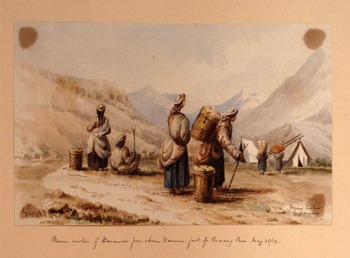
In examining tensions around self-fashioning, it is also important to consider that the accounts of altitude sickness discussed in this article were overwhelmingly written by men, and that in these the bodies they describe (both their own and those of their Asian companions) were never explicitly not male. This is not to say that these were spaces in which men and women did not suffer together, as Figure 2 demonstrates. Though perhaps more rather than less often homosocial affairs, that women were sometimes employed by expedition parties is also confirmed by written accounts. While negotiating a particularly treacherous and vertigo-inducing path while travelling to Lake Manasarovar and the Tibetan frontier in 1812, William Moorcroft noted that several of his bearers lost their nerve, but “one woman carried four burthens at different times for her less courageous companions.”Footnote 77 When it comes to Himalayan travel accounts written by women up to the midcentury, Hervey's The Adventures of a Lady in Tartary, Thibet, China and Kashmir is perhaps unique in explicitly describing symptoms of altitude sickness. Her three-volume journal of travels reflects a consolidated understanding of the bodily debility one was supposed to experience in high mountains, and while crossing the Hannoo Pass, for example, Hervey gives a visceral description, including a “terrible nausea, like to nothing else in its overpowering nature but sea-sickness.”Footnote 78 In terms of self-fashioning in her account, there is little to suggest she was less anxious about showing weakness than her male counterparts. The extant sources for this early phase of Himalayan travel thus do not allow for any real conclusions about the politics of comparison between men's and women's bodies (though contemporary representations of seasickness in relation to gender do suggest some interesting avenues for speculation).Footnote 79
“Women coolies of Kanawar from above Kanum. Foot of Ranung Pass, May 28, 1853.” Watercolour by Conway Shipley. Courtesy of the Central Asia Library of The Henry S. Hall, Jr. American Alpine Club Library.
When it came to assessing the credibility of accounts of bodily performance, the role of self-fashioning was not necessarily overlooked, and travellers’ assertions about their personal experiences of altitude were not always accepted uncritically. On occasion, travellers were suspected of deliberately downplaying the effects. For example, when Joseph Alexander Weller, at the time junior assistant commissioner of Kumaon, offhandedly referred to “a bad night's rest” while on a shooting trip to the Unta Dhura Pass in 1842, his editor John Batten remarked in a footnote that “probably the rarity of the air may have had a greater effect on our traveller than … he seems inclined to admit.”Footnote 80 The unevenness with which symptoms were felt thus left significant scope for members of expedition parties to try to disguise their symptoms, and this had to be factored into the politics of comparison. As James Fraser remarked:
After reaching that place [the Bamsaru Pass] no one was proof against this influence. It was ludicrous to see those who had laughed at others yielding, some to lassitude, and others to sickness, yet endeavouring to conceal it from the rest. I believe I held out longer than any one; yet after passing this gorge every few paces of ascent seemed an insuperable labour, and even in passing along the most level places my knees trembled under me.Footnote 81
This fits neatly into the trope of implying the superiority of European bodies while not discounting one's own suffering and the “trials of the body,” but it also suggests overlapping and contested performances within the expedition party, where exaggeration and concealment were ever-present concerns.
Himalayan explorers never really resolved the problem of how to record the symptoms of altitude in their own bodies and those of their Asian companions in the first half of the nineteenth century. Generally, travel-writing tropes allowed for maintaining hierarchies by asserting that European bodies performed as well or better, with exceptions sometimes excused by acclimatisation. Even if this reflected reality and not self-fashioning, it is possible these discrepancies partially stemmed from a difference in motivation, with wages likely less of an impulse to drag oneself upwards when compared to scientific and exploratory fervour or duty to empire. As was occasionally acknowledged, performance was also strongly correlated with exertion, and there was a significant difference in susceptibility depending on whether an individual was mounted or not, and the weight of the load they carried.Footnote 82 More significantly, these tropes also fail to account for the way that porters and guides might have exploited the “capricious and irregular” distribution of symptoms to resist sometimes brutal labour conditions. Indeed, as the various performances of Fraser's porters suggested, it is unlikely that European travellers were the only ones exploiting the politics of comparison around altitude for their own ends.
Quantification and the Instrumentalisation of Bodies
As evident in the way an exasperated James Fraser resorted to taking the pulse of a porter he suspected of feigning sickness, Himalayan explorers increasingly turned to methods for quantifying bodily performance. Measuring pulses and rates of breathing added a new dimension to the politics of comparison, seeming to offer an opportunity to make sense of the wildly differing symptoms, and of the real and perceived (not to mention performed) differences between members of expedition parties. In deploying their bodies and the bodies of others as corporeal instruments to read changes in atmospheric pressure, Himalayan travellers followed the example of early travellers in the Alps and the Andes, even if measurements were only carried out in an ad hoc rather than systematic, statistical fashion in this period.Footnote 83 James Manson offers one of the most extensive early attempts to quantitatively account for altitude sickness in the Himalaya, measuring his pulse and counting the frequency of his breathing using a “watch with a second hand,” recording, for example: “Ascended the whole without being obliged to stop to take breath. Pulse never exceeding 140 in a minute, nor the number of inspirations 32.”Footnote 84 Manson also measured and compared the bodies of his Asian companions: “I found on standing still after a little bit of steep ascent, that my pulse beat at the rate of 160 in a minute. A seapoy's (a hill man) who was with me, beat at the rate of 172.”Footnote 85 His identification of the soldier as a “hill man” rather than a lowlander suggests Manson was paying attention to acclimatisation, and he is also clearly grappling with the correlation between altitude sickness and exertion. In this section, I examine experiments with quantification, which ultimately point to an increasing, though haphazardly acquired, degree of coherence to medical topographies of the high Himalaya.
“Upon Pamir the pulsations in one minute.” From John Reference WoodWood, Narrative of a Journey to the Source of the River Oxus (London: John Murray, 1841), 363.
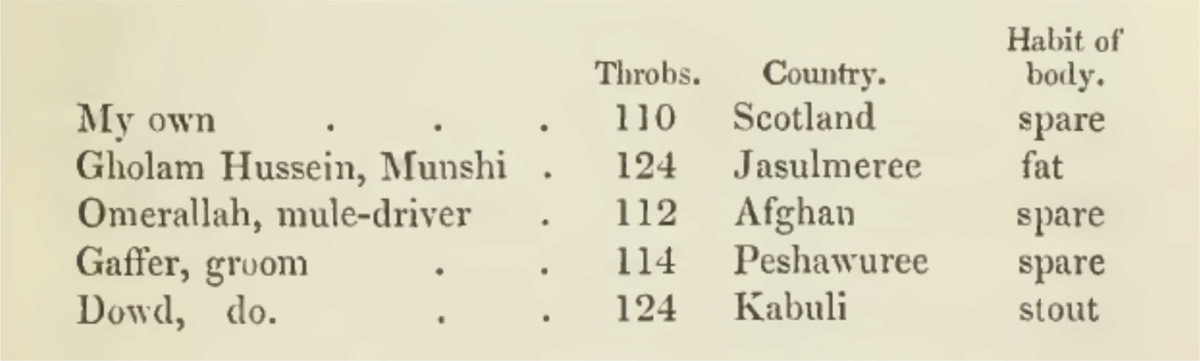
Scottish naval officer and surveyor John Wood (1812–1871), while in the Pamirs employed on a survey of the Indus River, examined the pulses of all his party, writing that “to my surprise found that the pulses of my companions beat yet faster than my own.”Footnote 86 He also went one step further, including a table of comparisons (see Figure 3). Both Wood's “surprise” and his assertion that his own body was better adapted than his Asian companions are suspicious, but he did acknowledge that the difference in loads carried meant that these comparisons were not entirely fair, or free of other variables such as fatigue. It is noteworthy that other than race and occupation, the only other variable he includes is general fitness. Age and gender, though implicit, are not addressed directly, indicating the limitations of these efforts compared to later systematic studies. Wood was nevertheless adamant about the body's potential for instrumentalisation, continuing:
When we afterwards commenced marching towards Wakhan I felt the pulses of the party whenever I registered the boiling point of water. The motion of the blood is in fact a sort of living barometer by which a man acquainted with his own habit of body can, in great altitudes, roughly calculate his height above the sea.Footnote 87
Just as the inhabitants of Kinnaur had trained themselves to observe their breathing to determine their rough height above sea level, Wood suggests that the rise and fall of the pulse offered the potential to quantify experiences of altitude, even if he acknowledges that these readings could only ever be approximate.
Assertions of the ability of the body to act as a sort of “living barometer” are not uncommon in travellers’ accounts. Before crossing the Niti Pass, William Moorcroft had questioned his guide, Amer Singh—a local and “the son of the Seyana [headman]” of the frontier village of Niti—and was told that the mountains were “not so high as many in Garwal.”Footnote 88 Moorcroft was sceptical of this information, of elevated importance for the way it was entangled with the delineation of the frontier, remarking that “from the view which I have had of them, it appears to me that they are higher,” and once across he noted that “the general difficulty of breathing experienced by us in passing them comes in confirmation of this opinion.”Footnote 89 Others pointed to discrepancies between barometric measurements and bodily readings, and as Hugh Falconer (1808–1865) wrote while returning to Ladakh: “I found the elevation to be 15,822 feet, considerably less than I imagined, as many of our party were attacked with the symptoms of distress about the head which extreme altitude brings on.”Footnote 90 In moments like this, when readings diverged, those from the boiling-point thermometers and barometers were thus preferred, and instrumentalised bodies were subservient to precision devices of metal and glass.
Far from passively entering mountainous spaces, Himalayan travellers actively sought out remedies and strategies to cope with the effects of high altitude, and thereby reduce the “friction of terrain.” James Gerard, for example, recorded that he had been told by a guide who had accompanied William Moorcroft “of fatal consequences from the want of due precaution. He says that the passage of the lofty range should be made while fasting, and recommends frequent doses of emetic tartar during the journey.”Footnote 91 For his part, Moorcroft noted various remedies collected from his Bhotiya guides, though he does not indicate whether he actually tried them: “The natives recommend a small quantity of coarse sugar to be eaten whilst we are mounting, and speak highly of the power of the kind of spar found near the snow reduced to powder and mixed with water, in diminishing the distressingly quickened action of breathing.”Footnote 92 While James Gerard was accompanying Alexander Burnes on a reconnaissance expedition to Bokhara, he was told by a “Mullah” named Najib that he and Burnes “should eat onions in all the countries we visited; as it is a popular belief that a foreigner becomes sooner acclimated from the use of that vegetable.”Footnote 93 This echoes the idea of the “onion mountains” and the way the Bis was sometimes ascribed to wild leeks, but it also suggests a local understanding of short-term acclimatisation. In this sense, it is also interesting that the onions were prescribed specifically as a remedy for foreigners, implying that Najib perceived a difference between the bodies of locals and those of the European travellers.
As well as seeking out remedies and monitoring physiological effects by taking pulses and counting inspirations, some Himalayan explorers also sought to theorise the causes behind their debility. James Gerard, for example, discussed the way that change in pressure was key to the underlying problem:
As respiration cannot be performed in a vacuum, we should consider that, at the height of 18,480 feet, the exhaustion is already half made, and … the progressive action becomes here an arithmetical series, reducible to an experiment in natural philosophy, where each succeeding stroke of the piston of an air-pump appears to draw the hand placed on the aperture closer and closer, till the pressure above so much overbalances that below, as to be insupportable to the person without risk of detriment. At 18,480 feet, the barometer, in the mean state of the air, stands at 15 inches, so that here we breathe an atmosphere half the density of that at the level of the sea; how then can we be surprised at the effects?Footnote 94
Here Gerard compares high-altitude spaces with laboratory experiments using a vacuum, evoking well-known demonstrations using air pumps. This reflects both his own attempt to parse his experiences as well as a method of recording and describing that might be explicable to an audience who had no direct firsthand contact with altitude sickness. Here he also sets up a parallel between experiences in the field and imagined laboratory experiments that could potentially explain what happened to the body in high places. Even if he did not have the resources to carry out such experiments himself, Gerard nevertheless identifies the trajectory that altitude physiology would take later in the century when French physiologist Paul Bert and his ilk began experimenting with pressure chambers large enough to encompass a human body.Footnote 95 Further advances in the scientific understanding of altitude awaited a new era of both laboratory experiments and systematic studies in the field, and this story thus ends where the historiography of altitude physiology to date usually begins.
Conclusion
In the early decades of the nineteenth century, the physiological effects of altitude became both a subject—if anecdotally and haphazardly—of scientific enquiry, and a (sometimes literal) headache for Himalayan exploration. In a context of attempts to delineate and map the East India Company's newly acquired high frontiers with China, and growing (if largely illusory) concerns with Russian activities in Central Asia, altitude sickness also presented a perplexing natural phenomenon that needed unravelling. Here altitude sickness amounted to both a physiological and social “friction of terrain,” circumscribing the mobilisation of labour and imperial possibilities in the high mountains. (Like other “frictions of terrain” it would eventually be reduced at the behest of lowland states, when “distance-demolishing technologies” such as roads decreased reliance on labour in parts of the mountains, but not until the twentieth century.Footnote 96) Ultimately, understanding the unequal and asymmetrical politics of comparisons around altitude in this period matters, because imperial administrators, scientists, and returning travellers used the accounts this article has traced to formulate nascent medical topographies of the high Himalaya. These, in turn, worked to constitute the upper reaches of the mountains in relation to lowland norms as aberrant environments and economically and politically peripheral spaces. However, “Zomia-thinking” also indicates that these divisions could be exploited by uplanders, and indeed imperial control in the Himalaya remained contested and incomplete, especially when compared with an increasingly expansionist and unforgiving British empire in the lowlands.
By the mid-nineteenth century, some of the uncertainty around altitude sickness had lessened, even if the complexities around partial pressures and the inherent variability of symptoms remained unresolved. As more and more accounts were compiled, travellers nevertheless came to expect that they would suffer in particular ways when venturing into high places. English naturalist Joseph Dalton Hooker (1817–1911) considered altitude sickness extensively in his Himalayan Journals (1854), arguably the most famous of the nineteenth-century Himalayan travel narratives, and included an appendix titled “On the weight of the atmosphere in Sikkim; and its effects on the human frame.”Footnote 97 Elsewhere, he repeated the story of the Bis, indicating the continuing utility of this trope.Footnote 98 In recording pulses and taking into account exertion and time since eating, Hooker provides a snapshot of the monitoring and recording practices that had developed by the midcentury. He also dealt with both short and long-term acclimatisation (recognising the former but not the later), and in his account there is a confidence, and a sense of familiarity. However, familiarity was by no means mastery, and the uneven distribution of symptoms continued to provide scope for self-fashioning.
Indeed, into the later nineteenth century, the tropes around bodily performance, far from vanishing, merely took different forms. In 1883, William Woodman Graham (ca. 1859–ca. 1932) made one of the first climbing trips to the Himalaya “more for sport and adventures than for the advancement of scientific knowledge,” and went on to (possibly) set a new world altitude record for the human body of 24,080 feet on Kabru.Footnote 99 Of this ascent he made the extraordinary assertion, quoted here from the published text of an address to a packed session of the Royal Geographical Society, that “neither in this nor in any other ascent did we feel any inconvenience in breathing other than the ordinary panting inseparable from any great muscular exertion. Headaches, nausea, bleeding at the nose, temporary loss of sight and hearing, were conspicuous only by their absence.”Footnote 100 He continued to note:
Unquestionably man's range is increasing. Read any old account of an ascent of Mont Blanc; it was expected that the climber should suffer every possible inconvenience from rarefied air, and the harrowing details were duly forthcoming. Now the ascent is mere child's play, and we hear no more of these agonising horrors.Footnote 101
These assertions might thus be seen as representing a new set of tropes. Indeed, anticipating Graham, Paul Bert noted that by the 1860s and ’70s, many mountaineers had stopped reporting altitude sickness symptoms altogether, because “they were almost as afraid of being ridiculed for mountain sickness as they were for sea sickness.”Footnote 102
Altitude thus continued to be a cipher, and to offer opportunities for travellers to represent their bodily experiences in self-serving ways. While in the early nineteenth century symptoms might have implied heroic challenge or bodily suffering that could be deployed to establish authority, by the later part of the century they were again sometimes being left unspoken in popular travel accounts (even as systematic scientific studies of respiratory physiology were beginning to be mounted in parallel). This article has examined the politics of bodily comparison around altitude in a particularly acute context, that of the cross-cultural and multiethnic, if imperially motivated, early exploration of the Himalaya. In this context, the omnipresence of Asian guides and porters became central not only to how explorers understood and represented altitude sickness, but also to the way they experienced its unsettling and ill-defined effects. Writing about the Arctic, Michael Bravo and Sverker Sörlin note that recovering the presence of indigenous peoples often has not gone far enough in histories of exploration, and sometimes “even studies of field practices in places and spaces where people are in abundance, can be carried out while completely ignoring the human beings who are present in the landscape.”Footnote 103 In the high spaces of the Himalaya, under the strain of the insidious and invisible effects of altitude sickness, this was never the case in the first half of the nineteenth century. As the many and often questionable tropes that propagated in the exploration narratives of this period demonstrate, the copresence of bodies, European and Asian, lowlander and uplander, were impossible to ignore.
Acknowledgements
The author thanks Sujit Sivasundaram, Tom Simpson, Simon Schaffer, the members of the Cabinet of Natural History, and the anonymous reviewers for their invaluable comments on versions of this article. He gratefully acknowledges the Cambridge Commonwealth, European, and International Trust and Clare College for support in conducting the research for this article.



