




Chronology of the Middle Bronze Age Near East
The early second millennium BC, equating to the Middle Bronze Age, was an international and literate era in the Near East. Long-distance exchange networks connected cities across the region, carrying metals, textiles, wool, wine, oil and other goods. Thousands of cuneiform tablets found at Kültepe (ancient Kanesh) in Türkiye document a sophisticated network of trading posts (kārū) operated by Assyrian merchants that linked northern Mesopotamia with central Anatolia (Larsen Reference Larsen2015). Thousands more texts from ancient Mari on the Euphrates document the intrigues and rivalries of the kingdoms of Syria and southern Mesopotamia (Sasson Reference Sasson2015) (Figure 1a–b). This combined corpus attests a web of interconnected people and events that allows a more detailed historical reconstruction to be drawn for the Middle Bronze Age than for any earlier period in the region. Detailed pottery chronologies and destruction levels at key sites tighten the mesh of synchrony still further. Establishing an absolute chronology, however, has proved problematic. Solar eclipses recorded in ancient texts can serve as anchors, for example, but only when candidate events are constrained by other evidence. Consequently, despite a century of debate, the Middle Bronze Age evidence has floated in absolute calendar time, with competing proposals differing by up to 150 years (Pruzsinszky Reference Pruzsinszky2009) (Figure 2). Moreover, the implications of these different chronologies affect historical understandings of the ensuing initial Late Bronze Age period that marked the rise of regional empires, but for which we have far fewer textual sources.
Maps of Middle Bronze Age sites in Syria, Anatolia and Mesopotamia: A) sites destroyed in late MB II with ceramic assemblages comparable to Zincirli Complex DD; B) possible locations of cities claimed to have been conquered by Hittite kings Ḫattusili I and Mursili I (prepared by V. Herrmann and D. Schloen).

Comparison of the date ranges for the First Dynasty of Babylon, according to five competing chronologies for Mesopotamian history (prepared by V. Herrmann).

Twenty-five years ago, many scholars were persuaded by arguments for an Ultra-Low ‘New’ Chronology (Gasche et al. Reference Gasche, Armstrong, Cole and Gurzadyan1998). Around the same time, an equally low chronology for the Eastern Mediterranean, based on proposed archaeological links at Tell el-Dabʿa with Egyptian historical chronology (Bietak Reference Bietak2002), found many adherents. That evidence from both regions seemed to point toward low dates was reassuring, because any mismatch implied significant problems with the dating of Levantine sites with connections to both chronologies, such as Alalakh (Tell Atchana, Türkiye) and Hazor (Israel). As Gates (Reference Gates and Åström1987: 60) observed, “the test for absolute chronology in the Ancient Near East cannot be run conclusively on sites within the heart-lands of major cultural regions, but rather on their intersecting or tangent peripheries”.
Recent advances in radiocarbon and dendrochronology offer a path forward. For the Mesopotamian chronology, studies linking textual and archaeological evidence, especially from Kültepe, Mari and Acemhöyük (Türkiye), with dendrochronological and radiocarbon evidence from Kültepe and Acemhöyük, have created an independent dating framework (Barjamovic et al. Reference Barjamovic, Hertel and Larsen2012; Manning et al. Reference Manning2016, Reference Manning2020). This aligns best with the High-Middle Chronology (hMC) or Low-Middle Chronology (lMC) (see Roaf Reference Roaf2012; de Jong Reference de Jong2012–2013, Reference de Jong2016–2017; Höflmayer & Manning Reference Höflmayer and Manning2022), which put the key synchronism of the death of Assyrian king Šamši-Adad I in the eighteenth year of the reign of Hammurabi of Babylon at, respectively, 1776 or 1768 BC (using dates from Barjamovic et al. Reference Barjamovic, Hertel and Larsen2012; different interpretations push these dates very slightly up or down). Meanwhile, revision of the Tell el-Dabʿa chronology, reconciling its radiocarbon dates and archaeo-historical chronology with new radiocarbon dates from sites in the Central and Southern Levant, raises the end of the Middle Bronze Age in the Eastern Mediterranean to c. 1600 BC (Höflmayer et al. Reference Höflmayer2016a, Reference Höflmayer2016b; Höflmayer Reference Höflmayer2019; Höflmayer & Manning Reference Höflmayer and Manning2022; pace Bietak Reference Bietak2021).
New results from the Northern Levant—the region that links the Mesopotamian and Eastern Mediterranean chronologies—affirm these higher dates for the Middle Bronze Age. Here, we present evidence for the absolute and relative chronology of a late Middle Bronze Age (MB) II destruction event at Zincirli (Türkiye), a site on the border between the Syrian and Anatolian spheres. The destruction is dated with unusual precision by 11 short-lived radiocarbon samples from closed contexts, and the assemblage of pottery found therein affords key synchronisms with final Middle Bronze Age strata at other sites in the Northern Levant, Cilicia and Anatolia. The results provide important evidence for the resolution of the long-running chronological debate.
Middle Bronze Age Zincirli
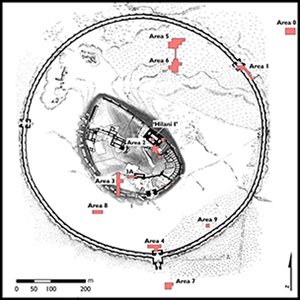
Zincirli sits in the İslahiye Valley at a control point linking the Northern Levant with the Anatolian Plateau (Figure 1a). Nineteenth-century excavations revealed the Iron Age city of Sam'al, dated to c. 900–600 BC (Wartke Reference Wartke2005; Figure 3), while the current expedition is investigating earlier strata, including a destruction phase towards the end of MB II (Herrmann & Schloen Reference Herrmann and Schloen2021).
Plan of Zincirli, showing structures excavated 1888–1894 (von Luschan et al. Reference von Luschan, Humann and Koldewey1898: pls 28–29) and 2006–2018 excavation trenches (pink) (prepared by V. Herrmann; courtesy of the Chicago-Tübingen Excavations at Zincirli).

Middle Bronze Age Zincirli was probably an outpost of Tilmen Höyük, a fortified palatial centre 8km to the south—likely the city Zalwar or Zalba(r) (Forlanini Reference Forlanini1985: 55; Miller & Corti Reference Miller, Corti and Streck2017; Figure 1a). Late in the Middle Bronze Age, the Hittite kingdom unified central Anatolia, subsequently making repeated incursions into the Northern Levant. Zalba(r) appears as an initial target of the Hittite king Ḫattusili I (conventionally, hMC c. 1650–1620 BC), whose Annals (CTH 4, §2–3, A i 9–14; Košak et al. Reference Košak2021) recount his destruction of the city (Beckman Reference Beckman and Chavalas2006: 219–20). Subsequent campaigns against Alalakh, Uršu, Ḫaššum and Ḫaḫḫum show a strategy of picking off the states between Anatolia and Yamḫad (Figure 1b) (Klengel Reference Klengel1999: 44–55). Ḫattusili's successor, Mursili I, sacked Yamḫad's capital Ḫalpa (Aleppo) and, in a famous raid at the end of the reign of Babylonian king Samsuditana (hMC/lMC 1595/1587 BC, or possibly 1602/1594 BC; Roaf Reference Roaf2012), Babylon itself (Figure 1b). This latter event marks the sole direct synchronism of Old Hittite history with the Mesopotamian sequence.
The Hittite expansion demarcates the beginning of the Late Bronze Age in the region, sparking the subsequent coalescence of Mitanni in northern Syria. The sequence and relationships of the first Hittite kings before Ḫattusili I remain unclear (Simon Reference Simon2020; Kloekhorst Reference Kloekhorst2021), and the kings before and after Mursili I are dated only by generation count (Beckman Reference Beckman2000). The traditional hMC date of 1650 BC for the start of Ḫattusili's reign is reached simply by counting back two 25-year generations from Mursili's 1595 BC datum (hMC). As the Zincirli destruction can be linked to these Hittite campaigns through ceramic comparisons (see below), dating this event can throw new light on this period.
Excavations on the high north-eastern part of the Zincirli mound (Area 2 in Figure 3) between 2015 and 2018 uncovered MB II buildings (Buildings DD/I and DD/II: Area 2, Phase 4), which were destroyed by an intense fire that preserved extensive carbonised botanical remains and left large material culture assemblages in several rooms (Morgan & Soldi Reference Morgan and Soldi2021) (Figure 4). Preliminary analysis of these buildings reveals an array of administrative, storage, food-preparation and craft activities. Building DD/I was devoted mainly to food preparation, with installations and botanical remains indicating winemaking. Building DD/II hosted storage and administrative activities, attested by ceramic vessels, cylinder seals and clay sealings (e.g. Morgan & Soldi Reference Morgan and Soldi2021: fig. 6:3–5). DD/II's wide walls, casemate-like rooms and staircase suite (Rooms DD5–7) create a monumental and fortified aspect. The alleys between buildings produced caches of loom weights and cooking pots containing carbonised grain.
Plan of MB II structures excavated in Zincirli Area 2 (prepared by V. Herrmann; courtesy of the Chicago-Tübingen Excavations at Zincirli).

Comparison with Northern Levantine sites
The assemblage of complete vessels from Zincirli Area 2 allows comparison with late MB II sites across the Northern Levant and Cilicia. Vessel types characteristic of the local inventory are: small, fine-walled goblets (Figure 5A); cooking pots (Figure 5J); jars with perforated bases, possibly used for wine fermentation (Figure 5N); and elongated ovoid storage jars (Morgan & Soldi Reference Morgan and Soldi2021: figs 23–24). These offer comparisons with the final MB II repertoires at Tilmen Höyük (Levels IIb–c), Alalakh (Level VII), Ebla (Mardikh IIIB2), Kinet Höyük (Period 16), Umm el-Marra (Period IIIa–c), Zeytinli Bahçe Höyük (Building VII) and Lidar Höyük (Phase 5/Level 8) (Figure 5B–I, K–M, O–P; Morgan & Soldi Reference Morgan and Soldi2021).
Ceramic forms representative of the Zincirli MB II destruction assemblage, compared with forms from contemporaneous late MB II sites: A) Zincirli, goblet C17-46.0A#1; B) Tilmen (Marchetti Reference Marchetti and Cordoba2008: fig. 3:4; used with permission); C & D) Alalakh VII (Heinz Reference Heinz1992: pl. 5:25, 6:31; used with permission); E) Ebla IIIB2 (Pinnock Reference Pinnock2005: pl. 19:5; used with permission); F) Umm el-Marra late MB II (Schwartz et al. Reference Schwartz, Curvers, Dunham and Stuart2003: fig. 29:3; used with permission); G) Oylum (Özgen & Helwing Reference Özgen and Helwing2001: fig. 17:e; used with permission); H) Zeytinli Bahçe (Balossi et al. Reference Balossi, di Nocera, Frangipane, Kuzucuoğlu and Marro2007: fig. 10:e; used with permission); I) Lidar (after Kaschau Reference Kaschau1999: fig. 23:N 11a); J) Zincirli cooking pot R15-302; K) Tilmen (Marchetti Reference Marchetti and Cordoba2008: fig. 3:9; used with permission); L) Tilmen (Marchetti Reference Marchetti, Matthiae, Pinnock, Nigro and Marchetti2010: fig. 8:b; used with permission); M) Kinet (Gates Reference Gates2011: fig. 10:b; used with permission); N) Zincirli simple ware jar C17-46.0A#6; O) Lidar (after Kaschau Reference Kaschau1999: fig. 28:K/F 4b); P) Zeytinli Bahçe (Balossi et al. Reference Balossi, di Nocera, Frangipane, Kuzucuoğlu and Marro2007: fig. 10:a; used with permission). Scales in cm (prepared by S. Soldi).

The ceramic similarities provide a chronological link with historical events. If Tilmen Höyük is Zalb/war, the destruction of its MB II stratum can probably be attributed to the attack of Ḫattusili I. A door sealing of an official of the Babylonian king Sumu-la-el (hMC 1880–1845 BC) found in an MB II fortress provides another historical datum for the earlier part of this period (Marchesi & Marchetti Reference Marchesi and Marchetti2019). Ḫattusili claimed to have destroyed Alalakh the following year, and most attribute the destruction of the so-called Yarim-Lim Palace and temple of Alalakh Level VII to this event (pace Lauinger Reference Lauinger2015: 204–208). The first king of Alalakh was the son of Hammurabi I of Yamḫad, attested in Mari texts as ascending the throne in hMC 1764 BC, but the number of kings of Alalakh VII and their reign lengths are uncertain (Lauinger Reference Lauinger2015: 201–27). Finally, Ḫattusili's successor, Mursili I (conventionally, hMC c. 1620–1590 BC), was long assumed to have destroyed Ebla (Mardikh IIIB2, with final MB II ceramic assemblage apparently slightly later than Alalakh VII) as part of his campaign(s) against Aleppo, but the excavator more recently has attributed the city's destruction to Pizikarra of Nineveh (hypothetically, Mursili's ally) (Matthiae Reference Matthiae, Matthiae, Nigro, Peyronel and Pinnock2007). Close ceramic parallels between these three sites and the Zincirli MB II destruction make it highly probable that Zincirli was also destroyed at the time of these Hittite campaigns, probably during the attack on Zalb/war (Herrmann & Schloen Reference Herrmann and Schloen2021).
A synchronism with Middle Bronze Age Anatolia is offered by single-handled globular ‘pilgrim’ flasks, of which Complex DD yielded many examples, including seven complete and in situ (Figure 6A & D). These include larger plain and smaller painted flasks. Containers of this type—mostly unpainted—were widely distributed along the Euphrates from the late Early Bronze Age through to the Middle Bronze Age, and probably held wine (Figure 6E–H) (Morgan & Soldi Reference Morgan and Soldi2021). They have also been recovered from Kārum levels II and I at Kültepe-Kanesh, where they were identified as Northern Levantine imports (Emre Reference Emre, Calmeyer, Hecker, Jakob-Rost and Walker1994, Reference Emre1995). Indeed, records from Kültepe-Kārum II mention “(fine) sweet wine from Mamma” (probably Kahramanmaraş), transported in a container called an “aluarum-vessel”, as an expensive and desirable product (Barjamovic & Fairbairn Reference Barjamovic and Fairbairn2018: 251–53). Zincirli appears to have been part of the production region for this commodity (Morgan & Richardson Reference Morgan and Richardson2020).
Globular wine flasks found in the Zincirli MB II destruction assemblage, compared with flasks from contemporaneous late MB II sites: A) Zincirli, painted flask C18-46.0B#16 (height = 380mm); B) Kültepe (after Emre Reference Emre1995: fig. 7b; height = 260mm); C) Kültepe (after Emre Reference Emre1995: fig. 6; height = 286mm); D) Zincirli, unpainted flask C17-46.0B#6 (height 410mm); E) Kültepe (after Emre Reference Emre1995: fig. 21; height 240mm); F) Lidar (after Kaschau Reference Kaschau1999: fig. 29:K/F 6a; height = 340mm); G) Tilbeşar (Kepinski Reference Kepinski and Henry2012: fig. 11; height = 400mm; used with permission); H) Zeytinli Bahçe (Balossi et al. Reference Balossi, di Nocera, Frangipane, Kuzucuoğlu and Marro2007: fig. 12; used with permission). Scales in cm (prepared by S. Soldi).

Bichrome-painted flasks, such as those at Zincirli, are otherwise found only at Kültepe Kārum Ia (or sometimes Level I without specification) (type A1a in Emre Reference Emre1995), as well as Umm el-Marra (G. Schwartz, pers. comm.). Some appear so similar to those from Zincirli that they could have been produced by the same workshop (Figure 6B–C) (see Emre Reference Emre1995: pls 2:1a–b & 3:1a–b, figs 4 & 7), suggesting a direct chronological link between these two contexts. The transition between Kārum Ib and Ia occurred around the last decade of the eighteenth century (hMC; Barjamovic et al. Reference Barjamovic, Hertel and Larsen2012: 51–52). Emre (Reference Emre1995: 182–83), comparing the flasks with unpainted examples from Haradum Level 3B1 on the Middle Euphrates, which contained texts of the reign of Ammiditana (hMC 1683–1647 BC), proposed that Ia could have persisted to this period. Their attestation at Zincirli suggests the possibility of an end date for Kārum Ia that is even slightly later, in the reign of Ḫattusili I.
Dating the destruction
Radiocarbon samples
Eighteen samples from Area 2 were submitted for radiocarbon analysis (Table S1 in the online supplementary material (OSM)). Eleven came from three ceramic vessels containing bitter vetch or free-threshing wheat seeds, recovered from the destroyed complex (Figures S1–S3). We assume that these seeds were stored for a few years at most and were carbonised in a single conflagration. In addition, an olive pit from debris above the floor of Room DD2 was found to date to the third millennium BC and was thus apparently residual in the collapsed material (probably relating to EB IV activity).
Samples from later and earlier contexts bracket the destruction date. Additional dates were secured on a free-threshing wheat seed from the fill of a drain cutting the destruction material, and on a charcoal fragment from a pit cutting the stone socle of ‘Hilani I’ neighbouring DD/II to the north—both contexts ceramically dated to Iron Age II. One barley seed and three charcoal fragments were taken from fill layers on which Middle Bronze Age Complex DD was constructed, excavated in a probe on its eastern preserved edge.
Methods
Our aim was to define the calendar age of the late MB II (Area 2, Phase 4) destruction. We employed Bayesian chronological modelling using OxCal v4.4.4 and the IntCal20 radiocarbon calibration dataset (Bronk Ramsey Reference Bronk Ramsey2009; Bayliss Reference Bayliss2009; Hamilton & Krus Reference Hamilton and Krus2018; Reimer et al. Reference Reimer2020), with curve resolution set at one year in order to integrate prior archaeological sequence information with radiocarbon dating probabilities from the measured samples (for details, see the OSM).
Our stratigraphically informed sequence comprises:
1. A group of samples (Phase in OxCal) from fill for the Phase 4 structures, which contain material from an earlier period of the Middle Bronze Age in a secondary context;
2. The period of Phase 4 before its destruction—although we have no samples from this period, we treat it as a Phase and can quantify its calendar dates and duration with OxCal Date and Interval queries;
3. A group of samples (Phase in OxCal) on short-lived materials deriving from the burnt destruction deposits of Phase 4 (end MB II in Area 2), including one clearly residual sample (OxA-36326); and
4. Later reoccupation of Area 2 in Iron Age II (Phase 2b, called 3N in Herrmann & Schloen Reference Herrmann and Schloen2021: tab. 1), treated as a Phase. One sample (Tübitak-0461) is probably residual from the MB II destruction horizon, but we retain it in this Phase in Model 1 to demonstrate how it is recognised as an outlier and downweighted.
From this sequence, we constructed an initial model (Model 1a in Figure 7) that includes all dates and with samples from the same closed context combined as weighted averages (see the OSM). We then considered alternative models that kept each sample as an independent estimate (Models 1b, 2b and 3b), moved Tübitak-0461 and excluded OxA-36326 (Models 2a, 2b, 3a and 3b), and/or applied an offset based on an approximate Levantine growing season and probable error in IntCal20 due to legacy conventional radiocarbon data (Models 3a and 3b). These offset values are probably over-estimations for the Zincirli context (see the OSM), but they are considered in order to indicate the range of the latest plausible date estimate for the MB II destruction.
Model 1a: light-shaded distributions show non-modelled calibrated probabilities. Dark distributions show modelled probabilities, and lines beneath show 68.3% (upper line) and 95.4% (lower line) highest posterior density ranges. For dates on short-lived materials where the OxCal General Outlier model is applied, outlier probabilities are shown as Posterior/Prior (Prior is 5%). The two >10% probability outlier elements (OxA-36326 & Tübitak-0461) are shown in bold red. OxA-36326 is excluded in Models 2a, 2b, 3a and 3b as a probably residual EBIV sample, as indicated by the orange arrow. Tübitak-0461 is moved into the MBII destruction phase in Models 2a, 3a, 2b and 3b, as indicated by the dashed red arrow. For dates on charcoal samples where the OxCal Charcoal Outlier model is applied, these are 100/100 (prepared by S. Manning).

Results
Figures 7 and 8 show Models 1a and 1b in full, while Figures 9a and S5 show the modelled calendar-age probabilities for the date of the Phase 4 MB II destruction event from each model (and for Models 1a and 1b, excluding OxA-36326). Table 1 lists results for selected elements from (preferred) Models 2b and 3b. All models yield similar results: the most probable date range (68.3% highest posterior density) for the Phase 4 destruction falls in, or mainly indicates, the mid to later seventeenth century BC (Figures 9a & S5). The combination of the probability from all models gives a smallest continuous most probable and greater than 50 per cent probability region c. 1662–1606 BC, containing approximately 73.2 per cent of the probability (Figure 9a). Even allowing for possible small regional radiocarbon offsets and calibration-curve issues (Models 3a and 3b), the modelled age ranges are only slightly later, perhaps indicating a most probable 68.3 per cent date range in the later seventeenth century BC. Overall, we regard Models 2b and 3b, which treat all the dates as separate estimates within a Phase with an exponential distribution, as offering the best date estimates for the destruction (see the OSM). The most probable 59.8 per cent highest posterior density region in Model 2b lies at 1637–1614 BC (95.4% range 1670–1607 BC). The most probable 68.3 per cent highest posterior density region in Model 3b lies at 1627–1608 BC (95.4% range 1667–1646 [9.1%], 1643–1594 [86.4%] BC). Combining Models 1b (excluding OxA-36326), 2b and 3b, a single most probable approximately 56.2 per cent highest posterior density region lies c. 1632–1610 BC (Figure 9b); we use this as our best date approximation for the MB II destruction at Zincirli.
Model 1b: see Figure 7 caption. Move of Tübitak-0461 for Models 2a, 2b, 3a and 3b is indicated by the dashed red arrow (prepared by S. Manning).

a) The eight modelled dating probability distributions for the Phase 4 Destruction Boundary in Figure S5 overlaid. The approximately 73.2% highest posterior density (hpd) range from the combination of all these probability distributions lies c. 1662–1606 BC; b) the combination of the preferred ‘b’ approach models, using Model 1b excluding the residual OxA-36326, Model 2b and Model 3b, finds that the single most likely, approximately 56.2% hpd range lies c. 1632–1610 BC (prepared by S. Manning).

Summary results from Models 2b (2a) and 3b (3a). All elements with Convergence (C) ≥95. Interval or Difference queries (italics) are periods of calendar years. The 68.3% and 95.4% highest posterior density (hpd) ranges are given as whole (start–end) ranges; internal divisions are not listed (for details of the Phase 4 destruction event, see Figures 7–9 and S5).

The end of the Middle Bronze Age in the Northern Levant
The destruction of Zincirli Complex DD can be synchronised on archaeological and ceramic grounds with destruction layers attributed to the Hittite campaigns against the Northern Levant, marking the final phase of the Middle Bronze Age. The probable radiocarbon date for Zincirli's destruction, c. 1632–1610 BC, presents the most precise evidence thus far for the absolute chronology of these events. As this destruction probably occurred in the reign of Ḫattusili I, the Zincirli dates affirm the traditional estimate for this king's reign according to the hMC or lMC, one to two generations (25–50 years) before the sack of Babylon by Mursili I in 1595/1587 BC.
The new high-precision dates from Zincirli support accumulating radiocarbon evidence from other Northern Levantine sites that presents a generally consistent picture for MB II absolute chronology (Figure 10). Preliminary reports of radiocarbon dates from Tilmen Höyük indicate that “the origin of the monumental building phase at the site took place during the nineteenth century BC, while its destruction [occurred] during the second half of the seventeenth century BC” (Marchetti Reference Marchetti, Matthiae, Pinnock, Nigro and Marchetti2010: 370; see also Marchetti Reference Marchetti and Cordoba2008: 467). Radiocarbon results from final Middle Bronze Age destructions at Kinet Höyük in Cilicia, Ebla (Mardikh IIIB2), Oylum Höyük and Umm el-Marra to the south, and Lidar Höyük on the Euphrates (Figure 10), are also mostly compatible with a late seventeenth-century BC date for this horizon. The very few later dates are likely outliers. Compared with these various datasets, the set of short-lived samples in closed contexts from Zincirli's destruction deposits provides a better-defined and more robust indication for the date of the final phase of the Middle Bronze Age, with preferred Models 2b and 3b (Table 1) pointing to c. 1594 BC as a latest possible date (95.4% probability).
Interpretive figure showing radiocarbon dates from Northern Levantine sites destroyed in the late/final MB II and dendrochronological dates from Kültepe, correlated with historical events and compared with five proposed absolute chronologies for those events. HC = High Chronology; hMC = High-Middle Chronology; lMC = Low-Middle Chronology; LC = Low Chronology; NC/ULC = New Chronology/Ultra-Low Chronology (Pruzsinszky Reference Pruzsinszky2009; Höflmayer & Manning Reference Höflmayer and Manning2022). The green gradient approximates the apparent best fit with the majority of dates reported. For sources and explanation of the symbology, see the online supplementary material (OSM). Date ranges from reported radiocarbon analyses are given below relevant phases. All published single dates have been recalibrated with OxCal v.4.4.4 software using the IntCal20 curve (Bronk Ramsey Reference Bronk Ramsey2009; Reimer et al. Reference Reimer2020); the 68.3% highest posterior density range (or closest possible) is reported (prepared by V. Herrmann).

Alalakh, whose Level VII Ḫattusili I also possibly destroyed, has long been a key site for Syro-Mesopotamian chronology debates; additionally, it is a linchpin connecting the Mesopotamian and Eastern Mediterranean chronologies via the Cypriot imports from Level VI (whose end possibly coincides with the fall of Babylon). Until recently, the use of Mesopotamian Low or Ultra-Low Chronologies, seemingly supported by the Eastern Mediterranean low chronology, pulled Alalakh VII's destruction down into the sixteenth century BC based on Cypriot ceramic synchronisms (e.g. Bergoffen Reference Bergoffen2005: 55–72), carrying implications for the rest of the Northern Levant and beyond. Radiocarbon dates for the Level VII palace's construction, cited in the range 1780–1680 BC (Figure 10) (Yener Reference Yener and Matoian2021: 580, fig. 8), now support a higher chronology, allowing its destruction to fall in the second half of the seventeenth century BC.
As noted above, recent upward revision of the Eastern Mediterranean chronology also supports a seventeenth-century BC date. Cypriot Bichrome ware, which begins in Alalakh Level VI, is also found in Tell el-Dabʿa Strata D/1 and C/3. These strata had been dated to c. 1530–1470 BC (early Eighteenth Dynasty) in the historical chronology (Kutschera et al. Reference Kutschera2012: fig. 3), whereas modelled radiocarbon dates place them at 1679–1595 (Strata D/2 to D/1 Boundary) and 1635–1546 BC (start Stratum C/2 Boundary) at 95.4 per cent probability (following revision of Kutschera et al. Reference Kutschera2012 by Höflmayer & Manning Reference Höflmayer and Manning2022). New radiocarbon data from both Syro-Anatolia and Egypt thus find no contradiction at sites such as Alalakh, where the two chronological systems overlap. Likewise, Hazor is attested in Mari texts of the reigns of Šamši-Adad I and Zimri-Lim and has yielded MB IIB and IIC ceramics contemporaneous with Tell el-Dabʿa Strata F and E/3 (Ben-Tor Reference Ben-Tor2004). Following the Eastern Mediterranean low chronology advocated by Hazor's excavator, this would be c. 1710–1650 BC, while modelling of radiocarbon dates at Tell el-Dabʿa indicates ages a century earlier, between 1872–1752 (G/1-3 to F Boundary) and 1813–1710 BC (E/3 to E/2 Boundary), at 95.4 per cent probability (following revision of Kutschera et al. Reference Kutschera2012 by Höflmayer & Manning Reference Höflmayer and Manning2022). For Hazor, too, therefore, the new radiocarbon evidence supporting the Syro-Mesopotamian hMC or lMC, which dates the Hazor-Mari link to the first half of the eighteenth century BC, is consistent with the higher Eastern Mediterranean radiocarbon chronology.
Conclusion
Bayesian chronological modelling of radiocarbon dates on short-lived samples from closed contexts in destruction deposits at Zincirli gives the most precise dates yet available for the final phase of the Middle Bronze Age in the Northern Levant. Significantly, the new radiocarbon evidence from Zincirli and other sites in this region connecting the Near East and Eastern Mediterranean—in concert with radiocarbon and dendrochronological evidence from Anatolia, the Southern Levant and Egypt—is consistent only with the Syro-Mesopotamian High-Middle/Low–Middle Chronology. This result points to the resolution of a century of scholarly debate. Bringing this chronological conundrum to a close will permit scholars to address with greater confidence the many historical and archaeological questions raised for the Near East by the long start to the Late Bronze Age, c. 1600–1400 BC.
Acknowledgements
The authors thank the Turkish Ministry of Culture and Tourism, Cultural Heritage and Museums General Directorate, and the Gaziantep Archaeology Museum for their support of the excavations at Zincirli. We are also grateful for the suggestions of the two anonymous reviewers. We dedicate this article to the people of Zincirli and Fevzipaşa, Türkiye.
Funding statement
Funding was received from the Deutsche Forschungsgemeinschaft (Grant HE 7517/2, Urban Landscape and State Formation at Iron Age Zincirli, Turkey), the CRANE project based at the University of Toronto and funded by the Social Sciences and Humanities Research Council of Canada (Award 895-2011-1026), and the Mediterranean Archaeological Trust.
Supplementary material
To view supplementary material for this article, please visit https://doi.org/10.15184/aqy.2023.30


 Open access

