


Introduction
Several decades ago, restoration merely meant returning vegetation to a predisturbance condition, a characteristic state existing before its degradation or destruction. Guidance for such undertakings was often drawn from “reference conditions” on existing sites or those that were hypothesized to have existed in the past. In more recent decades, restoration usually has been employed to achieve multiple objectives. First, restoration is a way to combat species invasion, especially under the stresses of climate change and the expanding influence of human activities (Esler et al. Reference Esler, Prozesky, Sharma and McGeoch2010; Gaertner et al. Reference Gaertner, Fisher, Sharma and Esler2012; Hobbs and Richardson Reference Hobbs and Richardson2011; Kerns and Guo Reference Kerns and Guo2012). Second, restoration has been increasingly used to provide much-needed ecosystem services such as sequestering carbon (Carter Reference Carter2013) and providing wood, biofuels, and other products, partly because the sites needing restoration are often close to human populations and thus undergo greater ongoing disturbances and degradation (Hill Reference Hill2007; Lugo Reference Lugo2004; Roe Reference Roe2010). Therefore, today’s restoration efforts face much greater challenges than ever before, and the cost for restoration is drastically increasing through time. For these reasons, the importance of incorporating long-term and regional goals in design cannot be overstated (Guo and Norman Reference Guo and Norman2013).
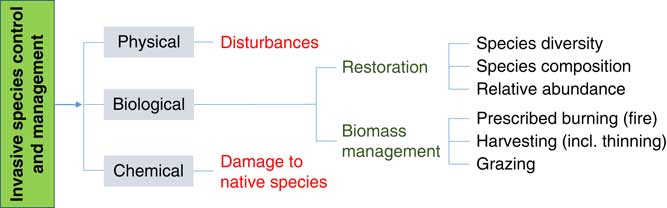
Invasive species, foreign or domestic, threaten native species diversity and ecosystem health and sustainability and cause ecological and economic losses and/or crises in many habitats around the world (Young et al. Reference Young, Clements and DiTommaso2017). In that many habitats have been invaded and suffer from varied degrees of invasion (DI), removal of invasive species is needed before any attempt at restoration. Although there are many approaches to control and manage invasive species, no method has gained broad acceptance as the most effective one (Figure 1). With natural areas and habitats being destroyed and degraded at an accelerating pace because of human population growth and associated activities, restoration offers an important opportunity for preventing invasion and managing invasive species. However, a key requirement of such an approach is that projects be carefully planned, designed, and implemented. This approach requires careful consideration of species selection, abundance, and planting order. Increasing evidence also indicates that local restoration needs to be informed by landscape or regional contexts (Bell et al. Reference Bell, Lyon, Gratton and Jackson2008) and possible temporal trends in climate conditions (Joyce et al. Reference Joyce, Briske, Brown, Polley, McCarl and Bailey2013; McCollum et al. Reference McCollum, Tanaka, Morgan, Mitchell, Fox, Maczko, Hidinger, Duke and Kreuter2017). Additionally, the success of restoration has been constrained by the lack of careful consideration of invasive species and poor design at the beginning of the project. New issues also emerge when considerable ecological, social, and conservation conflicts over invasive species management gradually become evident (Dickie et al. Reference Dickie, Bennett, Burrows, Nunez, Peltzer, Porté, Richardson, Rejmánek, Rundel and van Wilgen2014; Estévez et al. Reference Estévez, Anderson, Pizarro and Burgman2015).
Major methods for invasive plant control and management. Physical or mechanical removal may be most feasible at smaller scales, while chemicals (herbicides) may be applied in isolated patches (sites or individual trees). Both methods pose a risk to native species and ecosystems, although this risk can be minimized with careful implementation/application. Biological techniques might be more acceptable, although there are cases where introducing natural enemies could also have unforeseen consequences (either becoming invasive themselves or causing harm to native species). On the other hand, restoration and biomass manipulation (as biological or ecological approaches) are now increasingly used to curb species invasions.
Despite the apparent technological challenges, many studies have been conducted in recent years to address invasive species control in the context of ecological restoration. Biodiversity experiments have also offered new insights into restoration for maintaining ecosystem function and concurrently controlling species invasion. Increasing numbers of successful restoration and invasive species control efforts have been performed through integrated pest management (Kogan Reference Kogan1998), and many new studies are being conducted to address related emerging issues (SER 2016). Particularly, new experiments using various biomass treatments have substantially added to our understanding of restoration success. For example, a recent study demonstrated how seed limitation and intact plant ground cover can limit the abundance and performance of naturalized species in Pacific Northwest steppe and low-elevation forests (Connolly et al. Reference Connolly, Powers and Mack2017).
During the past decade, great progress has been made, with newly discovered knowledge and useful technical information becoming available at increased rates. As a result, a comprehensive review of this complex subject is needed to elucidate the most recent progress in both scientific research and field application. An important lesson from past experience is that successful restoration needs careful and integrated management as a necessary follow-up. To address this urgent need, we review and synthesize the new developments in both basic and applied ecology (especially within the last decade) to fill the critical information gap in the application of new scientific findings. Our goal is to provide a useful update of the most recent research, progress, and directions to both ecologists and land managers. The specific objectives of this review are to (1) provide information that will improve the effectiveness of controlling invasive species in invaded ecosystems and (2) aid practitioners in preventing or resisting future invasions when implementing restoration and management programs.
Key Issues
A new United Nations report, estimated that 15 billion trees and 24 billion metric tons of fertile soil are lost each year, resulting in a dramatic loss of natural resources during the past 30 yr. This estimate does not include natural habitats (lands) lost to development (e.g., new cities, roads). Because of this drastic loss of native species, many restoration efforts have either been planned or are currently ongoing around the world to create more desirable habitats, mostly with productivity (rate of biomass accumulation) of native species as a main focus (Grime Reference Grime1998). In that most invasive species prefer a disturbed environment and the most intensive invasions occur following disturbances, a major goal of restoration is to enhance resistance to biotic invasions through niche occupation. Restoration presents practitioners with a more critical set of choices than land management in general, and a well thought out and carefully designed restoration plan will serve as a solid start toward long-term resilience of the restored land. Such new designs need to fully appreciate the progress made, knowledge accumulated, and lessons learned from past restoration. We list in Box 1 common key issues in restoration efforts further discussed in the following sections.
Box 1. Pressing and Challenging Issues in Restoration
∙ Resistance to invasion, from high diversity/evenness native planting and tolerance to high exotic richness but not dominance, should be factored into restoration and management plans (Wilsey and Potvin Reference Wilsey and Potvin2000).
∙ Use functional diversity (evolutionary or phylogenetic), rather than simple overall species richness (the number of species), when designing planting mixes.
∙ Beta-diversity (species turnover over space) has received little attention in large-scale restoration planning. Considering scale-dependency (scaling) and macroecosystem approaches may be an effective way forward for future restoration (Fei et al. Reference Fei, Guo and Potter2016).
∙ For invasive species with long-term persistent seedbanks, a major task in restoration is to avoid secondary invasions (Chiquoine and Abella Reference Chiquoine and Abella2018; Pearson et al. Reference Pearson, Ortega, Runyon and Butler2016).
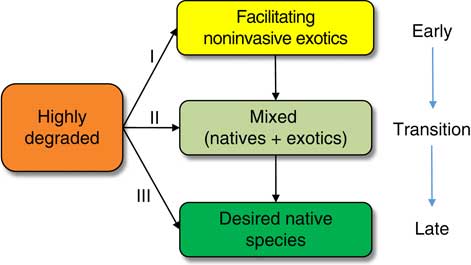
∙ In highly degraded or totally destroyed habitats, carefully selected exotic species could be used for early restoration or recovery (Guo and Norman Reference Guo and Norman2013; Ren et al. Reference Ren, Guo, Liu, Li, Zhang, Xu and Xu2014). Such species are often regarded as pioneer species and/or nitrogen fixers, which could facilitate native species colonization as nurse plants during the initial recovery (Liu et al. Reference Liu, Guo, Ren and Sun2016; Lugo Reference Lugo2004; Lugo and Erickson Reference Lugo and Erickson2017; Ren et al. Reference Ren, Jian, Lu, Zhang, Shen, Han, Yin and Guo2008, Reference Ren, Lu, Shen, Huang, Guo, Li and Jian2009) (Fig. 2).
∙ Lessons from grassland experiments around the world (e.g., restoration on the Great Plains of the United States) and experimental forests, including plantations (e.g., USDA–Forest Service), have not been extensively and effectively used.
∙ Succession theories related to invasibility and DI (e.g., how DI may change during succession) should be developed (Temperton et al. Reference Temperton, Hobbs, Nuttle and Halle2004).
∙ Species selection should take into account mounting evidence that species are shifting their ranges poleward (latitudinal) or upward (elevational). Specifically, planting species or genotypes from lower latitudes or elevations may be more effective for conforming to anticipated long-term environmental change.
∙ Careful extrapolation is required when applying knowledge derived from small-scale experimental restoration studies to larger-scale practice, where beta- and gamma-diversities are among the major objectives.
∙ Continued monitoring of vegetation development and the flux in other ecosystem factors is extremely important but often interrupted because of the lack of resources.
Lessons from Biodiversity Experiments
Experimental restoration research falls into two categories: the first includes many biodiversity experiments conducted to examine the productivity of planted native species at varied diversity levels (Isbell et al. Reference Isbell, Craven, Connolly, Loreau, Schmid, Beierkuhnlein, Bezemer, Bonin, Bruelheide and De Luca2015). Such experiments usually start with seeding different numbers of native species on bare or treated soils without preexisting vegetation. The second category includes the relatively much fewer invasion resistance experiments that have been performed to examine the role of existing native species in preventing and/or reducing species invasions through niche occupation (Fargione and Tilman Reference Fargione and Tilman2005; Kennedy et al. Reference Kennedy, Naeem, Howe, Knops, Tilman and Reich2002; Knops et al. Reference Knops, Tilman, Haddad, Naeem, Mitchell, Haarstad, Ritchie, Howe, Reich and Siemann1999; Tilman Reference Tilman1997). In such experiments, new species are planted into preexisting vegetation with different numbers of species to examine how newly seeded species (as invaders) may establish and grow.
Indeed, most small-scale experiments, especially those in grasslands (Isbell et al. Reference Isbell, Craven, Connolly, Loreau, Schmid, Beierkuhnlein, Bezemer, Bonin, Bruelheide and De Luca2015; Petersen et al. Reference Petersen, Wrage, Köhler, Leuschner and Isselstein2012; Zuo et al. Reference Zuo, Knops, Zhao, Zhao, Zhang, Li and Guo2012), have shown the ecological benefits of high-diversity planting, which include higher productivity and greater resistance to biotic invasions (Lyons and Schwartz Reference Lyons and Schwartz2001). Priority effects (i.e., a species having a larger impact on ecosystem development or succession because of earlier arrival) also have been demonstrated (e.g., Weidlich et al. Reference Weidlich, von Gillhaussen, Delory, Blossfeld, Poorter and Temperton2017) and suggest that planting order is important, but the practical implications of priority effects for restoration design have been little explored. Future restoration research should focus on these important issues in planning and implementation efforts (Temperton et al. Reference Temperton, Hobbs, Nuttle and Halle2004).
In practice, the area to be restored is expected to be much larger than an experimental site, thus the question is whether sufficient seeds (measured in both density and total weight) for each species to be planted can be obtained, especially when some species have very low germination rates. In some cases, the seeds/seedlings of native species could be quite expensive, because of the difficulties in collecting them. Yet most previous and ongoing biodiversity experiments may not have considered such economic realities, and the results from small plots may therefore not scale up to operational levels on larger sites. Small-scale experiments are useful for finding the optimal planting density (and species combination or species mix) for both the total amount of seeds/seedlings and density of each component species. However, practitioners must plan for financial costs, as well as a host of additional factors such as elevation, soil fertility, geomorphology, regional context, connectivity, and habitat heterogeneity of the areas to be restored (Doll et al. Reference Doll, Brink, Cates and Jackson2009; Webster et al. Reference Webster, Flaspohler, Jackson, Meehan and Gratton2010).
Site Selection, Assessment, and Preparation
Because restorations are often expensive and time-consuming, managers and practitioners should start with the most easily and effectively repaired lands, because the available resources will then be able to foster recovery across the largest area in need. More highly degraded and/or invaded sites (e.g., where the proportion of nonnative plants is greater than that of native species in terms of richness and/or biomass) can then be serially addressed through a process of site prioritization (Riitters et al. Reference Riitters, Potter, Iannone, Oswalt, Fei and Guo2018; Wickham et al. Reference Wickham, Riitters, Vogt, Costanza and Neale2017).
Previously, there were two common practices in restoration, sowing seeds or planting seedlings either (1) on barren lands (e.g., newly created lands after volcano eruption, landslides, abandoned mining or agricultural sites), often at smaller scales; or (2) into existing vegetation that may have been invaded or disturbed, such as grasslands in the Great Plains in the United States (Guo et al. Reference Guo, Shaffer and Buhl2006) or forests in China (Liu et al. Reference Liu, Ren, Yuan, Guo and Yang2013). The latter may be conducted at larger scales (e.g., sowing seeds via airplane). More recently, restoration that includes integrated pest management and invasive species removal through disturbance, such as herbicide and/or fire followed by seeding or plug planting, has become more widespread (Kogan Reference Kogan1998).
Sites on barren land need different site preparation approaches than those with existing vegetation. On barren lands, irrigation (if feasible) and nutrient supplementation, such as planting “fertilizer species” (e.g., many legumes, including naturalized nonnative species if not invasive) can be very helpful. Such rehabilitating treatments can improve soil fertility and moisture, and the planted species can serve as nurse plants, offering shade needed by certain native species (Figure 2). Soil tillage may also be useful, but may be impractical when the target area is very large (i.e., where aerial seeding is planned). When prairies are reconstructed on former agricultural lands, practitioners often find it useful to grow Roundup Ready® corn (Zea mays L.) and soybean [Glycine max (L.) Merr.] rotations for a few years to reduce weed pressure when the prairie is planted (Heap Reference Heap2014). In any of these cases, the underlying soils and prevailing climate should be taken into account during site preparation; trying to force arid, low-fertility lands to produce verdant vegetation will likely be costly and ultimately fail.
Possible pathways for restoring habitats with different levels of degradation and different starting points (e.g., barren sites such as abandoned mining sites vs. highly invaded sites with existing vegetation). In highly degraded or barren habitats, where suitable native species are not available, planting nonnative species (noninvasive) as nurse plants could help to improve conditions for native species to eventually become established. On the other hand, for some habitats where native species can establish themselves, planting natives will be the best choice, even if the recovery rate will be slow (Modified from Guo and Norman Reference Guo and Norman2013).
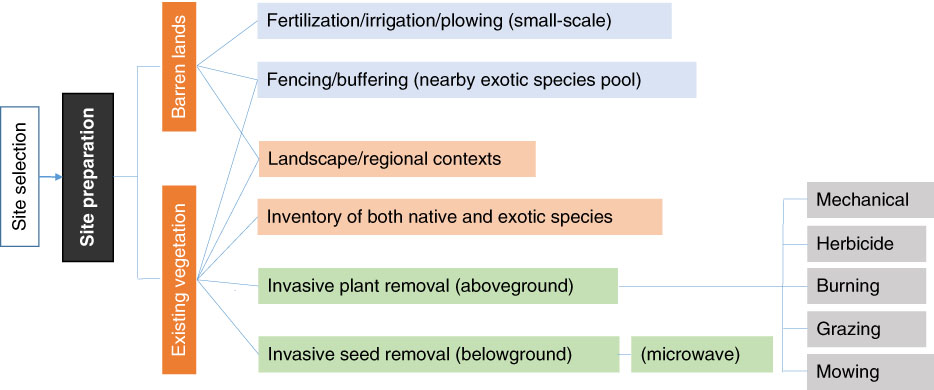
For sites with existing vegetation, the following procedure can be used as a reference before restoration begins: (1) conduct a comprehensive site assessment, including an inventory both aboveground (existing vegetation) and belowground (seedbanks) for native and exotic species (Chiquoine and Abella Reference Chiquoine and Abella2018; Thilmony and Lym Reference Thilmony and Lym2017; Wang et al. Reference Wang, Ren, Yang, Li and Guo2009, Reference Wang, Huang, Ren, Sun and Guo2015), with both domestic and foreign exotic and invasive species identified in local and regional species pools (Guo and Ricklefs Reference Guo and Ricklefs2010); (2) measure and rank exotic species, especially invasive species, based on their relative abundance, such as biomass and cover; and (3) establish a reasonable restoration goal based on the present condition and available resources (consider funding, available labor, existing species pools, historic vegetation, etc.). In addition to nearby natural vegetation (if available), records of historical vegetation (before massive human alternation) could be used as a potential target and, in some cases, soil pollen may also inform restoration plans and strategies, as indicated by a few more recent studies describing ecological memory theory (Sun et al. Reference Sun, Ren, Schaefer, Guo and Wang2014, Reference Sun, Wang, Ren, Guo, Shu and Liu2016). The boundary conditions outside the site being restored should also be assessed in case additional actions (e.g., fences, buffer zones) are needed (Figure 3).
Site preparation of restoration areas on barren lands and those with existing vegetation. Both types of sites need to take the regional context or at least the landscape context into account. Both may also need some type of buffer zone (or fence) with surrounding habitats to minimize new introductions of invasive species.
Restoration and invasive species management should be synchronized. Site preparation should be well executed before restoration starts to minimize the possible and often rapid invasions by nonnative species either on-site or from nearby areas. This is especially important, as most nonnative but especially invasive plants are favored by disturbance and can invade right after disturbances, such as fires, or on newly abandoned fields, such as mining and agricultural lands (Guo Reference Guo2017; Martín-Forés et al. Reference Martín-Forés, Guerin and Lowe2017; Middleton et al. Reference Middleton, Boudell and Fisichelli2017). Where restoration begins with existing vegetation invaded by invasive plants, herbicide application may be needed (Enloe et al. Reference Enloe, Lucardi, Loewenstein and Lauer2018). Also, the possibility of removing invasive species’ seeds or minimizing their germination should be considered. For example, some relatively new techniques such as prior microwave soil treatment on invasive seeds are being developed and evaluated (Wilde et al. Reference Wilde, Buisson, Yavercovski, Willm, Bieder and Mesléard2017).
Nonetheless, whether sites are barren or vegetated, because of existing exotic species pools, their generally greater dispersal capacity (Gaertner et al. Reference Gaertner, Fisher, Sharma and Esler2012; Ricklefs et al. Reference Ricklefs, Guo and Qian2008), and the present level of invasion worldwide (Richardson et al. Reference Richardson, Pyšek, Rejmanek, Barbour, Panetta and West2000), restoration practitioners will need to manage invasive species at both local and regional levels. This presents a problem when restorations are embedded in a mosaic of lands that are owned or managed by different entities whose goals may not coincide with those of the restoration manager. Broad stakeholder engagement and regional planning are key to successful outcomes in this scenario (Colvin et al. Reference Colvin, Witt and Lacey2016; Stokes et al. Reference Stokes, Montgomery, Dick, Maggs and McDonald2006).
Species Selection
The key decision in species selection, in places where dominant exotic or invasive species have been identified either before site preparation or in nearby areas, is to choose native species phylogenetically closely related to the invasive species that will be most effective in preventing or resisting exotic invasion (Guo and Norman Reference Guo and Norman2013; Norland et al. Reference Norland, Fasching, Dixon, Askerooth, Kelsey and Wang2013). Alternatively, one may choose native species that have similar functional traits to those of potential invasive species, as such communities might have greater resistance to potential invaders (Young et al. Reference Young, Barney, Kyser, Jones and DiTomaso2009). The argument for this practice is that the closely related species usually use similar niches; thus a competitive native species would exclude sister exotic species (but see Larson et al. Reference Larson, Bright, Drobney, Larson, Palaia, Rabie, Vacek and Wells2013). An additional recommendation is that when choices are available, we should choose the species that grow easily and quickly after restoration (Grime Reference Grime1998), although such species could be eventually replaced by more dominant species with slower growth rates. This was the case in an experimental prairie reconstruction study, where Canada wildrye (Elymus canadensis L.) established quickly and excluded invasive species during the early establishment phase, but declined rapidly thereafter (Larson et al. Reference Larson, Bright, Drobney, Larson, Palaia, Rabie, Vacek and Wells2013). Such scenarios fit general succession theory (McLane et al. Reference McLane, Battaglia, Gibson and Groninger2012). Finally, a suggested (Larson et al Reference Larson, Bright, Drobney, Larson, Palaia, Rabie, Vacek and Wells2013), but as yet untested, possibility is to include in the seed mix native species that are considered invasive outside their range, as a way to produce a reverse “novel weapons” effect on nonnative species that invade the restoration. We summarize here a few key points for consideration before actual restoration takes place.
∙ Optimal number of species per unit area needs to be evaluated at local and larger scales. Where and when resources are available, native species should be assessed by analysis of alpha (α)-diversity in each plant community; beta (β)-diversity, that is, species turnover rate between adjacent communities; and gamma (γ)-diversity across multiple communities at the landscape and regional levels (Figure 4) (Brockway Reference Brockway1998). Such an approach has been mostly ignored in previous restoration efforts, because comprehensive data and broad-scale coordination were lacking.
∙ The effects of seed/seedling size and sowing/planting density (number or weight of seeds or seedlings per unit area) should be major considerations, as well as the potential influence of species evenness relative to seed density versus seed weight (Guo Reference Guo2011; Wilsey and Potvin Reference Wilsey and Potvin2000).
∙ Cost of seeds and/or seedlings for the species to be planted must be considered.
∙ Sequence of seeding and/or planting must be determined. This may reflect known successional trends, such as establishing nurse plants to ameliorate the microclimate for less hardy species, similar to early succession, or to provide soil biota necessary for later successional species to establish.
∙ In prairie restorations, allowing weedy, early-successional native species to fill in between the planted species can enable planted species to gain dominance through time while reducing opportunities for invasive species to establish (Larson et al. Reference Larson, Bright, Drobney, Larson, Palaia, Rabie, Vacek and Wells2013).
Actual restoration process needs to assign the optimal number of species to be planted in a local plot or area (α-diversity) and the entire region (γ-diversity), species composition (identity of species and their relative abundance), and the order or sequence of species (groups) to be planted through time. Species composition should be determined following a comparative analysis of invasive plants (or all nonnative plants) either onsite or in nearby/surrounding areas (as potential invaders). The order of planting may also consider nonnative plants that are not invasive as nurse species if needed (see Figure 2).

The first step in selecting suitable species is to acquire a complete list of native and exotic species, both on-site and in nearby areas. When large areas of natural or historical vegetation have been destroyed or severely degraded, it can be challenging to establish a desired target condition for restoration. In such cases, ecological memory could be used through building a historical pollen spectrum (Sun et al. Reference Sun, Ren, Schaefer, Guo and Wang2014, Reference Sun, Wang, Ren, Guo, Shu and Liu2016). This approach can help in developing a more complete native species list, but historical climate shifts need to be taken into account.
The second step is to identify the dominant traits for these species. For example, which morphological and genetic traits exhibit high flexibility? How might such traits be related to species invasiveness or resistance to species invasion. Conversely, which species may have flexible or unique traits, such as allelopathic chemicals that impact others (Peng et al. Reference Peng, Wen and Guo2004)? It is helpful to carefully select nurse plants based on facilitation traits that build soil for use in degraded situations (Gómez-Aparicio et al. Reference Gómez-Aparicio, Zamora, Gómez, Hódar, Castro and Baraza2004; Liu and Guo Reference Liu and Guo2012; Liu et al. Reference Liu, Ren, Yuan, Guo and Yang2013) (Figure 2).
Seed source is another important factor to consider before beginning restoration (Wilsey Reference Wilsey2010). First, seed source may strongly influence the rate of restoration and performance of restored ecosystems. Some studies, such as that by Carter and Blair (Reference Carter and Blair2013), found no major effects of seed source on the performance of restored grassland. However, we believe that this could be a scale-dependence issue. That is, it depends on how far the seed source is from the target site for restoration. If the seed source is very far and different genotypes of the same species are mixed (i.e., could facilitate within-species evolution), the restoration outcome might be different. Second, it has been shown that mixing different genotypes of the same species could help resist pest or disease infestations (Zhu et al. Reference Zhu, Chen, Fan, Wang, Li, Chen, Fan, Yang, Hu and Leung2000). The bottom line is that species and seed source choices should avoid the unexpected consequence of planting native invasive species.
In heavily degraded systems (e.g., abandoned mines), where native species may not establish sustainable populations, using certain nonnative species may be considered an alternative option. Such nonnative species could subsequently create suitable conditions for native species. However, caution is strongly urged to ensure that there is a high possibility that such nonnative species will be eventually replaced by native species and not be invasive and difficult to eradicate (Guo and Norman Reference Guo and Norman2013; Lugo Reference Lugo2004; Ren et al. Reference Ren, Jian, Lu, Zhang, Shen, Han, Yin and Guo2008).
Recent studies of tallgrass prairie reconstruction in the midwestern United States have highlighted the importance of appropriate locally adapted soil biota, especially nodulating bacteria (Beyhaut et al. Reference Beyhaut, Larson, Allan and Graham2014) and arbuscular mycorrhizal fungi in both the establishment of planted species (Koziol and Bever Reference Koziol and Bever2017) and resilience to their stressors (Middleton et al. Reference Middleton, Holsten and van Diggelen2006). Methods for inoculation at field scales are still in development, but such soil conditioning promises improved resilience with less maintenance in the future and may be especially important when restoring native species in formerly invaded lands (Jordan et al. Reference Jordan, Larson and Huerd2011). Finally, to ensure the success of desirable native species, site conditions such as size, topographic position in the landscape, slope, aspect, soil type (e.g., texture, depth, drainage, fertility), and other factors related to microclimate and microhabitat complexity need to be considered in species selection.
During Restoration
The worst species invasions usually occur right after disturbances or planting and before the establishment of native species. When a site is chosen and preparation is done, a major goal of restoration is to enhance the germination rate and ensure high productivity. This could enforce the resistance to biotic invasions through fast niche occupation and higher community resilience under environmental fluctuation (Isbell et al. Reference Isbell, Craven, Connolly, Loreau, Schmid, Beierkuhnlein, Bezemer, Bonin, Bruelheide and De Luca2015). When a carefully planned procedure is in place, restoration practitioners need to closely follow and implement it, step-by-step (Figure 4). We list here a few items to be considered in practice.
∙ Monitor changes in species composition (Forsythe Reference Forsythe2013; Magiera et al. Reference Magiera, Feilhauer, Waldhardt, Wiesmair and Otte2017). A common mistake is for practitioners to choose one or two dominant native species for seeding. This is typical in forest plantations, done mostly to obtain economic gains through high production of the planted species (e.g., timber, medicine) or to lower the cost of seeds and/or seedlings (Chen et al. Reference Chen, Shahi, Chen and McLaren2017).
∙ Continue to monitor and identify species in restored ecosystems that could facilitate or resist nearby invasive species based on phylogenetic relatedness or functional traits (Young et al. Reference Young, Barney, Kyser, Jones and DiTomaso2009).
∙ Continue to add/seed suitable species when necessary to fill in the gaps where originally seeded species did not germinate or survive.
∙ Knowing which species have been successfully planted and/or what restoration strategies have been adopted in nearby areas/regions is useful.
∙ Determine which species contribute to resistance (high diversity/evenness planting) and tolerance (high exotic richness but not dominance) (Nunez-Mir et al. Reference Nunez-Mir, Liebhold, Guo, Brockerhoff, Jo, Ordonez and Fei2017). Relate phylogenetic resistance to the nearby nonnative species pool (Iannone et al. Reference Iannone, Potter, Hamil, Huang, Zhang, Guo, Oswalt, Woodall and Fei2016).
∙ With abundant evidence that species are shifting their ranges poleward (latitudinal) or upward (elevational), species selection for restoration needs to take this factor into account. Specifically, including genotypes that are from lower latitudes or elevations may be more effective.
Multitrophic Considerations
Webster et al. (Reference Webster, Flaspohler, Jackson, Meehan and Gratton2010) and Wilson et al. (Reference Wilson, Chen, Corlett, Didham, Ding, Holt, Holyoak, Hu, Hughes and Jiang2016) extensively discussed the role of animals and soil microbes. In particular, they examined how the structure, composition, and fragmentation of landscapes, especially edges, may influence the functional traits and diversity of a host of organisms, including microbes, pathogens, plants, mammals, birds, amphibians, and insect pollinators (bees and butterflies). Restoration needs to increasingly consider the species to be planted or introduced when they may serve as potential hosts for serious diseases or agents of secondary invasions. Maintaining biodiversity and associated functional traits in restoration is critical for the long-term sustainability of ecosystem function and ecological services at multiple trophic levels.
A timely example of the importance of maintaining multitrophic interactions during restoration is the plight of native pollinators, some of which have come to rely on floral resources provided by invasive species. It has been shown that flowering invasive species can fundamentally change pollination networks (Stouffer et al. Reference Stouffer, Cirtwill and Bascompte2014), but upon removal of the invasive flowers, these pollinators will take advantage of co-occurring floral resources (Larson et al. Reference Larson, Rabie, Droege, Larson and Haar2016). It behooves the manager to ensure that alternative floral resources are available before removal of the invasive, which can be difficult and require careful planning in a restoration context.
Management of Restored Vegetation
There is no question that species invasions are likely to be a major challenge; thus, determining how to better manage the restored ecosystem to reduce and resist invasive species will be a major task for us. An important consideration in managing the restored ecosystem is the role of succession and how the entire restored community and planted component species may vary with time. In a long-term (more than 20 yr) study, Ren et al. (Reference Ren, Du, Wang, Yu and Guo2007) found idiosyncratic responses of different ecosystem variables to time and microclimate change, with soil fertility being a critical factor that influences early recovery following degradation in subtropical China. In other words, different variables in the same community exhibited different rates of change through time. McLauchlan (Reference McLauchlan2006) found similar variability in recovery times from agricultural disturbance in the Great Plains, suggesting that ecosystem processes that influence vegetation during restoration are not synchronous.
The principal goal of ecological restoration and sustainable management (Guo Reference Guo2003), including biomass manipulation of planted species (Doll et al. Reference Doll, Brink, Cates and Jackson2009; Guo Reference Guo2007; Webster et al. Reference Webster, Flaspohler, Jackson, Meehan and Gratton2010), is to create an ecosystem that is self-perpetuating and resistant to biological invasion. This requires knowledge of the maximum and optimal diversity, biomass, and productivity, based on historic records and future projections. Ideally, both aboveground and belowground communities and conditions should be evaluated and closely monitored and manipulated to achieve optimal ecosystem performance (i.e., for productivity and stability). Specific management actions may include biomass reduction through fire, harvesting, mowing, and grazing (Bi et al. Reference Bi, Li, Fu, Fan, Ma, Yang, Nan, Dai and Zhang2018; Tälle et al. Reference Tälle, Deák, Poschlod, Valkó, Westerberg and Milberg2018) and biomass enhancement through fire suppression (although a risky option if applied long term in a fire-dependent plant community), fertilization, and irrigation (Dalmayne et al. Reference Dalmayne, Mockel, Prentice, Schmid and Hall2013; Lindgren and Sullivan Reference Lindgren and Sullivan2013). Because of the varying sensitivities of different community variables to environmental fluctuation, which could further influence the degree of invasion during restoration or succession, managers employing biomass manipulation must consider treatment effects on other community measures, especially diversity–biomass–productivity relationships (Guo Reference Guo2007; Li et al. Reference Li, Li, Liu, Zhang, Qi, Zhang, Knops and Lu2017). We discuss these manipulation options in detail in the following sections, and the techniques listed could be used separately or in combination to manage plant dominance in restoration projects.
Options for Biomass Reduction
∙ Fire: Ecological restoration should also include restoring historical disturbance regimes, such as periodic fire by prescribed burning, which emulates as much as possible the fire frequency and intensity that fostered development and maintenance of the desired historical plant community (Brockway et al. Reference Brockway, Outcalt, Tomczak and Johnson2005). Prescribed fires have several benefits when kept at appropriate levels: see the “intermediate disturbance hypothesis” in Huston (Reference Huston2014). Fire, which periodically reduces the long-term accumulation of dry biomass (e.g., forest fuels), can reduce the possibility of catastrophic events that result in massive destruction. It can improve habitat quality for wildlife, promote fire-tolerant species, reduce pathogens and pests, release nutrients bound in vegetation to the mineral soil, and decrease soil acidity. However, prescribed burning requires very careful planning and application with regard to area, frequency, intensity, season, and which native and exotic species are present (Fuentes et al. Reference Fuentes, Duguy and Nadal-Sala2018; Keeley Reference Keeley2006). Invertebrates, some of which have limited mobility during certain life stages, require special attention (Panzer Reference Panzer2003). Positive feedbacks between fire (as a disturbance agent) and species invasion have been reported in the past (Pauchard et al. Reference Pauchard, Garcia, Pena, Gonzalez, Cavieres and Bustamante2008), especially in more productive habitats (Huston Reference Huston2004). In this regard, consultation with local residents, landowners, and managers could be very helpful. Observations from a recently burned site could be useful as a reference.
∙ Grazing: The relative intensity and timing are critical factors in choosing and using this method. For example, a relatively new study on grasslands in northeastern China shows, after 5–8 yr, that areas fenced from grazing have better restoration results, in terms of vegetation and soil characteristics and recovery rates, although the long-term consequences remain to be seen (Li et al. Reference Li, Zhou, Jin, Wang, Song and Li2014). However, some other studies suggest a reduction of biomass could facilitate restoration. Nevertheless, even if the same amount of biomass is removed, another new study shows that rotational grazing (especially at a moderate level) is better than mowing in terms of reaching diversity goals (Na et al. Reference Na, Bao, Hashimoto, McCarthy and Hoshino2018; Wrage et al. Reference Wrage, Strodthoff, Cuchillo, Isselstein and Kayser2011). This is partly a result of natural grazing often being selective on species and creating spatial heterogeneity, whereas mowing usually targets all species (Middleton et al. Reference Middleton, Holsten and van Diggelen2006).
∙ Thinning: Yuan et al. (Reference Yuan, Ren, Liu, Wang and Guo2013) reported that thinning can enhance the establishment and growth of planted and naturally regenerated seedlings of native woody (tree) species. Thinning reduces organic matter, total nitrogen, bulk density, and water content of the soil, but increases phosphorus and potassium levels. Moderate thinning should be periodically used as part of the long-term management of plantations. Different thinning intensities (i.e., variable retention among forest trees) can be used to increase the spatial heterogeneity in overstory vegetation (Franklin et al. Reference Franklin, Mitchell and Palik2007). Uneven-aged silvicultural systems, such as single-tree selection and group selection (Brockway et al. Reference Brockway, Loewenstein and Outcalt2014), can also improve overstory structure while increasing the species diversity, richness, and evenness of native understory plants (Brockway and Outcalt Reference Brockway and Outcalt2015, Reference Brockway and Outcalt2017).
∙ Herbicides: Use of chemicals to control undesirable plant competitors or invaders is viewed as a less favorable option, because of the potential adverse effects posed to desirable species present in local and regional habitats. Although some of these chemicals are more selective in their action and can be safely used in forestry and some restoration programs, application of broad-spectrum chemicals can cause harm to understory species and may lead to soil pollution or a decline in biodiversity. When carefully applied in a limited spot-grid pattern, herbicides have been used to effectively reduce competition from understory and overstory oaks, thereby producing progressive increases in the foliar cover of desirable species of graminoids and forbs during restoration (Brockway and Outcalt Reference Brockway and Outcalt2000). The cost of herbicide application serves as a practical constraint on its use in the field, where it is often limited to smaller-scale and/or higher-value projects.
∙ Physical methods: In addition to thinning, forest restoration may be fostered through other mechanical management practices, such as clearcutting with reserves, to more rapidly change overstory composition from one dominant species to another, and partial-cutting through mastication (i.e., woody plant biomass reduction by a rotating drum with cutting heads, which leaves a shredded mulch on the forest floor). By retaining the preferred trees on-site, such practices create an opportunity for encouraging desirable plant species and more safely reestablishing natural processes, such as periodic prescribed burning following the removal of midstory fuel ladders (Brockway et al. Reference Brockway, Outcalt, Estes and Rummer2009). Mowing is a fairly common management practice that may be used in grasslands. However, its application should strive to be minimally disruptive to the life cycles of native species, while attempting to impair invasive species. Hand pulling of invasive plants may also be a helpful biomass reduction technique in communities invaded by exotic species that have not formed pure stands. However, physical methods may also create disturbances that have adverse impacts on other species or surrounding habitats. Therefore, they should be selectively used and carefully implemented, as either individual treatments or in combination with other biomass reduction techniques (chemical, fire, etc.) to produce desirable results.
Options for Biomass Enhancement
∙ Fertilization: Lindgren and Sullivan (Reference Lindgren and Sullivan2013) found that fertilizing 15-yr-old lodgepole pine [Pinus contorta Douglas var. latifolia (Engelm.) Critchfield] stands significantly enhanced mean structural diversity of the total plant community. A rich literature exists concerning forest fertilization to augment the biomass production of crop trees, with lesser focus on understory plant species. Fertilization mostly benefits the overstory following a thinning operation that allows the residual trees to grow more freely, with nitrogen an aid in rebuilding leaf biomass in the canopy, thus enhancing photosynthetic capacity and subsequent growth (Miller Reference Miller1981). However, the cost of fertilizer application limits its usefulness in the field to smaller-scale and higher-value restoration projects.
∙ Irrigation: In agronomic disciplines, irrigation and fertilization are common techniques for promoting plant growth. However, in a recent study, Müller et al. (Reference Müller, Buhk, Lange, Entling and Schirmel2016) found contrasting effects for irrigation and fertilization on the plant diversity in hay meadows, where plant species richness was unaffected by irrigation but negatively influenced by application of nitrogen fertilizer. This is a common outcome in grasslands, as well, primarily mediated via increased productivity (Hautier et al. Reference Hautier, Niklaus and Hector2009; Socher et al. Reference Socher, Prati, Boch, Müller, Klaus, Hölzel and Fischer2012). Use of irrigation is largely limited by costs and logistical considerations (i.e., proximity to a water source and ability to deliver water to the site). Thus, it is reserved for small-scale and high-value restoration projects where natural precipitation is inadequate and irrigation is crucial for success.
Management of Invasive Species
Unlike habitats that have long been invaded by exotic species, in newly restored habitats, exotic species can be fairly easy to physically remove, especially during early stages, because invasive species are few and their abundance is low. Therefore, early detection, rapid response (including eradication), and continuous monitoring are strongly recommended for newly restored habitats. New regulations to limit or minimize the possibility of bringing exotic species into such habitats may also be needed and/or enforced.
Disturbance and physical modification of habitats from human activities facilitate invasions by nonnative species (Fei et al. Reference Fei, Phillips and Shouse2014). At the same time, initial restoration work could also cause some level of “disturbance” that may facilitate species invasions (Hobbs and Richardson Reference Hobbs and Richardson2011). Therefore, during site preparation, managers should take precautions and consider removing invasive species before actual seeding and/or planting starts. Some undesirable species can be extremely abundant during the early (≤3 yr) stages of tallgrass prairie reconstruction from farmland, despite extensive site preparation, but naturally decline through time as more competitive planted species become established (Larson et al. Reference Larson, Bright, Drobney, Larson and Vacek2017). In this case, patience is the best response, as control methods, by further disturbing the site, may produce more harm than good.
More effort should be placed on reducing the dominance of invasive species (Hejda et al. Reference Hejda, Štajerová and Pyšek2016), not just decreasing the richness of all nonnative species. In habitats where complete eradication of invasive species is not possible, techniques that can effectively remove their biomass should be developed. However, it is prudent to bear in mind that management tools such as burning, grazing, physical or chemical treatment, and biocontrol agents (Figure 1) also cause new disturbances, and their effects on native species need to be evaluated. Based on available evidence, it is reasonable to argue that the effectiveness of such control methods or treatments would depend on the degree of invasion. For example, Ereth et al. (Reference Ereth, Hendrickson, Kirby, DeKeyser, Sedivec and West2017) recently reported that both herbicide and burning can help in controlling Kentucky bluegrass (Poa pratensis L.) invasion, but the outcome depends on its level of invasion. Poa pratensis and smooth bromegrass (Bromus inermis Leyss.), though initially absent in experimental tallgrass prairie reconstructions in Minnesota and Iowa, increased through the 10 yr that sites were monitored and constitute the greatest threat to the plant communities going forward. The frequency of invasive forbs, including noxious weeds such as Canada thistle [Cirsium arvense (L.) Scop.], stabilized or declined at the same sites shortly after planting without active control (Larson et al. Reference Larson, Bright, Drobney, Larson and Vacek2017). We list here some key points to be considered in managing invasive species during restoration.
∙ Belowground species richness and biomass should also be evaluated in restoration and management plans (Leisher et al. Reference Leisher, Hess, Boucher, van Beukering and Sanjayan2012).
∙ Different strategies are needed for managing individual (target) species (Deák et al. Reference Deák, Valkó, Kelemen, Török, Miglécz, Ölvedi, Lengyel and Tóthmérész2011) versus all nonnative species (Ruijven et al. Reference Ruijven, De Deyn and Berendse2003)
∙ Biocontrol may be a suitable alternative, if harm is not done to non-target desirable species (Miao et al. Reference Miao, Li, Guo, Yu, Ding, Yu, Liu, Zhang and Dong2012).
∙ Rapid evolution of invasive species is a concern, because adaptation is no doubt a key to their previous success and continuing persistence (LaRue et al. Reference LaRue, Chambers and Emery2017)
∙ There is an ongoing debate as to whether management efforts should be focused on the abundance centers or the invasion front/border (Dickie et al. Reference Dickie, Bennett, Burrows, Nunez, Peltzer, Porté, Richardson, Rejmánek, Rundel and van Wilgen2014; Simberloff Reference Simberloff2003). For example, the presence of kudzu [Pueraria lobota (Willd.) Ohwi] appears to be fine at its northern border (e.g., Nebraska), where it could be regarded as a “useful” plant. In North Carolina, however, where the species abundance center is located, there is too much of it, causing great damage to native species and costs in trying to control it. In management with limited resources, should we start from the abundance center or at the border or do everything we can across the species’ entire invaded range? Perhaps climate change models may suggest more focus is needed on higher latitudinal limits or higher elevations (Hellmann et al. Reference Hellmann, Byers, Bierwagen and Dukes2008). Similarly, under climate warming and other extreme weather/climate conditions, choosing the right plant species or genotypes is a critical element of resilient and sustainable restorations.
∙ The role of nonnative animals in restored ecosystems is less clear.
∙ There are alternative ways to use and control invasive species to facilitate restoration. Examples include (1) harvesting for biofuel and (2) increasing human use of invasive plants for a variety of purposes (e.g., food, medicine, chemicals, fiber for clothing, phytochemistry) (Stafford et al. Reference Stafford, Von Maltitz and Watson2018).
∙ The trajectory and ultimate success of any local restoration effort, to a large extent, depends on the landscape or regional context where the exotic species pool exists (Riitters et al. Reference Riitters, Potter, Iannone, Oswalt, Fei and Guo2018).
It is worth noting that, in addition to grazing generally reducing overall community biomass (as discussed in the previous section), grazing by introduced large herbivores can greatly alter plant community species composition by encouraging certain plants while depressing others. Taking grassland restoration as an example, grazing by different large herbivores and at different stocking rates could be a useful practice in managing degraded or invaded grasslands to control invasive species, although some exotic herbivores could sometimes directly facilitate certain exotic species (Best and Arcese Reference Best and Arcese2009; Skaer et al. Reference Skaer, Graydon and Cushman2013). On one hand, it is well known that foraging by different large herbivores exerts various effects through dietary selection by the animal (Liu et al. Reference Liu, Feng, Wang, Wang, Wilsey and Zhong2015; Zhong et al. Reference Zhong, Wang, Zhu, Wang, Feng and Wang2014). That is, cattle prefer foraging on grasses, while sheep like to eat forbs growing in steppe communities (Kimball and Schiffman Reference Kimball and Schiffman2003). Therefore, cattle grazing is often considered useful for controlling invasive annual grasses. Johnson and Cushman (Reference Johnson and Cushman2007) reported that reintroduction of elk can significantly reduce the abundance and biomass of highly invasive exotic grasses in a California grassland. On the other hand, because of the different responses of plant species to grazing intensity, large herbivores can enhance plant community tolerance through compensatory growth and thereby depress the invasive species (Gao et al. Reference Gao, Wang, Ba, Bai and Liu2008).
The Scale Issue
Despite many ongoing efforts in controlling species invasions, at the regional level the degree of invasions is likely to increase through time because of ongoing human activities (Guo Reference Guo2015, Reference Guo2017). Local invasive species removal needs to take this time factor and the regional exotic species pools into account. In addition to careful application of small-scale, experimental experience, there are several major differences between small- and large-scale restoration and management (Walters and Holling Reference Walters and Holling1990). The success and trajectory of a local restoration project to a large extent depends on pool of exotic species in the region (Larson et al. Reference Larson, Ahlering, Drobney, Esser, Larson and Viste-Sparkman2018). While large-scale removal of invasive species is often not feasible, successful removal and even total eradication of at least some species at local scales could be achieved. Large-scale restoration and invasive species management require long-term and collective efforts in collaboration and coordination by many local governments and managers (including the invasive species removal efforts) and involving public and private landowners (Colvin et al. Reference Colvin, Witt and Lacey2016; Stokes et al. Reference Stokes, Montgomery, Dick, Maggs and McDonald2006). More importantly, removal of invasive species at any scale is useful, as it would help open up niche spaces for native species and thus promote restoration.
Additional Thoughts
When both processes and consequences are monitored at a well-designed restoration site, ecologists can take advantage of the restoration project as a semi-controlled experiment, as an in-depth examination of the inhibitory and facilitating mechanisms of species invasion (Sargent et al. Reference Sargent, Angert and Williams2017). It is crucial to remember that any management action (e.g., burning, grazing, harvesting) that occurs after restoration can serve as a disturbance agent that may encourage a subsequent invasion of exotic species. Thus, considerable caution is always appropriate when planning management actions and careful execution is required during field implementation.
Research and management efforts at multiple levels will be strengthened through the global sharing of lessons learned and exchange of technical information related to successes and failures for restoration and curbing invasive species. Dissemination of helpful knowledge could be facilitated through citizen science and volunteer (learning-by-doing) programs, in addition to more formal education and onsite demonstrations for interested groups (e.g., landowners, policy makers) and the general public.
Most restoration efforts to date have focused on species at the same trophic level and the possible consequences for species at different trophic levels have been largely ignored, although pollinators are increasingly a target of restoration. In other words, when reintroducing particular species of animals and planting plants, practitioners should carefully consider what invasive plants or pests might be accompanying the restored species, using information from lessons learned about the plant–animal interactions from nearby species pools (Davidson et al. Reference Davidson, Hunter, Erz, Lightfoot, McCarthy, Mueller and Shoemaker2018).
Very much different from restoration efforts in earlier times, today’s restoration programs should increasingly aim to serve multiple purposes. These may include (1) restoring to desirable conditions, which protect high numbers of native species; (2) preventing and reducing biotic invasions; (3) maximizing economic goals (e.g., bioenergy crops can simultaneously restore degraded lands and serve food, energy, and water needs); and (4) ensuring long-term ecosystem sustainability as the basis for developmental stability (Chen et al. Reference Chen, Shahi, Chen and McLaren2017). To accomplish this, restoration needs to use both ecological and evolutionary theories and past experiences as progressive guides for future practice.
Related to our earlier discussions regarding the possible adverse effects of projected climate warming, many weather- and climate-related extreme events may serve as disturbance agents that could disrupt normal ecosystem processes and facilitate species invasions (Joyce et al. Reference Joyce, Briske, Brown, Polley, McCarl and Bailey2013). At the same time, they could also provide opportunities for restoration and invasive species management (Guo Reference Guo2003; Katz et al. Reference Katz, Brush and Parlange2005). This becomes increasingly important if climate change is leading to more severe and destructive conditions (Isbell et al. Reference Isbell, Craven, Connolly, Loreau, Schmid, Beierkuhnlein, Bezemer, Bonin, Bruelheide and De Luca2015). For example, in some heavily invaded habitats, extreme climate and weather could also cause negative effects on invasive species, thus affording opportunities for replacement with native species.
Finally, historical records and data sets of vegetative composition (e.g., fire and pre-restoration conditions), successional status (e.g., vegetation, soil), and management actions should be well maintained as much as possible for future evaluation purposes (Larson et al. Reference Larson, Ahlering, Drobney, Esser, Larson and Viste-Sparkman2018).
Conclusion
Today’s restoration programs need to target both natural conservation and economic aims. To achieve both goals, restoration needs to curb biotic invasions (even under ongoing climate change) and mitigate continuing human disturbance. Invasive plant management includes two traditional parallel lines leading to success. First, in basic research, (1) more experimental work at both population (individual species) and community (multispecies) levels and (2) greater focus on the idiosyncrasies of species and habitats in response to disturbance (e.g., resistance, acceptance) are needed (Moon et al. Reference Moon, Blackman and Brewer2015). Second, with regard to management, (1) setting more realistic goals and (2) establishing more inclusive communication with a broader and more diverse audience (e.g., different types of landowners) will enhance success (Estévez et al. Reference Estévez, Anderson, Pizarro and Burgman2015; Gaertner et al. Reference Gaertner, Fisher, Sharma and Esler2012).
Acknowledgments
We thank S. Fei, D. C. Lee, B. A. Middleton, and the anonymous reviewers for constructive comments. This study was supported in part by National Science Foundation Macrosystems Biology grants (DEB1241932 and DEB1638702). No conflicts of interest have been declared. Any use of trade, firm, or product names is for descriptive purposes only and does not imply endorsement by the U.S. government.


 Open access

