

1. Introduction
The POA has been developed over the past decade with the aim of improving English classroom instruction at the tertiary level in Mainland China (Wen Reference Wen2007, Reference Wen2008, Reference Wen2013, Reference Wen2014a, Reference Wen2014b, Reference Wen2015a, Reference Wen2015b, Reference Wen2015c). Unlike other instructional approaches for language learning, the POA starts teaching with language production and ends with production while input serves as an enabler to help accomplish productive activities. The term ‘production’ is used here instead of ‘output’ simply because it includes not only speaking and writing but also translation and interpreting. Furthermore, the POA is most suitable to young adult learners with intermediate level proficiency in English or above who have already finished learning basic English grammar and have about 2,000 or more high-frequency words. In Mainland China, university freshmen are just such learners who typically have a relatively large amount of receptive knowledge but limited experience using English for communication. For these reasons, their usual abilities in English do not satisfy employers, parents, or government officials. The POA has been developed as a potential remedy to this situation and through its use university students are expected to be able to participate actively in genuine communicative activities.
I address the POA and related issues under the following headings:
1. English instruction at the undergraduate level in Mainland China
2. Development of and justifications for the POA
3. The description and explanation of the POA
2. Current English instruction at the undergraduate level
The pedagogical methods used in mainstream education in Mainland China are characterized as being text-centered and input-based. That is to say, English instruction takes the text as an end rather than a means, and input-processing is the major learning task. Such English instruction can at most enhance students’ comprehension skills. Generally, text-centered and input-based instruction is of two kinds: bottom-up (popular from the 1950s onwards to the mid-1990s and still used in some remote areas in China) and top-down (increasingly dominant since the late 1990s) (Wen Reference Wen2014a). The deficiency in bottom-up instruction is too much emphasis on individual language items without prompting learners to produce extended discourse for meaningful communication. The weakness of top-down instruction is too much emphasis on the meaning of a text without activities for students to directly use linguistic forms learned from the text. In general, both bottom-up and top-down text-centered instruction separate learning from using language. Therefore, both have variously been criticized as being ‘high investment, low effectiveness’ (Cai Reference Cai2006), ‘spending enormous time but obtaining poor outcomes’ (Jing Reference Jing1999), and producing ‘dumb English’ (Dai Reference Dai2001).
Some innovative teachers are experimenting with task-based (Ellis Reference Ellis2003) or project-based (Markham Reference Markham2011) approaches in their English teaching (e.g. Xu Reference Xu2004), and it has been reported that experimental groups have obtained better outcomes than control groups and students have become more active, confident, and engaged in learning (e.g. Wen & Liu Reference Wen and Liu2007). Based on my personal observation of such classes, compared with bottom-up and top-down text instruction, these new approaches do indeed give students opportunities to bring their initiative into full play. But weaknesses are also evident, the first being that although such teaching pays attention to students using English, insufficient attention is paid to learning new linguistic forms (Wu & Pan Reference Wu and Pan2012). Fluency may improve, but this kind of production cannot effectively expand students’ knowledge base, language system, and discourse patterns. New language appearing in their production is most likely incidental rather than achieved by design. The second weakness is that students’ production occurs without a teacher's systematic guidance. This kind of pedagogy is somewhat like putting a group of people in a swimming pool and asking them to try to swim through their own efforts and practice. Such swimmers might make some limited progress through their own efforts and by observing or helping each other. Guidance by good swimming coaches, however, would make for faster and more efficient progress than through people struggling by themselves.
The POA has been developed to overcome these weaknesses in Chinese English instruction as well as the disadvantages of some Western approaches. It can enable university students to use English to undertake genuine communicative tasks with varied complexity depending on students’ actual English proficiency.
3. Development of, and justifications for, the POA
3.1 Development
The POA has developed over nearly ten years based on three rounds of research by eight English teachers from Chinese universities. The earliest version of the POA focused on an output-driven hypothesis which conjectured that output is more powerful than input in motivating university students to learn more English and perform better (Wen Reference Wen and Liu2007). The subsequent revised version became an output-driven plus input-enabled hypothesis which intended to specify the clear role of input as enabling when output serves as a motivating force (Wen Reference Wen2013). By October 2014, the POA as a whole was elaborated as a system. Since then, I have talked about the POA in keynote speeches at three international conferences where positive feedback, constructive suggestions, as well as criticisms were received (Wen Reference Wen2014b, Reference Wen2015a, Reference Wen2015b), leading to subsequent revisions. The initial research findings showed that the POA is feasible and effective for English learning at the tertiary level (Zhang Reference Zhang2015). For example, Zhang reported that the students in her experimental class outperformed the control class in their English composition in terms of language, ideas, and organization.
The principles of the POA have already been compiled in a number of textbooks and field tested (Wang & Wen Reference Wang and Wen2015). Since 2015, iEnglish has been used by university students with high levels of English proficiency and a study is now being carried out to examine the effectiveness of the POA.
3.2 Justification for the POA
All students in schools in Mainland China have been following the new syllabus of English instruction for secondary education issued by the Ministry of Education in 2003 (MOE 2003), which has more comprehensive objectives, offers varieties of English courses, and sets more demanding requirements compared to previous syllabi. Therefore, university freshmen, in general, can be expected to have reached a higher level of English proficiency compared with previous students. The new cohorts are eager to learn how to use English for genuine communicative purposes, and adult university students love goal-driven and problem-solving learning. With regard to their social needs, observation of language use in the workplace in China reveals that public professional or business communication in real life is primarily carried out through productive activities (i.e. speaking, writing, interpreting, and translating) with receptive activities (i.e. listening and reading) as mediators rather than as ends for their own sake (Wen Reference Wen2008). Therefore, the ultimate objective of adult English learning should aim at developing learners’ productive skills with receptive skills as enablers.
4. Description and explanation of the POA
4.1 Teaching principles
4.1.1 Learning-centered principle (LCP)
The first principle of the POA is learning-centeredness, which means that in classroom instruction, with limited classroom time, instructors have to employ all possible means to make full use of every minute of teaching so that students can engage in learning. The LCP focuses on activating processes of learning rather than on the learner as a person, thereby challenging the learner-centered principle, which was introduced to Mainland China at the end of 1990s (e.g. Huang & Gu Reference Huang and Guo1996) and has become increasingly popular. The introduction of the learner-centered principle did initially produce some positive impact on English instruction by challenging traditional teacher-centered instruction in China and raising awareness of students’ learning needs. However, by implementing the learner-centered principle, the role of the teacher has gradually been marginalized to that of a facilitator, consultant, and helper while downplaying the teacher's professional function as a designer, organizer, and director of English instruction. Accordingly, some Western scholars have also started to criticize learner-centeredness (Kirschner, Sweller & Clark Reference Kirschner, Sweller and Clark2006). I feel, like Kirschner et al. (Reference Kirschner, Sweller and Clark2006), that learner-centered instruction does not distinguish clearly between formal school instruction and informal learning in daily life. School instruction should be carefully planned, effectively organized, and professionally guided to achieve high efficiency.
4.1.2 Learning-using integration principle (LUIP)
The LUIP maintains that learning and using language must be integrally joined. That is to say, obtaining new linguistic elements or skills through input activities must be linked seamlessly by employing what has just been learned through the input in productive activities such as speaking, writing, translation, or interpreting.
The LUIP has the primary intention of overcoming the weaknesses of current text-centered, input-based, and top-down English instruction in China, which typically consists of four compulsory steps: (1) a lead-in to activate learners’ background knowledge; (2) skimming and scanning to obtain the main idea of a text; (3) analysis of the text structure to understand how its ideas are organized; and then (4) exercises that include reading comprehension questions or multiple-choice or fill-in-the-blanks items related to seemingly important vocabulary or expressions. Optional exercises sometimes also include translations from Chinese to English, focusing on expressions that appear difficult for students to understand or theme-related communicative activities. Such instruction treats studying the text as an end rather than as a means. At most, students obtain some reading skills. So-called theme-related productive activities, if done, can involve reviewing what was learned before, but this is not directly linked with the text studied. In other words, what has just been learned from the text has at most become receptive knowledge that cannot be automatically converted into productive knowledge because it has no immediate subsequent practice. Using Larsen-Freeman's term (Reference Larsen-Freeman2003: 8), this kind of knowledge is ‘inert knowledge’ (Whitehead Reference Whitehead1929). In practice, teachers often do not even have time to ask students to do these theme-related activities because they are hurrying to move on to the next unit.
The LUIP also aims to overcome the weakness of approaches prevailing in the West such as task-based and project-based approaches, which stress the use of language but without sufficient attention to the expansion of students’ current language system. The LUIP encourages students and teachers to pay attention to both learning language and using language simultaneously, integrating and smoothly articulating each, without an obvious gap or inordinate time lag between the two.
4.1.3 Whole-person education principle (WPEP)
Human beings have cognitive, affective, moral, and ethical needs. English language instruction is a part of higher education that on the whole aims to produce socially developed and globally aware citizens. WPEP emphasizes that English language teaching aims not only to realize instrumental objectives, such as developing students’ competence using English for communication, but also entails humanistic objectives such as cultivating students’ critical thinking skills, autonomous learning abilities, intercultural competence, and overall humanistic qualities.
Emphasizing WPEP does not mean that POA teachers need to allocate an inordinate amount of class time to it, but rather I suggest that English teachers can foster students’ humanistic qualities by following two major strategies. The first is to carefully select topics and teaching materials conducive to developing students’ positive world views, intercultural competence, and social responsibilities. For example, the topics of iEnglish are grouped into two categories. The first concerns students’ personal growth into socially responsible, international citizens such as ‘EQ (emotional quotient) and charisma’ in Book 1 and ‘kindness and indifference’ in Book 2. The second category centers on enhancing students’ social commitment such as in ‘law and morality’ in Book 2 and expanding their international vision such as ‘China and the world’ in Book 1. These topics, I hope, can all enable students to look at the world in a positive light, arouse their interest in important issues at home and abroad, and cultivate their analytical and synthetic thinking skills.
The second strategy is to design an optimal way of organizing students’ activities. For instance, pair or group work can develop students’ team spirit. Writing journals at regular intervals is beneficial for forming habits of self-reflection. Taking turns at being a group leader can give students opportunities to cultivate their leadership skills.
4.2 Hypotheses
4.2.1 Output-driven hypothesis (ODH)
The ODH says that second language (L2) learning with language output can lead to better learning outcomes than learning without output. Output serves as a driving force for language learning as well as being an eventual learning outcome itself. The POA starts with productive activities and ends with productive activities. Students are asked to try out a productive activity before getting help from any enabling materials. By doing so, students can notice what they lack in performing the assigned productive activity so that they are eager to learn what they want to. The ODH claims that once students understand the value of a productive task and become aware of what they lack for fulfilling the task, they will become more active and more engaged in studying the enabling materials (Wen Reference Wen2014c).
The ODH draws on the strengths of the input hypothesis (Krashen Reference Krashen1985), interaction hypothesis (Long Reference Long1983, Reference Long, Ritchie and Bhatia1996), and output hypothesis (Swain Reference Swain, Gass and Madden1985) while combining them to avoid the limitations of each individual hypothesis. The input hypothesis emphasizes the importance of language input while devaluing the function of output. The interaction hypothesis highlights the role of interaction. Its earlier version proposed that interaction can make input more comprehensible, and its revised version points out that corrective feedback can promote L2 acquisition. The output hypothesis extolls such functions of output as enhancing fluency, noticing, hypothesis testing, and metalanguage. The ODH admits the value of input, output, and interaction in L2 learning but disagrees with the assumption, shared by all three hypotheses, that learning begins with input followed by output. The ODH reverses the order of learning, that is, output is placed before input to serve as a driving force for L2 learning (as described below in a detailed example about teaching procedures). The ODH addresses the order of pedagogical activities rather than making claims about the actual order of L2 learning.
4.2.2 Input-enabling hypothesis (IEH)
Why does the IEH suggest that output-driven learning with enabling input materials can lead to better outcomes than without it? As a researcher with a keen interest in classroom instruction, I have had abundant opportunities to observe English lessons. I have found quite a few teachers like to assign students a speaking or writing activity preceded or followed by brain-storming. They may ask students to do pair or group work and then discuss that in class. Such a discussion does involve students at different levels of language proficiency, so students are able to learn from each other and co-construct knowledge together. However, this kind of discussion can only activate what students have stored in their memory, but it is not able to expand their knowledge and extend their English language abilities. To overcome this problem, the IEH advises these teachers, in addition to students’ interactions among themselves, carefully to select reading or listening materials, or both, pertinent to the assigned speaking or writing activity. These materials become enablers leading students to approach their own zones of proximal development (ZPD) (Vygotsky Reference Vygotsky1978), as illustrated below in Section 4.3.2.
4.2.3 Selective-learning hypothesis (SLH)
Selective learning means that the learner chooses to learn only what is useful for the assigned productive activity. The SLH assumes that output-driven learning with enabling input materials can lead to better outcomes when the input is selectively processed with a specific purpose for a productive activity (Hanten et al. Reference Hanten, Li, Chapman, Swank, Gamino, Roberson and Levin2007). The first reason to promote SLH in the POA derives from the psychological theory (Miyawaki Reference Miyawaki2012) that in formal or informal learning successful learners always allocate their attention to making a deep analysis of the most important information rather than analyzing all the available information without differentiating the more important from the less important. Without such focus, attention would scatter on multiple tasks and learning efficiency would be low.
What should be selected from the language input to fulfill productive activities successfully? Functioning as enablers, receptive activities such as listening and reading must provide students with relevant ideas, linguistic expressions, and discourse structures. The teacher is advised not to devote a large amount of time to a close analysis of input or to make great effort to prompt students to understand every bit of input. Instead, input should be dealt with selectively according to what it contains that is needed for productive activities. Although teachers can choose to focus students’ learning efforts, they cannot, of course, consciously determine what students actually learn.
4.3 Teaching procedures
Teaching with the POA consists of three phases: (1) motivating; (2) enabling; and (3) assessing. All three phases are mediated by teachers, whose mediating roles include guiding, designing, and scaffolding in addition to being a facilitator and a consultant. To help teachers implement these teaching procedures without too much difficulty, iEnglish structures each unit so that the teacher has a blueprint to follow, as presented in Figure 1. iPrepare matches with the first phase, iExplore with the second phase, and iProduce with the third phase.
Structure of one unit of iEnglish

4.3.1 Motivating
Motivating is the initial phase of the POA, making it different from other teaching approaches from the outset. Table 1 presents specific tasks with requirements during the first phase of instruction.
Tasks and requirements of the first, motivating phase
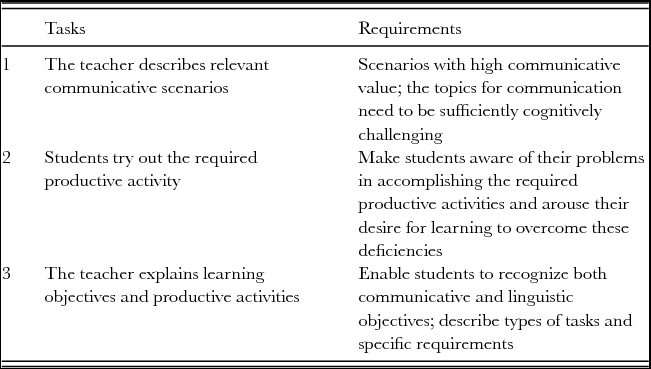
Unlike the ‘lead-in’ or ‘warm-up’ activity in traditional language teaching, the first step of this phase of the POA expects the teacher to make explicit the scenarios of to-be-finished tasks and how they plausibly might happen in students’ future lives. Take ‘Art and Nature’, Unit 2, Book 2 of iEnglish, for example. Two scenarios are described by the teacher (Yang Reference Yang2015).
Situation 1: You and your foreign friend are talking about art in the West and in China. You are discussing with your friend the major features of Da Vinci's Mona Lisa and Chinese paintings of mountains and water.
Situation 2: Your school is going to hold an international students’ forum. The theme is ‘East and West – Similar or Different’. The forum is to promote understanding of Western art and Chinese art. You are attending the painting symposium and are going to give a presentation. The presentation will be about the similarities and differences between Western and Chinese painting. What would you say?
To vividly enact the authenticity of the above scenarios, Yang chose to produce a video-tape for the first scenario where one Chinese student and one foreign teacher were invited to talk about the Mona Lisa and Chinese paintings of mountain and water. The Chinese student knows little more than the mysterious smile of the Mona Lisa. As for why most classical Chinese paintings depict mountains and water, she was caught blank. After watching the video-tape, students would naturally think about themselves and the extent to which they could perform the tasks. The POA assumes that if students realize their weaknesses, they, as adults, would like to learn more in order to avoid embarrassment and perform more effectively in the future. This kind of assumption, however, needs to be dealt with cautiously since it may be culturally sensitive.
The second step of the first phase is to ask students to try out the designated productive tasks. Through the students’ initial trial, the POA hopes that students come to know specifically what they lack for the tasks: Do they lack sufficient knowledge about the topic? If they do have adequate knowledge, do they know how to express it in English? Are they able to organize information in an appropriate way? Their deficiencies might appear in one or two or all three areas. Once students can identify their difficulties, they will have a clear focus for their learning.
The last step of this phase is to explain what students are expected to achieve at the end of the unit. The POA emphasizes a balance between realistic and obtainable communicative and linguistic objectives. In this sense, learning objectives necessarily vary according to students’ diverse abilities in English. The following are the communicative objectives of Unit 2 ‘Art and Nature’ set up by Yang (Reference Yang2015):
• Name and explain some features of a world-famous Western painting.
• Identify and analyze the subject matter in classical Chinese paintings.
• Make comparisons between Western and Chinese paintings from one or more perspectives.
Linguistic objectives include both language expressions and discourse structures. For language expressions, the POA suggests that the teacher list only the most essential words, expressions, and sentence structures to be mastered and closely related to the needs of accomplishing the assigned productive tasks. For discourse structures, although they might be various, students are expected to be able to use at least the most frequent and basic ones. A common implementation problem is that teachers may ask students to learn all the new items occurring in the text. However, if too many linguistic items are expected to be acquired, the results might contradict the SLH principles of the POA, and students’ confidence and interests in learning might be diminished if they feel they cannot meet the teacher's expectations no matter how hard they work.
4.3.2 Enabling
The second phase of the POA is called ‘enabling’, which means instruction must follow a series of steps designed by the teacher to lead students from being less to more able. This phase relates to the IEH and the SLH hypotheses described above. The IEH highlights the link between learning and using language while the SLH stresses how to learn selectively for a specific production purpose.
This phase is the essential part of the POA. On the one hand, all the teaching principles are primary in this phase. At the same time, the IEH and SLH are brought to the fore and tested in this phase (e.g. Zhang Reference Zhang2016). Traditional Chinese teaching places too much emphasis on learning without enough attention paid to using language whereas Western, task-based or project-based approaches put too much stress on using language without teachers providing students with systematic guidance for learning. During this enabling phase, the POA maintains that teachers should not simply or arbitrarily assign productive activities to students but rather find ways to guide students in learning step-by-step from their existing knowledge base, in a ZPD, expanding their linguistic systems and rhetorical devices gradually and progressively (Wen Reference Wen2015c).
In the Chinese context, textbook writers have responsibilities for selecting input materials that help learners complete the assigned productive activities successfully. From my personal experience of textbook writing, it is extremely difficult to find input materials that match 100% with the designed productive activities. On the other hand, textbook writers do not actually want materials with 100% matching because students need to learn how to process new materials and find out what they need for language production. Therefore, the criterion for selecting enabling input materials is relevance rather than matching. In addition to the materials provided by textbooks, the POA also expects a teacher to find suitable materials from websites or for students to search the internet for relevant materials under the teacher's guidance. Adequate materials provide students with relevant ideas, language expressions, or discourse structures for the assigned productive activity. The POA does not want to provide input materials for learners just to imitate.
For each unit of iEnglish, there are two texts as enablers. Again, take ‘Art and Nature’ as an example. Text A is about the Mona Lisa and Text B about classical Chinese paintings. The exercises include three types. The first type centers on identifying and synthesizing information, which helps students obtain crucial ideas from the text relevant to the productive activity. The second type is for building students’ language. The exercises within this type are various. The basic assumption is that although the text provided has many new words, expressions, and sentence structures, the textbook writers only focus on the most important ones and design several rounds of exercises from comprehension to production, encouraging students to learn important material step-by-step. There is also an extended box to supplement sentence structures that do not occur in the text but are useful for the productive tasks. The third type prepares students for the key discourse structure in the unit, normally, through an exemplary essay or speech produced previously by a student or a teacher on a similar but different topic. For example, if the productive task is to talk about the Mona Lisa, the preparatory listening or written materials are about another painting, the Last Supper. The students are expected to analyze the given materials and summarize their organizing structure. Model, exemplar texts by students or teachers are assumed, by the POA, to be more learnable and within students’ ZPD than would be texts published by famous native speakers of English.
My observations of English class instruction indicate that the second enabling phase is more demanding than the motivation or assessing phases. Instead of carefully guiding students to learn step-by-step, Chinese English teachers either give their students explanations or ask their students to provide answers to the questions in the exercise at the end of each text. Thus, their teaching does not involve a series of carefully designed procedures in which students are guided to learn new things progressively. Consequently, the enabling phase requires teachers spend considerable time understanding and preparing to follow the requirements of this enabling phase. Table 2 illustrates the specific tasks and requirements of the enabling phase.
Tasks and requirements of the second, enabling phase
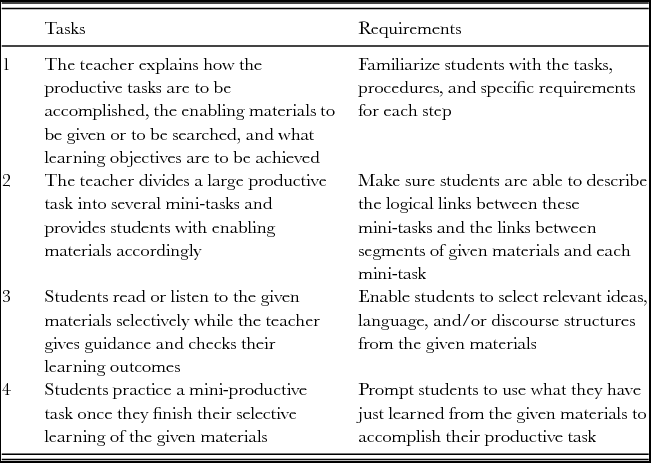
As Table 2 shows, the enabling phase of the POA consists of four major steps which can be rearranged and repeated according to the pedagogical situation. Teachers are often encouraged to segment a large productive activity into several mini-ones. For example, the overall productive activity for ‘Art and Nature’ is to make comparisons between Western and Chinese paintings from one or more perspectives. To accomplish this extended activity, students must first finish two sub-activities – talking about Western paintings and about Chinese paintings – that enable them to carry out the longer activity. Accordingly, teachers need to plan at least three cycles of instruction, each repeating the four steps in Table 2.
4.3.3 Assessing
Here, assessment can be grouped into two kinds. The first is ongoing diagnostic and formative classroom assessment that takes place in the enabling phase when students do selective learning or practice their mini-productive tasks. Based on the result of the ongoing diagnostic and formative assessment, the teacher should adjust the pace of instruction. The second is achievement assessment, which refers to the assessment undertaken at the next round of classes through students’ repeated practice outside class to check whether the students have achieved the objectives of the unit learned. Table 3 presents the tasks and the requirements of achievement assessment.
Tasks and requirements of achievement assessment
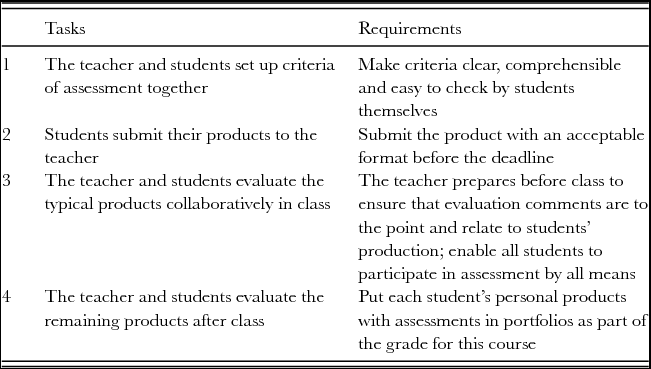
The last phase of the POA is to assess students’ language products, which might be written compositions, public speeches, translated texts, oral interpretations, simulated role plays, posters, and so on. The first step to this end is to set up criteria for assessment jointly among the teacher and students. Rather than constructing criteria for different types of language products at one go, it is better to construct sets of criteria while evaluating a particular type of language product. The criteria should be explicitly stated and easily comprehended so that students can make self-evaluations without difficulty. The second step is for students to submit their finished products. A deadline and format must be clearly specified in advance so that students’ submitted products are presented in a required format and handed in on time. The third step is the most crucial, involving collaborative assessment. The teacher organizes the assessment, whether in oral or written format, by selecting a few typical student products (without mentioning the students’ names) to be evaluated in class. For effective collaborative assessment, the teacher needs to prepare detailed evaluations of all students’ products before class. Then, in class, the students may first make comments and make revisions in pairs or groups, followed by whole-class discussion. In between these steps, the teacher may make comments on or prepare revised versions of the students’ products. Importantly, different revised versions should be compared and discussed as to why one version is better than another. This kind of collaborative assessment can lead to better learning outcomes than a teacher's individual feedback. On the one hand, the teacher can discuss common problems together among students; on the other, all the students’ attention can be aroused to influence maximally the teacher's corrective feedback on all students. The last step is to evaluate those products that have not been assessed in class, inviting all to participate in this after-class evaluation, each student scoring one or two other students’ productive work with detailed guidance from the teacher. The teacher's assessment is always needed along with these students’ evaluations. Each student's products can be put together with their assessment records throughout the term in a portfolio, which serves a double purpose. Students can review their own progress within a semester, and the teacher can use this portfolio for the purposes of formative and achievement assessments and grading.
5. Conclusion
The POA is still in its early stages and further revisions and progress will be made based on results from ongoing research. The whole system needs to be elaborated and optimized. The three hypotheses of the POA should be evaluated in diverse experiments. Furthermore, the POA should be experimented with in English instruction at primary and secondary schools to see to what extent the POA can be implemented effectively in those contexts. Although the POA has been developed to overcome the weaknesses in current English instruction in China, I believe, it is also suitable for other contexts where English is taught as a foreign language such as Japan, South Korea, or Thailand.
Acknowledgements
I would like to thank Alister Cumming, Peter Gu Yongqi, Bonny Norton, and the editor and reviewers of Language Teaching for their critical comments and suggestions for revisions.
Qiufang Wen is a professor of applied linguistics and a full-time researcher at the National Research Center for Foreign Language Education and the Consortium for Chinese Studies and Intercultural Communication, Beijing Foreign Studies University. She has taught Applied Linguistics and English for over 30 years and is now supervising ten doctoral students, having supervised a previous 42 to obtain their Ph.D. degrees. She is an experienced researcher, editor and reviewer, having published over 150 articles and 20 books on applied linguistics with a focus on English teaching and learning as a foreign language. She is President of the China English Language Education Association and the editor of the Chinese Journal of Applied Linguistics (in English) and of Foreign Language Education in China (in Chinese). She serves as a member on editorial boards of several international journals. She has presented at over 100 national and international conferences, many as a keynote speaker, and frequently conducts various kinds of workshops for university English teachers’ professional development in China. Her current research interests include L2 teaching and learning, teacher professional development, and national language capacity.



