



‘Fast food’ epitomises the change in food culture in Western countries over the last 60 years. More recently many of the most well-known quick-service chains have established themselves elsewhere, particularly in the Middle East and Asia-Pacific countries( Reference Pingali 1 , Reference Musaiger 2 ).
These outlets have evolved to meet the needs of time-poor consumers, offering standardised food and/or drink items that can be served quickly, from pre-prepared or processed ingredients, with outlets sited to be readily accessible to large numbers of consumers( Reference Monteiro 3 – Reference Fraser, Clarke and Cade 6 ). However, the ecological associations between fast-food outlets and the prevalence of obesity have raised health concerns. In the UK the density of fast-food outlets is greatest in areas of deprivation which also have a higher prevalence of childhood obesity( Reference Cummins, McKay and MacIntyre 7 , Reference Fraser and Edwards 8 ) and in the USA there is a demonstrated correlation between proximity to fast-food outlets and obesity( Reference Stark, Neckerman and Lovasi 9 , Reference Shier, An and Sturm 10 ). A review of the effects of fast foods in rural China has also shown a positive correlation between measures of obesity and the number of fast-food outlets( Reference Xu, Short and Liu 11 ). Other studies have related fast-food intake to weight gain and insulin resistance( Reference Pereira, Kartashov and Ebbeling 12 – Reference Ball, Brown and Crawford 16 ), associations attributed to the energy density and high levels of fat, saturated fat, added sugar and salt in many fast-food items( Reference Prentice and Jebb 17 ). Fast foods are often also offered in large serving sizes and up-selling is common both through promotions and at the point of sale( Reference Close and Schoeller 18 ).
Although usually purporting to be standardised products, there are reports of significant differences in the nutritional content of apparently identical fast-food items provided by the same vendor. In 2005–2006, a comparison of the fat content of French fries and fried chicken from thirty-five countries showed a range of 41 to 65 g/serving at McDonald’s and 42 to 74 g/serving at Kentucky Fried Chicken (KFC)( Reference Stender, Dyerberg and Astrup 19 ). More recently, a survey showed variability in the nutrient content of fast foods from leading chain restaurants in Australia( Reference Dunford, Webster and Barzi 20 ) and marked variation in salt content per 100 g of the same product in different countries( Reference Dunford, Webster and Woodward 21 ). Moreover, there can be considerable variation in serving size that impacts on the absolute nutrient content per serving. For example, serving sizes are reported to be greater in the USA than for comparable outlets in Europe( Reference Young and Nestle 22 ).
In 2010 the Global Food Monitoring Group was established with the aim of collating and sharing product data between collaborating countries, enabling tracking of changes in product nutritional composition worldwide, including both retail sales and out-of-home purchases( 23 ). Given the popularity of fast-food products we explored the reported nutrient contents of comparable food items from popular transnational chains, to determine the extent of cross-country variation in energy (kJ), total fat (g) and saturated fat (g) contents and to help guide the identification of better product formulation.
Methods
A survey of the reported energy (kJ), total fat (g) and saturated fat (g) contents per serving and per 100 g in food and drink items was undertaken across ten countries: Canada, USA, Netherlands, UK, Germany, United Arab Emirates (UAE), Australia, New Zealand, China and Japan, with data collected for products where the descriptors implied they were broadly comparable by ingredients or product type. Data were collected between January and March 2012 from company websites. Serving size and total fat data for McDonald’s Japan products were collected in November 2012 as this information was not previously available online and provided that the nutrient data online matched the information previously collected. A full outline of the data collection protocol for fast foods has been published previously( 23 ).
Data collection
A fast-food chain was defined as an outlet that sells food products that are ready-to-eat, sold in servings and not arriving in the outlet in their final package( 23 ). Data were obtained for all available food and drink products from fast-food chain websites specific to each country, using publically available product information, and entered into a data collection spreadsheet. Data for each food and drink item were collected by country, recording chain name, product title and serving size (g and ml for drinks). The nutritional content recorded for each product was energy (kJ/serving and kJ/100 g), total fat (g/serving and g/100 g) and saturated fat (g/serving and g/100 g). In instances where data were not provided per 100 g of product this was calculated based on the reported serving size weight. When energy content was provided only as kcal, it was converted to kJ using the conversion factor 1 kcal=4·184 kJ.
An attempt was made to collect information for all food and drink items displayed on chain websites, resulting in data for 2961 products. Where nutritional data or serving size information was not provided on the website, or if there was a technical fault with the website at the time of data collection, the relevant information was requested via email to customer services or the company nutritionist if known. A total of twenty emails were sent with three responses received in total. Data collected were subject to quality checks, with a random sample of 10 % of all products double checked by a nutritionist for legitimacy and errors in transcription from the original data source. The Google Translate tool was used to assist in language translation where web pages were not provided in English.
Product categories
Food items were grouped into eight categories: (i) breakfast items; (ii) burgers; (iii) chicken products; (iv) pizza; (v) sides; (vi) salads; (vii) sandwiches; and (viii) milkshake-type beverages (Table 1). These product categories are consistent with previous published reports in this field( Reference Dunford, Webster and Barzi 20 , Reference Dunford, Webster and Woodward 21 ). Any products that were family share combinations marketed to serve more than one person, or combinations of products falling into multiple categories, such as meal deals, were excluded from this analysis.
Fast-food categorisation system

Data analysis
The median nutrient content (kJ or g/serving and kJ or g/100 g), for each food category and country, were examined. Products were reviewed by title to ensure cross-country comparison of the same product. Of the 2961 products collected, ten food and drink products symbolising the brand as their signature product, or assumed by the authors as one of the most popular menu items, were directly compared at an individual level. Data were checked for distribution and medians and ranges were calculated using the statistical software package IBM SPSS Statistics version 21. Due to the nature of these data, statistical analysis was not appropriate; therefore descriptive data are presented only.
Results
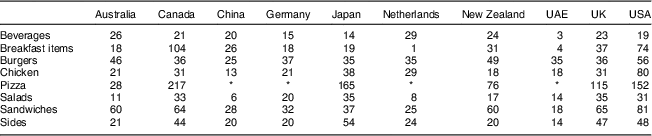
Data on the reported energy (kJ), total fat (g) and saturated fat (g) contents of fast-food products (n 2961) were collected across ten countries for five fast-food chains: (i) Burger King (Hungry Jack’s in Australia and New Zealand); (ii) KFC; (iii) McDonald’s; (iv) Pizza Hut; and (v) Subway. The fewest number of products were collected for the UAE (n 106), with the greatest number from Canada (n 550; Table 2). Pizza had the most products by category (n 753) whereas beverages had the fewest products (n 194).
Count (n) of categorised fast-food products across selected countries; data collected from company websites in a survey of fast-food items from five major chains across ten countries, January–March 2012
UAE, United Arab Emirates.
*Data not available online or received following direct contact.
Serving size comparisons by country
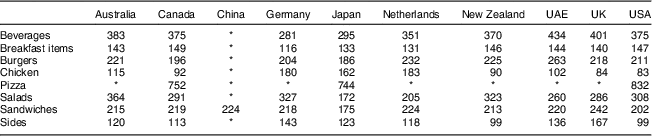
Across countries there was marked variation in the median serving size within product categories, with the lowest variation in breakfast items and the highest in salads (Table 3). Japan had the lowest serving sizes for four product categories: burgers, pizza, salads and sandwiches. Two countries had the highest median serving sizes for two product categories each: UAE for beverages and burgers, and the UK for sandwiches and sides. Small variations were observed in serving sizes of breakfast items, burgers, pizza, sandwiches and sides across the ten countries, with the maximum within-category difference in median serving size being 88 g or less. However, beverages and salads showed particularly large variability. Beverages ranged from the lowest median serving size of 281 ml in Germany to more than 50 % greater in the UAE, which had the highest median serving size of 434 ml. Salads ranged from the smallest median serving at 172 g in Japan to more than twice this size in Australia where the median serving was 364 g. Likewise, the median serving size for chicken in Germany was more than double that in the USA (180 g and 83 g, respectively).
Median serving sizes (g; ml for beverages) for fast-food products by category and country; data collected from company websites in a survey of fast-food items from five major chains across ten countries, January–March 2012
UAE, United Arab Emirates.
*Data not available online or received following direct contact.
Energy, total fat and saturated fat contents by country
The salads category displayed the lowest variation in energy, total fat and saturated fat contents across countries and chicken the highest (Figs 1, 2 and 3). Chicken in the Netherlands offered the lowest energy density (649 kJ/100 g) as compared with the USA which offered the highest (1196 kJ/100 g). Sides showed less variation, with Japan offering the lowest energy density (914 kJ/100 g) and Germany offering the highest (1238 kJ/100 g; Fig. 1).
(colour online) Median energy content (kJ/100 g; kJ/100 ml for beverages) of categorised fast-food products across selected countries; data collected from company websites in a survey of fast-food items from five major chains across ten countries, January–March 2012 (UAE, United Arab Emirates)

(colour online) Median total fat content (g/100 g; g/100 ml for beverages) of categorised fast-food products across selected countries; data collected from company websites in a survey of fast-food items from five major chains across ten countries, January–March 2012 (UAE, United Arab Emirates)

(colour online) Median saturated fat content (g/100 g; g/100 ml for beverages) of categorised fast-food products across selected countries; data collected from company websites in a survey of fast-food items from five major chains across ten countries, January–March 2012 (UAE, United Arab Emirates)

The lowest median total fat content per 100 g (per 100 ml for beverages) was observed in two categories each in Japan (beverages and sides), New Zealand (burgers and salads) and the UK (chicken and pizza); however, the highest median total fat per 100 g (per 100 ml for beverages) was observed in three categories each in Japan (breakfast items, burgers and salads) and the USA (beverages, chicken and pizza; Fig. 2). Large variations were observed in total fat per 100 g for all countries especially in the breakfast items and sandwiches categories. Breakfast items available in Japan offered the highest total fat (17·7 g/100 g) as compared with the UAE which offered the lowest (8·6 g/100 g). Sandwiches in China contained the lowest median total and saturated fat per 100 g (2·2 g and 0·8 g) as compared with the UAE (11·3 g and 4·4 g) reflecting differences in the menu items available.
New Zealand had the lowest saturated fat per 100 g (per 100 ml for beverages) in five product categories (beverages, burgers, chicken, salads and sides), whereas the UAE had the highest in three product categories (chicken, sandwiches and sides).
Energy, total fat and saturated fat contents per serving
The median energy content per serving varied within all product categories, with differences ranging from 364 kJ/serving for sandwiches to 1581 kJ/serving for beverages (see online supplementary material, Supplemental Table 1). Chicken products in the USA and Germany had comparable median energy per 100 g (1197 kJ and 1054 kJ, respectively) but the median serving size in Germany was more than double that in the USA (180 g and 83 g, respectively). Consequently chicken in the USA demonstrated the lowest median energy content per serving (1025 kJ) and Germany the highest (2096 kJ). Median energy per serving for sandwiches and sides from the UK were the highest among all countries, 1741 kJ and 1582 kJ respectively, which is in line with the UK recording the largest mean serving sizes for these product categories (242 g and 167 g).
A similar pattern was observed for total fat and saturated fat. Breakfast items available in China offered the highest median total fat (24·0 g) and saturated fat (10·0 g) contents per serving (see online supplementary material, Supplemental Tables 2 and 3) as compared with the UAE which offered the lowest total fat at 50 % less than that of China (12·0 g/serving). Canada had the lowest median saturated fat content per serving (5·0 g) for breakfast items. The total fat and saturated fat contents of beverages were greatest in Chinese products (18·5 g/serving and 13·5 g/serving), closely followed by the USA (18·0 g/serving and 12·0 g/serving) and more than 50 % higher than UK products (9·0 g/serving and 6·0 g/serving, respectively). The UK had the highest total fat content for sides (19·0 g/serving), which is 2·8 g/serving more than the next ranked country (UAE) and 8·5 g/serving more than the lowest ranked country (USA). Despite this the UAE had the highest saturated fat per serving for sides (7·1 g), which was 2·1 g/serving higher than the UK.
Specific product comparisons by country
In order to control for differences in available menu items, we reviewed the reported total energy, fat and saturated fat contents (g/100 g) of ten individual products across five chains, which were comparable by product name and description in all selected countries (results for energy are presented in Table 4; results for fat and saturated fat are presented in the online supplementary material, Supplemental Tables 4 and 5). Total energy and fat contents per 100 g varied for each product between countries. Burger King’s Whopper Burger showed the least variation (967–1029 kJ, 12·6–14·5 g) and KFC Original Recipe Chicken the most (536–1301 kJ, 7·5–18·2 g). McDonald’s Chicken McNuggets showed extreme variation with 12·0 g total fat per 100 g in Germany as compared with 21·1 g in New Zealand. Although KFC Original Recipe Chicken showed high variation in energy content (536–1301 kJ/100 g), only some countries stated the type of chicken piece, which could explain some of the variation. The McDonald’s Garden Side Salad in UAE was reported to contain 6·2 g total fat/100 g, whereas all countries except Canada (1·3 g fat/100 g) had a negligible value.
Reported total energy content (kJ/100 g) of comparable fast-food products, by country; data collected from company websites in a survey of fast-food items from five major chains across ten countries, January–March 2012

UAE, United Arab Emirates.
KFC Original Recipe Chicken in italics represent thigh pieces, others do not state type of piece.
*Data not available online or received following direct contact.
†Product is not available in this country.
Discussion
Our investigation of fast-food products demonstrates the wide variation in the serving size of similar products across different countries and reveals compositional differences in energy, total fat and saturated fat at both the category and individual product level. In some cases nutritional composition and serving size are additive, such that the energy and fat differences are greater when reviewed per serving rather than per 100 g. Our results support and extend previous findings to provide a more comprehensive analysis of the nutrient content of fast foods( Reference Dunford, Webster and Woodward 21 ).
The disparity in energy, total fat and saturated fat contents within the same food category and particularly within the same individual product available in different countries clearly indicates that it is technically feasible for manufacturers to improve the nutritional quality of fast-food products. Manufacturers have a responsibility to act, or should expect to be challenged by public health groups, on the disparity in products between countries. While there may be issues of consumer expectations about the taste of a product, the experience of reformulation in some countries has shown it is possible to make large reductions in levels of sodium, sugar and fat over time if done in small steps( Reference Buttriss 24 ). Serving dressing or sauces as an option as opposed to a standard offer, and increased amounts of fruit and vegetables where possible, may be more feasible for manufacturers in some countries than product reformulation to reduce the levels of fat, sugar and energy. Similarly, standardising serving sizes towards the lower end of the international range will help to reduce consumption of energy, fat and saturated fat from fast foods as the greatest variations in our study were observed when comparisons were made per serving.
It is notable that there is substantial variation within a single food category, for example chicken or salads. In the case of larger serving sizes of a comparable product, the higher energy content may be evident to consumers but in categories such as salads with greater diversity it may be less clear. This highlights the importance of clear food labelling so consumers can make a more informed choice at the point of purchase.
Our review has some limitations, primarily relating to data collection and availability. The presented data do not purport to represent the entire fast-food market. However, the review provides a useful snapshot of the international variations in nutrient composition and serving size of foods often considered to be a standardised product. We have captured data as available on company websites and available to consumers and have assumed these data are accurate; however, we do note data were collected in 2012 and products may have been modified since. Product data collected reflect online availability at that time and as such may contain some seasonal items; data for McDonald’s Japan included some Christmas varieties. Efforts were made to standardise data availability through the 3-month collection period between January and March, when there are generally fewer seasonal items on menus. As often the situation with data collection exercises, we could not have foreseen where data for nutrient content or serving size would be missing between brands and countries. Pizza Hut data were difficult to obtain in more than half our selected countries and data per 100 g or serving size were not available for all chains in China. Data on saturated fat content were not available for any Japanese chain, showing that chains opt to provide different information in different countries. Fast food and restaurant nutrition labelling has been exempt from food labelling laws until recently and is now starting to emerge as part of the legislation, which might explain some of the differences in the data availability between the countries. Product availability is shown in our data with the number of products reviewed varying substantially between long-standing fast-food markets of USA, Canada and the UK, compared with emerging markets in the Middle East countries and China. Where we have presented data for serving size, these are solely recommendations provided by manufacturers and although many items are single piece (such as burgers), there are some recommended for multiple servings that may be consumed as an individual serving. Additionally the data presented relate to the range of products on offer and do not reflect the pattern of purchasing of items, which may differ between countries.
The food environment is an important determinant of the choices made by individuals( Reference Story, Kaphingst and Robinson-O’Brien 25 , Reference Glanz, Sallis and Saelens 26 ). Given the continuing global rise in levels of obesity and its related diseases, there is a pressing need for global companies to consider the nutritional composition and serving sizes of the products they offer. Ensuring that the nutritional content in every country reflects the best that is possible anywhere in the world is an important step. It is hoped that responsible companies will want to ensure that progress made in some countries to reformulate should be matched worldwide and the current analysis will support the advocacy efforts of civil society to improve public health in countries where progress is slow. It also provides a baseline to assess secular trends in these products within each country over time.
Acknowledgements
Acknowledgements: The authors would like to acknowledge the work of the Global Food Monitoring Group for its involvement in generating the data collection protocol for fast foods, which was used to guide the method adopted in this work. Thanks are given to Ivonne Solis-Trapala of MRC Human Nutrition Research for providing statistical advice. Financial support: This work was supported by the UK Medical Research Council (programme number 53205). The funder had no role in the design, analysis or writing of this article. Conflict of interest: E.F., N.Z., L.E., E.D. and S.A.J. declare they have no conflict of interest and no competing interests. L.E. was an undergraduate placement student at MRC Human Nutrition Research during the time of this work and was responsible for collecting the nutritional information of foods. B.N. is the Chair of the Australian Division of World Action on Salt and Health, was a member of the Pepsico Global Scientific Advisory Board (2010 to 2012) and receives research funding from the Australian Food and Grocery Council as part of a National Health and Medical Research Council of Australia Partnership Grant (2010 to 2014). Authorship: S.A.J. and E.F. developed the concept of the paper. L.E. and N.Z. prepared the results. E.F. and N.Z. wrote the first draft of the manuscript and all authors were involved in the writing and critical review of this paper. Ethics of human subject participation: Ethical approval was not required.
Supplementary material
To view supplementary material for this article, please visit http://dx.doi.org/10.1017/S1368980015000336



