





Throughout the preschool years, children exhibit a remarkable surge in their ability to become attuned to others’ emotional cues (Wellman, Reference Wellman2014). As children progress through the preschool period, these social developmental milestones play a vital role in curbing aggressive behaviors that are often observed in two- to four-year-olds (Hay et al., Reference Hay, Payne and Chadwick2004; Tremblay, Reference Tremblay2000). Nevertheless, research indicates that a small subset of children consistently exhibits behavior problems, and their aggressive tendencies persist as they transition from preschool to elementary school (NICHD Early Child Care Research Network, 2004). One promising approach to effectively predict future behavior problems during early schooling that has emerged is the identification of callous-unemotional (CU) traits (McMahon et al., Reference McMahon, Witkiewitz and Kotler2010; Kruh et al., Reference Kruh, Frick and Clements2005; Rowe et al., Reference Rowe, Maughan, Moran, Ford, Briskman and Goodman2010). CU traits have been identified as comprising the affective deficits observed in adult psychopathy, and in youth, these traits are characterized by a lack of empathy and guilt, shallow or deficient affect, and being unconcerned about school performance (Frick & Hare, Reference Frick and Hare2002; Frick & Moffitt, Reference Frick and Moffitt2010).
A neurocognitive impairment in facial emotion recognition (FER) has been proposed as a reliable correlate of CU traits in children (Blair et al., Reference Blair, Leibenluft and Pine2014; Muñoz, Reference Muñoz2009; Dawel et al., Reference Dawel, O’Kearney, McKone and Palermo2012; Dadds et al., Reference Dadds, El Masry, Wimalaweera and Guastella2008, Reference Dadds, Jambrak, Pasalich, Hawes and Brennan2011; Díaz-Vázquez et al., Reference Díaz-Vázquez, López-Romero and Romero2024). Of all the emotional cues, facial emotional expressions are among the most efficient ways humans communicate their emotions (Ekman & Friesen, Reference Ekman and Friesen1971; Frith, Reference Frith2009), and being able to notice and recognize facial expressions facilitates prosocial behavior and socially appropriate conduct (Eisenberg et al., Reference Eisenberg, Fabes, Guthrie and Reiser2000, Reference Eisenberg, Eggum and Di Giunta2010; Frick & Morris, Reference Frick and Morris2004). Specifically, the ability to identify distress-related signals presented by others in social settings is also considered an important social developmental milestone influencing other aspects of socioemotional development (Russell & Widen, Reference Russell and Widen2002; Schultz et al., Reference Schultz, Izard and Ackerman2000). Within research contexts, facial emotion recognition is typically measured by quantifying the extent to which individuals can correctly identify a series of sequentially presented images of faces displaying various emotional expressions (Ekman & Friesen, Reference Ekman and Friesen1971).
Prior studies indicate that children with CU traits struggle to recognize others’ facial emotional expressions (Ciucci et al., Reference Ciucci, Baroncelli, Facci, Righi and Frick2024; Dawel et al., Reference Dawel, O’Kearney, McKone and Palermo2012; Frick & Viding, Reference Frick and Viding2009), particularly distress-related emotions of fear and sadness (Dadds et al., Reference Dadds, Perry, Hawes, Merz, Riddell, Haines, Solak and Abeygunawardane2006; Demetriou & Fanti, Reference Demetriou and Fanti2022). Notably, children with elevated CU traits show lower social motivation and emotional arousal in social settings where others are displaying distressing emotions compared to children without CU traits (Frick, Reference Frick2012). Blair’s Violence Inhibition Mechanism (VIM) theory (Reference Blair2001) considers the ability to recognize others’ distress-related facial emotional expressions as one of the prerequisites to suppress aggression and facilitate empathetic reactions (Blair & Coles, Reference Blair and Coles2000; Blair et al., Reference Blair, Colledge, Murray and Mitchell2001). Building upon the VIM framework, Frick et al. (Reference Frick, Ray, Thornton and Kahn2014) argue that limited prosocial understanding in early childhood among children with CU traits reflects their impaired ability to recognize distress-related emotions (Frick & Kemp, Reference Frick and Kemp2021). Meta-analytic evidence has suggested that FER deficits displayed by children with CU traits, while most often reported for distress-related emotional expressions (i.e., sadness & fear), are observed across various emotions (Dawel et al., Reference Dawel, O’Kearney, McKone and Palermo2012; Cooper et al., Reference Cooper, Hobson and van Goozen2020).
Anxiety and facial emotional recognition (FER)
Anxiety can be defined as the anticipation of future threat, characterized by cognitive, behavioral, and affective changes in response to the possibility of uncertain future negative incidents (Grupe & Nitschke, Reference Grupe and Nitschke2013). Anxiety is a common emotional experience that frequently serves as a natural reaction to stressors and threats that can facilitate adaptive alertness and changes in behavior to avert dangers. However, intense, frequent, or prolonged anxiety can significantly interfere with a child’s daily functioning, necessitating clinical attention (Murray et al., Reference Murray, Creswell and Cooper2009).
Evidence from various clinical and community samples of children and adolescents with anxiety problems suggests that anxiety could be associated with FER deficits, especially when anxiety levels are clinically impairing, though findings are inconsistent (Collin et al., Reference Collin, Bindra, Raju, Gillberg and Minnis2013). Easter et al. (Reference Easter, McClure, Monk, Dhanani, Hodgdon, Leibenluft, Charney, Pine and Ernst2005) found that children and adolescents with anxiety disorders performed significantly worse on FER tasks compared to healthy controls. However, this difference was observed only when viewing adult facial expressions, not child expressions. Children diagnosed with social phobia were found to generally perform worse than healthy controls in FER tasks (Simonian et al., Reference Simonian, Beidel, Turner, Berkes and Long2001). Demenescu et al. (Reference Demenescu, Kortekaas, den Boer and Aleman2010) conducted a meta-analysis that noted a general impairment in FER among adults diagnosed with anxiety disorders across studies but inconsistent findings among studies of anxious children. These discrepancies across child studies could result from multiple factors, such as sample demographics, nature of the FER tasks (e.g., adult vs. child stimuli), level of anxiety (e.g., clinically significant vs. subclinical), or deficits in FER related to specific emotions (Demenescu et al., Reference Demenescu, Kortekaas, den Boer and Aleman2010).
Specific FER deficits or patterns are also sometimes observed among anxious individuals. In particular, Kessler et al. (Reference Kessler, Roth, von Wietersheim, Deighton and Traue2007) and Mohlman et al. (Reference Mohlman, Carmin and Price2007) observed that socially anxious adults were more likely than healthy controls to misinterpret neutral emotional cues as angry ones. Regarding studies on youth, Kelly et al. (Reference Kelly, Maratos, Lipka and Croker2016) found that trait-anxious children appeared to be more likely to interpret uncertainty (neutral facial expressions) as threat (angry facial expressions), supporting the theory of heightened social vigilance in anxiety (Treves, Reference Treves2000). The tendency of anxious individuals to interpret neutral facial expressions in a negatively biased fashion could indicate a type of negative attribution bias (Bradley et al., Reference Bradley, Mogg, White, Groom and de Bono1999; Gilboa-Schechtman et al., Reference Gilboa-Schechtman, Foa and Amir1999). Specifically, the ongoing anxiety experienced by these individuals could lead them to become more worrisome and excessively sensitive to potential threats in their social environments, therefore mistakenly attributing neutral facial expressions as threat-related ones (i.e., angry facial cues) (Torro-Alves et al., Reference Torro-Alves, de Oliveira Bezerra, Claudino, Rodrigues, Machado-de-Sousa, de Lima Osório and Crippa2016; Alves et al., Reference Alves, Rodrigues, de Souza and de Sousa2012; Beard & Amir, Reference Beard and Amir2010; Yoon & Zinbarg, Reference Yoon and Zinbarg2008).
This threat interpretation bias in anxiety may be similar to the hostile attribution bias observed in aggressive children, who tend to interpret social cues as exhibiting hostile intent when the cue is ambiguous (Nasby et al., Reference Nasby, Hayden and DePaulo1980). Disruptive behaviors such as aggression and rule-breaking, which commonly co-occur with CU traits, are associated with a tendency to interpret ambiguous stimuli as hostile (Schönenberg & Jusyte, Reference Schönenberg and Jusyte2014; Schönenberg et al., Reference Schönenberg, Mayer, Christian, Louis and Jusyte2016), which may impact FER. Furthermore, evidence of FER difficulties was found in studies examining FER in children exhibiting disruptive behaviors and aggression (Marsh et al., Reference Marsh, Finger, Mitchell, Reid, Sims, Kosson, Towbin, Leibenluft, Pine and Blair2008; Bowen et al., Reference Bowen, Morgan, Moore and van Goozen2014). Thus, aggression and rule-breaking were considered as potential confounding variables to disentangle unique FER patterns while considering CU traits and anxiety.
While some studies suggest anxiety interferes with FER, trait anxiety and clinically significant levels of anxiety may enhance the sensitivity of individuals towards facial emotional expressions in general, thereby improving FER task performance, at least for recognition of some emotional expressions. For instance, Rappaport et al. (Reference Rappaport, Di Nardo, Brotman, Pine, Leibenluft, Roberson-Nay and Hettema2021) noted that clinically elevated Generalized Anxiety Disorder (GAD) symptoms were associated with more accurate FER recognition of happy and fearful faces among a community sample of 601 children while controlling for age and gender. Additionally, adults diagnosed with social phobia have demonstrated heightened sensitivity in identifying negative facial expressions, as observed in studies by Joormann and Gotlib (Reference Joormann and Gotlib2006). Surcinelli et al. (Reference Surcinelli, Codispoti, Montebarocci, Rossi and Baldaro2006) further revealed that university students exhibiting high-trait anxiety features exhibited an improved ability to recognize fearful facial expressions.
Considering the conflicting findings, it is conceivable that anxiety could constitute a non-linear association with FER in children. The Yerkes-Dodson Law (1908) proposes that task performance improves with physiological/mental arousal to a point at which excessive arousal interferes with concentration and performance (Yerkes & Dodson, Reference Yerkes and Dodson1908). Similarly, children’s FER proficiency may exhibit an incremental improvement until a critical threshold of anxiety is reached, beyond which a diminishing trend in performance occurs. Child anxiety levels vary on a continuum in community samples (Shear et al., Reference Shear, Cassano, Frank, Rucci, Rotondo and Fagiolini2002), and the literature on CU traits and anxiety generally has focused more on trait anxiety levels rather than on categorical anxiety disorder classifications (Craig & Moretti, Reference Craig and Moretti2019). In keeping with the growing appreciation for dimensional assessment of child anxiety (Möller et al., Reference Möller, Majdandžić, Craske and Bögels2014), in the current study, we examined anxiety as a continuous variable, rather than distinguishing pathological anxiety from subclinical manifestations, though we also considered the possibility of an optimal anxiety level for FER. Additionally, because children may not have sufficient insight when it comes to assessing emotional problems depending on their developmental stages (Cooper et al., Reference Cooper, Hobson and van Goozen2020; Murray et al., Reference Murray, Creswell and Cooper2009), parent-report anxiety was included in our study as an alternative informant of child self-report anxiety.
Potential moderating role of anxiety on the FER-CU trait relationship
Anxiety may moderate the relationship between CU traits and FER. Drawing on Karpman’s (Reference Karpman1941, Reference Karpman1948) theory of psychopathy, anxiety is proposed to be one of the two etiological factors differentiating primary and secondary developmental pathways of CU traits in children (Bennett & Kerig, Reference Bennett and Kerig2014; Craig et al., Reference Craig, Goulter and Moretti2021; Kahn et al., Reference Kahn, Frick, Youngstrom, Kogos Youngstrom, Feeny and Findling2013; Kimonis et al., Reference Kimonis, Frick, Skeem, Marsee, Cruise, Muñoz and Morris2008). Specifically, primary variants are conceptualized to be predominantly rooted in impoverished affect, whereas secondary variants emerge because of unfavorable environmental experiences such as childhood maltreatment history (Karpman, Reference Karpman1941).
To our knowledge, there are only two prior empirical investigations, published almost concurrently, that have explicitly considered the role of anxiety in the relationship between FER and CU traits among children and adolescents. Kahn et al. (Reference Kahn, Frick, Golmaryami and Marsee2017) applied a variable-centered, regression-based approach and recruited 107 justice-involved male adolescents to examine whether anxiety moderated the association between CU traits and FER deficits. CU traits were found to be positively correlated with fear recognition accuracy at relatively low levels of anxiety but not at relatively higher levels (Kahn et al., Reference Kahn, Frick, Golmaryami and Marsee2017). Their findings of a positive association between CU traits and FER accuracy at low levels of anxiety, and no relationship at higher anxiety levels, are notably contrary to prior research demonstrating an inverse association between CU traits and anxiety (e.g., Dadds et al., Reference Dadds, Perry, Hawes, Merz, Riddell, Haines, Solak and Abeygunawardane2006, Reference Dadds, El Masry, Wimalaweera and Guastella2008). Kahn et al. (Reference Kahn, Frick, Golmaryami and Marsee2017) also found a negative main effect of CU traits on disgust recognition accuracy and a marginal CU interaction with anxiety, such that CU traits were inversely related to disgust recognition at relatively high levels of anxiety. However, Kahn et al. (Reference Kahn, Frick, Golmaryami and Marsee2017) warned that these results should be interpreted with caution, because no significant main effects for CU traits or interactions with anxiety in predicting FER accuracy were observed in their initial analyses of FER across all emotions. Rather, the findings above only emerged in post-hoc analyses for specific emotional expressions.
In the other study considering the influence of anxiety on the CU traits – FER relationship, Dadds et al. (Reference Dadds, Kimonis, Schollar-Root, Moul and Hawes2018) tested a similar question with a mixed clinical sample of children and adolescents (ages ranging from 3 to 16; N = 364) using a person-centered analytical approach. Their sample was distributed into three clusters based on the report type of maltreatment history (i.e., youth self-report, clinical report, & teacher report) and analyzed with a regression-based approach. They failed to observe a moderating effect of anxiety across all three established clusters in their study. However, elevated CU traits were found to be associated with FER deficits among participants with relatively low anxiety within a subsample comprising the youth self-report measurement cluster. Dadds et al. (Reference Dadds, Kimonis, Schollar-Root, Moul and Hawes2018) acknowledged that this disparity in the moderating effect of anxiety between the three clusters might stem from factors such as sample diversity, methodological variations in gauging anxiety and CU traits, intricate interaction dynamics, unaccounted environmental variables, analytical techniques, or even random fluctuations. Collectively, these factors may have contributed to the inconsistent findings within each cluster they have established (Dadds et al., Reference Dadds, Kimonis, Schollar-Root, Moul and Hawes2018).
Notably, these two studies by Kahn et al. (Reference Kahn, Frick, Golmaryami and Marsee2017) and by Dadds et al. (Reference Dadds, Kimonis, Schollar-Root, Moul and Hawes2018) produced some divergent findings. Kahn et al. (Reference Kahn, Frick, Golmaryami and Marsee2017) found that CU traits were positively associated with a better FER performance, but only at relatively lower levels of anxiety, whereas Dadds et al. (Reference Dadds, Kimonis, Schollar-Root, Moul and Hawes2018) found that relatively higher CU traits were associated with poorer FER performance among children with relatively lower levels of anxiety in one of their subsamples (i.e., self-report maltreatment). Authors of both studies posited that the process of how anxiety affects the relationship between CU traits and FER could be specific to certain emotions (Dadds et al., Reference Dadds, Kimonis, Schollar-Root, Moul and Hawes2018; Khan et al., Reference Kahn, Frick, Golmaryami and Marsee2017). Some important methodological distinctions between these two studies (e.g., nature of sample, analytical approach) may explain their divergent findings. In sum, anxiety may moderate the CU – FER association under certain conditions, but elucidating these conditions requires further exploration.
Current study
The current study has 3 primary aims: (1) to examine the unique roles of anxiety and CU traits in their association with FER performance, (2) to examine potential attribution bias between neutral cues and threat-related facial emotional expressions (i.e., anger), and (3) to explore the possibility of anxiety as a moderator in the link between CU traits and FER performance.
We also considered several potential confounding variables when testing these hypotheses, including demographic variables (age, gender, racial/ethnic group), externalizing problems (inattention, aggression, and rule-breaking), and intelligence.
Hypothesis 1
Building upon prior theory suggesting CU traits reflect deficits in affective processing (Dadds et al., Reference Dadds, El Masry, Wimalaweera and Guastella2008, Reference Dadds, Kimonis, Schollar-Root, Moul and Hawes2018), we hypothesized that CU traits in children are associated with lower accuracy in recognizing facial expressions across emotions, which may be especially apparent for distress-related emotions (i.e., sadness and fear).
Hypothesis 2
Previous research suggested that anxious children may exhibit an attribution bias towards threat-related emotions, such as anger, potentially impacting their ability to accurately identify different emotional expressions, especially neutral ones (Kessler et al., Reference Kessler, Roth, von Wietersheim, Deighton and Traue2007; Mohlman et al., Reference Mohlman, Carmin and Price2007). We hypothesized that anxiety levels are uniquely associated, after controlling for CU traits, with misperceiving neutral (ambiguous) facial expressions as threatening, leading to a poorer FER accuracy for neutral facial expressions and an increased likelihood of mistaking neutral for angry facial expressions. Additionally, considering mixed prior findings in the literature, we explored whether there is an optimal level of anxiety regarding FER by testing whether the level of anxiety exerts a quadratic rather than linear effect on FER.
Moderation exploration
Lastly, although our sample size limited our statistical power and precision to detect interactions, we explored the possibility that anxiety moderates the association between CU traits and FER deficits.
Potential confounds
While often neglected in studies of the relationship between CU traits and FER, several variables can influence FER in children that are also often associated with CU traits and thus bear consideration. Relevant sociodemographic factors include age, gender, race, and intelligence (Chronaki et al., Reference Chronaki, Hadwin, Garner, Maurage and Sonuga-Barke2015). Older children (Kothari et al., Reference Kothari, Skuse, Wakefield and Micali2013; Rodger et al., Reference Rodger, Vizioli, Ouyang and Caldara2015) and girls (Lawrence et al., Reference Lawrence, Campbell and Skuse2015; Riddell et al., Reference Riddell, Nikolić, Dusseldorp and Kret2024) tend to show stronger FER abilities than younger children and boys (Herba & Phillips, Reference Herba and Phillips2004), and a same-race recognition bias has been observed for FER (Davidson et al., Reference Davidson, Hilvert, Vanegas and Tuminello2015; Markham & Wang, Reference Markham and Wang1996; Segal et al., Reference Segal, Reyes, Gobin and Moulson2019; Tuminello & Davidson, Reference Tuminello and Davidson2011). In turn, age (Frick et al., Reference Frick, Ray, Thornton and Kahn2014; Longman et al., Reference Longman, Hawes and Kohlhoff2016), gender (Carvalho & Rosa, Reference Carvalho and Rosa2020), and race (Sullivan & Kosson, Reference Sullivan and Kosson2006; Kimonis et al., Reference Kimonis, Graham and Cauffman2018) have been associated with CU traits.
Likewise, cognitive ability (Collin et al., Reference Collin, Bindra, Raju, Gillberg and Minnis2013; Lawrence et al., Reference Lawrence, Campbell and Skuse2015; Nook et al., Reference Nook, Sasse, Lambert, McLaughlin and Somerville2017), pervasive developmental disorders like autism and specific learning disorders (Operto et al., Reference Operto, Pastorino, Stellato, Morcaldi, Vetri, Carotenuto, Viggiano and Coppola2020), and externalizing behavior problems (Cooper et al., Reference Cooper, Hobson and van Goozen2020; Longman et al., Reference Longman, Hawes and Kohlhoff2016) are associated with FER deficits and with CU traits. Regarding intelligence, some prior research suggests a positive association between IQ and FER (Lawrence et al., Reference Lawrence, Campbell and Skuse2015) and an inverse association between CU traits and IQ (Fantozzi et al., Reference Fantozzi, Muratori, Levantini, Mammarella, Masi, Milone, Petrucci, Ricci, Tacchi, Cristofani and Valente2022). Conduct problems are often elevated in youth with CU traits (Longman et al., Reference Longman, Hawes and Kohlhoff2016), and several studies have found conduct problems to be associated with FER deficits (Blair et al., Reference Blair, Veroude and Buitelaar2018; Cooper et al., Reference Cooper, Hobson and van Goozen2020). ADHD symptoms, especially inattention, also commonly co-occur alongside CU traits and conduct problems (Frazier et al., Reference Frazier, Demaree and Youngstrom2004; Kolko & Pardini, Reference Kolko and Pardini2010; Kats-Gold et al., Reference Kats-Gold, Besser and Priel2007). Thus, failing to account for these correlates may obfuscate the unique association between CU traits and FER deficits.
Methods
Participants
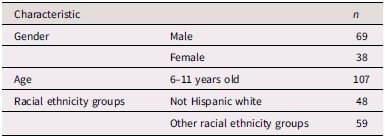
Table 1 summarizes sample characteristics. Initially, 126 participants were enrolled. Nineteen were excluded due to not meeting eligibility criteria – specifically, cognitive or developmental limitations, failed bipolar screening, or inability to complete the FER task – resulting in a final analytic sample of 107. Three additional eligible participants had partially missing questionnaire data and were retained using maximum likelihood estimation, which is robust under missing at random (MAR) assumptions. N = 107 child participants and their primary caregivers were recruited as part of a larger clinical trial, which involved oversampling for children with elevated CU traits.
Sample characteristics: participant demographic information
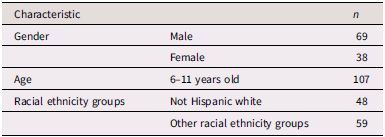
Among the N = 107 participants included in the analyses, including n = 38 children recruited with low CU traits. Per parent report, children ranged in age from 6-11 (mean age is 8.91), 64.5% of the child participants were male, 55.1% identified as people of color (including 48.6% African American, 2.8% Asian, and 3.7% multiracial participants), and 44.9% as Non-Hispanic White. All the child participants were screened for intellectual disabilities (IQ ≤ 72; Wechsler Abbreviated Scale of Intelligence, Second Edition; Wechsler, Reference Wechsler2011), autism spectrum disorder, and bipolar disorder (General Behavior Inventory Parent Version; Youngstrom et al., Reference Youngstrom, Findling, Danielson and Calabrese2001). N = 3 cases reported partially missing data during the data collection process (e.g., questionnaire, facial emotion recognition task).
Procedure
This research study was supported by the National Institute of Mental Health (grant [5R61MH117192]). The study was approved by the University of Alabama Institutional Review Board. All procedures were conducted in accordance with the Declaration of Helsinki and applicable federal regulations. Participants were recruited from community, school, and clinic settings in the southeastern U.S. and reimbursed for their time. Following informed consent and assent, parents completed the questionnaires while children completed the computer-based FER task and self-report surveys, including an anxiety measure with a research assistant.
Measures
Antisocial process screening device (APSD)
The Antisocial Process Screening Device (APSD) is a 20-item multi-informant measure developed to evaluate developmental precursors to adult psychopathic behavior (Frick et al., Reference Frick, Bodin and Barry2000; Frick & Hare, Reference Frick and Hare2002). Responses are recorded on a 3-point scale, with values ranging from 0 (Not at all true) to 2 (Definitely true). The APSD features a commonly used 4-item CU traits subscale that asks whether the child “feels bad or guilty,” “does not show emotions,” is “concerned about the feelings of others,” and is “unconcerned about school performance.” (Frick & Moffitt, Reference Frick and Moffitt2010). The APSD has been further developed with children and adolescents (N = 1,296) with a Flesch-Kincaid reading level of 5.99 (Cruise, Reference Cruise2001). In the present study, parent ratings on the APSD were employed to screen for CU traits, which have demonstrated reliability and validity in previous studies of children and adolescents, with Cronbach’s α estimates ranging from .64 and .72 (Frick et al., Reference Frick, Bodin and Barry2000, Reference Frick, Cornell, Barry, Bodin and Dane2003; Vitacco et al., Reference Vitacco, Rogers and Neumann2003; Vitacco & Rogers, Reference Vitacco and Rogers2001; Edens et al., Reference Edens, Skeem, Cruise and Caufmann2001; Rogers et al., Reference Rogers, Vitacco, Jackson, Martin, Collins and Sewell2002). In the current study, Cronbach’s α = 0.748 for the APSD CU items.
The child behavior checklist (CBCL)
The Child Behavior Checklist (CBCL) was used to collect parent-report data on child anxiety, aggression, and rule-breaking on a 3-point scale: 0 = Not True, 1 = Somewhat or Sometimes True, 2 = Very True or Often True. Raw scores for inattention problems, aggressive behavior, and rule-breaking were summed to form an externalizing composite variable. The validity of the CBCL scores has been supported by prior research (e.g., Achenbach, Reference Achenbach2001; Achenbach et al., Reference Achenbach, Dumenci and Rescorla2001). In the current study, the overall Cronbach’s α = 0.963, DSM anxiety problems composite α = 0.750, and the externalizing problem composite α = 0.915.
Revised children’s manifest anxiety scale, second edition (RCMAS-II)
The Revised Children’s Manifest Anxiety Scale, Second Edition (RCMAS-II), was used to assess anxiety levels in the participants via brief behavioral referents answered in a “yes” or “no” response format. There are four sub-scales: worry, social anxiety, physiological anxiety, and defensiveness. Raw subscale scores were used in the current study, with higher scores indicating greater anxiety. The validity of the RCMAS-II scores has been supported by previous research (Lowe, Reference Lowe2014; Reynolds & Richmond, Reference Reynolds and Richmond2008). In the current study, Cronbach’s α = 0.908.
University of New South Wales F.A.C.E.S task
The UNSW FACES Task (Dadds et al., Reference Dadds, Perry, Hawes, Merz, Riddell, Haines, Solak and Abeygunawardane2006) was utilized to measure FER. It comprises 36 facial emotional expressions presented for 2 s each, following a fixation cross. There are six non-Hispanic White models (two children, two adolescents, two adults), each displaying six emotions (e.g., angry, disgusted, fear, happy, neutral, sad). The child was prompted to identify via mouse click the correct emotion from six available options on the screen. Images were centrally positioned on the monitor screen and displayed following a 300-msec fixation cross. Following a separate practice activity with the response set to familiarize them with the task, child participants completed the FACES task. Extensive evidence substantiating the convergent and discriminant validity of the UNSW FACES Task has been documented across multiple studies (Dunn et al., Reference Dunn, Summersby, Towler, Davis and White2020; Dadds et al., Reference Dadds, El Masry, Wimalaweera and Guastella2008).
Wechsler Abbreviated Scale of Intelligence (WASI-II)
The WASI is a brief IQ assessment that is administered individually to evaluate general cognitive ability. It consists of four subtests, two of which were administered in this study: Matrix Reasoning (an index of nonverbal fluid abilities; 30 items) and Vocabulary (verbal expression; 31 items). Raw scores from these subtests are converted to T-scores, which are then combined to derive the Full-Scale IQ-2 (FSIQ-2) standard score. The WASI-II has demonstrated good reliability and validity, with McCrimmon and Smith (Reference McCrimmon and Smith2013) establishing high reliability and stability for the FSIQ-2 in children.
Statistical analyses
Preliminary analyses
An F-test for a regression model with two predictors was employed to estimate a sample of N = 68 participants required for power at .80 at an alpha level of .05 to detect a medium main effect via G*Power (Cohen, Reference Cohen1988). The sample size needed for power of .80 at alpha .05 to detect a small interaction effect in a moderation model comprising CU traits, anxiety, and CU traits X anxiety is N = 395. Power analyses were conducted to inform interpretation of null findings, particularly for moderation effects, rather than to guide analytic inclusion/exclusion. We acknowledge that moderation analyses are underpowered and interpret these results with caution.
We first examined descriptives and zero-order correlations among all study variables. Bivariate correlations among covariates were examined only to check for collinearity and not to guide their inclusion, which was theory-driven. Covariates (age, gender, race/ethnicity, IQ, and externalizing problems) were included in all primary GLMM models based on strong theoretical and empirical associations with facial emotion recognition (FER) and callous-unemotional (CU) traits. Specifically, age was included because FER abilities develop markedly throughout childhood (Lawrence et al., Reference Lawrence, Campbell and Skuse2015; Riddell et al., Reference Riddell, Nikolić, Dusseldorp and Kret2024). Gender was included given evidence that females often outperform males in FER tasks and may show different developmental trajectories (Lawrence et al., Reference Lawrence, Campbell and Skuse2015; Hall & Matsumoto, Reference Hall and Matsumoto2004). Race/ethnicity was included due to established in-group/out-group effects on FER and documented associations between race/ethnicity and CU traits (Elfenbein & Ambady, Reference Elfenbein and Ambady2002; Sullivan & Kosson, Reference Sullivan and Kosson2006). IQ was included because general cognitive ability is positively associated with FER performance and inversely associated with CU traits (Lawrence et al., Reference Lawrence, Campbell and Skuse2015; Fantozzi et al., Reference Fantozzi, Muratori, Levantini, Mammarella, Masi, Milone, Petrucci, Ricci, Tacchi, Cristofani and Valente2022). Finally, externalizing problems were included as they are closely linked to both CU traits and FER deficits and may confound observed associations if not accounted for (Frick et al., Reference Frick, Ray, Thornton and Kahn2014; Blair, Reference Blair1999). While we examined bivariate correlations to check for potential confounding, theoretical and empirical considerations guided final covariate selection. In addition to FER, CU trait, and anxiety variables, we considered IQ, age, and externalizing problems as potential confounds based on whether each of these variables was significantly correlated with both predictor variables and outcome variables as an empirical indication of a potential confounding effect. For categorical variables of racial group and gender, we applied ANOVA to determine if there are significant group differences on these variables in both the outcome variable (FER) and predictor variables (CU traits, anxiety).
We explored the feasibility of constructing a latent anxiety factor from parent- and child-report measures; however, the low correlation between these measures precluded a valid unified score. This is consistent with the literature on multi-informant discrepancies in child anxiety (De Los Reyes et al., Reference De Los Reyes, Bunnell and Beidel2013). Thus, we present analyses separately for each informant but acknowledge the limitations of this approach and recommend that future studies employ multi-informant latent variable modeling where possible.
Facial emotion recognition analyses
To address the hypotheses, the current study applied a cross-sectional design to test for the hypothesized unique linear effects and for potential interactions. Because trials within the FACES task cannot be assumed to be independent of one another but were instead nested within each child participant, we used multiple Generalized Linear Mixed Models (GLMM) to test our hypotheses. GLMM allowed us to account for repeated measures nested within each child by using a random effect for each child in the model (i.e., a random intercept for each child). We utilized this model to test whether CU traits and anxiety were each uniquely associated (over and above one another and potential confounds) on the facial emotion recognition task, whether anxiety predicts the likelihood of mistaking neutral for angry expressions, and whether anxiety moderates the CU – FER association. Our predictors included CU traits scores, anxiety scores (based on child self-report and parent report), and their interaction terms. The outcome FER variable was binary (correct or incorrect) for each of the six emotions (fear, angry, sad, happy, neutral, disgust).
For all analyses, we used binary logistic regression within the GLMM framework in Statistical Package for the Social Sciences (SPSS; IBM Corp., 2023). Separate GLMM models were run for each emotion expression and for each anxiety variable (parent-reported CBCL total anxiety and child-reported RCMAS Worry, Social Anxiety, Physiological Anxiety, and Total). To account for partially missing data, we defaulted to maximum likelihood estimation in all our analyses. To assess attribution bias, a binary variable was created coding ‘angry’ responses as 1 and all others as 0 for neutral faces. This contrast was modeled separately from the primary analyses of total FER accuracy.
Significant interactions were probed using simple slopes analysis at ±1 SD of the moderator. Regions of significance (RoS) were calculated using the Johnson–Neyman (J–N) technique adapted for generalized linear mixed models (GLMMs). For binary outcomes (e.g., FER accuracy, neutral-anger misattributions), we employed the Johnson–Neyman approach with multiple GLMM models using Statistical Package for the Social Sciences (SPSS v29.0; IBM Corp., 2023), which computes region of significance (RoS) for logistic models by identifying moderator values where the conditional effect transitions from non-significant to significant (α = 0.05). The proportion of the sample within the RoS was derived from the moderator’s empirical distribution.
A confusion matrix was also created to visually represent error patterns in incorrectly identified emotional expressions on the FACES task, following prior research (Faghel-Soubeyrand et al., Reference Faghel-Soubeyrand, Lecomte, Bravo, Lepage, Potvin, Abdel-Baki, Villeneuve and Gosselin2020; Airdrie et al., Reference Airdrie, Langley, Thapar and van Goozen2018). The confusion matrix visually summarizes the types and frequencies of misattributions in FER, offering insight into error patterns that may not be captured by overall accuracy or regression-based analyses (Faghel-Soubeyrand et al., Reference Faghel-Soubeyrand, Lecomte, Bravo, Lepage, Potvin, Abdel-Baki, Villeneuve and Gosselin2020). This descriptive information contextualizes the GLMM results and may inform future research on specific misattribution biases. The first cell of each row and column corresponds to the actual responses and predicted responses. Each remaining cell represents the log counts of alignment/misalignment between the actual and correct responses reported by the participants. This matrix allows us to observe the alignment or misalignment between the actual and correct responses.
Results
Preliminary analyses
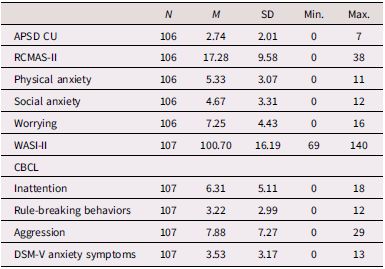
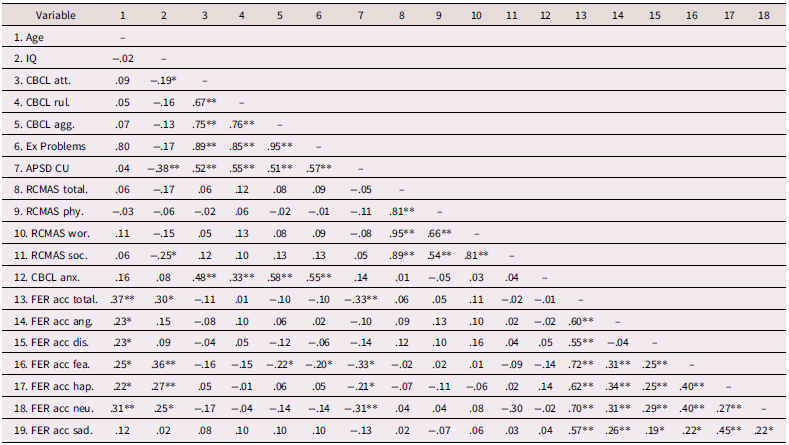
Table 2 indicates the descriptive statistics of variables of interest. Based on our a priori theoretical considerations, five covariates were included in our GLMM main-analysis models as potential confounds (e.g., age, race, gender, IQ, externalizing problems). However, we also considered in our preliminary analyses their relationships with the primary variables in the study. The results of bivariate correlations (Table 3) for potential covariates (i.e., age, IQ, externalizing problems) indicated that IQ is inversely correlated with CU traits r (107) = –0.38, p < 0.001, positively associated with total FER accuracy r (107) = 0.301, p = 0.002 and associated with better recognition of specific emotional expressions, including fear r (107) = 0.355, p < 0.001, happy r (107) = 0.267, p = 0.006, and neutral faces r (107) = 0.257, p = 0.011. CU traits were unrelated to child-report anxiety (p’s > 0.10) but positively associated with parent-report anxiety, r (107) = 0.249, p = 0.011. As expected, CU traits were also associated with poorer total FER accuracy r (107) = –0.333, p < 0.001, lower fear FER accuracy r (107) = –0.330, p < 0.001, and lower neutral FER accuracy r (107) = –0.311, p = 0.001. Child-report anxiety (total, physical anxiety, worrying, & social anxiety) and parent-report anxiety were unrelated to total or per-emotion FER (p’s > 0.10).
Descriptive statistics of variables of interest
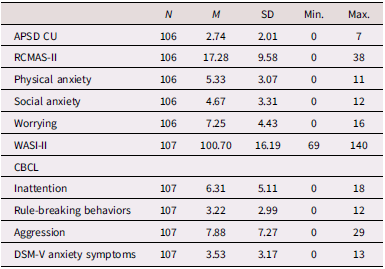
Note. APSD = antisocial process screening device; RCMAS-II = Revised children’s manifest anxiety scale, second edition; WASI-II = Wechsler abbreviated scale intelligence, second edition; CBCL = the child behavior checklist.
Bivariate correlations for study variables
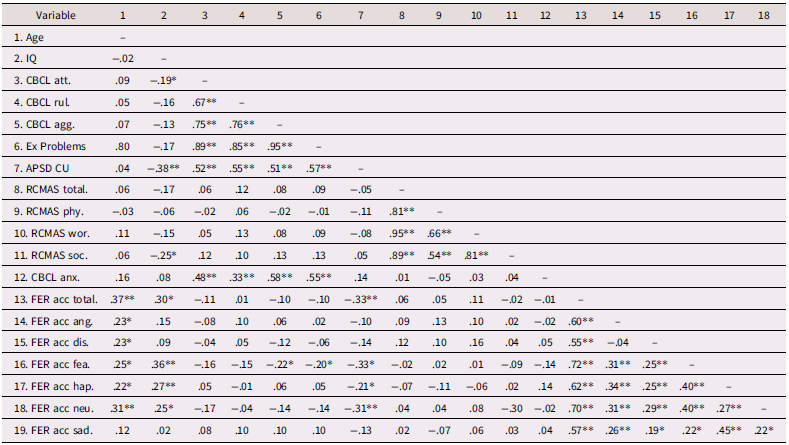
Note. APSD = antisocial process screening device; RCMAS-II = revised children’s manifest anxiety scale, second edition; WASI-II = Wechsler abbreviated scale intelligence, second edition; CBCL = the child behavior checklist [include IRB approval letter here, with blanked or redacted signatures].
* Correlation is significant at the 0.05 level (2-tailed). ** Correlation is significant at the 0.01 level (2-tailed).
The results of one-way ANOVAs indicated that there are significant differences between participants who identified as people of color and non-Hispanic White in their parent-reported CU traits F (1, 105) = 10.805, p = 0.001, child-reported total anxiety F (1, 105) = 6.013, p = 0.016, child-reported worry F (1, 105) = 4.285, p = 0.041, child-reported social anxiety F (1, 105) = 11.630, p < 0.001 and fear FER accuracy F (1, 105) = 7.290, p = 0.008. Non-Hispanic White participants reported lower CU trait scores, lower child-report total/social anxiety/worrying, and higher fear FER accuracy than participants from minority groups. No significant differences were observed between the girls and boys (p’s > 0.10). Regarding anxiety levels in our sample, of the final N = 107, 29.9% of the child participants self-reported clinically significant levels of anxiety symptoms (T > 60). Similarly, 20.6% of the primary caregivers reported that their children exhibited clinically elevated anxiety (T > 65) based on the administered clinical anxiety measures (RCMAS-II; CBCL). However, parent- and child-reported anxiety were uncorrelated.
For parent-reported CU traits on the APSD, the mean level was 2.74 with a standard deviation of 2.0. Additionally, the externalizing problems composite was negatively correlated with fear FER accuracy r (107) = –0.211, p = 0.04, and positively correlated with CU traits r (107) = 0.570, p < 0.001, and parent-report anxiety r (107) = 0.546, p < 0.001, but not with child-report anxiety (p’s>0.10).
Main analyses
Confusion matrix
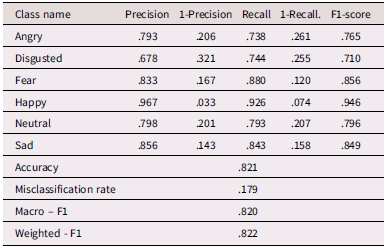
A confusion matrix (Table 4) was computed to evaluate classification performance across the six facial emotion categories (angry, disgusted, fear, happy, neutral, sad). Predicted and true emotion labels were formatted as factors with consistent levels to ensure valid comparisons. Using Confusion Matrix Generator (Perri et al., Reference Perri, Simonetti and Gervasi2021), we established the confusion matrix and extracted class-wise precision, recall, and F1 scores. We also computed 1 – precision and 1 – recall quantifying classification errors (false discovery and false negative rates, respectively) for each emotion category. In addition to class-level metrics, we calculated macro-F1 (unweighted average across classes), weighted-F1 (F1 scores weighted by class support), and the overall misclassification rate (proportion of incorrect predictions).
Overall, participants were more likely to misattribute neutral stimuli to sad faces (log n = 45) compared to angry faces (log n = 32), regardless of their anxiety levels. Participants’ overall accuracy, precision, recall rate, and F1-Scores were all listed in Table 4. Children in our sample exhibited the highest accuracy when happy faces (96.07%) were displayed and performed relatively poorly when disgusted faces (66.67%) were displayed.
Confusion matrix of FER performance for all participants
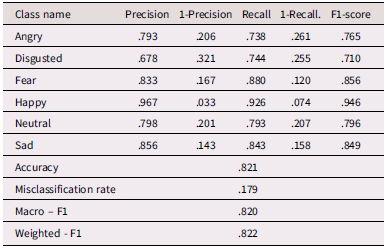
A chi-square goodness-of-fit test indicated that neutral faces were not equally misclassified across emotion categories, χ 2 (4) = 16.86, p = 0.002, suggesting systematic patterns in misattribution. Among the misclassifications, sad was the most frequent label assigned to neutral faces. Although angry was also somewhat overrepresented as a misclassification (observed = 32 vs. expected = 27.8), its contribution to the overall chi-square statistic was relatively small and not statistically significant, indicating that this pattern may reflect random variation rather than a systematic bias.
General linear mixed models
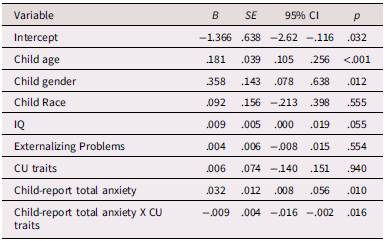
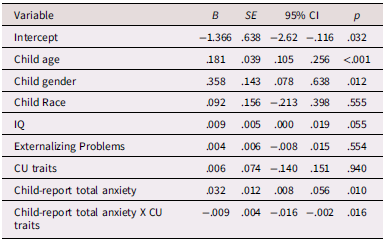
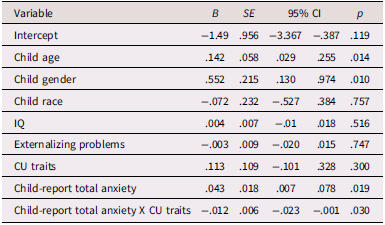
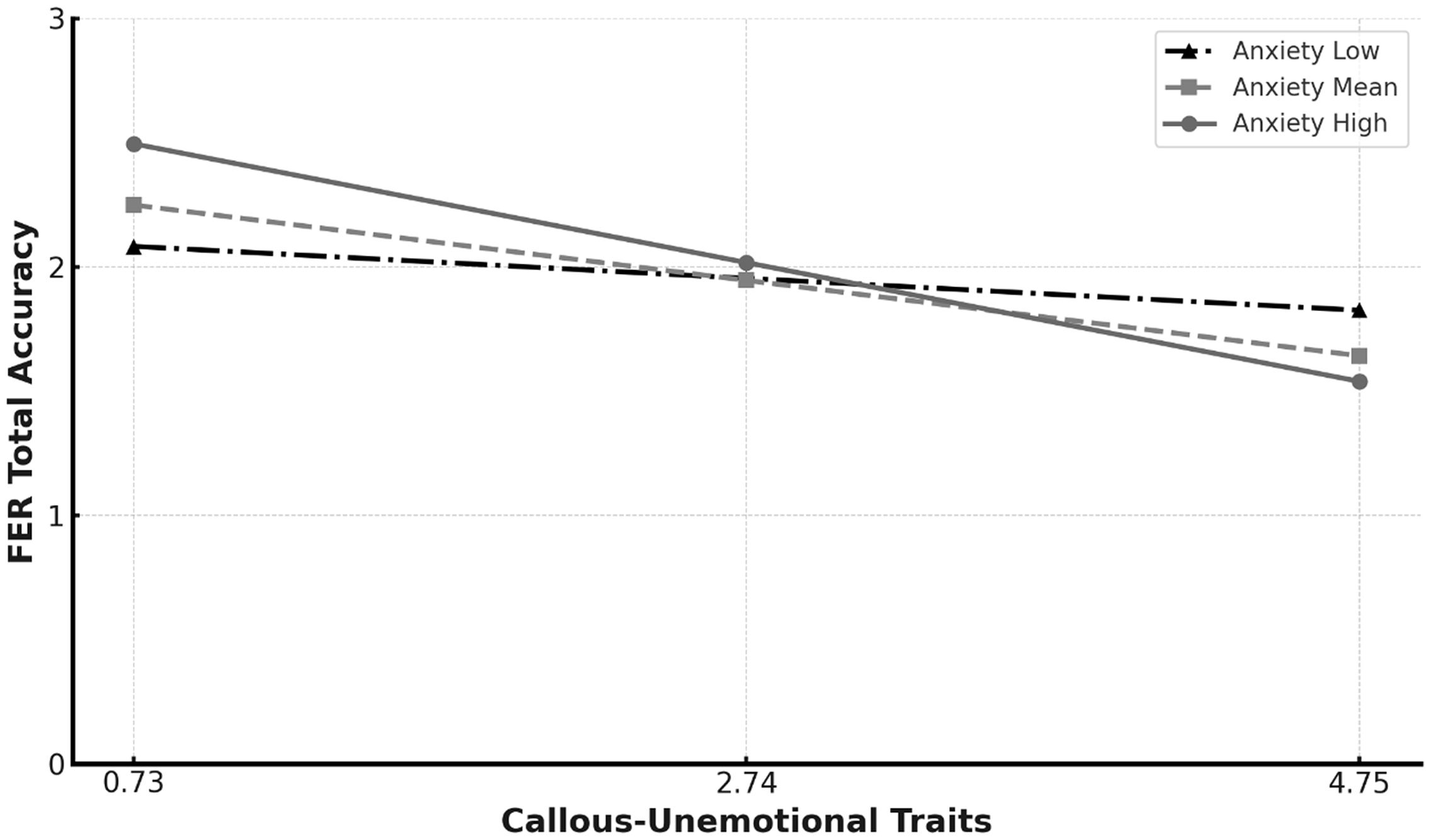
GLMM analyses are presented in Tables 5–11. The GLMM results indicated that child-reported total anxiety moderated the CU trait association with total FER accuracy (b = −0.009, SE = 0.003, z = −2.417, p = 0.016; Table 5)Footnote 1 . Significant interactions were probed using simple slopes analysis at ±1 SD of the moderator. We used the Johnson–Neyman (J-N) technique to identify the region of significance for the CU × moderator interaction (Hayes, Reference Hayes2017). Regions of significance were calculated to identify the range of moderator values where effects were significant, with sample proportions reported. Specifically, at relatively high (b = −0.238, SE = 0.062, z = −3.837, p < .001) and moderate (b = −0.151, SE = 0.045, z = −3.292, p = 0.001) levels of total anxiety, CU traits were negatively associated with total FER accuracy as indicated in Figure 1. However, at relatively low levels of anxiety, CU traits were not associated with total FER accuracy (b = −0.064, SE = 0.054, z = −1.174, p = 0.240). CU traits were significantly associated with lower overall FER accuracy when total anxiety symptoms were at or above 11.33 (Table 9), which corresponds to approximately 0.62 SD below the mean, encompassing approximately 68.2% of the sample (N = 107). This suggested that the negative effect of CU traits emerged at moderately below-average levels of overall anxiety.
GLMM regression analyses for the associations between child-report total anxiety, CU traits and FER total accuracy
Note. Unless otherwise notes, binary logistic regression models were applied for all GLMM analyses.
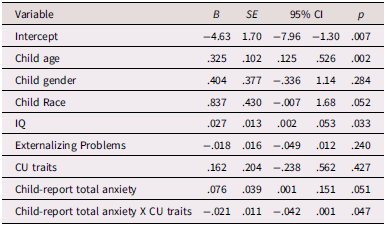
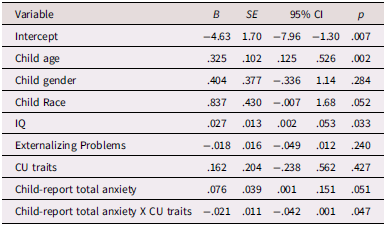
GLMM regression analyses for the associations between child-report total anxiety, CU traits and FER fear accuracy
Note. Unless otherwise notes, binary logistic regression models were applied for all GLMM analyses.
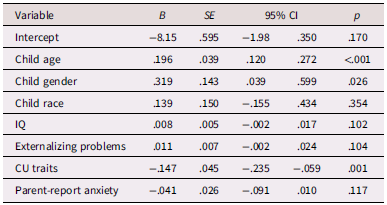
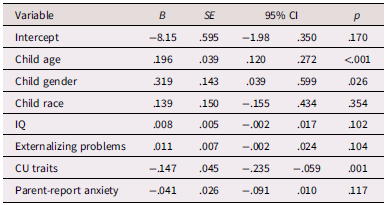
GLMM regression analyses for the associations between parent-report anxiety, CU traits and FER total accuracy
Note. Unless otherwise notes, binary logistic regression models were applied for all GLMM analyses.
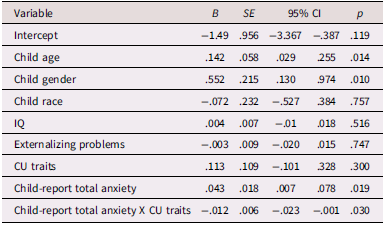
GLMM regression analyses for the associations between child-report total anxiety, CU traits and FER disgusted accuracy
Note. Unless otherwise notes, binary logistic regression models were applied for all GLMM analyses.
Analyses for the associations between child-report anxiety, CU traits and FER total accuracy

Note. Logit coefficients represent the conditional effect of [IV] predicting [DV] at the specified levels of the moderator. Regions of significance (RoS) indicate moderator values where the effect of [IV] was statistically significant (α = .05). Odds Ratios (ORs) are exponentiated B coefficients with 95% CIs. Sample proportions indicate the percentage of participants in the relevant range of the moderator where this effect holds.
Analyses for the associations between child-report anxiety, CU traits and FER fear accuracy

Note. Logit coefficients represent the conditional effect of [IV] predicting [DV] at the specified levels of the moderator. Regions of significance (RoS) indicate moderator values where the effect of [IV] was statistically significant (α = .05). Odds Ratios (ORs) are exponentiated B coefficients with 95% CIs. Sample proportions indicate the percentage of participants in the relevant range of the moderator where this effect holds.
Analyses for the associations between child-report anxiety, CU traits and FER disgusted accuracy

Note. Logit coefficients represent the conditional effect of [IV] predicting [DV] at the specified levels of the moderator. Regions of significance (RoS) indicate moderator values where the effect of [IV] was statistically significant (α = .05). Odds Ratios (ORs) are exponentiated B coefficients with 95% CIs. Sample proportions indicate the percentage of participants in the relevant range of the moderator where this effect holds.
Moderation analysis for child-report total anxiety, CU traits and FER total accuracy. notes. Binary logistic regression plotted results. Child-report total anxiety as the moderator between the association of CU traits and FER total accuracy.
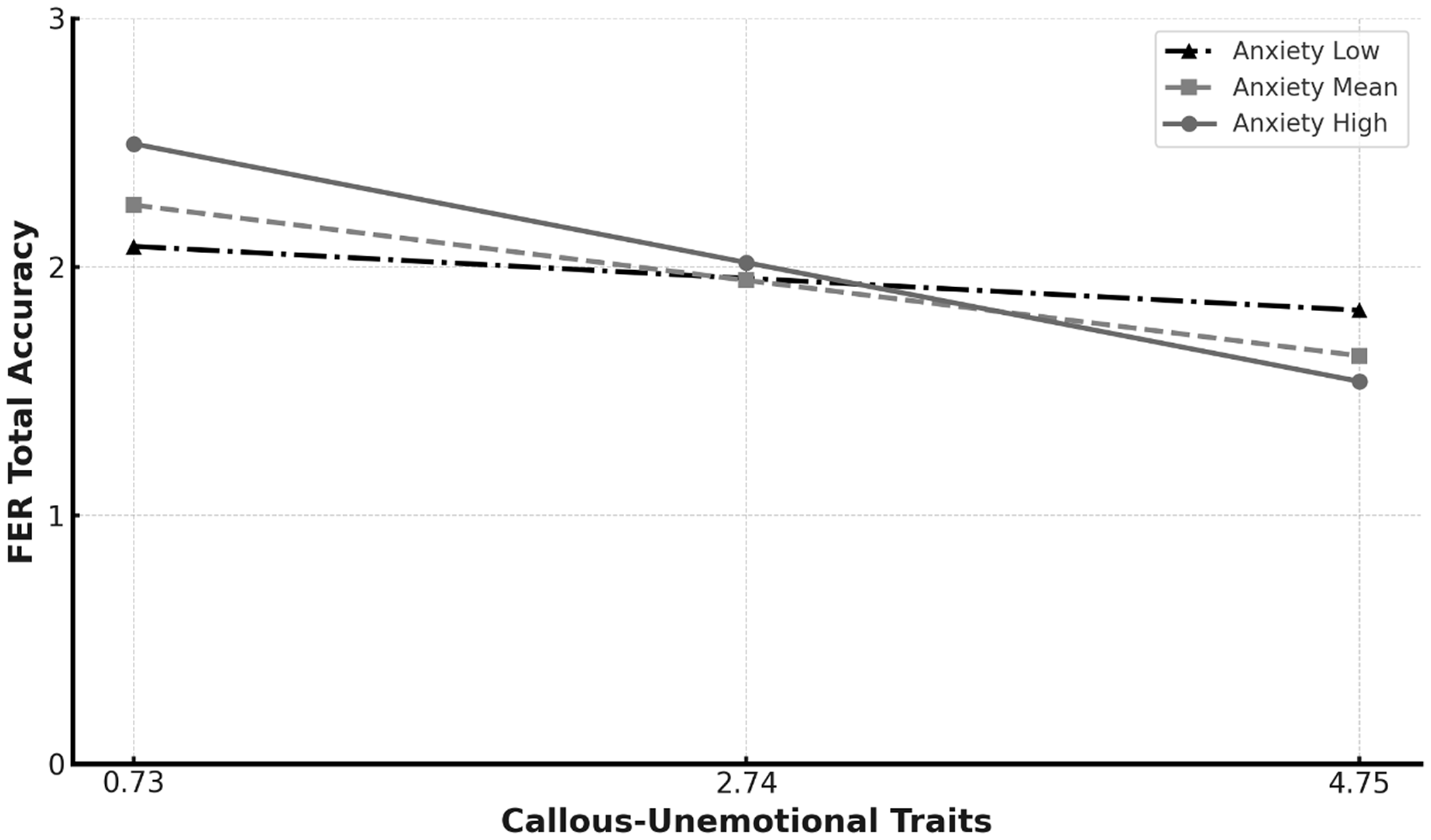
For the GLMM model using parent-reported anxiety, CU-traits were negatively associated with total FER accuracy (b = −0.147, SE = 0.045, z = −3.283, p = 0.001)Footnote 2 , though no interaction with parent-reported anxiety was found as indicated in Table 7. No significant result for potential quadratic effects of child-report anxiety (b = −0.001, SE = 0.001, z = −0.989, p = 0.323) or parent-reported anxiety quadratic effects (b = −0.005, SE = 0.003, z = −1.426, p = 0.154) emerged. When examining the “neutral to angry” responses using the prior binary logistic GLMM models, none of the variables, including CU traits and child-report/parent-report anxiety, predicted the hypothesized attribution bias (p’s > 0.10).
Additionally, we assessed FER accuracy for each of the six emotional expressions (angry, disgusted, fear, happy, neutral, sad) using the same GLMM model structure as with total FER accuracy as the outcome variable. Child-report total anxiety moderated the association between CU traits and fear FER accuracy (b = −0.021, SE = 0.010, z = −1.987, p = 0.047) as indicated in Table 6. Probing this interaction revealed that at relatively low (b = 0.002, SE = 0.147, z = −0.016, p = 0.987) and moderate (b = −0.198, SE = 0.122, z = − 1.615, p = 0.107) levels of total anxiety, CU traits were not significantly associated with fear FER accuracy; however, at high levels of anxiety, CU traits were negatively associated with fear FER accuracy (b = −0.399, SE = 0.169, z = −2.350, b = 0.019). Specifically, CU traits were significantly associated with lower fear FER accuracy when total anxiety symptoms reached 19.97 or higher (Table 10), which corresponds to approximately 0.28 SD above the mean, encompassing approximately 37.4% of the sample (N = 107). This indicated that the effect of CU traits emerged only when anxiety was relatively elevated.
Child-report total anxiety also moderated the association between CU traits and disgust FER accuracy (b = −0.012, SE = 0.005, z = −2.178, p = 0.030) as indicated in Table 8. Through probing this interaction, at relatively low (b = 0.021, SE = 0.080, z = 0.266, p = 0.790) and moderate (b = −0.094, SE = 0.068, z = −1.384, p = 0.167) levels of total anxiety, CU traits were not significantly associated with disgust FER accuracy; however, at high levels of total anxiety, CU traits were found negatively associated with disgust FER accuracy (b = −0.210, SE = 0.092, z = −2.282, b = 0.023). CU traits were significantly associated with lower disgust FER accuracy at higher levels of total anxiety (≥ 22.16) (Table 11), corresponding to approximately 0.51 standard deviations above the mean, encompassing approximately 30.8% of the sample (N = 107). This indicated that this negative effect of CU traits emerged only when total anxiety was moderately elevated. No significant results were observed when parent-report anxiety was included in the GLMM models.
Post-hoc analyses
In addition to testing our primary hypotheses, we utilized GLMM models to separately examine the role of child-reported physical anxiety, worrying, and social anxiety in children’s total FER accuracy, to determine whether specific anxiety subtypes matter. Child-report social anxiety moderated the association between CU traits and total FER accuracy (b = −0.026, SE = 0.038, z = −0.515, p = 0.023). Specifically, at low levels of social anxiety (b = −0.069, SE = 0.055, z = −1.244, p = 0.214), CU traits were not associated with total FER accuracy. At moderate (b = −0.153, SE = 0.0457, z = −3.358, p < 0.001) and relatively high levels of social anxiety (b = −0.238, SE = 0.0621, z = −3.828, p < 0.001), they were negatively associated with total FER accuracy. CU traits were significantly associated with lower overall FER accuracy at moderate to high levels of social anxiety (≥1.48), which corresponds to approximately 0.97 SD below the mean, encompassing approximately 81.3% of the sample (N = 107). This suggested that this effect of CU traits emerged even at relatively low levels of social anxiety.
Furthermore, child-report worrying moderated the association between CU traits and total FER accuracy (b = −0.018, SE = 0.008, z = −2.184, p = 0.029). At relatively low levels (b = −0.065, SE = 0.055, z = −1.175, p = 0.240), CU traits were not associated with total FER accuracy. However, at moderate (b = −0.143, SE = 0.046, z = −3.106, p = 0.002) and high levels (b = −0.221, SE = 0.061, z = −3.615, p < 0.001) of worrying, they were negatively associated with total FER accuracy. CU traits were significantly associated with worse overall FER accuracy at moderate to high levels of worry (≥4.59), corresponding to approximately 0.60 SD below the mean, encompassing approximately 71.0% of the sample (N = 107). This suggested that the effect of CU traits emerged even at slightly below average worry levels.
Moreover, child-report physical anxiety moderated the CU traits association with total FER accuracy (b = −0.025, SE = 0.012, z = −2.056, p = 0.040). At low levels (b = −0.078, SE = 0.054, z = −1.420, p = 0.156) of physical anxiety, CU traits were not associated with total FER accuracy. However, at moderate (b = −0.153, SE = 0.045, z = −3.333, p < 0.001) and high (b = −0.227, SE = 0.062, z = −3.666, p < 0.001) levels of physical anxiety, CU traits were negatively associated with total FER accuracy. CU traits are significantly associated with worse overall FER accuracy only when child-report physical anxiety is 3.07 (0.74 SD below the mean) or higher, encompassing approximately 64.5% of the sample (N = 107), suggesting the effect of CU traits emerged at relatively low levels of physical anxiety.
We also examined FER accuracy separately for each emotion using the same GLMM model structure alongside child-reported anxiety subtypes (physical anxiety, worrying, & social anxiety). Child-report social anxiety moderated the association between CU traits and fear FER accuracy (b = −0.078, SE = 0.030, z = −2.525, p = 0.012). At low (b = 0.046, SE = 0.147, z = 0.309, p = 0.757) and moderate (b = −0.210, SE = 0.121, z = −1.729, p = 0.084) levels of social anxiety, CU traits were not associated with fear FER accuracy. However, they exhibited an inverse association at high levels of social anxiety (b = −0.466, SE = 0.168, z = -2.771, p = 0.006). CU traits significantly predict lower fear FER accuracy only when social anxiety rating reached over 5.10, which corresponds to about 0.13 SD above the mean, encompassing approximately 39.2% of the sample (N = 107). This indicated the effect of CU traits emerging at slightly above-average levels of social anxiety.
Similarly, child-report social anxiety moderated the relationship between CU traits and disgust FER accuracy (b = −0.040, SE = 0.016, z = −2.407, p = 0.016). At low (b = 0.029, SE = 0.081, z = 0.358, p = 0.721) and moderate (b = −0.102, SE = 0.067, z = −1.522, p = 0.129) levels of social anxiety, CU traits were not associated with disgust FER accuracy; however, they were inversely associated with disgust FER accuracy at high levels of social anxiety (b = −0.234, SE = 0.091, z = −2.560, p = 0.011). CU traits were significantly associated with lower disgust FER accuracy when social anxiety scores were at or above 5.62, corresponding to approximately 0.29 standard deviations above the mean, encompassing approximately 39.2% of the sample (N = 107). This indicated the effect of CU traits emerging at above-average levels of social anxiety.
Additionally, child-report worrying moderated the relationship between CU traits and disgust FER accuracy (b = −0.025, SE = 0.012, z = −2.127, p = 0.034). Similarly with social anxiety, at low (b = 0.031, SE = 0.081, z = 0.375, p = 0.707) and moderate (b = -0.081, SE = 0.068, z = -1.189, p = 0.235) levels of worrying, CU traits were not associated with disgust FER accuracy. But they were inversely associated with disgust FER accuracy at high levels of worrying (b = -0.192, SE = 0.090, z = -2.133, p = 0.033). CU traits were significantly associated with lower disgust FER accuracy when worrying scores were at or above 10.76, corresponding to approximately 0.80 standard deviations above the mean, encompassing approximately 26.2% of the sample (N = 107). This indicated the effect of CU traits emerging at moderately above-average levels of worrying.
Lastly, child-reported physical anxiety was found to moderate the association between CU traits and neutral FER accuracy (b = −0.055, SE = 0.026, z = −2.096, p = 0.036). At a low (b = −0.101, SE = 0.116, z = −0.868, p = 0.386) level of physical anxiety, CU traits were not associated with neutral FER accuracy. They were, however, inversely associated with neutral FER accuracy at moderate (b = −0.268, SE = 0.098, z = −2.722, p = 0.007) and high (b = −0.435, SE = 0.136, z = −3.192, p = 0.001) levels. CU traits were significantly associated with lower neutral FER accuracy at higher levels of physical anxiety (≥3.99), corresponding to the emergence of a significant interaction effect at a relatively low level of physical anxiety (0.44 SD below the mean), encompassing approximately 64.5% of the sample (N = 107). This indicated the effect of CU traits emerging at above-average levels of physical anxiety. Nonsignificant trend was observed for child-report worrying concerning fear FER accuracy (b = −0.039, SE = 0.023, z = −1.714, p = 0.087).
Discussion
The current study examined the unique roles of anxiety and CU-traits in FER performance. Our key findings include that CU traits are associated with lower overall FER accuracy when controlling for parent-reported anxiety; child-reported anxiety moderates the relationship between CU traits and FER accuracy – specifically, CU traits were inversely related to FER accuracy at relatively high but not lower levels of child-reported anxiety; no evidence exists for a curvilinear relationship between anxiety and FER; and children are more likely to misattribute neutral expressions as sad in our sample. These results provide new insights into the complex interplay between CU traits, anxiety, and emotion recognition in children.
Aligned with the prior theories suggesting CU traits reflect deficits in affective processing (Dadds et al., Reference Dadds, El Masry, Wimalaweera and Guastella2008, Reference Dadds, Kimonis, Schollar-Root, Moul and Hawes2018), we found CU traits to be associated with lower overall FER accuracy after controlling for parent-reported anxiety. This trend was not observed for specific emotion types. Notably, parent-report anxiety and child-reported anxiety were uncorrelated in our sample, consistent with previous research on informant discrepancies in child anxiety in this age range (Briggs-Gowan et al., Reference Briggs-Gowan, Carter and Schwab-Stone1996; Grills & Ollendick, Reference Grills and Ollendick2003; De Los Reyes et al., Reference De Los Reyes, Bunnell and Beidel2013). We observed a positive relationship between parent ratings of child anxiety and CU traits, suggesting our sample may include a higher proportion of children fitting the secondary variant of CU traits. These discrepancies highlight the importance of a multi-informant perspective in assessing child anxiety and CU traits (De Los Reyes, Reference De Los Reyes2011).
When controlled for CU traits, neither parent-report nor child-report anxiety levels were uniquely associated with misperceiving neutral facial expressions as threatening. Participants in our sample were generally more likely to mistake neutral expressions for sad faces, with only a marginal difference between these misattribution rates. This suggests that future studies should explore various types of attribution bias beyond the hypothesized neutral-to-angry bias. The lack of a quadratic relationship between child anxiety and FER suggests there is no optimal level of anxiety regarding FER performance.
Recent work highlights the importance of stimulus characteristics (e.g., age, race, intensity of facial expressions) on FER performance, which may impact observed associations with CU traits (Powell et al., Reference Powell, Plate, Miron, Wagner and Waller2024; Bedford et al., Reference Bedford, Carter Leno, Wright, Bluett-Duncan, Smith, Anzures, Pickles, Sharp and Hill2021; Díaz-Vázquez et al., Reference Díaz-Vázquez, López-Romero and Romero2024). Our use of the UNSW FACES Task, which includes a range of ages and emotions, partially addresses these concerns, but future research should further examine how stimulus properties may interact with CU traits and anxiety.
Our results add heterogeneity to the mixed findings reported in prior studies on the association between anxiety and FER among children (Collin et al., Reference Collin, Bindra, Raju, Gillberg and Minnis2013; Cooper et al., Reference Cooper, Hobson and van Goozen2020). Notably, most previous studies reporting FER deficits in anxiety examined clinically elevated anxiety, whereas we recruited a community sample. This distinction is crucial, as our findings suggest that the relationship between anxiety and FER may differ between clinical and community samples when assessing FER in children, as this may help clarify inconsistencies in the literature.
A key finding in our study is that child-report anxiety moderates the association between CU traits and FER accuracy. Specifically, moderate to high anxiety levels were inversely related to overall FER accuracy in children with elevated CU traits. This result aligns more closely with the findings by Kahn et al. (Reference Kahn, Frick, Golmaryami and Marsee2017) among justice-involved male adolescents in the Southern United States than with Dadds et al. (Reference Dadds, Kimonis, Schollar-Root, Moul and Hawes2018) among clinically-referred Australian children with conduct problems. Our sample exhibited higher levels of child-report anxiety compared to some previous studies (Loney et al., Reference Loney, Frick, Clements, Ellis and Kerlin2003; Kimonis et al., Reference Kimonis, Frick, Cauffman, Goldweber and Skeem2012), which may partially explain these differences.
Limitations and future directions
This study has several limitations to consider. Its correlational nature precludes causal inferences. The relatively small sample size limits statistical power and precision, particularly for moderation analyses. Given limited statistical power for interaction effects, moderation findings should be considered preliminary and replicated in larger samples.
A key limitation is our reliance on parent-report measures for both CU traits and anxiety. Prior research indicates that parents who themselves are anxious, or whose children exhibit inhibited/anxious temperaments, may over-report anxiety and related behaviors (Briggs-Gowan et al., Reference Briggs-Gowan, Carter and Schwab-Stone1996; De Los Reyes, Reference De Los Reyes2011). While our study did not collect data on parent anxiety and thus could not examine measurement invariance as a function of parent characteristics, we acknowledge this as a limitation and recommend that future research include multi-informant approaches and direct assessment of parent characteristics to address this bias.
While our 4-item measure of CU traits demonstrated good internal consistency, more comprehensive measures could improve the construct validity. Childhood maltreatment history, which may be relevant to distinguishing primary and secondary CU variants, was not assessed. Future research should utilize more comprehensive measures of CU traits, incorporate eye-tracking data to better capture behavioral manifestations of inattentive symptoms, and investigate the effects of state anxiety on FER performance through experimental manipulation. Additionally, researchers should consider how best to operationalize primary and secondary CU variants, as Dadds et al. (Reference Dadds, Kimonis, Schollar-Root, Moul and Hawes2018) found divergence in associations with FER based on variant definitions.
Conclusions
Our study offers several insights for future research on the association between CU traits and facial emotion recognition.
First, elevated anxiety symptoms may significantly influence FER performance of children with CU traits, potentially distinguishing between primary and secondary CU variants.
Second, parent-report anxiety and child-report anxiety should be considered separately due to low correlation.
Third, future investigations should control for children’s general cognitive abilities when examining links between CU traits and FER.
These findings have implications for theoretical models of emotion recognition and the development of targeted interventions for at-risk populations. By providing a more nuanced understanding of how CU traits and anxiety interact to affect emotion recognition, our research can inform the development of comprehensive assessment tools and early interventions tailored to individual social profiles.
Data availability statement
The data are from an ongoing NIH-funded clinical trial involving minors and cannot be made publicly available due to ethical restrictions and participant privacy protections. De-identified data may be made available to qualified researchers upon reasonable request and following IRB approval and execution of appropriate data use agreements.
Competing interests
The authors declare no competing interests.
Funding statement
Research reported in this publication was supported by the National Institute of Mental Health of the National Institutes of Health under Award Number MH117192 (PI: Bradley White). The content is solely the responsibility of the authors and does not necessarily represent the official views of the National Institutes of Health.
Pre-registration statement
This manuscript reports a secondary analysis of data collected within a registered clinical trial. The specific hypotheses and analytic plan for this secondary analysis were not preregistered. The parent trial is registered at ClinicalTrials.gov (NCT04159168).




 Open access

