


Community conservation is considered an important contemporary tool for nature conservation (Adams & Hulme, Reference Adams and Hulme2001) but has mostly been implemented in and around protected areas rather than for the conservation of species occurring outside such areas. Here we present a case study of community conservation in India for the sarus crane Grus antigone antigone, which is categorized as Vulnerable on the IUCN Red List (IUCN, 2007) and occurs mostly in unprotected, wetland habitats. Although the sarus crane is regarded as a wetland species (Meine & Archibald, Reference Meine and Archibald1996; BirdLife International, 2001) it is increasingly being forced into agricultural fields because of the deterioration and destruction of its natural wetland habitat (Mukherjee, Reference Mukherjee1999; Sundar et al., Reference Sundar, Kaur and Choudhury2000; Sundar & Choudhury, Reference Sundar and Choudhury2003). In India there are some Community Conserved Areas for particular species (Pathak & Kothari, Reference Pathak and Kothari2006) but the sarus crane, which is not restricted to a single village or area, has not benefited from such schemes.
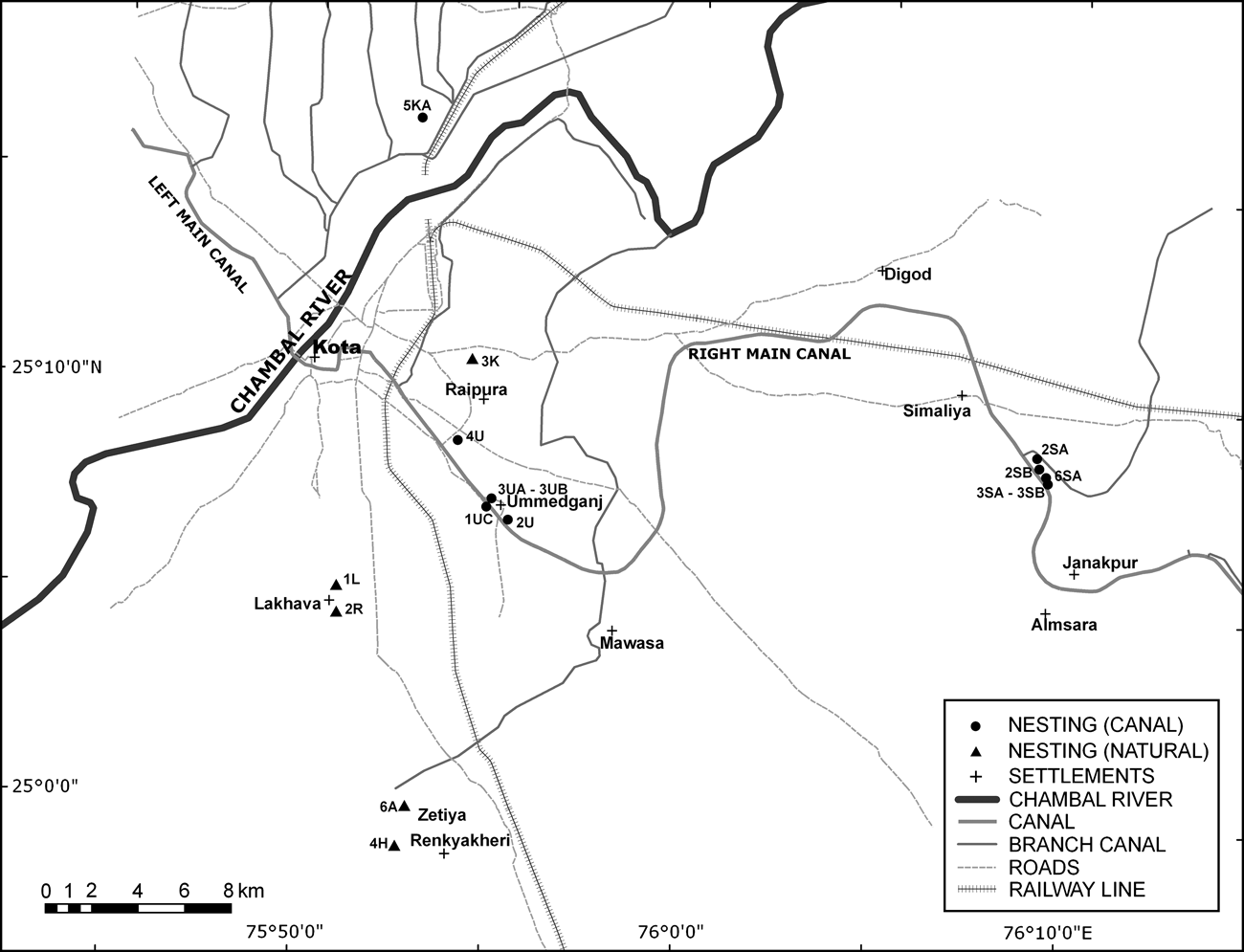
Kota district in Rajasthan has one of the largest reported breeding populations of sarus cranes and is one of the few places in India where the species can breed twice per year: in the wet season (July–October) and the dry season (February–May). This occurs because of the canalized system of the River Chambal (Vyas, Reference Vyas1999a,Reference Vyasb; J. Kaur, unpubl. data; Fig. 1). The canal is used to deliver water to the cooling plants of an electricity generation unit once every 15 days during the summer, which results in water flowing into the marshes along the canal. This causes the cranes to attempt a second breeding period. In a study during 1999–2002 disturbance by people was determined to be the greatest cause of egg mortality, with nests destroyed by children or removed by the itinerant labour force (Sundar et al., Reference Sundar, Kaur and Choudhury2000; Kaur & Choudhury, Reference Kaur and Choudhury2002, Reference Kaur and Choudhury2003a,Reference Kaur and Choudhuryb). In addition, feral and unmanaged dogs hunt down pre-fledged chicks (J. Kaur, pers. obs.). Reduction of breeding success following the destruction of eggs or killing of chicks could lead to local extinctions of slow-breeding species such as the sarus crane.
Locations of nesting sarus cranes in the study area in Kota district, Rajasthan, India (some points represent more than one nest). Nesting sites along natural wetlands are 1L (Lakawa), 2R (Ranpur), 3K (Kalatalab), 4H (Haripura) and 5KA (Keshoraipatan) and, along the canal, 1UC (Ummedganj-Dad Devi), 2U (Ummedganj-K. Palace), 3UA-3UB (Ummedganj-Overflow-I, II), 4U (Ummedganj-Sursagar), 3SA-SB (Sorsan-Dabur, Railgaon-I), 2SB (Sorsan-Railgaon-II), 2SA (Sorsan-Janakpur) and 6SA (Sorsan-Amalsara).
Meine & Archibald (Reference Meine and Archibald1996) suggested that wetland conservation should be integrated into village-based education and development programmes for preserving the habitat of the sarus crane in India. In the arid landscape of Rajasthan where water scarcity is a major concern, retention of minimum water levels in wetlands, and protection and management of these wetlands, are beneficial both for the sarus crane and for the people living in close proximity. Conservation action for the species is urgently required, including education and community development programmes (BirdLife International, 2001). Such activities are important for the sarus crane because it occurs mainly on private and community lands (Sundar et al., Reference Sundar, Kaur and Choudhury2000; Sundar & Choudhury, Reference Sundar and Choudhury2003). However, few activities have been implemented to raise awareness of the need to conserve the sarus cranes (Trivedi, Reference Trivedi2007), and no projects have previously been implemented to encourage the participation of local people in sarus crane conservation.
In an attempt to increase the breeding success of the cranes a preliminary education and awareness campaign was carried out in Kota during 2000–2002 (Kaur & Choudhury, Reference Kaur and Choudhury2003a). Farmers and villagers were approached personally and made aware of the need to protect crane nests, and printed postcards and pamphlets about the cranes were distributed in the community. Villagers and farmers were instrumental in protecting adult sarus cranes from poaching and were responsible for the successful fledging of a total of 19 hatchlings from 22 nests during the wet seasons of 2000 and 2001 (Table 1) but none during the dry season.
Numbers of sarus crane nests monitored and chicks successfully fledged during the wet and dry seasons of 2000 and 2001, the wet season of 2004 and the dry season of 2005. The total of 22 nests monitored in 2004–2005 included some of the same nests as in 2000–2001.

Building on the work carried out in 2000–2002 (Kaur & Choudhury, Reference Kaur and Choudhury2003a) we carried out further work in the same area in Kota from July 2004 to May 2005. Our aims were to conduct a more thorough awareness campaign for the sarus crane, with the involvement of local communities and NGOs, and to assess the impact of the campaign. Field visits to important sarus crane breeding sites were made every week during the breeding season. One thousand colour pamphlets and 500 postcards in local languages were printed for distribution in schools and villages. The pamphlets and postcards helped us obtain information from people about sarus crane nesting sites and juveniles, and reached people via their children in school or via friends and neighbours. People provided information by letter, phone, and in personal visits. The use of such printed postcards and pamphlets can be effective in gathering information from a wide area and from people who cannot be reached directly by any other means.
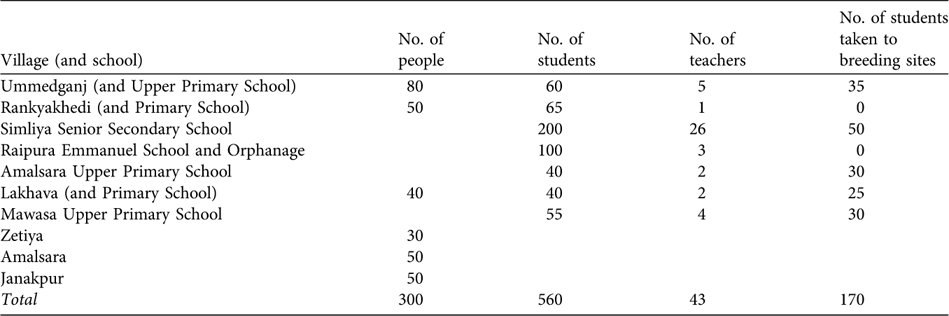
Audiovisual shows and lectures on the sarus crane, including a short documentary film explaining the breeding period, habitat, and development of the chicks, were undertaken with local NGOs (Table 2). The shows helped to dispel misconceptions regarding the crane's supposed destruction of crops, showed that its eggshells are ineffective for various health problems, increased people's knowledge of the species' breeding biology, and demonstrated the importance of the surrounding wetlands for the species. A quiz competition was conducted after the shows, and prizes were given to the winners. Schoolchildren living near breeding sites were taken to nesting sites (Table 2) and shown how to protect the nests and the chicks. To minimize the threat of nests being destroyed by farmers, letters were presented to the landowners of seven sites where sarus cranes were breeding, requesting the landowners to protect the cranes' nests.
The six villages in which people participated in the lectures and slide and film shows, with the approximate number of people participating, and the seven schools where slide and film shows were presented, with the numbers of students and teachers attending and the number of children that were subsequently taken to sarus crane breeding sites.
During the project we decided it was necessary to erect sign boards in important crane breeding sites to appeal to people whom we could not contact directly. A local school teacher volunteered to paint walls and sign boards. An interpretation board was installed at Ummedganj, a key breeding site for the sarus crane on the main canal of the river Chambal, and a painting was made at Janakpur on the outside wall of a house, and another at the Government Upper Primary School, Amalsara. Both these sites are situated on the way to the Great Indian Bustard Protected Area close to the canal. These paintings had information on the nesting of sarus cranes, information about the bird being farmer-friendly because it eats insects, that use of the bird's eggshell as medicine is harmful, and requesting further information regarding the sarus crane, with contact details of the researchers.
These interpretation boards and wall paintings were helpful in soliciting more information from villagers on an additional seven, previously unknown, sites comprising 23 adult and five juvenile sarus cranes. This simple method could be used as an effective model for gaining information on other species outside protected areas.
Sarus crane nests were monitored along the irrigation canal system in and around Kota city. During the field visits and awareness programmes villagers voluntarily came forward to form a total of 17 Rural Village Sarus Protection Groups. The responsibilities the Groups took on were the protection of eggs and juveniles from poaching and predation, and to ensure that during the nesting seasons the ponds and wetlands used by the sarus cranes were not disturbed. A total of 19 chicks successfully fledged from 22 nests in 2004-2005, including some in the dry season (Table 1).
Although many individuals were helpful during the crane nesting period, nine people made outstanding contributions. Following suggestions from national and local NGOs these enthusiasts were honoured with certificates and a bird identification book in the local language from the Indian Bird Conservation Network, Bombay Natural History Society, and the Indian Cranes and Wetlands Working Group. Local and national media highlighted the efforts of these volunteers (Anon., Reference Anon2005; Phatarphekar, Reference Phatarphekar2006), and journalists were taken to the breeding areas to learn about the work and meet the villagers whose efforts were helping to conserve the crane. The stories in the media motivated more people to come forward to provide information on sarus cranes from other sites.
Education is a vital part of any attempt to enforce legal protection for the sarus crane (Davis, Reference Davis1998), and for the long-term conservation of the species outside protected areas more community protection groups and education and awareness programmes will be required in other breeding areas. Development of an active network of farmers, village communities and NGOs will facilitate improved conservation of the species. Our experience with this project demonstrated that it is possible to re-establish a bond between farmers and nature, and work on community involvement for the sarus crane is continuing, with the involvement of more districts in Rajasthan.
Acknowledgements
We are grateful to the Oriental Bird Club, UK, for financing this project. We thank the GEER Foundation, Gandhinagar, Gujarat, for providing film on the sarus crane, Gopi Sundar for suggesting the writing of this paper and for comments on the manuscript, the Indian Cranes and Wetlands Working Group for assistance with literature, and Dr K. Ramesh and Nilanjana for preparing the figure.
Biographical sketches
Jatinder Kaur has conducted an all-India status survey of the sarus crane and research on the impact of changes in land use on the habitat, behaviour and breeding biology of the species in Rajasthan. Anil K. Nair is associated with local and national NGOs, and works on community participation projects for the conservation of various bird species in Rajasthan. His main interest is in awareness and education programmes tailored to specific needs. Professor B.C. Choudhury is head of the Endangered Species Management Department at the Wildlife Institute of India, Dehradhun. He began working on crocodiles in the mid 1970s, and since then has initiated conservation projects on other herpetofauna, wetlands and cranes.



