





1 A conception of truth (and determinateness)
In this work we offer a cluster of formal theories with unprecedented features and prove several results about them. The theories are accompanied by a conception of truth (and determinateness), which we outline in this introductory section.Footnote 1
1.1 Desiderata for truth
Following a long-standing tradition in formal theories of truth, starting at least with [Reference Kripke17], we believe that truth should be type-free; the truth predicate (provably) applies to sentences containing itself.
A type-free notion of truth, as it is well-known, calls for an account of the Liar and related paradoxes. We will shortly outline the solution implicit in our theories. Independently of the details, though, the view we put forward is strongly classical: not only the external logic of the theories should be classical, but we require the logic of their internal theoriesFootnote 2 to be classical as well. Our reasons for countenancing a classical external logic are the familiar ones. By endorsing a nonclassical theory of truth, one is bound to sever the links between the theory of truth and classical mathematics. This is a symptom of what McGee called ‘degradation of methodology’ [Reference McGee18, chap. 4]; the standards in one’s truth-theoretic theorizing shouldn’t be any lower than the ones employed in theorizing about core scientific subjects.Footnote 3
But, we argued, the logic of the internal theory should be classical as well. The truth predicate, in natural and formal languages, is used to express important general claims. To perform its generalization role in full, the truth predicate should be fully compositional, namely, commuting with all classical logical connectives, and without any type restrictions. Full compositionality is for instance required to establish the truth of the laws of our classical external logic, such as ‘all instances of the law of excluded middle are true’ [Reference Quine22]. Compositionality is also essential to capture logical inferences involving arbitrary sentences (or propositions), what [Reference Fujimoto12] calls blind deductions. For instance, to directly formalize the argument
Everything that Gerhard says about cut-elimination is true. David asserted the negation of some of Gerhard’s claims. Therefore, something David asserted is not true.
one requires commutation of truth with negation in fully quantified form (as well as no type restriction).
1.2 From significance to semantic (in)sensitivity
A type-free, strongly compositional notion of truth requires a principled account of how the truth predicate can self-apply sine contradictione. The naive principle
 $$ \begin{align} \text{for any } \varphi, `\varphi \text{ is true' is true iff } \varphi \text{ is true} \end{align} $$
is in fact inconsistent with the assumptions above. In their recent paper [Reference Fujimoto and Halbach13], Kentaro Fujimoto and Volker Halbach propose to restrict the principle (1) to what they call determinate sentences, while retaining a fully compositional truth predicate. The proposed restriction of (1), in turn, entails the restricted ${\mathrm {T}}$
-schema
${\mathrm {T}}$
-schema
 $$ \begin{align} \mathrm{D}\ulcorner A\urcorner\rightarrow ({\mathrm{T}}\ulcorner A\urcorner\leftrightarrow A), \end{align} $$
where $\mathrm {D}$
is a determinateness predicate.
$\mathrm {D}$
is a determinateness predicate.
Several theories satisfying (2) can be found in the context of Kripke–Feferman truth. Well-known examples are Feferman’s $\mathsf {KF}$
and
$\mathsf {KF}$
and $\mathsf {DT}$
—from [Reference Feferman5, Reference Feferman6], respectively. Such theories rely on a Russellian notion of range of significance for the interpretation of D, which in the context of Feferman’s theories can be further analyzed as the sentences which possess a classical truth value relative to the intended semantics:
$\mathsf {DT}$
—from [Reference Feferman5, Reference Feferman6], respectively. Such theories rely on a Russellian notion of range of significance for the interpretation of D, which in the context of Feferman’s theories can be further analyzed as the sentences which possess a classical truth value relative to the intended semantics:
I agree with Russell (1908) that every predicate has a domain of significance, and it makes sense to apply the predicate only to objects in that domain. In the case of truth, that domain D consists of the sentences that are meaningful and determinate, that is, have a definite truth value, true or false. D includes various but not necessarily all grammatically correct sentences that involve the notion of truth itself [Reference Feferman6, p. 206].
A similar picture is endorsed by Reinhardt, in [Reference Reinhardt23, Reference Reinhardt24], who labels classically true or false sentences ‘significant’. A well-known feature of the restriction of the ${\mathrm {T}}$
-schema to determinate sentences, already extensively discussed in [Reference Reinhardt24],Footnote
4
is that any such restriction would entail the existence of sentences that are provable and yet (provably) not determinate.
${\mathrm {T}}$
-schema to determinate sentences, already extensively discussed in [Reference Reinhardt24],Footnote
4
is that any such restriction would entail the existence of sentences that are provable and yet (provably) not determinate.
Fujimoto and Halbach, however, reject the Russellian view and claim that truth can be (provably) applied to sentences that are not determinate. They suggest moving from the notions of range of significance to a notion of semantic sensitivity: ‘some sentences, including liar sentences, are sensitive to the addition of another layer of truth. Stacking an additional layer of truth onto the liar sentence will change its semantic status; but that does not mean that the truth predicate cannot meaningfully be applied to it’ [Reference Fujimoto and Halbach13, p. 256]. The shift from ‘significance’ to ‘sensitivity’ has the effect of weakening the Reinhardt–Bacon issue; it is not problematic to prove sentences that are (provably) semantically sensitive.
The shift from significance to semantic sensitivity is, in our view, a valuable step forward. Fujimoto and Halbach, however, only devote a few remarks to the notion. We sketch below our own interpretation of semantic sensitivity in the context of type-free truth, and employ it to highlight the benefits of the theories proposed in the paper.
Another distinctive feature of Fujimoto and Halbach’s account is that determinateness cannot be explained in terms of truth. Their theories feature a primitive determinateness predicate as well as a primitive truth predicate. Fujimoto and Halbach suggest that this has to be so; in discussing Feferman’s notion of determinateness from [Reference Feferman6], they write ‘[Feferman] took D as definable in terms of truth by stipulating $\mathrm {D} x :\leftrightarrow {\mathrm {T}} x \vee \mathrm {F} x$
; but this definition does not yield the desired properties of D in our theory and we consequently introduce determinateness as primitive notion’ [Reference Fujimoto and Halbach13, p. 257].
$\mathrm {D} x :\leftrightarrow {\mathrm {T}} x \vee \mathrm {F} x$
; but this definition does not yield the desired properties of D in our theory and we consequently introduce determinateness as primitive notion’ [Reference Fujimoto and Halbach13, p. 257].
As some of our results will indicate, the primitive nature of the determinateness predicate significantly complicates the semantic analysis of the truth-theoretic language. Fortunately, as we will show, virtually all of the theoretical benefits sought for by Fujimoto and Halbach can be met by defining determinateness in terms of truth.
1.3 Logic and semantics
A formal theory of type-free truth plays, in our account, a double role. It provides general laws for truth that are used in several theoretical contexts, including semantic theorizing. As a result of the discussion above, these must include compositional axioms in combination with classical (external and internal) logic. In addition, the theory of truth provides a formalization of clear semantic rules to be applied to a well-defined and sufficiently comprehensive class of sentences of the (type-free) truth-theoretic language. Because of paradox, such rules may not coincide with the classical semantic rules. We will see that this is precisely what the theories introduced below will be able to achieve.
The semantic rules that we identify involve decomposition of semantic values according to the familiar Strong-Kleene truth conditions, including full disquotation for the truth predicate. In the class of models we privilege, the natural collection of sentences to which these rules unrestrictedly apply are the Kripke-determinate ones, that is sentences that are in the extension of the relevant consistent fixed-point model in the sense of [Reference Kripke17].Footnote
5
Relative to each such model, these are the determinate sentences, and the ${\mathrm {T}}$
-schema holds unrestrictedly for them. Relative to the minimal fixed point, the determinate sentences are simply the grounded ones.
${\mathrm {T}}$
-schema holds unrestrictedly for them. Relative to the minimal fixed point, the determinate sentences are simply the grounded ones.
As a consequence, just like in Fujimoto and Halbach’s picture, the determinate sentences are semantically insensitive in the sense that their semantic status is not affected by one or more iteration of the truth predicate on the sentence. However, unlike what happens in Fujimoto and Halbach’s theory, we can provide fully general and uniform semantic rules for the semantic analysis of the language with a type-free truth predicate. As the results of §3 will establish, such clearly defined rules cannot be found in Fujimoto and Halbach’s approach.
The logical role of truth is fulfilled, in our framework, primarily by full compositional principles. These cannot be semantically insensitive, as they are quantified sentences with instances that cannot be determinate. In fact, one of the novel features of our approach is the uniform combination of Kripkean fixed-point semantics with full compositionality. This is achieved by a move that we call classical closure of Kripkean truth. Formally, this prescribes that the extension of the truth predicate contain the sentences that are satisfied by the relevant closed-off fixed-point model. Conceptually, it demands that the truth-theorist engaged in semantic theorizing fully embrace the generalizing power afforded by the truth predicate.
It is worth noting that, as a direct consequence of full compositionality, some sentences happen to be in the extension of the classical closure of Kripkean truth only in virtue of the generalizing role of truth. This is for instance the case of classical logical truths. Take, e.g., the sentence $\lambda \vee \neg \lambda $
for
$\lambda \vee \neg \lambda $
for $\lambda $
a liar sentence. The sentence is true, but any further iteration of truth on it cannot be.
$\lambda $
a liar sentence. The sentence is true, but any further iteration of truth on it cannot be.
Ultimately, we are focusing on the classical models resulting from taking the classical closure of consistent fixed points as extension of the truth predicate. Given the set up, full compositional axioms will be satisfied in such models. Moreover, since the determinate sentences can be readily defined as the ones that are recognized as true or false (i.e., have a true negation) in the classical closure of Kripkean truth, a sentence will be determinate precisely when the sentence stating that it is true or false is itself true in the model. The model thus provides a strongly classical environment for the study of a traditional notion of determinateness.
1.4 Axiomatization and $\mathbb {N}$
-categoricity
$\mathbb {N}$
-categoricity

The paper is primarily concerned with axiomatic theories of truth capturing the intended semantics just sketched. Without axiomatization, semantic constructions are typically hard to pin down. Especially in the context of classical theories, a robust sense in which an axiomatic theory captures a semantic construction is given by the notion of $\mathbb {N}$
-categoricity introduced by [Reference Fischer, Halbach, Stern and Jönne9]. Let
$\mathbb {N}$
-categoricity introduced by [Reference Fischer, Halbach, Stern and Jönne9]. Let $\mathscr {E}\subseteq \mathscr {P}(\omega )$
be a collection of extensions of the truth predicate; a theory
$\mathscr {E}\subseteq \mathscr {P}(\omega )$
be a collection of extensions of the truth predicate; a theory $T\ \mathbb {N}$
-categorically axiomatizes
$T\ \mathbb {N}$
-categorically axiomatizes $\mathscr {E}$
just in case
$\mathscr {E}$
just in case
 $$\begin{align*}(\mathbb{N},S)\vDash T\text{ iff } S\in \mathscr{E}. \end{align*}$$
Another remarkable feature of the theories we introduce in the paper is that they turn out to be $\mathbb {N}$
-categorical with respect to the models described in the previous section. Specifically, a structure
$\mathbb {N}$
-categorical with respect to the models described in the previous section. Specifically, a structure $(\mathbb {N},S)$
models our theories if and only if S is the classical closure of a consistent Kripkean fixed point. The
$(\mathbb {N},S)$
models our theories if and only if S is the classical closure of a consistent Kripkean fixed point. The $\mathbb {N}$
-categoricity of our theories marks another key difference with Fujimoto and Halbach’s approach afforded by the defined determinateness predicate. As the results below will indicate, while some models of Fujimoto and Halbach’s theories are akin to the classical closure of Kripkean truth, some others are not.
$\mathbb {N}$
-categoricity of our theories marks another key difference with Fujimoto and Halbach’s approach afforded by the defined determinateness predicate. As the results below will indicate, while some models of Fujimoto and Halbach’s theories are akin to the classical closure of Kripkean truth, some others are not.
Therefore, there is a precise sense in which the conception of truth outlined in this section—and embodied in the class of $\omega $
-models just described—corresponds to the laws of truth we propose and study in the paper.
$\omega $
-models just described—corresponds to the laws of truth we propose and study in the paper.
1.5 Summary of the main results
From the technical side, we study theories that are closely related to the ones studied by Fujimoto and Halbach in their [Reference Fujimoto and Halbach13], but with important differences that will be highlighted in due course. Fujimoto and Halbach mainly focus on two systems, CD and $\mathsf {CD}^{+}$
(see Definition 1).
$\mathsf {CD}^{+}$
(see Definition 1). $\mathsf {CD}^{+}$
is obtained by strengthening the axiom
$\mathsf {CD}^{+}$
is obtained by strengthening the axiom
 $$ \begin{align} \forall t(\mathrm{D} {t}^{\circ}\rightarrow {\mathrm{T}}\mathrm{D} t) \end{align} $$
of CD with the (plausible) biconditional
 $$\begin{align} \forall t(\mathrm{D} {t}^{\circ}\leftrightarrow {\mathrm{T}}\mathrm{D} t). \end{align} $$
As we will explain shortly, in the paper we focus exclusively on $\mathsf {CD}^{+}$
. Here is a summary of the main results.
$\mathsf {CD}^{+}$
. Here is a summary of the main results.
-
(a) We introduce a theory of truth,
$\mathsf {CD}^{+}_{\mathrm {T}}$
, whose axioms are the axioms of
$\mathsf {CD}^{+}$
except that the determinateness predicate
$\mathrm {D} x$
is defined as
${\mathrm {T}}{\mathrm {T}} x\vee {\mathrm {T}}\mathrm {F} x$
(Definition 7). We show that the theory is consistent by displaying a natural class of
$\omega $
-models for it (Proposition 10), and that the theory is mutually reducible, in a strong sense, with
$\mathsf {CD}^{+}$
. -
(b) We show that
$\mathsf {CD}^{+}_{\mathrm {T}}$
can be reaxiomatized as what we will call
$\mathsf {KF}$
’s classical closure (
$\mathsf {CKF}_{\mathsf {cs}}$
, Definition 15), i.e., the fully compositional theory of type-free truth (with no axioms for determinateness) obtained by axiomatizing
$\mathsf {KF} +\mathsf {CONS}$
within the scope of a truth predicate satisfying unrestricted compositional principles (Proposition 25). A particularly nice feature of
$\mathsf {CKF}_{\mathsf {cs}}$
(and hence of
$\mathsf {CD}^{+}_{\mathrm {T}}$
) is its
$\mathbb {N}$
-categoricity with respect to the classical closures of consistent Kripkean fixed points (Proposition 21). This feature is not available for
$\mathsf {CD}^{+}$
. -
(c) While studying
$\mathsf {CD}^{+}_{\mathrm {T}}$
and
$\mathsf {CKF}_{\mathsf {cs}}$
, we provide additional results on both theories CD and
$\mathsf {CD}^{+}$
: we show that they cannot prove most of the key axioms of
$\mathsf {CKF}_{\mathsf {cs}}$
; some of these axioms were proved to be conservative over
$\mathsf {CD}^{+}$
in [Reference Fujimoto and Halbach13]. Our results show that the behaviour of CD and
$\mathsf {CD}^{+}$
’s truth predicate, while fully classical and compositional on the surface, becomes highly irregular within two or more layers of truth. -
(d) We show that our results are stable under a dual definition of
$\mathrm {D} x$
, which is suitable for a complete (but not consistent) truth predicate. Specifically, we introduce the theory
$\mathsf {CD}^{+}_{\mathrm {T}}[\mathsf {COMP}]$
, whose axioms are those of
$\mathsf {CD}^{+}$
except that
$\mathrm {D} x$
is defined as
$\neg {\mathrm {T}}{\mathrm {T}} x\vee \neg {\mathrm {T}}\mathrm {F} x$
, and show that it is mutually reducible with
$\mathsf {CD}^{+}$
. We also show that
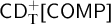
$\mathsf {CD}^{+}_{\mathrm {T}}[\mathsf {COMP}]$
can be reaxiomatized as the classical closure of
$\mathsf {KF} +\mathsf {COMP}$
.






The reason for focusing on $\mathsf {CD}^{+}$
is that the natural class of models referred to in (a) and the axiomatizations mentioned in (b)–(d) license all principles of
$\mathsf {CD}^{+}$
is that the natural class of models referred to in (a) and the axiomatizations mentioned in (b)–(d) license all principles of $\mathsf {CD}^{+}$
.Footnote
6
$\mathsf {CD}^{+}$
.Footnote
6
1.6 Technical preliminaries
We work over the language of arithmetic $\mathcal {L}_{\mathbb {N}}$
, which extends the standard signature
$\mathcal {L}_{\mathbb {N}}$
, which extends the standard signature $\{\overline {0},\mathrm {S},+,\times \}$
with finitely many function symbols for elementary syntactic operations (see the next paragraph for more details). Let
$\{\overline {0},\mathrm {S},+,\times \}$
with finitely many function symbols for elementary syntactic operations (see the next paragraph for more details). Let ${{\mathcal {L}}_{\mathrm {T}}:=\mathcal {L}_{\mathbb {N}}\cup \{{\mathrm {T}}\}}$
and
${{\mathcal {L}}_{\mathrm {T}}:=\mathcal {L}_{\mathbb {N}}\cup \{{\mathrm {T}}\}}$
and $\mathcal {L}_{\mathrm {D}}:={\mathcal {L}}_{\mathrm {T}}\cup \{\mathrm {D}\}$
, where
$\mathcal {L}_{\mathrm {D}}:={\mathcal {L}}_{\mathrm {T}}\cup \{\mathrm {D}\}$
, where ${\mathrm {T}}$
and D are unary truth and determinateness predicates, respectively. We fix a canonical Gödel numbering of
${\mathrm {T}}$
and D are unary truth and determinateness predicates, respectively. We fix a canonical Gödel numbering of $\mathcal {L}_{\mathrm {D}}$
-expressions and a formalization of syntactic notions and operations as it can be found, for instance, in [Reference Hájek and Pudlák14]. Following standard practice, we take Peano arithmetic to be the first-order theory in which this formalization is carried out, although of course much weaker systems would suffice. We write
$\mathcal {L}_{\mathrm {D}}$
-expressions and a formalization of syntactic notions and operations as it can be found, for instance, in [Reference Hájek and Pudlák14]. Following standard practice, we take Peano arithmetic to be the first-order theory in which this formalization is carried out, although of course much weaker systems would suffice. We write $\mathsf {PAT}$
for the theory obtained by formulating the axiom of
$\mathsf {PAT}$
for the theory obtained by formulating the axiom of $\mathsf {PA}$
in the expanded language
$\mathsf {PA}$
in the expanded language ${\mathcal {L}}_{\mathrm {T}}$
.
${\mathcal {L}}_{\mathrm {T}}$
.
The additional function symbols of $\mathcal {L}_{\mathbb {N}}$
include a symbol for the standard numeral function
$\mathcal {L}_{\mathbb {N}}$
include a symbol for the standard numeral function $\mathrm {num}(x)$
sending a number to the code of its numeral. A standard dot-notation to denote such symbols:
$\mathrm {num}(x)$
sending a number to the code of its numeral. A standard dot-notation to denote such symbols:

Using the conventions above, we define falsity as true negation, that is,  . We also take the following $\mathcal {L}_{\mathbb {N}}$
-predicates to abbreviate the equations for the (elementary) characteristic function for such sets:
$\mathcal {L}_{\mathbb {N}}$
-predicates to abbreviate the equations for the (elementary) characteristic function for such sets:
-
$\mathrm {Term}(x) \ (\mathrm {Cterm}(x)) := x$
is the Gödel number of a (closed) term;
-
$\mathrm {Fml}_{{\mathcal {L}}}^n(x) \ \ (\mathrm {Sent}_{{\mathcal {L}}}(x)) := x$
is the Gödel number of an
${\mathcal {L}}$
-formula with at most
$n \ (0)$
free distinct variables.


As in Halbach’s monograph [Reference Halbach16], we will employ a functional notation ${x}^{\circ }$
abbreviating the formula representing in
${x}^{\circ }$
abbreviating the formula representing in $\mathcal {L}_{\mathbb {N}}$
the evaluation function for closed terms of
$\mathcal {L}_{\mathbb {N}}$
the evaluation function for closed terms of $\mathcal {L}_{\mathbb {N}}$
and is such that
$\mathcal {L}_{\mathbb {N}}$
and is such that ${\ulcorner t\urcorner }^{\circ } = t$
for closed terms t.
${\ulcorner t\urcorner }^{\circ } = t$
for closed terms t.
Roman uppercase letters $A, B, C,\ldots $
range over formulae of
$A, B, C,\ldots $
range over formulae of $\mathcal {L}_{\mathrm {D}}$
. Greek lowercase letters
$\mathcal {L}_{\mathrm {D}}$
. Greek lowercase letters $\varphi ,\psi ,\xi ,\ldots $
will be used to abbreviate quantification over formal sentences, while
$\varphi ,\psi ,\xi ,\ldots $
will be used to abbreviate quantification over formal sentences, while $\varphi (v),\psi (v),\xi (v),\ldots $
will be used to abbreviate quantification over formal formulae with at most
$\varphi (v),\psi (v),\xi (v),\ldots $
will be used to abbreviate quantification over formal formulae with at most $v$
free. Also, for the sake of readability, we suppress codes, dots, and Quine corners when there is no danger of confusion. Similar conventions apply to
$v$
free. Also, for the sake of readability, we suppress codes, dots, and Quine corners when there is no danger of confusion. Similar conventions apply to ${\mathcal {L}}_{\mathrm {T}}$
. The expression
${\mathcal {L}}_{\mathrm {T}}$
. The expression $e(t/v_k)$
, sometimes abbreviated as
$e(t/v_k)$
, sometimes abbreviated as $e(t)$
, represents the syntactic substitution of a term t for a variable
$e(t)$
, represents the syntactic substitution of a term t for a variable $v_k$
in an expression e. So, for example, the expressions
$v_k$
in an expression e. So, for example, the expressions
 $$ \begin{align*} & (\forall\varphi,\psi\colon \mathcal{L}_{\mathrm{D}}) ({\mathrm{T}}(\varphi\land\psi) \leftrightarrow{\mathrm{T}}\varphi\land{\mathrm{T}}\psi)\\ & \forall t ({\mathrm{T}}{\mathrm{T}} t\rightarrow {\mathrm{T}} t^\circ)\\ & (\forall \varphi(v)\colon \mathcal{L}_{\mathrm{D}}) ({\mathrm{T}}(\forall v\varphi)\leftrightarrow \forall t\,{\mathrm{T}}\varphi(t/v)) \end{align*} $$
are short for, respectively,

We will also write $A\in X$
instead of
$A\in X$
instead of $\#A\in X$
or, for t ranging over closed terms,
$\#A\in X$
or, for t ranging over closed terms, ${\mathrm {T}}{\mathrm {T}}{\mathrm {T}} t$
instead of
${\mathrm {T}}{\mathrm {T}}{\mathrm {T}} t$
instead of  , etc.
We use standard notions of relative translation and relative interpretation as it can be found, for instance, in [Reference Halbach16, Reference Visser, Enayat, Kalantari and Moniri27]. We use the notions of $\mathcal {L}_{\mathbb {N}}$
-translations and
$\mathcal {L}_{\mathbb {N}}$
-translations and $\mathcal {L}_{\mathbb {N}}$
-interpretations: an
$\mathcal {L}_{\mathbb {N}}$
-interpretations: an $\mathcal {L}_{\mathbb {N}}$
-translation is a translation between theories in
$\mathcal {L}_{\mathbb {N}}$
-translation is a translation between theories in $\mathcal {L}_1, \mathcal {L}\supseteq \mathcal {L}_{\mathbb {N}}$
which does not relativize quantifiers and collapses into the identity function when restricted to
$\mathcal {L}_1, \mathcal {L}\supseteq \mathcal {L}_{\mathbb {N}}$
which does not relativize quantifiers and collapses into the identity function when restricted to $\mathcal {L}_{\mathbb {N}}$
. An
$\mathcal {L}_{\mathbb {N}}$
. An $\mathcal {L}_{\mathbb {N}}$
-interpretation is an
$\mathcal {L}_{\mathbb {N}}$
-interpretation is an $\mathcal {L}_{\mathbb {N}}$
-translation that preserves provability in the standard way. Indeed, the special case of
$\mathcal {L}_{\mathbb {N}}$
-translation that preserves provability in the standard way. Indeed, the special case of $\mathcal {L}_{\mathbb {N}}$
-interpretability in which
$\mathcal {L}_{\mathbb {N}}$
-interpretability in which $\mathcal {L}_1, \mathcal {L}\supseteq \mathcal {L}_{\mathbb {N}}$
expand the arithmetical signature with truth predicates is the notion of truth definability in the sense of [Reference Fujimoto11].
$\mathcal {L}_1, \mathcal {L}\supseteq \mathcal {L}_{\mathbb {N}}$
expand the arithmetical signature with truth predicates is the notion of truth definability in the sense of [Reference Fujimoto11].
2
$\mathsf {CD}^{+}$

Fujimoto and Halbach introduce the theory $\mathsf {CD}^{+}$
in [Reference Fujimoto and Halbach13].
$\mathsf {CD}^{+}$
in [Reference Fujimoto and Halbach13].
Definition 1. $\mathsf {CD}^{+}$
consists of the following extension of
$\mathsf {CD}^{+}$
consists of the following extension of $\mathsf {PA}$
in the language
$\mathsf {PA}$
in the language $\mathcal {L}_{\mathrm {D}}$
(where D and
$\mathcal {L}_{\mathrm {D}}$
(where D and ${\mathrm {T}}$
are allowed to appear in induction):
${\mathrm {T}}$
are allowed to appear in induction):
 $$ \begin{align} &\forall s\forall t({\mathrm{T}}(s = t) \leftrightarrow {s}^{\circ}={t}^{\circ}) \end{align} $$
 $$\begin{align} &\forall t (\mathrm{D}{t}^{\circ}\leftrightarrow {\mathrm{T}} \mathrm{D} t) \end{align}$$
 $$ \begin{align} &\forall t(\mathrm{D}{t}^{\circ}\rightarrow ({\mathrm{T}} {\mathrm{T}} t\leftrightarrow {\mathrm{T}} {t}^{\circ})) \end{align} $$
 $$ \begin{align} &(\forall \varphi\colon \mathcal{L}_{\mathrm{D}}) ({\mathrm{T}}(\neg \varphi)\leftrightarrow \neg {\mathrm{T}}\varphi) \end{align} $$
 $$ \begin{align} &(\forall \varphi,\psi\colon \mathcal{L}_{\mathrm{D}}) ({\mathrm{T}}(\varphi\land \psi)\leftrightarrow {\mathrm{T}}\varphi\land {\mathrm{T}}\psi) \end{align} $$
 $$ \begin{align} &(\forall \varphi(v)\colon \mathcal{L}_{\mathrm{D}}) ({\mathrm{T}}(\forall v\varphi)\leftrightarrow \forall t\,{\mathrm{T}}\varphi(t/v)) \end{align} $$
 $$ \begin{align} &\forall s\forall t \,\mathrm{D}(s =t) \end{align} $$
 $$ \begin{align} &\forall t (\mathrm{D}{\mathrm{T}} t\leftrightarrow \mathrm{D}{t}^{\circ}) \end{align} $$
 $$ \begin{align} &\forall t(\mathrm{D} \mathrm{D} t\leftrightarrow \mathrm{D}{t}^{\circ}) \end{align} $$
 $$ \begin{align} &(\forall \varphi\colon\mathcal{L}_{\mathrm{D}})(\mathrm{D}(\neg \varphi)\leftrightarrow \mathrm{D}\varphi) \end{align} $$
 $$ \begin{align} &(\forall \varphi,\psi\colon \mathcal{L}_{\mathrm{D}}) \big(\mathrm{D}(\varphi\land\psi)\leftrightarrow ((\mathrm{D} \varphi\land \mathrm{D} \psi)\vee (\mathrm{D}\varphi\land {\mathrm{T}}\neg\varphi)\vee(\mathrm{D} \psi\land {\mathrm{T}}\neg\psi))\big) \end{align} $$
 $$ \begin{align} &(\forall \varphi(v)\colon\mathcal{L}_{\mathrm{D}}) (\mathrm{D}(\forall v\varphi)\leftrightarrow (\forall t \,\mathrm{D}\varphi(t/v)\vee \exists t \,\mathrm{D}\varphi(t/v)\land {\mathrm{T}}\neg\varphi(t/v)). \end{align} $$
 $$ \begin{align} &(\forall \varphi(v)\colon \mathcal{L}_{\mathrm{D}})\forall s\forall t\big({s}^{\circ}= {t}^{\circ} \rightarrow ({\mathrm{T}}\varphi(s) \leftrightarrow {\mathrm{T}}\varphi(t))\big)\end{align} $$
 $$ \begin{align} &(\forall \varphi(v)\colon \mathcal{L}_{\mathrm{D}})\forall s\forall t\big({s}^{\circ}= {t}^{\circ} \rightarrow (\mathrm{D}\varphi(s) \leftrightarrow \mathrm{D}\varphi(t))\big). \end{align} $$
Fujimoto and Halbach establish the consistency of $\mathsf {CD}^{+}$
—and, of course, of CD—by exhibiting an
$\mathsf {CD}^{+}$
—and, of course, of CD—by exhibiting an $\omega $
-model. Since the construction will be relevant later on, we repeat it here. Let
$\omega $
-model. Since the construction will be relevant later on, we repeat it here. Let $\mathcal {D}(x)$
be the positive inductive definition associated with the (right-to-left direction) of the D-axioms
$\mathcal {D}(x)$
be the positive inductive definition associated with the (right-to-left direction) of the D-axioms $\mathrm {D}1$
–
$\mathrm {D}1$
– $\mathrm {D}6$
[Reference Fujimoto and Halbach13, sec. 4]. Let
$\mathrm {D}6$
[Reference Fujimoto and Halbach13, sec. 4]. Let
 $$\begin{align*}\Gamma_Y(X)=\{ n \;|\; (\mathbb{N},X,Y)\vDash \mathcal{D}(\overline{n})\}, \end{align*}$$
and define
 $$ \begin{align*} &D_0:=\varnothing&& T_0:=\varnothing\\ &D_{\alpha+1}:=\Gamma_{T_\alpha}(D_\alpha)&& T_{\alpha+1}:=\{A \in \mathcal{L}_{\mathrm{D}}\;|\; (\mathbb{N},D_\alpha,T_\alpha)\vDash A\}\\ &D_\lambda:=\bigcup_{\beta<\lambda} D_\beta &&T_\lambda :=\bigcup_{\beta<\lambda} \big( D_\beta\cap T_\beta\big). \end{align*} $$
Then $D_{\omega _1}$
is a fixed point of
$D_{\omega _1}$
is a fixed point of $\Gamma _{T_{\omega _1}}$
. Let us denote
$\Gamma _{T_{\omega _1}}$
. Let us denote $D_{\omega _1}$
and
$D_{\omega _1}$
and $T_{\omega _1}$
by
$T_{\omega _1}$
by $D_\infty $
and
$D_\infty $
and $T_\infty $
, respectively. Let:
$T_\infty $
, respectively. Let:
 $$\begin{align*}\mathbb T_\infty=\{ A\in \mathcal{L}_{\mathrm{D}} \;|\; (\mathbb{N}, D_\infty,T_\infty)\vDash A\}. \end{align*}$$
Lemma 2 [Reference Fujimoto and Halbach13, theorem 4.8]. $(\mathbb {N}, D_\infty ,\mathbb T_\infty )\vDash \mathsf {CD}^{+}$
.
$(\mathbb {N}, D_\infty ,\mathbb T_\infty )\vDash \mathsf {CD}^{+}$
.
The proof-theoretic analysis of $\mathsf {CD}^{+}$
is quite straightforward. It reduces the system to a theory resulting from a combination of typed truth with standard Kripke–Feferman systems. It employs
$\mathsf {CD}^{+}$
is quite straightforward. It reduces the system to a theory resulting from a combination of typed truth with standard Kripke–Feferman systems. It employs $\mathsf {CT[KF+CONS]}$
, which is the result of enriching the Kripke–Feferman theory with consistency with a typed, Tarskian truth predicate
$\mathsf {CT[KF+CONS]}$
, which is the result of enriching the Kripke–Feferman theory with consistency with a typed, Tarskian truth predicate $\mathbf {T}$
on top, but a version of
$\mathbf {T}$
on top, but a version of $\mathsf {KF}$
with the completeness axiom would work as well.
$\mathsf {KF}$
with the completeness axiom would work as well.
Definition 3. $\mathsf {KF}$
is the system in
$\mathsf {KF}$
is the system in ${\mathcal {L}}_{\mathrm {T}}$
extending
${\mathcal {L}}_{\mathrm {T}}$
extending $\mathsf {PAT}$
with the following axioms:
$\mathsf {PAT}$
with the following axioms:
 $$\begin{align} & \forall s\forall t({\mathrm{T}}(s=t)\leftrightarrow {s}^{\circ}={t}^{\circ})\land \forall s\forall t({\mathrm{T}}(s\neq t)\leftrightarrow {s}^{\circ}\neq {t}^{\circ}) \end{align}$$
 $$\begin{align} & \forall t ({\mathrm{T}}{\mathrm{T}} t\leftrightarrow {\mathrm{T}}{t}^{\circ})\land \forall t (\mathrm{F}{\mathrm{T}} t\leftrightarrow \mathrm{F}{t}^{\circ}\vee\neg \mathrm{Sent}({t}^{\circ})) \end{align}$$
 $$\begin{align} &(\forall \varphi\colon {\mathcal{L}}_{\mathrm{T}})(\mathrm{F} \neg \varphi\leftrightarrow {\mathrm{T}}\varphi) \end{align}$$
 $$\begin{align} & (\forall \varphi,\psi\colon {\mathcal{L}}_{\mathrm{T}})(({\mathrm{T}}(\varphi\land \psi)\leftrightarrow {\mathrm{T}}\varphi\land {\mathrm{T}}\psi)\land (\mathrm{F}(\varphi\land \psi)\leftrightarrow \mathrm{F}\varphi \vee \mathrm{F}\psi)) \end{align}$$
 $$\begin{align} & (\forall \varphi(v)\colon {\mathcal{L}}_{\mathrm{T}})\big(({\mathrm{T}}(\forall v\varphi)\leftrightarrow \forall t \,{\mathrm{T}}\varphi(t/v))\land ({\mathrm{T}}(\exists v\varphi)\leftrightarrow \exists t\,{\mathrm{T}}\varphi(t/v))\big). \end{align}$$ $\mathsf {KF+CONS}$
is obtained by adding to
$\mathsf {KF+CONS}$
is obtained by adding to $\mathsf {KF}$
the axiom
$\mathsf {KF}$
the axiom
 $$\begin{align} & (\forall \varphi\colon {\mathcal{L}}_{\mathrm{T}})(\mathrm{F} \varphi \rightarrow \neg {\mathrm{T}}\varphi); \end{align}$$ $\mathsf {KF+COMP}$
is obtained by adding to
$\mathsf {KF+COMP}$
is obtained by adding to $\mathsf {KF}$
the converse claim
$\mathsf {KF}$
the converse claim
 $$\begin{align} & (\forall \varphi \colon {\mathcal{L}}_{\mathrm{T}})(\neg{\mathrm{T}}\varphi \rightarrow \mathrm{F} \varphi). \end{align}$$
Definition 4 (
$\mathsf {CT[KF+CONS]}$
).

We expand ${\mathcal {L}}_{\mathrm {T}}$
with an additional truth predicate
${\mathcal {L}}_{\mathrm {T}}$
with an additional truth predicate $\mathbf {T}$
and call the resulting language
$\mathbf {T}$
and call the resulting language $\mathcal {L}_{{\mathrm {T}},\mathbf {T}}$
.
$\mathcal {L}_{{\mathrm {T}},\mathbf {T}}$
. $\mathsf {CT[KF+CONS]}$
is the theory in
$\mathsf {CT[KF+CONS]}$
is the theory in $\mathcal {L}_{{\mathrm {T}},\mathbf {T}}$
extending
$\mathcal {L}_{{\mathrm {T}},\mathbf {T}}$
extending $\mathsf {KF}+\mathsf {CONS}$
with the following axioms:
$\mathsf {KF}+\mathsf {CONS}$
with the following axioms:
 $$\begin{align} & (\mathbf{T}(s=t)\leftrightarrow {s}^{\circ}={t}^{\circ})\land \mathbf{T}{\mathrm{T}} t\leftrightarrow {\mathrm{T}} {t}^{\circ} \end{align}$$
 $$\begin{align} & (\forall \varphi\colon {\mathcal{L}}_{\mathrm{T}})(\mathbf{T}(\neg \varphi)\leftrightarrow \neg \mathbf{T}\varphi) \end{align}$$
 $$\begin{align} & (\forall \varphi,\psi \colon {\mathcal{L}}_{\mathrm{T}})(\mathbf{T}(\varphi\land \psi)\leftrightarrow \mathbf{T}\varphi \land \mathbf{T}\psi) \end{align}$$
 $$\begin{align} &(\forall \varphi(v)\colon {\mathcal{L}}_{\mathrm{T}})(\mathbf{T}(\forall v\varphi)\leftrightarrow \forall t \,\mathbf{T}(\varphi(t/v))). \end{align}$$
We assume a standard notation for ordinals below the Feferman–Schütte ordinal $\Gamma _0$
(see, e.g., [Reference Pohlers20, chap. 2]). In particular, we denote with
$\Gamma _0$
(see, e.g., [Reference Pohlers20, chap. 2]). In particular, we denote with $\varepsilon _\alpha $
the (code of) the
$\varepsilon _\alpha $
the (code of) the $\alpha ^{th}$
fixed point of the function
$\alpha ^{th}$
fixed point of the function $\lambda x.\,\omega ^x$
.
$\lambda x.\,\omega ^x$
.
Lemma 5 [Reference Fujimoto and Halbach13, theorem 7.12]. $\mathsf {CD}^{+}$
is mutually
$\mathsf {CD}^{+}$
is mutually $\mathcal {L}_{\mathbb {N}}$
-interpretable with
$\mathcal {L}_{\mathbb {N}}$
-interpretable with $\mathsf {CT[KF+CONS]}$
, and therefore with ramified truth/analysis up to any
$\mathsf {CT[KF+CONS]}$
, and therefore with ramified truth/analysis up to any $\alpha <\varepsilon _{\varepsilon _0}$
.
$\alpha <\varepsilon _{\varepsilon _0}$
.
Proof Idea.
To interpret $\mathsf {CD}^{+}$
in
$\mathsf {CD}^{+}$
in $\mathsf {CT[KF+CONS]}$
, external occurrences of
$\mathsf {CT[KF+CONS]}$
, external occurrences of ${\mathrm {T}}$
are translated by the Tarskian
${\mathrm {T}}$
are translated by the Tarskian $\mathbf {T}$
, whereas internal occurrences of
$\mathbf {T}$
, whereas internal occurrences of ${\mathrm {T}}$
are translated homophonically as
${\mathrm {T}}$
are translated homophonically as ${\mathrm {T}}$
. D becomes
${\mathrm {T}}$
. D becomes ${\mathrm {T}} \cup \mathrm {F}$
(the sentences with ‘a classical truth value’ in
${\mathrm {T}} \cup \mathrm {F}$
(the sentences with ‘a classical truth value’ in $\mathsf {KF+CONS}$
). Conversely, to interpret
$\mathsf {KF+CONS}$
). Conversely, to interpret $\mathsf {CT[KF+CONS]}$
in
$\mathsf {CT[KF+CONS]}$
in $\mathsf {CD}^{+}$
, the Tarskian
$\mathsf {CD}^{+}$
, the Tarskian $\mathbf {T}$
is translated as
$\mathbf {T}$
is translated as ${\mathrm {T}}$
, and the
${\mathrm {T}}$
, and the $\mathsf {KF+CONS}$
truth predicate
$\mathsf {KF+CONS}$
truth predicate ${\mathrm {T}}$
is instead translated as the ‘determinate truths’ of
${\mathrm {T}}$
is instead translated as the ‘determinate truths’ of $\mathsf {CD}^{+}$
, i.e.,
$\mathsf {CD}^{+}$
, i.e., ${\mathrm {T}} \cap \mathrm {D}$
.
${\mathrm {T}} \cap \mathrm {D}$
.
3
$\mathsf {CD}^{+}_{\mathrm {T}}$
and its intended models

Our first result consists in displaying a natural class of models for type-free truth, the classical closures of (consistent) Kripkean fixed points. We will also show that such structures model the axioms of Fujimoto and Halbach’s $\mathsf {CD}^{+}$
. Crucially, in these models, D is defined in terms of the notion of Kripkean determinateness. In the next section, we will provide direct axiomatizations of such structures in the language
$\mathsf {CD}^{+}$
. Crucially, in these models, D is defined in terms of the notion of Kripkean determinateness. In the next section, we will provide direct axiomatizations of such structures in the language ${\mathcal {L}}_{\mathrm {T}}$
.
${\mathcal {L}}_{\mathrm {T}}$
.
We recall the arithmetical operator associated with the Strong-Kleene version of the fixed-point semantics.
Definition 6 (
$\mathrm {K}$
-jump).

For any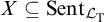 $X\subseteq \mathrm {Sent}_{{\mathcal {L}}_{\mathrm {T}}}$
,
$X\subseteq \mathrm {Sent}_{{\mathcal {L}}_{\mathrm {T}}}$
,
 $$ \begin{align*} n\in \mathscr{K}(X) :\leftrightarrow &\ n\in \mathrm{Sent}_{{\mathcal{L}}_{\mathrm{T}}}\land\\ & \big(\exists s\exists t (n=(s=t)\land {s}^{\circ} = {t}^{\circ}) \vee\\ & \exists s\exists t (n=(s\neq t)\land {s}^{\circ} \neq {t}^{\circ}) \vee\\ & \exists t (n=({\mathrm{T}} t)\land {t}^{\circ}\in X) \vee\\ & \exists t (n=(\neg {\mathrm{T}} t)\land \neg{t}^{\circ}\in X\vee {t}^{\circ}\in \omega\setminus \mathrm{Sent}_{{\mathcal{L}}_{\mathrm{T}}})\vee\\ & \exists \varphi(n=\neg\neg \varphi \land \varphi \in X)\vee\\ &\exists \varphi,\psi(n=(\varphi\land \psi)\land \varphi \in X\land \psi\in X)\vee\\ & \exists \varphi,\psi(n=\neg(\varphi\land \psi)\land \neg \varphi \in X \vee \neg \psi\in X)\\ & \exists \varphi(v)(n=(\forall v\varphi)\land \forall t \,\varphi(t/v)\in X)\\ & \exists \varphi(v)(n=\neg \forall v\varphi\land \exists t \,\neg\varphi(t/v)\in X)\big). \end{align*} $$
X occurs positively in $\mathscr {K}(X)$
and the
$\mathscr {K}(X)$
and the $\mathrm {K}$
-jump is monotone. Therefore, it will have fixed points. Note that fixed points of
$\mathrm {K}$
-jump is monotone. Therefore, it will have fixed points. Note that fixed points of $\mathscr {K}$
are closed under Strong-Kleene logic and are such that
$\mathscr {K}$
are closed under Strong-Kleene logic and are such that $(\neg )\varphi \in X$
iff
$(\neg )\varphi \in X$
iff $(\neg ){\mathrm {T}}\varphi \in X$
.Footnote
7
$(\neg ){\mathrm {T}}\varphi \in X$
.Footnote
7
In this section and the next we are interested in consistent fixed points of $\mathscr {K}$
(and theories that are sound with respect to them), that is, sets X such that
$\mathscr {K}$
(and theories that are sound with respect to them), that is, sets X such that $X=\mathscr {K}(X)$
and such that there’s no
$X=\mathscr {K}(X)$
and such that there’s no $\varphi $
such that
$\varphi $
such that $\varphi \land \neg \varphi \in X$
; we will consider other fixed points in a later section. The reason for this is both technical and conceptual. Technically, consistency delivers a simpler definition of determinateness and provides a basis for results about complete models and theories presented in later sections. Conceptually, we believe that a consistent extension of truth provides a more attractive notion of determinateness, as well as being in continuity with the above-mentioned works on truth-theoretic determinateness by Kripke, Reinhardt and Feferman.
$\varphi \land \neg \varphi \in X$
; we will consider other fixed points in a later section. The reason for this is both technical and conceptual. Technically, consistency delivers a simpler definition of determinateness and provides a basis for results about complete models and theories presented in later sections. Conceptually, we believe that a consistent extension of truth provides a more attractive notion of determinateness, as well as being in continuity with the above-mentioned works on truth-theoretic determinateness by Kripke, Reinhardt and Feferman.
For a consistent fixed-point X, let
 $$ \begin{align} \mathbb{T}_X=\{A\in {\mathcal{L}}_{\mathrm{T}} \;|\; (\mathbb{N},X)\vDash A\}. \end{align} $$
Incidentally, this set is considered by Fujimoto and Halbach as a model of $\mathsf {CT[KF+CONS]}$
[Reference Fujimoto and Halbach13, p. 251]. We will now show that this set can be used to provide a direct model construction for the principles of
$\mathsf {CT[KF+CONS]}$
[Reference Fujimoto and Halbach13, p. 251]. We will now show that this set can be used to provide a direct model construction for the principles of $\mathsf {CD}^{+}$
, and not only for a typed theory of truth interpreting
$\mathsf {CD}^{+}$
, and not only for a typed theory of truth interpreting $\mathsf {CD}^{+}$
.
$\mathsf {CD}^{+}$
.
Definition 7 (
$\mathsf {CD}^{+}_{\mathrm {T}}$
).
 $\mathsf {CD}^{+}_{\mathrm {T}}$
is the theory in
$\mathsf {CD}^{+}_{\mathrm {T}}$
is the theory in ${\mathcal {L}}_{\mathrm {T}}$
whose axioms are the axioms of
${\mathcal {L}}_{\mathrm {T}}$
whose axioms are the axioms of $\mathsf {CD}^{+}$
, but where D is now defined in terms of
$\mathsf {CD}^{+}$
, but where D is now defined in terms of ${\mathrm {T}}$
as
${\mathrm {T}}$
as
 $\mathsf {CD}^{+}_{\mathrm {T}}$
, just like
$\mathsf {CD}^{+}_{\mathrm {T}}$
, just like $\mathsf {CD}^{+}$
, delivers the intended restriction to the
$\mathsf {CD}^{+}$
, delivers the intended restriction to the ${\mathrm {T}}$
-schema to determinate sentences.
${\mathrm {T}}$
-schema to determinate sentences.
Observation 8. For any $A\in {\mathcal {L}}_{\mathrm {T}}$
:
$A\in {\mathcal {L}}_{\mathrm {T}}$
: $\mathsf {CD}^{+}_{\mathrm {T}}\vdash \mathrm {D}\ulcorner A\urcorner \rightarrow ({\mathrm {T}}\ulcorner A\urcorner \leftrightarrow A)$
.
$\mathsf {CD}^{+}_{\mathrm {T}}\vdash \mathrm {D}\ulcorner A\urcorner \rightarrow ({\mathrm {T}}\ulcorner A\urcorner \leftrightarrow A)$
.
Proof. By external induction on the complexity of A. Note that the case in which A is ${\mathrm {T}} t$
is an axiom of
${\mathrm {T}} t$
is an axiom of $\mathsf {CD}^{+}_{\mathrm {T}}$
.
$\mathsf {CD}^{+}_{\mathrm {T}}$
.
Our next goal is to show that, given a consistent fixed-point X, the structure $(\mathbb {N},\mathbb T_X)$
is a model of
$(\mathbb {N},\mathbb T_X)$
is a model of $\mathsf {CD}^{+}_{\mathrm {T}}$
. Since
$\mathsf {CD}^{+}_{\mathrm {T}}$
. Since $(\mathbb {N},X)\vDash \mathsf {KF+CONS}$
, and since
$(\mathbb {N},X)\vDash \mathsf {KF+CONS}$
, and since $\mathsf {KF+CONS}\vdash {\mathrm {T}}\ulcorner A\urcorner \rightarrow A$
, we have the following.
$\mathsf {KF+CONS}\vdash {\mathrm {T}}\ulcorner A\urcorner \rightarrow A$
, we have the following.
Fact 9. For any consistent fixed-point $X=\mathscr K(X)$
,
$X=\mathscr K(X)$
, $(\mathbb {N},X)\vDash {\mathrm {T}}\ulcorner A\urcorner \rightarrow A$
.
$(\mathbb {N},X)\vDash {\mathrm {T}}\ulcorner A\urcorner \rightarrow A$
.
Proposition 10. $(\mathbb {N},\mathbb T_X)\vDash \mathsf {CD}^{+}_{\mathrm {T}}$
.
$(\mathbb {N},\mathbb T_X)\vDash \mathsf {CD}^{+}_{\mathrm {T}}$
.
Proof. By induction on the length of the proof in $\mathsf {CD}^{+}_{\mathrm {T}}$
. We verify some key axioms, noting that T1 and T4–T6 are immediate by definition.
$\mathsf {CD}^{+}_{\mathrm {T}}$
. We verify some key axioms, noting that T1 and T4–T6 are immediate by definition.
T2 $^{+}$
:
$^{+}$
: $(\mathbb {N},\mathbb {T}_{X})\vDash {\mathrm {T}}{\mathrm {T}}\varphi \lor {\mathrm {T}}\mathrm {F}\varphi $
iff
$(\mathbb {N},\mathbb {T}_{X})\vDash {\mathrm {T}}{\mathrm {T}}\varphi \lor {\mathrm {T}}\mathrm {F}\varphi $
iff $(\mathbb {N},X)\vDash {\mathrm {T}}\varphi \lor \mathrm {F}\varphi $
iff
$(\mathbb {N},X)\vDash {\mathrm {T}}\varphi \lor \mathrm {F}\varphi $
iff $\{\varphi ,\neg \varphi \}\cap X\neq \varnothing $
iff
$\{\varphi ,\neg \varphi \}\cap X\neq \varnothing $
iff $\{{\mathrm {T}}\varphi ,\mathrm {F}\varphi \}\cap X\neq \varnothing $
(by the fixed-point property), iff
$\{{\mathrm {T}}\varphi ,\mathrm {F}\varphi \}\cap X\neq \varnothing $
(by the fixed-point property), iff $(\mathbb {N},X)\vDash {\mathrm {T}}{\mathrm {T}}\varphi \lor {\mathrm {T}}\mathrm {F}\varphi $
iff
$(\mathbb {N},X)\vDash {\mathrm {T}}{\mathrm {T}}\varphi \lor {\mathrm {T}}\mathrm {F}\varphi $
iff $(\mathbb {N},\mathbb {T}_X)\vDash {\mathrm {T}}({\mathrm {T}}{\mathrm {T}}\varphi \lor {\mathrm {T}}\mathrm {F}\varphi )$
.
$(\mathbb {N},\mathbb {T}_X)\vDash {\mathrm {T}}({\mathrm {T}}{\mathrm {T}}\varphi \lor {\mathrm {T}}\mathrm {F}\varphi )$
.
T3: Assume $(\mathbb {N},\mathbb {T}_{X})\vDash {\mathrm {T}}{\mathrm {T}}\varphi \lor {\mathrm {T}}\mathrm {F}\varphi $
, which is the case iff
$(\mathbb {N},\mathbb {T}_{X})\vDash {\mathrm {T}}{\mathrm {T}}\varphi \lor {\mathrm {T}}\mathrm {F}\varphi $
, which is the case iff $\{\varphi ,\neg \varphi \}\cap X\neq \varnothing $
. To show
$\{\varphi ,\neg \varphi \}\cap X\neq \varnothing $
. To show $(\mathbb {N}, \mathbb {T}_X)\vDash {\mathrm {T}}{\mathrm {T}}\varphi \rightarrow {\mathrm {T}}\varphi $
, we reason as follows, letting
$(\mathbb {N}, \mathbb {T}_X)\vDash {\mathrm {T}}{\mathrm {T}}\varphi \rightarrow {\mathrm {T}}\varphi $
, we reason as follows, letting $\varphi =\ulcorner A\urcorner $
:Footnote
8
$\varphi =\ulcorner A\urcorner $
:Footnote
8
 $$ \begin{align*} (\mathbb{N}, \mathbb{T}_{X})\vDash{\mathrm{T}}{\mathrm{T}}\varphi & \quad \text{ iff }\\ (\mathbb{N},{X})\vDash{\mathrm{T}}\varphi & \quad {hence}, \text{ by Fact 9},\\ (\mathbb{N}, X)\vDash A, & \quad \text{ iff}\\ (\mathbb{N}, \mathbb{T}_{X})\vDash{\mathrm{T}}\varphi. & \end{align*} $$
We notice that—due to the fact that we are reasoning in a consistent fixed-point model—the assumption $\mathrm {D}\varphi $
has not been employed in this part of the argument.
$\mathrm {D}\varphi $
has not been employed in this part of the argument.
Conversely, to show that $(\mathbb {N}, \mathbb {T}_X)\vDash {\mathrm {T}}\varphi \rightarrow {\mathrm {T}}{\mathrm {T}}\varphi $
, assume
$(\mathbb {N}, \mathbb {T}_X)\vDash {\mathrm {T}}\varphi \rightarrow {\mathrm {T}}{\mathrm {T}}\varphi $
, assume $(\mathbb {N}, \mathbb {T}_{X})\vDash {\mathrm {T}}\varphi $
, which is equivalent to
$(\mathbb {N}, \mathbb {T}_{X})\vDash {\mathrm {T}}\varphi $
, which is equivalent to $(\mathbb {N}, X)\vDash A$
. Towards a contradiction, suppose
$(\mathbb {N}, X)\vDash A$
. Towards a contradiction, suppose $(\mathbb {N}, \mathbb T_X)\not \vDash {\mathrm {T}}{\mathrm {T}}\varphi $
, hence
$(\mathbb {N}, \mathbb T_X)\not \vDash {\mathrm {T}}{\mathrm {T}}\varphi $
, hence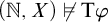 $(\mathbb {N}, X)\not \vDash {\mathrm {T}}\varphi $
. Then, since
$(\mathbb {N}, X)\not \vDash {\mathrm {T}}\varphi $
. Then, since $\{\varphi ,\neg \varphi \}\cap X\neq \varnothing $
by assumption,
$\{\varphi ,\neg \varphi \}\cap X\neq \varnothing $
by assumption,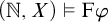 $(\mathbb {N}, X)\vDash \mathrm {F}\varphi $
, and therefore
$(\mathbb {N}, X)\vDash \mathrm {F}\varphi $
, and therefore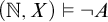 $(\mathbb {N}, X)\vDash \neg A$
by Fact 9, which contradicts
$(\mathbb {N}, X)\vDash \neg A$
by Fact 9, which contradicts $(\mathbb {N}, X)\vDash A$
.
$(\mathbb {N}, X)\vDash A$
.
D3: We need to show that $(\mathbb {N}, \mathbb T_X)\vDash {\mathrm {T}}{\mathrm {T}}\varphi \lor {\mathrm {T}}\mathrm {F}\varphi $
is equivalent to
$(\mathbb {N}, \mathbb T_X)\vDash {\mathrm {T}}{\mathrm {T}}\varphi \lor {\mathrm {T}}\mathrm {F}\varphi $
is equivalent to
 $$ \begin{align*}& (\mathbb{N}, \mathbb T_X)\vDash{\mathrm{T}}{\mathrm{T}} \big({\mathrm{T}}{\mathrm{T}}\varphi\lor{\mathrm{T}}\mathrm{F}\varphi\big) \lor {\mathrm{T}}\mathrm{F} \big({\mathrm{T}}{\mathrm{T}}\varphi\lor{\mathrm{T}}\mathrm{F}\varphi\big). \end{align*} $$
The latter is equivalent to
 $$ \begin{align*} \underbrace{(\mathbb{N}, X)\vDash{\mathrm{T}}\big({\mathrm{T}}{\mathrm{T}}\varphi\lor{\mathrm{T}}\mathrm{F}\varphi\big)}_{d_1} \text{ or }& \underbrace{(\mathbb{N}, X)\vDash\mathrm{F}\big({\mathrm{T}}{\mathrm{T}}\varphi\lor{\mathrm{T}}\mathrm{F}\varphi\big)}_{d_2}. \end{align*} $$
Since $d_1$
and
$d_1$
and $d_2$
are equivalent to, respectively,
$d_2$
are equivalent to, respectively, $(\mathbb {N}, X)\vDash {\mathrm {T}}\varphi \lor \mathrm {F}\varphi $
and
$(\mathbb {N}, X)\vDash {\mathrm {T}}\varphi \lor \mathrm {F}\varphi $
and $(\mathbb {N}, X)\vDash \mathrm {F}\varphi \land {\mathrm {T}}\varphi $
, by consistency of X it can be observed that their disjunction is equivalent to
$(\mathbb {N}, X)\vDash \mathrm {F}\varphi \land {\mathrm {T}}\varphi $
, by consistency of X it can be observed that their disjunction is equivalent to $d_1$
, which is equivalent to
$d_1$
, which is equivalent to $(\mathbb {N}, \mathbb T_X)\vDash {\mathrm {T}}{\mathrm {T}}\varphi \lor {\mathrm {T}}\mathrm {F}\varphi $
, as required.
$(\mathbb {N}, \mathbb T_X)\vDash {\mathrm {T}}{\mathrm {T}}\varphi \lor {\mathrm {T}}\mathrm {F}\varphi $
, as required.
D5: Assume $(\mathbb N,\mathbb T_X)\vDash {\mathrm {T}}{\mathrm {T}}(\varphi \land \psi )\lor {\mathrm {T}}\mathrm {F}(\varphi \land \psi )$
. If
$(\mathbb N,\mathbb T_X)\vDash {\mathrm {T}}{\mathrm {T}}(\varphi \land \psi )\lor {\mathrm {T}}\mathrm {F}(\varphi \land \psi )$
. If $(\mathbb N,\mathbb T_X)\vDash {\mathrm {T}}{\mathrm {T}}(\varphi \land \psi )$
, then
$(\mathbb N,\mathbb T_X)\vDash {\mathrm {T}}{\mathrm {T}}(\varphi \land \psi )$
, then $(\mathbb N,\mathbb T_X)\vDash {\mathrm {T}}{\mathrm {T}}\varphi \land {\mathrm {T}}{\mathrm {T}}\psi $
by the closure properties of X, hence both
$(\mathbb N,\mathbb T_X)\vDash {\mathrm {T}}{\mathrm {T}}\varphi \land {\mathrm {T}}{\mathrm {T}}\psi $
by the closure properties of X, hence both $\varphi $
and
$\varphi $
and $\psi $
are determinate. If
$\psi $
are determinate. If $(\mathbb N,\mathbb T_X)\vDash {\mathrm {T}}\mathrm {F}(\varphi \land \psi )$
then
$(\mathbb N,\mathbb T_X)\vDash {\mathrm {T}}\mathrm {F}(\varphi \land \psi )$
then $(\mathbb N,\mathbb T_X)\vDash {\mathrm {T}}\mathrm {F}\varphi \lor {\mathrm {T}}\mathrm {F}\psi $
by the properties of X. If
$(\mathbb N,\mathbb T_X)\vDash {\mathrm {T}}\mathrm {F}\varphi \lor {\mathrm {T}}\mathrm {F}\psi $
by the properties of X. If $(\mathbb N,\mathbb T_X)\vDash {\mathrm {T}}\mathrm {F}\varphi $
, then
$(\mathbb N,\mathbb T_X)\vDash {\mathrm {T}}\mathrm {F}\varphi $
, then $(\mathbb N, X)\vDash \mathrm {F}\varphi $
and hence
$(\mathbb N, X)\vDash \mathrm {F}\varphi $
and hence $(\mathbb N, X)\vDash \neg A$
by Fact 9, for
$(\mathbb N, X)\vDash \neg A$
by Fact 9, for $\varphi =\ulcorner A\urcorner $
. This in turn yields
$\varphi =\ulcorner A\urcorner $
. This in turn yields $(\mathbb N,\mathbb T_X)\vDash {\mathrm {T}}\mathrm {F}\varphi \land \mathrm {F}\varphi $
, hence
$(\mathbb N,\mathbb T_X)\vDash {\mathrm {T}}\mathrm {F}\varphi \land \mathrm {F}\varphi $
, hence $\varphi $
is determinate and false. Similarly if
$\varphi $
is determinate and false. Similarly if $(\mathbb N,\mathbb T_X)\vDash {\mathrm {T}}\mathrm {F}\psi $
.
$(\mathbb N,\mathbb T_X)\vDash {\mathrm {T}}\mathrm {F}\psi $
.
Conversely, if $(\mathbb N,\mathbb T_X)\vDash ({\mathrm {T}}{\mathrm {T}}\varphi \lor {\mathrm {T}}\mathrm {F}\varphi )\land ({\mathrm {T}}{\mathrm {T}}\psi \lor {\mathrm {T}}\mathrm {F}\psi )$
, then we get immediately
$(\mathbb N,\mathbb T_X)\vDash ({\mathrm {T}}{\mathrm {T}}\varphi \lor {\mathrm {T}}\mathrm {F}\varphi )\land ({\mathrm {T}}{\mathrm {T}}\psi \lor {\mathrm {T}}\mathrm {F}\psi )$
, then we get immediately $(\mathbb N,\mathbb T_X)\vDash {\mathrm {T}}{\mathrm {T}}(\varphi \land \psi )\lor {\mathrm {T}}\mathrm {F}(\varphi \land \psi )$
by closure properties of X. If
$(\mathbb N,\mathbb T_X)\vDash {\mathrm {T}}{\mathrm {T}}(\varphi \land \psi )\lor {\mathrm {T}}\mathrm {F}(\varphi \land \psi )$
by closure properties of X. If $(\mathbb N,\mathbb T_X)\vDash ({\mathrm {T}}{\mathrm {T}}\varphi \lor {\mathrm {T}}\mathrm {F}\varphi )\land \mathrm {F}\varphi $
, then
$(\mathbb N,\mathbb T_X)\vDash ({\mathrm {T}}{\mathrm {T}}\varphi \lor {\mathrm {T}}\mathrm {F}\varphi )\land \mathrm {F}\varphi $
, then $(\mathbb N,X)\vDash ({\mathrm {T}}\varphi \lor \mathrm {F}\varphi )\land \neg A$
, which by consistency of X is equivalent to
$(\mathbb N,X)\vDash ({\mathrm {T}}\varphi \lor \mathrm {F}\varphi )\land \neg A$
, which by consistency of X is equivalent to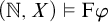 $(\mathbb N,X)\vDash \mathrm {F}\varphi $
, hence
$(\mathbb N,X)\vDash \mathrm {F}\varphi $
, hence $(\mathbb N,X)\vDash \mathrm {F}(\varphi \land \psi )$
for any
$(\mathbb N,X)\vDash \mathrm {F}(\varphi \land \psi )$
for any $\psi $
. It follows that
$\psi $
. It follows that $(\mathbb N,\mathbb T_X)\vDash {\mathrm {T}}\mathrm {F}(\varphi \land \psi )$
. Similarly if we assume
$(\mathbb N,\mathbb T_X)\vDash {\mathrm {T}}\mathrm {F}(\varphi \land \psi )$
. Similarly if we assume $(\mathbb N,\mathbb T_X)\vDash ({\mathrm {T}}{\mathrm {T}}\psi \lor {\mathrm {T}}\mathrm {F}\psi )\land \mathrm {F}\psi $
.
$(\mathbb N,\mathbb T_X)\vDash ({\mathrm {T}}{\mathrm {T}}\psi \lor {\mathrm {T}}\mathrm {F}\psi )\land \mathrm {F}\psi $
.
It is clear that $\mathsf {CD}^{+}_{\mathrm {T}}$
can interpret
$\mathsf {CD}^{+}_{\mathrm {T}}$
can interpret $\mathsf {CD}^{+}$
.
$\mathsf {CD}^{+}$
.
Observation 11. There is an $\mathcal {L}_{\mathbb {N}}$
-interpretation of
$\mathcal {L}_{\mathbb {N}}$
-interpretation of $\mathsf {CD}^{+}$
in
$\mathsf {CD}^{+}$
in $\mathsf {CD}^{+}_{\mathrm {T}}$
.
$\mathsf {CD}^{+}_{\mathrm {T}}$
.
Proof. We employ the recursion theorem to define an $\mathcal {L}_{\mathbb {N}}$
-translation
$\mathcal {L}_{\mathbb {N}}$
-translation $\delta \colon \mathcal {L}_{\mathrm {D}} \to {\mathcal {L}}_{\mathrm {T}}$
which systematically replaces D with its definition from (4). In more detail, the recursion theorem for primitive recursive functionsFootnote
9
can be employed to define an
$\delta \colon \mathcal {L}_{\mathrm {D}} \to {\mathcal {L}}_{\mathrm {T}}$
which systematically replaces D with its definition from (4). In more detail, the recursion theorem for primitive recursive functionsFootnote
9
can be employed to define an $\mathcal {L}_{\mathbb {N}}$
-translation
$\mathcal {L}_{\mathbb {N}}$
-translation $\delta \colon \mathcal {L}_{\mathrm {D}} \to {\mathcal {L}}_{\mathrm {T}}$
such that
$\delta \colon \mathcal {L}_{\mathrm {D}} \to {\mathcal {L}}_{\mathrm {T}}$
such that

The expression  abbreviates the formula representing $\delta $
in
$\delta $
in $\mathcal {L}_{\mathbb {N}}$
. The verification that
$\mathcal {L}_{\mathbb {N}}$
. The verification that
 $$ \begin{align} \mathsf{CD}^{+} \vdash A \text{ only if } \mathsf{CD}^{+}_{\mathrm{T}}\vdash A^\delta \end{align} $$
is immediate given some basic syntactic facts, provable in a subtheory of $\mathsf {PA}$
, including:
$\mathsf {PA}$
, including:

It will follow from the identity of $\mathsf {CKF}_{\mathsf {cs}}$
and
$\mathsf {CKF}_{\mathsf {cs}}$
and $\mathsf {CD}^{+}_{\mathrm {T}}$
(Proposition 25) that
$\mathsf {CD}^{+}_{\mathrm {T}}$
(Proposition 25) that $\mathsf {CD}^{+}$
and
$\mathsf {CD}^{+}$
and $\mathsf {CD}^{+}_{\mathrm {T}}$
are mutually
$\mathsf {CD}^{+}_{\mathrm {T}}$
are mutually $\mathcal {L}_{\mathbb {N}}$
-interpretable. It would be too hasty to think, however, that
$\mathcal {L}_{\mathbb {N}}$
-interpretable. It would be too hasty to think, however, that $\mathsf {CD}^{+}$
and
$\mathsf {CD}^{+}$
and $\mathsf {CD}^{+}_{\mathrm {T}}$
are “notational variants”;
$\mathsf {CD}^{+}_{\mathrm {T}}$
are “notational variants”; $\mathsf {CD}^{+}$
cannot define D in the manner prescribed by
$\mathsf {CD}^{+}$
cannot define D in the manner prescribed by $\mathsf {CD}^{+}_{\mathrm {T}}$
. This can be seen from the following observation. With reference to Fujimoto and Halbach’s semantic construction for
$\mathsf {CD}^{+}_{\mathrm {T}}$
. This can be seen from the following observation. With reference to Fujimoto and Halbach’s semantic construction for $\mathsf {CD}^{+}$
described on page 7, let
$\mathsf {CD}^{+}$
described on page 7, let
 $$\begin{align*}T_B:=T_\infty\cup \{B\}, \end{align*}$$
for B an $\mathcal {L}_{\mathrm {D}}$
-sentence, and
$\mathcal {L}_{\mathrm {D}}$
-sentence, and
 $$\begin{align*}\mathbb{T}_B:=\{ A \in \mathcal{L}_{\mathrm{D}} \;|\; (\mathbb{N},D_\infty,T_B)\vDash A\}. \end{align*}$$
Lemma 12. If $B \notin D_\infty $
, then
$B \notin D_\infty $
, then $(\mathbb {N}, D_\infty ,\mathbb {T}_B)\vDash \mathsf {CD}^{+}$
.
$(\mathbb {N}, D_\infty ,\mathbb {T}_B)\vDash \mathsf {CD}^{+}$
.
Proof. We first show, by induction on A, that if $A\in D_\infty $
, then
$A\in D_\infty $
, then
 $$ \begin{align}(\mathbb N, D_{\infty}, T_{\infty})\vDash A & \,\text{ iff } \,(\mathbb N, D_{\infty}, T_B)\vDash A. \end{align} $$
The crucial case is when $A={\mathrm {T}}\varphi $
:
$A={\mathrm {T}}\varphi $
: $(\mathbb N, D_{\infty }, T_{\infty })\vDash {\mathrm {T}}\varphi $
iff
$(\mathbb N, D_{\infty }, T_{\infty })\vDash {\mathrm {T}}\varphi $
iff $\varphi \in T_{\infty }$
, hence
$\varphi \in T_{\infty }$
, hence ${(\mathbb N, D_{\infty }, T_B)\vDash {\mathrm {T}}\varphi }$
. For the converse direction,
${(\mathbb N, D_{\infty }, T_B)\vDash {\mathrm {T}}\varphi }$
. For the converse direction, $(\mathbb N, D_{\infty }, T_B)\vDash {\mathrm {T}}\varphi $
iff either
$(\mathbb N, D_{\infty }, T_B)\vDash {\mathrm {T}}\varphi $
iff either $\varphi \in T_{\infty }$
, in which case we are done, or
$\varphi \in T_{\infty }$
, in which case we are done, or $\varphi =B$
. However, since
$\varphi =B$
. However, since ${\mathrm {T}}\varphi \in D_\infty $
, it follows that
${\mathrm {T}}\varphi \in D_\infty $
, it follows that $\varphi \in D_\infty $
, hence
$\varphi \in D_\infty $
, hence $\varphi \neq B$
.
$\varphi \neq B$
.
Having shown (7), we proceed with the main claim by induction on the length of proofs of $\mathsf {CD}^{+}$
. We check two cases where the use of (7) is relevant, letting
$\mathsf {CD}^{+}$
. We check two cases where the use of (7) is relevant, letting $\varphi =\ulcorner A\urcorner $
.
$\varphi =\ulcorner A\urcorner $
.
-
- For T3, assume
$A\in D_\infty $
. Then
$(\mathbb N, D_{\infty }, T_{\infty })\vDash A$
iff
$A\in T_{\infty }$
since
$(\mathbb N, D_{\infty }, \mathbb T_{\infty })$
models
$\mathsf {CD}^{+}$
. Then
$(\mathbb N, D_{\infty }, \mathbb T_B)\vDash {\mathrm {T}}\varphi $
iff
$(\mathbb N, D_{\infty }, T_B)\vDash A$
iff, by (7),
$(\mathbb N, D_{\infty }, T_{\infty })\vDash A$
iff
$A\in T_{\infty }$
iff, since
$A\neq B$
,
$(\mathbb N, D_{\infty }, T_B)\vDash {\mathrm {T}}\varphi $
iff
$(\mathbb N, D_{\infty }, \mathbb T_B)\vDash {\mathrm {T}}{\mathrm {T}}\varphi $
. -
- For D5, the left-to-right direction is immediate. As for right-to-left direction, it suffices to consider the case where, e.g.,
$(\mathbb N, D_{\infty }, \mathbb T_B)\vDash \mathrm {D}\varphi \land \mathrm {F}\varphi $
. This is the case iff
$(\mathbb N, D_{\infty }, T_B)\vDash \mathrm {D}\varphi \land \neg A$
iff, by (7),
$(\mathbb N, D_{\infty }, T_{\infty })\vDash \mathrm {D}\varphi \land \neg A$
iff
$(\mathbb N, D_{\infty }, \mathbb T_{\infty })\vDash \mathrm {D}\varphi \land \mathrm {F}\varphi $
, hence
$\varphi \land \psi \in D_\infty $
for any
$\psi $
, hence
$(\mathbb N, D_{\infty }, \mathbb T_B)\vDash \mathrm {D}(\varphi \land \psi )$
.

















While $\mathsf {CD}^{+}\vdash (\forall \varphi \colon \mathcal {L}_{\mathrm {D}})(\mathrm {D}\varphi \rightarrow {\mathrm {T}}{\mathrm {T}}\varphi \lor {\mathrm {T}}\mathrm {F}\varphi )$
, Lemma 12 yields that the converse implication is not provable.
$\mathsf {CD}^{+}\vdash (\forall \varphi \colon \mathcal {L}_{\mathrm {D}})(\mathrm {D}\varphi \rightarrow {\mathrm {T}}{\mathrm {T}}\varphi \lor {\mathrm {T}}\mathrm {F}\varphi )$
, Lemma 12 yields that the converse implication is not provable.
Corollary 13. $\mathsf {CD}^{+}\not \vdash (\forall \varphi \colon \mathcal {L}_{\mathrm {D}})({\mathrm {T}}{\mathrm {T}}\varphi \lor {\mathrm {T}}\mathrm {F}\varphi \rightarrow \mathrm {D}\varphi )$
.
$\mathsf {CD}^{+}\not \vdash (\forall \varphi \colon \mathcal {L}_{\mathrm {D}})({\mathrm {T}}{\mathrm {T}}\varphi \lor {\mathrm {T}}\mathrm {F}\varphi \rightarrow \mathrm {D}\varphi )$
.
Corollary 14. $\mathsf {CD}^{+}$
does not prove any of the following sentences:
$\mathsf {CD}^{+}$
does not prove any of the following sentences:
-
(i)
$\forall t( {\mathrm {T}}{\mathrm {T}} {\mathrm {T}} t \rightarrow {\mathrm {T}}{\mathrm {T}} t)$
; -
(ii)
$ \forall t( {\mathrm {T}}{\mathrm {T}} t \rightarrow {\mathrm {T}}{\mathrm {T}}{\mathrm {T}} t)$
; -
(iii)
$(\forall \varphi \colon {\mathcal {L}}_{\mathrm {T}})({\mathrm {T}}{\mathrm {T}}\varphi \leftrightarrow {\mathrm {T}}{\mathrm {T}}\neg \neg \varphi )$
; -
(iv)
$(\forall \varphi ,\psi \colon {\mathcal {L}}_{\mathrm {T}}) ({\mathrm {T}}{\mathrm {T}}(\varphi \land \psi )\leftrightarrow {\mathrm {T}}{\mathrm {T}}\varphi \land {\mathrm {T}}{\mathrm {T}}\psi )$
; -
(v)
$(\forall \varphi ,\psi \colon {\mathcal {L}}_{\mathrm {T}}) ({\mathrm {T}}\mathrm {F}(\varphi \land \psi )\leftrightarrow {\mathrm {T}}\mathrm {F}\varphi \lor {\mathrm {T}}{\mathrm {T}}\psi )$
; -
(vi)
$(\forall \varphi (v)\colon {\mathcal {L}}_{\mathrm {T}}) ({\mathrm {T}}{\mathrm {T}}\forall \varphi (v) \leftrightarrow {\mathrm {T}}\forall t{\mathrm {T}}\varphi (t)$
; -
(vii)
$(\forall \varphi (v)\colon {\mathcal {L}}_{\mathrm {T}}) ({\mathrm {T}}\mathrm {F}\forall \varphi (v) \leftrightarrow {\mathrm {T}}\exists t\mathrm {F}\varphi (t)$
.







Proof. For (i), to construct the required countermodel use $\neg \lambda $
, for
$\neg \lambda $
, for $\lambda $
a liar sentence, in place of B in Lemma 12; the model invalidates
$\lambda $
a liar sentence, in place of B in Lemma 12; the model invalidates ${\mathrm {T}}{\mathrm {T}}{\mathrm {T}}\lambda \rightarrow {\mathrm {T}}{\mathrm {T}}\lambda $
. For (ii), use
${\mathrm {T}}{\mathrm {T}}{\mathrm {T}}\lambda \rightarrow {\mathrm {T}}{\mathrm {T}}\lambda $
. For (ii), use $\lambda $
in place of B so to invalidate
$\lambda $
in place of B so to invalidate ${\mathrm {T}}{\mathrm {T}}\lambda \rightarrow {\mathrm {T}}{\mathrm {T}}{\mathrm {T}}\lambda $
. The other cases can be dealt with by emploing suitable truth-teller sentences. For instance, for (iv), define parametrized truth-tellers
${\mathrm {T}}{\mathrm {T}}\lambda \rightarrow {\mathrm {T}}{\mathrm {T}}{\mathrm {T}}\lambda $
. The other cases can be dealt with by emploing suitable truth-teller sentences. For instance, for (iv), define parametrized truth-tellers $\tau _0$
and
$\tau _0$
and $\tau _1$
, and replace
$\tau _1$
, and replace $\tau _0\land \tau _1$
for B in Lemma 12.
$\tau _0\land \tau _1$
for B in Lemma 12.
4
$\mathsf {KF}$
’s classical closure

The definition of $\mathsf {CD}^{+}_{\mathrm {T}}$
is parasitic on Fujimoto and Halbach’s
$\mathsf {CD}^{+}_{\mathrm {T}}$
is parasitic on Fujimoto and Halbach’s $\mathsf {CD}^{+}$
. As such, they are axiomatizations of both truth and determinateness. It is then natural to ask whether there is an axiomatization of truth that can be directly inspired by the models
$\mathsf {CD}^{+}$
. As such, they are axiomatizations of both truth and determinateness. It is then natural to ask whether there is an axiomatization of truth that can be directly inspired by the models $(\mathbb {N}, \mathbb {T}_X)$
introduced above and yet deliver the required principles for determinateness. In such models, full disquotation is allowed only under two or more layers of truth (or falsity): outside those layers, fully classical principles are licensed at the expense of disquotation. We will now answer the question positively. We will then explain in the final section how the theories capture the conception of truth (and determinateness) outlined in the opening section.
$(\mathbb {N}, \mathbb {T}_X)$
introduced above and yet deliver the required principles for determinateness. In such models, full disquotation is allowed only under two or more layers of truth (or falsity): outside those layers, fully classical principles are licensed at the expense of disquotation. We will now answer the question positively. We will then explain in the final section how the theories capture the conception of truth (and determinateness) outlined in the opening section.
We introduce the theory $\mathsf {CKF}_{\mathsf {cs}}$
(standing for the classical closure of
$\mathsf {CKF}_{\mathsf {cs}}$
(standing for the classical closure of $\mathsf {KF+CONS}$
).
$\mathsf {KF+CONS}$
). $\mathsf {CKF}_{\mathsf {cs}}$
combines full compositionality (
$\mathsf {CKF}_{\mathsf {cs}}$
combines full compositionality ( ${\mathrm {T}}1$
and
${\mathrm {T}}1$
and ${\mathrm {T}}4$
–
${\mathrm {T}}4$
– ${\mathrm {T}}6$
) with Kripkean truth conditions in the inner layers of truth, along with a disquotation principle for truth ascriptions that will ensure the consistency of the inner truth predicate.
${\mathrm {T}}6$
) with Kripkean truth conditions in the inner layers of truth, along with a disquotation principle for truth ascriptions that will ensure the consistency of the inner truth predicate.
Definition 15 (
$\mathsf {CKF}_{\mathsf {cs}}$
).

The axioms of the ${\mathcal {L}}_{\mathrm {T}}$
-theory
${\mathcal {L}}_{\mathrm {T}}$
-theory $\mathsf {CKF}_{\mathsf {cs}}$
are the axioms of
$\mathsf {CKF}_{\mathsf {cs}}$
are the axioms of $\mathsf {PAT}$
together with:
$\mathsf {PAT}$
together with:
 $$ \begin{align} &\forall s\forall t({\mathrm{T}}(s=t)\leftrightarrow {s}^{\circ}={t}^{\circ}) \end{align} $$
 $$ \begin{align} & (\forall \varphi \colon {\mathcal{L}}_{\mathrm{T}}) ({\mathrm{T}}(\neg \varphi)\leftrightarrow \neg {\mathrm{T}}\varphi) \end{align} $$
 $$ \begin{align} & (\forall \varphi,\psi\colon {\mathcal{L}}_{\mathrm{T}})({\mathrm{T}}(\varphi\land \psi)\leftrightarrow {\mathrm{T}}\varphi\land {\mathrm{T}}\psi) \end{align} $$
 $$ \begin{align} & (\forall \varphi(v)\colon {\mathcal{L}}_{\mathrm{T}})({\mathrm{T}}(\forall v\varphi)\leftrightarrow \forall t\,{\mathrm{T}}\varphi(t/v)) \end{align} $$
 $$ \begin{align} &\forall s\forall t({\mathrm{T}}{\mathrm{T}} s=t \leftrightarrow {s}^{\circ}= {t}^{\circ}) \end{align} $$
 $$ \begin{align} &\forall s\forall t({\mathrm{T}}\mathrm{F} s=t\leftrightarrow {s}^{\circ}\neq {t}^{\circ}) \end{align} $$
 $$ \begin{align} &(\forall \varphi \colon {\mathcal{L}}_{\mathrm{T}})({\mathrm{T}}{\mathrm{T}}\varphi\leftrightarrow {\mathrm{T}}{\mathrm{T}}\neg \neg \varphi) \end{align} $$
 $$ \begin{align} & (\forall \varphi,\psi \colon {\mathcal{L}}_{\mathrm{T}})({\mathrm{T}}{\mathrm{T}}(\varphi\land \psi)\leftrightarrow {\mathrm{T}}{\mathrm{T}}\varphi\land {\mathrm{T}}{\mathrm{T}}\psi) \end{align} $$
 $$ \begin{align} & (\forall \varphi,\psi \colon {\mathcal{L}}_{\mathrm{T}}) ({\mathrm{T}}\mathrm{F}(\varphi\land \psi)\leftrightarrow {\mathrm{T}}\mathrm{F}\varphi\lor {\mathrm{T}}{\mathrm{T}}\psi)\end{align} $$
 $$ \begin{align} & (\forall \varphi(v)\colon {\mathcal{L}}_{\mathrm{T}}) ({\mathrm{T}}{\mathrm{T}}\forall \varphi(v) \leftrightarrow{\mathrm{T}}\forall t{\mathrm{T}}\varphi(t))\end{align} $$
 $$ \begin{align} & (\forall \varphi(v)\colon {\mathcal{L}}_{\mathrm{T}} )({\mathrm{T}}\mathrm{F}\forall \varphi(v) \leftrightarrow{\mathrm{T}}\exists t\mathrm{F}\varphi(t)) \end{align} $$
 $$ \begin{align} &\forall t({\mathrm{T}}{\mathrm{T}}{\mathrm{T}} t\leftrightarrow {\mathrm{T}}{\mathrm{T}} t) \end{align} $$
 $$ \begin{align} &\forall t({\mathrm{T}}\mathrm{F}{\mathrm{T}} t\leftrightarrow {\mathrm{T}}\mathrm{F} t) \end{align} $$
 $$ \begin{align} &\forall t({\mathrm{T}}{\mathrm{T}} t\rightarrow{\mathrm{T}}{t}^{\circ})\end{align} $$
 $$ \begin{align} &(\forall \varphi(v)\colon {\mathcal{L}}_{\mathrm{T}})\forall s\forall t\big({s}^{\circ}= {t}^{\circ} \rightarrow ({\mathrm{T}}\varphi(s) \leftrightarrow {\mathrm{T}}\varphi(t))\big). \end{align} $$
Remark 16. In the definition of $\mathsf {CKF}_{\mathsf {cs}}$
, the version of
$\mathsf {CKF}_{\mathsf {cs}}$
, the version of $\mathsf {KF}$
that ‘lives’ inside one layer of truth is slightly different from the one presented in Definition 3. Specifically, axiom
$\mathsf {KF}$
that ‘lives’ inside one layer of truth is slightly different from the one presented in Definition 3. Specifically, axiom ${\mathrm {T}}15$
of
${\mathrm {T}}15$
of $\mathsf {CKF}_{\mathsf {cs}}$
does not feature, internally, the extra disjunct of
$\mathsf {CKF}_{\mathsf {cs}}$
does not feature, internally, the extra disjunct of $\mathsf {KF}2$
. This reformulation, albeit inessential either conceptually or from the perspective of proof-theoretic strength, is required by our arguments to obtain the identity of
$\mathsf {KF}2$
. This reformulation, albeit inessential either conceptually or from the perspective of proof-theoretic strength, is required by our arguments to obtain the identity of $\mathsf {CKF}_{\mathsf {cs}}$
and
$\mathsf {CKF}_{\mathsf {cs}}$
and $\mathsf {CD}^{+}_{\mathrm {T}}$
established in Proposition 25.
$\mathsf {CD}^{+}_{\mathrm {T}}$
established in Proposition 25.
We list some basic theorems of $\mathsf {CKF}_{\mathsf {cs}}$
that will be explicitly used below.Footnote
10
$\mathsf {CKF}_{\mathsf {cs}}$
that will be explicitly used below.Footnote
10
Observation 17. The following are derivable in $\mathsf {CKF}_{\mathsf {cs}}$
:
$\mathsf {CKF}_{\mathsf {cs}}$
:
 $$ \begin{align} &\forall t({\mathrm{T}}\mathrm{F} t \leftrightarrow{\mathrm{T}}{\mathrm{T}}\mathrm{F} t) \end{align} $$
 $$ \begin{align} &{\mathrm{T}}\mathrm{F}\varphi \rightarrow \neg {\mathrm{T}}{\mathrm{T}}\varphi \end{align} $$
 $$ \begin{align} &(\forall \varphi,\psi\colon {\mathcal{L}}_{\mathrm{T}})({\mathrm{T}}{\mathrm{T}}(\varphi\lor\psi) \leftrightarrow{\mathrm{T}}{\mathrm{T}}\varphi\lor{\mathrm{T}}{\mathrm{T}}\psi) \end{align} $$
 $$ \begin{align} &(\forall \varphi,\psi\colon {\mathcal{L}}_{\mathrm{T}})( {\mathrm{T}}\mathrm{F}(\varphi\lor\psi) \leftrightarrow{\mathrm{T}}\mathrm{F}\varphi\land{\mathrm{T}}\mathrm{F}\psi). \end{align} $$
As mentioned, the theory $\mathsf {CKF}_{\mathsf {cs}}$
is directly inspired by the models
$\mathsf {CKF}_{\mathsf {cs}}$
is directly inspired by the models $(\mathbb {N}, \mathbb T_X)$
introduced in the previous section. Our next results provide a full characterization of standard models of
$(\mathbb {N}, \mathbb T_X)$
introduced in the previous section. Our next results provide a full characterization of standard models of $\mathsf {CKF}_{\mathsf {cs}}$
in these terms: we show that they are exactly the classical closures of consistent fixed points.
$\mathsf {CKF}_{\mathsf {cs}}$
in these terms: we show that they are exactly the classical closures of consistent fixed points.
Lemma 18. For any consistent fixed-point X, $(\mathbb {N},\mathbb {T}_X)\vDash \mathsf {CKF}_{\mathsf {cs}}$
.
$(\mathbb {N},\mathbb {T}_X)\vDash \mathsf {CKF}_{\mathsf {cs}}$
.
Proof. Axioms T1 and T4–T6 are immediate by definition. Axioms T7–T15 and R1 readily follow from properties of X. As for T16, we reason as in the argument for case T3 in the proof of Proposition 10.
For any set S, let $S^{\mathscr {I}} :=\{A\;|\;(\mathbb N, S)\vDash {\mathrm {T}}\ulcorner {\mathrm {T}} \ulcorner A\urcorner \urcorner \}$
. Then
$S^{\mathscr {I}} :=\{A\;|\;(\mathbb N, S)\vDash {\mathrm {T}}\ulcorner {\mathrm {T}} \ulcorner A\urcorner \urcorner \}$
. Then
Lemma 19. Let $(\mathbb N, S)\vDash \mathsf {CKF}_{\mathsf {cs}}$
. Then
$(\mathbb N, S)\vDash \mathsf {CKF}_{\mathsf {cs}}$
. Then $S^{\mathscr {I}}$
is a consistent fixed point.
$S^{\mathscr {I}}$
is a consistent fixed point.
Proof. Let $(\mathbb N, S)\vDash \mathsf {CKF}_{\mathsf {cs}}$
. By induction on the positive complexity of A, one shows that
$(\mathbb N, S)\vDash \mathsf {CKF}_{\mathsf {cs}}$
. By induction on the positive complexity of A, one shows that $A\in S^{\mathscr {I}}$
iff
$A\in S^{\mathscr {I}}$
iff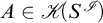 $A\in \mathscr K(S^{\mathscr {I}})$
. For example, if A is of the form
$A\in \mathscr K(S^{\mathscr {I}})$
. For example, if A is of the form $\neg {\mathrm {T}} t$
, one uses T15, or if A is of the form
$\neg {\mathrm {T}} t$
, one uses T15, or if A is of the form $\forall xB$
, one uses T6 and T12.
$\forall xB$
, one uses T6 and T12.
Lemma 20. Let $(\mathbb N, S)\vDash \mathsf {CKF}_{\mathsf {cs}}$
. Then
$(\mathbb N, S)\vDash \mathsf {CKF}_{\mathsf {cs}}$
. Then $S=\mathbb T_{S^{\mathscr {I}}}$
.
$S=\mathbb T_{S^{\mathscr {I}}}$
.
Proof. Let $(\mathbb N, S)\vDash \mathsf {CKF}_{\mathsf {cs}}$
. Again by positive induction on A, one shows that
$(\mathbb N, S)\vDash \mathsf {CKF}_{\mathsf {cs}}$
. Again by positive induction on A, one shows that $(\mathbb N, S)\vDash {\mathrm {T}}\ulcorner A\urcorner $
iff
$(\mathbb N, S)\vDash {\mathrm {T}}\ulcorner A\urcorner $
iff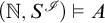 $(\mathbb N, S^{\mathscr {I}})\vDash A$
. For example, if A is
$(\mathbb N, S^{\mathscr {I}})\vDash A$
. For example, if A is ${\mathrm {T}}\ulcorner B\urcorner $
, then
${\mathrm {T}}\ulcorner B\urcorner $
, then $(\mathbb N, S)\vDash {\mathrm {T}}\ulcorner {\mathrm {T}}\ulcorner B\urcorner \urcorner $
iff
$(\mathbb N, S)\vDash {\mathrm {T}}\ulcorner {\mathrm {T}}\ulcorner B\urcorner \urcorner $
iff $B\in S^{\mathscr {I}}$
iff
$B\in S^{\mathscr {I}}$
iff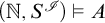 $(\mathbb N, S^{\mathscr {I}})\vDash A$
.
$(\mathbb N, S^{\mathscr {I}})\vDash A$
.
From Lemmata 18–20, we obtain the following characterization theorem.
Proposition 21 (
$\mathbb N$
-Categoricity).
 $(\mathbb N, S)\vDash \mathsf {CKF}_{\mathsf {cs}}$
iff
$(\mathbb N, S)\vDash \mathsf {CKF}_{\mathsf {cs}}$
iff $S=\mathbb T_{S^{\mathscr {I}}}$
.
$S=\mathbb T_{S^{\mathscr {I}}}$
.
There’s also a precise sense in which the logical strength of $\mathsf {CKF}_{\mathsf {cs}}$
coincides with the one of
$\mathsf {CKF}_{\mathsf {cs}}$
coincides with the one of $\mathsf {CT[KF+CONS]}$
, and therefore of
$\mathsf {CT[KF+CONS]}$
, and therefore of $\mathsf {CD}^{+}$
.
$\mathsf {CD}^{+}$
.
Proposition 22. $\mathsf {CKF}_{\mathsf {cs}}$
,
$\mathsf {CKF}_{\mathsf {cs}}$
, $\mathsf {CT[\mathsf {KF+CONS}]}$
, and
$\mathsf {CT[\mathsf {KF+CONS}]}$
, and $\mathsf {CD}^{+}$
are mutually
$\mathsf {CD}^{+}$
are mutually $\mathcal {L}_{\mathbb {N}}$
-interpretable.
$\mathcal {L}_{\mathbb {N}}$
-interpretable.
Proof. To $\mathcal {L}_{\mathbb {N}}$
-interpret
$\mathcal {L}_{\mathbb {N}}$
-interpret $\mathsf {CKF}_{\mathsf {cs}}$
in
$\mathsf {CKF}_{\mathsf {cs}}$
in $\mathsf {CT[\mathsf {KF+CONS}]}$
, one defines an
$\mathsf {CT[\mathsf {KF+CONS}]}$
, one defines an $\mathcal {L}_{\mathbb {N}}$
-translation
$\mathcal {L}_{\mathbb {N}}$
-translation $\tau \colon {\mathcal {L}}_{\mathrm {T}} \to \mathcal {L}_{{\mathrm {T}},\mathbf {T}}$
that replaces outer occurrences of
$\tau \colon {\mathcal {L}}_{\mathrm {T}} \to \mathcal {L}_{{\mathrm {T}},\mathbf {T}}$
that replaces outer occurrences of ${\mathrm {T}}$
with
${\mathrm {T}}$
with $\mathbf {T}$
:
$\mathbf {T}$
:
 $$ \begin{align*} &\tau(s=t):\leftrightarrow s=t\\ &\tau({\mathrm{T}} x):\leftrightarrow \mathbf{T}x\\ &\tau(\neg A):\leftrightarrow \neg \tau(A)\\ & \tau(A\land B):\leftrightarrow \tau(A)\land \tau(B)\\ &\tau(\forall v A):\leftrightarrow \forall x\, \tau (A(x/v)). \end{align*} $$
The translation $\tau $
is only external, and does not require applications of the primitive recursion theorem in its definition. The verification that
$\tau $
is only external, and does not require applications of the primitive recursion theorem in its definition. The verification that $\tau $
is an
$\tau $
is an $\mathcal {L}_{\mathbb {N}}$
-interpretation is fairly straightforward. The compositional principles (
$\mathcal {L}_{\mathbb {N}}$
-interpretation is fairly straightforward. The compositional principles ( ${\mathrm {T}}1$
and
${\mathrm {T}}1$
and ${\mathrm {T}}4\text {--}{\mathrm {T}}6$
) follow from the definition of the translation
${\mathrm {T}}4\text {--}{\mathrm {T}}6$
) follow from the definition of the translation $\tau $
and the compositional axioms for
$\tau $
and the compositional axioms for $\mathbf {T}$
of
$\mathbf {T}$
of $\mathsf {CT[KF+CONS]}$
. Axioms
$\mathsf {CT[KF+CONS]}$
. Axioms ${\mathrm {T}}7\text {--}{\mathrm {T}}13$
follow from the definition of
${\mathrm {T}}7\text {--}{\mathrm {T}}13$
follow from the definition of $\tau $
,
$\tau $
, $\mathbf {T}1$
, and the corresponding axiom of
$\mathbf {T}1$
, and the corresponding axiom of $\mathsf {KF}$
. For instance, for
$\mathsf {KF}$
. For instance, for ${\mathrm {T}}7$
(in non-abbreviated form):
${\mathrm {T}}7$
(in non-abbreviated form):

The last line is an axiom of $\mathsf {CT[KF+CONS]}$
. Axiom
$\mathsf {CT[KF+CONS]}$
. Axiom $\mathrm {R1}$
is proved by formal induction on the complexity of
$\mathrm {R1}$
is proved by formal induction on the complexity of $\varphi (v)$
.
$\varphi (v)$
.
For ${\mathrm {T}}\mathrm {Del}$
, one notices that, by the definition of
${\mathrm {T}}\mathrm {Del}$
, one notices that, by the definition of $\tau $
and
$\tau $
and $\mathbf {T}1$
, the translation of
$\mathbf {T}1$
, the translation of ${\mathrm {T}}\mathrm {Del}$
becomes
${\mathrm {T}}\mathrm {Del}$
becomes
 $$ \begin{align} {\mathrm{T}} {t}^{\circ}\rightarrow \mathbf{T}{t}^{\circ}. \end{align} $$
Now either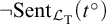 $\neg \mathrm {Sent}_{{\mathcal {L}}_{\mathrm {T}}}({t}^{\circ })$
or
$\neg \mathrm {Sent}_{{\mathcal {L}}_{\mathrm {T}}}({t}^{\circ })$
or $\mathrm {Sent}_{{\mathcal {L}}_{\mathrm {T}}}({t}^{\circ })$
. In the latter case we can then prove (11) by formal induction on the positive complexity of
$\mathrm {Sent}_{{\mathcal {L}}_{\mathrm {T}}}({t}^{\circ })$
. In the latter case we can then prove (11) by formal induction on the positive complexity of ${t}^{\circ }$
. Notice that in the case in which
${t}^{\circ }$
. Notice that in the case in which ${t}^{\circ }$
is of form
${t}^{\circ }$
is of form $\neg {\mathrm {T}} s$
, we employ
$\neg {\mathrm {T}} s$
, we employ $\mathsf {Cons}$
. If
$\mathsf {Cons}$
. If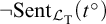 $\neg \mathrm {Sent}_{{\mathcal {L}}_{\mathrm {T}}}({t}^{\circ })$
, then
$\neg \mathrm {Sent}_{{\mathcal {L}}_{\mathrm {T}}}({t}^{\circ })$
, then $\mathrm {F}{\mathrm {T}} t$
by
$\mathrm {F}{\mathrm {T}} t$
by $\mathsf {KF}2$
, and
$\mathsf {KF}2$
, and $\neg {\mathrm {T}}{\mathrm {T}} t$
by
$\neg {\mathrm {T}}{\mathrm {T}} t$
by $\mathsf {Cons}$
, thus
$\mathsf {Cons}$
, thus $\neg {\mathrm {T}}{t}^{\circ }$
and
$\neg {\mathrm {T}}{t}^{\circ }$
and ${\mathrm {T}}{t}^{\circ }\rightarrow \mathbf {T}{t}^{\circ }$
follows trivially.
${\mathrm {T}}{t}^{\circ }\rightarrow \mathbf {T}{t}^{\circ }$
follows trivially.
To interpret $\mathsf {CT[KF+CONS]}$
in
$\mathsf {CT[KF+CONS]}$
in $\mathsf {CKF}_{\mathsf {cs}}$
, we first define the internal translation
$\mathsf {CKF}_{\mathsf {cs}}$
, we first define the internal translation $\iota \colon \mathcal {L}_{{\mathrm {T}},\mathbf {T}}\to {\mathcal {L}}_{\mathrm {T}}$
operating on codes of
$\iota \colon \mathcal {L}_{{\mathrm {T}},\mathbf {T}}\to {\mathcal {L}}_{\mathrm {T}}$
operating on codes of $\mathcal {L}_{{\mathrm {T}},\mathbf {T}}$
-formulae as follows:
$\mathcal {L}_{{\mathrm {T}},\mathbf {T}}$
-formulae as follows:

We then define the full translation $\sigma \colon \mathcal {L}_{{\mathrm {T}},\mathbf {T}}\to {\mathcal {L}}_{\mathrm {T}}$
, which replaces
$\sigma \colon \mathcal {L}_{{\mathrm {T}},\mathbf {T}}\to {\mathcal {L}}_{\mathrm {T}}$
, which replaces $\mathbf {T}$
with one single layer of
$\mathbf {T}$
with one single layer of $\mathsf {CKF}_{\mathsf {cs}}$
-truth and
$\mathsf {CKF}_{\mathsf {cs}}$
-truth and ${\mathrm {T}}$
by two, and behaves internally according to
${\mathrm {T}}$
by two, and behaves internally according to $\iota $
:
$\iota $
:

It remains to verify that $\sigma $
is the required
$\sigma $
is the required $\mathcal {L}_{\mathbb {N}}$
-interpretation of
$\mathcal {L}_{\mathbb {N}}$
-interpretation of $\mathsf {CT[KF+CONS]}$
in
$\mathsf {CT[KF+CONS]}$
in $\mathsf {CKF}_{\mathsf {cs}}$
. We consider the crucial case of
$\mathsf {CKF}_{\mathsf {cs}}$
. We consider the crucial case of $\mathsf {KF}2$
. The translation of its first conjunct is
$\mathsf {KF}2$
. The translation of its first conjunct is

which follows immediately from ${\mathrm {T}}14$
. The translation of the second conjunct of
${\mathrm {T}}14$
. The translation of the second conjunct of $\mathsf {KF}2$
is
$\mathsf {KF}2$
is

The left-to-right direction of (13) follows directly from ${\mathrm {T}}15$
. Similarly for the right-to-left direction, if
${\mathrm {T}}15$
. Similarly for the right-to-left direction, if  holds. If $\neg \mathrm {Sent}_{{\mathcal {L}}_{\mathrm {T}}}({t}^{\circ })$
,
$\neg \mathrm {Sent}_{{\mathcal {L}}_{\mathrm {T}}}({t}^{\circ })$
, $\iota ({t}^{\circ })=\ulcorner 0=1\urcorner $
, so
$\iota ({t}^{\circ })=\ulcorner 0=1\urcorner $
, so  .
.
Next, we turn to the question how $\mathsf {CD}^{+}_{\mathrm {T}}$
and
$\mathsf {CD}^{+}_{\mathrm {T}}$
and $\mathsf {CKF}_{\mathsf {cs}}$
are related. Corollaries 13 and 14 show that some of the axioms of
$\mathsf {CKF}_{\mathsf {cs}}$
are related. Corollaries 13 and 14 show that some of the axioms of $\mathsf {CKF}_{\mathsf {cs}}$
are not provable in
$\mathsf {CKF}_{\mathsf {cs}}$
are not provable in $\mathsf {CD}^{+}$
. However, as we shall see shortly, these are all provable in
$\mathsf {CD}^{+}$
. However, as we shall see shortly, these are all provable in $\mathsf {CD}^{+}_{\mathrm {T}}$
. In fact, we shall see that
$\mathsf {CD}^{+}_{\mathrm {T}}$
. In fact, we shall see that $\mathsf {CD}^{+}_{\mathrm {T}}$
and
$\mathsf {CD}^{+}_{\mathrm {T}}$
and $\mathsf {CKF}_{\mathsf {cs}}$
are identical theories.
$\mathsf {CKF}_{\mathsf {cs}}$
are identical theories.
Lemma 23. $\mathsf {CD}^{+}_{\mathrm {T}}$
is a subtheory of
$\mathsf {CD}^{+}_{\mathrm {T}}$
is a subtheory of $\mathsf {CKF}_{\mathsf {cs}}$
.
$\mathsf {CKF}_{\mathsf {cs}}$
.
Proof. We verify a few key axioms, reasoning informally within $\mathsf {CKF}_{\mathsf {cs}}$
.
$\mathsf {CKF}_{\mathsf {cs}}$
.
For T2 $^{+}$
, we use T14, (8), and distribution of T over
$^{+}$
, we use T14, (8), and distribution of T over $\lor $
.
$\lor $
.
For T3, since ${\mathrm {T}}{\mathrm {T}} t\rightarrow {\mathrm {T}}{t}^{\circ }$
is an axiom of
${\mathrm {T}}{\mathrm {T}} t\rightarrow {\mathrm {T}}{t}^{\circ }$
is an axiom of $\mathsf {CKF}_{\mathsf {cs}}$
, we have
$\mathsf {CKF}_{\mathsf {cs}}$
, we have ${\mathrm {T}}{\mathrm {T}} t\rightarrow ({\mathrm {T}}{\mathrm {T}} t\leftrightarrow {\mathrm {T}}{t}^{\circ })$
. So assume
${\mathrm {T}}{\mathrm {T}} t\rightarrow ({\mathrm {T}}{\mathrm {T}} t\leftrightarrow {\mathrm {T}}{t}^{\circ })$
. So assume ${\mathrm {T}}\mathrm {F} t$
. Then
${\mathrm {T}}\mathrm {F} t$
. Then $\mathrm {F}{t}^{\circ }$
, hence
$\mathrm {F}{t}^{\circ }$
, hence $\neg {\mathrm {T}}{t}^{\circ }$
and therefore
$\neg {\mathrm {T}}{t}^{\circ }$
and therefore ${\mathrm {T}}{t}^{\circ }\rightarrow {\mathrm {T}}{\mathrm {T}} t$
, hence
${\mathrm {T}}{t}^{\circ }\rightarrow {\mathrm {T}}{\mathrm {T}} t$
, hence ${\mathrm {T}}{t}^{\circ }\leftrightarrow {\mathrm {T}}{\mathrm {T}} t$
.
${\mathrm {T}}{t}^{\circ }\leftrightarrow {\mathrm {T}}{\mathrm {T}} t$
.
For D3, we use TCons and (10)—derivable in $\mathsf {CKF}_{\mathsf {cs}}$
—along with axioms T14 and T15.
$\mathsf {CKF}_{\mathsf {cs}}$
—along with axioms T14 and T15.
For D5, assume ${\mathrm {T}}{\mathrm {T}}(\varphi \land \psi ) \lor {\mathrm {T}}\mathrm {F}(\varphi \land \psi )$
. By T10 and T11, this is equivalent to
${\mathrm {T}}{\mathrm {T}}(\varphi \land \psi ) \lor {\mathrm {T}}\mathrm {F}(\varphi \land \psi )$
. By T10 and T11, this is equivalent to
 $$ \begin{align*} ({\mathrm{T}}{\mathrm{T}}\varphi\land{\mathrm{T}}{\mathrm{T}}\psi) &\lor ({\mathrm{T}}\mathrm{F}\varphi\lor{\mathrm{T}}\mathrm{F}\psi). \end{align*} $$
Since we have ${\mathrm {T}}\mathrm {F} t\rightarrow \mathrm {F}{t}^{\circ }$
, by a series of propositional inferences we obtain
${\mathrm {T}}\mathrm {F} t\rightarrow \mathrm {F}{t}^{\circ }$
, by a series of propositional inferences we obtain
 $$ \begin{align*}\underbrace{(({\mathrm{T}}{\mathrm{T}}\varphi\lor{\mathrm{T}}\mathrm{F}\varphi)\land({\mathrm{T}}{\mathrm{T}}\psi\lor{\mathrm{T}}\mathrm{F}\psi))}_{\delta_1} \ \lor \ \underbrace{(({\mathrm{T}}{\mathrm{T}}\varphi\lor{\mathrm{T}}\mathrm{F}\varphi)\land \mathrm{F}\varphi)}_{\delta_2} \ \lor \ \underbrace{(({\mathrm{T}}{\mathrm{T}}\psi\lor{\mathrm{T}}\mathrm{F}\psi)\land \mathrm{F}\psi)}_{\delta_3}. \end{align*} $$
Conversely, each combination obtainable from the conjuncts of $\delta _1$
entails
$\delta _1$
entails ${\mathrm {T}}{\mathrm {T}}(\varphi \land \psi ) \lor {\mathrm {T}}\mathrm {F}(\varphi \land \psi )$
. As
${\mathrm {T}}{\mathrm {T}}(\varphi \land \psi ) \lor {\mathrm {T}}\mathrm {F}(\varphi \land \psi )$
. As $\delta _2$
and
$\delta _2$
and $\delta _3$
, use T16 and T4 to obtain
$\delta _3$
, use T16 and T4 to obtain ${\mathrm {T}}\mathrm {F}\varphi \land \mathrm {F}\varphi $
, respectively,
${\mathrm {T}}\mathrm {F}\varphi \land \mathrm {F}\varphi $
, respectively, ${\mathrm {T}}\mathrm {F}\psi \land \mathrm {F}\psi $
, which entail the desired conclusion via T11.
${\mathrm {T}}\mathrm {F}\psi \land \mathrm {F}\psi $
, which entail the desired conclusion via T11.
Lemma 24. $\mathsf {CKF}_{\mathsf {cs}}$
is a subtheory of
$\mathsf {CKF}_{\mathsf {cs}}$
is a subtheory of $\mathsf {CD}^{+}_{\mathrm {T}}$
.
$\mathsf {CD}^{+}_{\mathrm {T}}$
.
Proof. The key observation is that, since $\mathsf {CD}^{+}_{\mathrm {T}}\vdash {\mathrm {T}}{\mathrm {T}}\varphi \lor {\mathrm {T}}\mathrm {F}\varphi \rightarrow ({\mathrm {T}}\varphi \leftrightarrow {\mathrm {T}}{\mathrm {T}}\varphi )$
, we can perform the necessary quotation and disquotation steps to prove compositionality within layers of
$\mathsf {CD}^{+}_{\mathrm {T}}\vdash {\mathrm {T}}{\mathrm {T}}\varphi \lor {\mathrm {T}}\mathrm {F}\varphi \rightarrow ({\mathrm {T}}\varphi \leftrightarrow {\mathrm {T}}{\mathrm {T}}\varphi )$
, we can perform the necessary quotation and disquotation steps to prove compositionality within layers of ${\mathrm {T}}$
. For example, to see that
${\mathrm {T}}$
. For example, to see that $\mathsf {CD}^{+}_{\mathrm {T}}\vdash {\mathrm {T}}9$
, assume
$\mathsf {CD}^{+}_{\mathrm {T}}\vdash {\mathrm {T}}9$
, assume ${\mathrm {T}}{\mathrm {T}}\varphi $
(or
${\mathrm {T}}{\mathrm {T}}\varphi $
(or ${\mathrm {T}}{\mathrm {T}}\neg \neg \varphi $
). Then
${\mathrm {T}}{\mathrm {T}}\neg \neg \varphi $
). Then ${\mathrm {T}}{\mathrm {T}}\varphi \lor {\mathrm {T}}\mathrm {F}\varphi $
and
${\mathrm {T}}{\mathrm {T}}\varphi \lor {\mathrm {T}}\mathrm {F}\varphi $
and ${\mathrm {T}}{\mathrm {T}}\neg \varphi \lor {\mathrm {T}}\mathrm {F}\neg \varphi $
, therefore we have both
${\mathrm {T}}{\mathrm {T}}\neg \varphi \lor {\mathrm {T}}\mathrm {F}\neg \varphi $
, therefore we have both ${\mathrm {T}}{\mathrm {T}}\varphi \leftrightarrow {\mathrm {T}}\varphi $
and
${\mathrm {T}}{\mathrm {T}}\varphi \leftrightarrow {\mathrm {T}}\varphi $
and ${\mathrm {T}}{\mathrm {T}}\neg \neg \varphi \leftrightarrow {\mathrm {T}}\neg \neg \varphi $
. But then
${\mathrm {T}}{\mathrm {T}}\neg \neg \varphi \leftrightarrow {\mathrm {T}}\neg \neg \varphi $
. But then ${\mathrm {T}}{\mathrm {T}}\varphi \leftrightarrow {\mathrm {T}}\varphi \leftrightarrow {\mathrm {T}}\neg \neg \varphi \leftrightarrow {\mathrm {T}}{\mathrm {T}}\neg \neg \varphi $
. The derivability of other axioms follows a similar pattern. We show some examples, reasoning informally within
${\mathrm {T}}{\mathrm {T}}\varphi \leftrightarrow {\mathrm {T}}\varphi \leftrightarrow {\mathrm {T}}\neg \neg \varphi \leftrightarrow {\mathrm {T}}{\mathrm {T}}\neg \neg \varphi $
. The derivability of other axioms follows a similar pattern. We show some examples, reasoning informally within $\mathsf {CD}^{+}_{\mathrm {T}}$
.
$\mathsf {CD}^{+}_{\mathrm {T}}$
.
T10: Assume ${\mathrm {T}}{\mathrm {T}}(\varphi \land \psi )$
. Then
${\mathrm {T}}{\mathrm {T}}(\varphi \land \psi )$
. Then ${\mathrm {T}}{\mathrm {T}}(\varphi \land \psi )\rightarrow {\mathrm {T}}(\varphi \land \psi )$
by T3,Footnote
11
hence
${\mathrm {T}}{\mathrm {T}}(\varphi \land \psi )\rightarrow {\mathrm {T}}(\varphi \land \psi )$
by T3,Footnote
11
hence ${\mathrm {T}}\varphi \land {\mathrm {T}}\psi $
, and therefore
${\mathrm {T}}\varphi \land {\mathrm {T}}\psi $
, and therefore $\neg \mathrm {F}\varphi \land \neg \mathrm {F}\psi $
. This together with
$\neg \mathrm {F}\varphi \land \neg \mathrm {F}\psi $
. This together with ${\mathrm {T}}{\mathrm {T}}(\varphi \land \psi )$
yields, via D5, that
${\mathrm {T}}{\mathrm {T}}(\varphi \land \psi )$
yields, via D5, that $\varphi $
and
$\varphi $
and $\psi $
are determinate, i.e.,
$\psi $
are determinate, i.e., ${\mathrm {T}}{\mathrm {T}}\varphi \lor {\mathrm {T}}\mathrm {F}\varphi $
and
${\mathrm {T}}{\mathrm {T}}\varphi \lor {\mathrm {T}}\mathrm {F}\varphi $
and ${\mathrm {T}}{\mathrm {T}}\psi \lor {\mathrm {T}}\mathrm {F}\psi $
. Hence we conclude
${\mathrm {T}}{\mathrm {T}}\psi \lor {\mathrm {T}}\mathrm {F}\psi $
. Hence we conclude ${\mathrm {T}}{\mathrm {T}}\varphi \land {\mathrm {T}}{\mathrm {T}}\psi $
from
${\mathrm {T}}{\mathrm {T}}\varphi \land {\mathrm {T}}{\mathrm {T}}\psi $
from ${\mathrm {T}}\varphi \land {\mathrm {T}}\psi $
.
${\mathrm {T}}\varphi \land {\mathrm {T}}\psi $
.
For the converse direction, ${\mathrm {T}}{\mathrm {T}}\varphi \land {\mathrm {T}}{\mathrm {T}}\psi $
entails
${\mathrm {T}}{\mathrm {T}}\varphi \land {\mathrm {T}}{\mathrm {T}}\psi $
entails ${\mathrm {T}}{\mathrm {T}}(\varphi \land \psi )\lor {\mathrm {T}}\mathrm {F}(\varphi \land \psi )$
by D5. Moreover, since
${\mathrm {T}}{\mathrm {T}}(\varphi \land \psi )\lor {\mathrm {T}}\mathrm {F}(\varphi \land \psi )$
by D5. Moreover, since ${\mathrm {T}}{\mathrm {T}}\varphi \land {\mathrm {T}}{\mathrm {T}}\psi $
also entails
${\mathrm {T}}{\mathrm {T}}\varphi \land {\mathrm {T}}{\mathrm {T}}\psi $
also entails ${\mathrm {T}}\varphi \land {\mathrm {T}}\psi $
, we get
${\mathrm {T}}\varphi \land {\mathrm {T}}\psi $
, we get ${\mathrm {T}}(\varphi \land \psi )$
, hence
${\mathrm {T}}(\varphi \land \psi )$
, hence ${\mathrm {T}}{\mathrm {T}}(\varphi \land \psi )$
by T3.
${\mathrm {T}}{\mathrm {T}}(\varphi \land \psi )$
by T3.
T16: If ${\mathrm {T}}{\mathrm {T}}\varphi $
, then
${\mathrm {T}}{\mathrm {T}}\varphi $
, then ${\mathrm {T}}{\mathrm {T}}\varphi \lor {\mathrm {T}}\mathrm {F}\varphi $
, hence
${\mathrm {T}}{\mathrm {T}}\varphi \lor {\mathrm {T}}\mathrm {F}\varphi $
, hence ${\mathrm {T}}\varphi $
by T3.
${\mathrm {T}}\varphi $
by T3.
As a corollary we obtain the following.
Proposition 25. $\mathsf {CD}^{+}_{\mathrm {T}}$
and
$\mathsf {CD}^{+}_{\mathrm {T}}$
and $\mathsf {CKF}_{\mathsf {cs}}$
are identical theories.
$\mathsf {CKF}_{\mathsf {cs}}$
are identical theories.
5 Alternative axiomatizations
As mentioned, the theory $\mathsf {CKF}_{\mathsf {cs}}$
contains, along with Kripkean truth conditions in the inner layers of truth, an axiom (TDel) restricting the class of fixed points to those that are consistent. In this section, we discuss alternative consistency axioms.
$\mathsf {CKF}_{\mathsf {cs}}$
contains, along with Kripkean truth conditions in the inner layers of truth, an axiom (TDel) restricting the class of fixed points to those that are consistent. In this section, we discuss alternative consistency axioms.
The axiom TDel is reminiscent of the schema often called T-Out: ${\mathrm {T}}\ulcorner A\urcorner \rightarrow A$
. It is also known (see [Reference Cantini4]) that T-Out is equivalent to the consistency axiom Cons:
${\mathrm {T}}\ulcorner A\urcorner \rightarrow A$
. It is also known (see [Reference Cantini4]) that T-Out is equivalent to the consistency axiom Cons: $\forall \varphi :{\mathcal {L}}_{\mathrm {T}} (\mathrm {F} \varphi \rightarrow \neg {\mathrm {T}} \varphi )$
. It may be asked whether TDel is equivalent to TCons from Observation 17:
$\forall \varphi :{\mathcal {L}}_{\mathrm {T}} (\mathrm {F} \varphi \rightarrow \neg {\mathrm {T}} \varphi )$
. It may be asked whether TDel is equivalent to TCons from Observation 17: ${\mathrm {T}}\mathrm {F} \varphi \rightarrow \neg {\mathrm {T}}{\mathrm {T}}\varphi $
. The fact that the latter follows from the former is straightforward:
${\mathrm {T}}\mathrm {F} \varphi \rightarrow \neg {\mathrm {T}}{\mathrm {T}}\varphi $
. The fact that the latter follows from the former is straightforward: ${\mathrm {T}}\mathrm {F} \varphi \rightarrow \mathrm {F}\varphi \rightarrow \neg {\mathrm {T}}\varphi \rightarrow \neg {\mathrm {T}}{\mathrm {T}}\varphi $
. However, the converse employs an extra axiom stating that only sentences are truly true.
${\mathrm {T}}\mathrm {F} \varphi \rightarrow \mathrm {F}\varphi \rightarrow \neg {\mathrm {T}}\varphi \rightarrow \neg {\mathrm {T}}{\mathrm {T}}\varphi $
. However, the converse employs an extra axiom stating that only sentences are truly true.
Lemma 26. $\mathsf {CKF}_{\mathsf {cs}}-{\mathrm {T}}\mathrm {Del}+\mathrm {TCons}+{\mathrm {T}}{\mathrm {T}} t\rightarrow \mathrm {Sent}_{{\mathcal {L}}_{\mathrm {T}}}(t^\circ )\vdash {\mathrm {T}}\mathrm {Del}$
.
$\mathsf {CKF}_{\mathsf {cs}}-{\mathrm {T}}\mathrm {Del}+\mathrm {TCons}+{\mathrm {T}}{\mathrm {T}} t\rightarrow \mathrm {Sent}_{{\mathcal {L}}_{\mathrm {T}}}(t^\circ )\vdash {\mathrm {T}}\mathrm {Del}$
.
Proof. We distinguish cases. If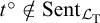 $t^\circ \notin \mathrm {Sent}_{{\mathcal {L}}_{\mathrm {T}}}$
, then
$t^\circ \notin \mathrm {Sent}_{{\mathcal {L}}_{\mathrm {T}}}$
, then $\neg {\mathrm {T}}{\mathrm {T}} t$
, hence trivially
$\neg {\mathrm {T}}{\mathrm {T}} t$
, hence trivially ${\mathrm {T}}{\mathrm {T}} t\rightarrow {\mathrm {T}} t$
. Else, we reason by induction on the formal complexity of
${\mathrm {T}}{\mathrm {T}} t\rightarrow {\mathrm {T}} t$
. Else, we reason by induction on the formal complexity of $t^\circ =\varphi $
. If
$t^\circ =\varphi $
. If $\varphi $
is an equality, the claim follows from T7 and T8. If
$\varphi $
is an equality, the claim follows from T7 and T8. If $\varphi \equiv {\mathrm {T}} t$
, the claim follows from T14. If
$\varphi \equiv {\mathrm {T}} t$
, the claim follows from T14. If $\varphi \equiv \neg {\mathrm {T}} t$
, we use T15 and the additional axiom:
$\varphi \equiv \neg {\mathrm {T}} t$
, we use T15 and the additional axiom: ${\mathrm {T}}{\mathrm {T}}\neg {\mathrm {T}} t\rightarrow {\mathrm {T}}\mathrm {F} t\rightarrow \neg {\mathrm {T}}{\mathrm {T}} t\rightarrow {\mathrm {T}}\neg {\mathrm {T}} t$
.
${\mathrm {T}}{\mathrm {T}}\neg {\mathrm {T}} t\rightarrow {\mathrm {T}}\mathrm {F} t\rightarrow \neg {\mathrm {T}}{\mathrm {T}} t\rightarrow {\mathrm {T}}\neg {\mathrm {T}} t$
.
Additionally, it can be observed that TCons is equivalent to ${\mathrm {T}}\mathrm {F}{\mathrm {T}} t\rightarrow \mathrm {F}{\mathrm {T}} t$
.
${\mathrm {T}}\mathrm {F}{\mathrm {T}} t\rightarrow \mathrm {F}{\mathrm {T}} t$
.
Lemma 27. The theories $\mathsf {CKF}_{\mathsf {cs}}-{\mathrm {T}}\mathrm {Del}+\mathrm {TCons}$
and
$\mathsf {CKF}_{\mathsf {cs}}-{\mathrm {T}}\mathrm {Del}+\mathrm {TCons}$
and $\mathsf {CKF}_{\mathsf {cs}}-{\mathrm {T}}\mathrm {Del}+{\mathrm {T}}\mathrm {F} t \rightarrow \neg {\mathrm {T}}{\mathrm {T}} t$
prove the same theorems.
$\mathsf {CKF}_{\mathsf {cs}}-{\mathrm {T}}\mathrm {Del}+{\mathrm {T}}\mathrm {F} t \rightarrow \neg {\mathrm {T}}{\mathrm {T}} t$
prove the same theorems.
Proof. To derive TCons from ${\mathrm {T}}\mathrm {F}{\mathrm {T}} t\rightarrow \mathrm {F}{\mathrm {T}} t$
, we use T15:
${\mathrm {T}}\mathrm {F}{\mathrm {T}} t\rightarrow \mathrm {F}{\mathrm {T}} t$
, we use T15: ${\mathrm {T}}\mathrm {F} t\rightarrow {\mathrm {T}}\mathrm {F}{\mathrm {T}} t\rightarrow \mathrm {F}{\mathrm {T}} t\rightarrow \neg {\mathrm {T}}{\mathrm {T}} t$
. Conversely, the claim follows from the previous lemma observing that, for
${\mathrm {T}}\mathrm {F} t\rightarrow {\mathrm {T}}\mathrm {F}{\mathrm {T}} t\rightarrow \mathrm {F}{\mathrm {T}} t\rightarrow \neg {\mathrm {T}}{\mathrm {T}} t$
. Conversely, the claim follows from the previous lemma observing that, for $t\in \mathrm {CTerm}$
, we have
$t\in \mathrm {CTerm}$
, we have ${\mathrm {T}}\mathrm {F} t\in \mathrm {Sent}_{{\mathcal {L}}_{\mathrm {T}}}$
.
${\mathrm {T}}\mathrm {F} t\in \mathrm {Sent}_{{\mathcal {L}}_{\mathrm {T}}}$
.
Collecting these observation together, we obtain the following proposition (cf. [Reference Halbach16, lemma 15.9]).
Proposition 28. Over $\mathsf {CKF}_{\mathsf {cs}}\,-\,{\mathrm {T}}\mathrm {Del}\, +\, {\mathrm {T}}{\mathrm {T}} t\rightarrow \mathrm {Sent}_{{\mathcal {L}}_{\mathrm {T}}}(t^\circ )$
, the following statements are equivalent:
$\mathsf {CKF}_{\mathsf {cs}}\,-\,{\mathrm {T}}\mathrm {Del}\, +\, {\mathrm {T}}{\mathrm {T}} t\rightarrow \mathrm {Sent}_{{\mathcal {L}}_{\mathrm {T}}}(t^\circ )$
, the following statements are equivalent:
-
(i)
${\mathrm {T}}{\mathrm {T}} t\rightarrow {\mathrm {T}} t$
; -
(ii)
${\mathrm {T}}\mathrm {F} t \rightarrow \neg {\mathrm {T}}{\mathrm {T}} t$
; -
(iii)
${\mathrm {T}}\mathrm {F}{\mathrm {T}} t\rightarrow \mathrm {F}{\mathrm {T}} t$
.



Some formulations of $\mathsf {KF}$
(e.g., [Reference Cantini3, Reference Reinhardt23]) do include the axiom
$\mathsf {KF}$
(e.g., [Reference Cantini3, Reference Reinhardt23]) do include the axiom ${\mathrm {T}} t\rightarrow \mathrm {Sent}(t^\circ )$
. However, we decided not to include
${\mathrm {T}} t\rightarrow \mathrm {Sent}(t^\circ )$
. However, we decided not to include ${\mathrm {T}}{\mathrm {T}} t\rightarrow \mathrm {Sent}_{{\mathcal {L}}_{\mathrm {T}}}(t^\circ )$
in our official formulation of
${\mathrm {T}}{\mathrm {T}} t\rightarrow \mathrm {Sent}_{{\mathcal {L}}_{\mathrm {T}}}(t^\circ )$
in our official formulation of $\mathsf {CKF}_{\mathsf {cs}}$
in order to simplify its comparison with
$\mathsf {CKF}_{\mathsf {cs}}$
in order to simplify its comparison with $\mathsf {CD}^{+}_{\mathrm {T}}$
. If
$\mathsf {CD}^{+}_{\mathrm {T}}$
. If $\mathsf {CKF}_{\mathsf {cs}}$
were defined without TDel but with, for example, TCons along with
$\mathsf {CKF}_{\mathsf {cs}}$
were defined without TDel but with, for example, TCons along with ${\mathrm {T}}{\mathrm {T}} t\rightarrow \mathrm {Sent}_{{\mathcal {L}}_{\mathrm {T}}}(t^\circ )$
, then the equivalence stated in Proposition 25 would need to be reformulated as follows.
${\mathrm {T}}{\mathrm {T}} t\rightarrow \mathrm {Sent}_{{\mathcal {L}}_{\mathrm {T}}}(t^\circ )$
, then the equivalence stated in Proposition 25 would need to be reformulated as follows.
Lemma 29. The theories $\mathsf {CKF}_{\mathsf {cs}}':=\mathsf {CKF}_{\mathsf {cs}} - {\mathrm {T}}\mathrm {Del} + \mathrm {TCons} + {\mathrm {T}}{\mathrm {T}} t\rightarrow \mathrm {Sent}_{{\mathcal {L}}_{\mathrm {T}}}(t^\circ )$
and
$\mathsf {CKF}_{\mathsf {cs}}':=\mathsf {CKF}_{\mathsf {cs}} - {\mathrm {T}}\mathrm {Del} + \mathrm {TCons} + {\mathrm {T}}{\mathrm {T}} t\rightarrow \mathrm {Sent}_{{\mathcal {L}}_{\mathrm {T}}}(t^\circ )$
and $\mathsf {CD}^{+}_{\mathrm {T}} + \mathrm {D} t \rightarrow \mathrm {Sent}_{{\mathcal {L}}_{\mathrm {T}}}(t^\circ )$
are identical.Footnote
12
$\mathsf {CD}^{+}_{\mathrm {T}} + \mathrm {D} t \rightarrow \mathrm {Sent}_{{\mathcal {L}}_{\mathrm {T}}}(t^\circ )$
are identical.Footnote
12
Proof. For the inclusion of $\mathsf {CD}^{+}_{\mathrm {T}} + \mathrm {D} t \rightarrow \mathrm {Sent}_{{\mathcal {L}}_{\mathrm {T}}}(t)$
into
$\mathsf {CD}^{+}_{\mathrm {T}} + \mathrm {D} t \rightarrow \mathrm {Sent}_{{\mathcal {L}}_{\mathrm {T}}}(t)$
into $\mathsf {CKF}_{\mathsf {cs}}'$
, the crucial axioms are T3 and
$\mathsf {CKF}_{\mathsf {cs}}'$
, the crucial axioms are T3 and $\mathrm {D} t \rightarrow \mathrm {Sent}_{{\mathcal {L}}_{\mathrm {T}}}(t^\circ )$
. As for the latter,
$\mathrm {D} t \rightarrow \mathrm {Sent}_{{\mathcal {L}}_{\mathrm {T}}}(t^\circ )$
. As for the latter, ${\mathrm {T}}{\mathrm {T}} t\rightarrow \mathrm {Sent}_{{\mathcal {L}}_{\mathrm {T}}}(t^\circ )$
is just an axiom of
${\mathrm {T}}{\mathrm {T}} t\rightarrow \mathrm {Sent}_{{\mathcal {L}}_{\mathrm {T}}}(t^\circ )$
is just an axiom of $\mathsf {CKF}_{\mathsf {cs}}'$
. As for
$\mathsf {CKF}_{\mathsf {cs}}'$
. As for ${\mathrm {T}}\mathrm {F} t\rightarrow \mathrm {Sent}_{{\mathcal {L}}_{\mathrm {T}}}(t^\circ )$
, it follows from
${\mathrm {T}}\mathrm {F} t\rightarrow \mathrm {Sent}_{{\mathcal {L}}_{\mathrm {T}}}(t^\circ )$
, it follows from  , hence $\mathrm {Sent}_{{\mathcal {L}}_{\mathrm {T}}}(t^\circ )$
.
$\mathrm {Sent}_{{\mathcal {L}}_{\mathrm {T}}}(t^\circ )$
.
For T3, we distinguish two cases. If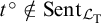 $t^\circ \notin \mathrm {Sent}_{{\mathcal {L}}_{\mathrm {T}}}$
, then
$t^\circ \notin \mathrm {Sent}_{{\mathcal {L}}_{\mathrm {T}}}$
, then 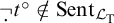 , hence ${\mathrm {T}}{\mathrm {T}} t\rightarrow \bot \land {\mathrm {T}}\mathrm {F} t\rightarrow \bot $
, hence trivially
${\mathrm {T}}{\mathrm {T}} t\rightarrow \bot \land {\mathrm {T}}\mathrm {F} t\rightarrow \bot $
, hence trivially ${\mathrm {T}}{\mathrm {T}} t\lor {\mathrm {T}}\mathrm {F} t\rightarrow ({\mathrm {T}}{\mathrm {T}} t\leftrightarrow {\mathrm {T}} t^\circ )$
. If
${\mathrm {T}}{\mathrm {T}} t\lor {\mathrm {T}}\mathrm {F} t\rightarrow ({\mathrm {T}}{\mathrm {T}} t\leftrightarrow {\mathrm {T}} t^\circ )$
. If $t\in \mathrm {Sent}(t)$
, by Lemma 26 we have
$t\in \mathrm {Sent}(t)$
, by Lemma 26 we have ${\mathrm {T}}{\mathrm {T}} t\rightarrow {\mathrm {T}} t^\circ $
, hence
${\mathrm {T}}{\mathrm {T}} t\rightarrow {\mathrm {T}} t^\circ $
, hence ${\mathrm {T}}{\mathrm {T}} t\leftrightarrow ({\mathrm {T}} t^\circ \leftrightarrow {\mathrm {T}}{\mathrm {T}} t)$
. For the second disjunct, using Proposition 28 we have
${\mathrm {T}}{\mathrm {T}} t\leftrightarrow ({\mathrm {T}} t^\circ \leftrightarrow {\mathrm {T}}{\mathrm {T}} t)$
. For the second disjunct, using Proposition 28 we have ${\mathrm {T}}\mathrm {F} t\rightarrow \mathrm {F} t^\circ \rightarrow \neg {\mathrm {T}} t^\circ \rightarrow ({\mathrm {T}} t^\circ \rightarrow {\mathrm {T}}{\mathrm {T}} t)$
.
${\mathrm {T}}\mathrm {F} t\rightarrow \mathrm {F} t^\circ \rightarrow \neg {\mathrm {T}} t^\circ \rightarrow ({\mathrm {T}} t^\circ \rightarrow {\mathrm {T}}{\mathrm {T}} t)$
.
For the converse inclusion of $\mathsf {CKF}_{\mathsf {cs}}'$
into
$\mathsf {CKF}_{\mathsf {cs}}'$
into $\mathsf {CD}^{+}_{\mathrm {T}} + \mathrm {D} t \rightarrow \mathrm {Sent}_{{\mathcal {L}}_{\mathrm {T}}}(t)$
, the crucial cases are TCons and
$\mathsf {CD}^{+}_{\mathrm {T}} + \mathrm {D} t \rightarrow \mathrm {Sent}_{{\mathcal {L}}_{\mathrm {T}}}(t)$
, the crucial cases are TCons and ${\mathrm {T}}{\mathrm {T}} t\rightarrow \mathrm {Sent}_{{\mathcal {L}}_{\mathrm {T}}}(t^\circ )$
. The latter follows from
${\mathrm {T}}{\mathrm {T}} t\rightarrow \mathrm {Sent}_{{\mathcal {L}}_{\mathrm {T}}}(t^\circ )$
. The latter follows from $\mathrm {D} t \rightarrow \mathrm {Sent}_{{\mathcal {L}}_{\mathrm {T}}}(t)$
. The former can be derived thus:
$\mathrm {D} t \rightarrow \mathrm {Sent}_{{\mathcal {L}}_{\mathrm {T}}}(t)$
. The former can be derived thus: ${\mathrm {T}}\mathrm {F} t\rightarrow \mathrm {F} t\rightarrow \neg {\mathrm {T}} t\rightarrow \neg {\mathrm {T}}{\mathrm {T}} t$
.
${\mathrm {T}}\mathrm {F} t\rightarrow \mathrm {F} t\rightarrow \neg {\mathrm {T}} t\rightarrow \neg {\mathrm {T}}{\mathrm {T}} t$
.
6 Complete, symmetric, and mixed fixed points
In this section, we verify whether the results from previous sections carry over if one focuses on different classes of fixed points of $\mathscr {K}$
. We provide a positive answer for the class of complete fixed points as well as for the class of consistent or complete fixed points. Specifically, given a complete fixed-point X of
$\mathscr {K}$
. We provide a positive answer for the class of complete fixed points as well as for the class of consistent or complete fixed points. Specifically, given a complete fixed-point X of $\mathscr {K}$
, the structure
$\mathscr {K}$
, the structure $(\mathbb {N},\mathbb T_X)$
can be shown to be a model of the determinateness axioms of
$(\mathbb {N},\mathbb T_X)$
can be shown to be a model of the determinateness axioms of $\mathsf {CD}^{+}$
with D defined in terms of
$\mathsf {CD}^{+}$
with D defined in terms of ${\mathrm {T}}$
. Moreover, the resulting theory can be shown to be identical to a variant of
${\mathrm {T}}$
. Moreover, the resulting theory can be shown to be identical to a variant of $\mathsf {CKF}_{\mathsf {cs}}$
. Similarly for the class of fixed points which are either consistent or complete. The question whether similar results are available for mixed fixed points, i.e., fixed points which are neither consistent nor complete, will be left open.
$\mathsf {CKF}_{\mathsf {cs}}$
. Similarly for the class of fixed points which are either consistent or complete. The question whether similar results are available for mixed fixed points, i.e., fixed points which are neither consistent nor complete, will be left open.
6.1 Complete models
Since the structure of the arguments is very similar, we limit ourselves to highlighting the necessary modifications.
Definition 30 (
${{\mathsf {CD}^{+}_{\mathrm {T}}}[\mathsf {COMP}]}$
).
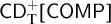
Let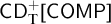 ${\mathsf {CD}^{+}_{\mathrm {T}}}[\mathsf {COMP}]$
be the
${\mathsf {CD}^{+}_{\mathrm {T}}}[\mathsf {COMP}]$
be the ${\mathcal {L}}_{\mathrm {T}}$
-theory whose axioms are those of
${\mathcal {L}}_{\mathrm {T}}$
-theory whose axioms are those of $\mathsf {CD}^{+}$
, but where D defined in terms of
$\mathsf {CD}^{+}$
, but where D defined in terms of ${\mathrm {T}}$
as
${\mathrm {T}}$
as
 $$ \begin{align} &\mathrm{D} x:\leftrightarrow \neg{\mathrm{T}}{\mathrm{T}} x\lor\neg{\mathrm{T}}\mathrm{F} x. \end{align} $$
It can be shown that, given a complete fixed-point $X=\mathscr {K}(X)$
, the structure
$X=\mathscr {K}(X)$
, the structure $(\mathbb N, \mathbb T_X)$
, where
$(\mathbb N, \mathbb T_X)$
, where $\mathbb T_X:=\{A\in {\mathcal {L}}_{\mathrm {T}}\mid (\mathbb N, X)\vDash A\}$
, is a model of
$\mathbb T_X:=\{A\in {\mathcal {L}}_{\mathrm {T}}\mid (\mathbb N, X)\vDash A\}$
, is a model of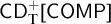 $\mathsf {CD}^{+}_{\mathrm {T}}[\mathsf {COMP}]$
. The argument follows the blueprint of Proposition 10. We first observe that, since a complete fixed-point X of
$\mathsf {CD}^{+}_{\mathrm {T}}[\mathsf {COMP}]$
. The argument follows the blueprint of Proposition 10. We first observe that, since a complete fixed-point X of $\mathscr K$
is such that
$\mathscr K$
is such that $(\mathbb {N}, X)\vDash \mathsf {KF+COMP}$
, and since
$(\mathbb {N}, X)\vDash \mathsf {KF+COMP}$
, and since $\mathsf {KF+COMP}$
derives the schema
$\mathsf {KF+COMP}$
derives the schema $A\rightarrow {\mathrm {T}}\ulcorner A\urcorner $
, we have the following.
$A\rightarrow {\mathrm {T}}\ulcorner A\urcorner $
, we have the following.
Fact 31. For any complete fixed-point X, for any A, $(\mathbb {N}, X)\vDash A\rightarrow {\mathrm {T}}\ulcorner A\urcorner $
.
$(\mathbb {N}, X)\vDash A\rightarrow {\mathrm {T}}\ulcorner A\urcorner $
.
Just as Fact 9 was used in the proof of Proposition 10, Fact 31 will play a similar role in the proof of the following.
Proposition 32. For a complete fixed-point X, $(\mathbb {N},\mathbb T_X)\vDash \mathsf {CD}^{+}_{\mathrm {T}}[\mathsf {COMP}]$
.
$(\mathbb {N},\mathbb T_X)\vDash \mathsf {CD}^{+}_{\mathrm {T}}[\mathsf {COMP}]$
.
Proof Sketch.
By induction on the length of proofs in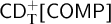 $\mathsf {CD}^{+}_{\mathrm {T}}[\mathsf {COMP}]$
. We verify T3 and D3, whose arguments are symmetric to those in the proof of Proposition 10.
$\mathsf {CD}^{+}_{\mathrm {T}}[\mathsf {COMP}]$
. We verify T3 and D3, whose arguments are symmetric to those in the proof of Proposition 10.
T3: Assume $(\mathbb {N},\mathbb {T}_{X})\vDash \neg {\mathrm {T}}{\mathrm {T}}\varphi \lor \neg {\mathrm {T}}\mathrm {F}\varphi $
, which is the case iff
$(\mathbb {N},\mathbb {T}_{X})\vDash \neg {\mathrm {T}}{\mathrm {T}}\varphi \lor \neg {\mathrm {T}}\mathrm {F}\varphi $
, which is the case iff $\{\varphi ,\neg \varphi \}\not \subseteq X$
. To show
$\{\varphi ,\neg \varphi \}\not \subseteq X$
. To show $(\mathbb {N}, \mathbb {T}_X)\vDash {\mathrm {T}}{\mathrm {T}}\varphi \rightarrow {\mathrm {T}}\varphi $
, let
$(\mathbb {N}, \mathbb {T}_X)\vDash {\mathrm {T}}{\mathrm {T}}\varphi \rightarrow {\mathrm {T}}\varphi $
, let $\varphi =\ulcorner A\urcorner $
and assume
$\varphi =\ulcorner A\urcorner $
and assume $(\mathbb {N}, \mathbb {T}_{X})\vDash {\mathrm {T}}{\mathrm {T}}\varphi $
, which is equivalent to
$(\mathbb {N}, \mathbb {T}_{X})\vDash {\mathrm {T}}{\mathrm {T}}\varphi $
, which is equivalent to $\varphi \in X$
. Towards a contradiction, suppose
$\varphi \in X$
. Towards a contradiction, suppose $(\mathbb {N}, \mathbb T_X)\not \vDash {\mathrm {T}}\varphi $
, hence
$(\mathbb {N}, \mathbb T_X)\not \vDash {\mathrm {T}}\varphi $
, hence $(\mathbb {N}, X)\not \vDash A$
. By Fact 31, we get
$(\mathbb {N}, X)\not \vDash A$
. By Fact 31, we get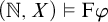 $(\mathbb {N}, X)\vDash \mathrm {F}\varphi $
iff
$(\mathbb {N}, X)\vDash \mathrm {F}\varphi $
iff $\neg \varphi \in X$
, contradicting our assumption.
$\neg \varphi \in X$
, contradicting our assumption.
Conversely, to show $(\mathbb {N}, \mathbb {T}_X)\vDash {\mathrm {T}}\varphi \rightarrow {\mathrm {T}}{\mathrm {T}}\varphi $
, we reason as follows without using the assumption on the determinateness of
$(\mathbb {N}, \mathbb {T}_X)\vDash {\mathrm {T}}\varphi \rightarrow {\mathrm {T}}{\mathrm {T}}\varphi $
, we reason as follows without using the assumption on the determinateness of $\varphi $
:
$\varphi $
:
 $$ \begin{align*}&(\mathbb{N}, \mathbb{T}_{X})\vDash{\mathrm{T}}\varphi, \kern27pt \text{ iff }\\&(\mathbb{N},{X})\vDash A, \kern39.5pt {hence}, \text{ by Fact 31}\\&(\mathbb{N}, X)\vDash {\mathrm{T}}\varphi, \kern32pt \text{ iff}\\&(\mathbb{N}, \mathbb{T}_{X})\vDash{\mathrm{T}}{\mathrm{T}}\varphi. \end{align*} $$
D3: We need to show that $(\mathbb {N}, \mathbb T_X)\vDash \neg {\mathrm {T}}{\mathrm {T}}\varphi \lor \neg {\mathrm {T}}\mathrm {F}\varphi $
is equivalent to
$(\mathbb {N}, \mathbb T_X)\vDash \neg {\mathrm {T}}{\mathrm {T}}\varphi \lor \neg {\mathrm {T}}\mathrm {F}\varphi $
is equivalent to
 $$ \begin{align*} & (\mathbb{N}, \mathbb T_X)\vDash\neg{\mathrm{T}}{\mathrm{T}} \big(\neg{\mathrm{T}}{\mathrm{T}}\varphi\lor\neg{\mathrm{T}}\mathrm{F}\varphi\big) \lor \neg{\mathrm{T}}\mathrm{F} \big(\neg{\mathrm{T}}{\mathrm{T}}\varphi\lor\neg{\mathrm{T}}\mathrm{F}\varphi\big). \end{align*} $$
The latter is equivalent to
 $$ \begin{align*} \underbrace{(\mathbb{N}, X)\vDash\neg{\mathrm{T}}\big(\neg{\mathrm{T}}{\mathrm{T}}\varphi\lor\neg{\mathrm{T}}\mathrm{F}\varphi\big)}_{d_1} \ \text{ or }& \ \underbrace{(\mathbb{N}, X)\vDash\neg\mathrm{F}\big(\neg{\mathrm{T}}{\mathrm{T}}\varphi\lor\neg{\mathrm{T}}\mathrm{F}\varphi\big)}_{d_2}. \end{align*} $$
Since $d_1$
and
$d_1$
and $d_2$
are equivalent to, respectively,
$d_2$
are equivalent to, respectively, $(\mathbb {N}, X)\vDash \neg {\mathrm {T}}\varphi \land \neg \mathrm {F}\varphi $
and
$(\mathbb {N}, X)\vDash \neg {\mathrm {T}}\varphi \land \neg \mathrm {F}\varphi $
and $(\mathbb {N}, X)\vDash \neg \mathrm {F}\varphi \lor \neg {\mathrm {T}}\varphi $
, by completeness of X it can be observed that their disjunction is equivalent to
$(\mathbb {N}, X)\vDash \neg \mathrm {F}\varphi \lor \neg {\mathrm {T}}\varphi $
, by completeness of X it can be observed that their disjunction is equivalent to $d_2$
, which is equivalent to
$d_2$
, which is equivalent to $(\mathbb {N}, \mathbb T_X)\vDash \neg {\mathrm {T}}{\mathrm {T}}\varphi \lor \neg {\mathrm {T}}\mathrm {F}\varphi $
, as required.
$(\mathbb {N}, \mathbb T_X)\vDash \neg {\mathrm {T}}{\mathrm {T}}\varphi \lor \neg {\mathrm {T}}\mathrm {F}\varphi $
, as required.
A collection of principles inspired by the models $(\mathbb N, \mathbb T_X)$
for X a complete fixed point can be obtained by modifying
$(\mathbb N, \mathbb T_X)$
for X a complete fixed point can be obtained by modifying $\mathsf {CKF}_{\mathsf {cs}}$
in the obvious way, that is, by replacing the axiom expressing consistency with one expressing completeness, leaving the remaining axioms characterising the closure of KF unmodified.
$\mathsf {CKF}_{\mathsf {cs}}$
in the obvious way, that is, by replacing the axiom expressing consistency with one expressing completeness, leaving the remaining axioms characterising the closure of KF unmodified.
Definition 33 (
$\mathsf {CKF_{cp}}$
).
 $\mathsf {CKF_{cp}}$
is the system obtained from
$\mathsf {CKF_{cp}}$
is the system obtained from $\mathsf {CKF}_{\mathsf {cs}}$
by replacing TDel with
$\mathsf {CKF}_{\mathsf {cs}}$
by replacing TDel with
 $$ \begin{align} & {\mathrm{T}} t\rightarrow {\mathrm{T}}{\mathrm{T}} t. \end{align} $$
Axiom TRep readily yields completeness ${\mathrm {T}}{\mathrm {T}} t\lor {\mathrm {T}}\mathrm {F} t$
via
${\mathrm {T}}{\mathrm {T}} t\lor {\mathrm {T}}\mathrm {F} t$
via $\neg {\mathrm {T}}{\mathrm {T}} t\rightarrow \neg {\mathrm {T}}{t}^{\circ }\rightarrow \mathrm {F}{t}^{\circ }\rightarrow {\mathrm {T}}\mathrm {F} t$
.
$\neg {\mathrm {T}}{\mathrm {T}} t\rightarrow \neg {\mathrm {T}}{t}^{\circ }\rightarrow \mathrm {F}{t}^{\circ }\rightarrow {\mathrm {T}}\mathrm {F} t$
.
Proposition 34.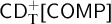 $\mathsf {CD}^{+}_{\mathrm {T}}[\mathsf {COMP}]$
and
$\mathsf {CD}^{+}_{\mathrm {T}}[\mathsf {COMP}]$
and $\mathsf {CKF_{cp}}$
are identical theories.
$\mathsf {CKF_{cp}}$
are identical theories.
Proof Sketch.
As in the proof of Lemma 24, the key observation to show that $\mathsf {CKF_{cp}}$
is a subtheory of
$\mathsf {CKF_{cp}}$
is a subtheory of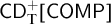 $\mathsf {CD}^{+}_{\mathrm {T}}[\mathsf {COMP}]$
is that
$\mathsf {CD}^{+}_{\mathrm {T}}[\mathsf {COMP}]$
is that $\mathsf {CD}^{+}_{\mathrm {T}}[\mathsf {COMP}]\vdash \neg {\mathrm {T}}{\mathrm {T}}\varphi \lor \neg {\mathrm {T}}\mathrm {F}\varphi \rightarrow ({\mathrm {T}}\varphi \leftrightarrow {\mathrm {T}}{\mathrm {T}}\varphi )$
. We can derive the counterpositive of each axiom of
$\mathsf {CD}^{+}_{\mathrm {T}}[\mathsf {COMP}]\vdash \neg {\mathrm {T}}{\mathrm {T}}\varphi \lor \neg {\mathrm {T}}\mathrm {F}\varphi \rightarrow ({\mathrm {T}}\varphi \leftrightarrow {\mathrm {T}}{\mathrm {T}}\varphi )$
. We can derive the counterpositive of each axiom of $\mathsf {CKF_{cp}}$
by performing the necessary quotation and disquotation step. For example, for T10 we assume
$\mathsf {CKF_{cp}}$
by performing the necessary quotation and disquotation step. For example, for T10 we assume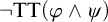 $\neg {\mathrm {T}}{\mathrm {T}}(\varphi \land \psi )$
, which implies
$\neg {\mathrm {T}}{\mathrm {T}}(\varphi \land \psi )$
, which implies $\neg {\mathrm {T}}(\varphi \land \psi )$
, hence
$\neg {\mathrm {T}}(\varphi \land \psi )$
, hence $\neg {\mathrm {T}}\varphi \lor \neg {\mathrm {T}}\psi $
. Via D5, at least one between
$\neg {\mathrm {T}}\varphi \lor \neg {\mathrm {T}}\psi $
. Via D5, at least one between $\varphi $
and
$\varphi $
and $\psi $
is determinate, hence we conclude
$\psi $
is determinate, hence we conclude $\neg {\mathrm {T}}{\mathrm {T}}\varphi \lor \neg {\mathrm {T}}{\mathrm {T}}\psi $
. In a similar way we can derive the counterpositive of TRep: if
$\neg {\mathrm {T}}{\mathrm {T}}\varphi \lor \neg {\mathrm {T}}{\mathrm {T}}\psi $
. In a similar way we can derive the counterpositive of TRep: if $\neg {\mathrm {T}}{\mathrm {T}} t$
, then
$\neg {\mathrm {T}}{\mathrm {T}} t$
, then ${\mathrm {T}} t\leftrightarrow {\mathrm {T}}{\mathrm {T}} t$
, hence
${\mathrm {T}} t\leftrightarrow {\mathrm {T}}{\mathrm {T}} t$
, hence $\neg {\mathrm {T}} t$
.
$\neg {\mathrm {T}} t$
.
Conversely, to show that $\mathsf {CD}^{+}_{\mathrm {T}}[\mathsf {COMP}]$
is a subtheory of
$\mathsf {CD}^{+}_{\mathrm {T}}[\mathsf {COMP}]$
is a subtheory of $\mathsf {CKF_{cp}}$
, the reasoning is similar to the proof for Lemma 23. We only verify T3: Since
$\mathsf {CKF_{cp}}$
, the reasoning is similar to the proof for Lemma 23. We only verify T3: Since ${\mathrm {T}} t\rightarrow {\mathrm {T}}{\mathrm {T}} t$
, we have immediately
${\mathrm {T}} t\rightarrow {\mathrm {T}}{\mathrm {T}} t$
, we have immediately $\neg {\mathrm {T}}{\mathrm {T}} t\rightarrow ({\mathrm {T}} t\leftrightarrow {\mathrm {T}}{\mathrm {T}} t)$
; for the other disjunct,
$\neg {\mathrm {T}}{\mathrm {T}} t\rightarrow ({\mathrm {T}} t\leftrightarrow {\mathrm {T}}{\mathrm {T}} t)$
; for the other disjunct, $\neg {\mathrm {T}}\mathrm {F} t\rightarrow \neg \mathrm {F} t\rightarrow {\mathrm {T}} t\rightarrow ({\mathrm {T}}{\mathrm {T}}\rightarrow {\mathrm {T}} t)$
.
$\neg {\mathrm {T}}\mathrm {F} t\rightarrow \neg \mathrm {F} t\rightarrow {\mathrm {T}} t\rightarrow ({\mathrm {T}}{\mathrm {T}}\rightarrow {\mathrm {T}} t)$
.
In fact, the well-known duality between consistency and completeness is preserved in the present setting, in that $\mathsf {CKF}_{\mathsf {cs}}$
and
$\mathsf {CKF}_{\mathsf {cs}}$
and $\mathsf {CKF_{cp}}$
are mutually
$\mathsf {CKF_{cp}}$
are mutually $\mathcal {L}_{\mathbb {N}}$
-interpretable via Cantini’s dual translation, mapping
$\mathcal {L}_{\mathbb {N}}$
-interpretable via Cantini’s dual translation, mapping ${\mathrm {T}}$
to
${\mathrm {T}}$
to $\neg \mathrm {F}$
[Reference Cantini3]. More precisely, let c be a map of
$\neg \mathrm {F}$
[Reference Cantini3]. More precisely, let c be a map of ${\mathcal {L}}_{\mathrm {T}}$
into itself preserving the arithmetical vocabulary, commuting with logical operations in the usual way, and mapping
${\mathcal {L}}_{\mathrm {T}}$
into itself preserving the arithmetical vocabulary, commuting with logical operations in the usual way, and mapping ${\mathrm {T}} x$
to
${\mathrm {T}} x$
to $\neg \mathrm {F} x$
.
$\neg \mathrm {F} x$
.
Proposition 35. $\mathsf {CKF}_{\mathsf {cs}}$
and
$\mathsf {CKF}_{\mathsf {cs}}$
and $\mathsf {CKF_{cp}}$
are mutually
$\mathsf {CKF_{cp}}$
are mutually $\mathcal {L}_{\mathbb {N}}$
-interpretable via
$\mathcal {L}_{\mathbb {N}}$
-interpretable via $c$
.
$c$
.
Proof Sketch.
For R1 and T1–T15, it suffices to observe that, within both $\mathsf {CKF}_{\mathsf {cs}}$
and
$\mathsf {CKF}_{\mathsf {cs}}$
and $\mathsf {CKF_{cp}}$
, their instances A are self-dual, in the sense that
$\mathsf {CKF_{cp}}$
, their instances A are self-dual, in the sense that $A\leftrightarrow A^c$
. For example, for T15 we have (tacitly using the fact that
$A\leftrightarrow A^c$
. For example, for T15 we have (tacitly using the fact that $t\in \mathrm {Cterm}$
)
$t\in \mathrm {Cterm}$
)
 $$ \begin{align*} ({\mathrm{T}}\mathrm{F}{\mathrm{T}} t \leftrightarrow {\mathrm{T}}\mathrm{F} t)^c &\text{ iff } \neg\mathrm{F}\neg\mathrm{F}\neg\neg{\mathrm{T}}\neg t \leftrightarrow \neg{\mathrm{T}}\neg\neg\mathrm{F}\neg t \qquad \text{def of }c\\&\text{ iff } \neg\mathrm{F}\neg\mathrm{F}{\mathrm{T}}\neg t \leftrightarrow \neg{\mathrm{T}}\mathrm{F}\neg t \kern48pt \text{T9}\\&\text{ iff } \neg{\mathrm{T}}\mathrm{F}{\mathrm{T}}\neg t \leftrightarrow \neg{\mathrm{T}}\mathrm{F}\neg t \kern54pt \text{def of }\mathrm{F}, \text{ T9}. \end{align*} $$
The last line is a counterpositive instance of T15.
Similarly for TDel and TRep, just note that $\text {TDel}^c=\neg \mathrm {F}\neg \mathrm {F} t\rightarrow \neg \mathrm {F} t\leftrightarrow (\neg {\mathrm {T}}\mathrm {F} t\rightarrow \neg \mathrm {F} t)$
, which is the counterpositive of TRep, and
$\text {TDel}^c=\neg \mathrm {F}\neg \mathrm {F} t\rightarrow \neg \mathrm {F} t\leftrightarrow (\neg {\mathrm {T}}\mathrm {F} t\rightarrow \neg \mathrm {F} t)$
, which is the counterpositive of TRep, and $\text {TRep}^c=\neg \mathrm {F} t\rightarrow \neg \mathrm {F}\neg \mathrm {F} t\leftrightarrow (\neg \mathrm {F} t\rightarrow \neg {\mathrm {T}}\mathrm {F} t)$
, which is the counterpositive of TDel.
$\text {TRep}^c=\neg \mathrm {F} t\rightarrow \neg \mathrm {F}\neg \mathrm {F} t\leftrightarrow (\neg \mathrm {F} t\rightarrow \neg {\mathrm {T}}\mathrm {F} t)$
, which is the counterpositive of TDel.
The duality between $\mathsf {KF}+\mathsf {CONS}$
and
$\mathsf {KF}+\mathsf {CONS}$
and $\mathsf {KF}+\mathsf {COMP}$
can be lifted to intertranslatability a.k.a. synonymy (see [Reference Nicolai19]); the same holds for
$\mathsf {KF}+\mathsf {COMP}$
can be lifted to intertranslatability a.k.a. synonymy (see [Reference Nicolai19]); the same holds for $\mathsf {CKF}_{\mathsf {cs}}$
and
$\mathsf {CKF}_{\mathsf {cs}}$
and $\mathsf {CKF_{cp}}$
.
$\mathsf {CKF_{cp}}$
.
Corollary 36. $\mathsf {CKF}_{\mathsf {cs}}$
and
$\mathsf {CKF}_{\mathsf {cs}}$
and $\mathsf {CKF_{cp}}$
are synonymous.
$\mathsf {CKF_{cp}}$
are synonymous.
In particular, this means that the logical strength of $\mathsf {CKF_{cp}}$
, too, coincides with that of
$\mathsf {CKF_{cp}}$
, too, coincides with that of $\mathsf {CD}^{+}$
.
$\mathsf {CD}^{+}$
.
6.2 Symmetric models
Combining the results on consistent and complete fixed points, it can also be shown that the definition of D can be adapted to obtain that the class of symmetric (i.e., consistent or complete) fixed points of $\mathscr {K}$
satisfies the axioms of
$\mathscr {K}$
satisfies the axioms of $\mathsf {CD}^{+}_{\mathrm {T}}$
with D defined disjunctively as follows.
$\mathsf {CD}^{+}_{\mathrm {T}}$
with D defined disjunctively as follows.
Definition 37 (
${\mathsf {CD}^{+}_{\mathrm {T}}[\mathsf {SYM}]}$
).

Let $\mathsf {CD}^{+}_{\mathrm {T}}[\mathsf {SYM}]$
be the
$\mathsf {CD}^{+}_{\mathrm {T}}[\mathsf {SYM}]$
be the ${\mathcal {L}}_{\mathrm {T}}$
-theory whose axioms are those of
${\mathcal {L}}_{\mathrm {T}}$
-theory whose axioms are those of $\mathsf {CD}^{+}$
, but where D defined in terms of
$\mathsf {CD}^{+}$
, but where D defined in terms of ${\mathrm {T}}$
as
${\mathrm {T}}$
as
 $$ \begin{align} &\mathrm{D} x:\leftrightarrow ({\mathrm{T}}{\mathrm{T}} x\lor{\mathrm{T}}\mathrm{F} x) \land (\neg{\mathrm{T}}{\mathrm{T}} x\lor\neg{\mathrm{T}}\mathrm{F} x). \end{align} $$
Using Facts 9 and 31, it can then be shown that symmetric fixed-point X can be used to obtain models of $\mathsf {CD}^{+}_{\mathrm {T}}[\mathsf {SYM}]$
.
$\mathsf {CD}^{+}_{\mathrm {T}}[\mathsf {SYM}]$
.
Proposition 38. For any symmetric fixed-point X, $(\mathbb N, \mathbb T_X)\vDash \mathsf {CD}^{+}_{\mathrm {T}}[\mathsf {SYM}]$
.
$(\mathbb N, \mathbb T_X)\vDash \mathsf {CD}^{+}_{\mathrm {T}}[\mathsf {SYM}]$
.
Proof. By induction on the length of proofs in $\mathsf {CD}^{+}_{\mathrm {T}}[\mathsf {SYM}]$
. For T3, one assumes
$\mathsf {CD}^{+}_{\mathrm {T}}[\mathsf {SYM}]$
. For T3, one assumes $(\mathbb {N},\mathbb {T}_{X})\vDash {\mathrm {T}}{\mathrm {T}}\varphi \lor {\mathrm {T}}\mathrm {F}\varphi \land (\neg {\mathrm {T}}{\mathrm {T}}\varphi \lor \neg {\mathrm {T}}\mathrm {F}\varphi )$
and may then reason by cases, depending on whether X is consistent or complete, following the arguments for Propositions 10 and 32.
$(\mathbb {N},\mathbb {T}_{X})\vDash {\mathrm {T}}{\mathrm {T}}\varphi \lor {\mathrm {T}}\mathrm {F}\varphi \land (\neg {\mathrm {T}}{\mathrm {T}}\varphi \lor \neg {\mathrm {T}}\mathrm {F}\varphi )$
and may then reason by cases, depending on whether X is consistent or complete, following the arguments for Propositions 10 and 32.
Accordingly, a corresponding CKF system is obtained by a disjunction of TDel and TRep.
Definition 39 (
$\mathsf {CKF_{sym}}$
).
 $\mathsf {CKF_{sym}}$
is the system obtained from
$\mathsf {CKF_{sym}}$
is the system obtained from $\mathsf {CKF}_{\mathsf {cs}}$
by replacing TDel with
$\mathsf {CKF}_{\mathsf {cs}}$
by replacing TDel with
 $$ \begin{align} &({\mathrm{T}}{\mathrm{T}} t\rightarrow {\mathrm{T}}{t}^{\circ}) \lor ({\mathrm{T}}{s}^{\circ}\rightarrow {\mathrm{T}}{\mathrm{T}} s). \end{align} $$
To see that axiom TSym yields consistency-or-completeness $({\mathrm {T}}{\mathrm {T}} t\land {\mathrm {T}}\mathrm {F} t)\rightarrow ({\mathrm {T}}{\mathrm {T}} s\lor {\mathrm {T}}\mathrm {F} s)$
, assume
$({\mathrm {T}}{\mathrm {T}} t\land {\mathrm {T}}\mathrm {F} t)\rightarrow ({\mathrm {T}}{\mathrm {T}} s\lor {\mathrm {T}}\mathrm {F} s)$
, assume ${\mathrm {T}}{\mathrm {T}} t\land {\mathrm {T}}\mathrm {F} t$
. If
${\mathrm {T}}{\mathrm {T}} t\land {\mathrm {T}}\mathrm {F} t$
. If $({\mathrm {T}}{\mathrm {T}} t\rightarrow {\mathrm {T}}{t}^{\circ })$
, then
$({\mathrm {T}}{\mathrm {T}} t\rightarrow {\mathrm {T}}{t}^{\circ })$
, then ${\mathrm {T}} t\land \mathrm {F} t$
, which is impossible, hence
${\mathrm {T}} t\land \mathrm {F} t$
, which is impossible, hence $({\mathrm {T}}{s}^{\circ }\rightarrow {\mathrm {T}}{\mathrm {T}} s)$
and therefore
$({\mathrm {T}}{s}^{\circ }\rightarrow {\mathrm {T}}{\mathrm {T}} s)$
and therefore $\neg {\mathrm {T}}{\mathrm {T}} s\lor \neg {\mathrm {T}}\mathrm {F} s$
.
$\neg {\mathrm {T}}{\mathrm {T}} s\lor \neg {\mathrm {T}}\mathrm {F} s$
.
It can also be observed that the translations $\tau $
and
$\tau $
and $\iota $
defined in the proof of Proposition 22 yield mutual interpretability of
$\iota $
defined in the proof of Proposition 22 yield mutual interpretability of $\mathsf {CKF_{sym}}$
with
$\mathsf {CKF_{sym}}$
with $\mathsf {CT}[\mathsf {KF}+(\mathsf {CONS\lor COMP})]$
, hence we obtain the following equivalence.
$\mathsf {CT}[\mathsf {KF}+(\mathsf {CONS\lor COMP})]$
, hence we obtain the following equivalence.
Corollary 40. The theories $\mathsf {CD}^{+}$
,
$\mathsf {CD}^{+}$
, $\mathsf {CKF}_{\mathsf {cs}}$
,
$\mathsf {CKF}_{\mathsf {cs}}$
, $\mathsf {CKF_{cp}}$
, and
$\mathsf {CKF_{cp}}$
, and $\mathsf {CKF_{sym}}$
have the same arithmetical consequences as the system
$\mathsf {CKF_{sym}}$
have the same arithmetical consequences as the system $\mathsf {RT}_{<\varepsilon _{\varepsilon _0}}$
of ramified truth up to
$\mathsf {RT}_{<\varepsilon _{\varepsilon _0}}$
of ramified truth up to $\varepsilon _{\varepsilon _0}$
.
$\varepsilon _{\varepsilon _0}$
.
6.3 Mixed models
Mixed fixed-point models are those in which the truth predicate can feature both gaps and gluts. Can mixed (i.e., neither consistent nor complete) fixed-point model $\mathsf {CD}^{+}_{\mathrm {T}}$
under a suitable definition of D? We leave this question open. However, we observe that mixed fixed points are not models of
$\mathsf {CD}^{+}_{\mathrm {T}}$
under a suitable definition of D? We leave this question open. However, we observe that mixed fixed points are not models of $\mathsf {CD}^{+}_{\mathrm {T}}$
under any of the definitions of D considered above.
$\mathsf {CD}^{+}_{\mathrm {T}}$
under any of the definitions of D considered above.
Proposition 41. Let X be a mixed fixed point and let $\mathsf {CD}^{+}_{\mathrm {T}}\star $
range over the theories
$\mathsf {CD}^{+}_{\mathrm {T}}\star $
range over the theories $\mathsf {CD}^{+}_{\mathrm {T}}, \mathsf {CD}^{+}_{\mathrm {T}}[\mathsf {COMP}], \mathsf {CD}^{+}_{\mathrm {T}}[\mathsf {SYM}]$
. Then
$\mathsf {CD}^{+}_{\mathrm {T}}, \mathsf {CD}^{+}_{\mathrm {T}}[\mathsf {COMP}], \mathsf {CD}^{+}_{\mathrm {T}}[\mathsf {SYM}]$
. Then $(\mathbb {N},\mathbb {T}_{X})\not \vDash \mathsf {CD}^{+}_{\mathrm {T}}\star $
.
$(\mathbb {N},\mathbb {T}_{X})\not \vDash \mathsf {CD}^{+}_{\mathrm {T}}\star $
.
Proof. In light of Proposition 10, we show that $(\mathbb {N},\mathbb T_X)\not \vDash {\mathrm {T}}3\lor \mathrm {D}5$
,Footnote
13
which are the two axioms where Facts 9 and 31 played a crucial role.
$(\mathbb {N},\mathbb T_X)\not \vDash {\mathrm {T}}3\lor \mathrm {D}5$
,Footnote
13
which are the two axioms where Facts 9 and 31 played a crucial role.
To show $(\mathbb {N},\mathbb {T}_{X})\not \vDash {\mathrm {T}}3$
, let
$(\mathbb {N},\mathbb {T}_{X})\not \vDash {\mathrm {T}}3$
, let $\lambda $
and
$\lambda $
and $\tau $
be such that
$\tau $
be such that $\lambda \land \neg \lambda \in X$
and
$\lambda \land \neg \lambda \in X$
and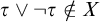 $\tau \lor \neg \tau \notin X$
, and assume moreover that
$\tau \lor \neg \tau \notin X$
, and assume moreover that $\textsf {PAT}\vdash \lambda \leftrightarrow \neg {\mathrm {T}}\lambda $
and
$\textsf {PAT}\vdash \lambda \leftrightarrow \neg {\mathrm {T}}\lambda $
and $\textsf {PAT}\vdash \tau \leftrightarrow {\mathrm {T}}\tau $
. Since
$\textsf {PAT}\vdash \tau \leftrightarrow {\mathrm {T}}\tau $
. Since $\neg (\tau \lor \lambda )\notin X$
, it can be observed that the following jointly hold:
$\neg (\tau \lor \lambda )\notin X$
, it can be observed that the following jointly hold:
 $$ \begin{align*} & (\mathbb{N},{X})\vDash\neg\mathrm{F}(\tau\lor\lambda),\\ & (\mathbb{N},{X})\vDash{\mathrm{T}}(\tau\lor\lambda),\\ & (\mathbb{N},{X})\vDash\neg(\tau\lor\lambda). \end{align*} $$
We derive, for D defined by (15),
 $$ \begin{align*} (\mathbb{N},\mathbb{T}_{X})\vDash\mathrm{D}(\tau\lor\lambda) & \land{\mathrm{T}}{\mathrm{T}}(\tau\lor\lambda)\land\neg{\mathrm{T}}(\tau\lor\lambda), \end{align*} $$
hence $(\mathbb {N},\mathbb {T}_{X})\not \vDash {\mathrm {T}}3$
.
$(\mathbb {N},\mathbb {T}_{X})\not \vDash {\mathrm {T}}3$
.
To show $(\mathbb {N},\mathbb {T}_{X})\not \vDash \mathrm {D}5$
, let similarly
$(\mathbb {N},\mathbb {T}_{X})\not \vDash \mathrm {D}5$
, let similarly $\varphi $
be such that
$\varphi $
be such that $\varphi \land \neg \varphi \in X$
, and let
$\varphi \land \neg \varphi \in X$
, and let $\psi $
be such that
$\psi $
be such that $\psi \lor \neg \psi \notin X$
. This entails
$\psi \lor \neg \psi \notin X$
. This entails
 $$ \begin{align*} &(\mathbb{N},{X})\vDash\mathrm{F}(\varphi\land\psi) \land \neg{\mathrm{T}}(\varphi\land\psi), \kern28pt \text{ iff}\\&(\mathbb{N},\mathbb{T}_{X})\vDash{\mathrm{T}}\mathrm{F}(\varphi\land\psi)\land\neg{\mathrm{T}}{\mathrm{T}}(\varphi\land\psi), \quad \text{ hence}\\&(\mathbb{N},\mathbb{T}_{X})\vDash\mathrm{D}(\varphi\land\psi). \end{align*} $$
with D defined as per (15). However, $(\mathbb {N},\mathbb {T}_{X})\not \vDash \mathrm {D}\varphi \lor \mathrm {D}\tau $
for any of the above definitions of D, since
$(\mathbb {N},\mathbb {T}_{X})\not \vDash \mathrm {D}\varphi \lor \mathrm {D}\tau $
for any of the above definitions of D, since $(\mathbb {N},\mathbb {T}_{X})\vDash ({\mathrm {T}}{\mathrm {T}}\varphi \land {\mathrm {T}}\mathrm {F}\varphi )\land (\neg {\mathrm {T}}{\mathrm {T}}\psi \land \neg {\mathrm {T}}\mathrm {F}\psi )$
, hence
$(\mathbb {N},\mathbb {T}_{X})\vDash ({\mathrm {T}}{\mathrm {T}}\varphi \land {\mathrm {T}}\mathrm {F}\varphi )\land (\neg {\mathrm {T}}{\mathrm {T}}\psi \land \neg {\mathrm {T}}\mathrm {F}\psi )$
, hence $(\mathbb {N},\mathbb {T}_{X})\not \vDash \mathrm {D}5$
.
$(\mathbb {N},\mathbb {T}_{X})\not \vDash \mathrm {D}5$
.
The reason why the class of symmetric, but not that of mixed, fixed points is suitable for modeling $\mathsf {CD}^{+}_{\mathrm {T}}$
can be explained as follows. The former, but not the latter, features a specific interplay between the notions of determinate and having a classical semantic value. Within both the class of consistent and the class of complete fixed points, we can single out an intended interpretation, where being determinate can be defined as having a classical semantic value. These intended models are the least fixed point, and the largest fixed point, where the set of sentences with a classical value are those which are grounded in Kripke’s sense. Proposition 41 clarifies why this is not possible in mixed models: in each of them, Boolean combinations of gluts and a gaps result in sentences which are strictly true or strictly false.Footnote
14
$\mathsf {CD}^{+}_{\mathrm {T}}$
can be explained as follows. The former, but not the latter, features a specific interplay between the notions of determinate and having a classical semantic value. Within both the class of consistent and the class of complete fixed points, we can single out an intended interpretation, where being determinate can be defined as having a classical semantic value. These intended models are the least fixed point, and the largest fixed point, where the set of sentences with a classical value are those which are grounded in Kripke’s sense. Proposition 41 clarifies why this is not possible in mixed models: in each of them, Boolean combinations of gluts and a gaps result in sentences which are strictly true or strictly false.Footnote
14
7 Assessment
The theories introduced in this work have unique features that place them among the most promising theories of truth available in the literature. In this section, we elaborate on some of these features, comparing variants of $\mathsf {CKF}_{\mathsf {cs}}$
with related approaches to truth and determinateness along the key dimensions outlined in the introductory section.
$\mathsf {CKF}_{\mathsf {cs}}$
with related approaches to truth and determinateness along the key dimensions outlined in the introductory section.
The generalizing function of truth, we argued, requires a strongly classical and fully compositional theory of truth. In our theories, such a function is realized in virtue of axioms ${\mathrm {T}}4$
–
${\mathrm {T}}4$
– ${\mathrm {T}}6$
. For example,
${\mathrm {T}}6$
. For example, ${\mathrm {T}}4$
is sufficient to exclude the existence of sentences that are both true and false and of sentences that are neither true nor false. In this sense, all variants of both CD and
${\mathrm {T}}4$
is sufficient to exclude the existence of sentences that are both true and false and of sentences that are neither true nor false. In this sense, all variants of both CD and $\mathsf {CKF}_{\mathsf {cs}}$
are classical theories of classical truth. To state this formally, recall that the internal theory of a theory of truth S be defined as
$\mathsf {CKF}_{\mathsf {cs}}$
are classical theories of classical truth. To state this formally, recall that the internal theory of a theory of truth S be defined as
 $$\begin{align*}\mathscr{I}(S)=\{ A \;|\; S \vdash {\mathrm{T}}\ulcorner A\urcorner\}. \end{align*}$$
For every variant $\mathsf {CKF}$
and CD, the logic of their internal theories is classical: (i) all (universal closures of) classical logical axioms in
$\mathsf {CKF}$
and CD, the logic of their internal theories is classical: (i) all (universal closures of) classical logical axioms in ${\mathcal {L}}_{\mathrm {T}}$
are true, and (ii) all classical logical inferences preserve truth, hence, (iii) all (universal closures of) theorems of classical logic in
${\mathcal {L}}_{\mathrm {T}}$
are true, and (ii) all classical logical inferences preserve truth, hence, (iii) all (universal closures of) theorems of classical logic in ${\mathcal {L}}_{\mathrm {T}}$
are true.Footnote
15
${\mathcal {L}}_{\mathrm {T}}$
are true.Footnote
15
By contrast, systems such as $\mathsf {KF}$
or
$\mathsf {KF}$
or $\mathsf {DT}$
are classical theories of nonclassical truth: they are formulated in classical logic, yet the logics governing their internal theories is nonclassical. As noted in the introduction, this compromises the generalizing power of its truth predicate. Advocates of such theories—e.g., [Reference Reinhardt24]—stress that their internal theories, despite not obeying the laws of classical logic, enjoy other truth-theoretic virtues. For instance, the internal theory of
$\mathsf {DT}$
are classical theories of nonclassical truth: they are formulated in classical logic, yet the logics governing their internal theories is nonclassical. As noted in the introduction, this compromises the generalizing power of its truth predicate. Advocates of such theories—e.g., [Reference Reinhardt24]—stress that their internal theories, despite not obeying the laws of classical logic, enjoy other truth-theoretic virtues. For instance, the internal theory of $\mathsf {KF}+\mathsf {CONS}$
is not only closed under Strong-Kleene Logic, but it is fully disquotational too:
$\mathsf {KF}+\mathsf {CONS}$
is not only closed under Strong-Kleene Logic, but it is fully disquotational too: $A\in \mathscr {I}(\mathsf {KF}+\mathsf {CONS})$
iff
$A\in \mathscr {I}(\mathsf {KF}+\mathsf {CONS})$
iff ${\mathrm {T}}\ulcorner A\urcorner \in \mathscr {I}(\mathsf {KF}+\mathsf {CONS})$
. Full disquotation is often taken to be crucial by truth theorists (see, e.g., [Reference Field7]). This property provably fails for the inner theory of any classical theory of classical truth that admits a standard model.
${\mathrm {T}}\ulcorner A\urcorner \in \mathscr {I}(\mathsf {KF}+\mathsf {CONS})$
. Full disquotation is often taken to be crucial by truth theorists (see, e.g., [Reference Field7]). This property provably fails for the inner theory of any classical theory of classical truth that admits a standard model.
However, our results show that, in addition to the internal theory, another notion plays a prominent theoretical role in this context. Define the deep theory of S as
 $$\begin{align*}\mathscr{D}(S)=\{ A \;|\; S\vdash {\mathrm{T}}\ulcorner{\mathrm{T}}\ulcorner A\urcorner\urcorner\}. \end{align*}$$
In theories of classical determinate truth such as the ones studied in this paper, the internal and deep theories provably differ.Footnote
16
One of the main virtues of the theories we propose is that the logics of their deep theories can be associated with well-known logics admitting a transparent truth predicate. For $\mathsf {CKF}_{\mathsf {cs}}$
, the logic of its deep theory amounts to the familiar Strong-Kleene logic with a transparent truth predicate. Thus, although not every classical axiom will be in
$\mathsf {CKF}_{\mathsf {cs}}$
, the logic of its deep theory amounts to the familiar Strong-Kleene logic with a transparent truth predicate. Thus, although not every classical axiom will be in $\mathscr {I}(\mathsf {CKF}_{\mathsf {cs}})$
, whatever is inside it can be closed under the relevant nonclassical rules of inferences and under iterations of
$\mathscr {I}(\mathsf {CKF}_{\mathsf {cs}})$
, whatever is inside it can be closed under the relevant nonclassical rules of inferences and under iterations of ${\mathrm {T}}$
. Analogously, the logic of
${\mathrm {T}}$
. Analogously, the logic of $\mathscr {D}(\mathsf {CKF_{cp}})$
corresponds to the Logic of Paradox [Reference Priest21], and the logic of
$\mathscr {D}(\mathsf {CKF_{cp}})$
corresponds to the Logic of Paradox [Reference Priest21], and the logic of $\mathscr {I}(\mathsf {CKF_{sym}})$
to Symmetric Strong-Kleene [Reference Blamey, Gabbay and Guenther2, Reference Scott and Böhm26].
$\mathscr {I}(\mathsf {CKF_{sym}})$
to Symmetric Strong-Kleene [Reference Blamey, Gabbay and Guenther2, Reference Scott and Böhm26].
As anticipated, our theories also provide clear semantic rules for the analysis of the language with type-free truth. To see this, we note that we can uniformly define a ‘semantic’ truth predicate ${\mathrm {T}}_{\mathrm {sem}}$
as
${\mathrm {T}}_{\mathrm {sem}}$
as ${\mathrm {T}}_{\mathrm {sem}} x:\leftrightarrow {\mathrm {T}}{\mathrm {T}} x$
. For such a predicate, the theories can prove universally quantified laws corresponding to the Strong-Kleene truth conditions for
${\mathrm {T}}_{\mathrm {sem}} x:\leftrightarrow {\mathrm {T}}{\mathrm {T}} x$
. For such a predicate, the theories can prove universally quantified laws corresponding to the Strong-Kleene truth conditions for ${\mathcal {L}}_{\mathrm {T}}$
.Footnote
17
In addition, the theories prove unrestricted positive and negative truth ascriptions for
${\mathcal {L}}_{\mathrm {T}}$
.Footnote
17
In addition, the theories prove unrestricted positive and negative truth ascriptions for ${\mathrm {T}}_{\mathrm {sem}}$
. In formalizing semantic rules for
${\mathrm {T}}_{\mathrm {sem}}$
. In formalizing semantic rules for ${\mathcal {L}}_{\mathrm {T}}$
, our theories also provide definite information on the space of ‘models’, or extensions of
${\mathcal {L}}_{\mathrm {T}}$
, our theories also provide definite information on the space of ‘models’, or extensions of ${\mathrm {T}}_{\mathrm {sem}}$
, that are admissible. While
${\mathrm {T}}_{\mathrm {sem}}$
, that are admissible. While $\mathsf {CKF}_{\mathsf {cs}}$
only allows consistent interpretations of
$\mathsf {CKF}_{\mathsf {cs}}$
only allows consistent interpretations of ${\mathrm {T}}_{\mathrm {sem}}$
,
${\mathrm {T}}_{\mathrm {sem}}$
, $\mathsf {CKF_{cp}}$
forces inconsistent but complete interpretations.
$\mathsf {CKF_{cp}}$
forces inconsistent but complete interpretations.
This is in stark contrast with CD and its variants, as they do not prove the Strong-Kleene conditions for ${\mathrm {T}}_{\mathrm {sem}}$
(cf. Corollaries 13 and 14). This means that, in such theories, truth behaves transparently and according to logical principles only on a restricted fragment of the language, namely, on determinate sentences. In addition, CD and its variants do not impose clear conditions of admissible interpretations of the true and determinate sentences—the analogue of our
${\mathrm {T}}_{\mathrm {sem}}$
(cf. Corollaries 13 and 14). This means that, in such theories, truth behaves transparently and according to logical principles only on a restricted fragment of the language, namely, on determinate sentences. In addition, CD and its variants do not impose clear conditions of admissible interpretations of the true and determinate sentences—the analogue of our ${\mathrm {T}}_{\mathrm {sem}}$
. As the results in Fujimoto and Halbach show [Reference Fujimoto and Halbach13, theorems 7.11 and 8.1], the theories are compatible with consistent or inconsistent interpretation of the true and determinate sentences. In our approach, there is a clear choice to be made depending on one’s chosen definition of determinateness: while the axioms of
${\mathrm {T}}_{\mathrm {sem}}$
. As the results in Fujimoto and Halbach show [Reference Fujimoto and Halbach13, theorems 7.11 and 8.1], the theories are compatible with consistent or inconsistent interpretation of the true and determinate sentences. In our approach, there is a clear choice to be made depending on one’s chosen definition of determinateness: while the axioms of $\mathsf {CD}^{+}$
formulated by means of the definition of D as
$\mathsf {CD}^{+}$
formulated by means of the definition of D as ${\mathrm {T}}{\mathrm {T}} x\vee {\mathrm {T}}\mathrm {F} x$
result in the theory
${\mathrm {T}}{\mathrm {T}} x\vee {\mathrm {T}}\mathrm {F} x$
result in the theory $\mathsf {CKF}_{\mathsf {cs}}$
, the dual definition as
$\mathsf {CKF}_{\mathsf {cs}}$
, the dual definition as $\neg {\mathrm {T}}{\mathrm {T}} x\land \neg {\mathrm {T}}\mathrm {F} x$
yields the theory
$\neg {\mathrm {T}}{\mathrm {T}} x\land \neg {\mathrm {T}}\mathrm {F} x$
yields the theory $\mathsf {CKF_{cp}}$
whose deep theory is inconsistent.
$\mathsf {CKF_{cp}}$
whose deep theory is inconsistent.
Combining these observations together, we see that variants of $\mathsf {CKF}_{\mathsf {cs}}$
(i) are fully compatible with the generalizing function of truth—unlike classical theories of nonclassical truth and (ii) capture a transparent and well-behaved notion of truth inside their deep theory—unlike CD and its variants.
$\mathsf {CKF}_{\mathsf {cs}}$
(i) are fully compatible with the generalizing function of truth—unlike classical theories of nonclassical truth and (ii) capture a transparent and well-behaved notion of truth inside their deep theory—unlike CD and its variants.
Another fundamental feature of the theories introduced in this work is that the notion of determinateness, just like what happens in well-known formal approaches to truth, is defined in terms of truth. Feferman [Reference Feferman6], for example, despite assigning priority to the axioms for determinateness over those for truth, defines a sentence to be determinate iff it is true or false (and not both). A similar case for a determinateness predicate defined in this way can be made for $\mathsf {KF}$
—see especially [Reference Feferman5, Reference Reinhardt24].
$\mathsf {KF}$
—see especially [Reference Feferman5, Reference Reinhardt24].
Feferman’s definition of determinateness is well suited for theories like $\mathsf {DT}$
and
$\mathsf {DT}$
and $\mathsf {KF}$
, which employ a self-applicable but nonclassical truth predicate. As Fujimoto and Halbach rightly point out, however, the definition
$\mathsf {KF}$
, which employ a self-applicable but nonclassical truth predicate. As Fujimoto and Halbach rightly point out, however, the definition $\mathrm {D} x:\leftrightarrow {\mathrm {T}} x\vee \mathrm {F} x$
is not appropriate for theories of a thoroughly classical conception of truth, such as CD and
$\mathrm {D} x:\leftrightarrow {\mathrm {T}} x\vee \mathrm {F} x$
is not appropriate for theories of a thoroughly classical conception of truth, such as CD and $\mathsf {CD}^{+}$
, or classical closures of Kripke–Feferman truth developed in this paper. This is why CD and
$\mathsf {CD}^{+}$
, or classical closures of Kripke–Feferman truth developed in this paper. This is why CD and $\mathsf {CD}^{+}$
treat determinateness as a primitive.
$\mathsf {CD}^{+}$
treat determinateness as a primitive.
By contrast, in our theories a strongly classical and compositional truth predicate co-exists with a defined determinateness predicate. In particular, our results show that the desiderata imposed to the notion of truth and determinateness by theories such as $\mathsf {CD}^{+}$
can in fact be realized by theories based on a defined determinateness predicate. While the definition
$\mathsf {CD}^{+}$
can in fact be realized by theories based on a defined determinateness predicate. While the definition $\mathrm {D} x:\leftrightarrow {\mathrm {T}} x\vee \mathrm {F} x$
is unsuitable in this context, the alternative
$\mathrm {D} x:\leftrightarrow {\mathrm {T}} x\vee \mathrm {F} x$
is unsuitable in this context, the alternative $\mathrm {D} x:\leftrightarrow {\mathrm {T}} {\mathrm {T}} x \vee {\mathrm {T}} \mathrm {F} x$
is just right to license the principles of
$\mathrm {D} x:\leftrightarrow {\mathrm {T}} {\mathrm {T}} x \vee {\mathrm {T}} \mathrm {F} x$
is just right to license the principles of $\mathsf {CD}^{+}$
, and more generally to meet the core desiderata for a thoroughly classical, self-applicable conception of truth.
$\mathsf {CD}^{+}$
, and more generally to meet the core desiderata for a thoroughly classical, self-applicable conception of truth.
One might object that our definition of D seems more artificial than Feferman’s, which rests on the natural thought that being determinate just means ‘having a determinate (classical) truth value’ in a paracomplete or paraconsistent model. But the definition we propose is in fact a rather natural incarnation of this standard notion. In particular, it puts $\mathsf {CKF}_{\mathsf {cs}}$
’s determinateness in continuity with the notion of determinateness available within
$\mathsf {CKF}_{\mathsf {cs}}$
’s determinateness in continuity with the notion of determinateness available within $\mathsf {KF+CONS}$
. Since in
$\mathsf {KF+CONS}$
. Since in $\mathsf {KF+CONS}$
determinateness is defined as
$\mathsf {KF+CONS}$
determinateness is defined as ${\mathrm {T}} x \lor \mathrm {F} x$
, extending the theory to its classical closure naturally requires introducing an additional layer of truth into the definition of D. If one endorses Feferman’s extension of determinateness as given in various manifestations of the Kripke–Feferman theory, its extensions will remain unchanged in our theories. What changes is the generalizing power afforded by the classical truth-theoretic layer. More precisely, the
${\mathrm {T}} x \lor \mathrm {F} x$
, extending the theory to its classical closure naturally requires introducing an additional layer of truth into the definition of D. If one endorses Feferman’s extension of determinateness as given in various manifestations of the Kripke–Feferman theory, its extensions will remain unchanged in our theories. What changes is the generalizing power afforded by the classical truth-theoretic layer. More precisely, the $\mathbb {N}$
-categoricity of our theories (Proposition 21) tells us that any
$\mathbb {N}$
-categoricity of our theories (Proposition 21) tells us that any $\omega $
-model of our theory features a standard, Kripke–Feferman notion of determinateness. And in each such model compositional axioms and classical logic are fully satisfied in a strong sense because it amounts to a classical closure of a Kripkean fixed point. In particular, if we consider the classical closure of the minimal fixed point of Kripke’s theory of truth, the extension of its determinateness predicate is just the set of grounded sentences of
$\omega $
-model of our theory features a standard, Kripke–Feferman notion of determinateness. And in each such model compositional axioms and classical logic are fully satisfied in a strong sense because it amounts to a classical closure of a Kripkean fixed point. In particular, if we consider the classical closure of the minimal fixed point of Kripke’s theory of truth, the extension of its determinateness predicate is just the set of grounded sentences of ${\mathcal {L}}_{\mathrm {T}}$
.Footnote
18
${\mathcal {L}}_{\mathrm {T}}$
.Footnote
18
We can reformulate the above observations without reference to Kripkean semantics. The Kripke–Feferman notion of determinateness amounts to being true or false. Its extension remains unchanged in (the consistent variant) of our theories, but its definition takes into account the strong classicality of our truth predicate required by its generalizing role. Determinateness is now defined as being semantically true or false, where ‘semantically true’ can be explicitly defined as the predicate ${\mathrm {T}}_{\mathrm {sem}}$
just introduced.
${\mathrm {T}}_{\mathrm {sem}}$
just introduced.
Taken together, the above observations point to a novel approach to truth and determinateness, yielding a family of axiomatic theories with distinctive features. Known theories that define determinateness in terms of truth and falsity—such as $\mathsf {KF}$
or
$\mathsf {KF}$
or $\mathsf {DT}$
—employ a compositional and self-applicable truth predicate, but one that, due to its nonclassical nature, does not perform well on generalizations such as the ones required in blind deductions.Footnote
19
Conversely, theories of classical truth like the Tarskian theory CT, variants of CD, or Friedman and Sheard’s FS, feature a strongly compositional truth predicate, but one that is not suitable to capture the Kripke–Feferman notion of determinateness. In addition, for CT and FS, no equally satisfactory notion of determinateness is likely to be found.
$\mathsf {DT}$
—employ a compositional and self-applicable truth predicate, but one that, due to its nonclassical nature, does not perform well on generalizations such as the ones required in blind deductions.Footnote
19
Conversely, theories of classical truth like the Tarskian theory CT, variants of CD, or Friedman and Sheard’s FS, feature a strongly compositional truth predicate, but one that is not suitable to capture the Kripke–Feferman notion of determinateness. In addition, for CT and FS, no equally satisfactory notion of determinateness is likely to be found.
However, the classical closures of $\mathsf {KF}$
show that it is possible to combine, in a single framework, both kinds of virtues: a classical, strongly compositional notion of truth that supports blind inferences, and the possibility of defining a class of determinate sentences satisfying desirable principles.Footnote
20
$\mathsf {KF}$
show that it is possible to combine, in a single framework, both kinds of virtues: a classical, strongly compositional notion of truth that supports blind inferences, and the possibility of defining a class of determinate sentences satisfying desirable principles.Footnote
20
8 Extensions and open questions
To conclude, we list some open questions and potential lines of research stemming from our work.
-
(1) Each of the introduced variants of
$\mathsf {CKF}_{\mathsf {cs}}$
restrict, in different ways, the class of Kripkean fixed points. For example, the axiom TDel in
$\mathsf {CKF}_{\mathsf {cs}}$
restricts the fixed points to the consistent ones. Let
$\mathsf {CKF}:=\mathsf {CKF}_{\mathsf {cs}}-\text {TDel}$
. Then:-
(i) Is there a definition of D that ensures the identity of
$\mathsf {CKF}$
and the appropriate reformulation of
$\mathsf {CD}^{+}_{\mathrm {T}}$
in terms of such a definition? -
(ii) Would this definition of D ensure the soundness of
$\mathsf {CD}^{+}_{\mathrm {T}}$
with respect to mixed models?
-





Moreover, one can ask whether there are natural principles that can be used to expand $\mathsf {CKF}_{\mathsf {cs}}$
, and how strong the resulting theories become. We mention two possible such expansions.
$\mathsf {CKF}_{\mathsf {cs}}$
, and how strong the resulting theories become. We mention two possible such expansions.
-
(2) Given the semantics of
$\mathsf {CKF}_{\mathsf {cs}}$
, one might treat the least fixed point of
$\mathscr {K}$
as the intended interpretation for its deep theory. One can then axiomatize this conception by adding a minimality schema to
$\mathsf {CKF}_{\mathsf {cs}}$
. So let
$\mathsf {CKF}_\mu $
be the theory obtained by expanding
$\mathsf {CKF}_{\mathsf {cs}}$
with the schema where, for
$$\begin{align*}K(\varphi(x)) \rightarrow \forall x({\mathrm{T}}{\mathrm{T}} x\rightarrow\varphi(x)), \end{align*}$$
$\varphi \in {\mathcal {L}}_{\mathrm {T}}$
,
$K(\varphi (x))$
expresses that
$\varphi (x)$
is a closed point of
$\mathscr {K}$
. Then:
-
(iii) What is the proof-theoretic strength of
$\mathsf {CKF}_\mu $
?
-
-
(3) One may also consider extensions of
$\mathsf {CKF}_{\mathsf {cs}}$
by means of reflection principles. It is well-known that the theory of truth enables one to directly express soundness extensions of theories in the form of Global Reflection Principles for a theory S: for any
$\varphi $
, if
$\varphi $
is provable in S, then
${\mathrm {T}}\varphi $
. It is also well-known that the most prominent type-free theories of truth don’t sit well with Global Reflection.Footnote
21
However, for such theories Global Reflection may not be the right soundness extension to focus on. Reinhardt [Reference Reinhardt24] proposed to consider instead a partial reflection principle for provably true sentences. A similar strategy is available in
$\mathsf {CKF}_{\mathsf {cs}}$
and its variants, if one looks at theorems under two layers of truth. The principle (16)is sound with respect to the semantics for
$$ \begin{align} (\forall \varphi \colon {\mathcal{L}}_{\mathrm{T}})(\mathrm{Prov}_{\mathsf{CKF}_{\mathsf{cs}}}({\mathrm{T}}{\mathrm{T}}\varphi)\rightarrow {\mathrm{T}}{\mathrm{T}}\varphi) \end{align} $$
$\mathsf {CKF}_{\mathsf {cs}}$
and can be safely added (and iterated) over our theories. It can then be asked:
-
(iv) What is the strength of the reflection principle (16) and iterations thereof?Footnote 22
-
-
(4) Finally, for technical interest, it remains to be explored whether an analogue of our results is available for the theory
$\mathsf {CD}_{{\mathrm {T}}}$
—as well as its variant
$\mathsf {CD}_{{\mathrm {T}}}[\mathsf { COMP}]$
. Specifically:-
(v) Does
$\mathsf {CD}_{{\mathrm {T}}}$
have a natural semantics validating the principle T2, i.e.,
$\mathrm {D} t\rightarrow {\mathrm {T}}\mathrm {D} t$
, but not necessarily its converse? -
(vi) Can the semantic construction be axiomatized in such a way that the resulting theory is identical to
$\mathsf {CD}_{{\mathrm {T}}}$
? -
(vii) What is the proof-theoretic strength of the resulting systems?
-





Acknowledgments
We would like to thank Kentaro Fujimoto, Volker Halbach, Johannes Stern, and Bartosz Wcisło for discussing selected topics contained in the paper.
Funding
L.C. would like to acknowledge funding from the NCN, MAESTRO grant 2019/34/A/HS1/00399 ‘Epistemic and Semantic Commitments of Foundational Theories’, the Italian Ministry of Education, University and Research, PRIN 2022 program ‘HERB—Human Explanation of Robotic Behaviour’ prot. 20224X95JC, and the Alexander von Humboldt Foundation, Humboldt Research Fellowship.
C.N. acknowledges funding from the AHRC Arts and Humanities Research Council, grants AH/V015516/1 and AH/Z506515/1, and the EPSRC Engineering and Physical Sciences Research Council/EU Commission, grant ‘PLEXUS: Philosophical, Logical, and Experimental Routes to Substructurality’.



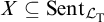



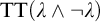





 Open access

