

In 1899, John Dewey was wrestling with an Indian problem. Three years earlier, in January of 1896, Dewey had opened the University Elementary School at the University of Chicago, which became known as the Laboratory School, or simply the Dewey School.Footnote 1 As the name suggests, the experimental school would make Dewey famous as a leader in the field of progressive education, a growing movement in the late nineteenth century sometimes called “the new education.”Footnote 2 Dewey worked in partnership with many other educators—many of whom were women—to design a school that would eventually grow to over 140 students overseen by twenty-three teachers.Footnote 3 It was there, in the course of trying to shape the school’s curriculum, that Dewey had encountered his Indian problem.
Dewey’s problem was with none other than Hiawatha. The real Hiawatha was a Haudenosaunee (Iroquois) leader who helped to create the Great Law of Peace and the League of the Haudenosaunee.Footnote 4 But the Hiawatha that Dewey was concerned about was the fictional product of Henry Wadsworth Longfellow. In 1855, Longfellow had written what was probably one of America’s most famous epic poems, The Song of Hiawatha. Based on Henry Rowe Schoolcraft’s two-volume compilation of Anishinaabe stories published in 1839, Longfellow wrote his version of Hiawatha as a Chippewa man from the Upper Peninsula of Michigan.Footnote 5 While some historians have suggested that its popularity had faded somewhat after 1850, by the 1890s, The Song of Hiawatha was experiencing something of a second life.Footnote 6
By the turn of the century, pedagogues across the US reached for Longfellow’s poem as an example of great American literature. The Song of Hiawatha was read in classrooms across the nation; illustrated editions adorned library bookshelves; and its story was frequently staged in countless schools, where it was performed in the mode of what Indigenous studies scholar Bethany Hughes chronicles as “redface.”Footnote 7 The Song of Hiawatha allowed Euro-Americans to sympathize with Indians as noble savages “safely dead and historically past,” without paying much heed to contemporary Indigenous people in the United States.Footnote 8 In using Indigenous characters as protagonists of an imagined American history—characters who were then conveniently ushered off the narrative stage at the conclusion of the epic—The Song of Hiawatha functioned as a literary expression of the logic of Native erasure. “Hiawatha triumphs also for the vision of conquest it sublimates,” explains historian Alan Trachtenberg.Footnote 9 This made the poem an ideal package for Euro-American instructors in classrooms eager to conscript Indians (both real and imagined) as a symbol of American identity. In an era of increasing immigration, this “Americanizing” function gave the text great utility for educators in public schools, settlement houses, and experimental schools, which composed the constellation of a growing progressive education movement.
None of this, however, provoked Dewey’s particular interest in Hiawatha. Instead, by 1899, Dewey had a bone to pick with a faction of educators and their agenda for Hiawatha. His ire was directed at a group of pedagogues associated with Johann Friederich Herbart, a German pedagogue who created a popular theory of learning by reference to “cultural epochs” of the past. Herbartian pedagogy stipulated that classroom activities should be structured around a child’s re-creation of the progress of mankind through various “epochs,” a series of sociocultural eras arranged in stadial evolution from savagery, through barbarism, to civilization. One of the ways that the Herbartians proposed to re-create such phases of history (often known as racial recapitulation theory) was through works of evocative literature supposedly representative of each epoch. As it was one of the nation’s most celebrated stories of Indians, Longfellow’s The Song of Hiawatha was regarded by the Herbartians as an ideal means for students to learn about the “savage” epoch of the distant past.Footnote 10
Dewey rejected this approach to Hiawatha. He felt that literature in the classroom, while valuable, paled in comparison to experiential education, especially in history. “I cannot avoid the feeling that much as the Herbartian school has done to enrich the elementary curriculum in the direction of history, it has often inverted the true relationship existing between history and literature,” Dewey wrote. “In a certain sense the motif of American colonial history and of De Foe’s ‘Robinson Crusoe’ are the same,” he mused. “Both represent man who has achieved civilization, who has attained a certain maturity of thought, who has developed ideals and means of action; but suddenly thrown back upon his own resources, having to cope with a raw and often hostile nature, and to regain success by sheer intelligence, energy, and persistence of character.”Footnote 11 Dewey remained unconvinced that educators should use such works of literary imagination as the means for students to understand the past, especially through works about Indians:
Whatever may be the worth of the study of savage life in general, and of the North American Indians in particular, why should that be approached circuitously through the medium of “Hiawatha” instead of at first hand?—employing, indeed, the poem to furnish the idealized and culminating touches to a series of conditions and struggles which the child has previously realized in more specific form. Either the life of the Indian presents some permanent questions and factors in social life or it has next to no place in a scheme of instruction. If it has such a value, this should be made to stand out on its own account instead of being lost in the very refinement and beauty of a purely literary presentation.Footnote 12
In contrast, Dewey proposed a very different lesson plan for Hiawatha: “Why not give the child the reality with its much larger sweep, its intenser [sic] forces, its more vivid and lasting value for life, using the ‘Robinson Crusoe’ [sic] as an imaginative idealization in a particular case of the same sort of problem and activities?”Footnote 13 In other words, instead of using literature of the past as a make-believe world students might imaginatively inhabit, Dewey felt that Hiawatha could instead be used as a blueprint to reconstruct the past in the present. Rather than have students simply imagine a wilderness past through literature about Indians, Dewey thought, why not use the classroom to have them re-experience that past firsthand? To best accomplish that, he suggested that teachers could use The Song of Hiawatha to construct a curriculum that would have students reenact the experience of Hiawatha for themselves. Instead of learning about Indians, the Laboratory School would offer students a way to think like Indians.
Using Dewey’s published philosophical texts, Laboratory School teachers’ writings, curricular notes and lesson plans, education periodicals, and correspondence, this article illustrates how Dewey and his teachers at the Laboratory School used The Song of Hiawatha as the inspiration for the school’s experiential history curriculum. Using a sand table, Laboratory School instructors encouraged their students to imagine themselves and their class as an Indian tribe tasked to resolve the problematic situations of the past, not unlike Hiawatha’s romanticized Chippewa. While the students did not dress up as Indians, they nevertheless used the sand table to re-create the practical problems, social occupations, and technological inventions of Indians as depicted in The Song of Hiawatha. All of this would prove to be a temporary learning experience; at the end of the school day, Dewey’s students left their Indian subjectivity behind in the sand table and re-inhabited their supposedly modern, civilized habits of mind. For Dewey, The Song of Hiawatha plus the sand table equaled the beginning of pedagogical Indian play.Footnote 14
This article interprets Dewey and his experimental Laboratory School history curriculum as a variant of a wider cultural practice known as playing Indian, a concept articulated by historian Philip Deloria in his book Playing Indian (1998). I seek to extend Deloria’s concept of playing Indian into the domain of schooling by dubbing this practice pedagogical playing Indian. I use the term pedagogical to orient scholars to the ways in which various idealized associations with “Indian-ness” have long been adopted by Euro-American instructors to serve various learning objectives. By using this technical term for didacticism, I mean to draw a distinction between children engaging in the cultural phenomenon of playing Indian (even at school) versus students playing Indian as a part of an intentional pedagogical function in an instructional setting. Consequently, I argue that playing Indian is not simply a learned behavior; it is also a behavior for learning.
Moreover, Dewey’s ideas animating the sand table would not remain confined to the Laboratory School. The federal Indian School Service also took note of Dewey’s curriculum. Estelle Reel, the superintendent of Indian Schools, was a careful contemporary reader of Dewey’s notes from the Laboratory School. In her Course of Study, published in 1901, Reel endeavored to introduce the sand table and other Deweyan insights into the classrooms of federal Indian schools. In an acerbic irony, what began as Dewey’s philosophizing about an idealized Hiawatha in the Laboratory School ended up shaping the experience of actual Indigenous people in federal Indian schools. This reinterpretation of Dewey, his Laboratory School curriculum, and the development of the sand table as a teaching tool in progressive education through the lens of playing Indian forges an important connection rarely made between Indigenous studies and education history.
The Psychological Rationale of Playing Indian
Playing Indian is a term theorized by Philip Deloria to describe the long history of Americans imagining themselves as Indians. This phenomenon, Deloria argues, activates many cultural associations affixed to Indigenous people. Deloria argues that time and time again throughout American history, Euro-Americans have turned to such signifiers—feathers, headdresses, buckskins, dream catchers, and multisyllabic, Indian-sounding names—as means to satisfy a range of desires. Playing Indian is, as Deloria notes, a Euro-American cultural appetite “to savor both civilized order and savage freedom at the same time.”Footnote 15 Rather than make such a practice cognitively dissonant, Deloria argues that “the contradictions embedded in noble savagery have themselves been the precondition for the formation of American identities.”Footnote 16 Whether at the Boston Tea Party, meetings of the Improved Order of Red Men, or Boy Scout summer camps, playing Indian has offered many generations of non-Natives a peculiar way to perform rituals of American “self-distinction.”
Scholars have offered a variety of institutional origins and rationales for pedagogical playing Indian in the United States. The habit of imagining oneself as an Indian as a pedagogical act has been traced back to late nineteenth-century summer camps, settlement houses, and public schools. In such venues, educators argued that playing Indian provided several pedagogical functions, including encouraging creativity, aesthetic appreciation, and imaginative play. Scholars have increasingly identified early twentieth-century groups such as the Boy Scouts and Camp Fire Girls and their penchant for playing Indian as a part of the curriculum for their anti-modern primitivist outdoor education.Footnote 17 For example, historian Jennifer Helgren has documented how the Camp Fire Girls encouraged their students to dress like Indian maidens and princesses, to write poetry “in Hiawatha meter,” and to perform imagined Indian naming rituals as a means for “accessing what they assumed were primitive emotions.”Footnote 18 As Alan Trachtenberg has argued, The Song of Hiawatha reached the height of its popularity as a touchstone of great American literature in both settlement houses and public schools, whose classrooms were increasingly filled with immigrant people. Furthermore, education scholars have documented the enduring habit of playing Indian in public schools (and its deleterious impact on Indigenous students) well into the late twentieth century and into the present.Footnote 19 By staging Thanksgiving pageants, pantomiming Mohawk Indians at the Boston Tea Party, or re-creating imagined scenes from the Oregon Trail, generations of American children have been dressing up like Indians in school (and often rooting on Indian-themed mascots) to supposedly accomplish all manner of various learning objectives.
I argue that progressive educators’ use of racial recapitulation theory is one overlooked origin for pedagogical playing Indian. Drawing from the theory of evolution, racial recapitulation held both that humankind developed from a state of savagery to a stage of barbarism to a stage of civilization, and that individuals reproduced this sequence of development in their own maturation (two ideas that historians have called linear historicism and genetic psychology, respectively). When translated into the schoolhouse, racial recapitulation theory offered educators a means to organize their curriculum around each individual student’s re-creation of “race progress.” Curriculum could be configured to maximize learning potential by aligning stages of stadial evolution to correspond with the stages of an individual child’s development.Footnote 20
As scholars such as Thomas Fallace and Trevor Pearce have shown in detail, Dewey employed a particularly idiosyncratic version of this popular theory.Footnote 21 Dewey’s racial recapitulation theory was first informed largely by G. Stanley Hall.Footnote 22 Hall was born in 1844 in Massachusetts and studied at Harvard University. By the time Dewey worked with him at Johns Hopkins University, Hall was a prominent racial recapitulationist. In the ensuing decades, Hall became a leading scholar of childhood psychology, epitomized by his 1904 book Adolescence, in which he conflated “the animal, savage, and child-soul.”Footnote 23 Following Georg W. F. Hegel and Wilhelm Wundt, Hall argued that “the child and race are keys to each other.”Footnote 24 While they shared many ideas about genetic psychology, Hall and Dewey came to differ about the essential quality of race.
Whereas Hall and other recapitulationist theorists imagined that students moved progressively from one racial stage to another, Dewey insisted that genetic psychology was cumulative. As Fallace explains, in Dewey’s philosophy, “there is no sudden conceptual shift or jump to a subsequent stage. Instead evolutionary growth is holistic and gradual.”Footnote 25 In another sense, Dewey also departed from Hall’s linear historicism because he felt that it “remained oriented towards the past and made fallacious ideas about biologically inherited traits the ‘limits of education,’” notes literary scholar Elizabeth Carolyn Brown. In contrast, Dewey insisted his version of racial recapitulation was “progressive,” a forward-looking “standpoint that would allow new ‘perceptions’ to transform students’ previous experiences and would therefore give them more rational control and direction over future actions.”Footnote 26 In this fashion, recapitulation theory proved appealing to Dewey less because of its racism, and more due to its historicism. “Dewey, although rejecting Hall’s attribution of mental traits to race, fully subscribed to the idea of social evolution, including the distinction between savagism and civilization,” observes historian David W. Adams. “Even though educators were urged to give proper pedagogical attention to a child’s background (however primitive), in the final analysis all humankind should ultimately be encouraged to join the march of scientific and social progress.”Footnote 27
By the time he opened the Laboratory School, racial recapitulation offered Dewey a way to harmonize the study of history with his emerging experimentalism. As historian Henry Cowles notes, by the time Dewey was wrestling with Hiawatha, he believed that “being a good scientist meant being ‘savage,’ too. Intuition, spontaneity, and the ability to throw out solutions to problems—these were the stuff of ‘savage intellect,’ but they were also essential to abstract scientific theorizing.”Footnote 28 Organizing curriculum using racial recapitulation theory was not merely a trick to capture the attention of children with novelty—it was engaging, Dewey held, because it was a way to make the problem-solving of the past come to life as a matter of immediate experience: “The child who is interested in the way in which men lived, the tools they had to do with, the new inventions they made, the transformations of life that arose from the power and leisure thus gained, is eager to repeat like processes in his own action, to remake utensils, to reproduce processes, to rehandle materials,” Dewey argued.Footnote 29 From its inception, racial recapitulation was the framework for the Laboratory School’s experiential curriculum.Footnote 30
Of course, racial recapitulation theorists in the United States specifically included American Indians as one of the stock characters of humanity’s past. Dewey was no exception. As he was planning to launch his Laboratory School in 1896, Dewey wrote to his teachers that their curriculum ought to harness a “child’s interest in ways of present living leading him back to social groups organized in that way—hunting & fishing to the Indians—building houses to way [sic] other people have lived.”Footnote 31 Dewey insisted that “the object of the study of primitive life is not to keep the child interested in lower and relatively savage stages, but to show him the steps of progress and development, especially along the line of invention, by which man was led into civilization.”Footnote 32 Dewey’s treatment of Hiawatha was poised to make the Laboratory School one of the most important sites in connecting the idea of “Indian-ness” to the “learning by doing” that would become a hallmark of progressive education.Footnote 33
Dewey’s interpretation of an evocative portion of The Song of Hiawatha illustrated how he proposed to distinguish his racial recapitulation theory at the Laboratory School. In one section titled “The Fasting of Hiawatha,” Hiawatha undergoes a fast. Over the course of seven days, Hiawatha prays for the relief of his people from famine. At sundown on the seventh day, he looks up to see “a youth approaching/Dressed in garments green and yellow/Coming through the purple twilight/Through the splendor of the sunset/Plumes of green bent o’er his forehead/And his hair was soft and golden.”Footnote 34 It was no coincidence that this figure was rendered as a bipedal cornstalk. His name is Mondamin, and he offers to wrestle Hiawatha. To make a very long story short, Hiawatha triumphs in his ordeal over Mondamin, and the divine messenger rewards Hiawatha with a set of instructions that Euro-American readers would have recognized as the procedure for planting corn. The wrestling is thus a metaphor for the labor required in the planting, growing, and harvesting mandaamin, the Anishinaabemowin name for maize (see Figure 1). In Longfellow’s telling, through the invention of agriculture, Mondamin freed Hiawatha and his people from their dependance on the fickle hunt.
Frederic Remington, Mondamin, in Henry Wadsworth Longfellow, The Song of Hiawatha, ill. ed. (Houghton Mifflin, 1895).

Dewey dismissed the Herbartian insistence that students might be able to imagine how Anishinaabe people planted corn through the vivid prose or poetic meter of passages like these. On the contrary, Dewey’s interest was piqued by how Longfellow’s story seemed to depict how the Anishinaabeg had solved a problem of associated life. What Longfellow fancifully described as a “wrestling match,” Dewey believed he could reframe as a lesson about how Indians invented agriculture. The Song of Hiawatha was therefore useful as an artful rendering of how the Anishinaabeg had overcome a deficiency of associated life. “History as simplified social life gives a proper foundation for teaching the literature of any period,” Dewey wrote. “Hiawatha or the Iliad should only be given in connection with a study of the social life of the people represented in the respective poems.”Footnote 35 Consequently, Dewey felt that the problem (food scarcity) that the Indians had seemed to have solved with the advent of a new social occupation (corn agriculturalist) was something worth re-experiencing in the Laboratory School classroom. “[Social occupations,] more than any other one study, more than reading or geography, story-telling or myth, evoke and direct what is most fundamental and vital in the child; that in which he is the heir of all the ages, and through which he recapitulates the progress of the race,” Dewey concluded.Footnote 36 Thus the Laboratory School classroom was primed for pedagogical playing Indian.
Pedagogical Playing Indian and the Sand Table
Dewey and his teachers fashioned a curriculum that would set their students on the path to imagining themselves as Indians. Around seven years of age, students at the Laboratory School began a course of study where they would experience “the historical development of industry and invention—starting with man as a savage and carrying him through the typical phases of his progress upward, until the iron age is reached and man begins to enter upon a civilized career.” Fourth grade was the appropriate age to begin such historical study, Dewey felt, because seven-year-olds’ mental capacities corresponded with the “savage mind” of Indian people. “There is certain nearness, after all, in the child to primitive forms of life,” he proffered.Footnote 37 Nevertheless, Dewey made a distinction between reenactment and real life. He maintained that “in one important respect, however, there is a fundamental difference between the child and primitive man. Necessity, the pressure of getting a living, was upon the savage. The child is, or should be, protected against economic stress and strain.” Dewey did not propose to teach children history by literally throwing them into the woods and expecting them to invent hunting or agriculture to satiate their urgent need to eat. Rather, he imagined that the Laboratory School could re-create this historical experience through students’ simulated play. “The expression of energy takes in his case a form of play—play which is not amusement, but the intrinsic exhibition of inherent powers so as to exercise and develop them,” he wrote.Footnote 38
For instance, in an essay titled “Mental Development” published in 1900, Dewey offered an account of play drawn from his observations at the Laboratory School. Play, he wrote, was a means for children to take spontaneous action in creative ways. “There is in play no conscious distinction between process and product,” Dewey wrote. Unlike labor or some directed sort of activity, what made play a distinct kind of experience is that it was an end unto itself: “Play must be its own excuse, its own motive and justification.”Footnote 39 For this reason, he theorized a relationship between play and art, the power of creation and make-believe. At the same time, he acknowledged that play was never purely sui generis—it activated the experience of the player.Footnote 40 Dewey made this point about the tension between pure imagination and the cultural fetters that shaped play, ironically, by referring to Indians: “The play of imagery therefore has certain limits within which it must work,” Dewey noted. “In certain games, as playing Indians or soldiers, etc., a quite complex variety of image content may be introduced.”Footnote 41 Despite the exogenous origin of such cultural impressions, Dewey believed that in their games, the creative energies of children were nevertheless invested fully in their activity. “The child’s only want is to do what he is doing to the full,” Dewey wrote. “If it is to build a house, it is to build as high a one as possible; if it is playing soldier, to have as much parade and display as possible; if hunting Indians, to have the maximum of sanguinary destruction.”Footnote 42 Dewey’s use of the term sanguine clearly means red or red-blooded, which is not only a reference to Indigenous people’s racialization as “red men,” but also stands in for both the vitality and exuberance of youth.Footnote 43 When Dewey thought about play, Indians were never far from his mind’s eye.
Meanwhile, as Dewey was developing this philosophy, Laboratory School instructors were busy realizing it in their teaching. In their roles as Laboratory School instructors, sisters Katherine Camp Mayhew and Anna Camp Edwards were clear-eyed about the use of racial recapitulation as the basis for what would become pedagogical playing Indian. “It could be said that the child is like the savage in ability but not in capability, for behind the former lies the great heritage of civilization,” they wrote. “It follows that the activities of primitive peoples are in line with the child’s interests and under wise direction this study can provide the avenues for his best effort.”Footnote 44 As these Laboratory School teachers clearly articulated, play was the essential mode for instruction at the school. “‘Play’ is the mode of attack,” explained another Laboratory School teacher, Laura Runyon.Footnote 45
That mode of attack was exhibited in the pedagogical playing Indian that structured the fourth-grade history curriculum.Footnote 46 According to Mayhew and Edwards, it was here that Dewey and the educators at the Laboratory School explicitly used their reading of The Song of Hiawatha to create curriculum for students to reinhabit the psychic lifeworld of the “savage mind.” When students reached the age of seven years old, they began a year-long exercise in the study of “primitive life.” As Mayhew and Edwards asserted, “It could be said with truth that the fundamental interests of a child at this stage of growth and of a savage are the same.”Footnote 47 With the right psychological alignment achieved, Mayhew and Edwards inaugurated their fourth-grade history curriculum by asking their students to imagine themselves going backward in time. To aid them in this experiential reconstruction of the past, they employed a time machine.
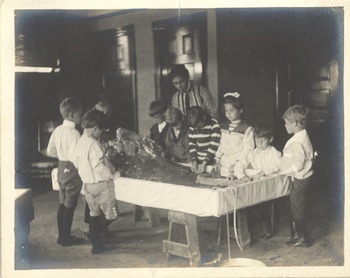
The teachers presented the fourth-grade students with a sand table. What began as a glorified wooden sandbox, measuring about four-by-four feet and placed in the center of the classroom, was transformed into a world in miniature. Much like a diorama, the sand table reproduced a vast topography of North America, including plains, mountains, caves, and streams. By the 1890s, such sand tables had become a common tool used by progressive educators to teach geography.Footnote 48 (Dewey’s former instructor, G. Stanley Hall, had written effusively of the use of sand boxes as pedagogical instruments in his 1886 book The Story of a Sand-Pile).Footnote 49 At the Laboratory School, however, the sand box was employed as the stage upon which students would be playing Indian.
History began when the Laboratory School teachers organized the fourth-grade students into a “tribe.” On the first day of class, the instructors presented them with a sand table (see Figure 2). Inside, they had created miniature terrain, marked by topographical features, vegetation, and even simulated watersheds. The student’s first assignment was to experience this landscape as if they were a tribe of Indians. “The class is his tribe, and the sand-box its habitat, which moss from the greenhouse can convert into the pastures of a river valley, or stones and clay into a mountain region where caves form a nature shelter,” the teachers explained.Footnote 50 Mayhew and Edwards elaborated that through “constant dramatization of imagined situations and behavior, these children had an early glimpse into the beginnings of the social organizations of tribal life, in its various stages of development.”Footnote 51 To this end, the students were presented materials in the sand table that were associated with savage life, mostly sticks and stones, and asked what could be made from them. “Much time … was spent in experimental work with the materials which primitive peoples would use,” a teacher described.Footnote 52 The teachers then led the class-cum-tribe through a discussion of fire, making weapons, heating stones, finding refuge from storms in caves—all the while suggesting something about the nature of combustion, geology, and weather. In her class, Laboratory School teacher Clara Mitchell proffered solutions to the problems of food, clothing, and shelter by means of exhibiting “mats, curtains, and baskets among cave men and Indians.”Footnote 53
Lander MacClintock, Map Project at Dewey Laboratory School, ca. 1896-1903, John Dewey Photograph Collection, Morris Library, Southern Illinois University.

Pursuant to Dewey’s philosophy, such artifacts offered Laboratory School teachers a way to reverse-engineer the social occupations of the past, to re-create problematic situations faced by primitive people for the students to collectively solve in the present. As Runyon notes, “The conditions of the environment must be made to yield means of subsistence, therefore, if this tribe were to continue. How this could be done was the first problem given to children.”Footnote 54 For example, the simulated hunting of animals for sustenance offered the students what Dewey later dubbed a “problematic situation” akin to the story of the adoption of corn agriculture in The Song of Hiawatha. Teachers prodded the students to brainstorm how their “tribe” might find food in such an environment as depicted in the sand table, which was changed over the course of the term. For instance, when the sand table had depicted a temperate forest, the children decided that their “tribe” would find sustenance in “berries, fruits, roots, and animal food” that they imagined might populate that environment.Footnote 55 So far, so good.
Foraging for berries, fruits, and roots was one thing, but what about catching an animal in a sand table that simulated a shortgrass prairie? When the “tribe” was asked to resolve that difficulty, “the first inventions suggested were improvements in weapons.”Footnote 56 Members of the “tribe” were then given flint, granite, and limestone, and asked by their teachers to experiment with each to see which might hold an edge. As Runyon notes, “The stick and stone united by a thong may make the spear the first invention and provide a weapon for attack and defense.”Footnote 57 Then, archery was examined “and its advantages for the tribe which possessed it.”Footnote 58 By such promptings by their teachers, “the children passed imaginatively through different stages of living,” as if they themselves had invented the spear, the bow, and the arrow themselves, thus solving the problematic situations posed by the environment just as their savage forerunners had.Footnote 59 Mayhew and Edwards encouraged the students to undertake “experimental activities incident to this phase of the study,” which included geometry in the design of pottery, the procedure for making ceramics, and studying “the source of the black [dye] used by the Navajo Indians.”Footnote 60
This was not the only reference to contemporary Indigenous people in the sand table. For instance, when the “tribe” encountered a need for the storage of food and water, Mayhew and Edwards reminded the students they had discovered a river on their way from the forest to their new simulated Great Plains hunting grounds. What materials might they use from this feature of the landscape to solve their problem? “One child suddenly recalled the fact that he himself had found clay in the banks overhanging a small river,” Mayhew and Edwards wrote.Footnote 61 Much to Mayhew and Edward’s delight, this inspired the students to adopt what they believed were Indigenous naming conventions: “They frequently discussed the individuals they were impersonating, some choosing names for themselves. One called himself Clay-finder.”Footnote 62 The teachers then offered the students clay, which was used for “modeling and baking of primitive dishes like those once made by the Indian tribes of this region,” and in the students’ hands would be “decorated with paints in original designs.”Footnote 63 One teacher recorded that her class had “been making bowls of clay, patterning them more or less on the Indian bowls.”Footnote 64 Soon, other elements were added to this role-play, including actual musical instruments. Dewey, Mayhew, and Edwards asserted that their students learned about musical composition “as they listened to the rhythmic beat of the tom-tom and caught the meaning of a metrical succession of notes all on one pitch.”Footnote 65 The class had become an Indian tribe.
One of the reasons why scholars may have largely overlooked such activity at the Laboratory School as a form of playing Indian is because they typically frame this heterogeneous cultural practice as a kind of performance. Material props—feathers, buckskin, headdresses, face paint, moccasins, and so on—are the telltale props for playing Indian, an activity where, “the donning of Indian clothes moved ideas from brains to bodies,” as Deloria notes. “There, identity was not so much imagined as it was performed, materialized through one’s body and through the witness and recognition of others.”Footnote 66 Students in the Laboratory School may not have been dressing up in buckskins and feathers, nor were they purporting to be Hiawatha himself. Nevertheless, by playing in the sand table to the rhythm of a tom-tom, pantomiming Indigenous style in arts and crafts, and adopting pseudo-Indian names, they were playing Indian all the same. It was not performance but play that proved to be the common medium linking the Laboratory School curriculum to the wider cultural currents of playing Indian. Deloria continues, “Play was powerful, for it not only made meanings, but made them real [emphasis in original].” Footnote 67 In this sense, the act of didactic play served as the medium for ideology to make the jump into material reality.
The community of parents, teachers, and observers in the Chicago neighborhood of Hyde Park proved to be quite sensitive to the fact that their students spent much of their school day as Indians. One visitor to the Laboratory School clearly understood the pedagogical utility of Indians to Dewey’s project: “The study of American Indians … is taken up … for the purpose of utilizing that identity of interests which anthropologists tell us exists between the child and primitive man.”Footnote 68 However, some worried that the Laboratory School’s reenactment of Indian experience was perhaps a little too effective. One such skeptic was Susan Elizabeth Blow, an educator who took issue with Dewey’s approach to playing Indian. “Chicago is an electric center for all sorts of educational heresies,” Blow wrote to Dewey’s mentor and US commissioner of education William Torrey Harris. Blow rejected wholesale Dewey’s premise of re-creating the savage mind through pedagogical playing Indian. “I saw Dr. Dewey’s School,” she wrote with disappointment, noting that “the whole principle they were working on seemed wrong.” Blow remarked on the alarming verisimilitude that Dewey and his instructors’ use of the history curriculum had achieved in re-creating the savage mind in their students. “Their purpose for why we should inflame the minds of our little civilized Aryans with the ideal of a savage Indian life I can’t see,” she worried. Encouraging Euro-American children to run about the school as savages was not only scandalous to Blow’s pedagogical sensibilities, but she was confident it would be an affront to the student’s sense of racial propriety as well. “In general the way they work on the imagination will I think nauseate the children,” she wrote. However, it was not all bad news. Evidently, Blow had encountered one friendly Indian at the Laboratory School of whom she approved. “I saw repeatedly exercises given with Hiawatha as core,” she noted approvingly, “so Hiawatha may not blight them.”Footnote 69 As a character of literature safely enclosed in the realm of high art, Blow concluded that Hiawatha was an Indian friendly to American educators.
Despite such anxieties, Dewey was not ready to surrender a more experimental Hiawatha to such critics. He squarely addressed the concern voiced by Blow that a curriculum that employed playing Indian risked elevating the state of savagery: “The aim is to avoid a mere excitation and indulgence of this interest, without regard to the motives lying behind them, the stimulus given to farther advance, or the ways in which men have got out of savagery into civilization,” he assured readers. “The effort is to lay hold of this interest in such a way as to use it as a projective—to bring out its defects as well as its dramatic incidents, to see how and why men worked their way out of it.”Footnote 70 Dewey wanted his Laboratory School students to inhabit the psychological state of Indian people not to esteem them, but rather so they might learn to think beyond them.
At the same time, Mayhew and Edwards stated even more unequivocally that their rationale for pedagogical playing Indian was for their students to appreciate firsthand the psychological backwardness of Indigenous people: “The dramatic use of its incidents utilized the interest of the child in the primitive way of living so as to minimize the sensational or merely picturesque features and bring out its defects.” In so doing, children would “realize the motives that otherwise lie hidden from the modern civilized child, and the hard conditions of primitive life that forced men to work their way to a better and better life of a kind that gave a sense of peace and security,” they asserted. “When the child realizes the reality of primitive problems, he wants to rediscover and reinvent for himself the better ways and means of living. He thus finds the secret of advance which has resulted for the race in an upward spiral of progressive action.”Footnote 71 Dewey and his teachers clearly understood the anxiety of educators and parents who were concerned he was glorifying savage people at the Laboratory School: “By throwing the emphasis upon the progress of man, and upon the way advance has been made, we hope to avoid the objections that hold against paying too much attention to the crudities and distracting excitements of savage life,” Dewey tried to clarify.Footnote 72
Mayhew and Edwards were even more explicit about such concerns over this form of pedagogical Indian play. “The dangers attendant upon an unwise use of the primitive life approach were fully recognized,” they wrote.Footnote 73 To assuage such concerns, the teachers emphasized how under their guidance, “it was not difficult for these children to doff their roles as members of a primitive tribe and don their parts as children of a Chicago school in 1900,” they promised.Footnote 74 In this fashion, the Laboratory School’s history curriculum was consistent with the wider phenomenon of playing Indian and its deliberately liminal quality. Indian play was always based on a performativity that was, despite its mixed or ambiguous meanings, predicated on the actors’ ability to step in and out of this state as they saw fit; the end of the school day was no exception.
The chronology of US settler colonialism in the school‘s history curriculum papered over some of these problems. Towards the culmination of the sand table exercise, Laboratory School teachers instructed their students to shed their tribal identity and take up the part of settlers. Runyon explained how she took the stand table and simply pushed the hands of the clock of history forward to the Euro-American settlement of the North America frontier: students “must therefore ‘play’ farmer, ranchman, miner, etc. and in his small way perform the occupations he would comprehend—not with imaginary materials, but with real ones, though his farm be but a 4 × 4 sand-box,” she related. “His farmhouse, barns, fences, etc. must be real, though they are constructed of thin wood, blocks, or paper.”Footnote 75 At the Laboratory School, pedagogical playing Indian yielded to playing settler.
The utility of the sand table was diminished, however, when history became a matter of mere re-enactment. Playing Indian had been an exemplary means to teach Laboratory School students about a time in the distant human past when imagination, deduction, and speculation were seemingly the only means to access it. When settlers appeared in the timeline of North American history, this sort of play offered diminishing returns. The challenge was noted by Runyon, who wrote, “History now becomes less empirical and more a matter of authentic record, so that the question of a definite recall of what has been studied comes more into the scheme,” she explained. “The attack upon subject-matter is different; it is not so much a question of how a people might meet a problem of conditions as a question of fact and why it happened.”Footnote 76 After fourth grade, the sand table gave way to more formalized historical study.Footnote 77 The arrival of white settlers in Chicago was a fitting moment to conclude Indian play. To continue pedagogical Indian play in the study of history past the point of US settlement might risk inflaming the anxieties of skeptical parents by placing students on the wrong side of an imagined frontier. As the past met the present, Indian play time was over.Footnote 78
Runyon’s account suggests how the conclusion of pedagogical playing Indian at the Laboratory School was devoid of any meaningful understanding for, let alone solidarity with, the contemporary political situation of American Indian people. “In getting land from the Indians the same methods were used that have prevailed through the ages when a people with superior weapons and brains, in sufficient number, meet an inferior people,” she concluded.Footnote 79 This aligns with Deloria’s observation that like so many other instances of playing Indian, “what might have been a serious consideration of the inequities that came with American nation building was harmonized as it was cloaked in the powerful, liberating frivolity of play.”Footnote 80
From Laboratory School to Federal Indian School
Dewey’s idiosyncratic form of pedagogical playing Indian at the Laboratory School might be a curious episode in the history of progressive education and a minor quirk in the broader cultural phenomenon of playing Indian were it not for its material connection to federal Indian policy. During Dewey’s tenure at the Laboratory School from 1896 to 1904, other educators began to translate his ideas into the schooling of Indigenous children. As early as 1819, the federal government had begun to contract with various churches and missionary organization to create a system of schools for Indians. By the 1880s, most of these contracts were ended, and the federal government began to directly administer these schools. This system grew to include hundreds of day schools, scores of reservation boarding schools, and dozens of off-reservation industrial boarding schools. In particular, the growth of the federal government’s industrial Indian boarding school system from 1879 to 1909 paralleled the growth of the progressive education movement, and in many cases, the two overlapped.Footnote 81 Dewey’s Laboratory School is one such node of convergence. For instance, in 1897 an unidentified donor realized that the products of student work from the Indian School Service (possibly from Native students at the Chilocco Indian Industrial School) could be used to improve the verisimilitude of the sand table component of the Laboratory School’s history curriculum. When University of Chicago Professor Julia Bulkley was sent such “drawings and samples of manual work” from “an Indian school in Oklahoma,” they were given to the students at the Laboratory School as a source of inspiration for their own playing Indian. Dewey’s enamored students “decided upon pieces of work which they could do and send in return.”Footnote 82
More often, however, the pedagogical exchange flowed from the Laboratory School to the Indian School Service, thanks in large part to Estelle Reel. Reel was a leading educator who rose to prominence in Wyoming, where she had been elected to various state positions, including state superintendent of public instruction. She became the first woman in a federal position confirmed by the US Senate when she was appointed as the superintendent of Indian Schools in 1898.Footnote 83 As she set out to standardize and codify the federal government’s industrial Indian school curriculum around 1900, Reel became interested in Dewey’s work at the Laboratory School.Footnote 84 For instance, in her annual report to the commissioner of Indian Affairs in 1905, she argued that handicrafts were increasingly important in progressive education, asserting that “weaving on hand looms has been introduced into the curricula of various industrial schools and other educational institutions.” This included the “the Dewey School in Chicago.” Reel cited Dewey’s cutting-edge experiments in education there as proof of concept for her arts and crafts curriculum in federal Indian schools. She concluded her report by stating that “it is earnestly recommended that the teaching of native industries be introduced at schools where practicable, varying the instruction according to the distinctive arts of the tribes represented.” In a strange twist, Dewey’s pedagogical playing Indian had left a vivid impression on the government’s leading schooler of actual Indigenous children.Footnote 85
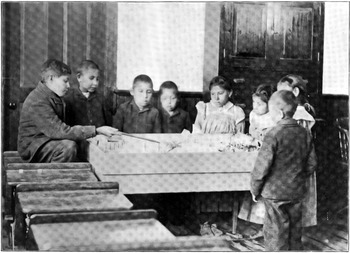
During her tenure as superintendent, Reel worked to incorporate sand tables into Indian schools. Education historians Jon Reyhner and Jeanne Eder note that by 1903, Reel had successfully brought the sand table to Indian schooling: “An interesting educational approach supported by Reel was sand tables for primary school children, which were used extensively in one-room BIA [Bureau of Indian Affairs] day schools on the Pine Ridge and Rosebud reservations in South Dakota.”Footnote 86 The 1903 Annual Report of the Commissioner of Indian Affairs chronicles this curricular innovation, complete with a photograph of Indigenous students at Pine Ridge Day School 27 using a sand table.Footnote 87 Reel’s version took Dewey’s innovations and transformed them for the federal government’s purposes. Namely, the sand table became an ideal tool for instructional goals set by the General Allotment Act of 1887, legislation which sought to break apart Indian reservations. The act targeted land previously set aside by treaty and held in common and divided it among individual Indigenous private landowners, who were then expected to homestead these allotments as yeoman farmers and “ancillary citizens” in the United States.Footnote 88
Reel employed the sandbox as a medium to convey to Native children the lessons required to make good on allotment policy. Rather than re-create the landscapes of the past, Reel used the sand table to lay out the landscape of the future. “The table is arranged like a home with irrigating ditch, ridge, fence posts made out of clothespins, house, etc. The pupil teacher says to the class, say ‘the horse,’ then ‘the horse runs,’ etc.”Footnote 89 Reel hoped that at the edges of the sand table, older Native students could become deputized instructors, teaching the younger students to speak English using the material objects of the homestead farmer that had been laid out in the sand table. J. J. Duncan, a day school inspector who observed Native students using the sand table, reported that the “sand table with its varied uses” was highly effective, especially as an instrument of teaching English to the students using the accoutrements of allotment—plows, horses, fences, and so on (see Figure 3).Footnote 90 In this fashion, the sand table was intended to inure Indian students to the expectations of allotment policy. Through Reel, one of Dewey’s Laboratory School innovations had become an element of the federal program of Native dispossession.
Method of Teaching English by Use of Sand Table, No. 27 Day School, in 1903 Annual Report of the Commissioner of Indian Affairs (Government Printing Office, 1904).

Reel’s ultimate purpose in citing Dewey’s Laboratory School activities, however, went beyond the sand tables. She cited Dewey’s curriculum at the Laboratory School to misrepresent the Course of Study’s rudimentary manual labor program for Indian schools as a form of robust industrial education. Specifically, Reel’s Course of Study refers to Dewey’s innovations in its section on culinary training for Indigenous girls. Cooking is depicted by the Course of Study as the “most important department in the school” for the typical Indian girl, as it was intended to “equip her with the ability to prepare appetizing meals from ordinary material, to enable her to make the home comfortable and attractive, to establish habits of neatness, promptness, and order, and to teach lessons of economy in the use of fuel.” For Reel, domestic foodways were the ideal place for the indoctrination of white, Victorian-era, gender-normative expectations for Indigenous girls and young women.Footnote 91
Reel used a Deweyan vocabulary of everyday experience to give her new Indian schooling curriculum the veneer of progressive pedagogy. Cooking lessons, she insisted, “should be occupied with work as nearly as possible like the familiar events of daily life in the home.”Footnote 92 Reel explicitly cited the Laboratory School to drive home this point: “In Dr. Dewey’s school the cooking of cereals is taught first, as this is probably the very simplest article of food to put into the hands of the small child to cook,” she wrote. She emphasized how Dewey’s students learned biology for understanding the organic origins of the food; math for dividing ingredients into increments; and chemistry to learn the chemical process of cooking or baking as they planted, grew, and harvested their crops from start to finish. Reel deliberately informed federal instructors to implement curricula that was nearly identical to Dewey’s lesson plans at the Laboratory School:
Have the child measure the amount of cereal to use and the exact amount of water necessary to cook it. She will thus learn to handle fractions in a most familiar way and understand their significance. The child must be taught to plan a meal for one, for two, or for three, or any given number, multiplying the amount for one by the number to be cooked for. Later the child will be able to write recipes, showing the amount of material to be used, the quantity of water to be added, and the length of time required to cook the material thoroughly. She thus learns unconsciously to tell time. The student must be taught the relation of fire, air, and water to life and to cookery.Footnote 93
Between the sand tables, the weaving, and the cooking, Dewey’s Laboratory School ultimately offered Reel a way to seize the imprimatur of experiential education for the Indian School Service to advance its program of schooling for assimilation. Such a project was rife with irony. When non-Native children were encouraged to learn like Indians in Dewey’s Laboratory School sand table, they were engaged in a kind of pedagogical playing Indian. When Native children in Reel’s federal Indian schools learned with sand tables, however, they were rehearsing for the part in which federal Indian policy had cast them: as colonial subjects. The former has been remembered by scholars as part of Dewey’s most remarkable, if not proudest, contributions in the history of progressive education; the latter has been largely forgotten. Rarely have they been considered as a mutually reinforcing part of the history of progressive education.
Conclusion
Dewey’s philosophy of play and pedagogical playing Indian grew up together. It began with Hiawatha and the Laboratory School. Historian Alan Trachtenberg calls performances of The Song of Hiawatha—such as pageants, parades, and woodcraft movements—an “institutional forms of mimesis.”Footnote 94 For Dewey, however, Hiawatha was the key to re-creating the psychology of the past—not by dramatizing Anishinaabe life through literature or mimicry through performance, but by offering the means to reconstruct the problematic situations of the past in the present. At the Laboratory School, this took the form of what I have called pedagogical playing Indian, anchored by the sand table. A close examination of the Laboratory School illustrates how playing Indian was a constituent element of progressive education in the late nineteenth and early twentieth century, not simply as a dramatic performance, but as critical node of articulation for early twentieth-century progressive and experiential education.
Ultimately, Hiawatha’s presence at the Laboratory School linked pedagogical playing Indian directly to Dewey’s emerging philosophy of experimentalism. Clara Mitchell reported that she read the “Fasting of Hiawatha” to her class of second graders not only because it was an example of great American literature, but because it was preparation for the Laboratory School’s sand table reenactment of the past.Footnote 95 Katherine Camp wrote with great precision about how Longfellow’s poem was used at the Laboratory School as the epitome of Dewey’s entire method. “Observation of the child’s natural interests has brought about the utilization of many of the spontaneous activities of children,” she wrote. “This has been helped, perhaps, by the convenience to the teacher of Longfellow’s literary expression of this life in Hiawatha.” In her account, pedagogical playing Indian had become synonymous with Dewey’s method of experimentalism itself: “In the summary of primitive history, through occupations from the side of invention and discovery, through imitation is introduced what might be legitimately called experimentation,” she concluded proudly.Footnote 96
Dewey’s enthusiasm for The Song of Hiawatha and his interest in pedagogical playing Indian displaced any potential concern of his for actual Indigenous people. As Elizabeth Carolyn Brown has observed, Dewey imagined Indians “as common-knowledge, un-cited historical referents” who “have little basis in empirical ‘reality.’”Footnote 97 In so doing, he left himself vulnerable to pedagogues who sought to apply his philosophy to their own ends, such as Estelle Reel. In the Laboratory School, the sand table was used for pedagogical playing Indian, to re-create social occupations of the past to train students to better solve contemporary problems. Such historical instruction was an integral part of Dewey’s burgeoning philosophy of education and democracy, and his insistence that such habits of mind would play a crucial part in every citizen’s training. In federal Indian schools, the sand table was intended to prepare Indigenous people for life as allotment farmers, housewives, and “ancillary citizens” as intended by the General Allotment Act of 1887. What Dewey and his Laboratory School colleagues refined for experiential education, Reel adapted to carry out federal Indian policy. This link ultimately chains John Dewey as a figure of imbrication between progressive education and the dispossessive logic of Indian schooling, a connection which invites closer scholarly scrutiny.
Such material connections between the Laboratory School and federal Indian schools have increasingly been flagged by scholars of Indigenous education calling for a dramatic reappraisal of Dewey’s esteemed place in the tradition of critical pedagogy. For instance, Indigenous education scholar Kimberly Richards suggests that Dewey may have “understood the psychological processes of dominance, exploitation and even racism to a certain degree, but was unable to recognize its roots in imperialism, colonialism, and even his own ethnocentrism.”Footnote 98 Furthermore, as Bayley Marquez notes, “much of Dewey’s understanding of development is based upon scales of civilization. This comparison of the stages of child development to European ideas of savagery and civilization produces a linear narrative in which Indigenous death and disappearance of Black death and pathologization are inevitable steps in a trajectory of progress.”Footnote 99 As Sandy Grande has rightly observed, “Like other whitestream thinkers … Dewey’s vision for an education system presumed the colonization of Indigenous peoples.”Footnote 100 At the Laboratory School, Dewey arguably not only presumed colonization, but enacted one of its oldest rituals—playing Indian. In 1899, Dewey had a pedagogical Indian problem on his hands; today, Dewey himself is a problem on the hands of Indigenous pedagogues.
Competing interests
Portions of this article appear in Matthew Villeneuve, Instrumental Indians: John Dewey and Indigenous Schools (University of Pennsylvania Press, 2026).
Matthew Villeneuve is Assistant Professor of US History at the University of Wisconsin-Madison.