

1. Introduction
Linell (Reference Linell2005) discusses how the field of linguistics is subject to a written language bias. This is true of all structural levels of theory and description, but is perhaps particularly the case for grammatical descriptions of languages with a long history of writing, such as Danish. In such descriptions, examples derived from introspection typically mirror the written language (ibid.:176), and attested examples typically come from written corpora.Footnote 1 The present study is part of a larger attempt to counteract this bias by describing the linguistic structure of Danish on the basis of how it is used in spoken discourse, or talk-in-interaction – the DanTIN (Danish Talk-in-Interaction) project. In recent years, this project has been publishing research on the grammatical structure of Danish talk-in-interaction as part of the online platform Samtalegrammatik.dk (Steensig et al. Reference Steensig, Brøcker, Grønkjær, Hamann, Hansen, Jørgensen, Kragelund, Mikkelsen, Mølgaard, Pedersen, Sørensen, Tholstrup, Heegård and Henrichsen2013). From an interactional or conversation analytic perspective, this means describing how linguistic resources are used for managing turn-taking and sequential organization (Sacks, Schegloff & Jefferson Reference Sacks, Schegloff and Jefferson1974; Schegloff Reference Schegloff and Dorval1990, Reference Schegloff and Ochs1996). From a strictly linguistic perspective, it means investigating how speakers make use of e.g. sounds and grammatical structures during talk-in-interaction.
The current study mostly falls in the latter category. This paper investigates the use of the prefield in Danish talk-in-interaction. The prefield denotes the highly flexible first position in declarative clauses as well as wh-initial interrogative clauses in all Germanic languages except English. This position is of particular interest to the overall framework, due to a cross-linguistic tendency to place known information clause-initially (e.g. Tomlin Reference Tomlin1986), meaning that the clause-opener is expected to be highly context-dependent. As such, a theory assuming context freedom in syntax is unlikely to provide a fulfilling description of which concerns go into choosing a constituent to place in the prefield. More generally, different considerations must be taken into account in talk-in-interaction than in written text, due to both the inherently temporal nature of talk-in-interaction (e.g. Auer Reference Auer2009, Hopper Reference Hopper, Auer and Pfänder2011) and the nature of turn organization.
In addition to providing a general overview of the prefield in talk-in-interaction, this paper focuses specifically on the functional considerations underlying the use of two items which very frequently occur in the prefield: det ‘it, that’, which acts as either a neuter third person pronoun or an expletive subject, and which takes no case marking; and så ‘then’, an adverb which has several related meanings in the temporal and modal domains, and happens to be homophonous with the semantically similar conjunction så ‘so’. I will argue that the semantic and functional flexibility of these two words renders them highly useful for speakers when shaping their clauses in real time, and that this is at least partially the reason for their rather extreme frequency as clause openers in talk-in-interaction. Sections 2–4 below will provide first a literature review of existing descriptions of the prefield, followed by a description of the theoretical framework of this study and the methodology. Section 5 will present the results of the analysis, and Section 6 will discuss and summarize the results.
2. Previous descriptions of the prefield
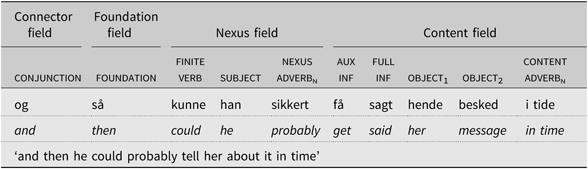
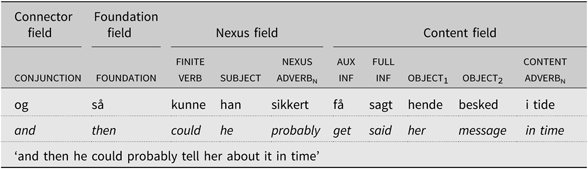
Similar to the other Germanic languages (except English), Danish syntax is notable for having what can be referred to as XV or V2 (verb-second) word order in main clauses (Platzack Reference Platzack1985, Vikner Reference Vikner1995): all grammatical roles have canonical positions in the clause, but almost all constituents can also principally be clause-initial. If the finite verb is clause-initial, it typically indicates an imperative or interrogative illocutionary frame (although see Rathje Reference Rathje, Borchman, Hansen, Hougaard, Togeby and Widell2013, Jensen Reference Jensen, Hansen and Hougaard2015). If any other constituent is clause-initial, it typicallyFootnote 2 indicates an indicative frame (e.g. Hansen & Heltoft Reference Hansen and Heltoft2011:38). The first position in an indicative clause is the prefield, called fundamentfelt (‘foundation field’, following Diderichsen Reference Diderichsen1946; henceforth simply referred to as F) in the Danish grammatical tradition. In large part because of F, the most popular way of visualizing Danish clause structure is still the topological model popularized by Diderichsen (Reference Diderichsen1946) under the name sætningsskemaet (‘the clause schema’). Modified versions of this model with varying terminology have since also been used for the description of Norwegian (Faarlund, Lie & Vannebo Reference Faarlund, Lie and Vannebo1997:858), Swedish (Teleman, Hellberg & Andersson Reference Teleman, Hellberg and Andersson1999), and German (Wöllstein-Leisten et al. Reference Wöllstein-Leisten, Heilmann, Stepan and Vikner1997:55), for which a similar model was already proposed by Drach (Reference Drach1940). Diderichsen’s (Reference Diderichsen1962:186) original main clause model can be seen in Table 1.
Diderichsen’s (Reference Diderichsen1962:186) main clause model.
As an integral part of Danish syntax, F is mentioned in most descriptions of Danish, although descriptions have generally gone into greater detail with its effects on the surrounding syntax, and lesser detail with its function in and of itself. Major typological overviews (e.g. Dryer Reference Dryer, Dryer and Haspelmath2013) tend to classify Danish as an SVO-language, presumably because there is a history of identifying the subject as the unmarked F in Danish grammatical research (e.g. Mikkelsen Reference Mikkelsen1911:573ff.; Diderichsen Reference Diderichsen1962:171; Nielsen Reference Nielsen1975; Heltoft Reference Heltoft, Heltoft and Andersen1986; Hansen & Heltoft Reference Hansen and Heltoft2011:74; but compare Brøndal Reference Brøndal1928 and Hansen Reference Hansen1933 for opposing points of view). With regard to the communicative function of F, Diderichsen (Reference Diderichsen1962:192ff.) suggests some primary considerations guiding the choice of F: previously mentioned referents are often used in F, and F can be used for emphasis (as he envisions to be the case when it is occupied by non-subjects; this was also the position taken by Togeby Reference Togeby1993:111ff.). Hansen (Reference Hansen1933:74ff.), however, noted that F can only be used emphatically if it is prosodically marked as such. The general tendency to place known information early in the clause is very common cross-linguistically, and is often mentioned in the literature on information structure (e.g. Mathesius Reference Mathesius1929, Firbas Reference Firbas1971, Lambrecht Reference Lambrecht1994). Tomlin (Reference Tomlin1986) refers to this tendency as the theme first principle. Thomsen’s (Reference Thomsen1992) quantitative study of F in spoken Danish established that this principle also applies to Danish.
In Hansen & Heltoft’s (Reference Hansen and Heltoft2011:1729ff.) comprehensive grammar of Danish, the authors suggest three ways in which F can be filled: (i) anaphorically, referring to something previously mentioned in the text; (ii) dynamically, in which case the referent is not directly mentioned previously in the text but activated through association with previously mentioned referents; and (iii) focally, indicating what the speaker considers to be the most important part of the clause; note that this use of ‘focal’ differs from how the term is used in much of usage-based grammar (e.g. Lambrecht Reference Lambrecht1994 or Dik Reference Dik1997), where it refers specifically to new information.Footnote 3 Hansen & Heltoft make a distinction between tema ‘theme’ and emne ‘topic’; the subject is theme regardless of its position, while F is (typically) topic regardless of its grammatical role (Hansen & Heltoft Reference Hansen and Heltoft2011:1196ff., 1728ff. inter alia). Given its function of framing the state-of-affairs in a certain light, the subject is considered to be innately topical, but in a clause without initial subject, another topical role is required in this position.
Several studies on Danish (e.g. Thomsen Reference Thomsen1992, Brøcker et al. Reference Brøcker, Hamann, Jørgensen, Lange, Mikkelsen and Steensig2012, Jørgensen Reference Jørgensen, Vikner, Jørgensen and Gelderen2016) have investigated the preference for left dislocation in some forms of language use. This entails a preferenceFootnote 4 for using short, light constituents in F; if heavier constituents are needed, such as full noun phrases or subordinate clauses, they are relegated to clausal extra positions either preceding or following the clause proper.Footnote 5 F itself then consists of an anaphoric or cataphoric copy of the heavier constituent, typically a pronoun or a light adverb. The phenomenon is relatively frequent in Danish talk-in-interaction (Brøcker et al. Reference Brøcker, Hamann, Jørgensen, Lange, Mikkelsen and Steensig2012, Brøcker Reference Brøcker2014) and has been found in all the Nordic languages (Johannessen Reference Johannessen2014).
There are quantitative studies available of F in Danish and other Germanic languages. Table 2 provides an overview of the results of these. This overview aims to be exhaustive for Danish, but not necessarily for other languages. Table 2 demonstrates that even though F provides the same syntactic flexibility in these languages, it is not utilized in the same way. There are also considerable intra-language differences, which can presumably be attributed to F exhibiting different usage patterns for different genres. With regard to information structure, Bohnacker & Rosén (Reference Bohnacker and Rosén2008) reports that a preference for known information is F is far more pronounced in Swedish than in German, which is mirrored in the coding in that subjects are less frequent in F in German. Similarly, Bohnacker & Lindgren (Reference Bohnacker and Lindgren2014:43) report a more pronounced preference for function word Fs in Swedish than in Dutch. Given the wide range of genres reported on here, it is unclear how comparable these studies are to each other and to talk-in-interaction, where different considerations are at play with regard to structuring cohesion.
Overview of constituents found in F in previous quantitative studies.
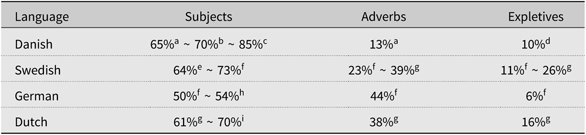
a Jensen (Reference Jensen2003 vol. II: 4–5): spoken, sociolinguistic interviews
b Smidt (Reference Smidt1971), cited from Jørgensen (Reference Jørgensen2013:184): written, front pages of newspapers
c Buhl (Reference Buhl2004), cited from Jørgensen (Reference Jørgensen2013:184): written, various genres
d Thomsen (Reference Thomsen1992:199): spoken, sociolinguistic interviews
e Westman (Reference Westman1974:155): written, various genres
f Bohnacker & Rosén (Reference Bohnacker and Rosén2008:517): written, various informal genres
g Bohnacker & Lindgren (Reference Bohnacker and Lindgren2014:42): spoken, image description task
h Fabricius-Hansen & Solfjeld (Reference Fabricius-Hansen and Solfjeld1994:101): written, newspaper articles
i Bouma (Reference Bouma2008:96): spoken, various genres
It should be noted that F is not necessarily strictly speaking a clause opener. As can be seen in Table 1 above, it can be preceded by a conjunction (the ‘connector field’ as per Diderichsen Reference Diderichsen1946), and in talk-in-interaction, this is very often the case. However, the connector field and F have very different interactional functions and grammatical properties (Steensig Reference Steensig2001:207ff.), and F can reasonably labeled the first position of the clause proper, as is also done by Hansen & Heltoft (Reference Hansen and Heltoft2011:331). The same has been noted for Swedish, where Lindström (Reference Lindström2008:205ff.) in his description of Swedish turn construction describes how conjunctions group with certain discourse particles in providing initial contextualization for a clause, while the contribution of the clause begins with F.
3. Theoretical framework
This paper uses a combination of interactional and more traditional grammatical methods for data analysis. The different frameworks drawn upon are presented in this section. As mentioned above, the study theoretically aligns with the work of the research group DanTIN, which uses a combination of Conversation Analysis and traditional grammatical analytical resources such as syntagmatic and paradigmatic distribution. As with much other work on the interface between interaction and grammar, the theoretical perspective of the group is usage-based without adhering to any one particular theory. The more linguistically inclined work in Conversation Analysis is sometimes referred to using the umbrella term Interactional Linguistics (Couper-Kuhlen & Selting Reference Couper-Kuhlen, Selting, Selting and Couper-Kuhlen2001, Reference Couper-Kuhlen and Selting2018; Steensig Reference Steensig2001; Lindström Reference Lindström, D’hondt, Östman and Verschueren2009). This tradition provides an important methodological and analytical toolkit for this study. As the name suggests, there is a predominant focus on interactional structure in Interactional Linguistics; this paper, however, mostly focuses on grammatical structure, and is in that sense more aligned with the related Discourse & Grammar framework (Du Bois Reference Du Bois2003), in analyzing linguistic structure on the basis of its use in spoken discourse, and in partially doing so on the basis of a numerical account of the phenomenon in question (see also e.g. Hopper & Thompson Reference Hopper and Thompson1980, Reference Hopper and Thompson1984; Du Bois Reference Du Bois1987).
Important insights from Interactional Linguistics are incorporated in the analysis, including (i) the temporal structure of utterance formation, (ii) a focus on the placement of utterances within social actions, and (iii) an insistence on using naturally occurring data as the basis for analysis (see Couper-Kuhlen & Selting Reference Couper-Kuhlen and Selting2018:18ff.). By the first criterion is meant that speakers do not fully plan utterances ahead of time but rather shape them as they are being uttered (syntax is on-line; Auer Reference Auer, Heringer, Jäger, Kurz and Stötzel2000, Reference Auer2009); this is only rarely acknowledged in other grammatical frameworks, and although it is theoretically acknowledged in Cognitive Grammar (Langacker Reference Langacker2008:79ff.), it appears to have had little influence on the overall framework. By the second criterion is meant that speakers use utterances to carry out social actions in a sequentially organized manner (Sacks et al. Reference Sacks, Schegloff and Jefferson1974), and the particular social action or sequential position of an utterance is sometimes said to be partially or fully responsible for the syntactic coding of a given utterance, in what Schegloff (Reference Schegloff and Ochs1996) refers to as ‘positionally sensitive grammars’ (see also Ford, Fox & Thompson Reference Ford, Fox, Thompson and Tomasello2003, Fox & Thompson Reference Fox and Thompson2010, Thompson, Fox & Couper-Kuhlen Reference Thompson, Fox and Couper-Kuhlen2015). These interactional insights are highly integrated in Discourse & Grammar, but are at most vaguely acknowledged in other usage-based schools of grammar.
While the frameworks of Interactional Linguistics and Discourse & Grammar bring important analytical and methodological insights to working with talk-in-interaction, none of them have fully-fledged grammatical toolkits. Regarding the use of nominal Fs, the primary function of the clause opener is intricately linked with information structure. For the analysis of information structure, one must look for a traditional grammatical framework to combine with the more interactional frameworks. It is a general tenet of usage-based frameworks of grammar that the context of an utterance has an observable influence on its structure (Du Bois Reference Du Bois2003), and as such, all major usage-based frameworks have theories of how grammar is affected by information structure. These theories differ in both their implementation of information structure and their terminology; for example, the Systemic Functional Grammar notion of theme (Halliday Reference Halliday1967) appears very similar to the Construction Grammar notion of topic (Lambrecht Reference Lambrecht1994), while the Cognitive Grammar notion of topic (Langacker Reference Langacker1991:313) has altogether different connotations. Several of these treatments of information structure have useful insights.
The theory of information structure which forms the basis of that component of both Role and Reference Grammar (Van Valin Reference Van and van Valin1993, Reference Van Valin2005) and several types of Construction Grammar (Michaelis & Lambrecht Reference Michaelis and Lambrecht1996, Goldberg Reference Goldberg2006) comes from Lambrecht (Reference Lambrecht1994). His notion of topicality is the primary one used here. In his theory, the topic of a clause is a lexicogrammatical manifestation of part of that clause’s pragmatic presupposition. The presupposition refers to what the speaker believes that the hearer knows and is aware of at the time of the utterance, and the topic is a delimited part of the presupposition which forms the basis for the clause’s assertion. Another component of Lambrecht’s theory concerns the activation status of referents. They can be either active, inactive or semi-active (i.e. easily activated through association with other active referents). A well-formed topic is either active or semi-active, and its coding is dependent on its activation status.
The Cognitive Grammar notion of topic (Langacker Reference Langacker1991) can be loosely defined as what a clause is about. For example, in the discourse stretch ‘I’ve been thinking about the wedding … The back yard would be a good place’, the wedding is considered the topic of both clauses (ibid.:313), even though it would not be considered topical in either clause by Lambrecht. While Langacker’s notion of topic lacks the nuance of Lambrecht, Lambrecht’s theory similarly lacks a term for the overall topic of talk; such a unit, however, has analytical merit, at least to the extent that speakers orient towards it. In the analysis below, I will refer to it as the discourse topic, and use it alongside topic (as defined by Lambrecht). Another useful notion from Cognitive Grammar that will be made reference to in the analysis is the discourse space (Langacker Reference Langacker2001), which refers to all information available to the interlocutors at the time of an utterance, including not just the pragmatic presupposition but also the physical setting of the speakers.
In their discussions of topic management, the above-mentioned theories generally take for granted that a discourse topic refers to a specific referent. This is not something the authors discuss per se, but it is clear from their examples. By specific referents, I refer to persons, objects, concepts, etc. that are typically coded using nouns or noun phrases. This is practical, since they are easy to track in discourse; for a pronominal topic, one can easily draw a line to a focal noun phrase in the previous clause, for example. These are presented as prototypical topics, but as is shown below, this is not representative of Danish talk-in-interaction, in which the referential scope of topical det ‘it, that’ tends to be broader and more diffuse, even if its function as expletive subject is not considered. The descriptions of topic management in the theories presented above cannot neatly cover diffuse elements, such as pronouns referring to states-of-affairs or entire discourse stretches.
4. Data and methodology
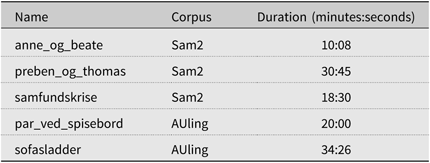
The material for this study comes from two corpora: Sam2 (MacWhinney & Wagner Reference MacWhinney and Wagner2010a, b) and AUling (see Samtalegrammatik.dk 2018). Sam2 (MacWhinney & Wagner Reference MacWhinney and Wagner2010b) is a publicly available corpus of three audiovisual recordings of free two-person interactions between acquaintances collected for the larger Samtalebank and Talkbank repositories. No researchers are present during the recordings. AUling is a large corpus of various types of interactional data gathered by students and staff at Aarhus University; this corpus is not publicly available, but videos can be obtained after signing a non-disclosure agreement. The recordings from AUling used for this study are similar in nature to the recordings from the Sam2 corpus. The speakers analyzed for this study are from various age groups, and all speak Western varieties of Standard Danish. In total, five videos were used for the study, including all videos from the Sam2 corpus and two videos from AUling that were chosen on the basis of their overall similarity to the Sam2 videos, i.e. free two-person interactions between acquaintances not involved in other activity than spoken interaction. Table 3 shows an overview of the recordings used.
The recordings themselves are the object of analysis, but they are represented here in the form of transcriptions according to Jefferson’s (Reference Jefferson and Lerner2004) conventions for Conversation Analysis. Jeffersonian transcription essentially follows the conventional grapheme–phoneme correspondences of the target language, but not necessarily the spelling conventions. This allows for relative ease of transcription as compared to phonetic transcription, while also allowing the researcher to show e.g. phonetic reduction through orthographic modification.Footnote 6 Pauses, overlap, stress, intonation patterns, and several other types of prosodic modification are all indicated in Jeffersonian transcription. The recordings have all previously been transcribed to varying degrees of granularity, but all examples in the paper have been re-transcribed by the author. An overview of transcription conventions is given in Appendix A. All participants have been anonymized.
Overview of recordings used for the study.
In order to get a general overview of the usage of F in talk-in-interaction, F of 100 consecutive clauses with main clause word orderFootnote 7 were analyzed from each of the recordings. Each of the 500 clauses were coded for a number of parameters: the form of F, its grammatical role in the carrier clause, the activation status of its referent, the direction of phoric reference if applicable, its referential scope, and its position in the turn-at-talk.
All examples analyzed in the remainder of this paper come from this corpus of 500 clauses and have been chosen because they illuminate dominant structures or contain interesting exceptions. Examples typically include multiple clauses of interest to the topic at hand, along with their surrounding interactional context. They are presented with corpus name, file name, and line number in the original transcript, for convenient reference. All examples are accompanied by English translations, while clauses which are actively used in the analysis are also accompanied by morpheme-by-morpheme glosses (see conventions in Appendix B). Note that only the glosses themselves include indications of morpheme boundaries, in order to avoid intrusive characters in the transcribed speech. The clauses in focus are marked with arrows, and the relevant Fs are in boldface.
5. Results
This section presents the results of the analysis. First, the general findings are presented in the form of a numerical account of the use of F in talk-in-interaction. Following this, exemplified in-depth analyses are presented of the different usage patterns of det ‘it, that’ and så ‘then’.
5.1 General overview
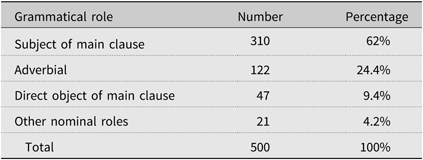
Table 4 shows the distribution of grammatical roles of Fs in the data. As seen in Table 4, most Fs are grammatical subjects in the main clause. Adverbials are also quite frequent, and significantly more so than in Jensen’s (Reference Jensen2003) study of F (recall Table 2 above). They are less frequent, however, than has been reported for Dutch and German (Bohnacker & Rosén Reference Bohnacker and Rosén2008, Bohnacker & Lindgren Reference Bohnacker and Lindgren2014). Other nominal roles than subject are less frequent, although they are somewhat more frequent than in other Germanic languages, as reported by Bohnacker and colleagues. The other-category in Table 4 includes e.g. prepositional objects and arguments from subordinate clauses, of which all logical possibilities except for indirect object are found in the data, mirroring Jensen’s (Reference Jensen2003) findings.
Grammatical roles in the prefield.
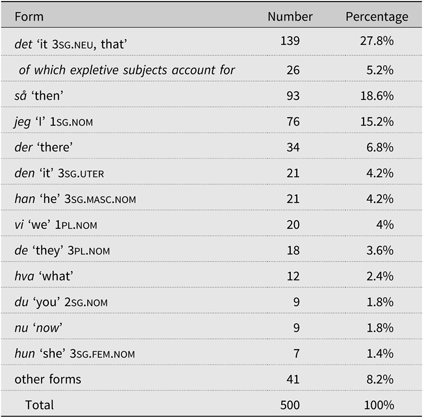
An overview of frequent forms found in F in the data can be seen in Table 5. Note that the forms in Table 5 refer to Fs proper and may be preceded in their respective clauses by heavier constituents in extraposition. A striking thing about the above numbers is the extreme frequency of the most frequent Fs, with the three most frequent ones appearing in more than half of the analyzed clauses. Steensig (Reference Steensig1994:76, Reference Steensig2001:231) mentions the frequency of det ‘it, that’ and så ‘then’ in this position in talk-in-interaction, and in the sociolinguistic interviews analyzed by Jensen (Reference Jensen2003), det ‘it, that’ is actually found to occupy the prefield even more frequently than here. Otherwise this frequency goes unmentioned in the traditional grammatical literature. With the exception of så ‘then’ and nu ‘now’, both of which are light adverbs, all other frequent forms are pronominal. This preference for pronouns was also reported by Thomsen (Reference Thomsen1992) and Jensen (Reference Jensen2003), and for Swedish by Bohnacker & Lindgren (Reference Bohnacker and Lindgren2014). This study, however, finds significantly fewer expletive subjects in F than Thomsen (Reference Thomsen1992) did, and much fewer than has been reported for Swedish (recall Table 2 above). This may be due to the nature of the data. The relatively frequent forms shown in Table 4 above make up more than 90% of all Fs in the data, clearly indicating a preference for Fs containing brief references to active referents. Of the 41 Fs in the other-category, most are other pronouns and light adverbs. Only eight Fs contain lexical noun phrases or proper nouns, while three contain heavy adverbial phrases and three contain direct quotes. Semantically heavier Fs in talk-in-interaction are thus possible, but fairly rare; see Puggaard (Reference Puggaard, Hansen, Hougaard and Goldshtein2019) for more detail on these.
Most frequent forms in the prefield.
Most pronominal Fs have a pronounced tendency to be grammatical subjects, but this is not the case for the most frequent form, det ‘it, that’. Many pronominal Fs refer to nominal-type elements such as persons, objects, concepts, etc.; this type of reference is henceforth referred to as narrow referential scope. In contrast, det most often refers to larger structures, i.e. the state-of-affairs of a preceding clause, or even larger discourse structures; this will henceforth be called broad referential scope.
5.2 Flexibility of det ‘it, that’
Det ‘it, that’ is by far the most frequent F in Danish talk-in-interaction, and (perhaps for this reason) is also highly semantically and pragmatically flexible. Part of this flexibility can be attributed to det’s dual function of pronoun and expletive subject. This is an important distinction, syntactically and pragmatically, but since they are homophonous, this distinction is not available to hearers on occurrence; as discussed below, this formal identity may also be part of the appeal for speakers in using it as clause opener. When not acting as expletive subject, det is grammatically a neuter gender third person singular pronoun, but whether or not its gender has any significance depends on the context. Similar to the corresponding uter gender (also known as common gender) pronoun den, but unlike other Danish personal pronouns, det does not take case inflection, and thus does not require any modification in order to appear in F occupying diverse grammatical roles in the carrier clause. This section explores the multiple functions of det in F (F–det), in turn covering the flexible referential scope of pronominal F–det, cases in which the function of F–det is not clear from the context, and finally expletive use.
5.2.1 Flexible referential scope
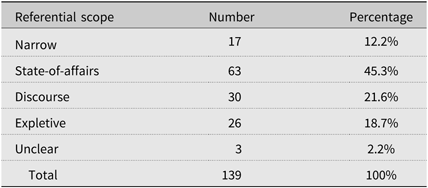
F–det can have both relatively narrow and very broad referential scope. In this paper, F–det with clear reference (see Section 5.2.2) is characterized either as having narrow, state-of-affairs or discourse reference, or as having an expletive function; these are all exemplified below. Their distribution is seen in Table 6.
Distribution of referential scope in F–det.
In (1) below, F–det is used with both broad and narrow use, the former having state-of-affairs scope. Grammatically, det with narrow scope clearly differs from det with broad scope, in that it exhibits neuter gender agreement with a noun phrase, while grammatical gender is not relevant to det with broad scope (Kappelgaard & Hjorth Reference Kappelgaard and Hjorth2017:23).
(1) Sam2 | preben_og_thomas | l.299






In (1), the interlocutors are discussing the house that Preben’s daughter and son-in-law have recently bought, and how they will need to build rooms in the basement to increase the living area of the property. F–det is used twice in (1) with varying referential scope. In line 5, F–det is used with reference to huset ‘the house’. It is the grammatical subject, which is almost always the case when F–det has narrow referential scope. Huset ‘the house’ is the discourse topic, but it has not been mentioned either explicitly or with an anaphor for a while, with the interaction instead revolving around sub-topics such as the basement, the rooms, etc. Huset ‘the house’ is thus in itself only semi-active as this point, and Preben appears to think that the anaphor may be an insufficient reference, as he refreshes it with a full mention of huset ‘the house’ in extraposition following the clause proper in line 6. The reference of F–det in line 5 is thus simultaneously anaphoric and cataphoric, referring to both the semi-active discourse topic and the explicit extraposition. Such an anaphoric–cataphoric split reference can be illustrated as in Figure 1, which shows how the intended reference of F–det in line 5 is huset ‘the house’, the last explicit mention of which is approximately 30 seconds earlier in the interaction. As a range of related referents have become topics, huset ‘the house’ is at this point dynamically active. Analyzing F–det in Figure 1 as a cataphor is admittedly a post hoc measure; it was probably not conceived as such, but that is how it is eventually presented to the hearer. It was presumably conceived as an anaphor only, with the extraposition added as a repair strategy. A plausible explanation for this is that for det to be parsed as a neuter gender reference, an available neuter gender referent needs to be highly active.
Illustration of narrow anaphoric–cataphoric split reference.

The reference of the other example of F–det in (1) cannot be equally clearly delimited. In line 2, F–det is the object of a subordinate clause (line 3). This F–det is semantically incompatible with huset ‘the house’, and grammatically incompatible with værelser ‘rooms’ of line 1 (as that would have required an oblique case third person plural pronoun dem ‘them’). Rather, F–det refers to the state-of-affairs of the previous clause (line 1), i.e. the conceptual content of the predicate nødt til å ha nogen værelser ‘need to have some rooms’. The given topic of the clause in line 2 does not refer to a nominal-type entity, but rather the assertion of the preceding clause. This use of broad reference topics is mentioned surprisingly little in the grammatical literature (although see Houser, Mikkelsen & Toosarvandani Reference Houser, Mikkelsen, Toosarvandani, Bainbridge and Agbayani2007), although it does surface in text linguistic literature on cohesion (e.g. Ulbæk Reference Ulbæk2005:44). From an interactional, pragmatic point of view, they are to be expected: clauses build upon each other and will be naturally prone to include relevant portions of the discourse space or pragmatic presupposition with a reference that is as light as possible.
The excerpt in (2) contains two further instances of F–det referring to states-of-affairs:
(2) Samtalebank | samfundskrise | l.278


In (2), Asta and Lis discuss how much the value of stocks have dropped in the wake of the financial crisis. In lines 1–4, Asta says that stocks have dropped to half of their previous value, and in lines 5–6, Lis repeats this information to clarify her understanding. In line 4, F–det refers to the state-of-affairs in the preceding clause in line 3, i.e. the complex predicate er faldet til det halve ‘have fallen to half’; F–det is not compatible with any other linguistic element in the immediately preceding discourse. The grammatical role of F–det in line 4 is subject predicate. The state-of-affairs reference is illustrated in Figure 2.
Illustration of state-of-affairs reference.

F–det refers to the state-of-affairs and not the entire preceding clause, as the grammatical subject of line 3 ( aktierne ‘the stocks’) is repeated in line 4; in fact, the subject is repeated with a stronger reference in line 4, being referred to with a pronoun de ‘they’ in line 3 but a full noun aktierne ‘the stocks’ in line 4. Grimes (Reference Grimes1975) notes that referents are generally coded with progressively weaker references within the same identification span of the referent; this would indicate that part of the communicative purpose of the clause in line 4 is to clarify the pronominal reference in line 3. In line 5, after uttering the realization token nåja (Emmertsen & Heinemann Reference Emmertsen and Heinemann2010), Lis reformulates the gist of Asta’s turn in order to display her understanding, in what Heritage & Watson (Reference Heritage, Watson and Psathas1979) call an upshot formulation. The preferred response to an upshot formulation is a confirmation (ibid.), but rather than awaiting confirmation from Asta, Lis produces one herself in line 6. The most likely referent of F–det in line 6 is the state-of-affairs of the directly preceding clause.
The excerpt in (3) contains an instance of F–det referring to the conceptual content of a longer stretch of discourse:
(3) AULing | par_ved_spisebord | l.394


In (3), Adam is summarizing the plot of the film The Imitation Game to Eva, in which the protagonist builds the world’s first computer in order to decode messages that the Allies intercepted from Germans during the Second World War. This film has been the discourse topic for a while at this point in the interaction, with various sub-topics being introduced and discussed along the way. Prior to the sequence in (3), Adam has explained the notion of decoding messages, when Eva asks in line 2 what decoding has to do with the world’s first computer. Adam responds in lines 5–14 by explaining what is meant by computer in this context. In lines 15–17, Eva wraps up the discourse topic with a particle indicating her understanding m:, followed by an assessment of the plot. F–det in line 17 does not refer to any specific predicate-type or nominal-type referent. It clearly does not refer to the discourse topic filmen ‘the film’, as that would require uter gender agreement. Rather, it refers to the entire preceding stretch of discourse, scoping over several turns-at-talk, presumably including not just the sequence included in (3), but what precedes it as well. The discourse reference of this F–det is illustrated in Figure 3.
Illustration of discourse reference.

F–det with discourse reference tends to be the grammatical subject of the carrier clause. This pattern is functionally motivated: when F–det has discourse reference, the clause typically provides an assessment of the discourse topic of the preceding stretch of interaction. These tend to be predicative clauses, often with the format F–det + copula verb + assessment (Garly Reference Garly2018:37). Assessments are a typical resource for closing storytelling sequences (Goodwin & Goodwin Reference Goodwin and Goodwin1987, Garly Reference Garly2018:17).
Thus, F–det with either narrow or discourse reference tends to act as the grammatical subject of its carrier clause, but this is not the case when F–det refers to states-of-affairs. In fact, when a clause contains det referring to states-of-affairs, it generally occupies F of said clause, no matter what its grammatical role is. In these cases, the information structural function of the word overshadows the grammatical role in the clause. This is demonstrated in (4):
(4) AULing | par_ved_spisebord | l.250


In (4), Eva and Adam talk about some small hairs that Eva has found in her food. Adam suggests that the hairs might come from Eva’s shirt, and she responds in line 5 by saying that she had not thought of this but that it might very well be the case. F–det in line 4 is the grammatical subject of the clause. It refers cataphorically to the assertion in the subordinate clause de:t din trøje ‘it’s your shirt’. Line 5 begins with the realization token nåja (Emmertsen & Heinemann Reference Emmertsen and Heinemann2010), which is lengthened. There are two instances of det in line 5; an expletive subject and a broad anaphoric reference to the preceding state-of-affairs. The latter is not prosodically emphasized, and information structurally it is the clause’s topic. The grammatical literature would suggest that the expletive subject is the textually unmarked F here (e.g. Heltoft Reference Heltoft, Heltoft and Andersen1986), but in this case topical det is in F. This indicates that – at least in the case of det – information structure is weighted higher than grammatical role when it comes to choosing a clause opener. Theories on information structure have long assumed that a clause tends to take the preceding clause’s message (rheme, assertion, focus, etc.) as its starting point, and clauses containing F–det with broad referential scope are a dedicated construction for doing just that.
5.2.2 Unclear reference and grammatical role
In the examples analyzed above, the references and grammatical roles of F–det are relatively clear. However, there are also examples of F–det having unclear reference, typically because the original clause format is abandoned before the clause is finished. In some cases, this obscures whether F–det was pronominal or expletive, which grammatical role was intended, etc. These examples can illuminate some features of the use of F–det. (5) illustrates a clause format being abandoned, leaving F–det with unclear reference. In (5), there is an instance of F–det which may be either pronominal or expletive:
(5) Samtalebank | samfundskrise | l.411


In (5), Asta and Lis are comparing the financial crisis of the late ‘00s with the oil crisis in the 1970s. The two are talking about how high interests during the oil crisis were tax deductible, so that if your interest was at 20%, you only had to pay around 10%. Asta makes this point in lines 4–5. The clause in line 4 has F–det. It is the grammatical subject of the clause, as observable from the fact that no other nominal constituent follows the verb. This format is abandoned before the clause is finished, and after a brief pause, the clause is reformulated as conditional. Since the clause in line 4 is never finished, the function of F–det is never clarified; since we are privy to the intended message as it appears in line 5, we might assume that it would have been an expletive subject. But it could also have been an anaphor with broad referential scope or a cataphor to be expanded upon in extraposition, as shown in the constructed examples in (6a, b):
(6)


F–det’s flexibility in referential scope is an advantage to language users. As evidenced by lines 4–5 in (5), language users often do not have a finished format for a clause by the time they start uttering it; rather, clauses take shape as they are being uttered (Auer Reference Auer2009), and sometimes the originally chosen format for a clause only reveals itself to be impractical when the clause is being spoken. Given this insight, it is very practical for language users to have a standardized clause format that is also highly flexible, which is the case for clauses with initial F–det.
An example of a clause with F–det in which the grammatical role is unclear can be seen in (7):
(7) AULing | par_ved_spisebord | l.283


The interaction in (7) takes place just before that in (3); Eva has just said that she wants to see the film The Imitation Game, and Adam brings up that she mentioned the day before that she did not want to see it. In line 2, Eva begins uttering a clause in which she intends to say that she changed her mind (as evidenced by line 6), but this format is abandoned, presumably due to extensive overlap from Adam in which he reenacts her saying previously that she does not want to see the film. In lines 4–6, Eva delivers the message with a new format: in line 4, jeg ‘I’ is F in the superordinate clause, while in line 6, the subordinate clause uses a format with F–det. While the subordinate clause has main clause constituent order (as is frequently the case in talk-in-interaction; see note 7), Eva’s turn in lines 4–6 clearly constitutes a single prosodic unit.
The clause in line 2 has F–det, with reference to the state-of-affairs in the previous clause in line 1. Since the format in line 2 is abandoned before the clause is finished, the grammatical role of F–det is unclear. Jeg ‘I’ is the grammatical subject, and det is rather a constituent in a subordinate clause which is ultimately never realized (this is known as a knude construction or sentence intertwining; e.g. Jakobsen Reference Jakobsen, Devriendt, Goossens and van der Auwera1995, Jensen Reference Jensen2002). Depending on how the clause would have been formed, it could have been subject, object, or prepositional object of that subordinate clause, as shown in the constructed examples in (8a–c). In these examples, the canonical position of the prefield constituent is indicated with 0, following Jakobsen (Reference Jakobsen, Devriendt, Goossens and van der Auwera1995).
(8)


While the clause in line 2 in (7) was in all probability not abandoned due to the format, but rather due to Adam’s overlapping parody, it remains the case that a standardized clause format with a semantically and syntactically flexible first position is very advantageous to language users when interacting in real time.
As mentioned above, det does not take case inflection, as opposed to most other personal pronouns in Danish. This serves to make F–det more functionally flexible, and may serve to explain why the F–det construction is so frequent. Speakers of Danish appear to find the construction highly intuitive, and they are not discouraged when F–det fulfills a grammatical role which has a canonical position much further into the clause. This may precisely be because the grammatical role of F–det does not need to be specified before beginning the clause. F–det can be considered a place-holder of sorts for clauses which are to some extent based on part of the active discourse space, which is the case for most clauses in talk-in-interaction; note that this is a different place-holder function from the purely syntactic one attributed to expletive subjects (e.g. Hammarberg & Viberg Reference Hammarberg and Viberg1977). From the vantage point of information packaging, the reference of F–det is generally initially vague, and only becomes clear in the context of its carrier sentence.
There are advantages to using F–det for both the speaker and the hearer. If F–det refers to a specific nominal-type referent, it will normally quickly be identifiable as such on the basis of gender agreement, particularly since uter gendered nouns are more frequent than neuter gendered ones (approx. 75% of nouns are uter gendered; Hansen Reference Hansen1967:29). F–det with broad referential scope is thus quickly identifiable as such, and a light anaphor for this purpose is necessary to solve what Levinson (Reference Levinson and Palmer1995:95) calls the ‘bottleneck in human communication’: the conceptual structure of a message is generally much more complex than what can be extrapolated from the linguistic substance itself, which is why languages need generalized patterns dedicated to e.g. indicating a relationship between a clause and the preceding clause. The F–det format is an example of such a pattern, which is explainable in part by Levinson’s (Reference Levinson and Palmer1995, Reference Levinson2000) I-heuristic: ‘minimal forms warrant maximal interpretations’ (Reference Levinson and Palmer1995:97). In other words, for the hearer, F–det can easily be parsed as having broad reference, precisely due to its flexibility in referential scope.
5.2.3 Expletive function and cataphoric reference
Expletive subjects are frequently found in F. While such expletive subjects are always grammatical subjects, it is not similarly the case that expletive subjects are always Fs, as illustrated in e.g. (4) above (see also Bohnacker & Lindgren Reference Bohnacker and Lindgren2014). Their function is to satisfy the syntactic requirement for a subject in clauses which do not have an obvious semantic subject. Det is traditionally thought of as the only expletive subject, although Hansen & Heltoft (Reference Hansen and Heltoft2011:1212) note that der ‘there’ is also leaning towards a purely expletive function. The majority of clauses with expletive subjects either have an overt copula verb or direct juxtaposition of subject and subject predicate due to copula deletion.Footnote 8 As such, the referential content of expletive det can often be equated to its predicate. An example can be seen in (9):
(9) Samtalebank | preben_og_thomas | l.365


In (9), as in (1), Preben and Thomas are discussing the house that Preben’s son-in-law just bought, and how making changes to a house can increase its selling price. In the sentence in lines 5–6, the subject as well as F is det. The assertion in line 5 is that det is a good investment; in the course of on-line parsing, the clause can be heard as syntactically and possibly pragmatically complete by the end of line 5, but not prosodically so (see Ford & Thompson Reference Ford, Thompson and Ochs1996). At this point, F–det is not analyzable to the hearer as an expletive, but rather a broad-reference anaphor. Given the full context, F–det emerges as an expletive, but can still be analyzed as referring cataphorically to the subordinate clause in line 6 å gå å lave sånoget selv ‘to be doing such stuff yourself’, which is in itself an explicit form of the discourse topic. Both parses are illustrated in Figures 4 and 5. As illustrated in these figures, in the course of on-line parsing, det is first analyzable as referring to the preceding discourse, but eventually as an expletive with cataphoric reference to the subordinate clause – which is in itself an overt mention of the discourse topic. The structure is similar to that in (1) above, in that the subordinate clause is there to clarify the reference of det. The speaker’s inclusion of this clarification indicates that the discourse topic may not be considered an easily retrievable referent on the basis of only a light anaphor.
Illustration of reference of det after line 5.

Illustration of reference of det given full context.

The expletive function of F–det in talk-in-interaction is similar to the previously discussed functions in that it does not need to be decided by the speaker when they start uttering the clause. Their conceptual content differs, in that a well-formed non-expletive F–det has recoverable anaphoric reference, while expletive F–det does not. For both types, however, it is the case that this reference is only clarified by the context. It was mentioned above that non-expletive F–det is used whenever a connection is explicitly made to some aspect of the preceding discourse; expletive F–det, on the other hand, is used when there is no part of the pragmatic presupposition to draw upon in making an assertion, i.e. when a clause is purely focal. This extends the flexibility of F–det further, and suggests that Danish talk-in-interaction does not simply have a preferred ordering of elements on the basis of their contribution to the information structure of the clause, but rather a preference against clause-initial focal elements, even when there are no topical elements.
5.3 Flexibility of så ‘then’
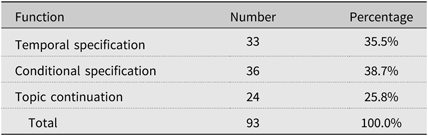
As with det, the second most frequent F så ‘then’ also has several different functions as a clause opener; they are classified here as temporal specification, conditional specification, and topic continuation. They will be introduced and discussed in turn below. They are fairly evenly distributed, as seen in Table 7.
Distribution of functions of så ‘then’.
5.3.1 Temporal specification
The most common function of F–så is to indicate that the conceptual content of the current clause follows or follows from what has been said in the immediately preceding discourse. It may temporally follow, in that the state-of-affairs being described occur after previously described states-of-affairs. It may follow from, in that it is true or contextually relevant as a result of something previously said (on the relationship between truth and contextual relevance, see Sweetser Reference Sweetser1990:113ff.). This section covers temporal specification, while the next will cover conditional specification. There is quite a bit of overlap between the two; for example, a state-of-affairs may be relevant in the context of another precisely because it temporally follows it. The ambivalence of F–så suggests that the two are also conceptually closely related.
Temporal F–så is associated with storytelling sequences, as illustrated in (10):
(10) Samtalebank | anne_og_beate | l.190





In (10), Anne and Beate are negotiating a common understanding of what happened the previous Saturday night, when the two were supposed to meet up but failed to do so due to a series of misunderstandings. The sequence seen in (10) mostly consists of Beate presenting the events of that night chronologically, frequently using F–så to indicate temporal progression. The clauses with F–så (lines 1, 7, 12, 14, 17, 18) constitute new events in the story, while the other clauses consist of disruptions in the temporal progression of the story. In line 1, Beate references a phone call she made to Anne; the phone call is a progression in the ongoing story, and thus has F–så. Lines 2–6 relay the contents of the phone call, and do not in themselves include temporal progressions in the story; none of these clauses have F–så. The only full clause by Anne (line 7) also has F–så, as it is a contribution to Beate’s story which modifies Beate’s understanding of the events. Beate indicates in lines 9–11 that her understanding has changed, before progressing with the story in line 12. Accordingly, the clause in line 12 has F–så, but the ones in lines 9–11 do not. Lines 14-15 are also a progression of the story with F–så. Line 15 is not a progression of the story, but an explanation for the message in line 14, and thus does not have F–så. Lines 16-18 are all progressions in the story, and all have F–så. It may not always be the case that progressions in storytelling have F–så, but there is a strong tendency. Since turns-at-talk in storytelling sequences generally consist of many clauses, temporal F–så tends to occur turn-internally.
5.3.2 Conditional specification
In addition to temporal specification, F–så is often used for specifying a conditional relationship with the preceding discourse. This usage is more likely than temporal F–så to occur turn-initially, as it is not associated with storytelling sequences. The function of conditional F–så may be formalized as in (11):
(11)

This use of F–så is probably formed on the basis of analogy with conditional clauses with the hvis p så q ‘if p then q’ format. In such conditionals, the protasis is syntactically in the extraposition, while the apodosis has F–så (e.g. Diderichsen Reference Diderichsen1962:204), which follows Haiman’s (Reference Haiman1978) claim that conditionals typologically behave like topics. Clauses with conditional F–så are pragmatically analogous to conditional clauses (as characterized by Comrie Reference Comrie, Traugott, Meulen, Reilly and Ferguson1986), but instead of the protasis being found in extraposition, it is found in a different clause or across several clauses, possibly in the speech of another speaker.
Several instances of turn-initial conditional F–så can be seen in (12):
(12) Samtalebank | samfundskrise | l.278


In (12), Asta and Lis are discussing the state of the stock market. In the preceding discourse, Lis has mentioned a friend who lost 50,000 DKK of a 300,000 DKK savings account due to the stock market crash. Asta is making the point that many people had it much worse, and that many people’s stocks dropped to half. In line 7, Lis concludes that her friend was actually comparatively lucky. In this brief example, F–så is used four times. In line 3, Lis starts her turn with the realization token nåja, used to indicate that a problem in her epistemic access has been solved (Emmertsen & Heinemann Reference Emmertsen and Heinemann2010). The rest of the clause is an upshot formulation (Heritage & Watson Reference Heritage, Watson and Psathas1979), also used to indicate that Lis’ understanding is now up to date. In line 5, Asta begins another clause with F–så and the expletive subject der ‘there’; she abandons this format in favor of another, which also has F–så, but with generalized du ‘you’ as its grammatical subject. If analyzed as conditional, the protasis to this clause consists of the assertion in lines 1–2, as illustrated in (13):
(13)

The clause in line 7 also has F–så. It is not clear if this clause constitutes a separate turn from the one in lines 3–4, as Lis has been speaking in overlap with Asta almost throughout Asta’s turn in lines 5–6. The scope of the protasis in this clause is not clearly delimited but refers to at least the assertion in lines 1–2 and presumably also her own realization in lines 3–4.
In (14), several examples are shown of turn-internal F–så. When F–så appears turn-internally, it is difficult to distinguish between temporal and conditional readings:
(14) Samtalebank | anne_og_beate | l.243


In (14), as in previous examples, Anne and Beate are discussing the events of the previous Saturday night. Anne says that she called various friends of hers, but that all of them were busy with something. She also did not know the karate guys (line 6) that Beate was with at the time, so she decided to go to sleep. In line 1, Anne initiates a clause with F–så, but abandons the format after the finite verb. She initiates another clause with F–så in line 2, which may be identical to the clause that she originally intended in line 1. The clause in line 2 is a quotative construction which is common among younger speakers of Danish (Rathje Reference Rathje, Gregersen, Parrott and Quist2011). The quote in such a construction does not need to be represented speech but can also be represented thought (Rathje Reference Rathje2009), as is the case here. F–så in line 2 can be analyzed as indicating either temporal or conditional specification. (14) is part of a longer storytelling sequence, so F–så in line 2 may indicate that the clause temporally follows the previously covered events, as discussed above, or may indicate that the represented thought follows as a result of the preceding discourse, i.e. that all of the friends that Anne called already had other plans. The two meanings are interrelated to the point of being interchangeable.
F–så in line 4 is more easily recognizable as having conditional meaning, since it does not describe an event per se, and has no temporal position in the storytelling sequence. It constitutes represented thought, but can easily be analyzed as a consequence of the clause in line 1, as illustrated in (15):
(15)

The clause in line 8 also has F–så. Here, the temporal and conditional meanings are also hard to tease apart. The clause is part of a storytelling sequence and can reasonably be analyzed as temporally following the preceding parts of the sequence: the decision to go to sleep temporally follows the decision not to go out. It can also be analyzed as conditionally following the preceding, as the decision to go to sleep may follow as a result of deciding not to go out. As with F–det, it is probably the case that the frequency and semantic flexibility of the F–så clause format are mutually strengthening. Due to its semantic flexibility, it can effectively be used as a placeholder by the speaker before they have decided upon the full format of a clause, as long as they have decided the primary pragmatic function of the clause, i.e. to provide an assertion which somehow follows (from) the preceding discourse. The extreme frequency of the construction leads to polysemy, which is to be expected (e.g. Langacker Reference Langacker, Kardela and Persson1995; see Geeraerts Reference Geeraerts1993 for a critical discussion of the notion of polysemy).
Finally, it is worth noting that while it is fully grammatical for both temporal and conditional F–så to occur in the canonical position for adverbs in the clause model, they are only rarely found outside of F in the data set. This further indicates that the unmarked prefield is not the clause’s subject, but rather a fitting discourse structuring device.
5.3.3 Topic continuation
The final frequent function that F–så has can be referred to as topic continuation. This use of F–så has the function of indicating that the assertion of the carrier clause provides additional information about a discourse topic. Thus, it clarifies the interactional purpose of its carrier clause.
This function is illustrated in (16):
(16) AULing | sofasladder | l.107





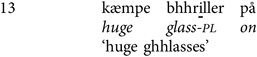
In (16), Clara has just asked Ditte how it is going with a mutual acquaintance of theirs. Ditte tells Clara of some embarrassing pictures she has uncovered of him from when he had his Confirmation, a common rite of passage for adolescents in Danish society. The sequence contains two instances of F–så. In lines 5–6, Ditte explains how his hair was dyed black at the time, and was very long, which she indicates with an arm gesture. The clauses in lines 5–6 provide closely related assertions. In the following clause by Ditte, in lines 12–13, she explains how he wore large glasses in the picture. Taken together, the clauses in lines 5–6 and 12–13 constitute a three-part list of physical features found in these pictures; Jefferson (Reference Jefferson and Psathas1990) notes a general preference for three-part lists, and similar sequences are also analyzed by Selting (Reference Selting, Femø Nielsen and Wagner2007) in her work on list construction in German talk-in-interaction. The clauses in lines 6 and 12–13 have F–så, indicating that the clauses provide additional information about the discourse topic.
F–så indicating topic continuation is typically found turn-internally, as the additional information typically modifies a discourse topic introduced by the same speaker. It is often but not always preceded by å ‘and’, with the possible implication that a constructional status of å så is emergent; such a construction may be most prevalently associated with lists, but such a claim must be verified by an independent study. As with temporal and conditional så, topic continuation så typically occurs either in F or not at all, although it is not syntactically restricted to F. This is functionally motivated, since its meaning is primarily modal, and an indication of the rhetorical function of a clause is most informative if preceding the assertion.
None of the functions of F–så are topical in the traditional sense. The temporal and conditional uses can be said to have anaphoric reference, as their meanings are specified by the surrounding discourse; temporal F–så, for instance, is specified on the basis of the temporal setting of the preceding discourse. Topic continuation F–så has no phoric reference, as its specific meaning does not lie in any of the preceding or following discourse. Generally, this means that F–så does not conform to any traditional notions of topicality. For speakers, however, it is a useful tool for grounding a clause in the surrounding discourse, either by specifying its relation to what precedes it, or by indicating the interactional purpose of the carrier clause.
6. Discussion and conclusions
This paper has investigated the use of the prefield in Danish on the basis of its use in talk-in-interaction. A quantitative study of 500 clauses was followed up with in-depth analyses of the highly flexible use of det ‘it, that’ and så ‘then’. There are a number of discrepancies between this study and previous studies of the Danish prefield.
With a few notable exceptions (see in particular Hansen Reference Hansen1933), Danish grammarians have consistently claimed that non-subject Fs are textually marked. While this paper has only covered in detail the use of det and så, these make up almost half of Fs in talk-in-interaction, and their usage does not support textual markedness of non-subject Fs. As an adverb, F–så is unable to act as the grammatical subject of its carrier clause, and the choice of F–det does not appear to be grounded in concerns about its grammatical role whatsoever. Some simplified preferences guiding the choice of F can be summarized as follows: if the carrier clause temporally or conditionally follows (from) the preceding discourse, F–så is preferred; if the carrier clause is grounded in the preceding predicate or discourse stretch, or if the carrier clause’s assertion is purely focal, F–det is preferred. If none of these criteria apply, the topic of the clause is often a more concrete element, which is most often referred to using a personal pronoun, and which most often acts as simultaneously F and grammatical subject. A functional motivation for these preferences can be found in the temporal structure of clause formation; both F–det and F–så are functionally flexible and are thus available to speakers before they have fully decided upon a syntactic format for the message they wish to deliver, as long as they have decided upon the overall interactional purpose of the clause.
The interactional perspective taken in this paper is crucial to the results that were found. Superficially, the perspective has been important because the use of interactional data in itself reveals major differences in the use of F between talk-in-interaction and other types of language use. From a more analytical point of view, different considerations come into play in the contexts researched here than in other linguistic contexts. Because of the temporality of spoken language, little time is available to speakers when forming utterances, making them more likely to use grammatical constructions that are available to them with relatively little modification. This predicts that speakers are likely to choose clause openers that are pragmatically immediately available in the discourse, and that are formally chosen from a small set of frequent clause openers – which is indeed the case. Put simply by Du Bois (Reference Du Bois2003:49), ‘[g]rammars code best what speakers do most’. A related consideration that follows from temporality is the irreversibility (Auer Reference Auer2009:3) of spoken language; interlocutors have no way of editing their message after the fact, making certain style factors that are important to the written language less viable. Another consideration that is specific to talk-in-interaction is how the action type of an utterance restricts its coding possibilities, with e.g. a pronounced preference for F–så in certain clauses in storytelling sequences.
The flexibility of F is of particular significance. The semantically and functionally flexible det and så are highly frequent, and there is a very low frequency of hapax legomena, i.e. unique Fs in the data. F–det and F–så are expected to be very frequent in part because they are highly flexible, and vice versa. They can be seen as partially formulaic constructions; in the case of F–det, due to its high flexibility, language users need not have decided upon either the referential scope of det or the format of the clause prior to using the construction, as it can be used to make an assertion based on a discourse entity of any size, and can alternatively be used with cataphoric reference or as an expletive. In the case of så used as a clause opener, it is possible that language users have not even decided upon its grammatical role before commencing the clause.
The interactional perspective taken here has presumably led to different results than what would have been found in other genres, making comparison with previous studies difficult. Danish appears similar to Swedish in its distinct preference for known information clause-initially, and in mostly choosing clause openers from a small set (Bohnacker & Rosén Reference Bohnacker and Rosén2008); expletive subjects in F are, however, less frequent in the current study than what has been found for Swedish. This may be a result of the different genres under investigation; it remains unclear how the current results would compare to Swedish talk-in-interaction.
The study complies with the general notion that topics/themes tend to be clause-initial, but the notion of topic must be extended so it covers not just distinct referents but also broad and diffuse referents. In fact, the preference for topic-initial clauses is most clear from the vantage point of broad-reference topics, as these are most likely to override any preference for clause-initial subjects.
While the preferences reported on in this paper are not absolute, there are good motivations why language users would make active use of broadly functional, partially prefabricated constructions in interacting with each other, and why these constructions would be particularly flexible in the early stages of clause formation. At this point, the language user may have a good idea of what information structural and interactional considerations should be kept in mind, but not yet what the actual format of the clause should be.
Author ORCIDs
Rasmus Puggaard, 0000-0003-4522-9987
Acknowledgements
I would like to express my gratitude to Jakob Steensig for extensive guidance on a previous version of this project. I would also like to thank Tanya Karoli Christensen for useful comments and literature recommendations for an adjacent paper. Finally, I would like to thank the editors at Nordic Journal of Linguistics as well as three anonymous reviewers for helping a great deal to present the current results in the best and clearest possible manner. Any remaining faults are, of course, my own.
Appendix A. Transcription Conventions
The following symbols are used throughout in transcriptions:

Appendix B. Glossing Conventions
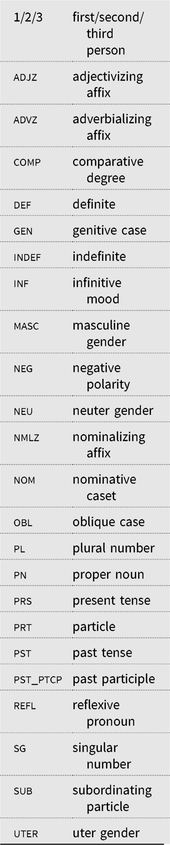
The glosses follow the Leipzig glossing conventions (Comrie, Haspelmath & Bickel Reference Comrie, Haspelmath and Bickel2015). The following abbreviations are used:


 Open access

