


Introduction
Snow gliding (slip of snowpack over sloping terrain) is related to the interaction of the roughness elements at the interface over which the snow is gliding and the distribution of water there (Reference McClungMcClung, 1981; Reference McClungMcClung and Clarke, 1987). The study of snow gliding has three important applications: (1) gliding can result in high forces on structures placed on sloping alpine terrain (e.g. Reference McClung and LarsenMcClung and Larsen, 1989); (2) gliding can be an important consideration for slip of snow on roofs of buildings, resulting in damage to chimneys, vents and other objects; and (3) in alpine terrain and on roofs, gliding can result in full-depth avalanche release (Reference McClungMcClung, 1987) as a result of reduction in snow ground interface friction associated with the interaction of free water and ground roughness elements.
In this paper, field measurements are presented for two winters of gliding measured hourly on steep rock (31° slope angle) in the North Cascade Mountains above the Coquihalla Highway, southwestern British Columbia. Supporting measurements include air and ground interface temperatures, and precipitation and snowpack properties. The principal results include temporal characteristics of gliding on two time scales (diurnal and seasonal), correlation of the measurements with full depth avalanche occurrences (not addressed in this paper) and the effect of an open crack (glide crack) on glide speed above and below the crack.
In addition to glide speed characteristics, the measurements are briefly discussed relative to existing theoretical formulations of the snow-earth interface boundary condition and its relation to engineering problems. Particular attention is given to forces on restraining barriers on roofs and avalanche formation on roofs subject to gliding.
Description of measurements and the site
Our measurement method involves using glide displacement gauges (3 m maximum displacement) similar to those described by Reference Gand and ZupancicGand and Zupancic (1966). During the fall of 1987 we installed five gauges on a rock slab at 1450 m elevation on a south-facing slope with 31° inclination (see plan view in Figure 1). The site is characterized by a step in the rock below which the snowpack separates from the rock to form an open crack. The site was chosen to be steep enough for gliding to be representative of nearby avalanche starting zones but not steep enough for avalanches to start there normally.
Supporting measurements at the site include temperatures at the snow rock interface, air temperature 3 m above the snowpack surface, and air temperature near the bottom of the crack between the rock step and the snowpack (indicative of temperatures in a “glide crack”). All temperature measurements were made with calibrated thermistors. Snow gliding and temperature measurements were made hourly throughout the winter. However, the gliding dala reported in this paper include those summed over two 12-hour intervals per day : 0600 h to 1800 h (daytime observations) and 1800 h to 0600 h (night observations). The accuracy of glide displacement measurements was about 1 mm and in most cases, 12 h displacements exceed 10 mm. Gliding and temperature measurements were recorded by a data logger at the site connected to a radio and modem accessible from a personal computer at the base station below.
We also assessed snowpack properties at the site by taking snow profiles approximately every two weeks throughout the winter. These measurements showed that the snowpack almost always had a layer of wet snow at the bottom with water content (by volume)
Plan and side views of snow glide gauge placements (G#1 through G#5) relative to a 2m high step in the rock. Glide interface temperature measurements are made at G#1, G#2 and G#5. Also shown are locations of thermistors in the glide crack beltveen the step in the rock and the snowpack and air temperature 3 m above the snowpack. A side view shows the configuration of the rock and snowcover.

which ranged from about 8 to 15% or greater with thickness one to several cm. The exception occurcd only-early in winter during cold conditions when the snowpack was thin. In this case, glide was not observed and the snowpack was frozen to the interface. Our measurements showed snow depths at the site which ranged up to about 2 m.
Theoretical foundations of snow gliding
Snow gliding occurs as a result of the snowpack sliding over the snow/ground interface roughness elements (McClung, Reference McClung1981, Reference McClung1987; Reference McClung and ClarkeMcClung and Clarke, 1987). Friction is accounted for by creep over the ground roughness elements with nearly zero friction when the roughness elements are drowned or when the effective ratio of amplitude to wavelength of roughness elements is very low. In order for the snowpack to remain in equilibrium at least some portions of the roughness elements must slope uphill. Since gliding is not observed in alpine terrain unless wet snow is present at the interface, the usual assumption is that at least a thin water layer is present at the base of the snowpack. That being the case, the snowpack drag is calculated as the downslope component of the normal forces on the ground roughness elements averaged in the downslope direction. If the snowpack is taken to be separated from the ground roughness elements by a very thin film of water everywhere, the constitutive equation for the downslope (tangential) drag, τ, is given by Reference McClungMcClung (1981) as:

where U is glide speed, D is a length parameter which depends only on interface geometry and μ, v are the shear viscosity and viscous Poisson ratio of snow at the interface. Equation (1) is derived without consideration of large-scale longitudinal gradients of stresses and material properties in the snowpack. It is also assumed that snow deforms as a linear, viscous material with a constitutive equation equivalent to a Newtonian viscous compressible fluid with neglect of the static pressure term (Reference McClungMcClung, 1981; Reference Salm and Ôura.Salm, 1967).
Equation (1) gives an expression which may be taken to represent steady glide rate if the material properties of snow are assumed constant. In reality, both μ and v will slowly increase with time due to bulk deformation and they can be functions of the water content (Reference McClung and ClarkeMcClung and Clarke, 1987; Reference Izumi and AkitayaIzumi and Akitaya, 1985). Since water content may vary on short time scales in the lowest portion of the snowpack, Equation (1) may also be used to explain fluctuations in gliding due to changes in μ and v with water content.
The above theory may explain part of the fluctuating component of gliding. However, it is our belief that the most important part of the fluctuating component of gliding is due to the changes in friction conditions at the interface by drowning (or partial drowning) of interface roughness obstacles governed by the supply of water there. Reference McClung and ClarkeMcClung and Clarke (1987) examined the problem in a simple way and concluded that the simplest extension of Equation (1) is given by:

where D* is greater than D when part of the interface area is drowned by water so that a smoother interface geometry is present. Equation (2) has the capability of explaining fluctuations of glide rate on the order of 100 times depending on water distribution and interface roughness (Reference McClung and ClarkeMcClung and Clarke, 1987). The gliding data presented in this study showed wildly fluctuating values throughout the season. We believe that the effect of water on the interface geometry described by Equation (2) explains most of the fluctuations, rather than variations of μ and v with water content. Since our field observations showed that the character of snow at the interface (usually slush) did not vary greatly over the course of the winter, the greatest share of the fluctuating component of gliding must be due to changes in the area of the interface which is drowned or partly drowned by changing supply of water there (Reference McClung and ClarkeMcClung and Clarke, 1987). Since seasonal alpine snow is so highly porous (porosity usually 50% or above), we do not feel that pore pressure effects are significant in the snow-gliding measurements reported in this paper.
Seasonal character of gliding
Figure 2a-c shows data for the 1989–90 winter from glide gauge 1 (above the step in the rock, see Fig. 1) and glide gauges 2 and 3 (below the crack step in the rock). The data depicted are 12 h average glide speeds resulting in two data points per 24 h period (0600 h to 1800 h; 1800 h to 0600 h). The data show highly fluctuating values throughout the season at site 1 with high fluctuations in early season. At sites 2 and 3, high early season fluctuations were exhibited in early season as well as late season (spring conditions). All three sites exhibited two periods with zero glide in early season. For the first of these, the snowpack completely melted. For the second, the snowpack was very thin and the weather was cold, resulting in the snowpack being frozen to the interface (verified by our interface temperature measurements). The high glide rates during spring at sites 2 and 3 are attributed to addition of melt water and rain during spring thaw conditions.
The high fluctuating values and high glide rates in early season are seen in all our data. We believe that two competing effects contribute; (1) heat stored in the rock during summer results in melt at the interface to change the viscosities and the interface geometry and (2) the early season snow is of relatively low density and therefore the shear viscosity is low, resulting in faster deformation at the interface.
Our data also indicale that roughly the same seasonal pattern of gliding and rates of gliding roughly repeat on a year-to-year basis (compare Figs 2a and 3a and Figs 2b and, 3b). This is due to the roughly similar character of the snowpack and weather patterns during the two seasons of data presented.
Spatial pattern of gliding at the site
With reference to Figure 2a-c, our data show that glide rates increased in the downslope direction from gauges 1 (above the crack) 2 and 3 (below the crack). Table I shows mean values and standard deviations for glide rates for two seasons’ data. It may be noted that the data from site 4 (left flank) are very similar to those from site 3. Also at site 5, the glide rates and fluctuations were nearly double for 1989–90 as compared to 1988–89. In this case, we believe there are two competing effects: (1) the placement of the glide shoe was further downslope in 1989-90 and (2) we believe the supply interface water
Glide speed (mm d−1 ) measurements based on two 12 h averages (0600–1800 h; 1800–0600 h) per 24 h periods (1989–90 winter), a, Gauge #1. b, Gauge #2. c, Guage #3.

Glide speed (mm d−1) measurements based on two 12h averages (0600–1800 h; 1800–0600 h) per 24 h periods (1988–89 winter), a, Gauge #1. b, Gauge #2. The gauge exceeded the displacement limit past day 130.

from sources high on the slope at site 5 was extremely variable near the location of site 5.
Diurnal variations
Based on two seasons, we have analyzed the information with respect to gliding speeds collected during the day hours (0600–1800 h) and the night (1800–0600 h). Our data show that during 1988–89, gliding was generally faster during the day than at night (Figs 4a and 5a), while in 1989–90 there was no apparent difference between day and night-time values (Figs 4b and 5b). We do not have a complete explanation of these results but we believe that our planned studies of radiation input and cloudiness at the site may be revealing. In addition, air temperature records at the site on a diurnal basis have not yet been analyzed.
Two seasons of glide data. Mean and standard deviations in. mm d−1

Air temperatures
We have not completely analyzed our snow gliding fluctuations in relation to air temperatures. In general, snow glide rates do tend to increase with air temperature at our site. However, the relationship is far from simple due to effects which compete in a multivariate sense: loading by precipitation (snow and rain), snowmelt by solar radiation, the direct influences of water from rainfall and the large-scale water drainage patterns at the snow-rock interface. A comprehensive analysis is planned in our future work.
Engineering applications of gliding: forces on structures in deep snow covers and barriers and snow fences on roofs
Consider the plane-strain problem of forces on a structure placed perpendicular to a snow-covered surface which can allow snow gliding. For a rough glide interface such as an alpine terrain, the tangential drag at the snow earth interface may be represented by Equation (2). Reference McClung and LarsenMcClung and Larsen (1989) gave analytical solutions for the forces on the barrier, due to interruption of snowpack creep (internal deformation) and glide. It is assumed that the proportionality between τ and U (Equation (2)) is constant all along the glide interface. The major component of the barrier force is that in the downslope direction with a depth averaged value  given by Reference McClung and LarsenMcClung and Larsen (1989):

In Equation (3), Η is snowpack depth, ψ is slope angle,  depth averaged density (see Figure 6a for the
Quanlile-quantile plots of glide rates for day (0600–1800 h) versus night (1800–0600 h) at gauge #1. a, 1988–89 winter, b, 1989–90 winter. Note: glide rates are plotted as mm d −1 (24 h period)

geometry). As with Equations (1) and (2), in Equation (3) it is assumed that the snow deforms as a linear, compressible Newtonian viscous fluid with neglect of the static pressure term. The parameter L/H depends upon the boundary conditions on the face of the barrier (see Reference McClung and LarsenMcClung and Larsen, 1989). For example, if the barrier face is traction free,  (Reference McClung and LarsenMcClung and Larsen, 1989).
If the glide interface is very smooth, such as on a smooth roof, Equation (2) may be replaced in the extreme low friction limit by (Reference McClungMcClung, 1981):

In Equation (4), μw is the viscosity of water at 0°C and δ is a parameter with dimensions oflength. It (δ) is equal to
Quantile-quantite plots of glide rates for day (0600–1800 h) versus night (1800–0600 h) at gauge #2. a, 1988–89 winter, b, 1989–90 winter. Note: glide rates are plotted as mm d−1 (24 h period)

the thickness of the thin water film separating the snowpack and the roof if they are taken to have parallel sides (originally stated by Newton). In this case, the tangential drag is extremely low and even though one could replace D* in Equation (3) by

the physical problem changes. In fact, with such low interface friction, high tensile forces can develop in the snow cover to produce a tensile crack high on the roof (see Fig. 6b). Figure 7 gives an example of this common configuration. Crack formation allows the entire snow cover to act on the barrier to produce longitudinal barrier
Schematic for calculation of stresses on a barrier on a slope subject to snow gliding and slip, a, Equation (3) gives the longitudinal stress on the barrier for moderate gliding without presence of a tensile crack, b, Equation (6) gives a simple formulation for rapid sliding (zero friction) when a tensile crack forms upslope from the barrier.

stresses given in a one-dimensional approximation by:

where X0 is the length along the roof from the barrier face to the position of the tensile crack. Equation (6) is derived by direct integration of the equilibrium equation assuming zero friction at the glide interface with a free surface at the upslope end of the snowpack. Equation (6) may be taken as an approximate conservative engineering design equation for the longitudinal stress on a barrier placed on a very smooth wet roof subject to snow gliding. Reference TaylorTaylor (1987) reports coefficients of sliding friction on roofs as 0.05 for smooth steel or painted roofs and 0.02 for smooth glass. Therefore, the design friction may be taken near zero for a wetted, smooth roof (Reference TaylorTaylor, 1987). Since the friction all along the glide interface is assumed zero, glide parameters (D* or δ) do not appear.
Appearance of a tensile crack high on a roof caused by gliding. Equation (6) provides estimates of stresses on a barrier where X0 is shown in Fig. 6b.

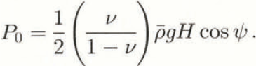
For avalanche formation on roofs subject to gliding which do not have restraining barriers at the bottom (near the eave), tensile stresses in the slab are higher than for the case of avalanche formation in an alpine snowpack (Reference McClungMcClung, 1987) for the same glide interface boundary conditions. In the case of the snow slab on a roof, the lower, longitudinal boundary is a free surface instead of being restrained by lateral compressive stresses (analogous to the earth pressure at rest) as in the case of the alpine snow slab. Therefore, this effect plus the possibility that roofs can have smoother glide surfaces than in alpine terrain can lead to easier sliding and earlier avalanche formation than in alpine terrain. Reference TaylorTaylor (1987) reported that roof designers in the U.S.A. and Canada begin to allow for sliding on warm slippery roofs at slope angles exceeding 15°. Avalanche formation by gliding in alpine terrain begins at about 25° and it is probably true that both effects mentioned above contribute to producing roof avalanches on slope angles as low as 15°. For roofs, a smooth interface can allow-faster gliding and with a free surface at the lower end of the slab, tensile stresses in the upper end of the slab are higher than they would be if a free surface was not present (see Reference McClungMcClung, 1987, for the estimates without the free surface) by approximately:
Examination of glide constitutive parameters
We believe Equation (2) is more appropriate to describe snow gliding for an alpine snowpack than Equation (4). In Equation (2), both viscosity parameters μ and v may be influenced by changing water contem in the snow layer near the boundary. However, data by Reference Izumi and AkitayaIzumi and Akitaya (1985) on hardness of wet snow as a function of water content indicate that this effect is too limited to explain fully the fluctuations in glide velocity indicated by our data. Their data show that hardness can decrease by a factor of about 25% for coarse-grained wet snow over the variations in water content (8 to 15%) we observed in the layer near the snow-rock interface. Our data show that glide speeds may vary up to a factor of about 10 (Fig. 2b) in alpine terrain. We therefore attribute the highest fluctuations to changes in D* as water content increases at the rock interface. We feel that lesser changes in glide speed are due to decreases in μ and v as water content increases in the lowest layer, assuming that viscosity and hardness both vary with water content as shown in the data of Reference Izumi and AkitayaIzumi and Akitaya (1985).
From the equations of equilibrium, we may equate snowpack drag to the basal shear stress at the bottom of the snowpack in a region assumed free of longitudinal gradients of stresses and material properties:

We have approximate estimates of all of these parameters except μ (shear viscosity). From our data, typical parameters are:  400 kg m−3, H = 1 m, ψ = 31°, U0 ∼ mm d−1 (Table 1) and v
  0.2 (e.g. Reference SalmSalm, 1977). Given these parameters and D*/H in the range 0.1 to 1 (e.g. Reference GuidelinesSwiss Guidelines, 1990; McClung, in press) yields values for μ in the range 0.2 2 × 10kg sec m −2. Reference Haefeli and ÔuraHaefeli (1967) gives a value of about 0.4 × 10¹¹kg sec m−2 for the shear viscosity of snow with density 400 kg m −3. It may be noted that these estimates of viscosity are about five orders of magnitude higher than estimated by Reference Gand and ZupancicGand and Zupancic (1966) by application of a different glide constitutive equation. Therefore, even though this dimensional argument is only approximate and somewhat circular, we believe it lends some support for our proposed glide constitutive Equation (2). In our view, Equation (2) may be used to describe gliding with the fluctuations interpreted by changes in D* and to a lesser extent μ and v as water content varies near and at the snow rock boundary.
Summary discussion
Our data from gliding on sleep rock show the following characteristics:
-
Highly fluctuating values of glide speed are found particularly in early winter and late spring. Those characteristics are, however, consistent with gliding theory.
-
Data for two winters showed that glide rates tend to be similar at the same location for winters of similar character.
-
Our studies of spatial variation show that glide speed is higher below the step in the rock (where snow has separated from the rock) in the snow cover than above it. There are probably two contributing effects: (1) the presence of the free surface at the uphill surface of the snow allows easier downslope motion of the gliding slab and (2) the open crack can help to concentrate melt water at the glide interface by serving as an open reservoir for surface melt water to concentrate.
-
We cannot conclusively say whether glide rates are, on average, faster during the day than at night. Better scrutiny of meteorological parameters is needed to understand gliding on a diurnal time scale. Two winters’ gliding data do not yield a clear answer.
-
We have presented simple analytical expressions for the longitudinal force on restraining barriers in deep snow covers (Reference McClung and ClarkeMcClung and Larsen, 1989) and on roofs when gliding is present. The character of the problem on a warm, smooth roof is obviously of a different character than that of a deep snow cover but it may be approached from a similar mechanics formalism. In the zero friction limit (Equation (3b)) constants from the glide constitutive equation do not appear.
One aspect of gliding which is not included in our simple analytical formulae for barrier forces is time dependence. Even though gliding shows highly fluctuating time dependence our equations are based on quasistatic formulations. A complete time-dependent solution is not available yet and its implications for engineering problems have not been fully considered. Our simple analysis of the fluctuations (Equation (8)) and physics of snow gliding shows consistency with the proposed gliding constitutive Equation (2). However, this analysis does not constitute a proof that Equation (2) is appropriate.
Acknowledgements
This research was sponsored by the National Research Council of Canada, the Natural Sciences and Engineering Research Council of Canada and the British Columbia Ministry of Transportation and Highways. We are grateful for these sources of support and to Jack Bennetto of the British Columbia Ministry of Transportation and Highways for his help and support on this research.



