

The passage of the US Native American Graves Protection and Repatriation Act (NAGPRA) in 1990 is widely regarded as a watershed moment in the relationship between North American archaeology and Native American communities. The discussions that began around the treatment of ancestral remains and other culturally important objects forced many North American archaeologists to confront other long-standing inequities inherent in Native-focused research, including fieldwork and publication practices. Over the past three decades, many archaeological research programs in the United States and elsewhere have reoriented toward collaborative paradigms in which work “with, for, and by” Native American communities takes center stage (Atalay Reference Atalay2006). Even as this “Indigenous Archaeology” movement has helped transform the “traditional” ways in which fieldwork, curation, and publication are done (e.g., Atalay Reference Atalay2012; Cipolla and Quinn Reference Cipolla and Quinn2016; Gonzalez et al. Reference Gonzalez, Kretzler and Edwards2018; Roberts Thompson et al. Reference Roberts Thompson, Thompson, Garland, Butler, deBeaubien, Panther and Hunt2023), the rapid growth of computer sciences in the twenty-first century has meant that the relationship with data, a fundamental component of the research process, has often been left out of the Indigenous Archaeology discussion.
This article shares recent lessons learned from the second-generation expansion and operation of cyberSW, the largest archaeological research database in the US Southwest. Developed and hosted by the Tucson-based cultural heritage nonprofit organization Archaeology Southwest, cyberSW makes pre-settler US Southwest / northwest Mexico archaeological data accessible through an open access web platform, cyberSW.org (Figure 1). In 2021, work began on cyberSW 2.0, including the creation of a Tribal Working Group (TWG) that could advise the Archaeology Southwest team on ways in which both current and future versions of cyberSW could be made more relevant and useful to individual Native scholars and Tribal governments alike.
Map displaying all site records available in cyberSW (current as of September 9, 2025).

Figure 1 Long description
The map displays archaeological site records in the cyberSW database as of September 2025 , marked with various colored circles. Each circle contains a number, representing the amount of sites in that sub-region. The map includes regions such as Arizona, New Mexico and parts of California and Texas, as well as the Mexican states of Baja California, Sonora, and Chihuahua. On the right, there is a panel titled 'Explore' with options to filter sites by criteria such as defined area, polygon project area, time, material class and affect class. The map interface includes navigation tools and a search bar at the top.
Over the past five years, the role(s) and goal(s) of the cyberSW TWG have evolved considerably, helping augment the database’s capability while also expanding the possible understandings of what archaeological databases might do for communities. In the spirit of Archaeology Southwest’s commitment to honoring the processes underlying Indigenous collaboration, particularly the values of relationship, responsibility, reciprocity, and redistribution (Thompson and Begay Reference Thompson and Begay2023), this article shares the details of the cyberSW TWG’s creation, its contributions, and the results and lessons learned to date.
What Is cyberSW?
cyberSW is the largest research archaeological database in the US Southwest / northwest Mexico: it contains information about sites in Arizona, New Mexico, Utah, Colorado, California, Nevada, and Texas, as well as Sonora and Chihuahua. It comprises a living Neo4jFootnote 1 database and associated web application that are continually being updated, revised, and augmented. The database contains two datasets: archaeological site locations and a small number of specific artifact and feature types (and their counts) associated with each site. Traditional cultural properties (TCPs) and other types of sites commonly regarded as culturally sensitive—for example, shrines and petroglyphs/pictographs—are not included nor is any ethnographic information directly appended to the database entries. Day-to-day operations are overseen by a database manager (Watts) and a systems developer/analyst (Takagi). Data in cyberSW are standardized across projects and can be queried and retrieved for user-defined exploration and analysis using multiple methods. It also has an analytical tool kit that includes various statistical analyses and tools for reconstructing chronology, demography, and social networks.
The current cyberSW dataset builds on the work of six National Science Foundation (NSF) grant-funded projects spanning more than two decades, with the five most-relevant grants discussed here. The Coalescent Communities Project initially focused on collecting basic information about Indigenous ancestral settlements in the region to reconstruct demographic trends during the late pre-Settler period (Hill et al. Reference Hill, Clark, Doelle and Lyons2004). The database was then expanded by two subsequent projects—the Southwest Social Networks and Chaco Social Networks projects—that gathered data on ceramics, geochemically sourced obsidian, and ceremonial architecture to reconstruct social networks among ancient Indigenous settlements through time (e.g., Mills et al. Reference Mills, Clark, Peeples, Haas, Roberts, Hill and Huntley2013, Reference Mills, Peeples, Aragon, Bellorado, Clark, Giomi and Windes2018). A fourth grant added more ceramic, obsidian, and settlement data and led to the synthesis and development of the cyberSW 1.0 web platform that was launched in June 2020. Much of the database’s growth since 2020 is due to the incorporation of data published in cultural resource management (CRM) reports or from working directly with CRM firms to integrate their data into cyberSW. Desert Archaeology Inc. in Tucson was a particularly strong partner in this effort. With the exception of archaeological site locations (which are protected by built-in geomasking protocols), all non-mortuary information gathered up to this point from these projects was standardized, aggregated, and made available on the web platform.
Currently, cyberSW has information on more than 17.7 million ceramic artifacts, 630,000 other artifacts (stone, bone, shell, plants), 1,100 ceremonial architectural features, 19,000 primary and secondary features, and basic settlement size and occupation span data from more than 26,700 Indigenous ancestral settlements.Footnote 2 It has been widely used by the US Southwest / northwest Mexico archaeological community for research and class instruction. The web platform had more than 60,500 visits during September 19, 2024–September 18, 2025, with an average of 165 visits per day and peak daily traffic of 1,200 visits. There are more than 850 registered users (primarily archaeologists). We plan to greatly expand the Indigenous user base and enhance the Indigenous user experience in future projects.
The Cybersw 2.0 Grant and the Creation of the TWG
We have completed work on the fifth NSF grant, which had two major goals: (1) adding information at the intra-settlement level (i.e., household, feature, context) for better temporal and spatial resolution and (2) making cyberSW useful to Indigenous groups whose ancestors lived in the settlements represented in the database. To help accomplish this second goal, a plan to fund the creation of an Indigenous advisory panel was explicitly written into the NSF HNDS-I (Human Networks and Data Science-Infrastructure) grant proposal. The proposal also created a Native American fellowship position, the roles for which would later be defined collaboratively with the TWG. Following the award of the grant in August 2021, Archaeology Southwest’s then-director of Tribal collaboration, Ashleigh Thompson (Red Lake Ojibwe Nation), was tasked with developing the cyberSW Tribal Working Group.
The initial TWG was formed in March 2022 and consisted of three Tribal members, one each from the Salt River Pima-Maricopa Indian Community, the Gila River Indian Community, and the Navajo Nation. Their experience with the cyberSW platform was limited, with only one member having explored the database prior to joining the TWG. Honoraria were offered on a per meeting basis with the expectation of one meeting a month for 18 months. Even though the initial group included individuals with backgrounds in Tribal government (including one Tribal historic preservation officer), CRM, and academia, it was determined that the group size was too small to engage with the larger regional scope of the cyberSW database.
As a result, an effort was made to recruit additional members by leveraging both Archaeology Southwest and the TWG’s knowledge of Tribal members in the cultural heritage field. Diversity in age, life/career path, and gender were all priorities, with a concerted effort to identify relatively tech-savvy recruits who had experience with databases and web applications. Over the course of 2022 and 2023, eight additional nongovernmental advisers were added from the Hopi, Southern Ute, Ohkay Owingeh, Caddo, and White Mountain Apache communities (Archaeology Southwest 2023; Figure 2). As of summer 2025, the TWG comprised 11 individuals from seven Tribal communities (Archaeology Southwest 2025).Footnote 3
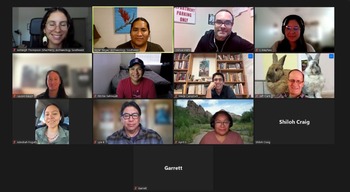
A typical monthly meeting between members of the Archaeology Southwest cyberSW team and the Tribal Working Group.

Figure 2 Long description
The image shows a virtual meeting with 11 participants displayed in a grid format. Each participant occupies a separate square, with some using virtual backgrounds. The participants include both men and women, with various backgrounds such as bookshelves, plain walls and nature scenes. Names are visible under each participant's image .
Now in its fourth year, the cyberSW–TWG collaboration has a clear workflow. Monthly meetings over Zoom coupled with periodic ad hoc email requests form the general activities of the TWG, with participation compensated through small, attendance-based honoraria. Once the TWG startup funding from NSF was expended, financial support came from private donations to Archaeology Southwest (and future grant proposals will include continuing support for the TWG). Archaeology Southwest and TWG volunteers have collaborated to produce two substantial blog posts detailing the efforts of the working group (Archaeology Southwest 2023, 2025), presented on the TWG-related database updates at the 2024 Theoretical Archaeology Group meeting, and engaged in public outreach at southern Arizona venues. This article was co-developed in the same manner, with the goal of sharing our process and results with a larger public.
We view our work as rooted in archaeology in a way that reexamines collaboration and beneficence through contemporary Indigenous lenses. Recognition is broader than formal Tribal government approval; community-based endorsement and the practice of working together also confer legitimacy. Shared Indigenous participation sets the ethic here and drives stronger Tribal protections and durable collaborations across archaeological domains.
cyberSW 2.0—TWG Collaboration
Engaging with the Largest Archaeological Database in the US Southwest / Northwest Mexico
A key component of the TWG’s original charge was helping the cyberSW team develop a conceptual vocabulary for the expanded 2.0 database that would be informed by Indigenous values, interests, and conceptual frameworks (e.g., “Indigenous Cultural Landscapes” [Beacham et al. Reference Beacham, Copping, Reynolds and Black2017]). The initial discussions revolved around understanding the different types of archaeological data in cyberSW and what elements could be expanded (and how); in addition, questions about data accessibility, archaeological site security, and cultural sensitivity were addressed. Establishing a shared knowledge base was important because cyberSW 1.0 was the direct descendant of a series of earlier archaeological database projects that, while providing large amounts of easily incorporated data, also made it the unintentional heir to those projects’ accumulated organizational logics and limitations.
Notably, the archaeological sites included in cyberSW 1.0 were mainly limited to large sedentary village settlements (more than 12 rooms) and sites with large-scale public or ceremonial architecture. The types of material culture associated with each site in the database were confined to two “traditional” categories: ceramics and geochemically sourced obsidian. Even though they are equally valid sources of archaeological information, small or ephemeral settlements were not included, nor were other “classic” areas of archaeological interest, such as rock imagery, archaeobotanical and zooarchaeological remains, ground and chipped stone tools, personal ornaments, and more.
When considering possible avenues for expansion, the TWG raised several issues with the cyberSW team. First, the original databases’ focus on large settlements unintentionally excluded more mobile southwestern peoples who did not generally create such sites, including (but not limited to) ancestral Athabaskan, Numic, Yuman, and Tarahumara-speaking groups.Footnote 4 This imbalance is representative of southwestern archaeology’s larger fixation on a particular mode of sedentary agriculturalist village life, which ignores the complex mobile-sedentary community relationships that have defined Southwest life since time immemorial (see Lekson [Reference Lekson2018] for a critique). An attempt was made to incorporate CRM data about early Diné (Navajo) sites from the Fruitland Project in northwest New Mexico (Brown Reference Brown2014); however, difficulties securing the necessary data-sharing permissions have stalled this effort.
Second, the TWG highlighted that, even though obsidian source locales and ceramics counts are topics of deep archaeological fascination, these data are not generally the most engaging topics for many Native individuals, even those interested in cultural heritage issues more broadly. By adding new types of data to the program, particularly related to past plant and animal use, the TWG envisioned greater uptake by a variety of Tribal partners, including land and wildlife managers. During this conversation, the cyberSW team also brought up the topic of introducing basic published mortuary data into cyberSW, because differing burial practices across the Southwest offer unique insights into the lives of ancestral communities (Watson and Rakita Reference Watson and Rakita2020). The TWG’s feedback on this proposal, however, was clear: making mortuary data available, even if previously published and readily accessible, flies in the face of basic human dignity. As a result, all mortuary contexts (including animal burials) are filtered out of datasets before those data are added into cyberSW.
Third, the online geospatial component of cyberSW 2.0 prompted a series of conversations around how Indigenous geographic ontologies could be faithfully represented in a geographic information system (GIS) platform organized according to Western geospatial logics. Several ideas were proposed, with the most concrete being the incorporation of both modern Tribal reservation boundaries and related ancestral Indigenous territories derived from the crowdsourced native-land.ca web application (Figure 3).Footnote 5 Adding ancestral territories to the map allows researchers to have a fuller understanding of the potential connections between sites of interest and descendant communities, particularly in those areas that do not overlap with reservation lands. In a similar vein, the TWG discussed the possibility of adding Tribally specific place-name layers similar to those that have been developed for popular online GIS programs like Google Earth and OpenStreetMap.Footnote 6 Although the potential value of such data layers for Indigenous landscape archaeology research is clear and can readily build on existing place-names and landscape studies (e.g., Bernadini and Peeples Reference Bernardini and Peeples2015), the amount of labor required to build out this functionality made it a lower priority for cyberSW 2.0.
The cyberSW web application interface showing relationships between sites in the database and both modern and ancestral Indigenous territories, using the four O’odham Tribal Nations of southern Arizona and their related ancestral territories as an example.

Figure 3 Long description
An image of the cyberSW web application interface, which includes a left map pane displaying overlapping ancestral and modern Indigenous territories highlighted in a large overlay. The right pane offers exploration options for the application, including filters for sites by name, time range and features. The map includes navigation and zoom controls and the larger interface has tabs that link to other parts of the cyberSW application .
Tribal Influence and Widening the Scope of cyberSW
The TWG discussions have led cyberSW to explore new directions beyond the classic boundaries of many archaeological datasets. Specifically, the TWG expressed broad interest in past Indigenous uses of culturally important plants and animals and how they have changed through time. Because of this feedback, the cyberSW team moved to add zooarchaeological and paleoethnobotanical data from ancestral Indigenous sites to cyberSW at the intrasite scale. We are still in the initial stages of adding plant and animal data (more than 98,000 plant remains and 110,000 faunal remains from over 200 sites as of September 2025) but plan to continue this effort. Although access to past plant and animal data has direct scientific and management value (e.g., Hayashida Reference Hayashida2005; Wolverton and Lyman Reference Wolverton and Lyman2012), the TWG also expressed a strong desire for the information to be integrated with contemporary/ethnographic Indigenous knowledge, including the possible use of Indigenous ontologies for data organization and display. It was envisioned that incorporating this capacity would make cyberSW a tool capable of helping younger Tribal members on their educational journeys and spur discussions about cultural revitalization and sovereignty.
Part of this vision included tailoring the cyberSW 2.0 NSF HNDS-I grant-funded Native American Fellow position to focus on “Indigenous Uses of Plants and Animals in the US Southwest.” Based on discussions with the TWG, life or work experience in an Indigenous community was emphasized, and a college degree was not required in recognition of the fact that many Indigenous knowledge carriers do not always take formal secondary education paths. TWG members also played a role in advertising the finalized job description through their own academic, professional, and Tribal networks, in addition to Archaeology Southwest’s formal advertisement and outreach to regional Tribal Historic Preservation Offices.
This community-focused process resulted in the hiring of Caitlynn Mayhew (Diné) as the cyberSW Native American Fellow in July 2023. Building on her experience developing a guide to the bird species of her traditional homelands on the Navajo Nation (Mayhew Reference Mayhew2020), she proposed to create a Digital Indigenous Field Guide detailing those plants and animals considered Cultural Keystone Species (CKS) by US Southwest / northwest Mexico Indigenous communities with ancestral settlements represented in cyberSW. CKS are species that hold a high degree of significance within a community; their presence can be seen through various linguistic, ceremonial, and narrative references (Clark et al. Reference Clark, Artelle, Darimont, Housty, Tallio, Neasloss, Schmidt, Wiget and Turner2021; Garibaldi and Turner Reference Garibaldi and Turner2004).
Over the course of 2023–2024, Mayhew and the other members of the cyberSW team met with representatives from Arizona’s Four Southern Tribes Cultural Resource Working Group to design a collaborative, community-based project focusing on the plant and animal CKS of the O’odham nations in southern Arizona.Footnote 7 This O’odham-focused Digital Indigenous Field Guide will use cyberSW data and interface with the web platform in a way that is readily accessible to members of these Nations and the public (Figure 4). The proposed project will be set to include as many CKS as possible, with the goal of creating a comprehensive field guide that addresses cultural sensitivity issues, establishes cultural protocols, and serves as an educational tool for O’odham communities.
Example of a typical entry being developed in collaboration with the Gila River Indian community for the cyberSW Digital Indigenous Field Guide. The left image shows the field guide interface, which includes the Akimel O’odham name and related cultural information for specific species. When complete, entries will also include identifying photographs and species range information similar to the image on the right.

Figure 4 Long description
The left side displays a digital field guide entry for the Verdin bird. It includes sections describing the bird’s physical description, diet and conservation status, and O’odham traditional knowledge about the bird. The description provides details about the bird's characteristics and habitat. Traditional knowledge mentions its cultural significance. The diet section lists seeds, insects, fruit and berries, with icons representing each food type. Conservation status is indicated with a checkmark. The right side shows an image of the bird perched on a branch; the bird is identified by its O’odham name ‘Gi:sob’, with its Latin name 'Auriparus flaviceps' and common English name written below the image.
Specifically, the cyberSW team has focused on co-developing the Digital Indigenous Field Guide in partnership with the Gila River Indian Community (GRIC). The cyberSW team approached GRIC’s Tribal Historic Preservation Office with a project idea that was open to collaboration, rather than a rigid set of researcher-driven expectations on how the data would be managed. This ground-up approach necessitated a 16-month period of navigating the proper channels to obtain approval for the project. This path led to the creation of a formal Tribal Collaboration Agreement between Archaeology Southwest and GRIC, because this Tribal Nation does not have an Institutional Review Board (IRB) overseeing these types of activities. The project-specific Tribal Collaboration Agreement was developed after the cyberSW team, in consultation with the TWG, highlighted a need for codified protocols that could be tailored for Archaeology Southwest’s broader Tribal collaboration initiatives moving forward. The resulting collaboration agreement was signed by the GRIC’s governor after receiving input from the Tribe’s general counsel and addressed GRIC’s nation-specific requests to ensure that the project and data collected would not impair, affect, or modify the Tribe’s sovereignty.
As detailed in the collaboration agreement, the O’odham-focused Digital Indigenous Field Guide will be hosted on the cyberSW site, but the distribution of the guide and the cultural and linguistic information provided by the Tribe will be governed by the GRIC Tribal Historic Preservation Office. This project was awarded a $350,000 grant by the National Endowment for the Humanities (NEH) in early January 2025, but the award was abruptly terminated by the Trump administration’s Department of Government Efficiency (DOGE) in early April 2025 without adequate explanation (Lidz Reference Lidz2025). A much smaller version of the Digital Indigenous Field Guide is currently being developed with private funding.
cyberSW 2.0, FAIR and CARE, and Indigenous Data Sovereignty
In archaeology, the ethics and practices that guide the curation and preservation of data, particularly in digital, online contexts, continue to lag behind the rules guiding the care of artifacts and sites (e.g., Huggett Reference Huggett2020; Lake Reference Lake2012; Nicholson et al. Reference Nicholson, Kansa, Gupta and Fernandez2023). This disconnect is exacerbated by the rapid expansion of work in digital archaeology, digital heritage, and the digital humanities more broadly, which has rapidly reshaped the ways archaeological data can be generated, shared, and consumed (see summary in Morgan Reference Morgan2022). Digital archaeology and specifically “open archaeology” (Marwick et al. Reference Marwick, Guedes, Barton, Bates, Baxter, Bevan and Bollwerk2017) seek to improve transparency and access to legacy archaeological data. The open archaeology framework is directly positioned as part of larger open science or open scholarship initiatives (e.g., Burgelman et al. Reference Burgelman, Katarzyna, Corina, von Schomberg, Karalopoulos, Repanas and Schouppe2019) that which seek to shift scholarly contributions and practices from a focus on publications to an open exchange of knowledge.
Crucially, the open scholarship initiative relies on data being fully available to encourage their reuse, the enrichment of datasets, and replication studies. To this end, Wilkinson and colleagues (Reference Wilkinson, Dumontier, Aalbersberg, Appleton, Axton, Baak and Blomberg2016) developed the FAIR guiding principles that call for open data to be Findable, Accessible, Interoperable, and Reusable. What has been left out in many discussions about open data, however, is an acknowledgment of the exploitive nature of research that has been conducted at the expense of Indigenous Peoples and Nations. As a result, Carroll and colleagues (Reference Carroll, Garba, Figueroa-Rodríguez, Holbrook, Lovett, Materechera and Parsons2020) established the correlative CARE principles that emphasize Collective benefit, Authority to control, Responsibility, and Ethics (see also Gupta et al. Reference Gupta, Martindale, Supernant and Elvidge2023). The CARE principles form a key part of a larger set of interdisciplinary Indigenous Data Sovereignty initiatives, which uphold the rights of Indigenous Peoples over datasets created with or about Indigenous Peoples, lands, and nonhuman relations (e.g., Carroll et al. Reference Carroll, Duarte, Liboiron, Burrell, Singh and Davison2024; Jennings et al. Reference Jennings, Jones, Taitingfong, Martinez, David-Chavez, Alegado and Tofighi-Niaki2025; Kukutai and Taylor Reference Kukutai and Taylor2016).
cyberSW is built on Indigenous data. Except for application-specific data like site traffic analytics or user accounts, nearly everything in cyberSW relates to the material record of ancestral Indigenous Peoples across the US Southwest / northwest Mexico. However, the legacy datasets that make up cyberSW were generally not created or controlled by contemporary Indigenous communities.Footnote 8 Establishing and working with the TWG thus aligns well with incorporating CARE principles for how cyberSW serves up the datasets to the public.
Notably, implementing the TWG represents a change in how cyberSW is managed that is more than just a symbolic nod to CARE. This is important to note, because the earlier sequence of decisions that guided the initial development of cyberSW led to a complicated situation regarding data governance. Among other things, when one has a regional-scale, integrated database with thousands of cited sources referencing work that was often done with public funding, what does “authority to control” even mean in this context? Together, the cyberSW admins and the TWG have tried to engage with CARE insofar as we have been able to see how to do so, given the weird and messy legacy of the data. CyberSW developers have tried to be responsive to requests from TWG to remove sensitive data (particularly mortuary contexts, not just from the public-facing application but from the database entirely), which does represent some control over the resource. Yet at the same time, the Neo4j database and web application are managed by non-Indigenous researchers on servers maintained by Archaeology Southwest.
Other CARE themes that surfaced in work with the TWG included regular feedback from several members to push for better deployment of the database and application to benefit Indigenous communities. Objectively, cyberSW has not been very successful in this regard—the core database and application largely remain a resource built by and for archaeologists. In contrast, the work on the Digital Indigenous Field Guide is almost entirely about collective benefit and offers a roadmap for future collaborations with other Tribal communities. Independent Indigenous scholars have also used cyberSW in their research, and they are well represented on our user list. Overall, efforts are ongoing to package the information in cyberSW in a way that would be of broader interest to Indigenous communities for purposes like education and management, and we intend to make progress in this direction over the next several years.
FAIR and CARE are both largely about articulating the ethics and best practices for data governance, yet neither framework clearly interfaces with laws and norms relating to intellectual property in the United States or elsewhere. Interestingly, when attempting to acquire and integrate more datasets into cyberSW from various sources, some of the cyberSW team’s more frustrating interactions have been with other data “owners.” Whereas academics tend to lean hard on the FAIR principles (i.e., open data mean better science), the attitudes of many CRM companies and independent analysts vary widely.
Frequently, these groups’ understandings of data ownership and control depend on terms set with clients: sometimes they “own” the data and are interested in sharing, but in many other situations, the data belong to a private entity or government agency that must give permission to share any datasets. In the cyberSW team’s experience, many government archaeologists have tended to be very protective of datasets because of worries about how data sharing might affect their own relationships with Tribal agencies.
Refusal to approve the sharing of datasets (or simply making it a bureaucratic nightmare to secure permissions) is not at all consistent with either FAIR or CARE, even if the presumed intention is to protect datasets that Tribes may or may not want publicly available. Indigenous data are sensitive and, in some cases, sacred. Informed consent protocols and guidelines for data sharing must be collaboratively established with the Indigenous nation to uphold sovereignty and prevent the exploitation and misinterpretation of data (Mengoni Goñalons and Figuerero Torres Reference Mengoni Goñalons and José Figuerero Torres2023). Unfettered public access to data could lead to vandalism or looting of sacred sites. Additionally, researchers must also become comfortable with the word “no,” because Indigenous nations have the right to refuse to participate in projects or share data they deem private. These and other issues surrounding control of Indigenous-related datasets—which are relevant not only to Indigenous Data Sovereignty but also to many other legal and ethical issues—will continue to be a focus of cyberSW.
The TWG collaboration is not the entire answer to these issues, but it matters in the absence of clear best practices for working with Indigenous-focused archaeological datasets. cyberSW is not an archive akin to tDAR or OpenContext; it is a research platform built on a large integrated database. It has different challenges and opportunities relative to those archives, and the extent to which FAIR and CARE practices that work in digital libraries contexts will be relevant to us is unclear. Legacy archaeological datasets are an interesting place to negotiate these themes, and we are invested in that process. cyberSW staff and members of the TWG attended the Indigenous Data Sovereignty & Governance Summit 2024 in Tucson where, despite the existence of the FAIR+CARE Heritage Network (see Kansa et al. Reference Kansa, Gupta, Martinez and Nicholson2025), we were the only group to engage on archaeology-related issues (Begay et al. Reference Begay, Mayhew and Watts2024). At the April 2026 summit we launched Archaeology Southwest’s position paper on Indigenous Data Sovereignty (Watts et al. Reference Watts, Begay and Mayhew2026) and hosted a panel discussion of archaeologists working on that topic. Also, at the 2026 SAA Annual Meeting in San Francisco we presented a paper discussing the TWG model in a Indigenous Data Sovereignty-focused symposium.
The TWG and Its Move beyond cyberSW 2.0
The Database Focus, or Occasional Lack Thereof
Through reflective discussions, the TWG quickly revealed that its mandate could not be confined to the database alone. The work expanded into wider questions of data sovereignty, accountability, representation, and responsibility, demonstrating both the limits of data systems and the potential for collaborative structures to shape something larger than their original scope. Many of the challenges we observed revealed the limitations of conventional archaeological categorization, which privileges a narrow understanding of material records that fragments Indigenous histories into data points. Data are never neutral, and current databases elevate traceable remnants and artifact counts while erasing the relationships and practices through which our Ancestors carried meaning and continuity across generations. These omissions cannot be treated simply as technical gaps; they are reminders that Indigenous ways of knowing life and history exceed what non-Indigenous-led research is designed to observe.
The TWG did not dismiss these limitations as failures. Instead, they became learning points—moments to broaden the discussion beyond cyberSW’s technical infrastructure and into questions about what it means for a database platform to serve contemporary descendant communities. One key lesson was the importance of sustainable relationships. The cyberSW 2.0 Digital Indigenous Field Guide project, which aimed to integrate plant and animal CKS into cyberSW, embodied the hope of linking archaeological information with Indigenous priorities (Oas and Mayhew Reference Oas and Mayhew2025). Yet, when NEH funding was cut by the Trump administration, it underscored how fragile such efforts can be when dependent on short-term grant cycles and shifting political agendas. For Native Peoples, responsibilities for knowledge are long term and continuous, and so too must be the partnerships that sustain this work.
Considering the Human Factor
As conversations deepened, the TWG emphasized that cyberSW’s value cannot be measured in numbers alone—whether in terms of artifacts or in users. Its meaning must also be carried through responsibilities of outreach and engagement. Members called for creating pathways for Native students and professionals—the beginnings of “Indigenous continuums,” a term we use here to describe ongoing flows of knowledge, responsibility, and opportunity that extend across generations and sustain development beyond the database to nurture leadership, training, and opportunities in cultural heritage and research fields. This was not ancillary to the project but was integral to ensuring that Native Nations are not positioned merely as tokenized consultants used for the validation of outsiders’ interpretive projections but as future decision-makers and knowledge holders who will shape the trajectories of such platforms.
At the same time, we recognize that although cyberSW includes information about ancestral Indigenous places in both the US Southwest and northwest Mexico, the TWG does not currently include Indigenous Mexican representation. This is partially because of the complicated nature of Indigeneity in Mexico, where Indigenous communities lack the sovereign political status held by Native American nations in the United States. However, many Tribal communities in the region like the O’odham, Apache, and Yaqui maintain (or historically maintained) community relationships that transcend the modern US-Mexico border—driving home the point that this lack of “international” representation on the cyberSW TWG should be rectified in the future.
The process of building and expanding the TWG also made visible the challenges of sustaining collaborative groups. The honoraria provided recognition of expertise, but they could not resolve questions about long-term sustainability or the risk of burnout. Indeed, there is a dangerous instability in expecting a small circle of Indigenous cultural heritage professionals to bear the weight of consultation across multiple projects, committees, and jobs. Several individuals invited to join the TWG declined because of their other commitments, whereas others joined with the understanding that they would not be able to attend all the monthly meetings. These issues are not unique to cyberSW: they are lessons that any initiative considering the creation of an Indigenous advisory group must take seriously if it wishes to avoid reproducing extractive dynamics under the guise of inclusion.
Looking beyond the US Southwest
Taken together, these experiences show how the TWG expanded the scope of cyberSW beyond its initial goals. By surfacing legacy harms, questioning contemporary practices, and pushing for greater community applicability of Southwest archaeological work writ large, the group modeled a collaborative process that is as much about the nature of past, present, and future relationships with archaeological data as it is about the data itself (Liebmann Reference Liebmann, Oland, Hart and Frink2012; Panich and Schneider Reference Panich and Schneider2019). For TWG member Lauren Haupt, the relevance to issues and communities outside the US Southwest is clear. Her Tribe, the Caddo Nation of Oklahoma, has often seen their ancestral connections with east Texas fragmented by compliance-driven archaeology projects that ignore the Caddo’s ongoing ties to the region.
This archaeological disassociation is not an isolated event but is part of a longer legacy of harm throughout North America, particularly in the Southeast and Midwest where Tribes were forcibly removed from their homelands to Oklahoma throughout the nineteenth century. The kinds of noncollaborative CRM work being carried out in east Texas echoes the reprehensible looting of Spiro Mounds in the 1930s, when one of the most significant Caddo ceremonial centers was desecrated and its belongings scattered for profit and academic curiosity—an act sensationalized at the time as “America’s King Tut’s Tomb” (Anderson Reference Brain1988; La Vere Reference La Vere2007; James Brown Reference Brown1996). The devastation was immense: burial chambers were dynamited, and thousands of irreplaceable items were broken, discarded, or stolen. Thus, an incalculable amount of cultural knowledge and ancestral memory was destroyed. That history is not distant; it lives on in the way public and academic archaeology continue to be staged under the guise of “education” or “enriching the human knowledge base.” The scene of hundreds of non-Indigenous participants celebrating as they disturbed a Caddo site made clear that the same logic persists: our places are too often treated as resources to be consumed, while the costs to Indigenous Peoples are ignored. Public archaeology in these forms does not repair relationships—it repeats the trauma, packaged differently but with the same disregard for those who still carry responsibilities and ancestral relationships to these places.
This same disregard was made visible again in the recent controversy within the Southeastern Archaeological Conference (SEAC), when the organization moved to prohibit the publication of funerary objects in its journal Southeastern Archaeology (SEAC Executive Board 2022). What should have been a straightforward measure of respect provoked an uproar. A significant portion of the membership resisted the policy, some with open hostility to the idea that Indigenous Nations should have any say in how their Ancestors and belongings are represented. The vehemence of this opposition exposed the persistence of colonial entitlement—the belief that archaeologists and other cultural outsiders retain the right to claim authority over the intellectual and cultural legacies carried by our ancestral belongings, even when such actions cause direct harm to Indigenous Peoples. Since 2022, however, the SEAC image policy furor has also prompted greater critical reflection as to the nature of Tribal collaboration in the US Southeast and the ways new and existing partnerships can be expanded (Byrd and Thompson Reference Byrd and Thompson2024; Holland-Lulewicz Reference Holland-Lulewicz2025).
cyberSW 2.0’s turn toward Indigenous voices thus offers interested parties with a framework that is potentially applicable to a variety of collaborative projects well beyond the US Southwest. We suggest that both the TWG model and the cyberSW platform could be adopted in other regions, depending on interest and capacity. Success of efforts like the TWG must be redefined through Tribal-defined outcomes, such as academic and professional training, cultural revitalization, and sociopolitical empowerment. Accountability must be paramount and include a clear demonstration of how Tribal guidance will be honored and sustained beyond grant cycles. Indigenous data sovereignty protocols must also be adopted so that knowledge is managed for Tribal benefit and under Indigenous authority. Partnerships must be structured for longevity, avoiding tokenized consultation and ensuring that Indigenous authority directs the research process. Finally, funded opportunities and mentorship pathways for Native professionals and students must be secured such that Indigenous continuums can become established and set the stage for future leaders and collaborators.
Conclusion
Collaboration takes time. Successful co-management timelines for resources like cyberSW and the related field guide project play out over years, maybe even decades. However, the institutions that have supported both cyberSW and the TWG are facing considerable instability in the current political climate. Long-term planning for efforts like the TWG collaboration is difficult, given that grant cycles are often limited to two or three years at a time when we are unsure about what will be happening in the next six months. Despite that uncertainty, the TWG is a good example of Archaeology Southwest’s commitment to Tribal collaboration, and there is broad consensus that it should continue.Footnote 9 As long as the cyberSW program can be supported by Archaeology Southwest, there will be interest in continuing the work of the TWG.
To achieve this goal requires both advocacy and planning, so we briefly share here some efforts that the TWG might focus on in the future. First, the original mission of the cyberSW TWG was defined by Archaeology Southwest staff working within the organization’s Tribal Collaboration Model (Thompson and Begay Reference Thompson and Begay2023). As this article demonstrates, however, the group has evolved considerably and questions about “What exactly are we doing here?” have occasionally surfaced during meetings. Having the TWG members more formally articulate their mission for the next several years is a necessary exercise that would inform cyberSW’s strategic plan and collaboratively set the course for the long-term co-management of the database.
Second, building Indigenous continuums is key. Specifically, we will work to develop a cohort of Indigenous archaeologists who may be interested and available to join the TWG when others are ready to rotate off. Importantly, the TWG should include members with varying professional backgrounds and from different Indigenous nations (potentially even beyond the US Southwest or northwest Mexico). This is particularly important because not every nation holds the same perspectives toward archaeology. More broadly, we want to see other programs (whether data related or just more broadly archaeological) develop advisory groups like the TWG, while simultaneously ensuring a sufficiently large and diverse pool of participants to provide broad perspectives and to ensure individuals are not stretched too thin. There are analogous “Indian Working Groups” in other disciplines, but such efforts are not widespread. Our capacity to facilitate the broader adoption of TWG-like advisory groups is small, but we can help match potential recruits in our networks with TWGs that suit their interests.
Third, the regular monthly meeting format followed in the first years of the TWG should evolve, depending on the needs of both the cyberSW and the TWG. cyberSW does not necessarily need input on website design every month, but group feedback does help when planning substantive changes for either the web application or the database. Quarterly instead of monthly meetings might be a good middle ground, although regular meetings are beneficial: for cyberSW, these meetings provide accountability while also helping maintain a cohesive, focused TWG. Both of those themes—accountability and internal group dynamics—would be further enhanced by building in-person workshops into future grants and meet-ups at conferences.
Fourth, the TWG will continue to work with cyberSW on how to implement CARE principles in ways that work for descendant communities, as well as the current cohort of archaeologists. Although somewhat speculative, some concrete steps could be taken on this front. For example, cyberSW could pursue investing in the computing resources needed to regularly back up the Neo4j database to servers owned by THPOs or Tribal CRM offices in the Southwest. Alternatively, cyberSW and the TWG could develop capacity-building trainings or webinars targeted to Tribal community members interested in working with the data.
Fifth, the TWG will continue to advise the cyberSW team on the platform’s development, maintaining a critical eye on what an archaeological database and application program like cyberSW can offer descendant communities. The Digital Indigenous Field Guide concept might interest other Tribes if successfully developed for the O’odham. Occasionally, cyberSW staff have been asked by Tribal agency employees about sites in the database from their lands. They were not looking to shut down the program; instead, they were curious and would like to see their heritage well represented—so long as they have some control over it. Building on this, the team can potentially begin to consider the discussions (and permissions) needed to incorporate Tribally owned datasets into cyberSW.
The TWG also made some specific requests in 2025 that we hope to implement relatively soon. These include much better representation of Athabaskan, Numic, Yuman, and Tarahumara-speaking groups, as well as better continuity across all cultural groups from precontact to modern times. We will also pursue incorporating into the database museum/repository storage information for those materials described in cyberSW, so that Indigenous communities have a more accessible record of those materials’ current locations.
Finally, the TWG should feel enough ownership of cyberSW that members could advocate for the project when we approach Tribes (or federal agencies deferring to Tribes) about data or developing resources like the Field Guide. For example, this could lead to engaging with a Tribal Institutional Review Board (IRB) or, in the case of the Field Guide project, assisting in navigating the system of government within the nation to obtain official permission from the chief executive. In the past, members of the TWG were instrumental in setting up meetings with cultural offices in the early phases of envisioning the Field Guide. Reflecting on Acebo and colleagues’ (Reference Acebo, Campbell, González-Tennant, Odewale, Van Alst, White, Mrozowski, Montgomery, Cipolla and Agbe-Davies2025) call to “un-discipline” archaeology by emphasizing community interests, knowledge, and controls, a TWG fully committed to steering the database toward better utility for Indigenous audiences and invested enough to advocate for cyberSW as a valuable resource in their communities would be a powerful demonstration of the “reclamatory” potential inherent in collaboratively developing a science gateway for Indigenous communities.
In moving beyond cyberSW 2.0, the TWG revealed that the work is not only about what can be added to a database. It is also about how Indigenous peoples shape the conditions of knowledge itself, how sustainable partnerships are secured, and how pathways for restoring equitable research are cultivated. The emphasis on process over product is a lesson that reaches far beyond the Southwest, offering direction for collaborative work throughout the country, where all archaeologists continue to generate their careers and livelihoods on the lands unethically taken from Native Peoples.
Acknowledgments
Archaeology Southwest’s internal strategic planning process in 2020 refocused the mission of the organization to emphasize collaboration with Tribes. That effort motivated William Doelle and John Welch to craft the language inserted into the NSF HNDS-I grant proposal that led to the creation of the Tribal Working Group. Many thanks to Gabriel Vicencio Castellanos for the Spanish abstract translation, as well as the five anonymous reviewers whose comments helped improve the article.
Funding Statement
The cyberSW archaeological database project has been financially supported by grants from the National Science Foundation (since 2017: RIDIR Award #1738062; HNDS-I Award #2121925; HNDS-R Award #2213962) and the National Endowment for the Humanities (Award #HAA-304015-25). Additional funding was made possible through generous contributions from private donors to Archaeology Southwest, including a gift specifically earmarked for the Tribal Working Group initiative.
Data Availability Statement
All data pertaining to the TWG are provided here; information about the cyberSW database can be found at cybersw.org.
Competing Interests
The authors declare none.



 Open access

