


Marleen Gorris’ feminist classic A Question of Silence (1982) features what may well be one of the most powerful fictional court scenes ever filmed: an extended scene of wild laughter that grows and grows to eventually engulf all the women in a courtroom during the trial of three women prosecuted for the murder of a man. The women break the law by committing murder, then by breaking out in laughter, but this is no ordinary breach. Creating a laughterhood among the women in the courtroom,Footnote 1 it is a transgression that cannot be re-contained by law, and it re-signifies the murder itself as uncontainable by law’s own terms. Placed towards the end of the film, the scene is cathartic, and yet it works only if one has been tuned into that potential of uncontainability all along. The force of the scene is that it taps into a certain embodied knowledge of the here and now, as well as its potential elsewhere. If the knowledge of the here and now is derived from accumulations of lived experience, the knowledge of its potential elsewhere is also embodied, a heterotopia that is conjectured and conjured from within the laughterhood. We know it is (t)here.
There is of course an economy to the chosen setting for this powerful depiction of the force and potential of feminist refusal. Bodily acts (including acts of speech, but also gestures and indeed laughter) matter in unusually accentuated ways in public trials, where performative operations of law are at their most exposed. As I parse elsewhere by distinguishing between legal performativity and legal performance to think their linkages more carefully, what allows law to operate as if it were fate (the masquerade whereby legal performatives pass as constatives) is more prone to unravelling in this particular setting.Footnote 2 This is why trial scenes, fictional or actual, always have strong dramatic potential. But the trial scene in A Question of Silence is potent even if read merely literally, as a scene of forensic refusal: the refusal in and of the forum. In critical legal literature, acts of refusal in trials have been figured primarily in terms of resistance and rupture. In this chapter, I draw on another critical legal theme, ‘minor jurisprudence’, to explore refusal in the alluring terms proposed by Bonnie Honig in A Feminist Theory of Refusal (2021): not only as rejecting the here and now, but also as practising the elsewhere in the here and now. Something of a counter-forum emerges in the collective laughter of A Question of Silence, but where and what is it? I attempt an answer through a close reading of the film and by juxtaposing its trial scene with a number of other scenes of feminist refusal, to ask after the role and workings of the uncontainable, the untameable, the inassimilable in the forum.
A caveat as I revise this chapter for publication in the immediate aftermath of the bizarre judgment of the Supreme Court of the United Kingdom (UKSC) in For Women Scotland Ltd., and as we witness the even more bizarre ways in which the judgment is interpreted in transphobic campaigns in the UK and beyond. The film this chapter focuses on is now more than four decades old, and its immediate references in feminist literature are also of a period whose radical feminism is nominally claimed today in grotesquely essentialist ways. There has been much feminist thinking over the past few decades, including trans-feminist work, on how to read the seeming biological essentialism of some key feminist texts of the past century. It is beyond the scope of this chapter to delve into that rich discussion, but suffice it to say that when I write of ‘women’, I do not claim the category as an exclusive territory that must be guarded against incursions. In effect, the appeal to law in For Women Scotland for its paternalistic aegis, the call to reinscribe women’s ‘sex’ as a ‘characteristic’ whose ‘protection’ requires a practice of exclusion could not be further from the orientation vis-à-vis law that I describe here in terms of feminist refusal.Footnote 3
She Can Communicate But Sees No Point in It
Our protagonist is Janine van den Bos, a well-respected forensic psychiatrist at the height of her career. She’s upper-middle class, attractive, married to a successful lawyer. They make something of a power couple, with an even distribution of power within the couple: he (too) cooks and cleans, she (too) initiates sex, her professional career (too) is all-important, and so on. That’s the set-up. The plot? Janine needs to write a report. She is to provide her expert opinion to the court on the mental state of three women involved in the gruesome killing of a man, the proprietor of a boutique for women’s clothes. But it is not an easy case to make sense of. None of the women knew the victim or each other before the killing. They all readily and in good humour admit their responsibility for the crime at the police station where they are brought the following day. This is also where they first learn each other’s names. None have any prior criminal records or histories of violence. The killing was seemingly unprovoked but very violent, as the forensic pathologist reports to Janine drily:
injuries to the whole body inflicted by blows and kicks, with hands, shoes and several blunt and sharp instruments like coat hangers and a shopping cart … The blows were mainly aimed at the head, the abdomen and the genitals … The torso has a deep cut from the Adam’s apple, which was also heavily damaged, to the lower abdomen, probably caused by a broken plastic coat-hanger wielded with great violence. The genitals are barely recognizable as such.
This excess of blood and gore has all the male characters – the inspector, the prosecutor, the judges, even Janine’s lawyer husband who has nothing to do with the case – convinced that the three women are insane, or at least were temporarily so at the time of the crime: ‘There’s no doubt about it, they’re completely crazy. But I don’t have to explain what you know professionally,’ says one official to Janine before she has even met the women. At a later stage in her investigation, ‘it’s obvious’, says Janine’s husband, oblivious to what Janine has just been telling him about them. ‘These women are completely deranged.’ But it is not so open-and-shut for Janine, whose opinion is technically meant to be the one that counts. And the more she engages with the women, the more she sees that something is wrong not with them, but rather with the world that surrounds them.
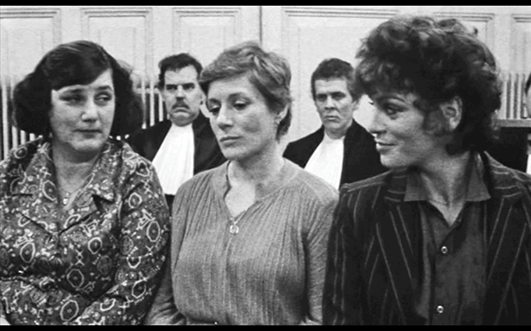
Janine recognizes them as three ‘really very ordinary women’ (Figure 10.1): the oldest, Annie, is a waitress at a greasy spoon, a divorcee who is also estranged from her daughter and lives alone. We get a glimpse of her daily banter with the male clientele of the cafeteria, where she bats off the sexist missiles coming her way with raw wit and wild laughter. The other two are younger. Andrea is beautiful, brilliant, single. She works as an executive secretary at an international corporation. Her work there is well above her pay grade, indispensable, and invisibilized. There is a scene at a board meeting where she makes a well-reasoned proposal concerning the company’s trade activities – her speech is barely tolerated and does not register. She is the only woman at the meeting. Minutes later, the same proposal is offered by another attendee, as if spoken for the first time – ‘Good thinking, Bob’, says the chair. The third woman is Christine, married to a minor civil servant, mother of three, a housewife. She has stopped speaking altogether. Janine first thinks that it is catatonia induced by the killing, but it turns out that Christine stopped speaking long before the killing, and it is not pathology but a clear choice, a refusal. As Annie has to explain to Janine: ‘Do you really wonder why Christine stopped talking? Nobody is listening.’
Three ‘really very ordinary women’: Annie, Christine, Andrea. Still from A Question of Silence.
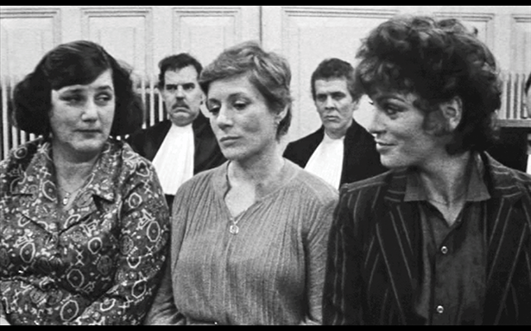
Figure 10.1 Long description
The middle woman, with trim blond hair and a violet blouse, looks down, while the women on either side look over their shoulder toward her. Two men sit in the gaps behind, looking sternly on.
It is Christine’s silence that gives Marleen Gorris’ film its original title, De stilte rond Christine M., which translates as The Silence around (or surrounding) Christine M. Her silence is indeed quite central to the film’s plot line, as that which Janine keeps trying to crack. Reading Christine’s silence first as pathology, Janine tries to crack it open into speech – any speech. Then understanding it as a choice and the refusal that it is, she tries to pry it open for potential mitigation of punishment. Finally, Janine tries to break through Christine’s silence for her own need of connection, once the three women make it clear that they have come to the end of their tolerance for her and her interviews. ‘You don’t understand people at all, do you?’ says Andrea. ‘And certainly not women’. The film’s English title is A Question of Silence, offering a more capacious sense of what it depicts, namely silence in its two related guises:Footnote 4 as a condition imposed on women, and as a form that women’s refusal takes. As an imposed condition, silence also has to do with that which cannot be mediated through speech: the difficulty of bringing to language the minor but relentless manifestations, operations and effects of patriarchy and sexism. As a form of refusal, silence is about that which is better left unmediated in language: women’s solidarity against patriarchy is depicted in the film as a silent agreement that not only needs no words, but is also wary of them.
Silence is crucial to the narrative arc of the film, which is character-led and can be read as the story of Janine, an accomplished professional, seemingly a master of her speech, with recognized jurisdiction as an acclaimed and effective forensic psychiatrist, eventually arriving at this silent complicity with the women. She finally fully recognizes the silence of Christine M., and also understands the other silences that initially perplex her, such as that of a number of unidentified women at the boutique who must have witnessed the crime but never came forward to testify. We, the viewers, know what the men of law never figure out but Janine eventually will: that a diverse cohort of four women eye-witnesses silently agree to a pact of silence after watching the maiming, mutilation and killing of the shopkeeper from the beginning to the end of the attack. Yet Janine’s own route to this silent complicity is not so straightforward. ‘I can’t reach them,’ she admits, exasperated, at a late stage in her investigation. It is further a personal affront to Janine that the women mock her conviction that her report will actually speak: that it will communicate to the court, register and effect some form of justice, possibly leading to a finding of diminished responsibility and a mitigation in the sentences, particularly if Janine is to pathologize them by declaring them insane for the crime that the women sanely avow and readily take responsibility for. By eventually becoming convinced that these women are all too sane, and finally refusing to pathologize them before the law, despite the prosecutor aggressively pressing her and the chief judge practically begging her to do so, Janine too comes to arrive at silence as a form of refusal, adopting what she says about Christine’s silence: ‘She can communicate but sees no point in it.’
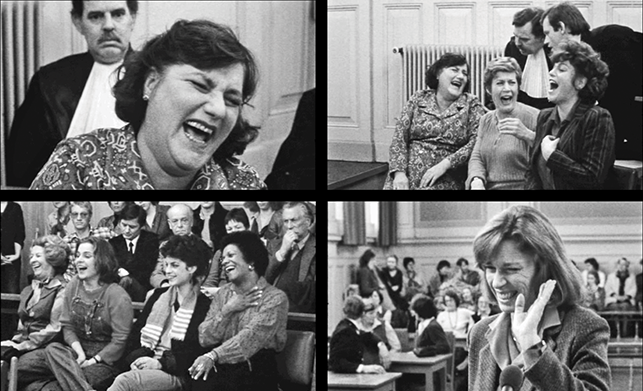
Janine’s eventual arrival at this point of there-really-is-no-point is depicted in the most dramatic scene of the film towards the end, during her testimony as an expert witness in the trial of the three women. It is a wild and astonishingly brilliant scene of women’s collective and contagious laughter that erupts in the courtroom and disrupts the proceedings (Figure 10.2). The onslaught of laughter cathartically resolves an extended build-up of tension around Janine’s speech in previous scenes. As an expert witness, her speech is supposed to chime into the exercise of juris-diction, the speaking of the law that is taking place in that space, but instead it proves inassimilable. Her statement of expert opinion that ‘the three women are completely sound of mind’, sends shockwaves through the audience and outrages the prosecutor, who begins to push Janine with a liberal dose of casual sexism, implying that she is speaking as a woman and not an expert, and that she is obviously failing in her duty to be objective. The faceoff continues after a lunch break, during which Janine’s husband, who has been watching the proceedings, asks her to hold off on her ‘peculiar ideas’, express herself ‘less vehemently’, and be ‘more realistic’ – that is, to consider the damage she could inflict on her (read: his own) reputation and career if she were to insist on her opinion. Angered but resolved to stay on course, Janine returns to the courtroom and is questioned further on her report by the judge and the prosecutor, who now ask her to provide her opinion as to the motive behind the killing. Janine hesitates to speak what is a matter of silence, but begins to try to put into words what has in the course of the movie become crystal clear: ‘It surely didn’t escape your attention that these women killed a man who also happened to be the owner of a boutique.’ The prosecutor dismissively retorts that the case would be no different if one hypothetically swapped genders, say, if the women had killed a female shop owner, or if the killers were three men. This is when Annie’s rambunctious laughter first fills the courtroom, then spreads to the four witnesses in the audience, to the other two defendants, and finally to Janine, who makes one last-ditch attempt to explain the situation to a bewildered chief judge before fully surrendering to laughter: ‘It’s really quite funny,’ she says. ‘What did you say?’ the judge asks, Janine gestures never-mind with a flick of her hand. The wild, contagious laughter continues in waves for nearly three minutes on screen until the end of the scene.
The laughterhood. Stills from A Question of Silence.
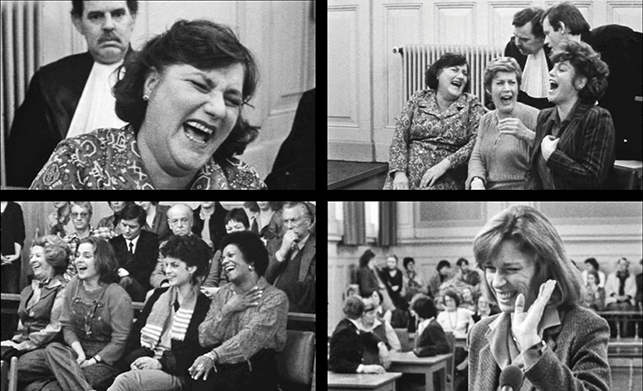
Figure 10.2 Long description
Top left: A woman laughs heartily, in a close-up. A man looks sternly from behind. Top right: Three women, seated shoulder to shoulder, laugh contagiously, mouths agape. Bottom left: Four women, different from those above, smile and laugh sincerely from a bench. Two rows behind sit in refined postures. Bottom right: A close-up of a woman, in business attire, who laughs fully. Her hand is raised mid-laugh.
Silence and laughter are thus presented as key manifestations of women’s refusal in A Question of Silence. Commentators have heard the echoes of Hélène Cixous’ influential essay ‘Laugh of the Medusa’ in the coupling of silence and laughter, and have fittingly situated the film in relation to feminist work on phallogocentrism and within a milieu of thinking about écriture féminine. While ‘neither self-conscious nor particularly intellectual’,Footnote 5 nor anywhere as formally daring as the avant-garde feminist filmmaking of its time,Footnote 6 the film does take up in a kindred spirit some of the key themes in Cixous’ ebullient call for women to ‘confirm women in a place other than that which is reserved in and by the symbolic, that is in a place other than silence’, for us to ‘break out of the snare of silence’, ‘in order to smash everything, to shatter the framework of institutions, to blow up the law, to break up the “truth” with laughter’.Footnote 7 The scene of laughter in the courtroom in A Question of Silence is so powerful because after depicting the ceaselessly minor, relentlessly mundane, mercilessly banal operations of patriarchy in every nook and cranny of women’s life, the film finally offers the trial scene as a bold literalization of patriarchy and its symbolic authority as ‘law’, performed with the requisite gravitas on the stage of a trial by men in judicial costumes. And then it just shatters it with something so simple and so readily available as laughter.
Obscene Protest
What brings me back to this scene is something that jumped out at me in the work that instigated this collection: Julie Stone Peters’ Law as Performance. This is a book rich in historical detail on the ways in which performance has been central to Western jurisprudence as its constitutive element. In one regard, the dazzling array of resources that Peters has gathered can be read as the long Western history of saning, taming and engineering legal performance; an account of just how much ink and sweat has been spent in trying to subdue this unavowably essential element in law. Then again, what had drawn me to Peters’ previous work on law and performance was her incisive formulation of the ever-present risk of the untameability of legal performance, and her formulation of the deep ambivalence that law has to its constitutive dependency on its performance as that which will make it, but might just also break it.Footnote 8
I must already have been looking for the untameable as I was reading Peters’ book. I read it as a PDF on my computer, and so I fantasize that what jumped out at me is presented in the form of a pop-up in the actual tangible book, because it is right around the middle, in chapter 4: an image depicting Calefurnia in the court, baring her ass to the judge. Peters gleaned this image from a mid fifteenth-century tract, but she also includes an earlier image of Calefurnia in the book, one that apparently ‘circulated widely in late medieval Europe’,Footnote 9 having first appeared in thirteenth-century illustrated editions of an influential compilation of Saxon law. Calefurnia here is depicted as scolding the judge, cursing him with one hand and holding her crotch with the other. The illustration was included in the compilation to explain the exclusion of women from the forum, accompanied by the caption, ‘no woman may be a pleader, nor may she bring a suit without a guardian’.Footnote 10 Then again, Calefurnia defied the judge in this way because she was furious at not being allowed to plead for herself. So what we have here is a fabulous causality, that strange self-fulfilling temporality of patriarchy, whereby the exclusion that is presented as a reasonable response to the obscene protest is in fact the very thing that the protest was a response to. Peters suggests that Calefurnia may have inspired another woman whose obscene protest is featured prominently in the book: Catharina Arndes, a well-respected late fifteenth-century townswoman, who during a confrontation with a delegation seeking to impose the archbishop’s new rules on the local women’s monastery, effectively chases the clergymen away by lifting up her skirts at them.Footnote 11 ‘Let the priests tremble’, writes Cixous half a millennium later, ‘we’re going to show them our sexts!’Footnote 12
In her Laughter: Notes on a Passion, Anca Parvulescu suggests that there is a ‘special relation’ between exposed female genitals and laughter.Footnote 13 Parvulescu reads Cixous’ ‘Laugh of the Medusa’ as crystallizing this special link, as it introduces a key twist on Sigmund Freud’s reading of the myth of Medusa in a brief research note from 1922. Here Freud famously suggests that ‘to decapitate = to castrate’Footnote 14 and that Medusa’s severed and petrified head ‘takes the place of a representation of the female genitals’, the paradigmatic sight that arouses terror of castration, which Freud describes as what happens ‘when a boy … catches sight of the female genitals, probably those of an adult … and essentially those of his mother’.Footnote 15 Cixous’ twist is simple and precise: ‘You only have to look at the Medusa straight on to see her. And she’s not deadly. She’s beautiful and she’s laughing.’Footnote 16 It turns out that the link between women’s laughter and public exposure of genitals has a bountiful archive: Parvulescu draws on Cixous’ other works on laughter, on other figurations of Medusa, and also on other ancient figures of ‘gaping mouths’, such as the old woman, Baubo, who helps bring Spring back to earth, jolting Demeter out of her depression by getting her to laugh at the sight of her aged vulva. There is also the ‘exuberantly vaginal’Footnote 17 and ‘cunt-threatening’Footnote 18 Celtic ‘old hag’ figure of Sheela na gig, powerfully refigured in artist Nancy Spero’s work to emphasize that the threat laughingly posed by exposed female genitals is not merely one of castration but also of engulfment (‘and essentially those of his mother’).Footnote 19
A further term that Parvulescu brings into this discussion of laughter and exposure is the ‘revolution’, and although I consider ‘refusal’ a more generative term to think with here, it is worth a brief detour, if only to get us to the question of violence, which I will eventually return to. Parvulescu’s route to revolution is via another text on the politics of the figure of the Medusa: Neil Hertz’s discussion of a scene of two women on the barricades in Paris during the June 1848 uprising, lifting their skirts at armed soldiers while shouting obscenities at them. This a scene purportedly reported by Victor Hugo (with the preface ‘the June uprising … displayed suddenly, to a horrified society, monstrous and unknown forms’),Footnote 20 but might well have been fantasized by him, as Hertz is careful to note in his discussion of male hysteria finding expression in the representation of political threats as sexual threats: ‘What the revolution is said to be doing figuratively is precisely what – in a moment – each of the women will be represented as doing literally, suddenly displaying monstrous and unknown forms to a horrified society.’Footnote 21
Women’s self-exposure in defiance, medieval European scenes of which we find in Peters’ book, is indeed a long-standing repertoire of contention that continues to have currency around the world. Naminata Diabate, who conceptualizes the act in terms of ‘naked agency’, notes that ‘the aggressive disrobing of mature women is a practice documented since medieval times in Africa’ as well, and writes of having documented hundreds of acts of naked protest around the world over the past couple of decades.Footnote 22 One key suggestion of Diabate’s study is that it may be misguided to consider this form of protest always and everywhere non-violent as such, as some instances clearly draw on traditions of genital cursing and thus aim to bring about the social or literal death of their targets.Footnote 23 Notably, the Catharina Arndes scene that Peters relates, which apparently may have involved other townswomen joining Arndes in the action but reportedly did not involve any physical contact or scuffle, was described by the chroniclers of the time as ‘violent’.Footnote 24
A Minor Jurisprudence of Refusal?
Forensic refusal breaches orderly legal proceedings, the rituals and paraphernalia of dignity, authority and majesty. The breach causes but a temporary suspension, and it justifies (both retroactively and preventively in that strange self-fulfilling temporality of patriarchy) the permanent exclusion – or at least, the perpetual alienation – of the outragers from the forum, rather than transforming the forum itself. This breach is not quite the ‘strategy of rupture’ that is based on identifying and exploiting the contradictions in sovereign recourses to law. Forensic rupture, as Emilios Christodoulidis succinctly defines it via Jacques Vergès, is brought about by ‘an act of resistance’ that ‘registers without being absorbed, integrated or co-opted into the system against which it stands’.Footnote 25 Representations of Calefurnia’s breach are absorbed into the forum as the commonsensical justification for women’s exclusion from the forum. ‘The hearing will continue in the absence of the defendants,’ announces the chief judge following the breach of collective laughter in A Question of Silence, as the laughing women are escorted out of the courtroom.
It is in fact difficult to discern a ‘strategy’ in this type of breach, particularly when we know how laughter in the courtroom can work strategically: in classic rhetoric, laughter is considered a forensic weapon, and rhetoricians have sought to engineer its tamed and disciplined versions for timely deployment against an opponent whose ridicule may well tip the scales in one’s favour. But the laughers of A Question of Silence laugh themselves out of the courtroom, just as Calefurnia’s exposure results in (the retroactive justification of) her expulsion. How to understand these performances of refusal, particularly in their ancient, mythical and persistent dimensions, as more than just amusing one-liners – that is, as more than acts that merely cancel themselves out once the laughter settles?
The opening scene of Peters’ Law as Performance is the trial by battle at Tothill Fields in 1571, a time when such proceedings were no longer common. It is a strange and fascinating event that allows Peters to lay out a number of the key questions that drive her inquiry about the centrality of performance to law. But perhaps most importantly, it crystallizes Peters’ important point that ‘the public spectacle ensures the validity of the legal decision’.Footnote 26 The spectacle that can validate can, of course, also invalidate. Yet one thing we come to understand in the course of Peters’ discussion is that there are no magically total operations of validation or invalidation, but rather a vast range in between, and this range in between is precisely what makes the inquiry into performance in law and law as performance actually interesting. Valuable in this regard is Peters’ literary studies approach of ‘dwelling on small but significant moments’.Footnote 27 In turn, this reading practice and methodological orientation undergirds a key claim of the book, namely that ‘it is not only sovereigns, legislatures, and judges who create law through grand edicts; so do its subjects, not only through words but through actions large and small’.Footnote 28 Peters thus suggests that performance can be understood as a form of ‘minor jurisprudence’, and then (perhaps too swiftly) adds that sometimes it is ‘not minor at all’.Footnote 29
We do not get a more extensive discussion of minor jurisprudence than this one gesture in the book, but Peters evokes the concept with reference to Peter Goodrich’s 1996 book Law in the Courts of Love: Literature and Other Minor Jurisprudences. This is where Goodrich discussed the fifteenth-century High Court of Love in Paris as ‘but one instance of an alternative jurisdiction or forum of judgment drawn from the diversities of the legal and literary past’,Footnote 30 and suggested that there is ‘a much larger and as yet unwritten history of repressed, forgotten and failed jurisdictions’.Footnote 31 While Goodrich’s key example was indeed that of a specific court and a specific minor tradition of jurisdiction, he proposed the notion in the more capacious sense of jurisprudence, counting, for example, ‘lost critical and satirical traditions of jurisprudence’, and contemporary critical legal studies as minor jurisprudences.Footnote 32 Panu Minkkinen had also used the formulation in a similar sense in his 1994 paper on Kafka’s ‘minor jurisprudence’ – reworking Gilles Deleuze and Félix Guattari’s notion of ‘minor literature’ into ‘minor legal literature’.Footnote 33 In this regard, Peters’ suggestion concerning performance as a minor jurisprudence is borne out by her extensive review of the legal canon on performance, but the suggestion is further that unstudied and perhaps unrehearsed performance practices by law’s subjects in the forum may too have the capacity to constitute what may be understood as a minor jurisprudence. I hold on to this for thinking about my juxtaposed scenes of refusal.
A more recent collective re-visitationFootnote 34 of Goodrich and Minkkinen’s earlier formulations attests that the concept of minor jurisprudence(s) may owe its evocativeness and attractiveness in part to its fuzziness. Commentators tend to problematize both component terms of the phrase, but ‘minor’ more so. One key question has been around how the minor relates to the major, with some general agreement that it must always be defined as such in relation to the major. Genevieve Painter, for example, writes that ‘the idea of the minor needs the major’,Footnote 35 while Christopher Tomlins puts it in more theatrical terms, proposing that the thinking of minor jurisprudences ‘embrace a “major” as their stage or backdrop’.Footnote 36 Mark Antaki tries something different in article that explores the boundaries of the concept, tackling it from numerous directions at once and asking it a somewhat discordant set of questions. He asks, for instance, whether minor jurisprudence can be understood as ‘not a minor to a major but something beyond (existing?) minor-major dualities’.Footnote 37 But he also questions the ‘jurisprudence’ component of the notion as well. What if, Antaki suggests, ‘“Minor Jurisprudence” does away with law as we know it and invites us to a life “beside” – but not “in” or “of” or “with” law?’Footnote 38 Can minor jurisprudence, he further asks, be understood as ‘an anti-, or better yet, a non-, jurisprudence?’Footnote 39 In the end, Antaki too opts to preserve the relationship to the major and to jurisprudence as such in the concept. He does this through a more elaborate and sustained engagement with the vicissitudes of Deleuze and Guattari’s definition of ‘minor literature’, which allows him to point out that ‘the minor is a “practice” of the major’, that they are ‘different modalities of the same’Footnote 40 and that there is thus ‘an inter-belonging of minor and major’.Footnote 41
In thinking about a minor jurisprudence of refusal, there may be some value in holding on to those questions that Antaki raises about the jurisprudentiality of minor jurisprudences and their prepositionality to ‘law as we know it’, even if these questions may at first seem to push the concept even beyond its own fuzzy boundaries. Here one notable aspect of Goodrich’s early definition of minor jurisprudences is that it implies a definition of major jurisprudence as that which is not quite what it makes itself out to be. Minor jurisprudences are ‘a challenge to the science of law and a threat to its monopoly of legal knowledge’.Footnote 42 They are ‘forms of legal knowledge that escape the phantom of a sovereign and unitary law’ and ‘interrupt the idolatry of one law’.Footnote 43 So the minor is also what exposes, challenges and perhaps thereby undermines the phantasmatic and the imaginary elements that allow the major to constitute itself as such. It is perhaps primarily in this sense that minor jurisprudences are interruptive, that they ‘cut holes in the in the fabric of the law’, but while actually ‘inhabiting institutional space’.Footnote 44 Hence the tried and tested utility of ‘minor jurisprudence’ for theorizing the place of critique vis-à-vis law. But what about refusal? In bringing the concept to bear on my juxtaposed scenes, I wish to repurpose for refusal the questions that have been asked of it regarding critique: How does refusal work within law while also remaining without it? How to think about the elsewhere of refusal that also occupies institutional space? Is it possible to seek minor jurisprudences in bursts and pockets of extra-legality that may spill over the frames that attempt to contain them – frames of, say, madness, crime, contempt? It is suggested that minor jurisprudences are a ‘taking away from, abrogating, suspending, unfinishing’,Footnote 45 but can minor jurisprudences be discerned in a turning away from, withdrawing, refusing?
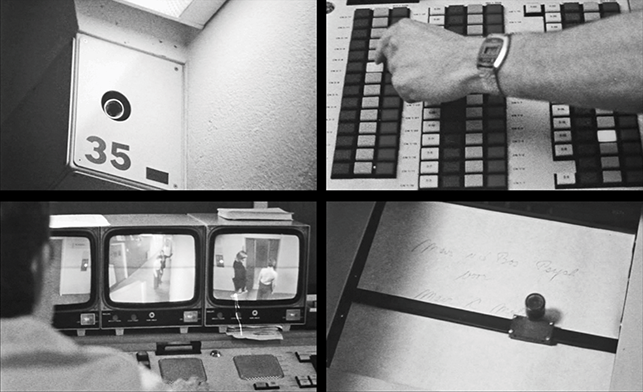
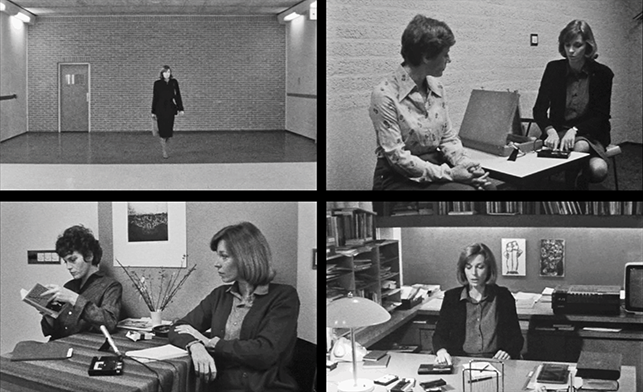
To return to A Question of Silence in attempting to tackle these questions, one key figuration of the women’s refusal in the film is their refusal of mediation, particularly the mediation of law. Peter Goodrich writes of ‘the foundational character of law as a medium, a symbolic and discursive enterprise’Footnote 46 and Cornelia Vismann draws upon the work of Antoine Garapon to propose the ‘mediality of the justice system’, which, in a criminal case, is meant ‘to translate the criminal act into a symbolic form’ by providing a frame within which a speechless and unrepresentable act is captured in words’.Footnote 47 If Vismann is right in suggesting that the justice system ‘seems to have forgotten its own mediality’,Footnote 48 it is one of the surprising gifts of the film that it represents this mediality so captivatingly, particularly in its subtler moments. The film is bracketed by two obvious guises of law: the police arresting each of the three women at the beginning of the film, and the trial scene at the end. But between these bookends, law is represented mainly through its recording, copying, filing and surveillance practices and technologies (Figure 10.3). Indeed, if it weren’t for the camera’s studious attention to these mechanic workings of legal media technologies, we could mistake the prison that the women are kept in for some kind of residential care unit, a colourful and benign space of confinement with bookshelves, indoor plants and kindly women guards who look more like social workers.
Law is represented mainly through its recording, copying, filing, and surveillance practices in A Question of Silence. Stills from the film.
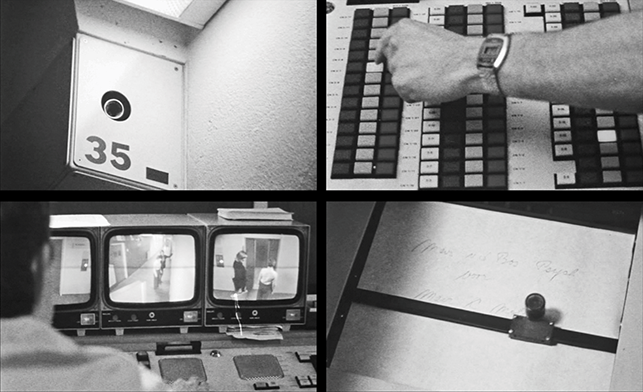
Figure 10.3 Long description
Top left: A security camera, mounted in an upper corner of a white space. The number 35 in grey font appears beneath the lens. Top right: A control board features vertical rows of blue, yellow, and red keys. A hand stretches across, reaching for a lit-up key. Bottom left: Three security monitors appear in focus; the guard who monitors these feeds is blurred in the foreground. Bottom right: Two slips of paper, neatly filed, with hand-written font indecipherable.
Janine herself is clearly part of this legal apparatus of mediation as a court-appointed psychiatrist, and she is keen to successfully fulfil her duty to mediate between the women and the law. She is never without her tape recorder while interviewing the women, and she spends sleepless nights with this device, playing and replaying extracts from the interviews (Figure 10.4). Her coming around to join in the women’s refusal – their silence and their laughter – is often read as the result of a process of identification. Ruby Rich suggests that ‘she comes to doubt the women’s insanity and to understand their motive as potentially, hypothetically, her own’.Footnote 49 Likewise, for Jane Arthurs, in this film ‘“identification” depends to an extent on an intellectual alignment with a middle-class professional’s growing realization of her own oppression, through a rational process of investigation that reveals the institutionalized forms of patriarchal power’.Footnote 50 So the suggestion is not only that Janine comes to identify with the three women through her forensic methods, but also that the viewer is drawn into the film’s world of meaning cerebrally by means of the same methods, through a rational identification with her. While the film does indeed work through identification with Janine for viewers who would be inclined to identify with her, in the narrative world of the film, it is not the rationalized bureaucratic process of forensic mediation that brings Janine around, but rather her decisive break with it. At a critical turning point, as the women begin to lose patience with her and push back, we see her lose mastery of her speech in the interviews: her sentences are left incomplete, her tape recorder on pause. Her participation in the laughter in the courtroom is her final break with law’s mediality. Is that break therefore to be interpreted as an embrace of immediacy and unmediation? Or is it rather that we arrive at another (a minor?) type of mediation, another modality of ‘hearing’?
Janine with her tape recorder. Stills from A Question of Silence.
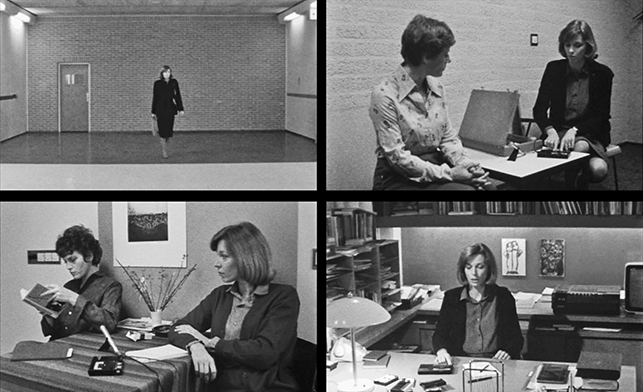
Figure 10.4 Long description
Top left: A woman walks forward in an otherwise empty room. She holds a briefcase in her right hand. Top right: Two women sit across from each other at a low table. A briefcase and tape recorder sit on the table between them. Bottom left: Two women sit at a table. Various books, linens, and flowers fill the room. A tape recorder sits on the table. Bottom right: A woman sits at a desk and credenza filled with books, facing the camera. Her right hand is raised, ready to press the tape recorder that sits in front of her.
Violence
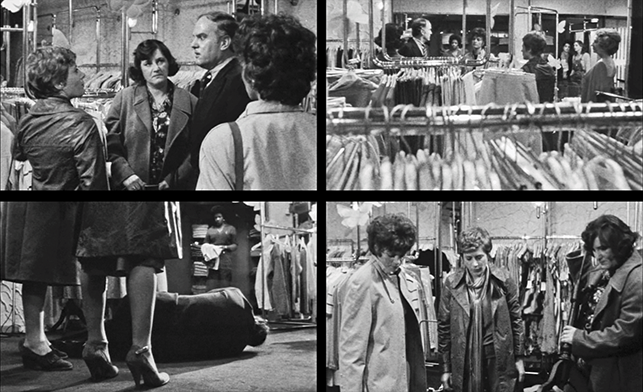
I have emphasized silence and laughter as two key manifestations of women’s refusal in A Question of Silence. But there is also, of course, the violence. Perhaps because of how the killing is framed in the film, or rather because the entire film is about reworking its framing, commentators on the film tend to shy away from reckoning with the act of killing itself. This avoidance may be seen to be facilitated by its decisively limited visual depiction. We understand what happened to the victim through the dry forensic pathology report, tidily packaged and self-contained. There is eventually a scene of the attack in a flashback: The shopkeeper catches Christine as she steals an item of clothing. He approaches her, takes it out of her bag and smugly points to the price tag. Christine takes it back and calmly stuffs it and then a few other items into her bag. Amused by this scene of defiance, the other two women join in, taking their time to methodically stuff garments in their bags in full view of the shopkeeper. The women then slowly circle around and close in on him. A push, a push, a slap – he is down. A kick, a shopping trolley, a broken plastic hanger – he stops groaning. Another kick, a broken glass shelf, a heavy glass ashtray, and on it goes: taking their time and acting with calm deliberation, the three women improvise weapons to torture, mutilate and kill the boutique owner. Except for two momentary glimpses of it on the ground before any blood is spilled, the body of the victim remains out of frame: no gore, no graphic visual depiction, only some campily exaggerated sound effects overlaid on a 1980s experimental electronic musical score. ‘Stylized through a deliberate, almost ritual execution, and a camera calmly intent on the slayers, not the slain’,Footnote 51 the scene’s pace and choreography indeed unfold as if it were a sacrificial rite, as if the women are ‘performing or reenacting an already rehearsed scene’.Footnote 52 Perhaps we are watching a modern retake on a mythical scene: Pentheus being torn apart by the bacchants (Figure 10.5).Footnote 53
Pentheus amid the bacchants. Stills from A Question of Silence.
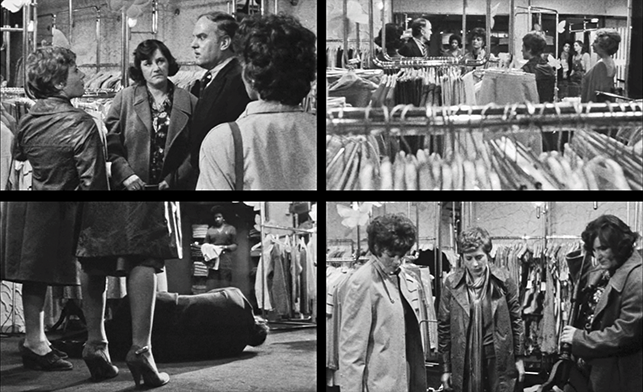
Figure 10.5 Long description
Top left: Four people stand conversing amongst racks of clothes, shown from the waist up. Top right: Metal hangars on a clothes rack fill the foreground. Shoppers stand behind. Bottom left: A close-up of the heeled pumps of two shoppers in A-line skirts. A man lies on the ground, as if he has fallen. His back is to the camera, face not shown. Bottom right: Three women stand in a circle, looking down, as if a man has fallen there. Clothes racks fill out the background.
Gorris’ decision to not show the victim’s body seems to have served as a kind of license to look away from the violence, with commentators treating the act of killing merely as a metaphor, or an unpleasant yet indispensable plot device. Whereas the legal system, as depicted rather realistically in the film, can only register the act as crime and madness,Footnote 54 most sympathetic readings of the film, in not paying close attention to the formal aesthetics of the killing, tend to frame it as a ‘feminist snap’Footnote 55 in response to an accumulation of ‘the small indignities of women’s lives’,Footnote 56 thus excusing and, worse, explaining it away. But in thinking refusal through, we may need to read the scene of the attack more boldly on its own terms. Geetha Ramanathan does precisely this, and proposes that the killing is in effect a ‘speech act’ that is an articulation of women’s political desire: ‘their desire for female solidarity and their desire to undo patriarchy’.Footnote 57 Pointing out the significance of the boutique as a male owned female ‘public’ space in the discursive arrangement of the text,Footnote 58 Ramanathan interprets the act of killing as the women reclaiming that space for themselves by acting in concert, and thus ‘rewriting their identities as women in a public space’.Footnote 59 She reads the silent complicity of the witnesses as their approval, validation and legitimation of the killing as ‘an act of battle by the women rather than a sudden spontaneous “feminine” outburst of rage’.Footnote 60
Cinema as Counter-Forum
Ramanathan’s reading partially problematizes Linda Williams’ influential reading of the film as skilfully tapping into what Elaine Showalter has defined as the ‘wild zone’ of women’s culture: a mysterious zone of women’s experience that is ‘conceived outside the limits of all existing language, all “known” reality’.Footnote 61 This is risky territory for feminist artists according to Williams, but necessary to engage with to validate women’s ‘muted’ experiences. She praises Gorris’ film for doing so while avoiding ‘the pitfalls of a facile or utopian feminist revision’.Footnote 62 Williams too reads ‘the violence of the crime’ as ‘a form of speech’,Footnote 63 but then does not fully follow through with the implications of this. Taking shelter in the film’s motif of silence, Williams suggests that the film demonstrates the heroic moment of feminist consciousness as the moment of solidarity ‘with an identity that has not yet been spoken and that cannot yet speak itself’.Footnote 64 But for Ramanathan, ‘The greater act of courage, as the film presents it, is that the women speak to what has been named in such an extraordinary way: female desire as violence.’Footnote 65 What is interesting here is that Williams, finding the power of the film in ‘its refusal to narrate the positive, utopian identity of women’,Footnote 66 holds on to an ideal of a feminist utopia that nevertheless must be protected from articulation because it will be just too crass to speak of it.Footnote 67 The wild zone is to thrill, it is to excite feminist desires, and to inform feminist aesthetics, but it must do all this while remaining a no-place. But what if that zone is not so much a utopia which shall remain unspoken of and uninhabited, but a heterotopia that is a space and time of rehearsal, a space for prefigurative practices towards another way of living? A heterotopia that thus may well be both very here/now and elsewhere at once, much in the way desire desires?
I borrow the heterotopia formulation from Bonnie Honig’s A Feminist Theory of Refusal, where she offers an alluring reading of Euripides’s play the Bacchae as yielding an understanding of refusal as not merely an act, but as having an arc, which has ‘the city as its destination’.Footnote 68 The arc of refusal means that the heterotopian escape from the city to the Cithaeron, where the women render inoperative their productive and reproductive capacities, has to be followed up by a return to the city to claim it:
Heterotopias valuably serve as spaces or times of rehearsal where alternative forms of life can be tried out and explored. … The bacchants teach the importance of that experience as rehearsal and example when they complete the arc of their refusal by returning to the city to claim it. At that point, it is up to the city: is it ready to receive them?Footnote 69
While the play is commonly read in centuries of reception as the tragedy of Agave (who with her sister and other bacchants ‘maddened’ by Dionysus, kills her son the king Pentheus on Cithaeron, mistaking him for a lion cub while in bacchic delirium) or that of King Pentheus (who is punished by Dionysus with death by his mother’s hand because he refuses to recognize the god as one), for Honig the tragedy is that of the city, because it is not ready to receive the women as they complete their arc of refusal. This argument necessitates a re-signification of the killing of Pentheus, an act that is so ‘nauseatingly horrifying’ that it ‘leads most readers or viewers to condemn the women who committed the violence and to see them as mad’.Footnote 70 Then again, we would do well to remember how, Honig suggests, ‘the conventional center holds on to power in the face of such challenges … : by turning such heterotopias into sites of madness or exception’.Footnote 71 Approaching the killing of Pentheus for its political meaning much as Ramanathan approaches the killing in the film, Honig pursues the question of ‘what it would mean to see the women’s violence as, in some way, deliberate and free: a refusal’.Footnote 72 In Honig’s reading, the killing of Pentheus is not merely a tragically unknowing filicide, but also and primarily a regicideFootnote 73 that is part of the larger and deliberate regicidal project (a ‘slow regicide’) of the bacchants, a project apparent in their every act. For Honig, ‘when the bacchants kill the king, they release everyone and him, too, from the false idolatry of patriarchal sovereignty’.Footnote 74 Their return to the city to demand to be celebrated for the ‘hunt’ is a return that therefore ‘has the power to inaugurate a politics’,Footnote 75 but only if the city is indeed ready to receive the women and their regicidal politics.
While many film critics and feminist film scholars, particularly at the time, read A Question of Silence as promoting separatism (on Cithaeron, perhaps), it is possible to read this film with Honig as bearing an arc that involves a return to the city. For this, we must return to the scene of laughter. One rather challenging and compelling proposal that Anca Parvulescu makes is that in thinking about laughter we must ‘focus on the burst of laughter itself’, rather than doing what most ‘theories of laughter’ do, which is to focus on the something else that laughter is a response to: ‘the comic, jokes, humor, the grotesque, the ridiculous, the ludicrous etc.’.Footnote 76 What would it mean to consider laughter in the courtroom scene as untethered from its object, the law? In Parvulescu’s reading of the film at the end of her book, the scene already depicts this very untethering:
Soon all the protagonists, spectators to the spectacle of law, are roaring with laughter. … Slowly, laughter dislocates itself from its object, the gender-blind court of law, and, by extension, the law itself. It is a laughter that has its own raison d’être, apart from any specific laughable object. And laughter reproduces itself, laughter asks for more laughter. It not only interrupts, but repeats itself and spreads.Footnote 77
What gets created in this contagion of laughter is a ‘laughterhood’Footnote 78 of laughers. But this laughterhood is importantly both on screen and off: the contagion of laughter in the courtroom spreads beyond the screen to the film theatre, thus constituting the latter as a counter-forum, a site of minor jurisprudence that emerges precisely due to the avowed medial force of the space.
‘Interestingly, at each screening of the film that I attended, this infectious rupture spread to the theater audience, producing a moment of stunning solidarity,’Footnote 79 testifies Barbara Kruger. The film ‘works on its viewers as forcefully as water on dehydrated food, reconstituting its proper audience even as it unreels upon the screen. … It is a gendered audience to which Gorris appeals, a subversive audience of women scattered throughout the movie theater, rising up in instinctive laughter’, writes Ruby Rich.Footnote 80 Linda Williams attests to ‘the genuine sense of danger and excitement’ generated by two screenings of the film she attended,Footnote 81 and Sheila Johnston writes of how the ‘implied sense of solidarity is – irrationally, perversely – exhilarating’.Footnote 82 This, perhaps, is the episode of the ‘return to the city’ in refusal’s arc: the film’s own mediality reconstitutes the space of the film theatre as a counter-forum, as the site of a minor jurisprudence of laughter. But what jurisdiction could this refusal have? I will leave two anecdotes here to begin to imagine answers. The first is by Jane Root who worked at Cinema of Women, the film’s British distributor at the time of its release in London. It was, she says, ‘a film which dramatically divided audiences. Some women stood up and cheered, while other (often male) viewers left enraged. … I was told that the Pizza Hut restaurant next door to one of the cinemas was full, night after night, with couples engaged in deep and sometimes angry arguments about the film’.Footnote 83 And one from Ruby Rich: ‘At the New Directors preview in New York, the audience recapitulated the film’s own ending: man after man rose to confront Gorris with hostile or garbled questions, only to encounter raucous laughter from most of the women in the audience. Gorris wasn’t surprised; she had observed this pattern everywhere the film had shown.’Footnote 84 It is in and through this laughter that the city prepares to receive the bacchants upon their return from Cithaeron.

 Open access