1. INTRODUCTION
We consider a model motivated by the problem of scheduling
transmissions of multiple data users (flows) sharing the same wireless
channel (server). The unique “wireless” feature of this
problem is the fact that the capacity (service rate) of the channel
varies with time randomly and asynchronously for different
users. The variations of the channel capacity are due to different,
random interference levels observed by different users and due to
fast fading of the signal received by a user. We will refer to
this problem as the variable channel scheduling problem.
The variable channel problem arises, for example, in the 3G CDMA High
Data Rate (HDR) system [6]. (See
also [27] for a background on CDMA
wireless systems.) In HDR, multiple mobile users in a cell share the
same CDMA wireless channel. On the downlink (the link from the cell
base station to users), time is divided into fixed-size (1.67-ms) time
slots. This slot size is short enough so that (each user's)
channel quality stays approximately constant within one or even a few
consecutive time slots. (To be more precise, this is true only for
relatively low mobile user velocities; see [27].) In each time slot, data can be
transmitted to only one user. Each user constantly reports to the base
station its “instantaneous” channel capacity (i.e., the
rate at which data can be transmitted if this user is scheduled for
transmission in the current time slot).
In the HDR system (and in the generic variable channel model as
well), a scheduling algorithm can take advantage of channel variations
by giving some form of priority to users with (temporarily) better
channels. Since channel capacities of different users vary in time in
an asynchronous manner, the quality of service (QoS) of all users can
be improved, as compared to scheduling schemes which do not take
channel conditions into account. A scheduling rule providing
proportional fairness in the achieved long-term throughput of
different users was proposed and analyzed in [25]. (See also [26].)
The QoS of a data user can be defined in different ways. If data
users are real-time users, then the packet delays of each flow
need to be kept below a certain threshold. This means that the primary
goal of a scheduling algorithm is to keep all queues stable
(i.e., to be able to handle all the offered traffic without queues
“blowing up”).
In this article, we consider the generic variable channel scheduling
model. Our main result is that a simple online scheduling discipline,
modified largest weighted delay first (M-LWDF), is
throughput optimal; namely it ensures that the queues are
stable as long as the vector of average arrival rates is within the
system's maximum stability region.
In a time slot t, the M-LWDF discipline serves the flow
j for which
is maximal, where Wj(t) is the
head-of-the-line packet delay for flow j,
μj(t) is the server capacity for flow
j at time t, and β and the
γj's are arbitrary positive constants.
(The name M-LWDF is because this discipline is a generalization of the
LWDF discipline [1,22].) Moreover, as we discuss in Section 4,
our result actually holds for a quite wide class of
disciplines (of which M-LWDF is a member) and a more general class of
models. In particular, the throughput optimality holds if instead of
maximizing (1), the scheduling rule maximizes
where Vj(t) =
ηj(W)Wj(t)
+
ηj(Q)Qj(t).
Here, ηj(W) ≥ 0 and
ηj(Q) ≥ 0 are arbitrary
parameters for flow j, not equal to zero simultaneously and
possibly dependent on j.
Our main stability results are closely related to the series of
results on the stability of MaxWeight-type scheduling
algorithms in queuing networks and in input-buffered crossbar switches.
The first results of this type were obtained by Tassiulas and
Ephremides [23,24] in the context of wireless systems. For
the switch scheduling stability results, see [15,17] and a recent
paper [10]. In the context of
interactive parallel server systems and systems with randomly varying
connectivity, MaxWeight-type stability results were obtained in
[3,5].
(See also [4], which is a recent
extension of [3].)
The underlying intuition behind the stability of a MaxWeight-type
algorithm is the fact that it minimizes the drift of a Lyapunov
function of the form
[sum ]j[Vj(t)]β+1.
Most of the algorithms studied before are for the case β = 1 and
Vj(t) =
Qj(t). As far as we are aware,
[17] was the first in which the
stability result for a MaxWeight-type rule using flow delays
Wj(t) (as opposed to queue
lengths Qj(t)) was derived. (A
similar result was formulated but not proved in [14].)
The main contribution of this article is that we show that a
MaxWeight-type algorithm retains stability properties even if the
“weight” of an individual queue j has a form as
general as
[Vj(t)]β.
Such a generalization is important because the additional parameters
β, ηj(W), and
ηj(Q) allow for a more
flexible control of queue lengths and delay distributions, to satisfy a
variety of QoS constraints. For example, if we are interested in giving
tight delay bounds to a flow j with a low arrival rate, then
the “weight” for flow j should be based more on
head-of-the-line packet delay than on queue length (i.e.,
ηj(W) should be large
relative to ηj(Q)).
Conversely, if flow j has a high arrival rate and we want to
bound its buffer space requirements, then
ηj(Q) should be large
relative to ηj(W).
To prove our stability results, we use the fluid limit
technique [7,8,9,19,20]. (For a
MaxWeight-type rule, the technique was also used in [10] in a “switch” model context.)
Use of this technique makes the above-described generalization very
natural. Roughly speaking, in the “fluid limit” and after
some initial period of time,
Qj(t) and
Wj(t) stay proportional to each
other; thus, MaxWeight algorithms using
Qj(t),
Wj(t), or a linear combination
Vj(t) are in some sense
“indistinguishable” in the fluid limit.
It is shown recently in [21],
which analyzes a more general (described in Section 4.2) version of our
model, that, in addition to throughput optimality, MaxWeight-type rules
have certain asymptotic optimality properties when the system is
heavily loaded.
Practical implications of using M-LWDF to provide QoS for real-time
data users are addressed in [2]. In
particular, we show in [2] that the
M-LWDF discipline, with “appropriately” chosen parameters
γi, provides good QoS defined in terms of the
probabilities of packet delays exceeding predefined thresholds.
The rest of the article is organized as follows. In Section 2, we
introduce the formal variable channel scheduling queuing
model. Necessary and sufficient stability conditions are derived and
the system stability region is defined in Section 3. In Section 4, we
introduce the M-LWDF scheduling rule and formulate our main
result—Theorem 3, which states that M-LWDF (along with a wide
class of rules generalizing it) is throughput optimal. The proof of
Theorem 3 is presented in Section 5.
2. VARIABLE CHANNEL SCHEDULING MODEL
Consider the following queuing system. There is a finite number
N of input flows, indexed by i = 1,2,…,
N, served by a server. Each input flow consists of
discrete customers. (One customer models one byte or bit of
data). The system operates in discrete time t =
0,1,2,…. By convention, we will
(a) identify an (integer) time t,
with the unit time interval [t,t + 1), which
will sometimes be referred to as the time slot t
(b) assume that all processes we consider are constant within
each time slot.
There is a finite set {1,…,M} of server
states. This set itself we also denote by M (as well
as its cardinality). Associated with each state m ∈
M is a fixed vector of service rates
(μ1m,…,
μNm), where all
μim are nonnegative
integers. The meaning of
μim is as follows. If in
time slot t the server is in state m and the service
(in this time slot) is given exclusively to queue i, then
μim type i
customers are served from those present at time t (or the
entire queue i content at t, whichever is less). We
assume that, within each type, customers are served in the order of
their arrival in the system.
The random server state process m = m(t),
t = 0,1,2,… is assumed to be an irreducible (see
[12]) discrete-time Markov chain
with the (finite) state space M. The (unique) stationary
distribution of this Markov chain we denote by π =
(π1,…, πM). Note that,
due to irreducibility, πm > 0 for all
m ∈ M.
We make a nondegeneracy assumption that for each flow i,
there is at least one server state m ∈ M such
that μim > 0.
(Otherwise, we would have flows which simply can never be served.)
Denote by Ai(t) the number of
type i customers that arrived at time t, and assume
by convention that these customers are immediately available for
service. We assume that each input process
Ai is an irreducible positive recurrent
(see [12]) Markov chain with
countable state space and that the input processes are mutually
independent. (This condition can be relaxed as follows. The aggregate
arrival process A =
{(A1(t),…,
AN(t)), t =
1,2,…} can be described by a finite number of regenerative
processes [12] with finite mean
regeneration cycles.) Let us denote by λi,
i = 1,…,N, the mean arrival rate for flow
i (i.e., the mean number of type i customers arriving
in one time slot). The vector of mean arrival rates is denoted by λ
[esdot ] (λ1,…, λN).
The random process describing the behavior of the entire system is
(S = S(t), t = 0,1,2,…),
where
Qi(t) is the type i
queue length at time t, and
Uik(t) is the current sojourn
time, or delay, of the kth type i customer
present in the system at time t. (Within each type, the
customers are numbered in the order of their arrival.)
A mapping H which takes a system state
S(t) in a time slot into a fixed probability
distribution H(S(t)) on the set of queues
N will be called a scheduling rule, or a queuing
discipline. With a fixed discipline H, the queue to serve
at time t is chosen randomly according to the distribution
H(S(t)). So, the number
Di(t) of type i
customers served in the time slot t is equal to
min{Qi(t),
μim(t)} if queue
i is chosen for service and equal to zero otherwise. According
to our conventions, for each time t,
Our assumptions imply that with any scheduling rule, S is a
discrete-time countable Markov chain. By stability of the
Markov chain S (and stability of the system) we mean the
following property: The set of positive recurrent states is nonempty
and it contains a finite subset which is reached with probability one
(within finite time) from any initial state. Stability implies the
existence of a stationary probability distribution. (If all positive
recurrent states are connected, the stationary distribution is
unique.)
We conclude this section with some basic notation we use throughout
the article. Vector inequalities are understood componentwise;
[lfloor ]z[rfloor ] and [lceil ]z[rceil ] denote the
integer part and the “ceiling” of a real number z,
respectively. We say that a function f (t) of a real
variable t is RCLL if it is right-continuous and has left
limit in every point t of its domain. The abbreviation
“u.o.c.” in a convergence statement means that the
convergence is uniform on any fixed compact subset of the corresponding
function domain. We denote by
the set of
positive natural numbers.
3. NECESSARY AND SUFFICIENT STABILITY
CONDITIONS. STABILITY REGION
Suppose a stochastic matrix φ = (φmi,
m ∈ M, i = 1,…, N) is
fixed, which means that φmi ≥ 0 for all
m and i, and [sum ]i
φmi = 1 for every m. Consider a
static service split (SSS) scheduling rule, parameterized by
the matrix φ. When the server is in state m, the SSS rule
chooses for service queue i with probability
φmi. (The word static in the name of
the rule reflects the fact that scheduling decisions depend only on the
server state.) Clearly, the vector v =
(v1,…,vN) =
v(φ), where
gives the long-term average service rates allocated to different
flows. This observation makes the following simple (and quite standard)
result very intuitive.
Theorem 1: For the existence of a scheduling rule H
under which the system is stable, condition (3) is necessary
and condition (4) is sufficient
Proof: The necessity of condition (3) is almost obvious.
Consider a rule H under which the system is stable and
consider the Markov chain S in a stationary regime. (Such a
stationary regime exists, but is not necessarily unique.) We will
denote by Hi(s) the probability
with which the SSS rule chooses for service the queue i when
S(t) = s. Then, for any i (and
arbitrary fixed time slot t), we can write
Obviously, we have [sum ]i
φmi = 1 for each m. The necessity of
(3) is proved.
Sufficiency of condition (4) is almost obvious as well. The SSS rule
associated with any matrix φ satisfying (4) makes the system
stable. Indeed, the rates at which service is provided to different
flows i is a random process “modulated” by the
underlying (ergodic) Markov chain m, independent of the
aggregate arrival process A. Moreover, the average service
rate vi(φ) available to each flow
i is strictly greater than its average arrival rate
λi. If the Markov chain of interest would be
(viz. its states would track queue lengths only), then, for example,
maxi Qi(t)
can be used as a Lyapunov function to show the stability via standard
“drift” criteria, such as those in [18]. However, the states of our Markov chain
S include customer sojourn times as well. To accommodate this,
the stability proof for the SSS rule (assuming (4)) can be obtained,
for example, as a much simplified version of the proof of M-LWDF rule
stability (Theorem 3), which is the main result of this article. Since
such a proof requires a fair amount of preliminaries, introduced later
in the article, we present its details in the Appendix for the
interested reader. (We also note that Theorem 3 itself implies
sufficiency of (4). It is, however, more intuitive, simple, and
standard to demonstrate this fact via the SSS rule or a similar static
rule. That is why we discuss the SSS rule here.) █
The set of all (average arrival rate) vectors λ satisfying
condition (4) is usually called the system maximum stability
region, or just stability region.
An SSS rule associated with stochastic matrix φ* will be called
maximal if the vector v(φ*) is not dominated by
v(φ) for any other stochastic matrix φ. (We say that
vector v(1) is dominated by vector
v(2) if
vi(1) ≤
vi(2) for all i and
the strict inequality vi(1)
< vi(2) holds for at least
one i.) The following theorem provides a useful
characterization of maximal SSS rules.
Theorem 2: Consider a maximal SSS rule associated with a
stochastic matrix φ*. Suppose, in addition, that all components
of v* = v(φ*) are strictly positive. Then, there exists
a set of strictly positive constants αi,
i = 1,2,…,N, such that for any m and i,
The theorem says that a maximal SSS rule always chooses for service
at any time t a queue i for which
αi
μim(t) is maximal.
(It does not say what to do in case of a tie.)
Proof: Consider the following linear program:
subject to
From the definition of v*, we know that Λ = 1 and φ
= φ* solve this linear program, with constraints (6) satisfied as
equalities. Then, by the Kuhn–Tucker theorem (see, e.g.,
[13]), there exists a set of
nonnegative Lagrange multipliers α0,
α1,…, αN such that Λ
= 1 and φ = φ* also solve the following linear program (with
the same value of the maximum):
subject to
It is easy to verify that all αi must be
strictly positive and α0 = 1. Then, rewriting (8) as
we see that condition (5) must hold, because otherwise the maximum
would not be achieved by φ = φ*. █
5. PROOF OF THEOREM 3
Throughout the proof, we consider a system with a fixed set of
parameters such that condition (4) holds. It needs to be proved that
this system is stable under both M-LWDF and M-LWWF rules.
To simplify notation, the proof will be for the case β = 1. The
generalization of the proof for arbitrary β > 0 is trivial: The
quadratic Lyapunov function in (36) needs to be replaced by the power
law function
in the formulations of Lemmas 2 and 6,
qi(t),
qj(t),
wi(t), and
wj(t) need to be replaced by
qi(t)β,
qj(t)β,
wi(t)β, and
wj(t)β,
respectively; corresponding minor adjustments need to be made
throughout the proofs.
5.1. Preliminaries
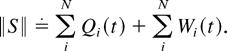
Let us define the norm of the state S(t) as follows:
Let S(n) denote a process S
with an initial condition such that
∥S(n)(0)∥ = n. In the
analysis to follow, all variables associated with a process
S(n) will be supplied with the upper index
(n).
The following theorem follows from the state-dependent Lyapunov-type
stability criteria for countable Markov chains, obtained first by
Malyshev and Menshikov [16].
Theorem 4: Suppose that there exist ε > 0
and an integer T > 0 such that for any sequence of
processes {S(n),n = 1,2,…},
we have
Then, S is stable.
It was shown by Rybko and Stolyar [19] that a stability condition of the type
(10) naturally leads to a fluid-limit approach to the stability problem
of queuing systems. This approach was further developed by Dai
[8], Chen [7], Stolyar [20], and Dai and Meyn [9]. As the form of (10) suggests, the approach
studies a fluid process s(t) obtained as a limit of
the sequence of scaled processes
(1/n)S(n)(nt),t
≥ 0. At the heart of the approach in its standard form is a proof
that any s(t) starting from any initial state with
norm ∥s(0)∥ = 1 reaches zero in finite time T
and stays there. It is sufficient, however, to show that for some ε
> 0, ∥s(T)∥ ≤ 1 − ε, which is
what we are going to do in this article. (In many cases of interest, a
still weaker condition is sufficient: It is enough to verify that any
s(t) is such that
inft≥0∥s(t)∥ < 1,
as shown in [20]. This is true in
our case as well, as could be shown with a little extra work.) In our
setting, we need to define what the scaling
(1/n)S(n)(nt) means.
In order for this scaling to make sense, we will need an alternative
definition of the process.
To this end, let us define the following random functions associated
with the process S(n)(t). Let
Fi(n)(t) be
the total number of type i customers that arrived by time
t ≥ 0, including the customers present at time 0, and let
be the number of type i customers that were served by time
t ≥ 0. Obviously,
for all i. As in [19]
and [20], we “encode”
the initial state of the system; in particular, we extend the
definition of
Fi(n)(t) to
the negative interval t ∈ [−n,0) by
assuming that the customers present in the system in its initial state
S(n)(0) arrived in the past at some of the
time instants −(n − 1),−(n −
2),…,0, according to their delays in the state S(0). By
this convention,
Fi(n)(−n)
= 0 for all i and n and
.
Also, denote by
Gm(n)(t) the
total number of time slots before time t (i.e., among the
slots 0,1,…,t − 1), when the server was in state
m, and by
the number of time slots before time t when the server state
was m and the server was allocated to serve queue i.
Let us also denote
Then, the following relations obviously hold:
It is clear that the process
,
where
In other words, a sample path of X(n)
uniquely defines the sample path of
S(n).
Let us also adopt the convention
with t ≥ −n for Y =
Fi(n) and t
≥ 0 for all other functions. This convention allows us to view the
above functions as continuous-time processes defined for all t
≥ 0 (or t ≥ −n), but having constant
values in each interval [t,t + 1).
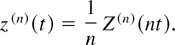
Now, consider the scaled process
,
where
and the scaling is defined as
From (11), we get
The following lemma establishes convergence to a fluid process and is
a variant of Theorem 4.1 in [8].
The lemma is a list of basic convergence properties of the scaled
sequences {x(n)} which we need for future
reference. Although the lemma statement is quite long, the properties
it describes are rather simple because they follow almost directly from
the structure of the model and the strong law of large numbers for the
input flow and server state processes.
Lemma 1: Consider our system under any scheduling rule
such that, within each type i, the customers are served in the order of
their arrival in the system. The following statements hold with
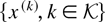
probability 1. For any sequence of processes
,
there exists a subsequence
such that as k
→ ∞, the scaled subsequence
has
the following convergence properties for each i ∈
{1,…,N} and m ∈ M:
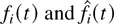
where the functions fi are RCLL
nonnegative nondecreasing in [−1,∞), the
functions
are nonnegative nondecreasing Lipschitz-continuous in
[0,∞), functions qi are continuous
in [0,∞),
functions ui are nondecreasing RCLL in
[0,∞), functions wi are
nonnegative RCLL in [0,∞), and “⇒”
signifies convergence at every continuity point of the corresponding
limit function. The limiting set of functions
also satisfies the following properties for all i ∈
{1,…,N} and m ∈ M:
for any interval
[t1,t2] ⊂
[0,∞),
if qi(t) > 0 for t
∈ [t1,t2] ⊂
[0,∞), then
for any fixed t1 > 0, the conditions
are equivalent and if they hold, then in the interval
[t1,∞),
which, in particular, implies that wi
and ui are Lipschitz-continuous in
[t1,∞).
Remark: The sets of functions x are
(“fluid”) limits of the sequences of scaled paths
{x(k)}. As such, its components have the
usual natural interpretations. For example,
are the amounts
of type i “fluid” that arrived into the system and
are served by the system by the (scaled) time t, respectively,
and
is the amount
of unserved type i at time t;
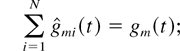
gm(t) is the total (scaled) time
before time t when the server state was m;
is the total (scaled) time before time t when the server state was
m and queue i was chosen for service. Property (23)
then means that after time 0, the fluid of each type arrives at the
constant rate λi; this is generally not true
for the interval [−1,0] because the fluid arrival
processes fi(t) in this interval
simply code sojourn times of the customers present at time 0, and these
initial sojourn times can be distributed in a “bad” way.
Inequality (30) simply means that the amount of fluid served in any
interval cannot exceed the “potential” amount which could
be served if the server would never incur idleness while serving queue
i (the idleness is incurred when queue i is served in
a slot at the rate μim, but
there are less than μim
customers in the queue); inequality (31) means that if the amount of
unserved fluid qi(t) in some
(scaled) interval is bounded away from zero, then the actual amount of
fluid served in this interval is exactly equal to the potential amount
of service. The property containing (33) is also simple, but is
particularly important for our analysis: It says that if by some fixed
(scaled) time t1, the amount of type i
fluid served is greater than its initial amount (in particular, all of
the “initial fluid” is “gone” by time
t1), then for all t ≥
t1, the strict linear relation
λi wi(t)
= qi(t) exists between the amount
of fluid qi(t) and the
“head-of-the-line” fluid delay
wi(t). It is this relation which
will allow us to, roughly speaking, make a “transition”
from the stability of M-LWWF to the stability of M-LWDF by showing that
the fluid limit under M-LWDF is in a certain sense indistinguishable
from that under M-LWWF, after the system “gets rid” of all
the initial fluid.
Proof of Lemma 1: It follows from the strong law of large
numbers that, with probability 1 for every i,
To prove (15), (22), and (23), it suffices to choose a subsequence
{x(k)} such that for every i, lim
fi(k)(0) exists, and
denote the limit by fi(0). Since all
fi(k) and
ui(k) are
nondecreasing, we can always choose a further subsequence such that
(14) and (20) hold. Then, (21) follows from (20).
Properties (18) and (26) follow from the ergodicity of the server
state process.
Also, for any fixed 0 ≤ t1 ≤
t2, for every i, m, and any
n, we have (using the notation μ* [esdot ]
maxm,j
μjm)
From this inequality, we deduce the existence of a subsequence (of
the subsequence already chosen) such that the convergences (16) and
(19) take place and (30) holds.
Relations (24), (25), (28), (29), and (32) follow from the
corresponding relations which trivially hold for the prelimit functions
(for any index
.
The convergence (17) and
identity (27) trivially follow from identity (13).
Suppose that qi(t) > 0 for
t ∈
[t1,t2] ⊂
[0,∞). Let us fix δ ∈
(0,mint∈[t1,t2]
qi(t)). The Lipschitz continuity
of qi(·), along with u.o.c.
convergence of qi(k)
to qi, implies that (with probability 1)
the sequence {X(k)} is such that for all
sufficiently large k, the following inequalities hold:
The latter property implies that if the queue i was chosen
for service anywhere in the interval
[[lfloor ]t1
k[rfloor ],t2 k + 1] when the
server state was m, then exactly
μim type i
customers were served. So, we must have
Multiplying the last inequality by 1/k and taking the
limit k → ∞, we obtain (31).
Property (33) easily follows from the fact that in the interval
[0,∞), the scaled input flow function
fi(k)(·)
converges u.o.c. to the strictly increasing linear function
fi(0) + λi
t. We omit details. █
Since some of the component functions included in x (viz.
are Lipschitz in
[0,∞), they are absolutely continuous. Therefore, at almost
all points t ∈ [0,∞) (with respect to Lebesgue
measure), the derivatives of all those functions exist. We will call
such points regular.
In the rest of this article, when we consider a fixed limiting set of
functions x, as defined in Lemma 1, we always assume that a
sequence of prelimit paths {x(k)}, which
“defines it” (viz. the convergence properties of Lemma 1
hold), is fixed as well, along with the corresponding sequence of
unscaled paths {X(k)}.
5.2. Proof of Theorem 3 for the M-LWWF Discipline
The meaning of the following auxiliary lemma is that if relation (34)
holds at some (scaled) time t, then by virtue of the M-LWWF
scheduling rule, in some neighborhood of point t, flow
i cannot be served.
Lemma 2: Consider the system with the M-LWWF discipline.
With probability 1, a limiting set of functions x, as defined in
Lemma 1, satisfies the following additional property. If
for some regular point t ≥ 0, for some i and m,
then
Proof: Let us pick a j at which the maximum in
inequality (34) is attained. In a similar manner to the proof of
property (31) (in Lemma 1), we can fix a small positive
δ1 > 0 such that, for all sufficiently large
k, for the unscaled path X(k) we
must have
(If t = 0, then the time interval should be
[0,δ1 k] .) This means that in the
interval [(t − δ1)k +
1,(t + δ1)k − 1] , queue
i cannot be served in any time slot when the server is in
state m because it would contradict the M-LWWF scheduling
rule. Thus, for all sufficiently large k, we must have
which implies
,
and we are done. █
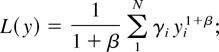
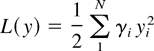
Let us introduce a quadratic Lyapunov function
for a vector y =
(y1,…,yN).
The following lemma embodies the key idea behind MaxWeight-type
scheduling rules: They try to maximize the rate of decrease of the
Lyapunov function L(q(t)). So, roughly
speaking, since there exists at least one scheduling rule (e.g., an SSS
rule with φ such that λ < v(φ)) under which
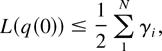
L(q(t)) has a negative drift (when
L(q(t)) > 0), the drift of
L(q(t)) under M-LWWF has to be negative as
well.
Lemma 3: Consider a system with the M-LWWF discipline.
For any δ1 > 0, there exists δ2
> 0 such that the following holds. With probability 1, a
limiting set of functions x, as defined in Lemma 1, satisfies the following
additional properties:
L(q(t)),t ≥ 0, is an
absolutely continuous function,
and at any regular point t,
Proof: Let us pick a fixed stochastic matrix φ such
that λi <
vi(φ) for all i. (The
existence of such a matrix is condition (4).)
For any regular t ≥ 0 such that
L(q(t)) > 0, the derivative of
L(q(t)) can be written
where
and we use the fact (following from property (31)) that
Let us choose δ3 > 0 such that
L(y) ≥ δ1 implies
maxi yi ≥
δ3. Then, the first sum in (40) is bounded as
follows:
It remains to show that
where K(ξ,y) denotes the function of a
stochastic M × N matrix ξ and a nonnegative
N-dimensional vector y, defined as
It is easy to see that for any nonnegative vector y, a
stochastic matrix ξ maximizes K(ξ,y) if and
only if the following condition holds for every i and
m: If γi
μimyi
< maxj γj
μjmyj,
then
However, property (35) shows that (42) is satisfied for
.
This
proves (41) and the lemma. █
Lemma 4: Consider a system with the M-LWWF discipline.
For any δ > 0, there exists T > 0 such that with
probability 1, a limiting set of functions x, as defined in
Lemma 1, satisfies the following additional property:
The proof follows from Lemma 3.
Proof of Theorem 3 for M-LWWF: According to Lemmas
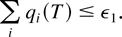
1–4, for any fixed ε1 > 0 we can always choose
a large enough integer T > 0 such that for any sequence of
random processes {X(n)}, there exists a
subsequence {X(k)} such that with
probability 1, the convergence to a limiting set of functions
x takes place and, moreover,
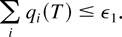
If we recall that T is large, then it follows from (44) that
implying (by (33)) that
This, in turn, implies (since ε1 is small) that
Therefore, with probability 1,
Since
our input process assumptions easily imply that the sequence
{(1/n)∥S(n)(nT)∥}
is uniformly integrable. This, along with (47), verifies condition
(10). The proof is complete. █
The following supplemental statement about the M-LWWF discipline will
play an important role in the stability proof for the M-LWDF
discipline.
Consider a generalized system with a given discipline
H. The generalization is to assume that some time slots are
unavailable for service of any queue. In each available for service
time slot, the scheduling rule is H. In a generalized system,
let Gm(n)(t)
denote the number of available for service time slots (by time
t) when the server is in state m. (Such a generalized
system arises later, when we want to study the service dynamics of a
subset of queues. To do that, we will view the time slots
allocated to any other queue as unavailable for service of the subset
of queues on which we focus.)
Lemma 5: Let positive constants K0 and
K1 be fixed. Consider a sequence of fixed sample
paths {X(k)} of the generalized system
under M-LWWF such that as k → ∞, all properties
described in Lemmas 1 and 2 hold with the following modifications:
Property (22) is replaced by
property (26) is replaced by
where each function hm is
nondecreasing Lipschitz-continuous, hm(0) = 0,
and
Then, the function L(q(t)) has the upper
bound C < ∞, which depends only on K0
and K1:
Proof: The idea of the proof is simple: the total
“amount” of (scaled) time when service is unavailable to
the queues is finite, bounded above by K1. During
the “rest of the time,” when the service is available, the
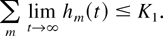
Lyapunov function L(q(t)) cannot increase,
due to the “reasons” presented in the proof of Lemma 3.
However, we need to apply this idea in a continuous time setting, which
requires some care with the estimates. We now proceed with the
details.
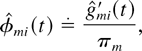
We will use the notation L(t) [esdot ]
L(q(t)). Let us choose δ > 0 small
enough so that the following holds for regular points t. If
gm′(t) ≥
πm − δ for each m, then
(d/dt)L(t) < 0. (The
existence of such a δ is easily obtained using the argument and the
estimates used in the proof of Lemma 3.) Note that [sum ]m
hm′(t) ≤ δ implies
gm′(t) ≥
πm − δ for each m.
Let us denote by Λ the Lebesgue measure and by ℒ the
σ-algebra of Lebesgue-measurable subsets of [0,∞).
Consider the subset
It is easy to check that B ∈ ℒ and
Define the measure ν on ℒ as follows:
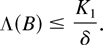
Notice that ν([0,∞)) = Λ(B).
For future reference, we note that for some fixed positive
c1 and c2 and all regular
t,
which follows from the estimate
We see that the derivative L′(t) is bounded
above as in (51) at regular points t ∈ B, and it
is negative at regular points t ∈
[0,∞)[setmn ]B. We can write
Applying Gronwall's inequality [11, p.498], we obtain
and, finally,
which proves the lemma. █
5.3. Proof of Theorem 3 for the M-LWDF Discipline
The following lemma describes the key property of the M-LWDF
discipline which is analogous to the M-LWWF property described in Lemma
2.
Lemma 6: Consider a system with the M-LWDF discipline.
With probability 1, a limiting set of functions x, as defined in
Lemma 1, satisfies the following additional property. If in some
interval [t1,t2], 0
≤ t1 < t2 < ∞,
for some fixed m and fixed i and j we have
then
Proof: The proof is analogous to the proof of Lemma 2. (The
only additional difficulty is the fact that the functions
wi(·) may not be continuous.) Note
that condition (52) implies that
μjm > 0. We will
consider only the nontrivial case when
μim > 0. (The case
μim = 0 is treated
analogously to and simpler than this case.) Let us fix positive
constants α and δ such that
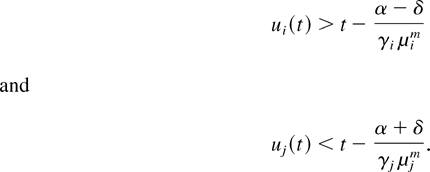
Then, for all t ∈
[t1,t2] , we have
Since for each i, ui(·)
and all
ui(k)(·) are
nondecreasing and we have the convergence
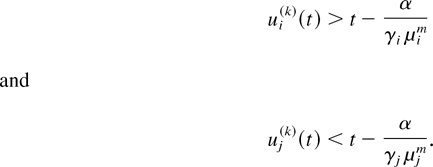
ui(k)(t)
→ ui(t) for every t
where ui is continuous, we see that for
all sufficiently large k and for all t ∈
[t1,t2] ,
From the latter two inequalities, we see that
Just as in the proof of Lemma 2, we observe that the latter property
implies that for all large k,
because the corresponding unscaled path
X(k) is such that queue i may not
be served in any time slot in the interval
[kt1 + 1,kt2 −
1] when the server is in state m. (Otherwise, we would
get a violation of the M-LWDF scheduling rule.) Taking the limit
k → ∞ completes the proof. █
The following lemma shows that under M-LWDF, all fluid limits
x are such that after some fixed time
TN, all of the “initial fluid”
is served (and, therefore, the linear relation
qi(t) =
λi wi(t)
holds) for all t ≥ TN and all
queues i.
Lemma 7: Consider a system with the M-LWDF discipline.
There exists TN > 0 such that with
probability 1, a limiting set of functions x, as defined in
Lemma 1, satisfies the following additional property:
To illustrate the intuition behind the formal proof, we present the
following informal discussion. Suppose we consider the system with two
flows i = 1,2 and assume that by some fixed time
T1 ≥ 0, we have
(i.e., all of the initial fluid of type 1 has
been served). Consider a fixed sufficiently large time
T2. Let us show why the assumption that the initial
type 2 fluid is not served by time T2, namely
leads to a contradiction. We observe that, first, the flow 2 delay
w2(t) ≥ t for all t
∈ [T1,T2] .
Second, the amount of time unavailable to flow 1 in
[T1,T2] is bounded
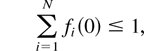
above: f2(0) ≤ 1. Then, according to Lemma 5,
q1(t)—and therefore
w1(t) =
q1(t)/λ1—is
bounded above in
[T1,T2] by a
constant independent of T2. Therefore, during most of
the interval [T1,T2],
the ratio of the waiting times
w2(t)/w1(t)
is very large. This means that (during most of the interval
[T1,T2]) as long as
the server state m is such that flow 2 can be served at
strictly positive rate μ2m, the
M-LWDF rule must choose for service queue 2 over queue 1. This means
that the amount of time when queue 2 is served is of the order of
T2, which is large. However, then all of initial
type 2 fluid, the amount of which is upper bounded by 1, must be served
by time T2—a contradiction to assumption
(55).
Proof of Lemma 7: Let us fix an arbitrary ε2
> 0. We have
We will show the existence of TN such that
The proof of (56) is by induction.
Induction Base. There exists T1 > 0 such that
for at least one i,
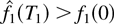
Let us set T1 [esdot ] ε2 +
K1 /π*, where π* is the sum of the
stationary probabilities πm over server states
m such that μjm
> 0 for at least one j. Suppose the statement of the
induction base, with this T1, does not hold. Then,
for all sufficiently large k, we must have
where o(1) is a term vanishing as k → ∞.
Taking the k → ∞ limit, we obtain
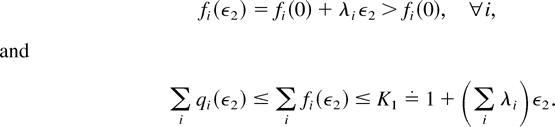
which means (see the definition of K1) that
and, therefore,
for at least
one i. This contradiction proves the induction base.
Induction Step. Suppose that there exists
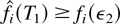
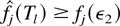
Tl > 0, 1 ≤ l < N
such that for at least one subset Nl ⊂
{1,…,N} of cardinality l, we have
for all j ∈ Nl. Then,
there exists Tl+1 ≥
Tl such that (57) holds for all j
within at least one subset Nl+1 of
cardinality l + 1.
We will prove the induction step for l = 1. (The
generalization for arbitrary l is straightforward.) Thus, we
need to prove the existence of T2 ≥
T1 such that for at least two different flows
i and r, (57) holds for j =
i,r, with T1 being the constant
from the induction base statement.
Let us fix i for which
according to the induction base. Suppose
We observe that
where K1 is as defined earlier, and
Suppose that a constant T2 >
T1 is fixed such that
(Below, we provide a choice of T2 such that
assumption (59) leads to a contradiction.)
Let us view each unscaled path X(k)
after time kT1 as a generalized system (described
just above Lemma 5) with the single input flow of type i and
with time slots allocated to any other flow being unavailable to flow
i. (By convention, only the slots in which at least one
customer of at least one flow r ≠ i was actually
served are considered unavailable to flow i.) Then, for the
scaled generalized system, starting at time T1, we
have
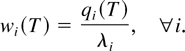
Since x is such that the simple linear relation
λi wi(t)
= qi(t) holds for flow i
for all t ≥ T1, the generalized system
with the M-LWDF discipline satisfies all of the properties of the
generalized system with the M-LWWF discipline (including Lemma 5), with
each γi replaced by γi
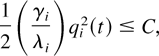
/λi. Thus, from Lemma 5, we have
where the left-hand side is the
“L(q(t))” for the generalized
system and C ≥ 0 is the constant defined in Lemma 5,
depending only on the constants K0 and
K1 specified in this proof. From the last display
we have the estimate
Note that C1 does not depend on the choice of
T2.
From this point, we “switch back” to interpreting
X(k) as a path of the original system. Let
us denote by M(i) the subset of elements m
∈ M such that
μjm > 0 for at least one
flow j ≠ i and denote π*(i) [esdot ]
[sum ]m∈M(i)
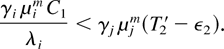
πm. Let us choose T2′
> T1 large enough so that for any pair of
j ≠ i and m ∈ M such that
μjm > 0, we have
Finally, let us choose T2 >
T2′ large enough so that
Our choice of T2′ in (62) guarantees that
for all sufficiently large k, the unscaled path
X(k) must be (according to the M-LWDF
rule) such that in the interval
[kT2′,kT2] , in
every time slot in which the state of the server belongs to the set
M(i), one of the flows r ≠ i is
chosen for service. This observation implies that in the k
→ ∞ limit for the corresponding scaled paths, we must
have
This is a contradiction to (60), which shows that, for the
T2 chosen above, (59) cannot hold, and,
therefore,
for at least one r ≠ i.
We have proved claim (63), assuming condition (58). However, the
opposite of condition (58) means that, trivially, (63) holds for some
r ≠ i and any T2 ≥
T1. Thus, (63) holds for the chosen
T2 regardless of condition (58).
Our choice of T2 depended on i. However,
since there is only a finite number of possible values of i,
we can choose T2 so that (63) holds for some
r ≠ i no matter what i is. The proof of
the induction step is complete. █
Proof of Theorem 3 for M-LWDF: We proved the existence of
TN > 0 such that for any sequence of
random processes {X(n)}, there exists a
subsequence {X(k)} such that with
probability 1, the convergence to a limiting set of functions
x takes place, and, moreover, x is such that the
linear relation exists for all i:
This fact, along with Lemma 6, means that with probability 1 in the
interval [TN,∞) the set
x also satisfies all the properties described in Lemmas
2–4 if only in their formulations we replace
γi by γi
/λi, replace (37) by the condition
and move the time origin to TN.
Therefore, for any ε1 > 0, there exists T
≥ TN such that with probability 1,
x satisfies the condition
The rest is exactly as in the proof of the theorem for M-LWWF. The
only difference is that we obtain (46) directly from the property (33)
and Lemma 7, not from (45).