

We confidently call ourselves practitioners of “political science,” yet few among us question the meaning of this compound term. Most North American universities assemble the study of the political under a “political science” nomenclatureFootnote 1 and the term is entangled with the history of the discipline itself, replete with now-famous debates and long-standing disagreements (Taylor Reference Taylor1971; Wolin Reference Wolin1969). Methodological cleavages and differences continue to percolate in the contemporary era—cropping up most recently in relation to the Data Access and Research Transparency (or DA-RT) initiatives of the 2010s.Footnote 2
Little of this history or of the epistemological underpinnings of the discipline’s name regularly make it into methods curricula, however. Methods courses tend to follow two tracks (or a hybrid of these): the first might privilege “tools” such as interviewing, statistics, and content analysis that students practice or apply more or less immediately, often within a single semester; the second teaches research logics to elucidate the steps of the scientific method—that is, the identification of a research question and the development of a hypothesis along with the presentation of strategies to conceptualize, collect, measure, sample, compare, and analyze data. However, both models (likely due to time constraints) often skip over an explicit discussion of how scholars of politics should think about making sense of the empirical world in the first place, what counts as evidence and why, and what types of questions might “properly” shape our discipline’s collective inquiry.Footnote 3 If and when such questions do feature, many mainstream reading lists are so oriented toward positivist paradigmsFootnote 4 as to make it appear that no alternatives exist, cutting off entire histories of political science practice and ways of being political in the world.
If indeed the activity we engage might be understood as science, it is surprising that more attention is not given to what the term signifies and which philosophical convictions and doctrines “science” valorizes and debases. To wit, claims that philosophy of science should be included as a standard part of the methods sequence in the classroom often evoke surprise, followed by a demand for justification. That is, given the already crowded curriculum and the pressures facing higher education, why should educators spend precious time on topics the mainstream discipline often deems normatively established? Even if critics grant that such discussions add value, how might these philosophical positions and debates be introduced effectively without sinking under the weight of centuries of metaphysical readings?
FOUNDATIONS OF ANALYSIS IN METHODS COURSES
I suggest that a basic grounding in philosophy of science is an essential foundation for political inquiry of all types and that such a grounding might fruitfully kickstart contemporary methods courses at the undergraduate level and beyond. This position has been voiced by political scientists at various timesFootnote 5 but has yet to transform common disciplinary practices in meaningful ways, thus seemingly fated to be regularly reasserted in an ongoing effort to chip away at grooved routines and inherited conventions (Funk Reference Funk2019).
The merit of a basic grounding in philosophy of science cannot be overstated: in the so-called post-truth era—in which collectives struggle to share a common vision of events—understanding distinct epistemological start points and the methodologies that flow from these is essential not only to making informed and responsible decisions about research design and data but also to developing critical-thinking skills that carry through in every area of life. The authority of scientific theory itself is at stake. Also at stake is the capacity to speak across paradigms in order to escape a polarizing relativism that draws ever more narrowly defined cultural boundaries buttressing exclusionary beliefs. Attending to differences in philosophy of science makes students and scholars aware of how they might begin to adjudicate competing claims across dissimilar epistemes. Drawing attention to the construction of scientific authority and its limits may pave a way toward reestablishing rather than undermining trust in science and expert claims.
Attending to differences in philosophy of science makes students and scholars aware of how they might begin to adjudicate competing claims across dissimilar epistemes.
Hesitation around incorporating topics in philosophy of science in the methods curriculum may stem from professorial humility in the face of what is, after all, rich and expansive intellectual terrain. Yet, a grounding in epistemological traditions need not consist of a full immersion into the separate field of philosophy of science, and adding entire books by Thomas Kuhn (Reference Kuhn1962) and Paul Feyerabend (Reference Feyerabend1975) to the syllabus may not be the most effective tactic to capture undergraduate imagination.Footnote 6 In their 2009 articles, Schwartz-Shea and Adcock both cautioned against pedagogical strategies that introduce epistemology head on. They warned that theory-heavy texts risk overwhelming students, alienating them such that they lose interest or fail to see the immediate applicability of these methodological positions—or worse—summarily “reject” one or another epistemological position in search of intellectual firm ground.Footnote 7 In lieu of philosophy readings, then, how might concepts of epistemological difference and their relevance to political science research be communicated efficiently and profitably in an introductory methods course?
ACTIVE LEARNING: IS SEEING BELIEVING?
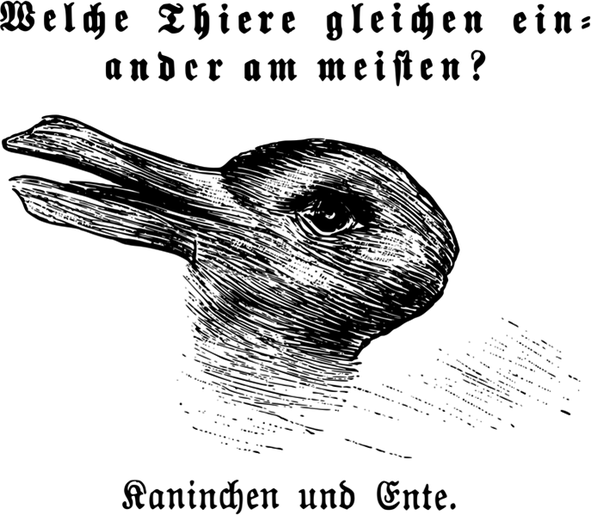
Taking seriously Schwartz-Shea’s (Reference Schwartz-Shea2009) and Adcock’s (Reference Adcock2009) admonitions against a lengthy reading assignment, a single classroom slide depicting an optical illusion may serve as an effective starting point to concretize seemingly abstract topics. The following six-step practical exercise, which could be tailored to the learning goals and timing of diverse methods courses, provides one pathway to teaching the material in introductory courses. While it cannot substitute for more immersive engagement with these ideas, it represents a springboard for discussion and a catalyst for thinking across epistemological difference. This exercise grew out of an informal classroom discussion in a graduate field seminar I co-taught in Fall 2023. Students had been assigned Wedeen’s (Reference Wedeen2002) American Political Science Review article and were coming to terms with post-structural theory and interpretation. The material was relatively intricate and discussion was faltering; it was apparent that the epistemological presuppositions of interpretative approaches were not immediately clear. Because of my work with the American Political Science Association’s (APSA’s) Interpretive Methodologies and Methods Related Group (2025), I had the image of Wittgenstein’s (Reference Wittgenstein and Anscombe1973) duck–rabbit illustration on my laptop (figure 1). I pulled it up, projected it on the class screen, and asked students what they saw.

Class reactions unfolded along the lines outlined here. With the help of the visual, students could understand the conceptual shift away from fixed systems of meaning and exogenously defined concepts toward evolving, situated practices of meaning making and the role of interpretation. This image took the discussion into the terrain of observation and empiricism, meaning making, symbols, semiotics, and cultural relativism. The following steps formalize the organic process we followed in that course, with an aim toward making it accessible to undergraduate and broader settings. In thinking about how to systematize the classroom discussion and render it useful for others, I also drew on Schwartz-Shea’s (Reference Schwartz-Shea2009) idea of the “approaches assignment,”Footnote 8 in which students are asked to design the same project from distinct epistemological start points.
-
1. Instructors begin by presenting an ambiguous optical illusion to the class, asking students to write down the first thing they see. Once they have identified the object, students should add a few notes of self-reflection on why they saw that image first (this might include factors such as recent exposure to a similar object, personal background, cultural associations, and other reasons).
Whereas any optical illusion could work, this article uses Wittgenstein’s (Reference Wittgenstein and Anscombe1973) duck–rabbit image as illustration. The caption for this illustration, translated from the German, asks “Which animals are most similar to each other?” to which the answer is “rabbit and duck.” The illustration depicts an image that, depending on the viewer’s interpretation, may be perceived as either animal—or, indeed, neither, representing a fantastical duck–rabbit.
-
2. Instructors collect students’ answers. Who saw a duck? Who saw a rabbit? Then, who saw a duck–rabbit? In the classroom exercise, the optical illusion should be introduced as a single piece of “evidence” that students are asked to analyze, with the premise that researchers should be able to rely on empirical material as grounding for their claims. Some students inevitably see a rabbit, whereas others see a duck. Some students change their mind as discussion evolves and they begin to see the image differently. The ensuing discussion reveals that multiple realities may emerge from the same picture (or dataset). Grappling with the “truth” of an optical illusion succinctly and irrevocably raises essential questions about empirics, data collection, and truth claims that may be fruitfully applied to many topic areas in a standard methods course.
Once the class has established multiple ways of reading the image,Footnote 9 a common student response is to state that there is no single answer as to what the picture represents and the meaning of the image depends on one’s perspective. Although attention to meaning making and positionality is a welcomed move, a wholesale retreat to cultural relativism is unsatisfactory because it leaves researchers without a plausible route toward making an empirical claim or (for public administration–oriented courses) suggesting a policy. Perceiving the image as a duck leads to certain conclusions and policies. Understanding it as a rabbit may produce different findings. Claiming that “it depends” raises questions about scope conditions and whether more minimal or contextualized truth may be proffered. Instructors may use this dilemma to point out that the datum presented reasonably lends itself to exactly three interpretations: either a duck, a rabbit, or a duck–rabbit—not a lion, a tiger, or a giraffe. Thus, whereas perspective and positionality are essential components of truth claims, interpretations are always restricted by and related to data in various ways.Footnote 10
-
3. Divide the class into two groups: Group A role plays as interpretivists and Group B role plays as positivists. The interpretivist group should discuss how and why individuals might perceive different significations from the image, focusing on meaning making, context, and subjectivity. Group A may trace the ways viewers arrived at their decision to deem the image a duck, a rabbit, or a duck–rabbit. Group B, the positivists, should analyze the image as if there were an objective truth to be uncovered. They should aim to determine which interpretation is more correct or accurate, as well as to identify explicitly the source of authority for such judgment. Group B then might ask what is the correct reading of the image and describe how it reached this conclusion. Both groups should seek to understand and identify the goal, or objective, of research that emanates from their assigned philosophical approach, identifying the types of questions this approach can pose, which methods might best suit this approach, and what counts as valid or authoritative knowledge within this epistemological orientation.
-
4. Organize short (e.g., five-minute) presentations in which both groups present the findings of their discussion.
-
5. Following the presentations, facilitate a class discussion that compares both approaches. To avert potential devolution toward the expression of absolutist personal preferences, the discussion might be structured around teasing out how each approach defines “truth” or reality and whether the sources of authority differ from one another. The instructor further may ask students to identify strengths and weaknesses of each approach or prompt them to brainstorm how each approach might be harnessed to study political phenomena such as culture, nationalism, polarization, voter behavior, identity, and resistance. This in turn may prompt a discussion of how concepts such as “culture” and “resistance” are shaped by epistemological presuppositions. Encouraging students to deepen the discussion via familiar empirical examples can further concretize the pedagogical impact of the optical-illusion exercise.
-
6. The exercise may be extended or revisited over the course of the semester in various productive ways. Instructors could ask students to submit a written reflection on which epistemological perspective they find more compelling for the type of research they envision and why, in combination with a discussion of research design, for example. A second writing assignment, which might be paired profitably with a discussion of case selection or thinking about the deployment of mixed methods, could be to reflect on whether it is possible to integrate epistemological approaches. This assignment could be extended by asking for students’ reflections on how the positivist/post-positivist divide maps onto quantitative and qualitative methods as well as how these concepts and categories differ. Another follow-on assignment might ask students to reflect on how the exercise relates to understanding contemporary politics, using a specific event as grounding for discussion.
TAKE-AWAYS: IN SUPPORT OF CRITICAL THINKING AND PLURALISM
By the end of the exercise, students should be able to distinguish between positivist and interpretivist epistemologies and the types of research that these distinct starting points enable. However, the take-aways exceed this definition-centric learning outcome. By setting up an exercise in which an optical illusion constitutes the totality of what can be known and then asking students to make claims about an empirical datapoint that eludes ontological certainty, they may practice attending to (1) how particular ways of seeing/knowing influence what they understand to be true; (2) how ways of seeing/knowing might morph over time and depend on one’s vantage point; and (3) blindnesses and omissions that may not be knowable for cultural or other reasons. In so doing, they become sensitized to the notion that knowledge claims are governed by norms that determine what counts as truth—norms that must be made explicit in good research.
Another key benefit of foregrounding philosophy of science discussions lies in introducing these contending views on knowledge production not as competitors in a zero-sum disciplinary game but instead as distinct options that students and scholars must consider throughout any intellectual inquiry. Discussion centered on the comparative advantages and disadvantages of epistemological presuppositions, as well as on the different ways of authoring truth claims within these paradigms, will deepen students’ understanding of rigor in knowledge production and research design. The aim of such an exercise should be to provide a more contextualized and pluralist understanding of the discipline’s approaches as well as the conceptual tools to read and speak across epistemological traditions so students may better judge the value of a given text’s contribution or claim.
Keeping in mind the lessons of the duck–rabbit exercise as the course progresses opens inroads to engage epistemic norms surrounding concepts of objectivity, rigor, validity, reliability, transparency, and ethics that emerge in many methods conversations—but it does so in a way that foregrounds epistemological difference.Footnote 11 The quest for “objectivity” and “validity” ceases being a one-sided conversation about how best to eradicate bias in the formulation of a hypothesis and the identification of dependent and independent variables—a quest that interpretivist scholars reject on grounds that positionality is inescapable and no Archimedean point exists from which “knowledge” may be viewed neutrally. Instead, recalling the duck–rabbit exercise at such junctures reminds students that “bias,” perspective, and the prior knowledge that structures concepts are inexorable and thus to be acknowledged and addressed head on in both data collection and the writing of the final research product.
This reckoning may take shape along positivist or post-positivist lines, but both persuasions may benefit from an explicit and reflexive engagement with these issues. Admitting that both positivist and post-positivist positions are obliged to interrogate objectivity and rigor in this way promises to keep philosophy of science concerns alive in practical decision making about how best to chart a path to answering a research question. As the course progresses, the duck–rabbit reference may serve as a reminder that all methods and methodologies are infused with assumptions about what counts as evidence, how evidence may be collected systematically, and how ultimate claims may be made. Foregrounding positionality at each juncture, demanding reflection on how the concepts we inherit are always already constructed, and raising questions about best practices for handling methodological complications that arise in application constitute essential considerations for interviewing and survey design as much as for measuring, sampling, and comparison.
Such a pluralist grounding matters not only for theoretical debates but also fundamentally and vitally for practical attempts critically to interrogate the frames and expectations that shape research in the discipline today. The norms that govern political science research evolved under specific historical and political conditions. Understanding that the current contours of the discipline are structured by ongoing race, gender, economic, and geopolitical power relations reminds us that the disciplinary knowledge in the past century was produced from specific perspectives with specific aims—and with attendant strengths and limitations. We have learned much, but there are other ways of seeing and being in the world—as the duck–rabbit attests.
ACKNOWLEDGMENTS
I am grateful to Shamira Gelbman, Sebastian Karcher, and the attendees of the 2023 APSA Virtual Qualitative Methods Teaching and Learning Symposium; Aarie Glas; and two anonymous reviewers for their thoughtful feedback.
CONFLICTS OF INTEREST
The author declares that there are no ethical issues or conflicts of interest in this research.

 Open access

