


Introduction
Amazonian savannahs are complex mosaics of open, seasonally flooded, natural grasslands surrounded by, and interspersed with, closed canopy forests with transition zones that support diverse vegetation communities, each of which provide food and cover and serve as pathways for the movement of unique mammal assemblages (Whitney & Davis, Reference Whitney and Davis1986; Risser, Reference Risser1990; Ribeiro & Walter, Reference Ribeiro and Walter2008; Simon et al., Reference Simon, Grether, de Queiroz, Skema, Pennington and Hughes2009; Carmignotto et al., Reference Carmignotto, Vivo, Langguth, Patterson and Costa2012; Maurin et al., Reference Maurin, Davies, Burrows, Daru, Yessoufou and Muasya2014). Although habitat mosaics may support high overall diversity as a result of a mixture of vegetation communities, mosaics may also contain smaller or lower quality representations of distinct habitat types with which species are typically associated (Foster & Gaines, Reference Foster and Gaines1991). As a result of these species–area relationships, densities of large mammals may be naturally lower along edges or within forested fragments or corridors compared to their source habitats, although variation is driven by patch quality and connectivity within the landscape (Bowers & Matter, Reference Bowers and Matter1997).
Habitats within mosaics are defined by interactions between local climate, hydrology, herbivory and soil conditions (Hopkins, Reference Hopkins, Furley, Proctor and Ratter1992; Staver et al., Reference Staver, Archibald and Levin2011), but fire seems to be the most important factor in maintaining Neotropical forest–savannah boundaries (Hoffmann et al., Reference Hoffmann, Geiger, Gotsch, Rossatto, Silva and Lau2012). The presence of riparian habitat (i.e. gallery forest) may provide refuge from frequent wildfires (Prada & Marinho-Filho, Reference Prada and Marinho-Filho2004), seasonal access to resources (water, fruits) and forested dispersal corridors (Redford & Fonseca, Reference Redford and Fonseca1986) for some species, and seasonal floods may also create adverse conditions and barriers to dispersal for others (Diniz-Filho et al., Reference Diniz-Filho, Bini, Vieira, Blamires, Terribile and Bastos2008). Although these generally open biomes comprise a large proportion of terrestrial landscapes (Furley, Reference Furley2006), savannah biodiversity, and wildlife in particular, have been neglected in scientific research in comparison to tropical forests (Werneck, Reference Werneck2011).
Amazonian savannahs are threatened by agriculture and livestock (San José & Montes, Reference San José and Montes2001; Rosa et al., Reference Rosa, Camarota, Zuanon, Tito, Maravalhas, Powell and Vasconcelos2021), uncontrolled burning and infrastructure development (Mustin et al., Reference Mustin, Carvalho, Hilário, Costa-Neto, Silva and Vasconcelos2017), all of which negatively impact mammal populations (de Marco et al., Reference de Marco, Villén, Mendes, Nóbrega, Cortes, Castro and Souza2020; Romero-Muñoz et al., Reference Romero-Muñoz, Fandos, Benítez-López and Kuemmerle2021). Reduction in both the quantity and quality of wildlife habitat also increases competition for resources, leading to conflict and retaliation for crop loss and depredation of livestock (de Souza et al., Reference de Souza, da Silva, Gonçalves, Jardim and Markwith2018). The advantageous combination of access to both savannah and forest resources also means that savannah–forest mosaics exist in close proximity to Indigenous communities that depend on wildlife for food and livelihoods (de Paula et al., Reference de Paula, Xerente and Pezzuti2017). Many Indigenous communities in the Amazon use fire to manage savannah grasses for livestock, to clear small patches of forest for traditional rotational agriculture, or for hunting (Mistry et al., Reference Mistry, Bilbao and Berardi2016), but when poorly managed these practices may be a threat to ill-adapted tropical forest habitat. Hunting intensity, which has already reached unsustainable levels in many forested areas across the Neotropics (Redford, Reference Redford1992; Fa & Peres, Reference Fa, Peres, Reynolds, Mace, Robinso and Redford2001; Wilkie et al., Reference Wilkie, Bennett, Peres and Cunningham2011), may also be higher in savannah–forest mosaics because of their proximity to human communities. Despite growing interest in the sustainability of hunting in the Neotropics, the response of mammal communities to hunting pressure within savannah and mosaic habitats remains largely understudied (Fernandes-Ferreira & Alves, Reference Fernandes-Ferreira and Alves2017).
Here, we aimed to contribute to a better understanding of the ecological and anthropogenic drivers of the diversity and distribution of terrestrial medium- and large-bodied mammals (henceforth ‘large mammals’) across savannah–forest mosaic habitats. We conducted a region-wide camera-trap study in the hyper-seasonal Rupununi savannah of south-west Guyana. The area remains largely understudied despite comprising c. 5% of Amazon savannahs and supplying an important source of dietary protein for Indigenous communities. Our study was carried out within Makushi and Wapichan Indigenous community-owned (customary) lands where communities have maintained traditional management practices for millennia and more recently engaged in the development of management plans for the sustainable use of wildlife. We hypothesized that the community of large mammals within this savannah–forest mosaic would be driven largely by forest cover and habitat type (with those habitats containing higher forest cover having higher species diversity and occupancy), and that anthropogenic factors would drive variation among species that are more susceptible to the effects of hunting, roads and livestock. Our assessment was carried out with the intention of informing management decisions in support of both traditional and modern local livelihoods in the Rupununi, while serving as a case study that may assist with the broader management of wildlife across Amazon savannahs.
Study area
The Rupununi savannahs are a low-lying, seasonally flooded, savannah–forest complex linked to Brazil’s Rio Branco savannahs (Montambault & Missa, Reference Montambault and Missa2002). They are divided into the North and South Rupununi by the Kanuku Mountains (Jansen-Jacobs & ter Steege, Reference Jansen-Jacobs, Ter Steege and ter Steege2000), covering an area of c. 13,000 km2. The Rupununi savannahs are contiguous with the Iwokrama International Centre for Rainforest Conservation & Development to the north, the Pakaraima Mountains and Gran Sabana to the west, and the Kanuku Mountains Protected Area to the east, which joins a vast expanse of intact Guiana Shield forest shared with Brazil, Suriname and French Guiana (Mittermeier et al., Reference Mittermeier, Myers, Thomsen, Da Fonseca and Olivieri1998).
The primary habitat types in the Rupununi, savannah and moist tropical forest, are principally determined by soil conditions, with savannah habitat occurring where trees cannot take root because a hard underlying clay layer limits penetration of their roots (Montambault & Missa, Reference Montambault and Missa2002). So-called bush islands are natural forest fragments that are scattered across the landscape on hilltops out of the reach of seasonal flood waters. Moist forest occurs on porous substrates along the slopes of hills and mountains, along rivers and in adjacent low-lying areas that receive nutrient runoff (Clark et al., Reference Clark, Brown, Kicklighter, Chambers, Thomlinson, Ni and Holland2001). The Rupununi savannahs are found at elevations of 120–150 m, the highest mountain peak is 1,067 m (Montambault & Missa, Reference Montambault and Missa2002), and gallery forests form along the edges of rivers and creeks. This region of Guyana experiences a single rainy season (May–August), and a longer dry season (September–April). Mean annual rainfall is 1,500–2,000 mm (Protected Areas Commission Guyana, 2015) and the main rivers rise by as much as 15 m during the peak of the rainy season, flooding low-lying forests and inundating adjacent savannahs.
The Rupununi region supports a low human population density (0.42 people/km2), with communities consisting of predominantly Indigenous Makushi and Wapichan people with mixed populations that include all of Guyana’s nine Indigenous groups, as well as Chinese-, Brazilian-, Afro-, and Indo-Guyanese (Stone, Reference Stone2002). The majority of Rupununi communities depend on subsistence activities for their livelihoods, with c. 20% of Rupununi households reporting that wild meat is their primary source of protein (along with 55% of households depending on fish; Luzar et al., Reference Luzar, Silvius and Fragoso2012). The Rupununi region is accessed from Guyana’s coastal capital via the 538 km long, largely unpaved, Georgetown–Lethem highway, and the remainder of the region is accessible via a network of unpaved roads constructed of a mix of laterite and sand (Paemelaere et al., Reference Paemelaere, Mejía, Quintero, Hallett, Li and Wilson2023).
Methods
Data collection
Camera traps (Bushnell Trophy Cams 119837 and 119876; Bushnell, USA) were set 2–3 km apart, with a single camera at each trap location, set 30–40 cm from the ground in proximity to observed animal signs. Cameras were active continuously, with a 1-second delay between captures, recording the date and time with each 3-image sequence. Images of the same species at the same trap site within a period of 30 min were excluded to ensure that photo occasions were independent (O’Brien et al., Reference O’Brien, Kinnaird and Wibisono2003). No scents or lures were used, and all cameras were equipped with infrared flash.
Camera-trap sites were selected across an assortment of variables relevant at a range of scales: subregion, habitat type, trail type and distance to nearest water body, road and human settlement (Fig. 1). Key limiting factors for camera placement were community permission, accessibility and threat of flood and fire. Supplementary Material 1 provides a full description of criteria for site selection. Camera traps were set in clusters of 20 cameras, installed for 8–177 trap nights (mean 89.5), and then moved to a second location, with the same sampling effort. The initial survey period occurred during the rainy season, followed by a second during the dry season. Overall, 199 sites were surveyed from May 2019 to March 2020, totalling 16,382 trap nights, yielding 485,953 photographs over 24,800 occasions (Table 1).
Locations of camera traps across habitat types and the five subregions of the Rupununi Region of Guyana. (Readers of the printed journal are referred to the online article for a colour version of this figure.)

Number of camera traps by habitat type, and number of trap nights, photographs and occasions, in the five subregions of the Rupununi Region of Guyana (Fig. 1).

Habitat type, per cent forest cover and distances to nearest trail, village and road were identified as relevant environmental and anthropogenic variables affecting the probability of occurrence of large mammals, with distance to nearest trail and village also used as potential covariates of detectability. Habitat type was determined at the site level using the definitions in Supplementary Material 1. Our predictions for the potential effect of these variables on occupancy and detectability are presented in Supplementary Material 2. Per cent forest cover was determined by placing a 1 km buffer around each camera trap and calculating the per cent forest cover from 30 m resolution global Landsat data (Hansen et al., Reference Hansen, Potapov, Moore, Hancher, Turubanova and Tyukavina2013) within each buffer using the Tabulate Area function. Distances to nearest village, road and trail were determined by calculating the Euclidean distance from camera-trap sites. All spatial analyses were conducted in ArcMap 10.4.1 (Esri, 2016).
Prior to modelling, we verified that variables were not collinear using a Pearson’s r > 0.7 threshold to indicate collinearity, and we did not detect any collinearity. Gallery forest and bush islands had a lower mean per cent forest cover than lowland and upland forest habitats (Supplementary Fig. 1).
Data analysis
We annotated camera-trap images manually and included in the analyses only mammals that are predominantly ground-dwelling and with a body mass of > 2 kg, which are the most likely to be detected by camera traps. Two pairs of species were similar in appearance and could not be differentiated reliably from photographs: Dasypus guianensis and Dasypus kappleri, as well as Philander opossum and Metachirus nudicaudatus; these were grouped and referred to as long-nosed armadillos and four-eyed opossums, respectively. An unknown species of cottontail rabbit that was detected during the survey is referred to as Sylvilagus sp.
We used a Bayesian hierarchical framework (Royle & Dorazio Reference Royle and Dorazio2008) to model large mammal occupancy at the community (Ψ; probability of occurrence for multiple species in each ecological unit) and species (Ψ; the probability of X species occurring in each ecological unit) level, with data augmentation to estimate species richness at the study area and camera-trap site level while accounting for the number of unobserved species (Dorazio et al., Reference Dorazio, Royle, Soderstrom and Glimskar2006). We fitted a single model with a limited number of covariates for which we hypothesized ecologically meaningful potential effects (Supplementary Table 2), following an established approach (e.g. Zipkin et al., Reference Zipkin, Royle, Dawson and Bates2010; Rich et al., Reference Rich, Miller, Robinson, McNutt and Kelly2016). We modelled intercepts and slopes of both re-gressions as species-specific random effects, drawn from a common prior distribution for the mammal community and with mean and variance hyper-parameters representing the average intercept and slopes across the observed mammal community and the variation among species. Details of the modelling framework are described in Supplementary Material 2.
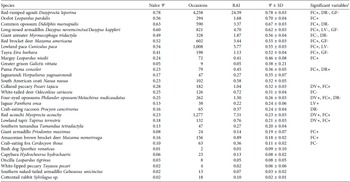
Naïve occupancy (Ψ), number of photographic occasions, relative abundance index (RAI; calculated as the number of photo events divided by the number of trap nights, multiplied by 100), occupancy (Ψ ± SD) and variables with statistically significant effects, with direction of relationship (+ or -) for each of the 30 medium- and large-bodied mammal species detected, ordered by decreasing Ψ.

1 DV, distance to nearest village; FC, forest cover; LV, livestock RAI; DR, distance to nearest road; GF, presence of gallery forest.
We implemented the models in a Bayesian framework using JAGS 4.3.0 (Plummer, Reference Plummer2003) in R 4.1.2 (R Core Team, 2017) with the R2jags 0.7-1 package (Su & Yajima, Reference Su and Yajima2015). Our study design allowed us to account for imperfect detec-tion and provided a robust estimate of detectability (p; a measure of uncertainty in detection applied at the community or species level). We specified a Uniform (0, 1) prior distribution for the data augmentation parameter (Ω), a Normal (0, 0.01) prior distribution on the logit scale for mean community detectability (μ α0 ) and occupancy (μ β0 ) parameters, and for all the covariate coefficients on detectability and occupancy (α and β). We generated three parallel chains of 100,000 iterations with a burn-in of 20,000 iterations and thinning by 20 to derive summaries of parameter posterior distribution. Convergence of the Markov chains was satisfactory based on the Gelman–Rubin statistic, which was always ≤ 1.04 (Gelman & Rubin, Reference Gelman and Rubin1992). We evaluated covariate effects by considering whether 90% Bayesian credible intervals (BCIs) encompassed zero. Community-level, species-specific and species trait-specific (body size and trophic guild) groupings were considered.
Results
Camera traps documented 47 mammal species in total across the survey area. Domestic species, people and 10 species of small mammals < 2 kg (Emmons, Reference Emmons1997) were excluded from subsequent analysis (Supplementary Table 1; Supplementary Plate 1).
Detections and estimated occupancy were heterogeneous across the 30 medium- and large-bodied native mammal species detected (Table 2). Eight species were disproportionally common, with an estimated occupancy > 0.5 and relative abundance index (RAI; calculated as the number of photo events divided by the number of trap nights, multiplied by 100) of 1.13–24.39: red-rumped agouti Dasyprocta leporina, ocelot Leopardus pardalis, common opossum Didelphis marsupialis, long-nosed armadillos, giant anteater Myrmecophaga tridactyla, red brocket deer Mazama americana, lowland paca Cuniculus paca and tayra Eira barbara. Six species were rarely detected, with an estimated occupancy < 0.1 and relative abundance index of 0.01–0.13: bush dog Speothos venaticus, capybara Hydrochoerus hydrochaeris, oncilla Leopardus tigrinus, white-lipped peccary Tayassu pecari, southern naked-tailed armadillo Cabassous unicinctus and cottontail rabbit.
At the community level, the model estimated 30–34 species (90% BCI) to be present (mean 31 ± SD 1.35; Supplementary Table 2). The median estimated camera-trap site richness was 3–16 species. Plotting site richness against selected covariates shows that richness tended to increase with forest cover and distance from nearest village, and was highest in upland and lowland forest, low-est in gallery forests and intermediate in bush islands (Supplementary Fig. 1).
Mean community occupancy was best predicted by forest cover, with a significant positive effect, and by distance to nearest village, with a marginally significant positive effect. Distance to nearest road and livestock RAI had negative effects (Fig. 2; Supplementary Table 2). Community occupancy was broadly similar across habitat types, with the exception of gallery forest where it was significantly lower than average. The effects of forest cover, distance to nearest village, distance to nearest road and livestock relative abundance index on community occupancy are shown in Fig. 3. Mean community detectability was positively and significantly associated with distance to nearest village, and distance to nearest road had a negative effect (Fig. 2).
Effect size plot for the influence of covariates on (a) community occupancy and (b) community detectability. The effects of habitat types are relative to the baseline level (bush islands). Segments show 90% (thick) and 50% (thin) Bayesian credible intervals, with black segments indicating those for which 90% BCI does not overlap zero.

Bivariate effects on community occupancy of (a) distance to nearest village, (b) per cent forest cover, (c) livestock relative abundance index (RAI), (d) distance to nearest road and (e) habitat, as estimated from camera trapping at 195 sites in Guyana (Fig. 1).

At the species level, forest cover was the most influential covariate, with 15 species whose occupancy was significantly and positively associated with it. Three species (white-tailed deer Odocoileus cariacou, giant anteater and crab-eating fox Cerdocyon thous) were significantly and negatively affected, and 12 species were not significantly affected (Supplementary Fig. 4). The negative effect of gallery forest habitat that was significant at community level was underlined by significant and negative effects at species level for red brocket deer, tayra, long-nosed armadillos and red-rumped agouti. The effect of this habitat on occupancy tended to be positive for the capybara and jaguarundi Herpailurus yagouaroundi. For covariates that were not significant at the community level, the species’ effects varied greatly on a case-by-case basis. For example, the occupancy of five species (lowland tapir, four-eyed opossums, collared peccary, red acouchi Myoprocta acouchy and Amazonian brown brocket deer Mazama nemorivaga) were significantly and positively associated with distance to nearest village. Similarly, puma Puma concolor occupancy was positively associated, and crab-eating raccoon Procyon cancrivorus, giant anteater, common opossum and red-rumped agouti were negatively associated with distance to nearest road. Jaguar occupancy was positively and significantly associated, and lowland paca and long-nosed armadillo negatively associated with livestock RAI (Fig. 4).
When we explored the magnitude of the effect of covariates on species traits, we found that forest cover, distance to nearest village and livestock RAI showed no pattern in relation to body mass, and distance to nearest road had a positive effect only on the largest species (Supplementary Fig. 2). Forest cover appeared least influential for the insectivores compared to other guilds; herbivores/frugivores and omnivores were more influ-enced by distance to nearest village than carnivores and insectivores; livestock RAI influenced the carnivores and omnivores more than the other guilds, and there was no clear pattern for distance to nearest road (Supplementary Fig. 3).
Discussion
Our study confirms the presence of 30 native, terrestrial medium- and large-bodied mammal species in the Rupununi, a diversity comparable to that of other rich neotropical savannah–forest systems, such as the Pantanal (Trolle, Reference Trolle2003). Average mammal community occupancy was similar across habitat types, except for within gallery forest habitat where it was significantly lower, and showed a significant positive association with forest cover, a mar-ginally significant positive association with distance to nearest village, and negative associations with distance to nearest road and livestock detection rate. As hypothesized, species-specific responses were variable and primarily linked to human activities.
Forest cover
Species richness increased with per cent forest cover, which was also the most important driver of community occupancy overall, and had a significant positive relationship with 15 of the species. The positive association is expected for semi-arboreal species such as the margay, tayra, common opossum and four-eyed opossum, which depend on tree canopies to hunt, forage or rest. A wide variety of herbivores/frugivores (tapir, brocket deer, collared peccary, paca, agouti, acouchi) that depend on the leaves, fruits and seeds of forest trees, palms and vines also had a significant positive relationship with forest cover. Puma occupancy was also positively correlated with per cent forest cover; this field primarily preys on mammalian herbivore/frugivore species (Foster et al., Reference Foster, Harmsen and Doncaster2010) that are associated with forested areas.
The occupancy of typically savannah-dwelling species (the crab-eating fox, white-tailed deer and giant anteater) had significant negative relationships with per cent forest cover. Although the former two are more limited in their distribution to open savannahs and forest edges, the latter readily inhabits intact forests but maintains higher population densities in open habitats with lower predator abundance (Quiroga et al., Reference Quiroga, Noss, Boaglio and Di Bitetti2016). Another six species (the southern naked-tailed armadillo, southern tamandua, capybara, crab-eating raccoon, South American coati and jaguarundi) had weak negative relationships with forest cover, showing their ability to utilize a variety of closed and open canopy habitats. All of these species feed on insects (forest cover appeared least influential for insectivores relative to other guilds), grasses or a generalized omnivorous diet.
Habitat type
Large mammal community occupancy was similar across habitat types, with the exception of a significant negative correlation with gallery forest habitat. Although individuals of some species may make seasonal use of gallery forests for dispersal or accessing water or palm fruits, gallery forest provides the least forest cover and seasonal flooding may limit the dispersal of some species, likely driving the negative relationship with most species (28 of 30). Thus, species with a clear preference for terra firme forest, such as the red brocket deer, tayra, red-rumped agouti and long-nosed armadillo, had a significant negative relationship with gallery forest. The capybara and jaguarundi were the only species with positive relationships with gallery forest habitat. The capybara eats riverside grasses and is semi-aquatic, characteristics suitable for this seasonally inundated environment (Moreira et al., Reference Moreira, Ferraz, Herrera and Macdonald2012). The jaguarundi is a good swimmer (Escobar-Anleu et al., Reference Escobar-Anleu, Quiñónez-Guzmán and Hernández-Gómez2020) and uses open habitats (Giordano, Reference Giordano2016) to avoid competition with larger felids (Caso, Reference Caso2013).
Bush islands had the highest mean community occupancy (Fig. 3e), potentially because of their accessibility to both savannah and forest-dwelling species. Although savannah species may make use of the cover provided by bush islands, the size of each individual bush island and its proximity to other bush islands within a network of forested stepping stones spread out across the landscape is likely the most important factor in predicting their use by forest-dwelling species. Increased farming, hunting and harvesting of large trees to supply growing village populations has resulted in observed declines in the size of, and diversity supported by, many bush islands. The high community occupancy of bush islands makes the management of these habitats, especially larger islands and those in close proximity to intact forest, particularly important.
Upland and lowland forest habitats had the highest mean forest cover, the least variation in forest cover, and the highest species richness among the sites sampled. These habitats are largely intact, managed for generations by the traditional management systems of the Indigenous communities of the Rupununi region. With their proximity to open savannah, lowland forests may vary in structure and composition and this forested ecotone also experiences the region’s highest rate of degradation and loss, primarily as a result of uncontrolled burning (Global Forest Watch, 2022). This issue is of growing concern because of more recent increases in both the frequency and duration of savannah fires, the result of the combination of a hotter, drier climate and loss of traditional fire management practices (Mistry et al., Reference Mistry, Bilbao and Berardi2016).
Distance to nearest village
Species richness tended to increase, and mammal community occupancy showed a marginally significant, positive correlation, with distance to nearest village. We believe these trends are likely driven by the effect of subsistence and commercial hunting, which provides a primary source of protein and income for many households and predominantly occurs 6–12 km from village centres (Read et al., Reference Read, Fragoso, Silvius, Luzar, Overman and Cummings2010). We cannot completely discount the effect of environmental noise associated with human settlements in reducing abundance (Shannon et al., Reference Shannon, McKenna, Angeloni, Crooks, Fristrup and Brown2016), as mean community detectability was also positively and significantly associated with distance to the nearest village. Studies of hunted areas within intact forest habitats experiencing lower hunting intensities (survey locations > 20 km from any village) have detected shifts in activity patterns away from peak times of human activity, but only detected weak effects on occupancy (Roopsind et al., Reference Roopsind, Caughlin, Sambhu, Fragoso and Putz2017; Hallett et al., Reference Hallett, Kinahan, McGregor, Baggallay, Babb and Barnabus2019). The community-level effects detected in our study are likely the result of a combination of naturally reduced densities of species in savannah–forest mosaics (when compared to intact forest), along with proximity to villages, which adds the combined effects of hunting, fire, farming, roads and livestock.
At the species level, the occupancy of two highly sought-after game species, the lowland tapir and collared peccary, had significant positive relationships with distance to nearest village. A number of forest-dwelling game species (the red and brown brocket deer, white-lipped peccary, lowland paca, and giant and long-nosed armadillos) also had weak positive relationships with distance to nearest village. Puma occupancy also had a marginally significant positive relationship with distance to nearest village, indicating that the effect of hunting detected in several important prey species is also having cascading effects on food chains. Pumas are known to feed on larger prey than other sympatric carnivores (Foster et al., Reference Foster, Harmsen and Doncaster2010) and their abundance decreases with prey abundance (Laundré et al., Reference LAUNDRÉ, HERNÁNDEZ and CLARK2007). Although the species-level effects may suggest that hunting is currently only negatively affecting a few large-bodied species preferred by hunters, the positive correlation between distance to nearest village and the occupancy of a suite of smaller-bodied or less preferred game species and an adaptable species like the puma is of concern with respect to the sustainability of current levels of subsistence and commercial hunting within the Rupununi savannah–forest mosaic.
Distance to nearest road
Giant anteater, red-rumped agouti, crab-eating raccoon and common and four-eyed opossums had significant negative relationships with distance to nearest road, likely driven by opportunities to forage on young plants and insects, scavenge on roadkill and discarded food, and drink from roadside ditches. However, a number of large-bodied game species (the giant armadillo, white-lipped peccary, lowland tapir and brown brocket deer) and the puma (primary predator of large mammals) all had positive relationships (significant for the puma) with distance to roads, indicating the negative impact of road access on species that may be hunted more efficiently from roads (Ramos-Robles et al., Reference Ramos-Robles, Gallina and Mandujano2013) and/or are susceptible to being struck by vehicles (Cáceres et al., Reference Cáceres, Hannibal, Freitas, Silva, Roman and Casella2010). Giant anteaters had a significant negative relationship with distance to roads, which raises concern because they are particularly vulnerable to collisions with vehicles (Paemelaere et al., Reference Paemelaere, Mejía, Quintero, Hallett, Li and Wilson2023) and the expansion of road networks decreases the suitability of their habitat (Pinto et al., Reference Pinto, Bager, Clevenger and Grilo2018). Proactive mitigation measures in the design of the current and proposed upgrades to the Georgetown–Lethem highway would help to reduce the impact of roads on this threatened species.
Jaguars and livestock
The occupancy of carnivores overall had a positive relationship with livestock RAI, and jaguar occupancy did not have a significant correlation with any other variable. Despite their popular association with tropical forests and ungulate prey, jaguars are highly adaptable opportunistic predators that inhabit a variety of habitats from moist forests to swamps, dry forests, scrub and grasslands, and prey on a wide range of mammals, reptiles and birds (Quigley et al., Reference Quigley, Foster, Petracca, Payan, Salom and Harmsen2017). Jaguars are regularly implicated in depredation of livestock (de Azevedo & Murray, Reference de Azevedo and Murray2007; Foster et al., Reference Foster, Harmsen and Doncaster2010) and depredation rates tend to increase with reduction in natural prey (Burgas et al., Reference Burgas, Amit and Lopez2014). Prey densities in our study area were noticeably lower than in the neighbouring Kanuku Mountains (Hallett et al., Reference Hallett, Kinahan, McGregor, Baggallay, Babb and Barnabus2019) or Iwokrama forest (Harris et al., Reference Harris, Hallett, Davis, Carter, Singh and Roopsind2023), probably reduced by the combination of natural and anthropogenic factors discussed above. Rupununi livestock are mainly managed in herds that range free over large areas, a key factor increasing depredation and conflict (de Azavedo & Murray, Reference de Azevedo and Murray2007; Montalvo et al., Reference Montalvo, Alfaro, Saenz, Cruz, Fuller and Carrillo2016). Although depredation rates in the Rupununi savannahs are not as high as elsewhere in the Neotropics, responses tend to be harsh, and retaliatory killing is the primary threat to jaguar populations (Hallett et al., Reference Hallett, Kawall, Pierre, Melville, Kenyon, de Freitas, van Vliet, Ponta, LeBel, McKenna and David2024). This association raises a concern that the Rupununi savannah–forest mosaic may be an ecological trap for jaguar populations, and warrants further research.
Conclusions
The Rupununi Region of Guyana has a rich and dynamic Amazonian savannah, but also faces a diverse collection of threats that are challenging to manage. Our study provides baseline data from a collaboration designed and implemented between Indigenous scientists and external partners. Indigenous communities in Guyana maintain ownership of their lands, and thus data-driven management strategies, such as the protection of sacred sites, improved control of hunters from outside the region, and the promotion of traditional hunting methods, could improve sustainability within these vital hunting areas. Management strategies to reduce or mitigate fire, timber harvest and agriculture within bush islands and lowland forest edges would also benefit important forested habitats within the mosaic. Implementation of improved livestock management and roadkill mitigation structures would help reduce conflict with species of conservation concern, the jaguar and giant anteater, respectively.
The supplementary material for this article is available at doi.org/10.1017/S003060532400156X
Author contributions
Study design, data collection: MH, NV, FL, RL, JM, AW, HB, AA, DS, EE, OD; data analysis: FR, MH, SQ; writing: MH, NV, FR, SQ.
Acknowledgements
We are grateful to the leadership and residents of Sustainable Wildlife Management Programme partner communities for their kindness, hospitality, generosity, cooperation, support and participation, without which this study could not have been carried out. This activity is part of the Sustainable Wildlife Management Programme, an Initiative of the Organization of African, Caribbean and Pacific States, which is funded by the European Union implemented through a consortium partnership that includes the Centre for International Forestry Research, the Food and Agriculture Organization of the United Nations, the Wildlife Conservation Society and the French Agricultural Research Centre for International Development.
Conflicts of interest
None.
Ethical standards
This research abided by the Oryx guidelines on ethical standards. Research protocols were reviewed, exempted from full review because the study was observational in nature and posed minimal risk, and approved by the Institutional Animal Care and Use Committee (IACUC) at the University of Florida. A free, prior and informed consent process facilitated by the Sustainable Wildlife Management Guyana Programme resulted in letters of consent signed by the 27 Indigenous communities that participated in this study. Research permits were approved by the Ministry of Amerindian Affairs and Environmental Protection Agency (#250219 BR01) in Guyana. Any photographs of people inadvertently obtained by camera traps were noted (i.e. recorded as people being present, without any further details) and then immediately and permanently deleted from the dataset.
Data availability
Participating Indigenous communities expressed their preference to restrict access to the data, to protect community resources and intellectual property.




 Open access

